REVIEW 3 major objections 5 minor 56 references
SVarM: Linear Support Varifold Machines for Classification and Regression on Geometric Data
T0 review · 3 major / 5 minor · reviewed 2026-08-07 · deepseek-v4-flash
Pith's one-line read Shapes can be represented as varifolds, and learning an affine functional on that measure space—with the test function implemented by a small neural network—gives parameterization-invariant regression and classification with accuracy…
desk verdict A genuinely new and well-theorized geometric learning model whose strongest experimental claim (COMA classification) is compromised by a likely subject-overlap split; worth reviewing once that is fixed. read the letter →
The pith
A machine-rendered reading of the paper's core claim, the machinery that carries it, and where it could break.
The reading
What carries the argument
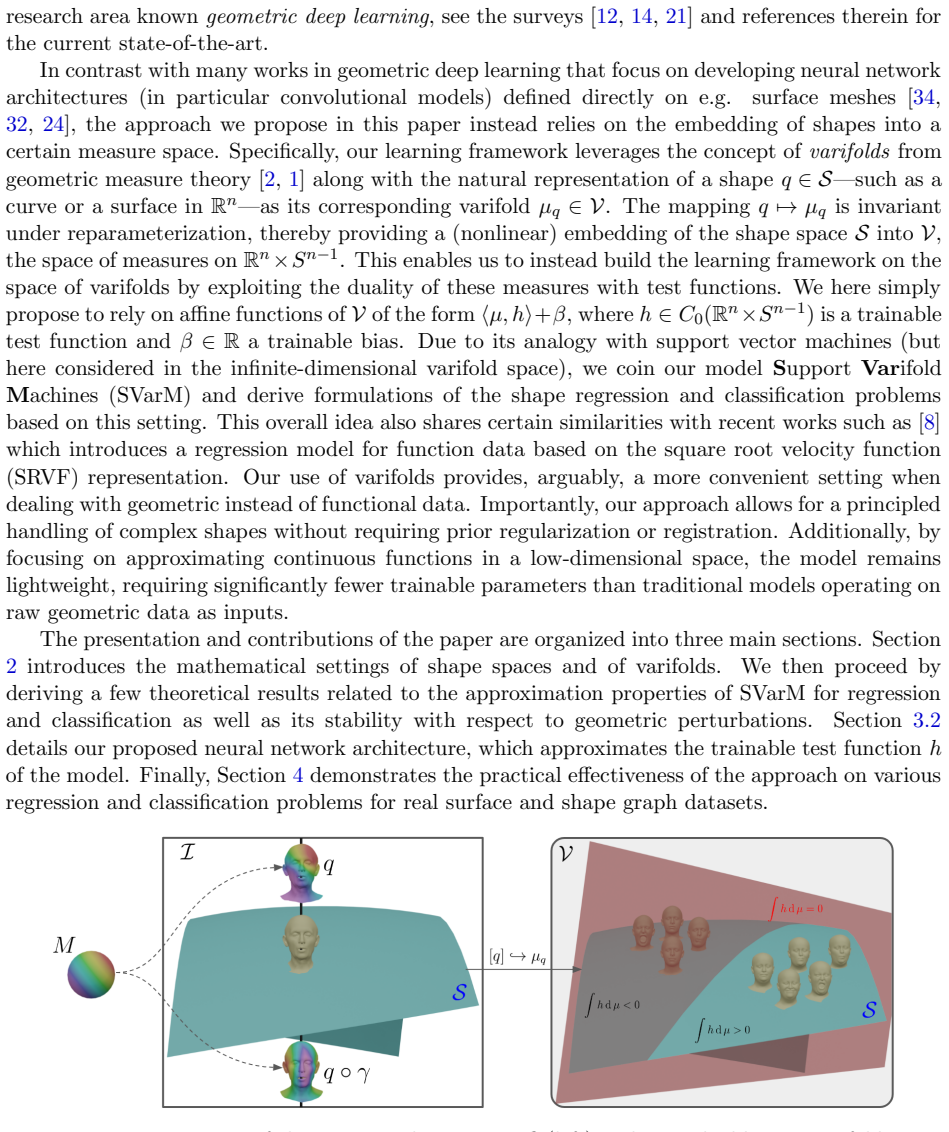
The load-bearing object is the varifold embedding $q \mapsto \mu_q = (q, v_q)_* \mathrm{vol}_q$, where $v_q$ is the unit tangent or normal field and $\mathrm{vol}_q$ the induced length or area measure. A shape becomes a measure on $\mathbb{R}^n \times S^{n-1}$; the model computes $\langle \mu_q, h_\theta\rangle + \beta$ by passing each support point $(x_i, v_i)$ through a small MLP $h_\theta$, weighting the outputs by the cell masses $w_i$, and summing. Proposition 1 supplies the theoretical status of this operation: affine $\mathrm{weak}^*$ continuous functionals on $\mathcal{V}$ are exactly of this form. Theorem 3 gives a sufficient separability condition for finite label sets, and Theorems 4 and 5 give Lipschitz stability bounds that explain the robustness experiments.
What would settle it
Train the COMA shape-graph classifier on scans from 10 of the 12 individuals and test on the remaining 2, or otherwise verify that no test scan's individual appears in training; if accuracy drops toward chance while the scan-level split stays near 99.98%, the generalization claim is not supported. A second check is to construct the two two-shape configurations of Figure 2 and verify that SVarM cannot separate them, as the support condition predicts.
Extended reading notes
Core claim
The central discovery is the identification of the model class: the set of functionals the SVarM architecture can represent is exactly the set of affine functionals on varifold space that are continuous for the $\mathrm{weak}^*$ topology (Proposition 1). Because the varifold map $q \mapsto \mu_q$ is invariant under reparameterization and injective on the shape space of rectifiable curves and surfaces, a single MLP-parameterized test function $h$ integrated against the shape's varifold yields a well-defined, registration-free geometric statistic. For finite classes, separation holds under a support condition: two finite sets of varifolds are strictly separable unless some element of one set has support contained in the union of supports of the other (Theorem 3). Stability bounds show the output changes continuously under total-variation perturbations and under $W^{1,\infty}$ perturbations of the embedding, with constants involving the Lipschitz constant of $h$. The paper's practical claim is that these affine varifold functionals deliver accuracy comparable to state-of-the-art geometric models on the tested tasks, with far fewer trainable parameters.
Load-bearing premise
The headline shape-graph accuracy rests on an 80/20 split of roughly 21,000 scans that the paper does not state is exclusive over the 12 individuals; if the same people appear in both training and test scans, the result can reflect identity memorization rather than generalization to new face shapes.
Editorial extensions
If this is right
- Shapes do not need to be registered, aligned, or consistently parametrized before training; reparameterization invariance is built into the representation.
- The model is lightweight, using on the order of $10^3$ trainable parameters on the tested tasks, so training and inference are feasible on commodity hardware.
- Robustness to face removal and mesh decimation follows from the stability bounds, giving a principled expectation of graceful degradation under occlusion and resampling.
- The learned test function $h$ is a spatially and directionally localized weighting of the shape, so the model's decision can be visualized directly on the shape's faces or edges.
- Nonlinear extensions obtained by composing several such affine forms (Section 5) would expand the separable class beyond the counterexample of Figure 2.
- The same architecture should transfer, with only the MLP input dimension changed, to other geometric objects such as point clouds, spatial transcriptomics measures, or high-angular-resolution diffusion data; that is an untested extension, not a claim of the paper.
Reading between the lines
- If the COMA shape-graph split is not subject-exclusive, the headline 99.98% accuracy should be read as identity recognition; a subject-exclusive split is the natural retest.
- The affine-in-varifold restriction suggests tasks that depend on global relational structure of a shape may need the nonlinear extension; the support-containment condition of Theorem 3 predicts where SVarM will struggle.
- The learned $h$ could be interpreted as a saliency map, and the paper's suggestion of regularizing $h$ points toward a testable way to make such maps more interpretable.
- Because the varifold representation is agnostic to dimension and cell type, the same architecture should transfer, with only the MLP input dimension changed, to other geometric objects such as point clouds, spatial transcriptomics measures, or high-angular-resolution diffusion data; that is an untested extension, not a claim of the paper.
Editorial analysis
A structured set of objections, weighed in public.
Referee Report
Summary. The paper proposes SVarM, a learning framework for curves, surfaces, and shape graphs. Each shape is mapped to a varifold measure and the model learns an affine functional of the form mu -> <mu,h_theta> + beta, with h_theta implemented by a small MLP. The paper proves that all affine weak-* continuous functionals on the varifold space are of this form, gives sufficient separation conditions for finite sets of varifolds, derives stability bounds for Lipschitz test functions, and presents an RKHS variant and a nonlinear extension. Experiments cover single-axis and full rotation regression on FAUST, surface-based MNIST classification, COMA and neuron shape-graph classification, and robustness ablations under decimation and missing faces.
Significance. The SVarM framework is conceptually clean: the varifold embedding removes reparameterization by construction, and the resulting linear model attains competitive accuracy with very few trainable parameters. The characterization of weak-* continuous affine functionals, the separation theorems, and the measure-representation ablation are useful contributions, and the public implementation supports reproducibility. However, the strongest classification result, on COMA, is not convincing as reported because the train/test split appears to be scan-level rather than subject-level, and the proof of Theorem 5 has arithmetic inconsistencies. These issues are fixable but must be addressed before the paper's central performance claims can be accepted.
major comments (3)
- [Section 4.4, Figure 7] The COMA shape-graph experiment uses approximately 21,000 scans of 12 individuals and the classification labels are the 12 subject identities. The paper describes an 80/20 split 'of the scans' but does not state that the test scans come from subjects absent from the training split. With a scan-level random split, scans of the same individual almost certainly appear in both training and test sets, so the reported 99.98% accuracy can reflect memorization of identity-specific facial geometry rather than generalization to new shapes. Please rerun the experiment with a subject-disjoint split, or explicitly document that identities are already separated, and report the baselines under the same protocol. The robustness experiment in Section 4.5 that uses COMA faces inherits the same concern if it uses the same split.
- [Section 2.3.2, Theorem 5] The proof of Theorem 5 does not imply the stated bound as written. From the paper's own inequality ||n_q - n_q'|| <= 2dL^{2d-1}||Dq - Dq'|| and ||Dq - Dq'|| <= C, one obtains ||(q,n_q) - (q',n_q')|| <= C sqrt(1 + 4d^2 L^{4d-2}), not C sqrt(2dL^{2d-1} + 1) as used in the first term. In the second term, combining the bounds |sqrt(|Jq|) - sqrt(|Jq'|)|/sqrt(|Jq|) <= (L^{2d}/2)| |Jq| - |Jq'| | and | |Jq| - |Jq'| | <= 2d^{d+1/2} C L^{2d-1} gives a factor of L^{4d-1}, not L^{2d+1}, in the final estimate. The statement or the proof must be corrected.
- [Sections 2.3.1 and 3.2] Proposition 1 equates SVarM functionals with affine weak-* continuous functionals represented by h in C0(R^n x S^{n-1}), but the MLP parameterization h_theta in Section 3.2 is not constrained to vanish at infinity. A generic sigmoid MLP does not define an element of C0, so the exactness claim is not directly supported for the implemented model. If the intended setting is that all input varifolds are supported in a fixed compact set, that assumption should be stated explicitly and the theoretical statement adjusted accordingly.
minor comments (5)
- [Section 4.2] The text contains the unresolved editorial note '(some explanation probably required here)' after the comparison with direct rotation optimization; this should be replaced with an actual description of the baseline method.
- [Section 4 and Appendix A] The results displayed as figures are sometimes referred to as tables, for example 'Table 11' in Appendix A while the corresponding object is Figure 11; the numbering and cross-references should be made consistent.
- [Section 2.3.2] The spelling 'Lipchitz' appears repeatedly and should be corrected to 'Lipschitz'.
- [Section 4] The experimental sections report point estimates without standard deviations or repeated-run variability; a brief statement on variance would strengthen the comparisons, especially for the small parameter-count models.
- [Theorem 5 proof] The proof uses inequalities such as sqrt(d)/L < ||Dq|| < sqrt(d)L after stating that the singular values of Dq lie in [1/L, L]; the norm convention (operator norm versus Frobenius norm) should be made explicit to avoid ambiguity.
Circularity Check
No significant circularity: the theoretical results are standard functional-analytic facts and the experiments hold out test data.
full rationale
I walked the claimed derivation chain. Proposition 1 is not circular: it characterizes the SVarM family by invoking the standard Banach-space fact (Proposition 3.14 of Brezis) that every weak-* continuous linear functional on M(R^n x S^{n-1}) is integration against a C0 test function; the SVarM form <mu,h>+beta is the object being characterized, not an input that predefines the conclusion. Theorems 2-3 rest on Hahn-Banach separation and support/convex-hull arguments, Proposition 2 on Goldstine's theorem, Theorems 4-5 on TV-norm and Wasserstein estimates, and Theorem 6 on Ismailov's independent universal approximation result; none assumes the target claim. The neural-network implementation of h is an approximation device justified by standard universal approximation theorems, and the reported accuracies are produced by models whose weights are fit on training splits and evaluated on held-out test splits. The COMA scan-level 80/20 split over 12 subjects is a real potential identity-leakage and generalization concern that the paper should address by confirming test subjects are disjoint from training subjects, but this is a data-protocol correctness issue, not a circular-equivalence issue. The self-citations that appear (e.g., [17] for the varifold construction and [25] as a baseline) are not load-bearing for the main derivation. The author's parenthetical in Section 4.2 and the affine limitation acknowledged in Section 5 are honesty notes rather than circular steps. No fitted parameter is relabeled as a prediction, and no theorem reduces to its own input by construction.
Assumptions & free parameters
free parameters (3)
- MLP weights and bias θ,β in SVarM =
not reported; e.g., mlp(6,16,64,10) for MNIST
- Architecture hyperparameters (width, depth, activation, learning rate, epochs) =
learning rate 0.005, 100 epochs, sigmoid; widths from ablation
- Mass normalization in regression robustness =
fixed total mass, value not specified
assumptions (7)
- standard math q is a bi-Lipschitz embedding and the area formula holds
- standard math Weak-* continuous linear functionals on M(R^n×S^{n-1}) are integration against C0 test functions
- standard math Hahn-Banach separation theorem in locally convex spaces
- standard math Goldstine theorem and density of C0 in its bidual
- standard math Universal approximation of continuous functions by MLPs
- domain assumption The discrete varifold approximation by weighted Diracs faithfully represents meshes
- ad hoc to paper Random scan-level train/test split in COMA is a valid generalization protocol
Cite this review
Pith. "Pith review of SVarM: Linear Support Varifold Machines for Classification and Regression on Geometric Data." pith.science (2026). https://pith.science/paper/QZM6BXSJ
@misc{pith2026250601189,
  author       = {Pith},
  title        = {Pith review of: SVarM: Linear Support Varifold Machines for Classification and Regression on Geometric Data},
  year         = {2026},
  howpublished = {\url{https://pith.science/paper/QZM6BXSJ}},
  note         = {Machine review of arXiv:2506.01189}
}
abstract
Despite progress in the rapidly developing field of geometric deep learning, performing statistical analysis on geometric data--where each observation is a shape such as a curve, graph, or surface--remains challenging due to the non-Euclidean nature of shape spaces, which are defined as equivalence classes under invariance groups. Building machine learning frameworks that incorporate such invariances, notably to shape parametrization, is often crucial to ensure generalizability of the trained models to new observations. This work proposes \textit{SVarM} to exploit varifold representations of shapes as measures and their duality with test functions $h:\mathbb{R}^n \times S^{n-1} \rightarrow \mathbb{R}$. This method provides a general framework akin to linear support vector machines but operating instead over the infinite-dimensional space of varifolds. We develop classification and regression models on shape datasets by introducing a neural network-based representation of the trainable test function $h$. This approach demonstrates strong performance and robustness across various shape graph and surface datasets, achieving results comparable to state-of-the-art methods while significantly reducing the number of trainable parameters.
Figures


Figures from the paper (10 more)


Reference graph
Works this paper leans on
-
[1]
W. Allard. On the first variation of a varifold. Annals of mathematics , 95(3), 1972
work page 1972
-
[2]
F. Almgren. Plateau’s Problem: An Invitation to Varifold Geometry . Student Mathematical Library, 1966
work page 1966
- [3]
-
[4]
A. B. Bal, X. Guo, T. Needham, and A. Srivastava. Statistical analysis of complex shape graphs. IEEE Transactions on Pattern Analysis and Machine Intelligence , 2024
work page 2024
- [5]
- [6]
-
[7]
T. Besnier, S. Arguill` ere, E. Pierson, and M. Daoudi. Toward mesh-invariant 3D generative deep learning with geometric measures. Computers & Graphics , 115:309–320, 2023
work page 2023
-
[8]
S. Bhadra and A. Srivastava. Scalar on shape regression using function data. In International Workshop on Functional and Operatorial Statistics , pages 43–50. Springer, 2025
work page 2025
Show all 56 references
-
[9]
F. Bogo, J. Romero, M. Loper, and M. J. Black. F AUST: Dataset and evaluation for 3D mesh registration. In Proceedings IEEE Conf. on Computer Vision and Pattern Recognition (CVPR), Piscataway, NJ, USA, June 2014. IEEE
2014
-
[10]
Br´ ezis
H. Br´ ezis. Functional analysis, Sobolev spaces and partial differential equations , volume 2. Springer, 2011
2011
-
[11]
A. M. Bronstein, M. M. Bronstein, and R. Kimmel. Generalized multidimensional scaling: a framework for isometry-invariant partial surface matching. Proceedings of the National Academy of Sciences, 103(5):1168–1172, 2006
2006
-
[12]
M. M. Bronstein, J. Bruna, Y. LeCun, A. Szlam, and P. Vandergheynst. Geometric deep learning: going beyond euclidean data. IEEE Signal Processing Magazine , 34(4):18–42, 2017
2017
-
[13]
B. Buet, G. P. Leonardi, and S. Masnou. Weak and approximate curvatures of a measure: a varifold perspective. Nonlinear Analysis, 222:112983, 2022
2022
-
[14]
W. Cao, Z. Yan, Z. He, and Z. He. A comprehensive survey on geometric deep learning. IEEE Access, 8:35929–35949, 2020
2020
-
[15]
Carlsson
G. Carlsson. Topology and data. Bulletin of the American Mathematical Society , 46(2):255– 308, 2009. 22
2009
-
[16]
R. Q. Charles, H. Su, M. Kaichun, and L. J. Guibas. Pointnet: Deep learning on point sets for 3d classification and segmentation. In 2017 IEEE Conference on Computer Vision and Pattern Recognition (CVPR), page 77–85. IEEE, Jul 2017
2017
-
[17]
Charon and A
N. Charon and A. Trouv´ e. The varifold representation of nonoriented shapes for diffeomorphic registration. SIAM journal on Imaging Sciences , 6(4):2547–2580, 2013
2013
-
[18]
P. Cook, D. Jammooa, M. Hjorth-Jensen, D. D. Lee, and D. Lee. Parametric matrix models, 2025
2025
-
[19]
G. Cybenko. Approximation by superpositions of a sigmoidal function. Mathematics of control, signals and systems , 2(4):303–314, 1989
1989
-
[20]
Edelsbrunner and D
H. Edelsbrunner and D. Morozov. Persistent homology. In Handbook of Discrete and Compu- tational Geometry, pages 637–661. Chapman and Hall/CRC, 2017
2017
-
[21]
J. E. Gerken, J. Aronsson, O. Carlsson, H. Linander, F. Ohlsson, C. Petersson, and D. Pers- son. Geometric deep learning and equivariant neural networks. Artificial Intelligence Review , 56(12):14605–14662, 2023
2023
-
[22]
R. Ghrist. Barcodes: the persistent topology of data. Bulletin of the American Mathematical Society, 45(1):61–75, 2008
2008
-
[23]
Grenander
U. Grenander. Elements of pattern theory . JHU Press, 1996
1996
-
[24]
Hanocka, A
R. Hanocka, A. Hertz, N. Fish, R. Giryes, S. Fleishman, and D. Cohen-Or. Meshcnn: a network with an edge. ACM Transactions on Graphics (ToG) , 38(4):1–12, 2019
2019
-
[25]
Hartman and E
E. Hartman and E. Pierson. Varigrad: A novel feature vector architecture for geometric deep learning on unregistered data. Eurographics Workshop on 3D Object Retrieval , 2023
2023
-
[26]
Hartman, E
E. Hartman, E. Pierson, M. Bauer, M. Daoudi, and N. Charon. Basis restricted elastic shape analysis on the space of unregistered surfaces. International Journal of Computer Vision , 133(4):1999–2024, 2025
1999
-
[27]
S. Haykin. Neural networks: a comprehensive foundation . Prentice Hall PTR, 1994
1994
-
[28]
Hornik, M
K. Hornik, M. Stinchcombe, and H. White. Multilayer feedforward networks are universal approximators. Neural networks, 2(5):359–366, 1989
1989
-
[29]
Hsieh and N
H.-W. Hsieh and N. Charon. Metrics, quantization and registration in varifold spaces. Foun- dations of Computational Mathematics , 21(5):1317–1361, 2021
2021
-
[30]
Ismailov
V. Ismailov. Universal approximation theorem for neural networks with inputs from a topo- logical vector space, 2024
2024
-
[31]
I. H. Jermyn, S. Kurtek, E. Klassen, and A. Srivastava. Elastic Shape Matching of Parameter- ized Surfaces Using Square Root Normal Fields. In European Conference on Computer Vision, page 804–817. Springer, 2012
2012
-
[32]
Jiang, Z
B. Jiang, Z. Zhang, D. Lin, J. Tang, and B. Luo. Semi-supervised learning with graph learning- convolutional networks. In Proceedings of the IEEE/CVF conference on computer vision and pattern recognition, pages 11313–11320, 2019. 23
2019
-
[33]
Kaltenmark, B
I. Kaltenmark, B. Charlier, and N. Charon. A general framework for curve and surface com- parison and registration with oriented varifolds. In Proceedings of the IEEE conference on computer vision and pattern recognition , pages 3346–3355, 2017
2017
-
[34]
Kostrikov, Z
I. Kostrikov, Z. Jiang, D. Panozzo, D. Zorin, and J. Bruna. Surface networks. In Proceedings of the IEEE conference on computer vision and pattern recognition , pages 2540–2548, 2018
2018
-
[35]
J. Lee, X. Cai, C.-B. Sch¨ onlieb, and S. Masnou. Neural varifolds: an aggregate representation for quantifying the geometry of point clouds. arXiv preprint arXiv:2407.04844 , 2024
2024 arXiv
-
[36]
H.-I. Liu, M. Galindo, H. Xie, L.-K. Wong, H.-H. Shuai, Y.-H. Li, and W.-H. Cheng. Lightweight deep learning for resource-constrained environments: A survey. ACM Computing Surveys, 56(10):1–42, 2024
2024
-
[37]
Z. Lu, H. Pu, F. Wang, Z. Hu, and L. Wang. The expressive power of neural networks: A view from the width. Advances in neural information processing systems , 30, 2017
2017
-
[38]
K. V. Mardia and P. E. Jupp. Directional statistics. John Wiley & Sons, 2009
2009
-
[39]
Mazzia, F
V. Mazzia, F. Salvetti, and M. Chiaberge. Efficient-capsnet: Capsule network with self- attention routing. Scientific Reports, 11:14634, 2021
2021
-
[40]
M´ emoli
F. M´ emoli. Gromov–wasserstein distances and the metric approach to object matching.Foun- dations of computational mathematics , 11:417–487, 2011
2011
-
[41]
P. W. Michor and D. Mumford. An Overview of the Riemannian Metrics on Spaces of Curves Using the Hamiltonian Approach. Applied and Computational Harmonic Analysis , 23(1):74–113, 2007
2007
-
[42]
Ovsjanikov, M
M. Ovsjanikov, M. Ben-Chen, J. Solomon, A. Butscher, and L. Guibas. Functional maps: a flexible representation of maps between shapes. ACM Transactions on Graphics (ToG) , 31(4):1–11, 2012
2012
-
[43]
A. Paul, N. Campbell, and T. Shardlow. Sparse Nystrom Approximation of Currents and Varifolds. arXiv preprint arXiv:2406.09932 , 2024
2024
-
[44]
Pierson, M
E. Pierson, M. Daoudi, and S. Arguillere. 3d shape sequence of human comparison and classification using current and varifolds. In European Conference on Computer Vision , pages 523–539. Springer, 2022
2022
-
[45]
Pishchik
E. Pishchik. Trainable activations for image classification. Preprints, January 2023
2023
-
[46]
Ranjan, T
A. Ranjan, T. Bolkart, S. Sanyal, and M. J. Black. Generating 3D faces using convolutional mesh autoencoders. In European Conference on Computer Vision (ECCV) , pages 725–741, 2018
2018
-
[47]
W. Rudin. Functional analysis 2nd ed. International Series in Pure and Applied Mathematics. McGraw-Hill, Inc., New York , 1991
1991
-
[48]
L. Simon. Introduction to geometric measure theory. Tsinghua Lectures, 2(2):3–1, 2014
2014
-
[49]
Srivastava and E
A. Srivastava and E. P. Klassen. Functional and Shape Data Analysis , volume 1. Springer, 2016. 24
2016
-
[50]
K. M. Stouffer, A. Trouv´ e, L. Younes, M. Kunst, L. Ng, H. Zeng, M. Anant, J. Fan, Y. Kim, X. Chen, et al. Cross-modality mapping using image varifolds to align tissue-scale atlases to molecular-scale measures with application to 2D brain sections. Nature communications, 15(1...
2024
-
[51]
Sukurdeep, M
Y. Sukurdeep, M. Bauer, and N. Charon. A new variational model for shape graph registration with partial matching constraints. SIAM Journal on Imaging Sciences , 15(1):261–292, 2022
2022
-
[52]
D. S. Tuch, T. G. Reese, M. R. Wiegell, N. Makris, J. W. Belliveau, and V. J. Wedeen. High angular resolution diffusion imaging reveals intravoxel white matter fiber heterogeneity. Magnetic Resonance in Medicine: An Official Journal of the International Society for Magnetic Re...
2002
-
[53]
C. Villani. Optimal Transport: Old and New , volume 338. Springer Science & Business Media, 2008
2008
-
[54]
Virmaux and K
A. Virmaux and K. Scaman. Lipschitz regularity of deep neural networks: analysis and efficient estimation. In S. Bengio, H. Wallach, H. Larochelle, K. Grauman, N. Cesa-Bianchi, and R. Garnett, editors, Advances in Neural Information Processing Systems , volume 31. Curran Assoc...
2018
-
[55]
Y. Wang, Y. Sun, Z. Liu, S. E. Sarma, M. M. Bronstein, and J. M. Solomon. Dynamic graph cnn for learning on point clouds. Acm Transactions On Graphics (tog) , 38(5):1–12, 2019
2019
-
[56]
L. Younes. Shapes and Diffeomorphisms , volume 171. Springer, 2019. 25 A Ablation Studies A.1 Choice of measure representation In this work, we have focused on learning methods that are based on the varifold representation of shapes, i.e. by learning functions on the space V =...
2019
Reviewed August 7, 2026 · model on record in the stance chip above.
Discussion (0). Sign in to comment.