REVIEW 3 major objections 7 minor 34 references
Superconducting properties of ultrapure niobium
T0 review · 3 major / 7 minor · reviewed 2026-08-07 · deepseek-v4-flash
Pith's one-line read This paper reports that ultrapure niobium is a type-I superconductor near its critical temperature, with impurity effects pushing it to type-II behavior.
desk verdict A transparent 1974 translation with unique ultrapure niobium data, but the type-I claim rests on a thin extrapolation that the paper itself does not quantify. read the letter →
The pith
A machine-rendered reading of the paper's core claim, the machinery that carries it, and where it could break.
The reading
What carries the argument
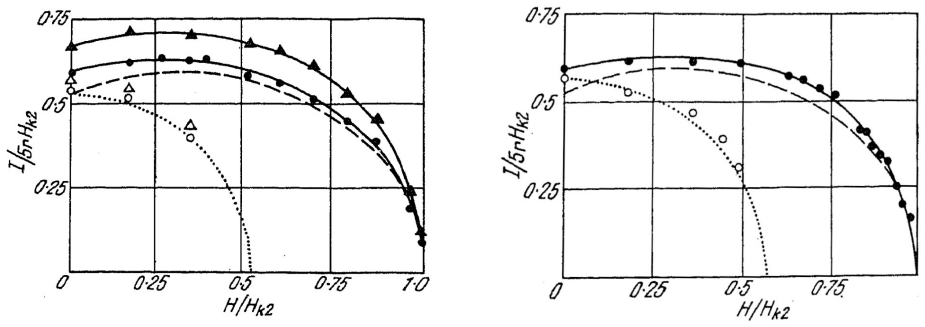
The machine that carries the argument is the Ginzburg-Landau parameter $\kappa$, computed for each wire sample from the thermodynamic critical field via $H_c^2/8\pi = -\int_0^{H_{c2}} M\,dH$ and from the ratios $\kappa_1 = H_{c2}/\sqrt{2}H_c$ and $\kappa_2^2 = \frac{1}{2}[1 + \frac{1}{4\pi \cdot 1.16}(dM/dH)_{H_{c2}}]$. At $t = T/T_c = 1$ the two parameters agree, $\kappa_1(1) = \kappa_2(1) = \kappa$, and $\kappa$ is plotted against the residual resistivity combined with the Sommerfeld constant through $\kappa = \kappa_0 + k \rho \sqrt{\gamma}$. The zero-resistivity intercept $\kappa_0 = 0.702$ is the load-bearing number: it lies below $1/\sqrt{2}$, the boundary separating type-I from type-II superconductors in Ginzburg-Landau theory. The temperature dependence then moves $\kappa_1$ and $\kappa_2$ upward as $T$ falls, which is why the material crosses into the type-II regime.
What would settle it
Take a niobium single crystal with residual resistance ratio above 100,000, measure its reversible magnetization at $T_c - T = 0.05$ K, and check whether $H_{c2}$ is strictly larger than $H_{c1}$; alternatively, on a wire with $\alpha$ above 3,000, determine $\kappa_1(1)$ by an independent method that does not rely on the linear extrapolation and compare it with $0.707$. Either observation at or above the boundary would falsify the type-I claim.
Extended reading notes
Core claim
The central claim is that ultrapure niobium is a type-I superconductor near its critical temperature. This is established from magnetization curves of single crystals with residual resistance ratios up to 61,000: as the temperature approaches $T_c$, the measured second critical field $H_{c2}$ drops toward the first critical field $H_{c1}$, and in the range $T_c - T \le 0.2$ K the curves show $H_{c2} = H_{c1}$, which is the signature of a type-I superconductor. Because the massive crystals' magnetization is strongly hysteretic, the precise values of $H_c$, $\kappa_1$ and $\kappa_2$ are extracted from polycrystalline wires, whose demagnetizing factor is zero and whose hysteresis from surface currents is reduced. For wires with residual resistance ratios from 91 to 15,000, the value $\kappa = \kappa_1(1) = \kappa_2(1)$ falls with increasing purity and follows the linear dependence $\kappa = \kappa_0 + k \rho \sqrt{\gamma}$ on residual resistivity; extrapolating to $\rho \to 0$ gives $\kappa_0 = 0.702 < 1/\sqrt{2}$. The paper concludes that pure niobium is intrinsically type-I at $T_c$ and becomes type-II at lower temperatures because of the temperature growth of $\kappa_1$ and $\kappa_2$.
Load-bearing premise
The whole classification depends on a linear extrapolation of the Ginzburg-Landau parameter $\kappa(\rho\sqrt{\gamma})$ measured on four wire samples down to zero residual resistivity, and the extrapolated value $\kappa_0 = 0.702$ sits so close to the type-I boundary $1/\sqrt{2} = 0.707$ that modest systematic errors in $H_c$, $H_{c2}$, or the wire surface contribution could move the material to the type-II side.
Editorial extensions
If this is right
- In as-grown, high-purity niobium single crystals within 0.2 K of $T_c$, the magnetization transition should have the first-order character of a type-I superconductor rather than the reversible second-order form of a type-II superconductor.
- The same material is type-II at lower temperatures, so standard mixed-state applications such as high-field magnets operating well below $T_c$ are not called into question; only the near-$T_c$ regime is reclassified.
- Earlier observations of type-II behavior in nominally pure niobium with residual resistance ratios of a few thousand were seeing the impurity-driven value of $\kappa$, not the intrinsic clean-limit value.
- The wire critical-current data in longitudinal fields are quantitatively consistent with a force-free spiral current distribution, meaning flux capture is essentially absent in the cleanest wires and force-free states can be realized in niobium.
Reading between the lines
- A direct check of the paper's extrapolation would be to measure $\kappa_1(1)$ on a single crystal with residual resistance ratio above $10^5$; if the value came out at or above $0.707$, the intrinsic type-I classification would need revision, and the paper itself notes that surface-to-volume effects may raise $\kappa$ in wires, making a crystal measurement the cleaner test.
- Because the fitted slope $k$ is 49% larger than the spherical-Fermi-surface value, the impurity contribution to $\kappa$ is enhanced by niobium's anisotropic Fermi surface; this suggests that theoretical estimates of $\kappa_0$ for anisotropic clean superconductors should be made with band-structure averages rather than free-electron models.
- The same protocol — purification to residual resistance ratio above $10^4$, then $\kappa$ extrapolation to zero impurity — could decide the intrinsic type-I/type-II status of other marginal elemental superconductors whose classification has historically been blurred by surface and impurity effects.
Editorial analysis
A structured set of objections, weighed in public.
Referee Report
Summary. The paper reports measurements of critical magnetic fields, magnetization curves, and critical currents on high-purity niobium single crystals and wires with residual resistance ratios up to 61,000. The authors claim that ultrapure niobium behaves as a type-I superconductor within about 0.2 K below the critical temperature, based on the near-coincidence of Hc1 and Hc2 in magnetization curves of massive single crystals and on a linear extrapolation of the Ginzburg-Landau parameter κ(t=1) to zero residual resistivity using Goodman's relation, yielding κ0 = 0.702 < 1/√2. The paper also discusses surface-related hysteresis, anisotropy of the upper critical field, and critical currents in longitudinal fields interpreted via force-free current distributions. The manuscript is an English translation of a 1974 Russian publication.
Significance. If the central claim is correct, the paper provides strong experimental support for the intrinsic type-I character of clean niobium near Tc, a question that has recently attracted renewed attention (e.g., Ref. [6]). The reported data on extremely pure samples (α up to 61,000) are unique and include comparisons with band-structure calculations and de Haas-van Alphen data. The paper also contains useful observations on surface hysteresis and force-free critical currents. However, the quantitative foundation of the type-I claim is the extrapolated value κ0 = 0.702, which lies only 0.7% below the type-I/II threshold, and the paper provides no uncertainty analysis.
major comments (3)
- [Section 4, Eq. (3), Table II] The central quantitative claim that κ0 = 0.702 < 1/√2 rests on a linear fit to only four wire samples (Nb6–Nb9) with no quoted error bars on κ(t=1). The two purest samples have κ(t=1) = 0.705 and 0.703, within 0.5% of the type-I/II boundary 1/√2 ≈ 0.7071. A systematic error of order 1% in the measured or extrapolated κ—from surface effects, from the difficulty of defining Hc1 and Hc2 near the boundary, or from the extrapolation of κ1(1) and κ2(1) to t = 1—would move the intercept above the threshold and overturn Conclusion 1. The authors should provide an uncertainty estimate or a sensitivity analysis demonstrating that κ0 is robustly below 1/√2.
- [Section 4, Eq. (3)] Goodman's relation κ = κ0 + kρ√γ is a dirty-limit result, but the wire samples are far from the dirty limit: the mean free path is orders of magnitude larger than the coherence length (Table III gives l/ξ0 > 1300 for α > 3×10^4 single crystals, and even the α = 9,000 wire has l ≫ ξ0). Applying a linear-in-√ρ extrapolation outside its domain of validity introduces an unquantified model error. The authors should justify the use of this relation for such pure samples, or show that a clean-limit extrapolation (e.g., of the form κ = κ0 + const/l) gives an intercept below 1/√2.
- [Section 3, Figure 3] The observation that Hc1 = Hc2 near Tc does not by itself establish type-I behavior, because a type-II superconductor with κ just above 1/√2 would exhibit a nearly vanishing Hc2 − Hc1 in the same temperature range. The paper acknowledges that κ cannot be determined accurately from the single-crystal magnetization curves; hence the type-I classification for these samples rests entirely on the wire-sample extrapolation. If the extrapolation is uncertain, Conclusion 1 is not independently supported.
minor comments (7)
- [Throughout] The notation for the type-I/II boundary is inconsistent (e.g., '1/√2', '1/√ 2', '1/√2'); it should be unified.
- [Figure 3 caption] The unit 'Qe' should be 'Oe' in '1000 Qe'.
- [Conclusion 3] 'Mattheis [17]' should be spelled 'Mattheiss [17]'.
- [Reference [16]] The surname is 'Goodman', not 'Goodmann'.
- [Title page] The manuscript does not explicitly mark itself as a translation from Fiz. metal. metalloved., 37, 63 (1974); a footnote would inform readers.
- [Section 4, text near Figure 6] The sentence 'If ρ → 0, κ → κ0 = 0.702 < 1/√2 (see Figure 6)' appears to refer to a plot that is not shown; Figure 6 displays κ1 and κ2 versus temperature, not the extrapolation to zero residual resistivity.
- [Section 6] 'Pulse setup allowed single sawtooth current pulses of up to 500 A with a duration of from 0.3 to 10 msec' should read 'with durations from 0.3 to 10 msec'.
Circularity Check
No circularity: type-I classification follows from measured κ(t=1) values and the direct Hc2≈Hc1 observation, with Goodman's relation and other theory used as external tools, not as self-referential inputs.
full rationale
The paper's derivation chain is self-contained. The central claim (ultrapure niobium is type-I near Tc) rests on two independent pieces of evidence: direct magnetization curves of massive single crystals showing Hc2=Hc1 for Tc−T≤0.2 K (Fig. 3), and wire-sample determinations of κ1 and κ2 from the standard GL definitions in Eq. (1), with the purest wires already giving κ(t=1)=0.705 and 0.703, below 1/√2. The extrapolation κ0=0.702 via Goodman's relation (Eq. 3) is a fit to these measured κ values, not a prediction renamed from the fit, and Goodman's relation is an external theoretical result. The nonlocal Hc2 expression (Eq. 4), the Werthamer–McMillan relation (Eq. 7), and the comparisons with Mattheiss's band-structure calculations and dHvA data all use independent literature values. The self-citations [5] and [18] are the original Russian report of the same data and a companion paper, respectively; neither is used to justify the type-I conclusion, and no uniqueness theorem or ansatz is imported from the authors' prior work. The skeptic's concern about the small margin between κ0=0.702 and 1/√2, and about unquantified systematic errors in the dirty-limit extrapolation, is a robustness/correctness issue rather than a circularity, because the paper does not define type-I behavior in terms of its own fitted intercept. No load-bearing step reduces to its own inputs by construction.
Assumptions & free parameters
free parameters (3)
- kappa0 =
0.702
- k =
11.2 x 10^3 (approximately)
- eta =
1.6 (average)
assumptions (4)
- standard math Ginzburg-Landau theory and Abrikosov's relations for kappa1 and kappa2 (Eq. 1) are valid for these samples.
- domain assumption Goodman's relation kappa = kappa0 + k*sqrt(rho*gamma) (Eq. 3) holds across the purity range studied.
- domain assumption Surface currents, not bulk flux pinning, cause the hysteresis in the measured magnetization curves.
- domain assumption The Werthamer-McMillan relation (Eq. 7) and its strong-coupling correction (Eq. 8) correctly connect dHc2/dt to <vF^2>.
Cite this review
Pith. "Pith review of Superconducting properties of ultrapure niobium." pith.science (2026). https://pith.science/paper/6WYDZ2YQ
@misc{pith2026250601330,
  author       = {Pith},
  title        = {Pith review of: Superconducting properties of ultrapure niobium},
  year         = {2026},
  howpublished = {\url{https://pith.science/paper/6WYDZ2YQ}},
  note         = {Machine review of arXiv:2506.01330}
}
read the original abstract
The results of determination of critical magnetic fields, magnetization curves and critical currents of niobium samples of different purity are presented. It is shown that ultrapure niobium near Tc is a superconductor of the first type and becomes a superconductor of the second type with decreasing temperature due to the temperature dependence of the Ginzburg-Landau parameters. The dependence of the hysteresis of the magnetization curves of massive samples on the surface state is investigated. A comparison of the superconducting parameters with the parameters of the electron spectrum of niobium is carried out. The dependence of the critical current of niobium wires on the longitudinal magnetic field agrees with the assumption of a force-free current distribution.
Figures


Figures from the paper (4 more)


Reference graph
Works this paper leans on
-
[6]
R. Prozorov, M. Zarea, J. A. Sauls, Niobium in clean limit: an intrinsic type-I superconductor, Phys. Rev. B 106, L180505 (2022) DOI: 10.1103/PhysRevB.106.L180505
-
[1]
D. K. Finnemore, T. F. Stromberg, C. A. Swenson, Superconducting Properties of High-Purity Niobium, Phys. Rev. 149, 231 (1966). DOI: 10.1103/PhysRev.149.231
-
[2]
R. A. French, Intrinsic type-2 superconductivity in pure niobium, Cryogenics 8, 301, (1968). DOI: 10.1016/S0011-2275(68)80007-4
-
[3]
A. Ikuschima, T. Mizusaki, Superconductivity in niobium and niobium-tantalum alloys, J. Phys, Chem. Solids 30, 873 (1969). DOI: 10.1016/0022-3697(69)90283-2
-
[4]
C. H. Hinrichs, C. A. Swenson, Superconducting Critical Field of Tantalum as a Function of Temper- ature and Pressure, Phys. Rev, 123, 1106 (1961). DOI: 10.1103/PhysRev.123.1106
-
[5]
N. E. Alekseyevskiy, V. I. Nizhankovskiy, K. H. Bertel, Superconductivity and Electronic Structure of Pure Niobium. II Superconducting Properties of Pure Niobium, Fiz. metal. metalloved., 37, 63 (1974). {in Russian}
work page 1974
-
[7]
1. Bartel, K. H. Bertel, K. Fischer, R. Gebel, G. Guntzler, M. Jurisch, W. Neuman, J. Kunze, P. Miill, H. Opperman, R. Petri, G. Sobe, G. Weise and U. Wisner, Superconductivity and Electronic Structure of Pure Niobium. I. Preparation of Ultra Pure Niobium, Fiz. metal. metalloved., 35, 921 (1973). {in Russian}
work page 1973
-
[8]
A. Koethe, J. I. Moench, Preparation of Ultra High Purity Niobium, Materials Transactions, JIM, 41, 7 (2000). DOI: 10.2320/matertrans1989.41.7
Show all 34 references
-
[9]
K. K. Schulze, Preparation and Characterization of Ultra-High-Purity Niobium, J. Met. 33, 33 (1981). DOI: 10.1007/BF03354422
1981 doi
-
[10]
Berndt, N
H. Berndt, N. Kartascheff, H. Wenzl, Influence of neutron irradiation at 4.6 K on the superconducting properties of niobium, Z. Angew. Phys. 24, 305 (1968). {in German}
1968
-
[11]
A. E. Jacobs, First-Order Transitions at Hc1 and Hc2 in Type-II Superconductors Phys. Rev. B4, 3022 (1971).DOI: 10.1103/PhysRevB.4.3022
1971 doi
-
[12]
E. H. Brandt, Ginsburg-Landau Theory of the Vortex Lattice in Type-I1 Superconductors for All Values of κ and B, Phys. stat. sol. B 51, 345 (1972). DOI: 10.1002/pssb.2220510135
1972 doi
-
[13]
L. J. Barnes, H. J. Fink, Critical Currents in the Superconducting Surface Sheath, Phys. Rev., 149, 186 (1966). DOI: 10.1103/PhysRev.149.186
1966 doi
-
[14]
Saint-James, G
D. Saint-James, G. Sarma, Edward John Thomas, Type II Superconductivity, Elsevier Science & Technology, 1969
1969
-
[15]
A. A. Abrikosov, On the Magnetic properties of superconductors of the second group, Zh.Eksp.Teor.Fiz. 32, 1442 (1957) [Sov.Phys.JETP 5, 1174 (1957)]. 13
1957
-
[16]
B. B. Goodmann, The Magnetic Behavior of Superconductors of Negative Surface Energy, IBM J. Res. Develop. 6, 63 (1962). DOI: 10.1147/rd.61.0063
1962 doi
-
[17]
L. F. Mattheiss, Electronic Structure of Niobium and Tantalum, Phys. Rev., B1, 373 (1970). DOI: 10.1103/PhysRevB.1.373
1970 doi
-
[18]
N. E. Alekseyevskiy, V. I. Nizhankovskiy, K. H. Bertel, Superconductivity and Electronic Structure of Pure Niobium. III Magnetoresistance and Magnetic Breakdown in High Magnetic Fields, Fiz. metal. metalloved., 42, 931 (1976). {in Russian}
1976
-
[19]
L. P. Gor’kov, Microscopic Derivation of the Ginzburg-Landau Equations in the Theory of Supercon- ductivity, Zh. Eksp. Teor. Fiz. 37, 833 (1959) [Sov. Phys. JETP 10, 593 (1960)]
1959
-
[20]
S. J. Williamson, L. Valby, Nonlocal Characteristics of the Bulk Upper Critical Field of Niobium, Phys. Rev. Letters 24, 1061 (1970). DOI: 10.1103/physrevlett.24.1061
1970 doi
-
[21]
C.Hohenberg, N
P. C.Hohenberg, N. R. Werthamer, Anisotropy and Temperature Dependence of the Upper Critical Field of Type-II Superconductors, Phys. Rev. 153, 493 (1967). DOI: 10.1103/PhysRev.153.493
1967 doi
-
[22]
S. J. Williamson, Bulk Upper Critical Field of Clean Type-II Superconductors: V and Nb, Phys. Rev. B2, 3545 (1970). DOI: 10.1103/PhysRevB.2.3545
1970 doi
-
[23]
N. R. Werthamer, W. L. McMillan, Temperature and Purity Dependence of the Superconducting Criti- cal Field Hc2. IV. Strong-Coupling Effects, Phys. Rev. 158, 415 (1967). DOI: 10.1103/PhysRev.158.415
1967 doi
-
[24]
Eilenberger, V
G. Eilenberger, V. Ambegaokar, Bulk ( Hc2) and Surface ( Hc3) Nucleation Fields of Strong-Coupling Superconducting Alloys, Phys. Rev., 158, 332 (1967). DOI: 10.1103/PhysRev.158.332
1967 doi
-
[25]
G. B. Scott, M. Springford, The Fermi surface in niobium, Proc. Roy. Soc. A320, 115 (1970). DOI: 10.1098/rspa.1970.0200
1970
-
[26]
H. A. Leupold, H. A. Boorse, Superconducting and Normal Specific Heats of a Single Crystal of Nio- bium, Phys. Rev., 134, A1322 (1964). DOI: 10.1103/PhysRev.134.A1322
1964 doi
-
[27]
Shoenberg, Superconductivity (Cambridge Monographs on Physics), Cambridge University Press (1952)
D. Shoenberg, Superconductivity (Cambridge Monographs on Physics), Cambridge University Press (1952)
1952
-
[28]
F. B. Silsbee, Current Distribution in Superconductors, Proc. Natl. Acad. Sci., USA 13, 516 (1927). DOI: 10.1073/pnas.13.7.516
1927 doi
-
[29]
L. N. J. De Jong, B. S. Blaisse, A Simple Model for the Magnetic Behaviour of Superconductors with an Anchored Filament Structure, Physics, 31, 317 (1965). DOI: 10.1016/0031-8914(65)90036-4
1965 doi
-
[30]
Bergeron, Simple model for longitudinal force-free current flow in superconductors of the second kind, J
C. Bergeron, Simple model for longitudinal force-free current flow in superconductors of the second kind, J. Appl. Phys. Letters, 3, 63 (1963). DOI: 10.1063/1.1753870
1963 doi
-
[31]
D. G. Walmsley, Normalizing current of a type II superconductor, Phys. Letters 36A, 357 (1971). DOI: 10.1016/0375-9601(71)90258-1
1971 doi
-
[32]
Meissner, F
W. Meissner, F. Schmeissner and H. Meissner, Messungen im ¨Ubergangsgebiet zur Supraleitung. III, Zs. Phys., 132, 529 (1952). DOI: 10.1007/BF01333213
1952 doi
-
[33]
A. F. Andreyev, Second Critical Current of Bulky Superconductors, Pis’ma v zh. eksp. teor. fiz. 10, 453 (1969)
1969
-
[34]
D. G. Walmsley, Force free magnetic fields in a type II superconducting cylinder, J. Phys. F 2, 510 (1972). DOI: 10.1088/0305-4608/2/3/020 14
1972 doi
Reviewed August 7, 2026 · model on record in the stance chip above.
Discussion (0). Continue with ORCID to comment.