REVIEW 5 major objections 6 minor 128 references
Self-supervised Latent Space Optimization with Nebula Variational Coding
T0 review · 5 major / 6 minor · reviewed 2026-08-07 · deepseek-v4-flash
Pith's one-line read Nebula anchors cluster latent spaces and sharpen 1D–3D tasks.
desk verdict The empirical claim is plausible and the evaluation is broad, but the repulsion term's stability proof is wrong as stated, and missing error bars and code make the gains hard to evaluate. read the letter →
The pith
A machine-rendered reading of the paper's core claim, the machinery that carries it, and where it could break.
The reading
What carries the argument
The load-bearing objects are the nebula anchors $A = \{a_1, \dots, a_m\}$, trainable vectors in latent space. Each latent feature is labeled by its nearest anchor, and the nebula loss $L_{\text{nebula}} = \sum_{i<j} M(a_i) M(a_j) (-\log \|a_j - a_i\|^2)$ defines a repulsive-attractive force: the mass $M(a_i) = 1 + \sum_{E(X) \in \mathcal{Z}_{a_i}} \|E(X) - a_i\|^2$ pulls assigned features toward the anchor while the negative-log term pushes anchors apart. The variational constraint (Gaussian prior, KL term $L_{\text{enc}}$, reparameterization) keeps the latent space a well-formed Gaussian, and the optional metric loss applies Siamese and triplet terms using the anchor-assigned labels to further separate clusters.
What would settle it
During a training run on a dataset such as MNIST, record the maximum pairwise distance between nebula anchors across steps. The paper's stability claim predicts this distance approaches 1 and stays there; if it instead grows steadily past 1 (for example beyond 2) while the nebula loss keeps decreasing, then the loss does not enforce the claimed equilibrium at distance 1, and the stated mechanism would be falsified even if the method still works empirically.
Extended reading notes
Core claim
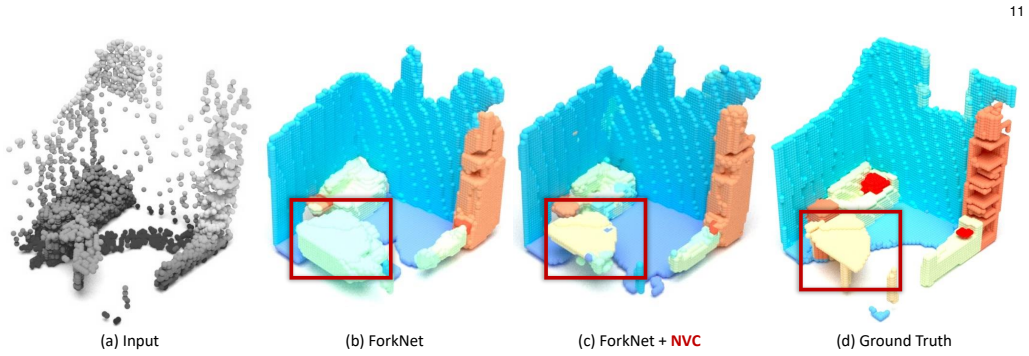
The paper's central claim is that a VAE-style encoder-decoder trained with the nebula loss plus the variational constraint produces a clustered latent manifold whose clusters align with semantic categories, and that this clustered manifold is a better substrate for downstream decoding. Concretely, the training objective is $L_{\text{total}} = L_{\text{enc-gen}} + L_{\text{nebula}} + L_{\text{metric}}$, where $L_{\text{nebula}}$ sums pairwise gravitational forces between anchors with mass equal to the spread of their assigned features, and $L_{\text{metric}}$ is an optional self-supervised Siamese/triplet loss using anchor-derived labels. The reported experiments show consistent gains over baselines across WMT16 translation, MNIST reconstruction, ShapeNet completion, PointNet segmentation, hand-pose estimation on Stereo and HOP, and planar and semantic scene completion on ScanNet, while the latent covariance remains close to identity.
Load-bearing premise
The loss assumes anchor-pair distances naturally stay below 1 because of the Gaussian latent assumption, so the negative-log repulsion settles at distance 1; but nothing in the loss or prior actually bounds those distances, so the claimed stable equilibrium is not guaranteed.
Editorial extensions
If this is right
- NVC can be added to existing encoder-decoder architectures without changing inference, because the anchors are used only during training.
- The paper reports consistent performance improvements on machine translation, image reconstruction, 3D object completion, point-cloud segmentation, and hand-pose estimation.
- The latent space forms clusters that correspond to semantic categories (e.g., MNIST digits) without labels, and more anchors reveal finer structure such as font style.
- Adding the optional metric learning stabilizes performance over a wider range of anchor counts, making the number of anchors easier to tune.
- The latent covariance with NVC stays close to identity, similar to plain VAE, unlike the compared InfoVAE, VQ-VAE, and GMVAE methods.
Reading between the lines
- The repulsive anchor loss may act as an implicit regularizer that prevents posterior collapse in text VAEs; this could be tested by comparing KL and ELBO curves on standard text modeling benchmarks.
- Because anchor labels are available without supervision, NVC could be combined with contrastive or prototypical learning to adapt the number of anchors dynamically during training.
- The same mechanism might extend to continual learning, where anchors could pin down old-task regions of the latent space and reduce forgetting, though the paper does not test this.
- For high-dimensional latent spaces, the pairwise anchor loss could be approximated by sampling anchor pairs, making it feasible to scale to thousands of anchors.
Editorial analysis
A structured set of objections, weighed in public.
Referee Report
Summary. The paper proposes Nebula Variational Coding (NVC), a method to regularize the latent space of encoder-decoder architectures by introducing 'nebula anchors' that act as cluster centers. The training objective combines a VAE-style term L_enc-gen, a nebula loss L_nebula that attracts latent features to anchors and repels anchors via a negative-log-distance term, and an optional self-supervised metric-learning loss. The authors claim that NVC produces clustered, semantically meaningful latent spaces and improves downstream performance across WMT translation, MNIST reconstruction, ShapeNet completion, PointNet segmentation, hand pose estimation, planar reconstruction, and semantic completion. The paper presents extensive experiments comparing baselines with and without NVC, including ablations on the number of anchors and loss components.
Significance. If the method works as described, NVC would be a useful, architecture-agnostic plug-in regularizer for VAE-style and other encoder-decoder networks, with the attractive property of requiring no labels at inference. The experimental breadth is a strength: results are reported on external benchmarks (BLEU, IoU, mIoU, AUC) across 1D, 2D, and 3D tasks, and the paper includes ablations on the number of anchors and loss components. The reproducibility of the experiments is limited by missing error bars and implementation details, and the theoretical justification of the repulsion term is flawed as stated; these issues need to be addressed before the claims can be fully accepted.
major comments (5)
- [Sec. 3.1.1, Eq. (5)] The repulsion term defined in Eq. (5) is -log||a_j - a_i||^2, and the text claims that because 'the distance between a pair of anchors ... has a stable range roughly between 0 to 1' under the variational Gaussian assumption, this term enforces an optimized inter-anchor distance of 1. This claim is not supported by the formulation. No term in the total loss in Eq. (17) constrains the anchor vectors; the variational constraint in Eq. (14) regularizes Q(z|X,A) and not the free parameters a_i. For any pair with ||a_j - a_i|| > 1, -log||a_j - a_i||^2 is negative and strictly decreasing as the distance grows, so minimizing L_nebula drives anchors apart without bound unless an additional constraint is imposed. The mass term in Eq. (4) does not prevent this; it only scales the force. Please either modify the repulsion term (e.g., use a bounded function such as -log min(||a_j-a_i||^2, 1) or a hinge on the distance), add a norm constraint to the anchors, or provide an analysis showing that the other terms in L_total indirectly bound the anchor distances. As stated, the claimed stability mechanism of NVC is absent.
- [Sec. 3.1.3] The paper states that 'there is no conflict in optimizing both losses' (L_enc and L_nebula), but this is asserted without proof. L_enc pushes the aggregate latent distribution toward a single Gaussian P(z), while L_nebula with its attraction and repulsion terms encourages separated clusters; these objectives are in tension for multi-modal data. Fig. 3 shows an empirical covariance matrix close to identity, but it does not constitute a proof and does not specify how the covariance is computed or how the figure is generated. Please provide a formal argument or a detailed empirical analysis (e.g., evolution of the KL term and cluster separation during training) to justify the compatibility claim. This matters because the name 'variational coding' and the claimed stable range of anchor distances depend on the Gaussian assumption being consistent with the clustering objective.
- [Sec. 4, Tables 2-10] Most experimental tables report only point estimates, without error bars, standard deviations, or the number of runs. For example, Table 5 shows that NVC-ML degrades performance on several classes (earpod, laptop, skateboard) relative to PointNet, yet the average improves; without variance information it is impossible to tell whether the average improvement is significant or the per-class differences are noise. Similarly, Table 4 reports improvements of 0.1-2.5 IoU points, which may be within run-to-run variability. Please report mean and standard deviation over at least three independent runs, or otherwise justify the statistical significance of the reported gains. This is necessary to support the central claim that NVC consistently improves downstream tasks.
- [Sec. 4.2, Table 3] The classification accuracy in Table 3 appears to be computed by assigning each latent feature to its closest anchor and comparing the anchor's majority label with the digit label. This is essentially the objective that the nebula loss and the anchor-based labeling already optimize, so high accuracy on this metric is partly by construction and does not independently validate that NVC recovers semantic clusters. Please state the exact evaluation protocol, and consider adding an external evaluation such as training a linear classifier on the NVC features and reporting held-out accuracy, or measuring cluster purity against ground-truth labels on a held-out set. As it stands, the circularity of this table weakens the semantic-clustering claim.
- [Sec. 3.2, Eq. (15)] The text states that the Siamese loss L_pair in Eq. (15) makes 'distances between the samples from the same category become smaller while the distances between the samples from different categories become larger,' but Eq. (15) contains only the positive-pair term |E(X_i)-E(X_p)|^2 and has no negative-pair repulsion. Only the triplet term in Eq. (16) penalizes negative pairs. Please correct the description, or modify L_pair to include a contrastive term for negative pairs.
minor comments (6)
- [Eq. (7)] The summation limits 'm \sum j=1+1' appear to be a typo; presumably j=i+1. Please fix the formula.
- [Eq. (5) and Fig. 2] The text says -log||a_j-a_i||^2 is 'proportional to the inverse of the distance', but it is not proportional to 1/||a_j-a_i||^2; the figure only illustrates a similar trend in a limited range. Please rephrase.
- [Sec. 5.1 and Table 10] The label 'without M_a' is used to mean replacing the nebula-mass-weighted loss by a plain Euclidean distance, but this is not defined in the table; please specify the exact objective used in that ablation.
- [Sec. 4] The paper does not specify how anchors are initialized (e.g., random vs. k-means on the first batch), how the number of anchors is chosen for each dataset, or the learning rates and batch sizes used. Please add implementation details for reproducibility.
- [Table 1] Table 1 reports variance for NVC/NVC-ML but not for the baseline methods; please state how variance is computed (number of runs) and report it consistently for all methods.
- [Fig. 5(a)] The claim that 'higher entropy implies that clusters formed are more separated' is not generally correct, since entropy of the full latent distribution can increase without cluster separation. Please rephrase or provide a more direct measure such as inter-cluster vs. intra-cluster distance ratio.
Circularity Check
No significant circularity: the main empirical claims are validated on external benchmarks, and the theoretical weakness in the nebula loss is an unsupported premise rather than a definitional or self-citational circularity.
full rationale
The paper's central claim—that adding the nebula loss and optional metric learning regularizes latent spaces and improves downstream tasks—is evaluated on external benchmarks (BLEU on WMT16, IoU on ShapeNet and CompleteScanNet, mIoU on PointNet, AUC/EPE on Stereo/HOP, recalls on ScanNet) against non-self baselines such as 3D-EPN, PointNet, 3D-GCN, ScanComplete, and SCFusion. These results are not equivalent to the training objective by construction, so the main empirical claim is self-contained. The only self-referential elements are the intrinsic cluster-accuracy check in Table 3 and the pseudo-label metric learning in Sec. 3.2; however, the paper does not present Table 3 as an independent downstream prediction, and the metric learning is optional and tested through its effect on external metrics. The most serious theoretical weakness is in Sec. 3.1.1/Eq. (5): the assertion that the negative-log repulsion 'enforce[s] the optimized distance between the two anchors to be 1' relies on an unstated assumption that anchor distances stay in [0,1]; no term in Eq. (14) or Eq. (17) bounds anchor norms or pairwise distances, and -log||aj-ai||^2 is unbounded below for distances greater than 1. This is an unsupported premise (and a potential sign/instability problem), but it is not circular: the claimed distance-1 optimum is an extra assumption, not an output already contained in the equations. Similarly, citations of the authors' own ForkNet and VO-Hand appear only as baseline architectures, not as load-bearing justification for the NVC derivation. No step reduces a predicted quantity to a fitted input or to a self-citation chain.
Assumptions & free parameters
free parameters (2)
- Number of nebula anchors m =
dataset-dependent: 10 on MNIST, 5/7/10 on hand pose datasets, 16/20/30/120 explored in Table 3
- Loss weights of L_nebula and L_metric =
1 for each term (implicit)
assumptions (4)
- standard math The VAE ELBO derivation in Eqs. 11-14 is valid, with a Gaussian posterior Q(z|X,A) parameterized by the encoder.
- ad hoc to paper The nebula loss and the Gaussian variational constraint can be optimized together without conflict.
- ad hoc to paper Anchor distances stay in the range [0,1] during training, so -log||a_j-a_i||^2 has its optimum at distance 1.
- domain assumption Hard nearest-anchor assignment is compatible with SGD training and provides stable pseudo-labels for metric learning.
invented entities (1)
-
Nebula anchors
Cite this review
Pith. "Pith review of Self-supervised Latent Space Optimization with Nebula Variational Coding." pith.science (2026). https://pith.science/paper/TXNBMBSC
@misc{pith2026250601414,
  author       = {Pith},
  title        = {Pith review of: Self-supervised Latent Space Optimization with Nebula Variational Coding},
  year         = {2026},
  howpublished = {\url{https://pith.science/paper/TXNBMBSC}},
  note         = {Machine review of arXiv:2506.01414}
}
read the original abstract
Deep learning approaches process data in a layer-by-layer way with intermediate (or latent) features. We aim at designing a general solution to optimize the latent manifolds to improve the performance on classification, segmentation, completion and/or reconstruction through probabilistic models. This paper proposes a variational inference model which leads to a clustered embedding. We introduce additional variables in the latent space, called \textbf{nebula anchors}, that guide the latent variables to form clusters during training. To prevent the anchors from clustering among themselves, we employ the variational constraint that enforces the latent features within an anchor to form a Gaussian distribution, resulting in a generative model we refer as Nebula Variational Coding (NVC). Since each latent feature can be labeled with the closest anchor, we also propose to apply metric learning in a self-supervised way to make the separation between clusters more explicit. As a consequence, the latent variables of our variational coder form clusters which adapt to the generated semantic of the training data, \textit{e.g.} the categorical labels of each sample. We demonstrate experimentally that it can be used within different architectures designed to solve different problems including text sequence, images, 3D point clouds and volumetric data, validating the advantage of our proposed method.
Figures


Figures from the paper (6 more)



Reference graph
Works this paper leans on
-
[1]
M. Lewis, Y. Liu, N. Goyal, M. Ghazvininejad, A. Mo- hamed, O. Levy, V . Stoyanov, and L. Zettlemoyer, “Bart: De- noising sequence-to-sequence pre-training for natural language generation, translation, and comprehension,”arXiv preprint arXiv:1910.13461, 2019
arXiv 1910
-
[2]
Cross-lingual language model pretraining,
G. Lample and A. Conneau, “Cross-lingual language model pretraining,”arXiv preprint arXiv:1901.07291, 2019
arXiv 1901
-
[3]
Shape completion using 3d- encoder-predictor cnns and shape synthesis,
A. Dai, C. R. Qi, and M. Nießner, “Shape completion using 3d- encoder-predictor cnns and shape synthesis,” inProc. IEEE Conf. on Computer Vision and Pattern Recognition (CVPR), vol. 3, 2017
2017
-
[4]
Pcn: Point completion network,
W. Yuan, T. Khot, D. Held, C. Mertz, and M. Hebert, “Pcn: Point completion network,” in3D Vision (3DV), 2018 International Conference on, 2018
2018
-
[5]
Forknet: Multi- branch volumetric semantic completion from a single depth image,
Y. Wang, D. J. Tan, N. Navab, and F. Tombari, “Forknet: Multi- branch volumetric semantic completion from a single depth image,” inProceedings of the IEEE International Conference on Computer Vision, 2019, pp. 8608–8617
2019
-
[6]
Efficient dynamic scene deblurring using spatially variant deconvolution network with optical flow guided training,
Y. Yuan, W. Su, and D. Ma, “Efficient dynamic scene deblurring using spatially variant deconvolution network with optical flow guided training,” inProceedings of the IEEE/CVF Conference on Computer Vision and Pattern Recognition, 2020, pp. 3555–3564
2020
-
[7]
Real image denoising based on multi-scale residual dense block and cascaded u-net with block-connection,
L. Bao, Z. Yang, S. Wang, D. Bai, and J. Lee, “Real image denoising based on multi-scale residual dense block and cascaded u-net with block-connection,” inProceedings of the IEEE/CVF Conference on Computer Vision and Pattern Recognition Workshops, 2020, pp. 448–449
2020
-
[8]
Cross- modal deep face normals with deactivable skip connections,
V . F. Abrevaya, A. Boukhayma, P . H. Torr, and E. Boyer, “Cross- modal deep face normals with deactivable skip connections,” inProceedings of the IEEE/CVF Conference on Computer Vision and Pattern Recognition, 2020, pp. 4979–4989
2020
Show all 128 references
-
[9]
Bi- directional convlstm u-net with densley connected convolu- tions,
R. Azad, M. Asadi-Aghbolaghi, M. Fathy, and S. Escalera, “Bi- directional convlstm u-net with densley connected convolu- tions,” inProceedings of the IEEE/CVF International Conference on Computer Vision Workshops, 2019, pp. 0–0
2019
-
[10]
Dense 3d object reconstruction from a single depth view,
B. Yang, S. Rosa, A. Markham, N. Trigoni, and H. Wen, “Dense 3d object reconstruction from a single depth view,”IEEE transactions on pattern analysis and machine intelligence, 2018
2018
-
[11]
Morphing and sampling network for dense point cloud completion,
M. Liu, L. Sheng, S. Yang, J. Shao, and S.-M. Hu, “Morphing and sampling network for dense point cloud completion,” in Proceedings of the AAAI Conference on Artificial Intelligence, vol. 34, 2020, pp. 11 596–11 603
2020
-
[12]
Grnet: Gridding residual network for dense point cloud completion,
H. Xie, H. Yao, S. Zhou, J. Mao, S. Zhang, and W. Sun, “Grnet: Gridding residual network for dense point cloud completion,” inComputer Vision – ECCV 2020, A. Vedaldi, H. Bischof, T. Brox, and J.-M. Frahm, Eds. Cham: Springer International Publishing, 2020, pp. 365–381
2020
-
[13]
Point cloud completion by skip-attention network with hierarchical folding,
X. Wen, T. Li, Z. Han, and Y.-S. Liu, “Point cloud completion by skip-attention network with hierarchical folding,” inProceedings of the IEEE/CVF Conference on Computer Vision and Pattern Recog- nition (CVPR), June 2020
2020
-
[14]
Deep octree-based cnns with output-guided skip connections for 3d shape and scene comple- tion,
P .-S. Wang, Y. Liu, and X. Tong, “Deep octree-based cnns with output-guided skip connections for 3d shape and scene comple- tion,” inProceedings of the IEEE/CVF Conference on Computer Vision and Pattern Recognition Workshops, 2020, pp. 266–267
2020
-
[15]
An information-maximization approach to blind separation and blind deconvolution,
A. J. Bell and T. J. Sejnowski, “An information-maximization approach to blind separation and blind deconvolution,”Neural computation, vol. 7, no. 6, pp. 1129–1159, 1995
1995
-
[16]
The fixed-point algorithm and maximum like- lihood estimation for independent component analysis,
A. Hyv ¨arinen, “The fixed-point algorithm and maximum like- lihood estimation for independent component analysis,”Neural Processing Letters, vol. 10, no. 1, pp. 1–5, 1999
1999
-
[17]
Using discriminant eigenfeatures for image retrieval,
D. L. Swets and J. J. Weng, “Using discriminant eigenfeatures for image retrieval,”IEEE Transactions on pattern analysis and machine intelligence, vol. 18, no. 8, pp. 831–836, 1996
1996
-
[18]
Stacked denoising autoencoders: Learning useful representa- tions in a deep network with a local denoising criterion,
P . Vincent, H. Larochelle, I. Lajoie, Y. Bengio, and P .-A. Manzagol, “Stacked denoising autoencoders: Learning useful representa- tions in a deep network with a local denoising criterion,”Journal of Machine Learning Research, vol. 11, no. Dec, pp. 3371–3408, 2010
2010
-
[19]
Ad- versarial autoencoders,
A. Makhzani, J. Shlens, N. Jaitly, I. Goodfellow, and B. Frey, “Ad- versarial autoencoders,”arXiv preprint arXiv:1511.05644, 2015
2015 arXiv
-
[20]
Generalized denois- ing auto-encoders as generative models,
Y. Bengio, L. Yao, G. Alain, and P . Vincent, “Generalized denois- ing auto-encoders as generative models,” inAdvances in Neural Information Processing Systems, 2013, pp. 899–907
2013
-
[21]
Denoising criterion for variational auto-encoding framework
D. J. Im, S. Ahn, R. Memisevic, Y. Bengioet al., “Denoising criterion for variational auto-encoding framework.” inAAAI, 2017, pp. 2059–2065
2017
-
[22]
Pairwise context similarity for image retrieval system using variational auto-encoder,
H. Yun, Y. Kim, T. Kang, and K. Jung, “Pairwise context similarity for image retrieval system using variational auto-encoder,”IEEE Access, 2021
2021
-
[23]
Ganerated hands for real-time 3d hand tracking from monocular rgb,
F. Mueller, F. Bernard, O. Sotnychenko, D. Mehta, S. Sridhar, D. Casas, and C. Theobalt, “Ganerated hands for real-time 3d hand tracking from monocular rgb,” inCVPR, 2018
2018
-
[24]
Learning to estimate 3d hand pose from single rgb images,
C. Zimmermann and T. Brox, “Learning to estimate 3d hand pose from single rgb images,” inICCV, 2017, pp. 4903–4911
2017
-
[25]
Variational object-aware 3d hand pose from a single rgb image,
Y. Gao, Y. Wang, P . Falco, N. Navab, and F. Tombari, “Variational object-aware 3d hand pose from a single rgb image,”IEEE Robotics and Automation Letters, 2019
2019
-
[26]
Y-autoencoders: Disentangling latent representations via sequential encoding,
M. Patacchiola, P . Fox-Roberts, and E. Rosten, “Y-autoencoders: Disentangling latent representations via sequential encoding,” Pattern Recognition Letters, vol. 140, pp. 59–65, 2020
2020
-
[27]
Bae-net: Branched autoencoder for shape co-segmentation,
Z. Chen, K. Yin, M. Fisher, S. Chaudhuri, and H. Zhang, “Bae-net: Branched autoencoder for shape co-segmentation,” inProceedings of the IEEE/CVF International Conference on Computer Vision, 2019, pp. 8490–8499
2019
-
[28]
Variational autoen- coders pursue pca directions (by accident),
M. Rolinek, D. Zietlow, and G. Martius, “Variational autoen- coders pursue pca directions (by accident),” inProceedings of the IEEE/CVF Conference on Computer Vision and Pattern Recognition, 2019, pp. 12 406–12 415
2019
-
[29]
Learning structured output repre- sentation using deep conditional generative models,
K. Sohn, H. Lee, and X. Yan, “Learning structured output repre- sentation using deep conditional generative models,” inAdvances in Neural Information Processing Systems 28, C. Cortes, N. D. Lawrence, D. D. Lee, M. Sugiyama, and R. Garnett, Eds. Curran Associates, Inc., 2015, p...
2015
-
[30]
Generating images with perceptual similarity metrics based on deep networks,
A. Dosovitskiy and T. Brox, “Generating images with perceptual similarity metrics based on deep networks,” inAdvances in Neural Information Processing Systems, 2016, pp. 658–666
2016
-
[31]
An uncertain future: Forecasting from static images using variational autoen- coders,
J. Walker, C. Doersch, A. Gupta, and M. Hebert, “An uncertain future: Forecasting from static images using variational autoen- coders,” inEuropean Conference on Computer Vision. Springer, 2016, pp. 835–851
2016
-
[32]
The mnist database of handwritten digits,
Y. LeCun, “The mnist database of handwritten digits,” http://yann. lecun. com/exdb/mnist/, 1998
1998
-
[33]
Neighborhood repulsed metric learning for kinship verification,
J. Lu, X. Zhou, Y.-P . Tan, Y. Shang, and J. Zhou, “Neighborhood repulsed metric learning for kinship verification,”IEEE transac- tions on pattern analysis and machine intelligence, vol. 36, no. 2, pp. 331–345, 2014
2014
-
[34]
Learning descriptors for object recognition and 3d pose estimation,
P . Wohlhart and V . Lepetit, “Learning descriptors for object recognition and 3d pose estimation,” inProc. IEEE CVPR, 2015
2015
-
[35]
Learning local image de- scriptors with deep siamese and triplet convolutional networks by minimising global loss functions,
B. Kumar, G. Carneiro, I. Reidet al., “Learning local image de- scriptors with deep siamese and triplet convolutional networks by minimising global loss functions,” inProceedings of the IEEE Conference on Computer Vision and Pattern Recognition, 2016, pp. 5385–5394
2016
-
[36]
No fuss distance metric learning using proxies,
Y. Movshovitz-Attias, A. Toshev, T. K. Leung, S. Ioffe, and S. Singh, “No fuss distance metric learning using proxies,” in Proceedings of the IEEE International Conference on Computer Vision, 2017, pp. 360–368
2017
-
[37]
Imagenet classi- fication with deep convolutional neural networks,
A. Krizhevsky, I. Sutskever, and G. E. Hinton, “Imagenet classi- fication with deep convolutional neural networks,” inAdvances in Neural Information Processing Systems 25. Curran Associates, Inc., 2012, pp. 1097–1105
2012
-
[38]
Going deeper with convolutions,
C. Szegedy, W. Liu, Y. Jia, P . Sermanet, S. Reed, D. Anguelov, D. Erhan, V . Vanhoucke, and A. Rabinovich, “Going deeper with convolutions,” inProceedings of the IEEE conference on computer vision and pattern recognition, 2015, pp. 1–9
2015
-
[39]
Sequence to sequence learning with neural networks,
I. Sutskever, O. Vinyals, and Q. V . Le, “Sequence to sequence learning with neural networks,” inAdvances in neural information processing systems, 2014, pp. 3104–3112
2014
-
[40]
Massive exploration of neural machine translation architectures,
D. Britz, A. Goldie, M.-T. Luong, and Q. Le, “Massive exploration of neural machine translation architectures,” inProceedings of the 2017 Conference on Empirical Methods in Natural Language Processing, 2017, pp. 1442–1451
2017
-
[41]
Generative adver- sarial nets,
I. Goodfellow, J. Pouget-Abadie, M. Mirza, B. Xu, D. Warde- Farley, S. Ozair, A. Courville, and Y. Bengio, “Generative adver- sarial nets,” inAdvances in Neural Information Processing Systems 27, Z. Ghahramani, M. Welling, C. Cortes, N. D. Lawrence, and K. Q. Weinberger, Eds. ...
2014
-
[42]
Aux- iliary deep generative models,
L. Maaløe, C. K. Sønderby, S. K. Sønderby, and O. Winther, “Aux- iliary deep generative models,”arXiv preprint arXiv:1602.05473, 2016
2016 arXiv
-
[43]
Findings of the 2016 conference on machine translation,
O. Bojar, R. Chatterjee, C. Federmann, Y. Graham, B. Haddow, M. Huck, A. J. Yepes, P . Koehn, V . Logacheva, C. Monzet al., “Findings of the 2016 conference on machine translation,” in Proceedings of the First Conference on Machine Translation: Volume 2, Shared Task Papers, 20...
2016
-
[44]
Pointnet: Deep learning on point sets for 3d classification and segmentation,
C. R. Qi, H. Su, K. Mo, and L. J. Guibas, “Pointnet: Deep learning on point sets for 3d classification and segmentation,” inProceedings of the IEEE conference on computer vision and pattern recognition, 2017, pp. 652–660
2017
-
[45]
3d hand pose tracking and estimation using stereo matching,
J. Zhang, J. Jiao, M. Chen, L. Qu, X. Xu, and Q. Yang, “3d hand pose tracking and estimation using stereo matching,”arXiv preprint arXiv:1610.07214, 2016
2016 arXiv
-
[46]
Single-image piece-wise planar 3d reconstruction via associative embedding,
Z. Yu, J. Zheng, D. Lian, Z. Zhou, and S. Gao, “Single-image piece-wise planar 3d reconstruction via associative embedding,” inProceedings of the IEEE Conference on Computer Vision and Pattern Recognition, 2019, pp. 1029–1037
2019
-
[47]
Scannet: Richly-annotated 3d reconstructions of indoor scenes,
A. Dai, A. X. Chang, M. Savva, M. Halber, T. Funkhouser, and M. Nießner, “Scannet: Richly-annotated 3d reconstructions of indoor scenes,” inProc. Computer Vision and Pattern Recognition (CVPR), IEEE, 2017
2017
-
[48]
Variable rate deep image compression with a conditional autoencoder,
Y. Choi, M. El-Khamy, and J. Lee, “Variable rate deep image compression with a conditional autoencoder,” inProceedings of the IEEE/CVF International Conference on Computer Vision, 2019, pp. 3146–3154
2019
-
[49]
Uc-net: Uncertainty inspired rgb-d saliency detection via conditional variational autoencoders,
J. Zhang, D.-P . Fan, Y. Dai, S. Anwar, F. S. Saleh, T. Zhang, and N. Barnes, “Uc-net: Uncertainty inspired rgb-d saliency detection via conditional variational autoencoders,” inProceedings of the IEEE/CVF conference on computer vision and pattern recognition, 2020, pp. 8582–8591
2020
-
[50]
Video compression with rate-distortion autoencoders,
A. Habibian, T. v. Rozendaal, J. M. Tomczak, and T. S. Co- hen, “Video compression with rate-distortion autoencoders,” in Proceedings of the IEEE/CVF International Conference on Computer Vision, 2019, pp. 7033–7042
2019
-
[51]
Memorizing normality to detect anomaly: Memory-augmented deep autoencoder for unsuper- vised anomaly detection,
D. Gong, L. Liu, V . Le, B. Saha, M. R. Mansour, S. Venkatesh, and A. v. d. Hengel, “Memorizing normality to detect anomaly: Memory-augmented deep autoencoder for unsuper- vised anomaly detection,” inProceedings of the IEEE/CVF Inter- national Conference on Computer Vision, 20...
2019
-
[52]
Stacked convolutional auto-encoders for hierarchical feature extraction,
J. Masci, U. Meier, D. Cires ¸an, and J. Schmidhuber, “Stacked convolutional auto-encoders for hierarchical feature extraction,” Artificial Neural Networks and Machine Learning–ICANN 2011, pp. 52–59, 2011
2011
-
[53]
Ae2-nets: Autoencoder in autoen- coder networks,
C. Zhang, Y. Liu, and H. Fu, “Ae2-nets: Autoencoder in autoen- coder networks,” inProceedings of the IEEE/CVF Conference on Computer Vision and Pattern Recognition, 2019, pp. 2577–2585
2019
-
[54]
Pcanet: A simple deep learning baseline for image classification?
T.-H. Chan, K. Jia, S. Gao, J. Lu, Z. Zeng, and Y. Ma, “Pcanet: A simple deep learning baseline for image classification?”IEEE transactions on image processing, vol. 24, no. 12, pp. 5017–5032, 2015
2015
-
[55]
Deep supervision with shape concepts for occlusion-aware 3d object parsing,
C. Li, M. Zeeshan Zia, Q.-H. Tran, X. Yu, G. D. Hager, and M. Chandraker, “Deep supervision with shape concepts for occlusion-aware 3d object parsing,” inProceedings of the IEEE Conference on Computer Vision and Pattern Recognition, 2017, pp. 5465–5474
2017
-
[56]
Boosting few-shot visual learning with self-supervision,
S. Gidaris, A. Bursuc, N. Komodakis, P . P ´erez, and M. Cord, “Boosting few-shot visual learning with self-supervision,” in Proceedings of the IEEE/CVF International Conference on Computer Vision, 2019, pp. 8059–8068
2019
-
[57]
Self-supervised 4d spatio-temporal feature learning via order prediction of se- quential point cloud clips,
H. Wang, L. Yang, X. Rong, J. Feng, and Y. Tian, “Self-supervised 4d spatio-temporal feature learning via order prediction of se- quential point cloud clips,” inProceedings of the IEEE/CVF Winter Conference on Applications of Computer Vision, 2021, pp. 3762–3771
2021
-
[58]
Self-supervised feature extraction for 3d axon seg- mentation,
T. Klinghoffer, P . Morales, Y.-G. Park, N. Evans, K. Chung, and L. J. Brattain, “Self-supervised feature extraction for 3d axon seg- mentation,” inProceedings of the IEEE/CVF Conference on Computer Vision and Pattern Recognition Workshops, 2020, pp. 978–979
2020
-
[59]
Deep un- supervised clustering with gaussian mixture variational autoen- coders,
N. Dilokthanakul, P . A. Mediano, M. Garnelo, M. C. Lee, H. Salimbeni, K. Arulkumaran, and M. Shanahan, “Deep un- supervised clustering with gaussian mixture variational autoen- coders,”arXiv preprint arXiv:1611.02648, 2016
2016 arXiv
-
[60]
Deep clustering by gaussian mixture variational autoencoders with graph embed- ding,
L. Yang, N.-M. Cheung, J. Li, and J. Fang, “Deep clustering by gaussian mixture variational autoencoders with graph embed- ding,” inProceedings of the IEEE/CVF International Conference on Computer Vision, 2019, pp. 6440–6449
2019
-
[61]
Neural discrete representation learning,
A. van den Oord, O. Vinyals, and K. Kavukcuoglu, “Neural discrete representation learning,” inProceedings of the 31st Inter- national Conference on Neural Information Processing Systems, 2017, pp. 6309–6318
2017
-
[62]
Infovae: Balancing learning and inference in variational autoencoders,
S. Zhao, J. Song, and S. Ermon, “Infovae: Balancing learning and inference in variational autoencoders,” inProceedings of the aaai conference on artificial intelligence, vol. 33, no. 01, 2019, pp. 5885– 5892
2019
-
[63]
Generating sentences from a continuous space,
S. R. Bowman, L. Vilnis, O. Vinyals, A. Dai, R. Jozefowicz, and S. Bengio, “Generating sentences from a continuous space,” inProceedings of The 20th SIGNLL Conference on Computational Natural Language Learning. Berlin, Germany: Association for Computational Linguistics, Aug. 2...
2016
-
[64]
Im- proved variational autoencoders for text modeling using di- lated convolutions,
Z. Yang, Z. Hu, R. Salakhutdinov, and T. Berg-Kirkpatrick, “Im- proved variational autoencoders for text modeling using di- lated convolutions,” inInternational conference on machine learning. PMLR, 2017, pp. 3881–3890
2017
-
[65]
A stable variational autoencoder for text modelling,
R. Li, X. Li, C. Lin, M. Collinson, and R. Mao, “A stable variational autoencoder for text modelling,” inProceedings of the 12th International Conference on Natural Language Generation. Tokyo, Japan: Association for Computational Linguistics, Oct.–Nov. 2019, pp. 594–599. [Onli...
2019
-
[66]
Unsupervised deep embed- ding for clustering analysis,
J. Xie, R. Girshick, and A. Farhadi, “Unsupervised deep embed- ding for clustering analysis,” inInternational conference on machine learning. PMLR, 2016, pp. 478–487
2016
-
[67]
Secrets of grabcut and kernel k-means,
M. Tang, I. B. Ayed, D. Marin, and Y. Boykov, “Secrets of grabcut and kernel k-means,” in2015 IEEE International Conference on Computer Vision (ICCV), 2015, pp. 1555–1563
2015
-
[68]
Cartesian k-means,
M. Norouzi and D. J. Fleet, “Cartesian k-means,” inProceedings 14 of the IEEE Conference on Computer Vision and Pattern Recognition (CVPR), June 2013
2013
-
[69]
Towards k- means-friendly spaces: Simultaneous deep learning and cluster- ing,
B. Yang, X. Fu, N. D. Sidiropoulos, and M. Hong, “Towards k- means-friendly spaces: Simultaneous deep learning and cluster- ing,” ininternational conference on machine learning. PMLR, 2017, pp. 3861–3870
2017
-
[70]
Categorical reparameterization with gumbel-softmax,
E. Jang, S. Gu, and B. Poole, “Categorical reparameterization with gumbel-softmax,” in5th International Conference on Learning Rep- resentations, ICLR 2017, Toulon, France, April 24-26, 2017, Conference Track Proceedings. OpenReview.net, 2017
2017
-
[71]
Prototypical networks for few-shot learning,
J. Snell, K. Swersky, and R. Zemel, “Prototypical networks for few-shot learning,”Advances in Neural Information Processing Sys- tems, vol. 30, pp. 4077–4087, 2017
2017
-
[72]
Hierarchical grouping to optimize an objective function,
J. H. W. Jr., “Hierarchical grouping to optimize an objective function,”Journal of the American Statistical Association, vol. 58, no. 301, pp. 236–244, 1963
1963
-
[73]
Deep adaptive image clustering,
J. Chang, L. Wang, G. Meng, S. Xiang, and C. Pan, “Deep adaptive image clustering,” inProceedings of the IEEE international conference on computer vision, 2017, pp. 5879–5887
2017
-
[74]
Invariant information clus- tering for unsupervised image classification and segmentation,
X. Ji, J. F. Henriques, and A. Vedaldi, “Invariant information clus- tering for unsupervised image classification and segmentation,” inProceedings of the IEEE International Conference on Computer Vision, 2019, pp. 9865–9874
2019
-
[75]
Image-to- image translation for cross-domain disentanglement,
A. Gonzalez-Garcia, J. Van De Weijer, and Y. Bengio, “Image-to- image translation for cross-domain disentanglement,”Advances in neural information processing systems, vol. 31, pp. 1287–1298, 2018
2018
-
[76]
A two-step disentanglement method,
N. Hadad, L. Wolf, and M. Shahar, “A two-step disentanglement method,” inProceedings of the IEEE Conference on Computer Vision and Pattern Recognition, 2018, pp. 772–780
2018
-
[77]
Disentangling latent space for vae by label relevant/irrelevant dimensions,
Z. Zheng and L. Sun, “Disentangling latent space for vae by label relevant/irrelevant dimensions,” inProceedings of the IEEE Conference on Computer Vision and Pattern Recognition, 2019, pp. 12 192–12 201
2019
-
[78]
Multi- similarity loss with general pair weighting for deep metric learn- ing,
X. Wang, X. Han, W. Huang, D. Dong, and M. R. Scott, “Multi- similarity loss with general pair weighting for deep metric learn- ing,” inProceedings of the IEEE/CVF Conference on Computer Vision and Pattern Recognition, 2019, pp. 5022–5030
2019
-
[79]
Improving generalization via scalable neighborhood component analysis,
Z. Wu, A. A. Efros, and S. X. Yu, “Improving generalization via scalable neighborhood component analysis,” inProceedings of the European Conference on Computer Vision (ECCV), 2018, pp. 685–701
2018
-
[80]
Deep metric learning using triplet network,
E. Hoffer and N. Ailon, “Deep metric learning using triplet network,” inInternational Workshop on Similarity-Based Pattern Recognition. Springer, 2015, pp. 84–92
2015
-
[81]
Improved deep metric learning with multi-class n-pair loss objective,
K. Sohn, “Improved deep metric learning with multi-class n-pair loss objective,” inProceedings of the 30th International Conference on Neural Information Processing Systems, 2016, pp. 1857–1865
2016
-
[82]
Deep metric learning via lifted structured feature embedding,
H. Oh Song, Y. Xiang, S. Jegelka, and S. Savarese, “Deep metric learning via lifted structured feature embedding,” inProceedings of the IEEE conference on computer vision and pattern recognition, 2016, pp. 4004–4012
2016
-
[83]
Dimensionality reduction by learning an invariant mapping,
R. Hadsell, S. Chopra, and Y. LeCun, “Dimensionality reduction by learning an invariant mapping,” in2006 IEEE Computer Society Conference on Computer Vision and Pattern Recognition (CVPR’06), vol. 2. IEEE, 2006, pp. 1735–1742
2006
-
[84]
Neighbourhood components analysis,
J. Goldberger, G. E. Hinton, S. Roweis, and R. R. Salakhutdinov, “Neighbourhood components analysis,”Advances in neural infor- mation processing systems, vol. 17, pp. 513–520, 2004
2004
-
[85]
Learning fine-grained image similarity with deep ranking,
J. Wang, Y. Song, T. Leung, C. Rosenberg, J. Wang, J. Philbin, B. Chen, and Y. Wu, “Learning fine-grained image similarity with deep ranking,” inProceedings of the IEEE conference on computer vision and pattern recognition, 2014, pp. 1386–1393
2014
-
[86]
Facenet: A unified embedding for face recognition and clustering,
F. Schroff, D. Kalenichenko, and J. Philbin, “Facenet: A unified embedding for face recognition and clustering,” inProceedings of the IEEE Conference on Computer Vision and Pattern Recognition, 2015, pp. 815–823
2015
-
[87]
Unsupervised domain adaptation with hierarchical gradient synchronization,
L. Hu, M. Kan, S. Shan, and X. Chen, “Unsupervised domain adaptation with hierarchical gradient synchronization,” inPro- ceedings of the IEEE/CVF Conference on Computer Vision and Pattern Recognition, 2020, pp. 4043–4052
2020
-
[88]
Unsupervised domain adaptation via structurally regularized deep clustering,
H. Tang, K. Chen, and K. Jia, “Unsupervised domain adaptation via structurally regularized deep clustering,” inProceedings of the IEEE/CVF conference on computer vision and pattern recognition, 2020, pp. 8725–8735
2020
-
[89]
One-shot domain adaptation for face generation,
C. Yang and S.-N. Lim, “One-shot domain adaptation for face generation,” inProceedings of the IEEE/CVF Conference on Computer Vision and Pattern Recognition, 2020, pp. 5921–5930
2020
-
[90]
Dlow: Domain flow for adaptation and generalization,
R. Gong, W. Li, Y. Chen, and L. V . Gool, “Dlow: Domain flow for adaptation and generalization,” inProceedings of the IEEE/CVF Conference on Computer Vision and Pattern Recognition, 2019, pp. 2477–2486
2019
-
[91]
A u-net based discrim- inator for generative adversarial networks,
E. Schonfeld, B. Schiele, and A. Khoreva, “A u-net based discrim- inator for generative adversarial networks,” inProceedings of the IEEE/CVF Conference on Computer Vision and Pattern Recognition, 2020, pp. 8207–8216
2020
-
[92]
Reusing discriminators for encoding: Towards unsupervised image-to- image translation,
R. Chen, W. Huang, B. Huang, F. Sun, and B. Fang, “Reusing discriminators for encoding: Towards unsupervised image-to- image translation,” inProceedings of the IEEE/CVF Conference on Computer Vision and Pattern Recognition, 2020, pp. 8168–8177
2020
-
[93]
Domain- adversarial training of neural networks,
Y. Ganin, E. Ustinova, H. Ajakan, P . Germain, H. Larochelle, F. Laviolette, M. Marchand, and V . Lempitsky, “Domain- adversarial training of neural networks,”The journal of machine learning research, vol. 17, no. 1, pp. 2096–2030, 2016
2016
-
[94]
Adversarial discriminative domain adaptation,
E. Tzeng, J. Hoffman, K. Saenko, and T. Darrell, “Adversarial discriminative domain adaptation,” inProceedings of the IEEE conference on computer vision and pattern recognition, 2017, pp. 7167–7176
2017
-
[95]
Domain-symmetric networks for adversarial domain adaptation,
Y. Zhang, H. Tang, K. Jia, and M. Tan, “Domain-symmetric networks for adversarial domain adaptation,” inProceedings of the IEEE/CVF Conference on Computer Vision and Pattern Recognition, 2019, pp. 5031–5040
2019
-
[96]
Grad- ually vanishing bridge for adversarial domain adaptation,
S. Cui, S. Wang, J. Zhuo, C. Su, Q. Huang, and Q. Tian, “Grad- ually vanishing bridge for adversarial domain adaptation,” in Proceedings of the IEEE/CVF Conference on Computer Vision and Pattern Recognition, 2020, pp. 12 455–12 464
2020
-
[97]
Auto-encoding variational bayes,
D. P . Kingma and M. Welling, “Auto-encoding variational bayes,” in2nd International Conference on Learning Representations, ICLR 2014, Banff, AB, Canada, April 14-16, 2014, Conference Track Pro- ceedings, Y. Bengio and Y. LeCun, Eds., 2014
2014
-
[98]
Google’s neural machine translation system: Bridging the gap between human and machine translation,
Y. Wu, M. Schuster, Z. Chen, Q. V . Le, M. Norouzi, W. Macherey, M. Krikun, Y. Cao, Q. Gao, K. Machereyet al., “Google’s neural machine translation system: Bridging the gap between human and machine translation,” inarXiv:1609.08144, 2016
2016 arXiv
-
[99]
Parallelized stochastic gradient descent,
M. Zinkevich, M. Weimer, L. Li, and A. J. Smola, “Parallelized stochastic gradient descent,” inAdvances in neural information processing systems, 2010, pp. 2595–2603
2010
-
[100]
A stochastic approximation method,
H. Robbins and S. Monro, “A stochastic approximation method,” Ann. Math. Statist., vol. 22, no. 3, pp. 400–407, 09 1951
1951
-
[101]
Variational infer- ence: A review for statisticians,
D. M. Blei, A. Kucukelbir, and J. D. McAuliffe, “Variational infer- ence: A review for statisticians,”Journal of the American Statistical Association, no. just-accepted, 2017
2017
-
[102]
ShapeNet: An Information-Rich 3D Model Repository,
A. X. Chang, T. Funkhouser, L. Guibas, P . Hanrahan, Q. Huang, Z. Li, S. Savarese, M. Savva, S. Song, H. Su, J. Xiao, L. Yi, and F. Yu, “ShapeNet: An Information-Rich 3D Model Repository,” Stanford University — Princeton University — Toyota Techno- logical Institute at Chicago...
2015 arXiv
-
[103]
Indoor se- mantic segmentation using depth information,
C. Couprie, C. Farabet, L. Najman, and Y. LeCun, “Indoor se- mantic segmentation using depth information,”arXiv preprint arXiv:1301.3572, 2013
2013 arXiv
-
[104]
Regularizing transformers with deep probabilistic layers,
A. C. Aguilera, P . M. Olmos, A. Art ´es-Rodr´ıguez, and F. P ´erez- Cruz, “Regularizing transformers with deep probabilistic layers,” arXiv preprint arXiv:2108.10764, 2021
2021 arXiv
-
[105]
Incorporating bert into neural machine translation,
J. Zhu, Y. Xia, L. Wu, D. He, T. Qin, W. Zhou, H. Li, and T. Liu, “Incorporating bert into neural machine translation,” in International Conference on Learning Representations, 2019
2019
-
[106]
Rethinking perturbations in encoder- decoders for fast training,
S. Takase and S. Kiyono, “Rethinking perturbations in encoder- decoders for fast training,” inProceedings of the 2021 Conference of the North American Chapter of the Association for Computational Linguistics: Human Language Technologies, 2021, pp. 5767–5780
2021
-
[107]
Learning phrase rep- resentations using rnn encoder-decoder for statistical machine translation,
K. Cho, B. Van Merri ¨enboer, C. Gulcehre, D. Bahdanau, F. Bougares, H. Schwenk, and Y. Bengio, “Learning phrase rep- resentations using rnn encoder-decoder for statistical machine translation,”arXiv preprint arXiv:1406.1078, 2014
2014 arXiv
-
[108]
Long short-term memory,
S. Hochreiter and J. Schmidhuber, “Long short-term memory,” Neural computation, vol. 9, no. 8, pp. 1735–1780, 1997
1997
-
[109]
Neural machine translation (seq2seq) tutorial,
M. Luong, E. Brevdo, and R. Zhao, “Neural machine translation (seq2seq) tutorial,”https://github.com/tensorflow/nmt, 2017
2017
-
[110]
Predicting depth, surface normals and semantic labels with a common multi-scale convolutional architecture,
D. Eigen and R. Fergus, “Predicting depth, surface normals and semantic labels with a common multi-scale convolutional architecture,” inProceedings of the IEEE International Conference on Computer Vision, 2015, pp. 2650–2658. 15
2015
-
[111]
Adabins: Depth estimation using adaptive bins,
S. F. Bhat, I. Alhashim, and P . Wonka, “Adabins: Depth estimation using adaptive bins,” inProceedings of the IEEE/CVF Conference on Computer Vision and Pattern Recognition, 2021, pp. 4009–4018
2021
-
[112]
Shape completion enabled robotic grasping,
J. Varley, C. DeChant, A. Richardson, J. Ruales, and P . Allen, “Shape completion enabled robotic grasping,” inIntelligent Robots and Systems (IROS), 2017 IEEE/RSJ International Conference on. IEEE, 2017, pp. 2442–2447
2017
-
[113]
High- resolution shape completion using deep neural networks for global structure and local geometry inference,
X. Han, Z. Li, H. Huang, E. Kalogerakis, and Y. Yu, “High- resolution shape completion using deep neural networks for global structure and local geometry inference,” inProceedings of IEEE International Conference on Computer Vision (ICCV), 2017
2017
-
[114]
Interactive shape co- segmentation via label propagation,
Z. Wu, R. Shou, Y. Wang, and X. Liu, “Interactive shape co- segmentation via label propagation,”Computers & Graphics, vol. 38, pp. 248–254, 2014
2014
-
[115]
A scalable active frame- work for region annotation in 3d shape collections,
L. Yi, V . G. Kim, D. Ceylan, I. Shen, M. Yan, H. Su, A. Lu, Q. Huang, A. Sheffer, L. Guibaset al., “A scalable active frame- work for region annotation in 3d shape collections,”ACM Trans- actions on Graphics (TOG), vol. 35, no. 6, p. 210, 2016
2016
-
[116]
Volumetric and multi-view cnns for object classification on 3d data,
C. R. Qi, H. Su, M. Nießner, A. Dai, M. Yan, and L. J. Guibas, “Volumetric and multi-view cnns for object classification on 3d data,” inProceedings of the IEEE Conference on Computer Vision and Pattern Recognition, 2016, pp. 5648–5656
2016
-
[117]
Sgpn: Similarity group proposal network for 3d point cloud instance segmenta- tion,
W. Wang, R. Yu, Q. Huang, and U. Neumann, “Sgpn: Similarity group proposal network for 3d point cloud instance segmenta- tion,” inProceedings of the IEEE Conference on Computer Vision and Pattern Recognition, 2018, pp. 2569–2578
2018
-
[118]
Syncspeccnn: Synchro- nized spectral cnn for 3d shape segmentation,
L. Yi, H. Su, X. Guo, and L. J. Guibas, “Syncspeccnn: Synchro- nized spectral cnn for 3d shape segmentation,” inProceedings of the IEEE Conference on Computer Vision and Pattern Recognition, 2017, pp. 2282–2290
2017
-
[119]
Pointnet++ deep hierarchical feature learning on point sets in a metric space,
C. R. Qi, L. Yi, H. Su, and L. J. Guibas, “Pointnet++ deep hierarchical feature learning on point sets in a metric space,” in Proceedings of the 31st International Conference on Neural Information Processing Systems, 2017, pp. 5105–5114
2017
-
[120]
Convolution in the cloud: Learning deformable kernels in 3d graph convolution networks for point cloud analysis,
Z.-H. Lin, S.-Y. Huang, and Y.-C. F. Wang, “Convolution in the cloud: Learning deformable kernels in 3d graph convolution networks for point cloud analysis,” inProceedings of the IEEE/CVF Conference on Computer Vision and Pattern Recognition, 2020, pp. 1800–1809
2020
-
[121]
Cascaded hand pose regression,
X. Sun, Y. Wei, S. Liang, X. Tang, and J. Sun, “Cascaded hand pose regression,” inCVPR, 2015
2015
-
[122]
Manhattan- world stereo,
Y. Furukawa, B. Curless, S. M. Seitz, and R. Szeliski, “Manhattan- world stereo,” in2009 IEEE Conference on Computer Vision and Pattern Recognition. IEEE, 2009, pp. 1422–1429
2009
-
[123]
Indoor seg- mentation and support inference from rgbd images,
N. Silberman, D. Hoiem, P . Kohli, and R. Fergus, “Indoor seg- mentation and support inference from rgbd images,” inEuropean conference on computer vision. Springer, 2012, pp. 746–760
2012
-
[124]
Planenet: Piece-wise planar reconstruction from a single rgb image,
C. Liu, J. Yang, D. Ceylan, E. Yumer, and Y. Furukawa, “Planenet: Piece-wise planar reconstruction from a single rgb image,” in Proceedings of the IEEE Conference on Computer Vision and Pattern Recognition, 2018, pp. 2579–2588
2018
-
[125]
Variational object-aware 3-d hand pose from a single rgb image,
Y. Gao, Y. Wang, P . Falco, N. Navab, and F. Tombari, “Variational object-aware 3-d hand pose from a single rgb image,”IEEE Robotics and Automation Letters, vol. 4, no. 4, pp. 4239–4246, 2019
2019
-
[126]
Single-image piece-wise planar 3d reconstruction via associative embedding,
Z. Yu, J. Zheng, D. Lian, Z. Zhou, and S. Gao, “Single-image piece-wise planar 3d reconstruction via associative embedding,” inCVPR, 2019, pp. 1029–1037
2019
-
[127]
Scancomplete: Large-scale scene completion and semantic seg- mentation for 3d scans,
A. Dai, D. Ritchie, M. Bokeloh, S. Reed, J. Sturm, and M. Nießner, “Scancomplete: Large-scale scene completion and semantic seg- mentation for 3d scans,” inProceedings of the IEEE Conference on Computer Vision and Pattern Recognition, 2018, pp. 4578–4587
2018
-
[128]
Scfusion: Real- time incremental scene reconstruction with semantic comple- tion,
S.-C. Wu, K. Tateno, N. Navab, and F. Tombari, “Scfusion: Real- time incremental scene reconstruction with semantic comple- tion,”arXiv preprint arXiv:2010.13662, 2020. Yida Wanghad received his Ph.D. from Tech- nische Universit ¨at M ¨unchen (TUM) focusing on 3D understanding...
2010 arXiv
Reviewed August 7, 2026 · model on record in the stance chip above.
Discussion (0). Sign in to comment.