REVIEW 3 major objections 5 minor 53 references
Multi-Modal Dataset Distillation in the Wild
T0 review · 3 major / 5 minor · reviewed 2026-08-07 · deepseek-v4-flash
Pith's one-line read The paper claims noisy web-scale image-text data can be distilled into tiny clean sets with provable tolerance to uniform label noise.
desk verdict A genuinely new and empirically strong method for distilling noisy multimodal data, but the theoretical claim is proved for a different noise model and the proof is missing. read the letter →
The pith
A machine-rendered reading of the paper's core claim, the machinery that carries it, and where it could break.
The reading
What carries the argument
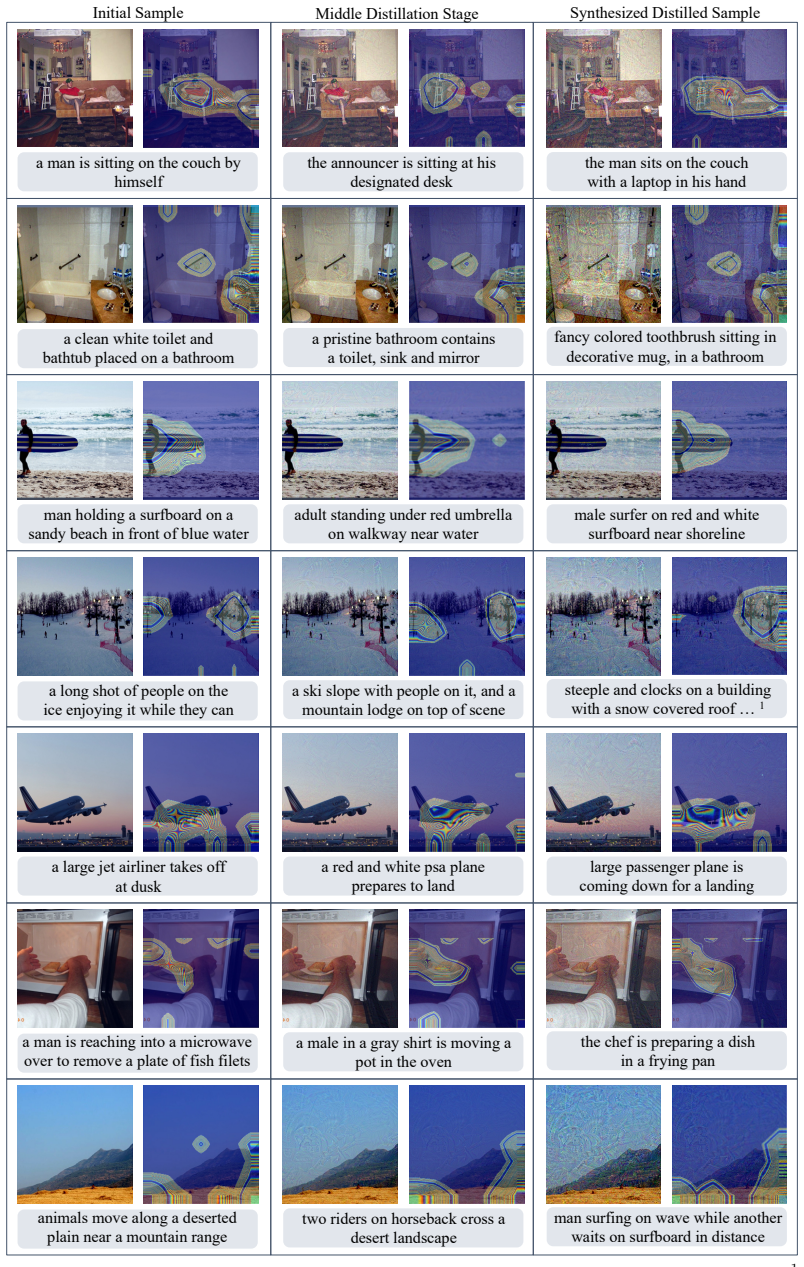
The load-bearing objects are the learnable soft matching probability matrix $\tilde{P}\in\mathbb{R}^{M\times M}$, which replaces hard binary match labels and lets each distilled image relate to several texts, and the dual-track collaborative learning (DTCL) loss $L_n$ built from negative matches across all samples. The paper proves Theorem 3.1: for noise ratio $\eta < (N-1)/N$, $L_n$ is noise tolerant against uniform corrupted matching labels in instance-level image-text matching, meaning its expected gradient direction stays close to the clean-label optimum. The third component is correspondence-enhanced optimization (CEO), which uses Grad-CAM activation maps of the expert visual encoder to compute per-pixel weights that amplify updates on correspondence-discriminative regions of distilled images. Together they carry the argument that distilled data can encode dense correspondence knowledge without being poisoned by PMPs.
What would settle it
Run MDW on a dataset where mismatches are semantically related rather than randomly shuffled (e.g., each noisy caption describes a scene similar to the image) and compare R@1 with the random-shuffle baseline; a large performance drop would show the uniform independent noise model in Theorem 3.1 misses the noise that matters.
Extended reading notes
Core claim
On the paper's own terms, the central discovery is that noisy multi-modal dataset distillation can be made robust by treating non-correspondence as a first-class supervision signal. The proposed MDW framework jointly optimizes synthesized images, text embeddings, and a soft matching probability matrix $\tilde{P}$ to capture fine-grained sample-level correspondences, and uses a negative-match loss $L_n = -\sum_i \sum_{j\neq i}(\log(1-p^{i2t}_{ij}) + \log(1-p^{t2i}_{ij}))$ whose noise tolerance is certified by Theorem 3.1 under uniform label corruption. This lets the expert model learn reliable cross-modal priors from noisy data without discarding most of the dataset, and then the distilled data are further refined by adaptively boosting updates in correspondence-discriminative image regions identified via Grad-CAM-style activation maps. The empirical claim is that models trained from scratch on the distilled sets surpass prior multi-modal distillation methods by more than 15% on standard retrieval benchmarks, with the gap widening as noise increases.
Load-bearing premise
The proof of noise tolerance assumes mismatched pairs are created by randomly flipping labels independently with the same probability; real web mismatches are correlated and structured, so if that uniformity fails the certified guarantee does not apply.
Editorial extensions
If this is right
- A 100-pair distilled set can replace training sets of 29k to 113k pairs for image-text retrieval, with MDW reporting higher R@1/R@5/R@10 than prior distillation methods at the same size.
- Using negative matches across all samples raises usable supervision from roughly $0.49N^2$ pairs after filtering to about $N^2 - 0.3N$ pairs, with no extra memory cost because the similarity matrix is already computed.
- The distilled datasets transfer across different visual architectures; models trained on MDW-distilled data retain a performance advantage over baselines when evaluated with ResNet or RegNet encoders.
- MDW scales with distilled set size: at 2,000 distilled pairs (under 1% of the original data) it reaches about 74% of the full-data retrieval performance on noisy Flickr30K.
- The noise-tolerant negative loss also improves the clean-subset selection accuracy used for positive-match learning, reaching 99.7% on Flickr30K with 30% noise.
Reading between the lines
- Not shown in the paper: the proof of Theorem 3.1 covers uniform, independent label corruption; real web noise is structured and correlated, so the certificate would likely need a stronger noise model to extend to arbitrary PMPs.
- The CEO weighting mechanism effectively edits distilled images to amplify task-relevant patterns, which suggests distilled images are not merely compressed data but actively constructed training examples; this could be tested by measuring whether downstream classifiers trained on them inherit the amplified cues.
- The soft matching probability matrix could be reused as a pseudo-label prior for other multi-modal tasks such as captioning or visual question answering, though the paper only evaluates retrieval.
- The sample-selection stage relies on the memorization effect of neural networks; at much larger scales or with very high noise ratios, that signal may weaken, and MDW's robustness would then depend on how much $L_n$ alone can compensate.
Editorial analysis
A structured set of objections, weighed in public.
Referee Report
Summary. The paper proposes MDW, a framework for distilling noisy multi-modal image-text datasets into compact clean synthetic datasets. The method combines fine-grained correspondence-enhanced distillation (learnable soft matching probabilities and Grad-CAM-based adaptive weighting) with dual-track collaborative learning (DTCL), which trains on clean positive pairs identified by a consensus-driven filter and on negative matches across all samples via a non-correspondence loss L_n. The authors state a theorem claiming L_n is noise tolerant under uniform label corruption and report extensive experiments on Flickr30K, COCO, and CC104K with synthetic and real noise, showing consistent improvements over prior multi-modal distillation methods. The paper also includes scalability, architecture-transfer, and efficiency analyses.
Significance. If the results hold, MDW would be the first framework to address partially mismatched pairs in multi-modal dataset distillation, an important practical problem given the prevalence of noisy web-crawled data. The empirical study is extensive: multiple datasets, noise ratios, distilled sizes, ablations, cross-architecture evaluation, and a real-world noisy benchmark (CC104K). The reported gains over strong baselines are large and consistent, and the efficiency analysis is useful. However, the theoretical guarantee that underpins the 'certifiable noise tolerance' claim is not proven in the manuscript, and its stated noise model does not match the actual PMP setting studied in the experiments. The empirical comparisons also lack error bars, so the statistical significance of the margins is not established.
major comments (3)
- [Section 3.4, Theorem 3.1] The theorem is stated without proof in the main text or any appendix. Since the abstract, introduction, and contribution list claim 'certifiable noise tolerance' and the theorem is the only formal support for this claim, a complete proof (or a precise pointer to an appendix containing one) is required. In addition, the theorem's noise model assumes label flips on a fully observed N×N matrix (y_ii flips from 1 to 0, y_ij flips from 0 to 1), whereas the PMP setting studied in the paper is a diagonal content mismatch: the observed positive label for a mismatched image-text pair remains 1, and the synthetic noise in Table 1 is injected by shuffling images. The theorem as stated does not cover this setting, so the 'certifiable' claim is currently unsupported for the actual problem the paper targets.
- [Section 3.4, Eq. (5) and Algorithm 2] The non-correspondence loss L_n = -Σ_i Σ_{j≠i} (log(1-p_i2t_ij) + log(1-p_t2i_ij)) only penalizes off-diagonal entries. Under the diagonal-mismatch noise model, a mismatched pair (V_i, T_i) still has y_ii=1 in the observed data, and L_n imposes no penalty on p_ii; indeed, making all off-diagonal probabilities small can drive the diagonal to dominate, which may strengthen the model's confidence on mismatched diagonals rather than suppress it. The paper needs a gradient-level analysis of L_n under content mismatch (or an explicit argument for why the labeled-diagonal assumption is unnecessary), because the current text only justifies L_n under the label-flip model.
- [Tables 1 and 2] No variance information is reported. Every table gives point estimates without standard deviations or the number of random seeds, so the claimed improvements (15–30% in R_sum) cannot be assessed for statistical significance. Please report mean ± std over at least three, preferably five, random seeds for the main comparisons in Tables 1 and 2, and ideally also for the ablation in Table 3.
minor comments (5)
- [Section 3.4 after Theorem 3.1] The sentence 'In essence, Ln ensures model convergence to a solution that deviates from the optimal one obtained with clean matching labels by a bounded margin' introduces a 'bounded margin' that is not formally defined anywhere; either define it in the theorem statement or remove it.
- [Appendix A.1, Eq. (6)] The text states that the consensus-driven sample selection is 'training-free and parameter-independent,' but the clean subset depends on the threshold δ and on the fitted Beta Mixture Model parameters; δ is itself a tuned hyperparameter in Table 12. Please qualify this claim.
- [Appendix A.1] The global-level partition fits a Beta Mixture Model to cosine similarities, but cosine similarity can be negative, while the beta distribution has support [0,1]. Please describe how the similarities are transformed or truncated before fitting, or justify the use of a beta distribution.
- [Section 3.3, Eq. (4)] The exponential moving average update for A_i is mentioned but its schedule (momentum, update frequency) is not specified; please give the exact update rule in the main text or Appendix F.
- [Table 1 caption] The caption says 'Model on original dataset training achieves ...' but it is not stated whether this refers to clean original data or noisy original data; clarifying this would help interpret the upper-bound comparisons.
Circularity Check
Theorem 3.1's noise-tolerance guarantee is true by construction because L_n never reads the matching labels, and the theorem's label-flip model does not cover the diagonal content mismatches the method actually targets.
-
self definitional
[Section 3.4, Eq. (5) and Theorem 3.1]
"Ln =−XiXj̸=i(log(1−p i2t ij ) + log(1−pt2i ij )).(5) ... Theorem 3.1.Given the noise ratio η < N−1 N , Ln is noise tolerant against uniform corrupted matching label ˆy in instance-level image-text matching task."
Eq. (5) is a sum over off-diagonal pairs j≠i only and contains no term involving y_ii or y_ij. Consequently, corrupting the matching labels ŷ — the only noise mechanism Theorem 3.1 considers — leaves both the value and the gradients of L_n unchanged. The claimed 'noise tolerance' is therefore an identity inherited from the definition of L_n, not a derived robustness property. Moreover, the paper applies Eq. (1) with y_ii=1 for real data and injects PMPs by 'randomly shuffling images' (content mismatches with the observed diagonal label unchanged), a setting the theorem's label-flip model does not cover; no proof for that setting is supplied, so the theorem cannot certify the method's headline robustness.
full rationale
The empirical evaluation is genuinely self-contained: distilled datasets are optimized by matching expert/student trajectories and then scored on held-out Flickr30K, COCO and CC104K test splits, with no test-set feedback used to fit the method's hyperparameters. Thus the '15% improvement' claim is not circular. The self-citations to the authors' prior noisy-correspondence papers [6,7] are not load-bearing, since the consensus-driven sample selection is specified in Appendix A rather than imported as a black box. However, the paper's theoretical centerpiece, Theorem 3.1, is circular in the sense of being definitionally vacuous: L_n in Eq. (5) never references the matching labels ŷ, so its 'noise tolerance' under the theorem's own label-corruption model is immediate from the loss definition, and no proof connects this model to the diagonal content-mismatch PMPs actually injected in Table 1 and found in CC3M. It is also flagged that no proof of Theorem 3.1 appears in the main text or any appendix, so the vacuity cannot be checked against a supplied argument. Because the method's practical results rest on independent held-out evaluation, the circularity is partial rather than total; the theoretical robustness claim itself, however, reduces to a construction.
Assumptions & free parameters
free parameters (4)
- delta (clean posterior threshold) =
0.6
- beta (CEO sharpness) =
not reported
- k (top-k texts for Grad-CAM aggregation) =
not reported
- Learning rates alpha_v, alpha_t, alpha_p =
dataset-dependent values in Table 12
assumptions (4)
- domain assumption Noise in matching labels is uniform and independent, with y_ii flipped to 0 with probability eta and y_ij flipped to 1 with probability eta/(N-1).
- domain assumption Neural networks learn clean samples before noisy ones, i.e., the memorization effect, which makes clean and noisy samples separable by similarity.
- domain assumption In the fitted Beta Mixture Model, the component with higher mean similarity corresponds to clean samples.
- domain assumption Pretrained ImageNet NFNet and BERT encoders provide a transferable initialization for expert-student trajectory matching.
Cite this review
Pith. "Pith review of Multi-Modal Dataset Distillation in the Wild." pith.science (2026). https://pith.science/paper/4SRJPGRH
@misc{pith2026250601586,
  author       = {Pith},
  title        = {Pith review of: Multi-Modal Dataset Distillation in the Wild},
  year         = {2026},
  howpublished = {\url{https://pith.science/paper/4SRJPGRH}},
  note         = {Machine review of arXiv:2506.01586}
}
read the original abstract
Recent multi-modal models have shown remarkable versatility in real-world applications. However, their rapid development encounters two critical data challenges. First, the training process requires large-scale datasets, leading to substantial storage and computational costs. Second, these data are typically web-crawled with inevitable noise, i.e., partially mismatched pairs, severely degrading model performance. To these ends, we propose Multi-modal dataset Distillation in the Wild, i.e., MDW, the first framework to distill noisy multi-modal datasets into compact clean ones for effective and efficient model training. Specifically, MDW introduces learnable fine-grained correspondences during distillation and adaptively optimizes distilled data to emphasize correspondence-discriminative regions, thereby enhancing distilled data's information density and efficacy. Moreover, to capture robust cross-modal correspondence prior knowledge from real data, MDW proposes dual-track collaborative learning to avoid the risky data noise, alleviating information loss with certifiable noise tolerance. Extensive experiments validate MDW's theoretical and empirical efficacy with remarkable scalability, surpassing prior methods by over 15% across various compression ratios, highlighting its appealing practicality for applications with diverse efficacy and resource needs.
Figures


Figures from the paper (5 more)


Reference graph
Works this paper leans on
-
[1]
Unsupervised label noise modeling and loss correction
Eric Arazo, Diego Ortego, Paul Albert, Noel O’Connor, and Kevin McGuinness. Unsupervised label noise modeling and loss correction. InInternational conference on machine learning, pages 312–321. PMLR, 2019
work page 2019
-
[2]
A closer look at memorization in deep networks
Devansh Arpit, Stanislaw Jastrzkebski, Nicolas Ballas, David Krueger, Emmanuel Bengio, Maxinder S Kanwal, Tegan Maharaj, Asja Fischer, Aaron Courville, Yoshua Bengio, et al. A closer look at memorization in deep networks. InInternational conference on machine learning, pages 233–242. PMLR, 2017
work page 2017
-
[3]
High-performance large-scale image recognition without normalization
Andy Brock, Soham De, Samuel L Smith, and Karen Simonyan. High-performance large-scale image recognition without normalization. InInternational conference on machine learning, pages 1059–1071. PMLR, 2021
2021
-
[4]
Dataset distillation by matching training trajectories
George Cazenavette, Tongzhou Wang, Antonio Torralba, Alexei A Efros, and Jun-Yan Zhu. Dataset distillation by matching training trajectories. InProceedings of the IEEE/CVF Confer- ence on Computer Vision and Pattern Recognition, pages 4750–4759, 2022
work page 2022
-
[5]
Scaling up dataset distillation to imagenet- 1k with constant memory
Justin Cui, Ruochen Wang, Si Si, and Cho-Jui Hsieh. Scaling up dataset distillation to imagenet- 1k with constant memory. InInternational Conference on Machine Learning, pages 6565–6590. PMLR, 2023
2023
-
[6]
Noisy correspondence learning with self-reinforcing errors mitigation
Zhuohang Dang, Minnan Luo, Chengyou Jia, Guang Dai, Xiaojun Chang, and Jingdong Wang. Noisy correspondence learning with self-reinforcing errors mitigation. InProceedings of the AAAI Conference on Artificial Intelligence, volume 38, pages 1463–1471, 2024
work page 2024
-
[7]
Disentangled noisy correspondence learning.IEEE Transactions on Image Processing, 2025
Zhuohang Dang, Minnan Luo, Jihong Wang, Chengyou Jia, Haochen Han, Herun Wan, Guang Dai, Xiaojun Chang, and Jingdong Wang. Disentangled noisy correspondence learning.IEEE Transactions on Image Processing, 2025
work page 2025
-
[8]
Imagenet: A large- scale hierarchical image database
Jia Deng, Wei Dong, Richard Socher, Li-Jia Li, Kai Li, and Li Fei-Fei. Imagenet: A large- scale hierarchical image database. In2009 IEEE conference on computer vision and pattern recognition, pages 248–255. Ieee, 2009
2009
Show all 53 references
-
[9]
Bert: Pre-training of deep bidirectional transformers for language understanding
Jacob Devlin. Bert: Pre-training of deep bidirectional transformers for language understanding. arXiv preprint arXiv:1810.04805, 2018
2018 arXiv
-
[10]
Similarity reasoning and filtration for image-text matching
Haiwen Diao, Ying Zhang, Lin Ma, and Huchuan Lu. Similarity reasoning and filtration for image-text matching. InProceedings of the AAAI conference on artificial intelligence, volume 35, pages 1218–1226, 2021
2021
-
[11]
An image is worth 16x16 words: Transformers for image recognition at scale.arXiv preprint arXiv:2010.11929, 2020
Alexey Dosovitskiy. An image is worth 16x16 words: Transformers for image recognition at scale.arXiv preprint arXiv:2010.11929, 2020
2010 arXiv
-
[12]
Robust loss functions under label noise for deep neural networks
Aritra Ghosh, Himanshu Kumar, and P Shanti Sastry. Robust loss functions under label noise for deep neural networks. InProceedings of the AAAI conference on artificial intelligence, volume 31, 2017
2017
-
[13]
To- wards lossless dataset distillation via difficulty-aligned trajectory matching
Ziyao Guo, Kai Wang, George Cazenavette, HUI LI, Kaipeng Zhang, and Yang You. To- wards lossless dataset distillation via difficulty-aligned trajectory matching. InThe Twelfth International Conference on Learning Representations, 2024. 10
2024
-
[14]
Noisy correspondence learning with meta similarity correction
Haochen Han, Kaiyao Miao, Qinghua Zheng, and Minnan Luo. Noisy correspondence learning with meta similarity correction. InProceedings of the IEEE/CVF Conference on Computer Vision and Pattern Recognition, 2023
2023
-
[15]
Deep residual learning for image recognition
Kaiming He, Xiangyu Zhang, Shaoqing Ren, and Jian Sun. Deep residual learning for image recognition. InProceedings of the IEEE conference on computer vision and pattern recognition, pages 770–778, 2016
2016
-
[16]
Learning with noisy correspondence for cross-modal matching.Advances in Neural Information Processing Systems, 34:29406–29419, 2021
Zhenyu Huang, Guocheng Niu, Xiao Liu, Wenbiao Ding, Xinyan Xiao, Hua Wu, and Xi Peng. Learning with noisy correspondence for cross-modal matching.Advances in Neural Information Processing Systems, 34:29406–29419, 2021
2021
-
[17]
Gpt-4o system card.arXiv preprint arXiv:2410.21276, 2024
Aaron Hurst, Adam Lerer, Adam P Goucher, Adam Perelman, Aditya Ramesh, Aidan Clark, AJ Ostrow, Akila Welihinda, Alan Hayes, Alec Radford, et al. Gpt-4o system card.arXiv preprint arXiv:2410.21276, 2024
2024 arXiv
-
[18]
Generating action-conditioned prompts for open-vocabulary video action recognition
Chengyou Jia, Minnan Luo, Xiaojun Chang, Zhuohang Dang, Mingfei Han, Mengmeng Wang, Guang Dai, Sizhe Dang, and Jingdong Wang. Generating action-conditioned prompts for open-vocabulary video action recognition. InProceedings of the 32nd ACM International Conference on Multimedi...
2024
-
[19]
Agentstore: Scalable integration of heterogeneous agents as specialized generalist computer assistant.arXiv preprint arXiv:2410.18603, 2024
Chengyou Jia, Minnan Luo, Zhuohang Dang, Qiushi Sun, Fangzhi Xu, Junlin Hu, Tianbao Xie, and Zhiyong Wu. Agentstore: Scalable integration of heterogeneous agents as specialized generalist computer assistant.arXiv preprint arXiv:2410.18603, 2024
-
[20]
Chatgen: Automatic text-to-image generation from freestyle chatting.arXiv preprint arXiv:2411.17176, 2024
Chengyou Jia, Changliang Xia, Zhuohang Dang, Weijia Wu, Hangwei Qian, and Minnan Luo. Chatgen: Automatic text-to-image generation from freestyle chatting.arXiv preprint arXiv:2411.17176, 2024
2024 arXiv
-
[21]
Stacked cross attention for image-text matching
Kuang-Huei Lee, Xi Chen, Gang Hua, Houdong Hu, and Xiaodong He. Stacked cross attention for image-text matching. InProceedings of the European conference on computer vision (ECCV), pages 201–216, 2018
2018
-
[22]
Factorized contrastive learning: Going beyond multi-view redundancy.Advances in Neural Information Processing Systems, 36:32971–32998, 2023
Paul Pu Liang, Zihao Deng, Martin Q Ma, James Y Zou, Louis-Philippe Morency, and Ruslan Salakhutdinov. Factorized contrastive learning: Going beyond multi-view redundancy.Advances in Neural Information Processing Systems, 36:32971–32998, 2023
2023
-
[23]
Focal loss for dense object detection.arXiv preprint arXiv:1708.02002, 2017
T Lin. Focal loss for dense object detection.arXiv preprint arXiv:1708.02002, 2017
2017 arXiv
-
[24]
Microsoft coco: Common objects in context
Tsung-Yi Lin, Michael Maire, Serge Belongie, James Hays, Pietro Perona, Deva Ramanan, Piotr Dollár, and C Lawrence Zitnick. Microsoft coco: Common objects in context. InComputer Vision–ECCV 2014: 13th European Conference, Zurich, Switzerland, September 6-12, 2014, Proceedings,...
2014
-
[25]
Energy-based out-of-distribution detection.Advances in neural information processing systems, 33:21464–21475, 2020
Weitang Liu, Xiaoyun Wang, John Owens, and Yixuan Li. Energy-based out-of-distribution detection.Advances in neural information processing systems, 33:21464–21475, 2020
2020
-
[26]
Dataset distillation with convexi- fied implicit gradients
Noel Loo, Ramin Hasani, Mathias Lechner, and Daniela Rus. Dataset distillation with convexi- fied implicit gradients. InInternational Conference on Machine Learning, pages 22649–22674. PMLR, 2023
2023
-
[27]
The expectation-maximization algorithm.IEEE Signal processing magazine, 13(6):47–60, 1996
Todd K Moon. The expectation-maximization algorithm.IEEE Signal processing magazine, 13(6):47–60, 1996
1996
-
[28]
Dataset meta-learning from kernel ridge-regression
Timothy Nguyen, Zhourong Chen, and Jaehoon Lee. Dataset meta-learning from kernel ridge-regression. InInternational Conference on Learning Representations, 2020
2020
-
[29]
Autogps: Automated geometry problem solving via multimodal formalization and deductive reasoning
Bowen Ping, Minnan Luo, Zhuohang Dang, Chenxi Wang, and Chengyou Jia. Autogps: Automated geometry problem solving via multimodal formalization and deductive reasoning. arXiv preprint arXiv:2505.23381, 2025
2025
-
[30]
Learning transferable visual models from natural language supervision
Alec Radford, Jong Wook Kim, Chris Hallacy, Aditya Ramesh, Gabriel Goh, Sandhini Agarwal, Girish Sastry, Amanda Askell, Pamela Mishkin, Jack Clark, et al. Learning transferable visual models from natural language supervision. InInternational conference on machine learning, pag...
2021
-
[31]
Design- ing network design spaces
Ilija Radosavovic, Raj Prateek Kosaraju, Ross Girshick, Kaiming He, and Piotr Dollár. Design- ing network design spaces. InProceedings of the IEEE/CVF conference on computer vision and pattern recognition, pages 10428–10436, 2020
2020
-
[32]
Distilbert, a distilled version of bert: smaller, faster, cheaper and lighter.arXiv preprint arXiv:1910.01108, 2019
V Sanh. Distilbert, a distilled version of bert: smaller, faster, cheaper and lighter.arXiv preprint arXiv:1910.01108, 2019
1910 arXiv
-
[33]
Grad-cam: Visual explanations from deep networks via gradient-based localization
Ramprasaath R Selvaraju, Michael Cogswell, Abhishek Das, Ramakrishna Vedantam, Devi Parikh, and Dhruv Batra. Grad-cam: Visual explanations from deep networks via gradient-based localization. InProceedings of the IEEE international conference on computer vision, pages 618–626, 2017
2017
-
[34]
Active learning for convolutional neural networks: A core-set approach
Ozan Sener and Silvio Savarese. Active learning for convolutional neural networks: A core-set approach. InInternational Conference on Learning Representations, 2018
2018
-
[35]
Conceptual captions: A cleaned, hypernymed, image alt-text dataset for automatic image captioning
Piyush Sharma, Nan Ding, Sebastian Goodman, and Radu Soricut. Conceptual captions: A cleaned, hypernymed, image alt-text dataset for automatic image captioning. InProceedings of the 56th Annual Meeting of the Association for Computational Linguistics (Volume 1: Long Papers), p...
2018
-
[36]
Gemini: a family of highly capable multimodal models.arXiv preprint arXiv:2312.11805, 2023
Gemini Team, Rohan Anil, Sebastian Borgeaud, Jean-Baptiste Alayrac, Jiahui Yu, Radu Soricut, Johan Schalkwyk, Andrew M Dai, Anja Hauth, Katie Millican, et al. Gemini: a family of highly capable multimodal models.arXiv preprint arXiv:2312.11805, 2023
2023 arXiv
-
[37]
An empirical study of example forgetting during deep neural network learning.arXiv preprint arXiv:1812.05159, 2018
Mariya Toneva, Alessandro Sordoni, Remi Tachet des Combes, Adam Trischler, Yoshua Bengio, and Geoffrey J Gordon. An empirical study of example forgetting during deep neural network learning.arXiv preprint arXiv:1812.05159, 2018
2018 arXiv
-
[38]
High-frequency component helps explain the generalization of convolutional neural networks
Haohan Wang, Xindi Wu, Zeyi Huang, and Eric P Xing. High-frequency component helps explain the generalization of convolutional neural networks. InProceedings of the IEEE/CVF conference on computer vision and pattern recognition, pages 8684–8694, 2020
2020
-
[39]
Cafe: Learning to condense dataset by aligning features
Kai Wang, Bo Zhao, Xiangyu Peng, Zheng Zhu, Shuo Yang, Shuo Wang, Guan Huang, Hakan Bilen, Xinchao Wang, and Yang You. Cafe: Learning to condense dataset by aligning features. InProceedings of the IEEE/CVF Conference on Computer Vision and Pattern Recognition, pages 12196–12205, 2022
2022
-
[40]
Multimodal dataset distillation for image-text retrieval.arXiv preprint arXiv:2308.07545, 2023
Xindi Wu, Zhiwei Deng, and Olga Russakovsky. Multimodal dataset distillation for image-text retrieval.arXiv preprint arXiv:2308.07545, 2023
2023 arXiv
-
[41]
Os-atlas: A foundation action model for generalist gui agents.arXiv preprint arXiv:2410.23218, 2024
Zhiyong Wu, Zhenyu Wu, Fangzhi Xu, Yian Wang, Qiushi Sun, Chengyou Jia, Kanzhi Cheng, Zichen Ding, Liheng Chen, Paul Pu Liang, et al. Os-atlas: A foundation action model for generalist gui agents.arXiv preprint arXiv:2410.23218, 2024
-
[42]
Regularly truncated m-estimators for learning with noisy labels.IEEE Transactions on Pattern Analysis and Machine Intelligence, 2023
Xiaobo Xia, Pengqian Lu, Chen Gong, Bo Han, Jun Yu, and Tongliang Liu. Regularly truncated m-estimators for learning with noisy labels.IEEE Transactions on Pattern Analysis and Machine Intelligence, 2023
2023
-
[43]
Low-rank similarity mining for multimodal dataset distillation
Yue Xu, Zhilin Lin, Yusong Qiu, Cewu Lu, and Yong-Lu Li. Low-rank similarity mining for multimodal dataset distillation. InForty-first International Conference on Machine Learning, 2024
2024
-
[44]
Bicro: Noisy correspondence rectification for multi-modality data via bi-directional cross-modal similarity consistency
Shuo Yang, Zhaopan Xu, Kai Wang, Yang You, Hongxun Yao, Tongliang Liu, and Min Xu. Bicro: Noisy correspondence rectification for multi-modality data via bi-directional cross-modal similarity consistency. InProceedings of the IEEE/CVF Conference on Computer Vision and Pattern R...
2023
-
[45]
Robust noisy correspondence learning with equivariant similarity consistency
Yuchen Yang, Likai Wang, Erkun Yang, and Cheng Deng. Robust noisy correspondence learning with equivariant similarity consistency. InProceedings of the IEEE/CVF Conference on Computer Vision and Pattern Recognition, pages 17700–17709, 2024
2024
-
[46]
Searching to exploit memorization effect in learning with noisy labels
Quanming Yao, Hansi Yang, Bo Han, Gang Niu, and James Tin-Yau Kwok. Searching to exploit memorization effect in learning with noisy labels. InInternational Conference on Machine Learning, pages 10789–10798. PMLR, 2020. 12
2020
-
[47]
From image descriptions to visual denotations: New similarity metrics for semantic inference over event descriptions
Peter Young, Alice Lai, Micah Hodosh, and Julia Hockenmaier. From image descriptions to visual denotations: New similarity metrics for semantic inference over event descriptions. Transactions of the Association for Computational Linguistics, 2:67–78, 2014
2014
-
[48]
Dataset distillation: A comprehensive review
Ruonan Yu, Songhua Liu, and Xinchao Wang. Dataset distillation: A comprehensive review. IEEE Transactions on Pattern Analysis and Machine Intelligence, 2023
2023
-
[49]
Visualizing and understanding convolutional networks
MD Zeiler. Visualizing and understanding convolutional networks. InEuropean conference on computer vision/arXiv, volume 1311, 2014
2014
-
[50]
Generalized cross entropy loss for training deep neural networks with noisy labels.Advances in neural information processing systems, 31, 2018
Zhilu Zhang and Mert Sabuncu. Generalized cross entropy loss for training deep neural networks with noisy labels.Advances in neural information processing systems, 31, 2018
2018
-
[51]
Dataset condensation with gradient matching
Bo Zhao, Konda Reddy Mopuri, and Hakan Bilen. Dataset condensation with gradient matching. InNinth International Conference on Learning Representations 2021, 2021
2021
-
[52]
Mitigating noisy correspondence by geometrical structure consistency learning
Zihua Zhao, Mengxi Chen, Tianjie Dai, Jiangchao Yao, Bo Han, Ya Zhang, and Yanfeng Wang. Mitigating noisy correspondence by geometrical structure consistency learning. InProceedings of the IEEE/CVF Conference on Computer Vision and Pattern Recognition, pages 27381–27390, 2024
2024
-
[53]
girl" and “couple
Yongchao Zhou, Ehsan Nezhadarya, and Jimmy Ba. Dataset distillation using neural feature regression.Advances in Neural Information Processing Systems, 35:9813–9827, 2022. 13 0.3 0.4 0.5 0.6 0.7 0.8 Similarity 0 1K 2K 3K 4K 5K 6K 7KNumbers clean noisy (a) Initial Distribution 0...
2022
Reviewed August 7, 2026 · model on record in the stance chip above.
Discussion (0). Sign in to comment.