REVIEW 3 major objections 6 minor 46 references
Bidirectional Soft Actor-Critic: Leveraging Forward and Reverse KL Divergence for Efficient Reinforcement Learning
T0 review · 3 major / 6 minor · reviewed 2026-08-07 · deepseek-v4-flash
Pith's one-line read Switching the KL direction in SAC turns its policy update into an explicit formula.
desk verdict The forward-KL projection derivation is correct but standard, and the Bidirectional SAC idea is reasonable, but the VDN-a critic's marginal recovery is unidentifiable and the experiments are too thinly reported to support the 30% claim. read the letter →
The pith
A machine-rendered reading of the paper's core claim, the machinery that carries it, and where it could break.
The reading
What carries the argument
The load-bearing object is the forward-KL projection identity: for a diagonal Gaussian policy, the optimal forward-KL projection of the Boltzmann distribution is obtained by setting each action dimension's mean and variance to the corresponding marginal moments, computed by numerical integration. The VDN-a critic, adapted from value decomposition networks, decomposes the global Q-function into per-action-dimension subnetworks plus an auxiliary interaction network so that each action marginal can be estimated independently. The Bidirectional SAC objective then uses the forward projection as both the initialization and a regularizer for the reverse-KL policy improvement step.
What would settle it
Train the VDN-a critic on a fixed Q-function whose Boltzmann distribution has a known bimodal marginal; if the mean and variance computed by Simpson integration of the learned marginal deviate from the true values by more than the integration error, the projection anchor is miscalibrated. Selecting a continuous-control task with strong action-dimension coupling and comparing Bidirectional SAC's episodic reward against standard SAC with identical hyperparameters would also test the claim.
Extended reading notes
Core claim
The paper's central claim is that the intractable projection step in SAC becomes explicit when the KL direction is flipped. For a Gaussian policy with diagonal covariance, the minimizer of $D_{\mathrm{KL}}(q(\cdot|s_t)\|\pi'(\cdot|s_t))$ is the product of one-dimensional Gaussians whose mean and variance are the mean and variance of the corresponding marginal of the Boltzmann target $q(a|s_t) \propto \exp(Q(s_t,a)/\alpha)$. The paper further claims that an actor initialized at this projection and then refined by reverse-KL minimization, through the Bidirectional SAC objective $D_{\mathrm{KL}}(\pi\|q) + \epsilon(\|f^* - f\|^2 + \|\Sigma^* - \Sigma\|^2)$, converges faster and reaches higher reward than standard SAC's purely gradient-based reverse-KL update. A value-decomposition-style critic with per-action-dimension subnetworks and an auxiliary interaction network is proposed to learn the marginals needed for the projection.
Load-bearing premise
The forward-KL anchor is only as good as the critic's estimate of each action dimension's share of the target distribution, and the paper's proof of correctness requires an auxiliary network that has fully learned the interactions between action dimensions.
Editorial extensions
If this is right
- Forward SAC alone obtains an explicit, gradient-free policy projection and outperforms standard SAC on simpler continuous-control tasks.
- Bidirectional SAC inherits the reverse-KL guarantee of monotonic Q improvement while starting from a better-conditioned initialization, giving faster convergence and higher asymptotic reward.
- The per-dimension marginal decomposition allows the forward projection to be computed with one-dimensional numerical integration, avoiding the curse of dimensionality.
- If the VDN-a critic captures the first two moments of each Boltzmann marginal, the same bidirectional update should transfer to other maximum-entropy algorithms that use the same Gaussian policy family.
Reading between the lines
- The authors do not test this, but the same moment-matching projection could initialize other maximum-entropy or trust-region policy algorithms, not just SAC.
- Because the method only needs the first two moments of each marginal, its occasional failure on bimodal marginals may not hurt control performance; a direct comparison of policies matched on mean and variance would test this.
- The result reframes SAC's reverse-KL gradient step as a noisy estimator of an exact moment-matching step, suggesting that variance reduction in policy updates, rather than a new objective, may be the primary source of the reported gains.
- A natural extension the paper leaves implicit is using higher-order marginal moments or non-Gaussian policy families when the Boltzmann target is strongly multimodal.
Editorial analysis
A structured set of objections, weighed in public.
Referee Report
Summary. The paper investigates the use of forward KL divergence in the SAC framework. It derives that, for diagonal Gaussian policies, the forward-KL optimal projection of a Boltzmann target onto the policy family is given by the marginal means and variances of the target distribution (Section 3.2). To compute these marginals efficiently, the paper introduces VDN-a, a single-agent adaptation of Value Decomposition Networks, and proposes two algorithms: Forward SAC, which updates the policy directly via the explicit projection, and Bidirectional SAC, which uses the forward projection to initialize and regularize the standard reverse-KL actor update (Section 4.2). Experiments on MuJoCo and Box2D environments claim that Bidirectional SAC improves sample efficiency and achieves up to a 30% increase in episodic rewards over SAC and other baselines (Section 5.1).
Significance. The explicit forward-KL projection formula in Section 3.2 is a valid and potentially useful observation: for a factorization of the Gaussian policy into independent diagonal components, the optimal projection is exactly the moment-matching solution. The proposed combination of forward and reverse KL in Bidirectional SAC is conceptually appealing, as it offers a concrete way to initialize the actor closer to the target before applying the reverse-KL update. However, the practical value of the method rests on the VDN-a critic's ability to recover the true Boltzmann marginals, and this is not established. Appendix C.2.4 proves marginal recovery only from an unverified 'sufficiently learned' condition, and the decomposition underlying VDN-a is not identifiable. Therefore, the central algorithmic claim is conditional; the theoretical contribution is sound in isolation but not yet connected to the proposed algorithm in a rigorous way.
major comments (3)
- [Section 3.3 / Appendix C.2.4] The claim that the VDN-a critic recovers the marginal Boltzmann distributions is not established. The additive decomposition Q(s,a)=Σ_j Qsub_j(s,a_j)+U_aux(s,a) is subject to a gauge freedom: for arbitrary functions g_j(a_j), replacing Qsub_j by Qsub_j+g_j and U_aux by U_aux-Σ_j g_j leaves the total Q invariant but changes each exp(Qsub_j) and hence all estimated marginals. Thus, a perfectly learned total Q does not uniquely determine the marginal Q components. The recovery proof in Appendix C.2.4 begins with the assumption exp(Qhat_j)=K_j M^(j), which is exactly the property that needs to be shown; the 'sufficiently learned U_aux' condition is a restatement, not a mechanism, of the desired outcome. Since the forward-projection moments f_i^* and Sigma_i^* in Eq. (7) are computed from these marginals, the central anchor of Bidirectional SAC is miscalibrated unless an identifiability constraint is imposed or a separate training objective enforces the decomposition.
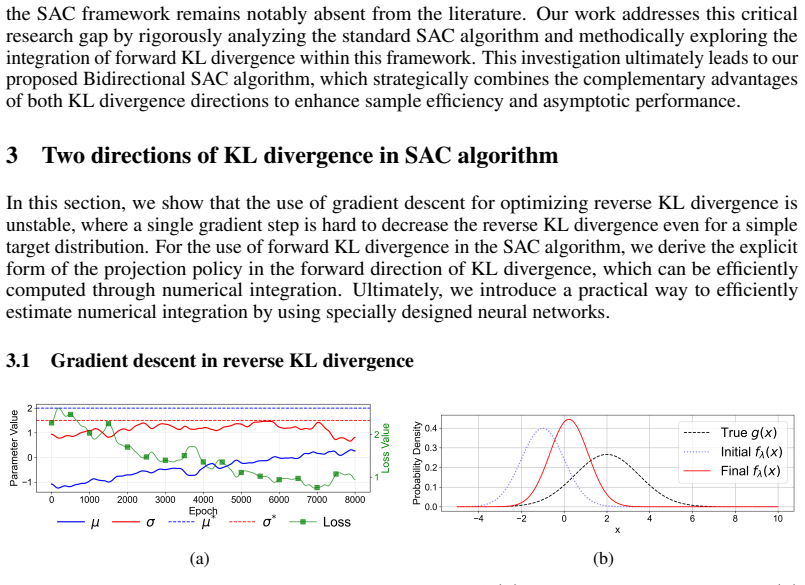
- [Appendix C.2.4, Figure 9] The paper concedes that VDN-a's approximation fails on bimodal marginal structures. The Boltzmann distribution in continuous control can be multimodal, and the paper does not quantify how often or how severely the estimated mean/variance deviate from the true moments in such cases. The statement that 'the first two moments are often still well-captured' is not supported by any numerical evidence. This is a load-bearing concern because the forward projection uses only these moments, and a miscalibrated mean or variance can mislead both the initialization and the regularization in Bidirectional SAC.
- [Section 5.1, Figure 4] The empirical claim of 'up to a 30% increase in episodic rewards' is not supported by standard statistical rigor. The learning curves are presented without error bars, and Appendix F does not report the number of independent runs or the variance across seeds. Without this information, the comparison against SAC, A2C, PPO, and DDPG is not verifiable, and the claim of 'significantly outperforms' is not substantiated. The paper should report means and standard deviations over at least 5-10 seeds for all environments and baselines.
minor comments (6)
- [Abstract / Section 3.2] The abstract and introduction state that the explicit projection holds 'for Gaussian policies'; the derivation in Section 3.2 specifically assumes a diagonal covariance matrix. Please state this assumption in the abstract or at the beginning of Section 3.2 to avoid overgeneralization.
- [Equation (12) / Equation (13)] Equation (12) introduces the integration bound b as a hyperparameter, and Equation (13) uses a Simpson partition count I, but no concrete values are given anywhere in the paper. Please provide these values or a sensitivity analysis.
- [Section 3.2] In Section 3.2, the notation Σ^i_φ is used both for the standard deviation in the Gaussian density and for the variance in the optimal projection formula. This is confusing; please use distinct symbols (e.g., σ for standard deviation and σ^2 for variance).
- [Appendix C.2.4, Figures 8 and 9] The captions for Figures 8 and 9 contain "(Assumed: ...)", which appears to be a placeholder. Please replace with proper captions that state precisely what is plotted (e.g., true vs. estimated marginal densities).
- [Section 5.1] The paper does not compare against modern SAC variants that also improve sample efficiency (e.g., REDQ, DroQ, or distributional SAC). Adding such comparisons would help isolate the contribution of the bidirectional mechanism.
- [Section 5.2, Figure 5] In Section 5.2, Figure 5 reports a qualitative comparison of estimated marginals to ground truth for a single state; please provide quantitative metrics (e.g., KL divergence, error in mean/variance) over a set of states to substantiate the claim that the first two moments are captured.
Circularity Check
Forward-KL projection is self-contained, but the VDN-a marginal-recovery theorem is definitional: it assumes the subnetwork identity it claims to prove.
-
self definitional
[Appendix C.2.4, 'Recovery of true marginal distributions' (also summarized in Section 3.3)]
"If exp( Qhat_j(a_j; s_t) ) = K_j(s_t) M^(j)(a_j; s_t) for some K_j(s_t) > 0, the denominator becomes K_j(s_t) ∫_{A_j} M^(j)(a'_j; s_t) da'_j. Since ∫_{A_j} M^(j)(a'_j; s_t) da'_j = Z(s_t), then: qhat_j(a_j|s_t) = M^(j)(a_j; s_t) / Z(s_t) = q_j(a_j|s_t). Thus, if each (1/α) Qsub_j(s_t, a_j) effectively learns ln(M^(j)(a_j; s_t)) (up to an additive constant), and U_aux isolates dependencies, then this procedure recovers the true marginal PDFs."
The recovery proof starts by assuming exp(Qhat_j) = K_j M^(j), which is exactly the property that the VDN-a subnetwork must learn. No training signal on the total Q forces this split: Q_total = sum_j Qsub_j + U_aux is invariant under Qsub_j -> Qsub_j + g_j, U_aux -> U_aux - sum_j g_j, so the same total critic yields arbitrary estimated marginals. Thus 'sufficiently learned U_aux' cannot select the true ln M^(j) decomposition. The final identity qhat_j = q_j follows by normalization from the assumed equality, i.e., the conclusion is the antecedent restated. Figure 9 concedes that the approximation fails on bimodal marginals, so the condition is not only unproved but empirically violated in some cases.
full rationale
Most of the derivation chain is self-contained and non-circular. Section 3.2 explicitly differentiates D_KL(q||pi') with respect to the Gaussian mean and variance and obtains f_i* and Sigma_i* as the marginal moments of q; this is a standard calculus result and does not depend on fitting or on the authors' prior work. The Bidirectional SAC objective in Equation (7) uses these moments as targets, which is algorithmic design rather than circular prediction. The empirical evaluation against SAC, PPO, and DDPG is independent of the disputed theorem. The one definitional step is Appendix C.2.4: the claim that VDN-a recovers the true Boltzmann marginals is conditional on exp(Qhat_j) proportional to M^(j), which is precisely the unidentified representation the network must learn. Because the critic loss supervises only the sum, the decomposition is non-identifiable up to additive gauge transformations, so the 'sufficiently learned U_aux' condition is not derived from the architecture or loss. This weakens the theoretical justification of the VDN-a-based forward projection, but it does not make the forward-KL moment projection or the benchmark results circular. There are no load-bearing self-citations in the paper. Score 4 reflects one definitional step in a supporting theorem while the central empirical and mathematical contributions retain independent content.
Assumptions & free parameters
free parameters (4)
- epsilon in Eq. (7)
- integration bound b in Eq. (12)
- Simpson partition count I in Eq. (13)
- temperature alpha in Eq. (1)
assumptions (5)
- domain assumption Diagonal Gaussian policy family
- standard math Sklar's theorem and copula decomposition
- ad hoc to paper Auxiliary network captures the copula interaction term
- domain assumption Boltzmann distribution is numerically integrable with Simpson's rule over a bounded interval
- domain assumption Reverse-KL gradient updates in SAC improve expected Q
invented entities (2)
-
VDN-a critic architecture
-
Auxiliary interaction network U_aux
Cite this review
Pith. "Pith review of Bidirectional Soft Actor-Critic: Leveraging Forward and Reverse KL Divergence for Efficient Reinforcement Learning." pith.science (2026). https://pith.science/paper/IVH46KBH
@misc{pith2026250601639,
  author       = {Pith},
  title        = {Pith review of: Bidirectional Soft Actor-Critic: Leveraging Forward and Reverse KL Divergence for Efficient Reinforcement Learning},
  year         = {2026},
  howpublished = {\url{https://pith.science/paper/IVH46KBH}},
  note         = {Machine review of arXiv:2506.01639}
}
abstract
The Soft Actor-Critic (SAC) algorithm, a state-of-the-art method in maximum entropy reinforcement learning, traditionally relies on minimizing reverse Kullback-Leibler (KL) divergence for policy updates. However, this approach leads to an intractable optimal projection policy, necessitating gradient-based approximations that can suffer from instability and poor sample efficiency. This paper investigates the alternative use of forward KL divergence within SAC. We demonstrate that for Gaussian policies, forward KL divergence yields an explicit optimal projection policy -- corresponding to the mean and variance of the target Boltzmann distribution's action marginals. Building on the distinct advantages of both KL directions, we propose Bidirectional SAC, an algorithm that first initializes the policy using the explicit forward KL projection and then refines it by optimizing the reverse KL divergence. Comprehensive experiments on continuous control benchmarks show that Bidirectional SAC significantly outperforms standard SAC and other baselines, achieving up to a $30\%$ increase in episodic rewards, alongside enhanced sample efficiency.
Figures


Figures from the paper (7 more)


Reference graph
Works this paper leans on
-
[1]
Deriving and improving cma-es with information geometric trust regions
Abbas Abdolmaleki, Bob Price, Nuno Lau, Luis Paulo Reis, and Gerhard Neumann. Deriving and improving cma-es with information geometric trust regions. In Proceedings of the Genetic and Evolutionary Computation Conference, pages 657--664, 2017
work page 2017
-
[2]
Maximum a posteriori policy optimisation
Abbas Abdolmaleki, Jost Tobias Springenberg, Yuval Tassa, Remi Munos, Nicolas Heess, and Martin Riedmiller. Maximum a posteriori policy optimisation. In International Conference on Learning Representations, 2018 a
work page 2018
-
[3]
Maximum a posteriori policy optimisation
Abbas Abdolmaleki, Jost Tobias Springenberg, Yuval Tassa, Remi Munos, Nicolas Heess, and Martin Riedmiller. Maximum a posteriori policy optimisation. arXiv preprint arXiv:1806.06920, 2018 b
arXiv 2018
-
[4]
Improved soft actor-critic: Mixing prioritized off-policy samples with on-policy experiences
Chayan Banerjee, Zhiyong Chen, and Nasimul Noman. Improved soft actor-critic: Mixing prioritized off-policy samples with on-policy experiences. IEEE Transactions on Neural Networks and Learning Systems, 35 0 (3): 0 3121--3129, 2022
work page 2022
- [5]
-
[6]
Box2d: A 2d physics engine for games
Erin Catto. Box2d: A 2d physics engine for games. URL: http://www. box2d. org, 2011
work page 2011
-
[7]
Greedification operators for policy optimization: Investigating forward and reverse kl divergences
Alan Chan, Hugo Silva, Sungsu Lim, Tadashi Kozuno, A Rupam Mahmood, and Martha White. Greedification operators for policy optimization: Investigating forward and reverse kl divergences. Journal of Machine Learning Research, 23 0 (253): 0 1--79, 2022
2022
-
[8]
Using expectation-maximization for reinforcement learning
Peter Dayan and Geoffrey E Hinton. Using expectation-maximization for reinforcement learning. Neural Computation, 9 0 (2): 0 271--278, 1997
work page 1997
Show all 46 references
-
[9]
Soft actor-critic for navigation of mobile robots
Junior Costa de Jesus, Victor Augusto Kich, Alisson Henrique Kolling, Ricardo Bedin Grando, Marco Antonio de Souza Leite Cuadros, and Daniel Fernando Tello Gamarra. Soft actor-critic for navigation of mobile robots. Journal of Intelligent & Robotic Systems, 102 0 (2): 0 31, 2021
2021
-
[10]
Distributional soft actor-critic: Off-policy reinforcement learning for addressing value estimation errors
Jingliang Duan, Yang Guan, Shengbo Eben Li, Yangang Ren, Qi Sun, and Bo Cheng. Distributional soft actor-critic: Off-policy reinforcement learning for addressing value estimation errors. IEEE transactions on Neural Networks and Learning Systems, 33 0 (11): 0 6584--6598, 2021 a
2021
-
[11]
Distributional soft actor-critic: Off-policy reinforcement learning for addressing value estimation errors
Jingliang Duan, Yang Guan, Shengbo Eben Li, Yangang Ren, Qi Sun, and Bo Cheng. Distributional soft actor-critic: Off-policy reinforcement learning for addressing value estimation errors. IEEE Transactions on Neural Networks and Learning Systems, 33 0 (11): 0 6584--6598, 2021 b
2021
-
[12]
Virel: A variational inference framework for reinforcement learning
Matthew Fellows, Anuj Mahajan, Tim GJ Rudner, and Shimon Whiteson. Virel: A variational inference framework for reinforcement learning. Advances in Neural Information Processing Systems, 32, 2019
2019
-
[13]
Brax - a differentiable physics engine for large scale rigid body simulation
Daniel Freeman, Erik Frey, Anton Raichuk, Sertan Girgin, Igor Mordatch, and Olivier Bachem. Brax - a differentiable physics engine for large scale rigid body simulation. In Proceedings of the Neural Information Processing Systems Track on Datasets and Benchmarks, 2021
2021
-
[14]
Iq-learn: Inverse soft-q learning for imitation
Divyansh Garg, Shuvam Chakraborty, Chris Cundy, Jiaming Song, and Stefano Ermon. Iq-learn: Inverse soft-q learning for imitation. Advances in Neural Information Processing Systems, 34, 2021
2021
-
[15]
Reinforcement learning with deep energy-based policies
Tuomas Haarnoja, Haoran Tang, Pieter Abbeel, and Sergey Levine. Reinforcement learning with deep energy-based policies. In Proceedings of the 34nd International Conference on Machine Learning, pages 1352--1361, 2017
2017
-
[16]
Soft actor-critic: Off-policy maximum entropy deep reinforcement learning with a stochastic actor
Tuomas Haarnoja, Aurick Zhou, Pieter Abbeel, and Sergey Levine. Soft actor-critic: Off-policy maximum entropy deep reinforcement learning with a stochastic actor. In Proceedings of the 35nd International Conference on Machine Learning, pages 1861--1870, 2018 a
2018
-
[17]
Soft actor-critic algorithms and applications
Tuomas Haarnoja, Aurick Zhou, Kristian Hartikainen, George Tucker, Sehoon Ha, Jie Tan, Vikash Kumar, Henry Zhu, Abhishek Gupta, Pieter Abbeel, et al. Soft actor-critic algorithms and applications. arXiv preprint arXiv:1812.05905, 2018 b
2018 arXiv
-
[18]
The curse of dimensionality for numerical integration of smooth functions
Aicke Hinrichs, Erich Novak, Mario Ullrich, and H Wo \'z niakowski. The curse of dimensionality for numerical integration of smooth functions. Mathematics of Computation, 83 0 (290): 0 2853--2863, 2014
2014
-
[19]
Graph soft actor–critic reinforcement learning for large-scale distributed multirobot coordination
Yifan Hu, Junjie Fu, and Guanghui Wen. Graph soft actor–critic reinforcement learning for large-scale distributed multirobot coordination. IEEE Transactions on Neural Networks and Learning Systems, 36 0 (1): 0 665--676, 2025
2025
-
[20]
Cleanrl: High-quality single-file implementations of deep reinforcement learning algorithms
Shengyi Huang, Rousslan Fernand Julien Dossa, Chang Ye, Jeff Braga, Dipam Chakraborty, Kinal Mehta, and Jo \ A G o GM Ara \ A s jo. Cleanrl: High-quality single-file implementations of deep reinforcement learning algorithms. Journal of Machine Learning Research, 23 0 (274): 0 ...
2022
-
[21]
Accelerating reinforcement learning with value-conditional state entropy exploration
Dongyoung Kim, Jinwoo Shin, Pieter Abbeel, and Younggyo Seo. Accelerating reinforcement learning with value-conditional state entropy exploration. Advances in Neural Information Processing Systems, 36, 2024
2024
-
[22]
Optimistic reinforcement learning by forward kullback--leibler divergence optimization
Taisuke Kobayashi. Optimistic reinforcement learning by forward kullback--leibler divergence optimization. Neural Networks, 152: 0 169--180, 2022
2022
-
[23]
Conservative q-learning for offline reinforcement learning
Aviral Kumar, Aurick Zhou, George Tucker, and Sergey Levine. Conservative q-learning for offline reinforcement learning. Advances in Neural Information Processing Systems, 33, 2020
2020
-
[24]
Continuous control with deep reinforcement learning
TP Lillicrap. Continuous control with deep reinforcement learning. arXiv preprint arXiv:1509.02971, 2015
2015 arXiv
-
[25]
Constrained variational policy optimization for safe reinforcement learning
Zuxin Liu, Zhepeng Cen, Vladislav Isenbaev, Wei Liu, Steven Wu, Bo Li, and Ding Zhao. Constrained variational policy optimization for safe reinforcement learning. In International Conference on Machine Learning, pages 13644--13668, 2022
2022
-
[26]
Algorithm 145: Adaptive numerical integration by simpson's rule
William Marshall McKeeman. Algorithm 145: Adaptive numerical integration by simpson's rule. Communications of the ACM, 5 0 (12): 0 604, 1962
1962
-
[27]
On principled entropy exploration in policy optimization
Jincheng Mei, Chenjun Xiao, Ruitong Huang, Dale Schuurmans, and Martin M \"u ller. On principled entropy exploration in policy optimization. In Proceedings of the 28th International Joint Conference on Artificial Intelligence, pages 3130--3136, 2019
2019
-
[28]
Importance sampling techniques for policy optimization
Alberto Maria Metelli, Matteo Papini, Nico Montali, and Marcello Restelli. Importance sampling techniques for policy optimization. Journal of Machine Learning Research, 21 0 (141): 0 1--75, 2020
2020
-
[29]
Human-level control through deep reinforcement learning
Volodymyr Mnih, Koray Kavukcuoglu, David Silver, Andrei A Rusu, Joel Veness, Marc G Bellemare, Alex Graves, Martin Riedmiller, Andreas K Fidjeland, Georg Ostrovski, et al. Human-level control through deep reinforcement learning. Nature, 518 0 (7540): 0 529--533, 2015
2015
-
[30]
Asynchronous methods for deep reinforcement learning
Volodymyr Mnih, Adria Puigdomenech Badia, Mehdi Mirza, Alex Graves, Timothy Lillicrap, Tim Harley, David Silver, and Koray Kavukcuoglu. Asynchronous methods for deep reinforcement learning. In Proceedings of The 33rd International Conference on Machine Learning, pages 1928--1937, 2016
1928
-
[31]
Improving policy gradient by exploring under-appreciated rewards
Ofir Nachum, Mohammad Norouzi, and Dale Schuurmans. Improving policy gradient by exploring under-appreciated rewards. arXiv preprint arXiv:1611.09321, 2016
2016 arXiv
-
[32]
Stable-baselines3: Reliable reinforcement learning implementations
Antonin Raffin, Ashley Hill, Adam Gleave, Anssi Kanervisto, Maximilian Ernestus, and Noah Dormann. Stable-baselines3: Reliable reinforcement learning implementations. Journal of Machine Learning Research, 22 0 (268): 0 1--8, 2021
2021
-
[33]
Trust region policy optimization
John Schulman, Sergey Levine, Pieter Abbeel, Michael Jordan, and Philipp Moritz. Trust region policy optimization. In Proceedings of the 32nd International Conference on Machine Learning, pages 1889--1897, 2015
2015
-
[34]
Proximal policy optimization algorithms
John Schulman, Filip Wolski, Prafulla Dhariwal, Alec Radford, and Oleg Klimov. Proximal policy optimization algorithms. arXiv preprint arXiv:1707.06347, 2017
2017 arXiv
-
[35]
Monte carlo sampling methods
Alexander Shapiro. Monte carlo sampling methods. Handbooks in Operations Research and Management Science, 10: 0 353--425, 2003
2003
-
[36]
V-mpo: On-policy maximum a posteriori policy optimization for discrete and continuous control
H Francis Song, Abbas Abdolmaleki, Jost Tobias Springenberg, Aidan Clark, Hubert Soyer, Jack W Rae, Seb Noury, Arun Ahuja, Siqi Liu, Dhruva Tirumala, et al. V-mpo: On-policy maximum a posteriori policy optimization for discrete and continuous control. In International Conferen...
2020
-
[37]
Value-decomposition networks for cooperative multi-agent learning
Peter Sunehag, Guy Lever, Audrunas Gruslys, Wojciech Marian Czarnecki, Vinicius Zambaldi, Max Jaderberg, Marc Lanctot, Nicolas Sonnerat, Joel Z Leibo, Karl Tuyls, et al. Value-decomposition networks for cooperative multi-agent learning. arXiv preprint arXiv:1706.05296, 2017
2017 arXiv
-
[38]
Sutton and Andrew G
Richard S. Sutton and Andrew G. Barto. Reinforcement Learning: An Introduction. A Bradford Book, 2018
2018
-
[39]
Mujoco: A physics engine for model-based control
Emanuel Todorov, Tom Erez, and Yuval Tassa. Mujoco: A physics engine for model-based control. In 2012 IEEE/RSJ International Conference on Intelligent Robots and Systems, pages 5026--5033, 2012
2012
-
[40]
Probabilistic inference for solving discrete and continuous state markov decision processes
Marc Toussaint and Amos Storkey. Probabilistic inference for solving discrete and continuous state markov decision processes. In Proceedings of the 23rd international conference on Machine learning, pages 945--952, 2006
2006
-
[41]
Self-play reinforcement learning guides protein engineering
Yi Wang, Hui Tang, Lichao Huang, Lulu Pan, Lixiang Yang, Huanming Yang, Feng Mu, and Meng Yang. Self-play reinforcement learning guides protein engineering. Nature Machine Intelligence, 5 0 (8): 0 845--860, 2023
2023
-
[42]
Scalable trust-region method for deep reinforcement learning using kronecker-factored approximation
Yuhuai Wu, Elman Mansimov, Roger B Grosse, Shun Liao, and Jimmy Ba. Scalable trust-region method for deep reinforcement learning using kronecker-factored approximation. Advances in Neural Information Processing Systems, 30, 2017
2017
-
[43]
Monocular vision approach for soft actor-critic based car-following strategy in adaptive cruise control
Jiachen Yang, Jiankun Peng, Quanwei Zhang, Weiqi Chen, and Chunye Ma. Monocular vision approach for soft actor-critic based car-following strategy in adaptive cruise control. Expert Systems with Applications, page 125999, 2024
2024
-
[44]
Wcsac: Worst-case soft actor critic for safety-constrained reinforcement learning
Qisong Yang, Thiago D Sim \ a o, Simon H Tindemans, and Matthijs TJ Spaan. Wcsac: Worst-case soft actor critic for safety-constrained reinforcement learning. In Proceedings of the AAAI Conference on Artificial Intelligence, pages 10639--10646, 2021
2021
-
[45]
Maximum entropy inverse reinforcement learning
Brian D Ziebart, Andrew L Maas, J Andrew Bagnell, Anind K Dey, et al. Maximum entropy inverse reinforcement learning. In Proceedings of the AAAI Conference on Artificial Intelligence, pages 1433--1438, 2008
2008
-
[46]
Wasserstein gradient flows for optimizing gaussian mixture policies
Hanna Ziesche and Leonel Rozo. Wasserstein gradient flows for optimizing gaussian mixture policies. Advances in Neural Information Processing Systems, 36, 2024
2024
Reviewed August 7, 2026 · model on record in the stance chip above.
Discussion (0). Sign in to comment.