REVIEW 3 major objections 5 minor 14 references
AIMSCheck: Leveraging LLMs for AI-Assisted Review of Modern Slavery Statements Across Jurisdictions
T0 review · 3 major / 5 minor · reviewed 2026-08-07 · deepseek-v4-flash
Pith's one-line read A sentence classifier fine-tuned on Australian corporate statements keeps most of its accuracy on UK and Canadian modern-slavery reports, and the authors package this into a three-level compliance review framework called AIMSCheck.
desk verdict The real contribution is the two new benchmark datasets and the cross-jurisdiction evaluation; the generalization claim is plausible but slightly overstated because the criteria mapping has a known legal conflation for remediation. read the letter →
The pith
A machine-rendered reading of the paper's core claim, the machinery that carries it, and where it could break.
The reading
What carries the argument
The load-bearing object is the nine-common-criteria mapping, an expert-curated translation of the Australian MSA's mandatory criteria, the UK Act's reporting suggestions, and the Canadian Act's obligations into one label set: Approval, Signature, Structure, Operations, Supply Chains, Risk Description, Risk Mitigation, Remediation, and Effectiveness. The sentence-level classifier makes nine binary relevance decisions per sentence, using a 100-word context window around the target sentence, and the framework layers SHAP token attributions and two evidence trackers on top (a tense classifier for future commitments and a zero-shot BART-MNLI model for denials). The mapping is what makes the three datasets commensurable, and the context window plus the trackers are what turn raw classifications into output a human reviewer can audit.
What would settle it
Have an independent legal expert who was not involved in the annotation guidelines re-annotate a random sample of AIMS.uk and AIMS.ca statements directly from the statutes and compare with the released labels; if Cohen's kappa falls below about 0.6, the nine-criteria mapping is not a stable ground truth and the cross-jurisdiction scores would rest on one expert's interpretation. A second check: train on AIMS.uk or AIMS.ca and test on AIMS.au; if transfer works only in the Australian-to-others direction, the reported generalization is an artifact of which dataset was labeled, not evidence of legal equivalence.
Extended reading notes
Core claim
On the paper's own terms, the central discovery is that cross-jurisdictional generalization works for sentence-level compliance classification: a Llama3.2 3B model fine-tuned on AIMS.au reaches 0.738 average F1 on Australian test sentences, 0.719 on the new Canadian dataset, and 0.686 on the new UK dataset, while a fine-tuned BERT trails slightly and zero-shot and few-shot GPT-4o and quantized DeepSeek-R1 land lower on every dataset. The authors also find that fine-tuned models consistently beat the prompt-based models, that calibration is good enough for reviewers to use probabilities as confidence signals, and that the evidence-status trackers can find future commitments and explicit denials in the statements. From this they conclude that, with the right compliance mapping, domain adaptation across modern-slavery jurisdictions is achievable and that the released benchmark datasets and framework support it.
Load-bearing premise
The load-bearing premise is that the nine common criteria, curated by domain experts, capture legally equivalent reporting requirements across the Australian, UK, and Canadian statutes; if that mapping gives way, the cross-jurisdictional F1 scores would measure an artificial common-denominator task rather than generalization of real compliance checking.
Editorial extensions
If this is right
- A compliance tool can be trained once on AIMS.au and applied in the UK and Canada without new annotation, since fine-tuned models keep most of their accuracy across the three jurisdictions.
- The release of AIMS.uk and AIMS.ca gives researchers and supervisory agencies public benchmarks for compliance sentence classification outside Australia, where only the Australian dataset existed before.
- Evidence-status tracking separates implemented measures from future promises and explicit denials, so reviewers can distinguish companies that have acted from companies that only say they will act.
- The per-criterion F1 pattern (high on approval and signature, low on risk mitigation and effectiveness) identifies where human reviewers should focus their attention when using the framework.
- Compliance-trend analysis of the UK dataset suggests that industry and infrastructure firms disclose risks less transparently than public-facing sectors, a pattern the pipeline can be used to probe at scale.
Reading between the lines
- The appendix's mapping of the nine criteria onto French, German, and Norwegian due-diligence laws is only a feasibility sketch; a direct test would be to annotate a few statements from one of those regimes and see whether an Australian-trained model survives the shift from 'modern slavery' to broader human-rights language.
- The consistent edge of a fine-tuned open model over much larger closed models implies that domain-labeled data, not model scale, is the binding constraint for this task; agencies with limited compute would likely get more value from fine-tuning than from API prompting, a cost conclusion the paper does not draw.
- The paper's Jensen-Shannon vocabulary-divergence measure could be reused as a domain-shift alarm: monitors could compute divergence on each new statement batch and re-annotate or retrain only when drift from the training distribution grows.
- A longitudinal design the paper gestures at but does not run would chain each company's statements across publication years, turning evidence-status labels into a per-company progress scoreboard of the kind regulators would need for enforcement and for measuring whether the Acts improve reporting over time.
Editorial analysis
A structured set of objections, weighed in public.
Referee Report
Summary. This paper introduces AIMS.uk and AIMS.ca, two new sentence-level annotated datasets of 50 modern slavery statements each, and proposes AIMSCheck, a three-level framework for compliance review: sentence-level multi-label classification, token-level SHAP explanations, and evidence-status tracking (future actions vs. negative evidence). The authors fine-tune BERT and Llama3.2 on the Australian AIMS.au dataset and evaluate on held-out Australian, UK, and Canadian test sets, comparing with zero-shot and few-shot GPT-4o and DeepSeek-R1. They report that fine-tuned models outperform prompting-based methods and generalize across jurisdictions, with only modest F1 degradation on UK and Canadian data. The paper also includes per-criterion results, calibration curves, error analysis, vocabulary-similarity analysis, and illustrative compliance-trend analyses.
Significance. If the main claim holds, the contribution is practically valuable: it would demonstrate that a single fine-tuned sentence classifier can transfer across three legal regimes, and the released datasets would support further work in a data-scarce and socially important domain. Strengths include genuinely held-out evaluation (training only on AIMS.au), public release of datasets, prompts, and weights under CC BY 4.0, per-criterion F1 reporting, calibration checks, and detailed qualitative error analyses. The main uncertainty is whether the nine-criteria legal mapping used for cross-jurisdictional evaluation is substantively valid; the paper itself notes that the Canadian Act contains a remediation obligation absent in Australia and the UK, which weakens the assumption that the merged C4 criterion is equivalent across all three jurisdictions.
major comments (3)
- [§2, Figure 3 / Table 4] The central claim that models trained on AIMS.au "generalize well" to the UK and Canada presupposes that the nine common criteria denote legally equivalent reporting obligations. The manuscript itself reports that the Canadian Act requires remediation of income loss caused by anti-slavery measures, a duty absent in Australia and the UK, and that a 1-to-1 mapping required merging granular criteria into broader categories. For C4 (remediation), AIMS.ca labels therefore include sentences addressing a different statutory obligation than those in AIMS.au and AIMS.uk. A model trained on Australian remediation is scored against Canadian sentences that are relevant to a distinct duty, so a high or low F1 on that criterion does not directly measure generalization of compliance checking. The only validation offered is agreement between two experts who were both involved in developing the annotation guidelines (Cohen's Kappa 0.776), which does not independently validate the mapping against external legal authority. Please add an external legal validation of the mapping, report per-criterion results that separate shared-core from jurisdiction-specific content, or otherwise demonstrate that the merged categories are substantively equivalent.
- [§2 Annotation Validation and §7 Limitations] The two new datasets were annotated by a single domain expert, and the reported agreement (Cohen's Kappa 0.776, Jaccard 0.813 on 140 samples) involves a second expert who was "deeply involved in developing the annotation guidelines." This is a useful check but not an independent validation of label quality, and the agreement is not broken down by criterion. Because the cross-jurisdictional F1 scores in Tables 2 and 3 depend on the reliability of AIMS.uk and AIMS.ca labels, the paper should provide per-criterion agreement, confidence intervals, and ideally an additional annotation pass by an expert not involved in designing the guidelines. At minimum, the single-annotator limitation should be reflected in the strength of the generalization claim.
- [§4, Table 2] The "generalize well" conclusion is based on F1 differences that are small in absolute terms (e.g., Llama3.2-100: 0.738 on AIMS.au, 0.719 on AIMS.ca, 0.686 on AIMS.uk), with no confidence intervals, significance tests, or statement-level variance. With only 50 statements per jurisdiction and many criteria having low positive-class rates, these differences may lie within sampling noise. Report bootstrap confidence intervals, per-statement standard deviations, or paired statistical tests across the nine criteria, and state a pre-specified threshold for what degree of degradation is compatible with "generalize well." Without this, the headline claim is not quantitatively supported.
minor comments (5)
- [§4, Table 2] The DeepSeek-R1 row reports values in the AIMS.ca and AIMS.uk columns, but the note below the table says DeepSeek-R1 is evaluated on AIMS.au; please clarify which datasets were actually scored.
- [§3.3 and §E.3] The negative-evidence detector's threshold is lowered from 0.5 to 0.35 with no sensitivity analysis; please report performance across thresholds or justify the chosen value.
- [Appendix C] The materials release section mentions GitHub, Hugging Face, and Figshare but gives no persistent identifiers; include URLs or DOIs for the datasets, prompts, and code.
- [Throughout] There are several typos and grammatical slips, including "mititation" (Section 3), "where as" (Section 2), "accessment" (Appendix A), "overal" (Appendix E.1), "Lllama" (Appendix H.2), and "Sentances" (Appendix H.2 title).
- [Figure 1 and Figure 3] The figures use similar but not identical criterion labels (e.g., "Approval" and "Approval from the board of directors"); consider harmonizing the labels and adding a caption note clarifying which criteria are common versus jurisdiction-specific, especially for C4 remediation.
Circularity Check
No significant circularity: held-out cross-jurisdictional evaluation supports the transfer claim; expert mapping and self-citations are assumptions and inputs, not reductions of the claimed result.
full rationale
The paper's central claim is that models fine-tuned on the Australian AIMS.au dataset generalize to the newly introduced AIMS.uk and AIMS.ca datasets. This claim is supported by genuinely held-out evaluation: the UK and Canadian statements are newly collected from government registries, annotated separately, and no sentence-level classifier parameter is fitted to the UK or Canadian labels. The negative-evidence threshold adjustment from 0.5 to 0.35 (Appendix E.3) concerns the auxiliary evidence-status component, is disclosed, and does not affect the headline sentence-level generalization result. Self-citations to Bora et al. (2025) provide the prior AIMS.au dataset, annotation guidelines, and prompt templates; these are inputs to the evaluation design rather than the result being established, and the new datasets are independently sourced. The expert-curated nine-criteria jurisdictional mapping (Section 2, Figures 1 and 3) is a substantive validity assumption, particularly for the Canadian remediation criterion where Section 2 notes a distinct statutory income-loss remediation requirement; however, this is a correctness and external-validity risk, not circularity, because the mapping is not derived from model outputs and is not fitted to the test labels. No load-bearing step reduces, by the paper's own equations or by self-citation, to the result it claims to predict.
Assumptions & free parameters
free parameters (2)
- BART-MNLI negative evidence threshold =
0.35
- Context window length =
100 words
assumptions (3)
- domain assumption The nine-criteria cross-jurisdictional mapping accurately reflects equivalent reporting obligations under the Australian, UK, and Canadian Modern Slavery Acts.
- domain assumption The AIMS.au annotation guidelines apply without modification to UK and Canadian statements (Section 2).
- domain assumption Sentence-level binary relevance labels are a sufficient representation of statutory compliance for the nine selected criteria (Section 3.1).
Cite this review
Pith. "Pith review of AIMSCheck: Leveraging LLMs for AI-Assisted Review of Modern Slavery Statements Across Jurisdictions." pith.science (2026). https://pith.science/paper/EJHZ4V7O
@misc{pith2026250601671,
  author       = {Pith},
  title        = {Pith review of: AIMSCheck: Leveraging LLMs for AI-Assisted Review of Modern Slavery Statements Across Jurisdictions},
  year         = {2026},
  howpublished = {\url{https://pith.science/paper/EJHZ4V7O}},
  note         = {Machine review of arXiv:2506.01671}
}
read the original abstract
Modern Slavery Acts mandate that corporations disclose their efforts to combat modern slavery, aiming to enhance transparency and strengthen practices for its eradication. However, verifying these statements remains challenging due to their complex, diversified language and the sheer number of statements that must be reviewed. The development of NLP tools to assist in this task is also difficult due to a scarcity of annotated data. Furthermore, as modern slavery transparency legislation has been introduced in several countries, the generalizability of such tools across legal jurisdictions must be studied. To address these challenges, we work with domain experts to make two key contributions. First, we present AIMS.uk and AIMS.ca, newly annotated datasets from the UK and Canada to enable cross-jurisdictional evaluation. Second, we introduce AIMSCheck, an end-to-end framework for compliance validation. AIMSCheck decomposes the compliance assessment task into three levels, enhancing interpretability and practical applicability. Our experiments show that models trained on an Australian dataset generalize well across UK and Canadian jurisdictions, demonstrating the potential for broader application in compliance monitoring. We release the benchmark datasets and AIMSCheck to the public to advance AI-adoption in compliance assessment and drive further research in this field.
Figures


Figures from the paper (15 more)




Reference graph
Works this paper leans on
-
[1]
We continue due diligence across all our direct and indirect suppliers
Target Sentence: "We continue due diligence across all our direct and indirect suppliers.”
-
[2]
Question: Is the target sentence relevant? (YES/NO)
-
[3]
It lacks the detailed information required to describe the supply chain
Reasoning: This sentence mentions due diligence efforts but does not provide specific descriptions of suppliers, their products or services, locations, or other attributes. It lacks the detailed information required to describe the supply chain
-
[4]
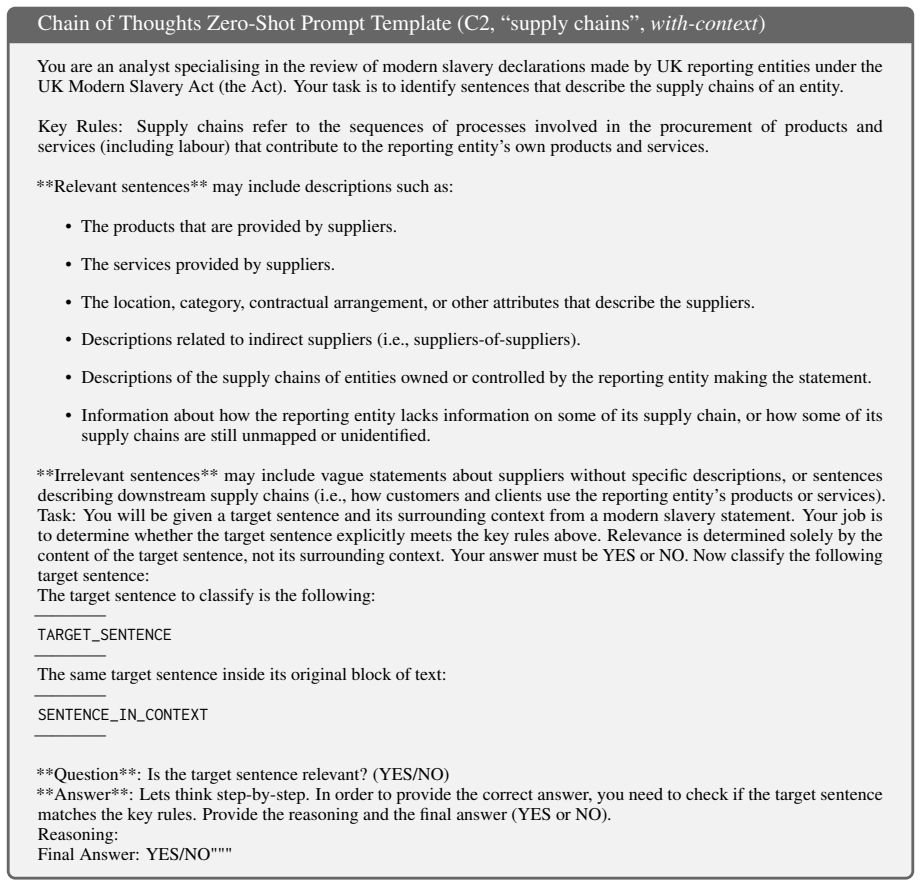
Final Answer: NO Now classify the following target sentence: The target sentence to classify is the following: ———— TARGET_SENTENCE ———— The same target sentence inside its original block of text: ———— SENTENCE_IN_CONTEXT ———— **Question**: Is the target sentence relevant? (YES/NO) **Answer**: Lets think step-by-step. In order to provide the correct answe...
work page 2017
-
[8]
Better sentence segmentation techniques and improve list extraction to reduce errors caused by formatting inconsistencies
-
[9]
Enhanced prompt engineering to specifically address false positives
-
[10]
Additional dataset augmentation to reduce confusion in overlapping criteria and the false negatives in fine-tuning models. I Compliance Trend in the AIMS.uk Dataset In this appendix, we present a compliance trend analysis based on the prediction outcomes of the Llama3 context-100 model on the 50 statements of AIMS.uk. For each criterion where a statement ...
work page 2025
-
[11]
The Industry & Infrastructure sector includes industries such as automotive, construction, durable consumer goods, mining, utilities, waste management, transportation, defense, and security services
Show all 14 references
-
[12]
The Commerce & Services sector covers con- sumer services, including hospitality, tourism, fashion, cosmetics, food and agriculture, fi- nance, professional services, IT, and media
-
[13]
The Public & Healthcare sector consists of public sector organizations, non-profits, edu- cation, healthcare, and forestry-related indus- tries
-
[14]
Figure 18 shows the compliance proportion by sector for each criterion
The Other category includes the statements that companies that had "other" in their met- data. Figure 18 shows the compliance proportion by sector for each criterion. 25 Key Observations • Companies within the Public and Healthcare sectors demonstrate the highest levels of com...
2022
-
[2019]
plan to" and
and Llama3.2 3B (Llama Team, 2024). The models were trained, starting from checkpoints available on HuggingFace repositories (Wolf et al., 2020), using the annotated training data from the AIMS.au database (Bora et al., 2025). For BERT, the full model weights were trained, whi...
2025
-
[2020]
In Findings of the Association for Com- putational Linguistics: EMNLP 2020 , pages 2898– 2904, Online
LEGAL-BERT: The muppets straight out of 10 law school. In Findings of the Association for Com- putational Linguistics: EMNLP 2020 , pages 2898– 2904, Online. Association for Computational Lin- guistics. R. Chambers and A.Y . Vastardis. 2020. Human rights disclosure and due dil...
2020 arXiv
-
[2022]
Tech- nical Report
Broken promises: Two years of corporate reporting under australia’s modern slavery act. Tech- nical Report. Federal Republic of Germany. 2021. Act on corporate due diligence obligations in supply chains (lieferket- tensorgfaltspflichtengesetz). Accessed: 2025-05-29. Neel Guha,...
2021 arXiv
Reviewed August 7, 2026 · model on record in the stance chip above.
Discussion (0). Sign in to comment.