REVIEW 2 major objections 3 minor 58 references
GRAM: Generative Recommendation via Semantic-aware Multi-granular Late Fusion
T0 review · 2 major / 3 minor · reviewed 2026-08-07 · deepseek-v4-flash
Pith's one-line read GRAM claims that hierarchical textual IDs plus decoder-side fusion of coarse user and fine item prompts let a small LLM beat eight generative recommenders, with gains up to 16.0% in Recall@5 and 13.6% in NDCG@5.
desk verdict A genuinely novel combination of hierarchical textual IDs and late fusion; the empirical work is solid, but the missing SASRec training-split statement controls whether the headline gains are real. read the letter →
The pith
A machine-rendered reading of the paper's core claim, the machinery that carries it, and where it could break.
The reading
What carries the argument
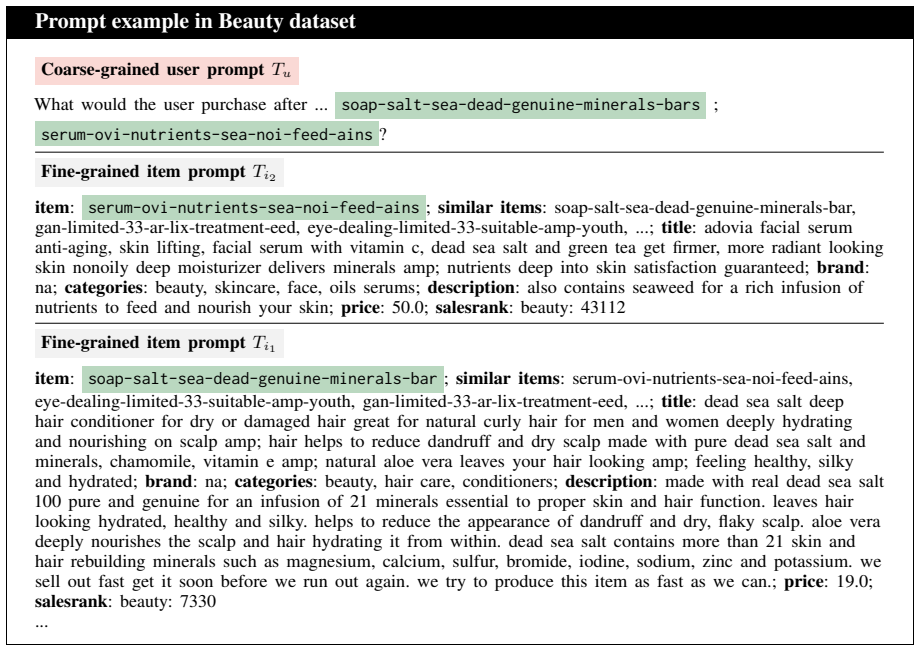
The load-bearing object is the pair consisting of semantic-to-lexical translation and multi-granular late fusion. Semantic-to-lexical translation is a preprocessing scheme: hierarchical k-means over item text embeddings yields cluster paths of depth at most $l$, each cluster is labelled by the vocabulary token with the highest average TF-IDF score, and the resulting token path is the item's textual ID; simultaneously, the top-$k$ items by embedding similarity from a collaborative filtering model are verbalized into a 'similar items' attribute. Multi-granular late fusion is the architecture that uses those IDs: one encoder reads the coarse user prompt (recent item IDs in reverse order), separate encoding passes read each fine-grained item prompt (ID, similar items, title, brand, categories, description, price), and the decoder's cross-attention over the concatenated, position-encoded representations fuses the two granularities while keeping input lengths manageable. The item ID appended inside each item prompt acts as the linking anchor between the coarse and fine streams.
What would settle it
Rerun GRAM with the collaborative filtering model and item text embeddings trained only on the training split, rebuild the hierarchical IDs and similar-item attributes without touching validation or test interactions, and compare the full model to the no-collaborative-semantics ablation; if the gap shrinks to near zero, the similar-item attribute was leaking target information.
Extended reading notes
Core claim
The central claim is that replacing both the item identifier and the input format changes what an LLM can do for recommendation. GRAM builds hierarchical textual IDs by recursive clustering of item text embeddings and maps each cluster to its most representative token in the LLM vocabulary, so semantically related items share prefixes and the decoder can generate a candidate ID from general to specific. It then writes the top similar items found by a collaborative filtering model as a 'similar items' attribute in each item's prompt. Instead of concatenating the user history and every item description into one long encoder input, GRAM encodes the coarse user ID sequence and each fine-grained item prompt separately, then concatenates the position-aware encoder outputs and lets the decoder attend to all of them, with item ID tokens acting as linking anchors. The paper claims this combination is what lets a small text-to-text model beat eight generative recommender baselines, with the late fusion providing most of the efficiency gain and the hierarchical IDs providing most of the accuracy gain.
Load-bearing premise
The reported gains assume the collaborative filtering model that produces each item's verbalized 'similar items' list was trained on training interactions only, so those lists never expose the validation or test target.
Editorial extensions
If this is right
- If the reported gains hold, generative recommenders no longer have to choose between short item IDs and full metadata, because decoder-side fusion uses both at once.
- The hierarchical ID scheme is portable: the paper shows it improves two existing generative recommenders when dropped into their pipelines.
- Online decoding becomes cheap enough for long item text because fine-grained item prompts are encoded once offline and their hidden states can be reused.
- The collaborative semantics component helps most on tail, low-popularity items, where interaction patterns are sparse and textual overlap among candidates is weaker.
- Delaying fusion until the decoder reduces online encoding complexity by about two orders of magnitude in the paper's illustrative setting, so the accuracy gains do not come at prohibitive inference cost.
Reading between the lines
- Editorial inference: the paper never specifies the split used to train its collaborative filtering model, so a strict rerun that fits that model and the item text embeddings on the training split alone would tell whether the reported collaborative-semantics gains are genuine or an artifact of target leakage.
- Editorial inference: the TF-IDF token selector is a bottleneck the paper itself flags, so replacing cluster-level token selection with learned sparse or attention-based token scoring is the most direct path toward higher ID quality.
- Editorial inference: the same separate-encode-then-fuse pattern could transfer to other settings with long context, such as conversational recommendation or listwise reranking with full item descriptions, although the paper does not test those settings.
- Editorial inference: the advantage of late fusion over early fusion should grow with history length; a direct length-stratified comparison of runtime and accuracy would quantify that predicted scaling.
Editorial analysis
A structured set of objections, weighed in public.
Referee Report
Summary. The paper proposes GRAM, a T5-based generative recommender whose two main components are semantic-to-lexical translation (hierarchical k-means textual IDs plus a collaboratively verbalized 'similar items' attribute) and multi-granular late fusion (separate encoding of a coarse-grained user prompt and fine-grained item prompts, with fusion delayed to the decoder). Experiments on Amazon Beauty, Toys, Sports, and Yelp under leave-one-out, full-ranking evaluation report consistent gains over eight generative baselines, and ablations attribute the gains to both the semantic translation and the late-fusion architecture.
Significance. If the results hold, GRAM is a solid empirical contribution to generative recommendation. The full-ranking evaluation, the leave-one-out splits, the explicit leakage fixes for IDGenRec and ELMRec, the component ablations, the efficiency analysis, and the released code are all concrete strengths that make the main claim credible. The central idea of combining hierarchical textual IDs with decoder-side fusion of coarse and fine prompts is plausible and well supported by the ablation tables. The main risk is the collaborative-semantics channel: its benefit depends on a data-hygiene precondition that is not documented, and the paper's own case study shows that the CF signal can directly name the target item. That issue must be resolved before the headline improvements can be accepted as unconfounded.
major comments (2)
- [Section 3.2.2, Eq. (1)-(2); Section 4; Appendix G.4.1] The paper never states the training split for the SASRec model that produces the item embeddings in Eq. (1). Under leave-one-out evaluation, the top-k 'similar items' written into each item prompt in Eq. (2) are safe only if SASRec was trained without validation and test interactions. If SASRec was trained on the full interaction data, the held-out target item can appear verbatim in the prompt's similar-item list, reducing the task to copying. This is not a hypothetical concern: Appendix H.7 reports that 'when the CF model predicts the target item as a similar item, GRAM effectively leverages this information to rank the target item as the top-1 recommendation,' and the ablation in Table 3 shows a substantial drop without aCF. Appendices E and F show that the authors already fixed exactly this class of leakage in IDGenRec and ELMRec, so the absence of the corresponding statement for GRAM's own CF component is load-bearing. Please specify the split used to train SASRec (and, if the full data were used, rerun the experiments with a train-only CF model and update Tables 2, 3, and Appendix H accordingly).
- [Table 2; Section 4] All results are reported as means over three seeds without standard deviations or per-seed values, and significance is indicated by a paired t-test whose pairing units are unspecified. With only three seeds, a paired t-test has two degrees of freedom, and 16 metrics are tested, so the '∗' marks should be accompanied by variance estimates and a statement of the test's pairing (e.g., per-user scores or per-seed means). This is not a fatal flaw, but the current reporting makes the statistical significance claim difficult to verify.
minor comments (3)
- [Section 5.2] The sentence 'Both hierarchical and collaborative semantics yield 27.2% and 10.8% improvement in N@5, respectively' appears reversed relative to Table 3 and to the later statement in Section 5.3. In Table 3, removing CF gives the larger drop (e.g., Toys N@5 from 0.0516 to 0.0406, a 27.1% relative drop), while removing hierarchy gives a smaller drop (0.0516 to 0.0466, 10.7%). Please reorder or correct the percentages.
- [Section 5.3 vs. Table 12] The text says 'The optimal values for (l,k) are (5,7) and (10,5) for the Beauty and Toys, respectively,' but Table 12 lists l=7 and k=10 for Beauty and l=5 and k=5 for Toys. Please clarify what (l,k) denotes in each place and reconcile the two presentations.
- [Section 4, Implementation Details] The sentence 'For hierarchical IDs, l and c are tuned among {5,7,9} and {32,128,512}' is ambiguous about which set bounds l and which bounds c. Table 12 suggests l ranges over {5,7,9} and c over {32,128}, but the sentence should state this explicitly.
Circularity Check
No proven circularity: GRAM is an empirical benchmark whose main derivation is self-contained, with an unresolved but resolvable data-split premise for the SASRec collaborative-semantics component.
full rationale
GRAM's central claim is an experimental comparison rather than a formal derivation, so the claimed chain is: item metadata and interactions are converted into hierarchical IDs and collaborative similar-item text via Section 3.2; these become multi-granular prompts in Section 3.3; a T5 encoder-decoder is trained to generate the next item ID. No equation in the paper defines the prediction as equal to an input by construction. Eq. (2) verbalizes top-k similar items of history items, and Eq. (10) trains the decoder on the target ID; the target ID is not guaranteed to be part of the input unless the CF model was trained on data that includes the held-out target interaction. Section 3.2.2 only says SASRec is used as an 'off-the-shelf' CF model, and Appendix G.4.1 gives no statement that SASRec was trained on the training split only. Appendix H.7 further shows a case where 'the CF model predicts the target item as a similar item' and GRAM ranks it top-1. If the CF embeddings were fit on all interactions, then the target ID could appear inside aCF in a history item's prompt and the generation would be a copy task, which would be an input-fitted prediction. However, the paper never states this, and training SASRec only on the training split is fully consistent with the text and would make the component legitimate. The only self-citations are GLEN for a Trie data structure and SPADE as future work; neither is load-bearing. Thus no circular step is demonstrated; the CF data-split omission is a correctness risk to flag rather than a proven circularity.
Assumptions & free parameters
free parameters (4)
- max ID depth l =
7 (Beauty), 5 (Toys), 7 (Sports), 9 (Yelp)
- number of clusters k (hierarchical k-means) =
128 (Beauty), 32 (Toys/Sports/Yelp)
- minimum cluster size c =
128 (Beauty), 32 (Toys/Sports/Yelp)
- number of similar items k for CF verbalization =
10 (Beauty/Sports), 5 (Toys/Yelp)
assumptions (5)
- domain assumption Item text embeddings from NV-Embed capture semantic similarity sufficient for hierarchical clustering.
- domain assumption SASRec item embeddings capture collaborative item relationships, and the top-k similar items are informative as text to the LLM.
- domain assumption T5's pretrained language knowledge transfers to recommendation when item IDs are composed of natural-language tokens.
- domain assumption Leave-one-out full-ranking evaluation is an unbiased estimator of recommendation accuracy.
- standard math Standard sequence-to-sequence training with cross-entropy and teacher forcing optimizes the autoregressive ID generation objective.
Cite this review
Pith. "Pith review of GRAM: Generative Recommendation via Semantic-aware Multi-granular Late Fusion." pith.science (2026). https://pith.science/paper/V3NE6BBV
@misc{pith2026250601673,
  author       = {Pith},
  title        = {Pith review of: GRAM: Generative Recommendation via Semantic-aware Multi-granular Late Fusion},
  year         = {2026},
  howpublished = {\url{https://pith.science/paper/V3NE6BBV}},
  note         = {Machine review of arXiv:2506.01673}
}
read the original abstract
Generative recommendation is an emerging paradigm that leverages the extensive knowledge of large language models by formulating recommendations into a text-to-text generation task. However, existing studies face two key limitations in (i) incorporating implicit item relationships and (ii) utilizing rich yet lengthy item information. To address these challenges, we propose a Generative Recommender via semantic-Aware Multi-granular late fusion (GRAM), introducing two synergistic innovations. First, we design semantic-to-lexical translation to encode implicit hierarchical and collaborative item relationships into the vocabulary space of LLMs. Second, we present multi-granular late fusion to integrate rich semantics efficiently with minimal information loss. It employs separate encoders for multi-granular prompts, delaying the fusion until the decoding stage. Experiments on four benchmark datasets show that GRAM outperforms eight state-of-the-art generative recommendation models, achieving significant improvements of 11.5-16.0% in Recall@5 and 5.3-13.6% in NDCG@5. The source code is available at https://github.com/skleee/GRAM.
Figures


Figures from the paper (6 more)




Reference graph
Works this paper leans on
-
[1]
online" 'onlinestring :=
ENTRY address archivePrefix author booktitle chapter edition editor eid eprint eprinttype howpublished institution journal key month note number organization pages publisher school series title type volume year doi pubmed url lastchecked label extra.label sort.label short.list INTEGERS output.state before.all mid.sentence after.sentence after.block STRING...
-
[2]
write newline
" write newline "" before.all 'output.state := FUNCTION n.dashify 't := "" t empty not t #1 #1 substring "-" = t #1 #2 substring "--" = not "--" * t #2 global.max substring 't := t #1 #1 substring "-" = "-" * t #2 global.max substring 't := while if t #1 #1 substring * t #2 global.max substring 't := if while FUNCTION word.in bbl.in capitalize " " * FUNCT...
-
[3]
Keqin Bao, Jizhi Zhang, Yang Zhang, Xinyue Huo, Chong Chen, and Fuli Feng. 2024. https://doi.org/10.18653/v1/2024.emnlp-main.589 Decoding matters: Addressing amplification bias and homogeneity issue for llm-based recommendation . In EMNLP, pages 10540--10552
-
[4]
Keqin Bao, Jizhi Zhang, Yang Zhang, Wenjie Wang, Fuli Feng, and Xiangnan He. 2023. https://doi.org/10.1145/3604915.3608857 Tallrec: An effective and efficient tuning framework to align large language model with recommendation . In RecSys, pages 1007--1014
arXiv 2023
-
[5]
Tom B. Brown, Benjamin Mann, Nick Ryder, Melanie Subbiah, Jared Kaplan, Prafulla Dhariwal, Arvind Neelakantan, Pranav Shyam, Girish Sastry, Amanda Askell, Sandhini Agarwal, Ariel Herbert - Voss, Gretchen Krueger, Tom Henighan, Rewon Child, Aditya Ramesh, Daniel M. Ziegler, Jeffrey Wu, Clemens Winter, and 12 others. 2020. https://proceedings.neurips.cc/pap...
work page 2020
-
[6]
Yongjun Chen, Zhiwei Liu, Jia Li, Julian J. McAuley, and Caiming Xiong. 2022. https://doi.org/10.1145/3485447.3512090 Intent contrastive learning for sequential recommendation . In WWW, pages 2172--2182
arXiv 2022
-
[7]
Eunseong Choi, Sunkyung Lee, Minjin Choi, Hyeseon Ko, Young - In Song, and Jongwuk Lee. 2022. https://doi.org/10.1145/3511808.3557456 Spade: Improving sparse representations using a dual document encoder for first-stage retrieval . In CIKM, pages 272--282
arXiv 2022
-
[8]
Thomas H Cormen, Charles E Leiserson, Ronald L Rivest, and Clifford Stein. 2022. https://mitpress.mit.edu/9780262046305/introduction-to-algorithms/ Introduction to algorithms . MIT press
arXiv 2022
Show all 58 references
-
[9]
Sunhao Dai, Ninglu Shao, Haiyuan Zhao, Weijie Yu, Zihua Si, Chen Xu, Zhongxiang Sun, Xiao Zhang, and Jun Xu. 2023. https://doi.org/10.1145/3604915.3610646 Uncovering chatgpt's capabilities in recommender systems . In RecSys, pages 1126--1132
2023
-
[10]
Michiel de Jong, Yury Zemlyanskiy, Joshua Ainslie, Nicholas FitzGerald, Sumit Sanghai, Fei Sha, and William W. Cohen. 2023. https://doi.org/10.18653/v1/2023.findings-acl.732 Fido: Fusion-in-decoder optimized for stronger performance and faster inference . In Findings of the AC...
2023 doi
-
[11]
Jacob Devlin, Ming - Wei Chang, Kenton Lee, and Kristina Toutanova. 2019. https://doi.org/10.18653/v1/n19-1423 BERT: pre-training of deep bidirectional transformers for language understanding . In NAACL-HLT, pages 4171--4186
2019 doi
-
[12]
Thibault Formal, Carlos Lassance, Benjamin Piwowarski, and St \' e phane Clinchant. 2022. https://doi.org/10.1145/3477495.3531857 From distillation to hard negative sampling: Making sparse neural IR models more effective . In SIGIR, pages 2353--2359
2022
-
[13]
Thibault Formal, Benjamin Piwowarski, and St \' e phane Clinchant. 2021. https://doi.org/10.1145/3404835.3463098 SPLADE: sparse lexical and expansion model for first stage ranking . In SIGIR, pages 2288--2292
2021
- [14]
-
[15]
Shijie Geng, Shuchang Liu, Zuohui Fu, Yingqiang Ge, and Yongfeng Zhang. 2022. https://doi.org/10.1145/3523227.3546767 Recommendation as language processing (RLP): A unified pretrain, personalized prompt & predict paradigm (P5) . In RecSys, pages 299--315
2022
-
[16]
Ruining He and Julian J. McAuley. 2016. https://doi.org/10.1145/2872427.2883037 Ups and downs: Modeling the visual evolution of fashion trends with one-class collaborative filtering . In WWW, pages 507--517
2016
-
[17]
Bal \' a zs Hidasi, Alexandros Karatzoglou, Linas Baltrunas, and Domonkos Tikk. 2016. http://arxiv.org/abs/1511.06939 Session-based recommendations with recurrent neural networks . In ICLR
2016 arXiv
-
[18]
Yupeng Hou, Shanlei Mu, Wayne Xin Zhao, Yaliang Li, Bolin Ding, and Ji - Rong Wen. 2022. https://doi.org/10.1145/3534678.3539381 Towards universal sequence representation learning for recommender systems . In KDD, pages 585--593
2022
-
[19]
Wenyue Hua, Shuyuan Xu, Yingqiang Ge, and Yongfeng Zhang. 2023. https://doi.org/10.1145/3624918.3625339 How to index item ids for recommendation foundation models . In SIGIR-AP, pages 195--204
2023
-
[20]
Gautier Izacard and Edouard Grave. 2021. https://doi.org/10.18653/v1/2021.eacl-main.74 Leveraging passage retrieval with generative models for open domain question answering . In EACL, pages 874--880
2021 doi
-
[21]
Karen Sparck Jones. 2004. https://doi.org/10.1108/00220410410560573 A statistical interpretation of term specificity and its application in retrieval . J. Documentation, 60(5):493--502
2004 doi
-
[22]
Wang - Cheng Kang and Julian J. McAuley. 2018. https://doi.org/10.1109/ICDM.2018.00035 Self-attentive sequential recommendation . In ICDM, pages 197--206
2018
-
[23]
Sein Kim, Hongseok Kang, Seungyoon Choi, Donghyun Kim, Min - Chul Yang, and Chanyoung Park. 2024. https://doi.org/10.1145/3637528.3671931 Large language models meet collaborative filtering: An efficient all-round llm-based recommender system . In KDD, pages 1395--1406
2024
-
[24]
Kingma and Jimmy Ba
Diederik P. Kingma and Jimmy Ba. 2015. http://arxiv.org/abs/1412.6980 Adam: A method for stochastic optimization . In ICLR
2015 arXiv
- [25]
-
[26]
Sunkyung Lee, Minjin Choi, and Jongwuk Lee. 2023. https://doi.org/10.18653/v1/2023.emnlp-main.477 GLEN: generative retrieval via lexical index learning . In EMNLP, pages 7693--7704
2023 doi
-
[27]
Jiacheng Li, Ming Wang, Jin Li, Jinmiao Fu, Xin Shen, Jingbo Shang, and Julian J. McAuley. 2023 a . https://doi.org/10.1145/3580305.3599519 Text is all you need: Learning language representations for sequential recommendation . In KDD, pages 1258--1267
2023
-
[29]
Lei Li, Yongfeng Zhang, Dugang Liu, and Li Chen. 2024 a . https://aclanthology.org/2024.lrec-main.886 Large language models for generative recommendation: A survey and visionary discussions . In LREC-COLING, pages 10146--10159
2024
-
[30]
Yaoyiran Li, Xiang Zhai, Moustafa Alzantot, Keyi Yu, Ivan Vulic, Anna Korhonen, and Mohamed Hammad. 2024 b . https://doi.org/10.1145/3640457.3688121 Calrec: Contrastive alignment of generative llms for sequential recommendation . In RecSys, pages 422--432
2024
- [31]
-
[32]
Jiayi Liao, Sihang Li, Zhengyi Yang, Jiancan Wu, Yancheng Yuan, Xiang Wang, and Xiangnan He. 2024. https://doi.org/10.1145/3626772.3657690 Llara: Large language-recommendation assistant . In SIGIR, pages 1785--1795
2024
-
[33]
Xinyu Lin, Wenjie Wang, Yongqi Li, Fuli Feng, See - Kiong Ng, and Tat - Seng Chua. 2024. https://doi.org/10.1145/3637528.3671884 Bridging items and language: A transition paradigm for large language model-based recommendation . In KDD, pages 1816--1826
2024
-
[34]
Zhenghao Liu, Sen Mei, Chenyan Xiong, Xiaohua Li, Shi Yu, Zhiyuan Liu, Yu Gu, and Ge Yu. 2023. https://doi.org/10.1145/3583780.3615077 Text matching improves sequential recommendation by reducing popularity biases . In CIKM, pages 1534--1544
2023
-
[35]
Chen Ma, Peng Kang, and Xue Liu. 2019. https://doi.org/10.1145/3292500.3330984 Hierarchical gating networks for sequential recommendation . In KDD, pages 825--833
2019
-
[36]
McAuley, Christopher Targett, Qinfeng Shi, and Anton van den Hengel
Julian J. McAuley, Christopher Targett, Qinfeng Shi, and Anton van den Hengel. 2015. https://doi.org/10.1145/2766462.2767755 Image-based recommendations on styles and substitutes . In SIGIR, pages 43--52
2015
-
[37]
Hall, Daniel Cer, and Yinfei Yang
Jianmo Ni, Gustavo Hern \' a ndez \' A brego, Noah Constant, Ji Ma, Keith B. Hall, Daniel Cer, and Yinfei Yang. 2022. https://doi.org/10.18653/v1/2022.findings-acl.146 Sentence-t5: Scalable sentence encoders from pre-trained text-to-text models . In Findings of the ACL, pages ...
2022 doi
-
[38]
Colin Raffel, Noam Shazeer, Adam Roberts, Katherine Lee, Sharan Narang, Michael Matena, Yanqi Zhou, Wei Li, and Peter J. Liu. 2020. https://jmlr.org/papers/v21/20-074.html Exploring the limits of transfer learning with a unified text-to-text transformer . J. Mach. Learn. Res.,...
2020
-
[39]
Tran, Jonah Samost, Maciej Kula, Ed H
Shashank Rajput, Nikhil Mehta, Anima Singh, Raghunandan Hulikal Keshavan, Trung Vu, Lukasz Heldt, Lichan Hong, Yi Tay, Vinh Q. Tran, Jonah Samost, Maciej Kula, Ed H. Chi, and Mahesh Sathiamoorthy. 2023. http://papers.nips.cc/paper\_files/paper/2023/hash/20dcab0f14046a5c6b02b61...
2023
-
[40]
Rico Sennrich, Barry Haddow, and Alexandra Birch. 2016. https://doi.org/10.18653/v1/p16-1162 Neural machine translation of rare words with subword units . In ACL
2016 doi
-
[41]
Fei Sun, Jun Liu, Jian Wu, Changhua Pei, Xiao Lin, Wenwu Ou, and Peng Jiang. 2019. https://doi.org/10.1145/3357384.3357895 Bert4rec: Sequential recommendation with bidirectional encoder representations from transformer . In CIKM, pages 1441--1450
2019
-
[43]
Zuoli Tang, Lin Wang, Lixin Zou, Xiaolu Zhang, Jun Zhou, and Chenliang Li. 2023. https://doi.org/10.1145/3539618.3591778 Towards multi-interest pre-training with sparse capsule network . In SIGIR, pages 311--320
2023
-
[44]
Cohen, and Donald Metzler
Yi Tay, Vinh Tran, Mostafa Dehghani, Jianmo Ni, Dara Bahri, Harsh Mehta, Zhen Qin, Kai Hui, Zhe Zhao, Jai Prakash Gupta, Tal Schuster, William W. Cohen, and Donald Metzler. 2022. http://papers.nips.cc/paper\_files/paper/2022/hash/892840a6123b5ec99ebaab8be1530fba-Abstract-Confe...
2022
- [45]
-
[46]
Sheng, and Mehmet A
Shoujin Wang, Liang Hu, Yan Wang, Longbing Cao, Quan Z. Sheng, and Mehmet A. Orgun. 2019. https://doi.org/10.24963/ijcai.2019/883 Sequential recommender systems: Challenges, progress and prospects . In IJCAI, pages 6332--6338
2019 doi
-
[47]
Wenjie Wang, Honghui Bao, Xinyu Lin, Jizhi Zhang, Yongqi Li, Fuli Feng, See - Kiong Ng, and Tat - Seng Chua. 2024 a . https://doi.org/10.1145/3627673.3679569 Learnable item tokenization for generative recommendation . In CIKM, pages 2400--2409
2024
-
[48]
Xinfeng Wang, Jin Cui, Fumiyo Fukumoto, and Yoshimi Suzuki. 2024 b . https://aclanthology.org/2024.emnlp-main.653 Enhancing high-order interaction awareness in llm-based recommender model . In EMNLP, pages 11696--11711
2024
-
[49]
Likang Wu, Zhi Zheng, Zhaopeng Qiu, Hao Wang, Hongchao Gu, Tingjia Shen, Chuan Qin, Chen Zhu, Hengshu Zhu, Qi Liu, Hui Xiong, and Enhong Chen. 2023. https://doi.org/10.1007/s11280-024-01291-2 A survey on large language models for recommendation . CoRR
2023 doi
-
[50]
Shu Wu, Yuyuan Tang, Yanqiao Zhu, Liang Wang, Xing Xie, and Tieniu Tan. 2019. https://doi.org/10.1609/aaai.v33i01.3301346 Session-based recommendation with graph neural networks . In AAAI, pages 346--353
2019 doi
-
[51]
Lanling Xu, Zhen Tian, Gaowei Zhang, Junjie Zhang, Lei Wang, Bowen Zheng, Yifan Li, Jiakai Tang, Zeyu Zhang, Yupeng Hou, Xingyu Pan, Wayne Xin Zhao, Xu Chen, and Ji - Rong Wen. 2023. https://doi.org/10.1145/3539618.3591889 Towards a more user-friendly and easy-to-use benchmark...
2023
-
[52]
Shuyuan Xu, Wenyue Hua, and Yongfeng Zhang. 2024. https://doi.org/10.1145/3626772.3657883 Openp5: An open-source platform for developing, training, and evaluating llm-based recommender systems . In SIGIR, pages 386--394
2024
- [53]
-
[54]
Peters, Xiang Ren, and Hannaneh Hajishirzi
Qinyuan Ye, Iz Beltagy, Matthew E. Peters, Xiang Ren, and Hannaneh Hajishirzi. 2023. https://doi.org/10.18653/v1/2023.acl-long.454 Fid-icl: A fusion-in-decoder approach for efficient in-context learning . In ACL, pages 8158--8185
2023 doi
-
[55]
Neil Zeghidour, Alejandro Luebs, Ahmed Omran, Jan Skoglund, and Marco Tagliasacchi. 2022. https://doi.org/10.1109/TASLP.2021.3129994 Soundstream: An end-to-end neural audio codec . IEEE ACM Trans. Audio Speech Lang. Process. , 30:495--507
2022
-
[56]
Sheng, Jiajie Xu, Deqing Wang, Guanfeng Liu, and Xiaofang Zhou
Tingting Zhang, Pengpeng Zhao, Yanchi Liu, Victor S. Sheng, Jiajie Xu, Deqing Wang, Guanfeng Liu, and Xiaofang Zhou. 2019. https://doi.org/10.24963/ijcai.2019/600 Feature-level deeper self-attention network for sequential recommendation . In IJCAI, pages 4320--4326
2019 doi
-
[57]
Yang Zhang, Keqin Bao, Ming Yan, Wenjie Wang, Fuli Feng, and Xiangnan He. 2024. https://doi.org/10.18653/v1/2024.acl-long.497 Text-like encoding of collaborative information in large language models for recommendation . In ACL, pages 9181--9191
2024 doi
- [58]
-
[59]
Bowen Zheng, Yupeng Hou, Hongyu Lu, Yu Chen, Wayne Xin Zhao, Ming Chen, and Ji - Rong Wen. 2024. https://doi.org/10.1109/ICDE60146.2024.00118 Adapting large language models by integrating collaborative semantics for recommendation . In ICDE, pages 1435--1448
2024
-
[60]
Kun Zhou, Hui Wang, Wayne Xin Zhao, Yutao Zhu, Sirui Wang, Fuzheng Zhang, Zhongyuan Wang, and Ji - Rong Wen. 2020. https://doi.org/10.1145/3340531.3411954 S3-rec: Self-supervised learning for sequential recommendation with mutual information maximization . In CIKM, pages 1893--1902
2020
Reviewed August 7, 2026 · model on record in the stance chip above.
Discussion (0). Sign in to comment.