REVIEW 3 major objections 6 minor 47 references
Overcoming Labelled Data Scarcity for Defect Classification in Scanning Tunneling Microscopy
T0 review · 3 major / 6 minor · reviewed 2026-08-07 · deepseek-v4-flash
Pith's one-line read A two-stage pipeline combining unsupervised segmentation with few-shot classification can classify atomic-scale defects in scanning tunnelling microscopy images of a new surface using as few as one labelled example per class.
desk verdict Useful, honest applied FSL benchmark for STM, but the Si(001) one-shot result is undermined by train/test augmentation leakage and the abstract oversells the accuracy. read the letter →
The pith
A machine-rendered reading of the paper's core claim, the machinery that carries it, and where it could break.
The reading
What carries the argument
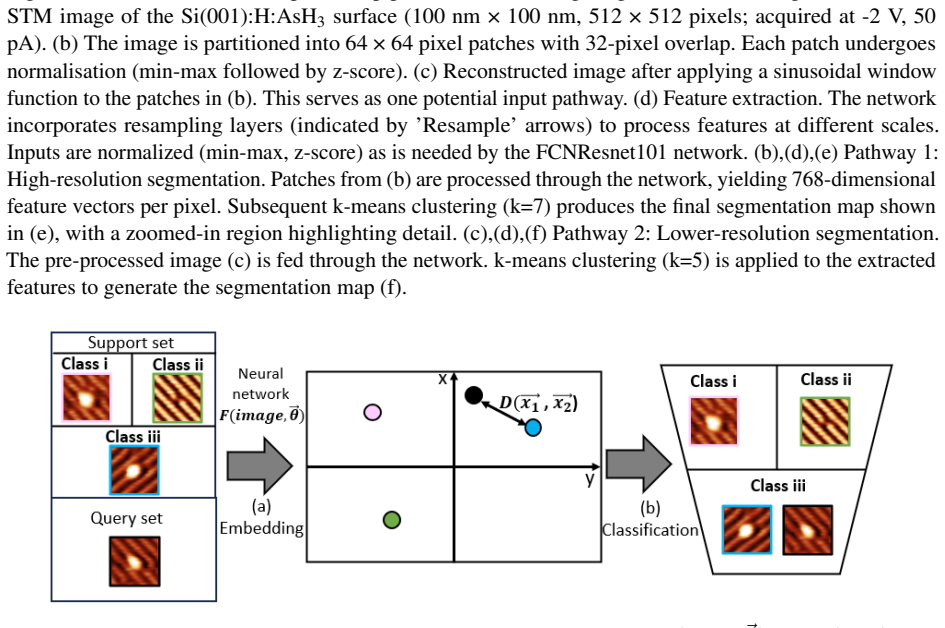
The load-bearing object is the two-module pipeline, not a single network. Module 1 produces training labels without human annotation: it runs an ImageNet-pretrained fully convolutional network over the STM image, clusters the resulting per-pixel feature vectors with k-means, and thresholds the clusters into a binary defect/lattice mask. A U-Net is then trained on those masks so that inference runs quickly on a CPU. Module 3 is the few-shot classifier, using prototypical networks, which embed each defect crop in a learned vector space and classify a query crop by its distance to the mean embedding, or prototype, of each class's K support examples; the support set is chosen by the user from a handful of crops. The argument turns on this split: the unsupervised module supplies the where, the few-shot module supplies the what, and only the latter requires new labels.
What would settle it
On a fourth surface with a known, manually counted defect inventory, run the full pipeline and compare the final classified feature map with the manual count. If the U-Net's defect-only dice score lands near the 0.64 reported for Si(001), more than a third of defects would never reach the few-shot classifier, and the one-shot adaptation claim would fail as a complete segmentation despite high classifier accuracy.
Extended reading notes
Core claim
The central claim is that defect classification in STM can be decomposed so that the expensive part, learning what a defect looks like, is done once on well-studied surfaces, while adapting to a new surface costs almost nothing in labels. On germanium and titania, where neither substrate appeared in training, models classify defects with 61 to 70 percent one-shot accuracy; on a held-out set of silicon adsorbate features, the same approach reaches 93 percent. The paper further claims that the segmentation bottleneck can be automated: a pretrained feature extractor followed by k-means clustering produces binary defect maps for a new substrate, and a standard U-Net distilled from those maps segments full scans on a CPU in seconds with total dice scores between 0.96 and 0.99.
Load-bearing premise
The load-bearing premise is that the unsupervised labelling module finds most true defects on any new substrate, because the few-shot classifier can only sort defects that the first pass did not miss.
Editorial extensions
If this is right
- Researchers studying a new adsorbate on a known substrate can count and classify defects with one to three labelled examples per class, with accuracies that support surface-chemistry statistics on silicon but are weaker on germanium and titania.
- A new substrate needs only about five scans and an unsupervised labelling pass to train the segmentation stage, not thousands of manually annotated images.
- Because the support set can be redefined on the fly, a user can re-label classes during an experiment to account for tip changes and exclude anomalous features, which fixed-class supervised models cannot do.
- Among the tested algorithms, prototypical and matching networks outperform relation and simple-shot networks, and synthetic inverse defects added to training classes improve accuracy by up to 16 percent, giving a labelling-free route to better embeddings.
- The unsupervised labelling step transfers to other microscopy modes, as the authors show by applying it to a STEM image and obtaining pixel-level segmentation comparable to a published few-shot patch-based method.
Reading between the lines
- Beyond the paper's own claims, the weak point to watch is the U-Net's defect-only dice score: on Si(001) it is 0.64, meaning roughly a third of true defect pixels never reach the classifier, so the final feature map is incomplete regardless of FSL accuracy.
- On a genuinely new surface, the likely failure point is this under-detection in the unsupervised first pass rather than the few-shot classifier, so testing the pipeline on a fourth surface with a known defect inventory would be the natural next experiment.
- The one-shot claim would be stronger if support sets were drawn from the same scan or imaging conditions as the query data; the paper's test sets may share more with training than a true first encounter would.
- The same architecture could be driven by active learning, where the system asks the user to label only the most uncertain crops, potentially raising germanium and titania accuracies toward the silicon result.
Editorial analysis
A structured set of objections, weighed in public.
Referee Report
Summary. The paper presents a modular pipeline for automated segmentation and classification of atomic-scale features in STM images. It combines an unsupervised labelling module (using ImageNet-pretrained FCN features with k-means clustering) to produce training labels, a U-Net for coarse pixel-wise segmentation of defects, and a few-shot learning classifier (comparing prototypical, matching, relation, and simple-shot networks) that labels cropped defects using a user-supplied support set. The pipeline is evaluated on three surfaces: Si(001) (including Si(001):H and AsH3-exposed), Ge(001):AsH3, and TiO2(110). The authors report U-Net total dice scores of 0.96-0.99 and 1-shot FSL accuracies of up to 93% (Si), 62% (Ge), and 70% (TiO2).
Significance. The problem addressed - reducing manual labelling for STM image analysis - is practically important and timely. The paper's strengths are its clear modular design, the comparison of four FSL algorithms, the use of disjoint train/test classes for the Ge and TiO2 evaluations, the ablation study with inverse-class augmentation, and the open release of code (GitHub) and data (Zenodo). If the claims were fully supported, the work would provide a useful guide for applying FSL in the SPM community. However, the headline one-shot generalization claim rests on the Si(001) result, which is compromised by augmentation leakage between train and test sets, and the Ge and TiO2 accuracies are too low to support the abstract's 'high accuracy' promise. The approach is promising but the evidence needs to be re-evaluated and the claims tempered.
major comments (3)
- [Appendix 11.1 and Section 3.4] The Si(001) 4-way 1-shot accuracy of 93.3 ± 0.4% reported in Table 3 is not a valid measure of generalization to unseen classes. Appendix 11.1 states that the rare feature classes h1 and h2 were augmented with rotations and reflections during training, testing, and validating, so augmented versions of the same source crops appear in both training and test sets. This violates the protocol stated in Section 3.4 that Ttr, Tte, and V cannot share any classes. The reported accuracy may largely reflect memorization of augmented variants of the same instances, rather than classification of genuinely new classes. Although the authors disclose this limitation in the appendix, the 93% figure is the strongest evidence for the abstract's claim of 'high accuracy' and the conclusion's '1-shot accuracies of up to 93%'. Please provide a clean class-disjoint evaluation on Si, or explicitly exclude the augmented classes from the headline claims.
- [Abstract and Sections 3.1-3.3] The abstract's statement that the model 'can be adapted to unseen surfaces with as few as one additional labelled data point' overstates the workflow's data requirements. Module 1 (Section 3.2) still requires a GPU-based unsupervised labelling step, and Module 2 (Section 3.3) trains a U-Net on five scans per new substrate; only Module 3 (FSL) uses a single labelled example per class, and it operates on crops produced by the U-Net. The one-labelled-point claim should be scoped to the classification sub-problem, and the abstract should mention the additional segmentation data required for a new surface.
- [Section 5 and Table 2] The conclusion's summary of '1-shot accuracies of up to 93%, 62%, and 70%' is misleading when combined with the abstract's 'high accuracy': once the leakage in the Si result is accounted for, the reliable accuracies are 62% (Ge) and 70% (TiO2), which the paper itself states would not be sufficient for definitive conclusions. Furthermore, the U-Net defect dice score for Si(001) is only 0.64 (Table 2), meaning a substantial fraction of defect pixels is missed; this under-detection limits the completeness of the final classified feature map regardless of FSL performance. Please revise the abstract and conclusion to reflect the actual evidence and to discuss the pipeline-level impact of U-Net recall.
minor comments (6)
- [Section 1] The Introduction contains a duplicated word: 'training data sets of this size may may not be practical' should read 'may not be practical'.
- [Section 3.3] The phrase 'Course segmentation' should be 'Coarse segmentation' to describe the U-Net's binary map.
- [Section 3.4 and Appendix 11.1] Section 3.4 states that the only augmentation used in training the FSL networks is rotation by 0, 90, 180, 270 degrees, whereas Appendix 11.1 mentions rotations and reflections for the rare classes h1 and h2; please clarify which augmentations were actually used.
- [Table 3 and Appendix 11.4] The kNN baseline rows list training data identical to the test data (classes 5-8 or 9-13), while the FSL models use disjoint classes, so the comparison is not on equal footing; please explain the rationale or provide a more meaningful baseline.
- [Section 5] The sentence 'progress can be continued towards an efficient... with minimal labelled data requirements' is followed by 'hyperparameter exploration,.'; the stray comma before the period should be removed.
- [Figure 3 caption] The pathway labels in the caption ('(b),(d),(e) Pathway 1' and '(c),(d),(f) Pathway 2') are confusing because panel (d) appears in both; consider simplifying the caption to clarify the flow.
Circularity Check
No significant circularity: the FSL evaluations use disjoint held-out classes and external pretrained features; the disclosed h1/h2 augmentation overlap is an evaluation caveat, not a circular derivation.
full rationale
The central FSL results are obtained from genuinely disjoint class splits: the silicon test classes 5-8 are absent from the training classes 1-4 and 9-15, the germanium test classes 9-13 are absent from the silicon/titania training classes, and the titania test classes 14-15 are absent from training (Table 3). The embeddings use standard conv4/ResNet18 backbones or ImageNet-pretrained features, all external benchmarks, and the accuracy is measured against held-out labelled crops rather than against the support set used to define the task. The unsupervised labelling module distils ImageNet-pretrained FCN features into a small U-Net; although the U-Net is trained on labels produced by that module, its dice scores are presented as segmentation performance on the three surfaces (Table 2) and are compared with an external supervised benchmark, not reused as the FSL prediction. The inverse-class augmentation is a training-set construction that adds new artificial classes; it is not used to fabricate the test classes. Self-citations to the authors' prior experimental work ([17], [38], [45]) are confined to sample preparation and are not load-bearing for the machine-learning derivation. The paper itself discloses a genuine evaluation-protocol limitation in Appendix 11.1: features h1 and h2 were augmented 'during training, testing, and validating', so augmented versions of the same crops appear in more than one split; this can inflate the silicon 1-shot 93% figure, but it is a robustness and correctness caveat rather than a case where a predicted quantity equals an input by construction. Overall, the derivation chain is self-contained against external benchmarks, so the circularity burden is minimal; the score of 2 reflects only the presence of minor, non-load-bearing self-citations.
Assumptions & free parameters
free parameters (4)
- k_means_k_high_res =
7
- k_means_k_low_res =
5
- unet_crop_size =
64x64 pixels
- fsl_training_episodes =
2000 (proto/matching), 5000 (relation), 20 epochs (simple shot)
assumptions (4)
- domain assumption ImageNet-pretrained FCN-ResNet101 features separate STM defect pixels from lattice pixels via k-means.
- domain assumption The user-defined FSL support set correctly labels K examples per class.
- domain assumption Training classes from Si, Ge, and TiO2 are representative enough to embed unseen surface features.
- domain assumption Ground-truth labels used for evaluation are correct.
Cite this review
Pith. "Pith review of Overcoming Labelled Data Scarcity for Defect Classification in Scanning Tunneling Microscopy." pith.science (2026). https://pith.science/paper/PMFI2YIO
@misc{pith2026250601678,
  author       = {Pith},
  title        = {Pith review of: Overcoming Labelled Data Scarcity for Defect Classification in Scanning Tunneling Microscopy},
  year         = {2026},
  howpublished = {\url{https://pith.science/paper/PMFI2YIO}},
  note         = {Machine review of arXiv:2506.01678}
}
abstract
Scanning tunnelling microscopy (STM) is a powerful technique for imaging surfaces with atomic resolution, providing insight into physical and chemical processes at the level of single atoms and molecules. A regular task of STM image analysis is the identification and labelling of features of interest against a uniform background. Performing this manually is a labour-intensive task, requiring significant human effort. To reduce this burden, we propose an automated approach to the segmentation of STM images that uses both few-shot learning and unsupervised learning. Our technique offers greater flexibility compared to previous supervised methods; it removes the requirement for large manually annotated datasets and is thus easier to adapt to an unseen surface while still maintaining a high accuracy. We demonstrate the effectiveness of our approach by using it to recognise atomic features on three distinct surfaces: Si(001), Ge(001), and TiO$_2$(110), including adsorbed AsH$_3$ molecules on the silicon and germanium surfaces. Our model exhibits strong generalisation capabilities, and following initial training, can be adapted to unseen surfaces with as few as one additional labelled data point. This work is a significant step towards efficient and material-agnostic, automatic segmentation of STM images.
Figures


Figures from the paper (6 more)


Reference graph
Works this paper leans on
-
[1]
Matthews, Le Wang, Yingge Du, and Steven R
Sarah Akers, Elizabeth Kautz, Andrea Trevino- Gavito, Matthew Olszta, Bethany E. Matthews, Le Wang, Yingge Du, and Steven R. Spurgeon. Rapid and flexible segmentation of electron mi- croscopy data using few-shot machine learning. npj Computational Materials, 7(1):187, 2021
work page 2021
-
[2]
Segment anything for microscopy
Anwai Archit, Sushmita Nair, Nabeel Khalid, Paul Hilt, Vikas Rajashekar, Marei Freitag, Sag- nik Gupta, Andreas Dengel, Sheraz Ahmed, and Constantin Pape. Segment anything for microscopy. bioRxiv, 2023
work page 2023
-
[3]
Direct visualization of defect- mediated dissociation of water on tio2 (110)
Oier Bikondoa, Chi L Pang, Roslinda Ithnin, Christopher A Muryn, Hiroshi Onishi, and Ge- off Thornton. Direct visualization of defect- mediated dissociation of water on tio2 (110). Nature materials, 5(3):189–192, 2006
work page 2006
- [4]
-
[5]
D. R. Bowler, J. H. G. Owen, K. Miki, and G. A. D. Briggs. Diffusion of paired hydrogen on si(001). Phys. Rev. B, 57:8790–8793, Apr 1998. 11
work page 1998
-
[6]
S. K. Broome, M. A.and Gorman, M. G. House, S. J. Hile, J. G. Keizer, D. Keith, Hill C. D., T. F. Watson, W. J. Baker, L. C. L. Hollenberg, and M. Y . Simmons. Two-electron spin correlations in precision placed donors in silicon. Nature Communications, 9, March 2018
work page 2018
-
[7]
K. Choudhary, Camp C. Kevin F., Kalinin Sergei V ., R. Vasudevan, M. Zi- atdinov, and F. Tavazza. Computational scanning tunneling microscope image database. Scientific Data, 2021
work page 2021
-
[8]
Jeremiah Croshaw, Thomas Dienel, Taleana Huff, and Robert Wolkow. Atomic defect classi- fication of the h–si(100) surface through multi- mode scanning probe microscopy. Beilstein Journal of Nanotechnology, 11:1346–1360, sep 2020
work page 2020
Show all 47 references
-
[9]
The surface science of titanium dioxide
Ulrike Diebold. The surface science of titanium dioxide. Surface Science Reports , 48(5):53– 229, 2003
2003
-
[10]
Gordon, P
O. Gordon, P. D’Hondt, L. Knijff, S. E. Freeney, F. Junqueira, P. Moriarty, and I. Swart. Scanning tunneling state recognition with multi-class neu- ral network ensembles. Review of Scientific Instruments, 90(10):103704, 10 2019
2019
-
[11]
Embedding human heuristics in machine-learning-enabled probe microscopy
Oliver M Gordon, Filipe LQ Junqueira, and Philip J Moriarty. Embedding human heuristics in machine-learning-enabled probe microscopy. Machine Learning: Science and Technology , 1(1):015001, 2020
2020
-
[12]
Nanoscale imaging of mobile carriers and trapped charges in delta doped silicon p–n junc- tions
Georg Gramse, Alexander Kölker, Tomáš Šk- ereˇn, Taylor JZ Stock, Gabriel Aeppli, Ferry Kienberger, Andreas Fuhrer, and Neil J Cur- son. Nanoscale imaging of mobile carriers and trapped charges in delta doped silicon p–n junc- tions. Nature Electronics, 3(9):531–538, 2020
2020
-
[13]
Torch- bench: Benchmarking pytorch with high api surface coverage
Yueming Hao, Xu Zhao, Bin Bao, David Berard, Will Constable, Adnan Aziz, and Xu Liu. Torch- bench: Benchmarking pytorch with high api surface coverage. arXiv e-prints, pages arXiv– 2304, 2023
2023
-
[15]
Deep residual learning for image recognition
Kaiming He, Xiangyu Zhang, Shaoqing Ren, and Jian Sun. Deep residual learning for image recognition. CoRR, abs/1512.03385, 2015
2015 arXiv
-
[16]
Metaau- dio: A few-shot audio classification benchmark
Calum Heggan, Sam Budgett, Timothy Hospedales, and Mehrdad Yaghoobi. Metaau- dio: A few-shot audio classification benchmark. In International Conference on Artificial Neural Networks , pages 219–230. Springer, 2022
2022
-
[17]
Emily V . S. Hofmann, Taylor J. Z. Stock, Oliver Warschkow, Rebecca Conybeare, Neil J. Cur- son, and Steven R. Schofield. Room temper- ature incorporation of arsenic atoms into the germanium (001) surface. Angewandte Chemie International Edition, 62(7):e202213982, 2023
2023
-
[18]
Carlo Innamorati, Tobias Ritschel, Tim Weyrich, and Niloy J. Mitra. Learning on the edge: Explicit boundary handling in cnns. CoRR, abs/1805.03106, 2018
2018 arXiv
-
[19]
Davenport, Zhe- hao Ge, Eberth A
Frédéric Joucken, John L. Davenport, Zhe- hao Ge, Eberth A. Quezada-Lopez, Takashi Taniguchi, Kenji Watanabe, Jairo Velasco, Jérôme Lagoute, and Robert A. Kaindl. De- noising scanning tunneling microscopy images of graphene with supervised machine learning. Phys. Rev. Mater., ...
2022
-
[20]
Efficient few-shot machine learning for classification of ebsd patterns
Kevin Kaufmann, Hobson Lane, Xiao Liu, and Kenneth S Vecchio. Efficient few-shot machine learning for classification of ebsd patterns. Sci- entific reports, 11(1):8172, 2021
2021
-
[21]
Huang, and Bryan K
Abid Khan, Chia-Hao Lee, Pinshane Y . Huang, and Bryan K. Clark. Leveraging generative adversarial networks to create realistic scanning transmission electron microscopy images. npj Computational Materials, 9(1), may 2023
2023
-
[22]
Krull, P
A. Krull, P. Hirsch, C. Rother, A. Schiffrin, and Krull C. Artificial-intelligence-driven scanning probe microscopy. Nature, Mar 2020
2020
-
[23]
Prototypical network for radar image recogni- tion with few samples
Diyang Liu, Xunzhang Gao, and Qinmu Shen. Prototypical network for radar image recogni- tion with few samples. Journal of Physics: Con- ference Series, 1634(1):012116, sep 2020. 12
2020
-
[24]
Fully convolutional networks for se- mantic segmentation
Jonathan Long, Evan Shelhamer, and Trevor Darrell. Fully convolutional networks for se- mantic segmentation. CoRR, abs/1411.4038, 2014
2014 arXiv
-
[25]
Nanoscale patterning and oxida- tion of h-passivated si (100)-2× 1 surfaces with an ultrahigh vacuum scanning tunneling micro- scope
JW Lyding, T-C Shen, JS Hubacek, JR Tucker, and GC Abeln. Nanoscale patterning and oxida- tion of h-passivated si (100)-2× 1 surfaces with an ultrahigh vacuum scanning tunneling micro- scope. Applied physics letters , 64(15):2010– 2012, 1994
2010
-
[26]
Proto-clip: Vision-language prototypical network for few-shot learning
Kamalesh Palanisamy, Yu-Wei Chao, Xinya Du, Yu Xiang, et al. Proto-clip: Vision-language prototypical network for few-shot learning. In 2024 IEEE/RSJ International Conference on Intelligent Robots and Systems (IROS), pages 2594–2601. IEEE, 2024
2024
-
[27]
Structure of clean and adsorbate- covered single-crystal rutile tio2 surfaces
Chi Lun Pang, Robert Lindsay, and Geoff Thornton. Structure of clean and adsorbate- covered single-crystal rutile tio2 surfaces. Chemical reviews, 113(6):3887–3948, 2013
2013
-
[28]
Intro- ducing hann windows for reducing edge-effects in patch-based image segmentation
Nicolas Pielawski and Carolina Wählby. Intro- ducing hann windows for reducing edge-effects in patch-based image segmentation. PLOS ONE, 15(3):e0229839, March 2020
2020
-
[29]
Deep learning-guided surface characterization for autonomous hydro- gen lithography
Mohammad Rashidi, Jeremiah Croshaw, Kieran Mastel, Marcus Tamura, Hedieh Hosseinzadeh, and Robert A Wolkow. Deep learning-guided surface characterization for autonomous hydro- gen lithography. Machine Learning: Science and Technology, 1(2):025001, mar 2020
2020
-
[30]
Au- tonomous scanning probe microscopy in situ tip conditioning through machine learning
Mohammad Rashidi and Robert A Wolkow. Au- tonomous scanning probe microscopy in situ tip conditioning through machine learning. ACS nano, 12(6):5185–5189, 2018
2018
-
[31]
Dissociative adsorption of diethyl ether on si(001) studied by means of scanning tunneling microscopy and photoelec- tron spectroscopy
Marcel Reutzel, Gerson Mette, Peter Stromberger, Ulrich Koert, Michael Dürr, and Ulrich Höfer. Dissociative adsorption of diethyl ether on si(001) studied by means of scanning tunneling microscopy and photoelec- tron spectroscopy. The Journal of Physical Chemistry C, 119, March 2015
2015
-
[32]
U-net: Convolutional networks for biomedical image segmentation
Olaf Ronneberger, Philipp Fischer, and Thomas Brox. U-net: Convolutional networks for biomedical image segmentation. In Medi- cal image computing and computer-assisted intervention–MICCAI 2015: 18th international conference, Munich, Germany, October 5-9, 2015, proceedings, par...
2015
-
[33]
True first- order surface phase transition without nanoscale phase separation
Hyungjoon Shim and Geunseop Lee. True first- order surface phase transition without nanoscale phase separation. ACS Nano, 17, Jul 2023
2023
-
[34]
Bipolar device fabrication using a scan- ning tunnelling microscope
Tomáš Škere ˇn, Sigrun A Köster, Bastien Douhard, Claudia Fleischmann, and Andreas Fuhrer. Bipolar device fabrication using a scan- ning tunnelling microscope. Nature Electronics, 3(9):524–530, 2020
2020
-
[35]
Prototypical networks for few-shot learning.Ad- vances in neural information processing sys- tems, 30, 2017
Jake Snell, Kevin Swersky, and Richard Zemel. Prototypical networks for few-shot learning.Ad- vances in neural information processing sys- tems, 30, 2017
2017
-
[36]
Atom- istic origin of metal versus charge-density-wave phase separation in indium atomic wires on si(111)
Sun Kyu Song and Han Woong Yeom. Atom- istic origin of metal versus charge-density-wave phase separation in indium atomic wires on si(111). Phys. Rev. B, 104:035420, Jul 2021
2021
-
[37]
A com- prehensive survey of few-shot learning: Evolu- tion, applications, challenges, and opportunities
Yisheng Song, Ting Wang, Puyu Cai, Subrota K Mondal, and Jyoti Prakash Sahoo. A com- prehensive survey of few-shot learning: Evolu- tion, applications, challenges, and opportunities. ACM Computing Surveys, 55(13s), 2023
2023
-
[38]
Single-atom con- trol of arsenic incorporation in silicon for high- yield artificial lattice fabrication
Taylor JZ Stock, Oliver Warschkow, Proco- pios C Constantinou, David R Bowler, Steven R Schofield, and Neil J Curson. Single-atom con- trol of arsenic incorporation in silicon for high- yield artificial lattice fabrication. Advanced Ma- terials, 36(24):2312282, 2024
2024
-
[39]
Microstructure segmentation with deep learning encoders pre-trained on a large mi- croscopy dataset
Joshua Stuckner, Bryan Harder, and Timothy M Smith. Microstructure segmentation with deep learning encoders pre-trained on a large mi- croscopy dataset. npj Computational Materials, 8(1):200, 2022
2022
-
[40]
Learning to compare: Relation network for few-shot learning
Flood Sung, Yongxin Yang, Li Zhang, Tao Xiang, Philip HS Torr, and Timothy M Hospedales. Learning to compare: Relation network for few-shot learning. In Proceedings of the IEEE conference on computer vision and pattern recognition, pages 1199–1208, 2018
2018
-
[41]
Matching networks 13 for one shot learning
Oriol Vinyals, Charles Blundell, Timothy Lilli- crap, Daan Wierstra, et al. Matching networks 13 for one shot learning. Advances in neural infor- mation processing systems, 29, 2016
2016
-
[42]
Kashid, Pradeep Namboodiri, Andrew Schmucker, Scott W.and Murphy, M
Xiqiao Wang, Jonathan Wyrick, Ranjit V . Kashid, Pradeep Namboodiri, Andrew Schmucker, Scott W.and Murphy, M. D. Stewart, and Richard M. Silver. Atomic-scale control of tunneling in donor-based devices. Communications Physics, 3, May 2020
2020
-
[43]
Sim- pleshot: Revisiting nearest-neighbor classifica- tion for few-shot learning
Yan Wang, Wei-Lun Chao, Kilian Q Wein- berger, and Laurens van der Maaten. Sim- pleshot: Revisiting nearest-neighbor classifica- tion for few-shot learning. arXiv e-prints, pages arXiv–1911, 2019
1911
-
[44]
Warschkow, N
O. Warschkow, N. J. Curson, S. R. Schofield, N. A. Marks, H. F. Wilson, M. W. Radny, P. V . Smith, T. C. G. Reusch, D. R. McKenzie, and M. Y . Simmons. Reaction paths of phosphine dissociation on silicon (001). The Journal of Chemical Physics, 144(1):014705, 01 2016
2016
-
[45]
Direct visual- ization of a gold nanoparticle electron trapping effect
Oscar Bentley Jerdmyr Williams, Khabiboulakh Katsiev, Byeongjin Baek, George Harrison, Ge- off Thornton, and Hicham Idriss. Direct visual- ization of a gold nanoparticle electron trapping effect. Journal of the American Chemical Soci- ety, 144(2):1034–1044, 2022
2022
-
[46]
Classifying galaxy morphologies with few-shot learning
Zhirui Zhang, Zhiqiang Zou, Nan Li, and Yanli Chen. Classifying galaxy morphologies with few-shot learning. Research in Astronomy and Astrophysics, 22(5):055002, 2022
2022
-
[47]
Ro- bust multi-scale multi-feature deep learning for atomic and defect identification in scanning tun- neling microscopy on h-si (100) 2x1 surface
Maxim Ziatdinov, Udi Fuchs, James HG Owen, John N Randall, and Sergei V Kalinin. Ro- bust multi-scale multi-feature deep learning for atomic and defect identification in scanning tun- neling microscopy on h-si (100) 2x1 surface. arXiv e-prints, pages arXiv–2002, 2020
2002
-
[48]
Maxim Ziatdinov, Ayana Ghosh, Chun Yin Wong, and Sergei V . Kalinin. Atomai frame- work for deep learning analysis of image and spectroscopy data in electron and scanning probe microscopy. Nature Machine Intelligence, 4(12):1101–1112, December 2022. 14 11 Appendix 11.1 Dataset...
2022
Reviewed August 7, 2026 · model on record in the stance chip above.
Discussion (0). Sign in to comment.