REVIEW 2 major objections 5 minor 31 references
Gauge-invariant Slavnov-Taylor Decomposition for Trilinear Vertices
T0 review · 2 major / 5 minor · reviewed 2026-08-07 · deepseek-v4-flash
Pith's one-line read This paper shows that trilinear one-loop amplitudes in a broken Abelian gauge theory with chiral fermions satisfy the Slavnov-Taylor identity sector by sector, which enables a layer-by-layer construction of finite counter-terms.
desk verdict A legitimate sector-by-sector extension of the FMS program, but the printed amplitudes fail one of the two-point Slavnov-Taylor identities, so the central check is not reproducible as written. read the letter →
The pith
A machine-rendered reading of the paper's core claim, the machinery that carries it, and where it could break.
The reading
What carries the argument
The load-bearing object is the $(l_h, l_{a'})$-grading of 1-PI amplitudes together with the FMS gauge-invariant fields $h \sim \frac{1}{v}(\phi^\dagger\phi - v^2/2)$ and $a_\mu \sim \frac{i}{ev^2}(2\phi^\dagger D_\mu\phi - \partial_\mu(\phi^\dagger\phi))$, made power-counting renormalizable by Lagrange multipliers $X$, $X_\mu$ embedded in BRST doublets. The cancellations run through the tree-level tensor $\Sigma^{(0)}_{\mu\nu} = (\Box g_{\mu\nu} - \partial_\mu\partial_\nu) + M_A^2 g_{\mu\nu}$ and the two identities $\Sigma^{(0)}_{\mu\nu}\Delta^{a'\nu a'\rho} = i g_\mu^{\ \rho}$ and $\Delta^{a'\nu a'\rho}(k+p)_\nu = \frac{i}{M_A^2}(k+p)^\rho$, which convert sums of gauge and Goldstone vertex diagrams into vanishing expressions. The dictionary to ordinary amplitudes replaces the auxiliary source $\bar c^*$ by $\frac{1}{v}(M^2-m^2)(\phi^\dagger\phi - v^2/2)$ and discards the homogeneous solution $\eta$ of the $h$ equation of motion, relying on the quantum equations of motion and the equivalence theorem.
What would settle it
Compute the fully renormalized finite parts of the one-loop trilinear fermionic amplitudes in the $(1,1)$ sector in a scheme that preserves the Slavnov-Taylor identities and check whether $-ik^\mu \Gamma^{(1;1,1)}_{\psi\bar\psi A_\mu} + ev\,\Gamma^{(1;1,1)}_{\psi\bar\psi\chi} = 0$ holds exactly as it does for the ultraviolet-divergent parts; a failure would show the sector decomposition is only a statement about divergences. A second decisive test is to repeat the whole computation with the unphysical parameter $m \neq 0$ and verify that the summed sectors reproduce conventional amplitudes independently of $m$, since the claim that $m$ disappears relies on the dictionary.
Extended reading notes
Core claim
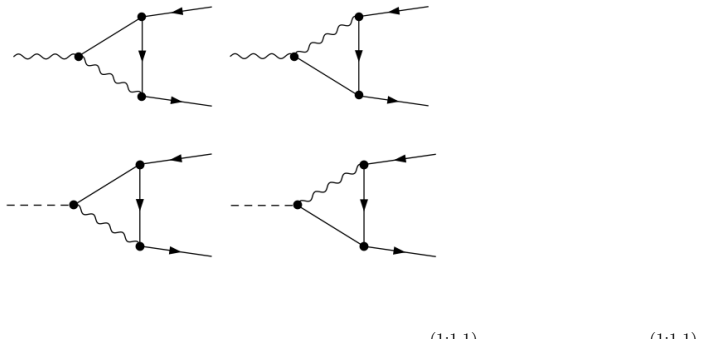
The central discovery is that the sector decomposition of 1-PI amplitudes in the FMS gauge-invariant formalism, previously established for two-point functions, continues to hold for three-point amplitudes: each $(l_h, l_{a'})$ sector separately satisfies the Slavnov-Taylor identity. For the fermionic trilinear vertices the cancellation is shown explicitly: in the $(1,1)$ sector the identity reduces to the purely trilinear relation $-ik^\mu \bar{\Gamma}^{(1;1,1)}_{\psi\bar\psi A_\mu} + ev\,\bar{\Gamma}^{(1;1,1)}_{\psi\bar\psi\chi} = 0$, because the fermion two-point function carries no $(1,1)$ component; the mechanism is the algebraic identity $\Sigma^{(0)}_{\mu\nu}\Delta^{a'\nu a'\rho} = i g_\mu^{\ \rho}$ together with $\Delta^{a'\nu a'\rho}(k+p)_\nu = \frac{i}{M_A^2}(k+p)^\rho$, which annihilate the sum of gauge and Goldstone vertex diagrams. For bosonic identities, fermion bubbles are confined to the $(0,0)$ sector, and in the highest sectors $l_h + l_{a'} = 3$ the two-point functions drop out entirely, so restoring the identities there requires only three-point counter-terms. The paper also documents that power-counting renormalizability fails inside individual sectors, with some form factors reaching ultraviolet degree $p^4$, while the full sector sum obeys the renormalizability bound, a consistency check on the entire grading.
Load-bearing premise
The load-bearing premise is that the on-shell dictionary of Section III — replacing the auxiliary source $\bar c^*$ by $\frac{1}{v}(M^2-m^2)(\phi^\dagger\phi - v^2/2)$ and dropping the homogeneous solution $\eta$ — correctly reproduces the conventional one-loop amplitudes; if it fails, the sector decomposition describes a different theory.
Editorial extensions
If this is right
- Finite symmetry-restoring counter-terms can be arranged in layers: two-point counter-terms affect only sectors with $l_h + l_{a'} \leq 2$, while in sectors with $l_h + l_{a'} = 3$ only three-point counter-terms enter.
- A mixed regularization is viable for chiral theories: naive dimensional regularization with anticommuting $\gamma_5$ in all sectors without fermion chains, plus a consistent scheme such as BMHV with finite counter-terms in the fermionic sectors.
- Renormalizing the theory sector by sector is legitimate because the Slavnov-Taylor identities hold independently in each sector, to all orders in perturbation theory.
- Each individual sector is not power-counting renormalizable, so practical calculations must keep the full sector sum to recover renormalizable amplitudes.
Reading between the lines
- If the sector-wise identities survive renormalization at the level of finite parts as they do for the divergent parts, the layer-by-layer counter-term strategy should extend beyond one loop, since the grading argument itself is all-order.
- The same algebraic mechanism should be transferable to non-Abelian theories, where ghost self-interactions would enter the higher sectors of purely bosonic amplitudes; the paper flags this as future work.
- A sharper test of the Section III dictionary would compute the finite parts of the $(1,1)$ fermionic amplitudes in a Slavnov-Taylor-preserving scheme and check the same identity; the divergent parts alone cannot detect a wrong on-shell replacement that happens to be homogeneous.
Editorial analysis
A structured set of objections, weighed in public.
Referee Report
Summary. The paper studies the Frohlich-Morchio-Strocchi (FMS) gauge-invariant formalism for an Abelian Higgs-Kibble model with chiral fermions, extending the sector-by-sector Slavnov-Taylor (ST) decomposition of [15] to trilinear 1-PI vertices. The central claim is that, after expanding 1-PI amplitudes according to the numbers (l_h,l_a') of internal FMS scalar and vector lines, the ST identity holds separately in each sector, and that at one loop the UV-divergent parts of the relevant three-point and two-point functions satisfy the projected identities. The paper also gives a dictionary between FMS amplitudes and conventional amplitudes and discusses how this sector structure could guide the construction of finite ST-restoring counterterms in chiral theories. The explicit one-loop amplitudes are listed in Appendix C, and selected identities are checked in the text.
Significance. If the sector-by-sector ST structure is correct, it provides a genuinely useful organizing principle for finite symmetry-restoring counterterms in chiral gauge theories, where no fully invariant regularization scheme is known. The explicit (1,1)-fermionic cancellation in Eqs. (5.3)-(5.8) is clean and transparent, and the manuscript contains no fitted parameters and no circular use of the identities it claims to verify. However, the central quantitative check is not reproducible as printed: the (0,0) two-point omega-chi identity fails against the displayed form factors by a nonzero residual. The underlying idea remains plausible, but the present version does not establish the claimed sector-by-sector verification.
major comments (2)
- [§IV.C, Eqs. (4.6), (C2), (C3), (C5)] Direct substitution of the printed UV-divergent parts into Eq. (4.6) in the (0,0) sector does not give zero. With k=p, Eq. (C5) gives -i k^mu Gamma_{A_mu chi} = e m_e^2 p^2/(4 pi^2 v epsilon); Eq. (C2) gives -e Gamma_sigma = + e m_e^4/(2 pi^2 v epsilon); Eq. (C3) gives e v Gamma_{chi chi} = e m_e^2(p^2 - 2 m_e^2)/(4 pi^2 v epsilon). The sum is e m_e^2 p^2/(2 pi^2 v epsilon), not zero. Since the text states that Eq. (4.6) is checked 'by direct inspection' of exactly these formulas, the printed amplitudes are mutually inconsistent with the claimed sector-by-sector identity. This is a load-bearing check for the paper's central claim, so the authors must correct the sign or coefficient error and re-verify the full set of sectors.
- [§VI and §V.B] The paper states in §VI that 'we have explicitly verified all the relevant ST identities in each (lh,la') sectors by direct computations,' but the only diagrammatic derivation actually shown is the (1,1) fermionic cancellation in Eqs. (5.3)-(5.8). The remaining fermionic and bosonic sectors, including the diagrams of Fig. 6 and the identities in Eqs. (6.2)-(6.4), are asserted without a residual table or reproducible computation. In view of the failure documented in the previous comment, this is not a matter of presentation: the central claim requires a systematic, checkable verification of the identities in §§IV-VI against the form factors of Appendix C, for example a table of residuals for each sector or an ancillary file with the amplitudes.
minor comments (5)
- [Appendix C, Eq. (C18)] Most entries in the G-form factors are missing the explicit 1/epsilon factor, unlike every other amplitude list in the same appendix; this makes the 'UV divergent part' convention inconsistent and hampers verification of the fermionic ST identities.
- [Appendix C, Eq. (C11)] The entry for E^{(1;1,1)}_2 is written without the closing 1/epsilon factor, reading '24 pi^2 v^3,' whereas all neighboring entries carry 1/epsilon; this appears to be a typographical omission.
- [Appendix C, Eq. (C10)] The formula for E^{(1;0,0)}_0 includes an explicit g_{mu nu} inside the coefficient, but in Eq. (C9) the form factor E_0 multiplies g_{mu nu}; the coefficient should be a scalar.
- [§VI, around Eq. (6.5)] The sentence 'The results for the UV divergent terms are reported in Eqs (C3), (C4), (??), (C5), (C11) and (C13)' contains an unresolved '(??)' placeholder, and the word 'tapdole' should be 'tadpole'.
- [Appendix C, Eq. (C14)] Several sectors contain the expression p_1^2 p_2^2 (p_1^2 + p_2^3); the exponent p_2^3 is presumably a typo for p_2^4, and the corresponding terms should be checked for symmetry under p_1 <-> p_2.
Circularity Check
No circularity: the one-loop Slavnov-Taylor checks are computed from the stated action, not fitted; the self-citation [15] supplies an independent prior proof, and the only defect found is a non-circular arithmetic inconsistency in the (0,0) identity.
full rationale
The paper's derivation chain is self-contained for the advertised one-loop checks: no parameter is fitted and then renamed as a prediction. The UV-divergent amplitudes in Appendix C are computed from the tree-level action (A1) with the stated Feynman rules and propagators, and the sector-decomposed ST identities (4.1), (4.6), (5.1)-(5.2), (6.2) are then presented as identities to be verified, not as outputs of a fit. The on-shell dictionary of Sect. III is an equivalence step based on the functional identities (B4)-(B9) and on prior equivalence theorems; it is an explicit input assumption (indeed the weakest one), not a definition of the amplitudes in terms of the ST identities, and the paper does not hide it. The only author-overlapping citation that is load-bearing is [15], which supplies the all-orders statement that sectors (l_h,l_a') satisfy ST identities separately; this is a prior, peer-reviewed, parameter-free theorem with its own proof, so under the stated rules it is real external evidence rather than a circular reduction. One non-circular defect was noted while checking the quoted equations: substituting (C2), (C3) and (C5) into the (0,0) version of Eq. (4.6) leaves a residual e m_e^2 p^2/(2 pi^2 v epsilon), not zero, so the printed amplitudes do not reproduce the claimed cancellation in that sector. That inconsistency is a sign or coefficient error in the amplitude set or in the verification statement; it is a correctness issue, not a circularity, and it does not affect the circularity score. No step reduces to its own input by definition.
Assumptions & free parameters
free parameters (2)
- m (auxiliary mass parameter) =
0
- xi (gauge-fixing parameter) =
0 (Landau gauge)
assumptions (5)
- domain assumption BRST doublets preserve power-counting renormalizability while enforcing the FMS field redefinitions
- domain assumption The quantum X and X_mu equations of motion (B4)-(B9) hold to all orders, so loop dependence on X and X_mu occurs only through the combinations in Eq.(3.1)
- domain assumption Naive dimensional regularization with anticommuting gamma5 gives correct one-loop ultraviolet divergences
- domain assumption Setting m=0 and xi=0 entails no loss of generality for the sector decomposition
- domain assumption The homogeneous solution eta in Eq.(3.6) can be neglected at the perturbative level
Cite this review
Pith. "Pith review of Gauge-invariant Slavnov-Taylor Decomposition for Trilinear Vertices." pith.science (2026). https://pith.science/paper/MDGOZIJC
@misc{pith2026250601858,
  author       = {Pith},
  title        = {Pith review of: Gauge-invariant Slavnov-Taylor Decomposition for Trilinear Vertices},
  year         = {2026},
  howpublished = {\url{https://pith.science/paper/MDGOZIJC}},
  note         = {Machine review of arXiv:2506.01858}
}
read the original abstract
We continue the analysis of the gauge-invariant decomposition of amplitudes in spontaneously broken massive gauge theories by providing a characterization of separately gauge-invariant subsectors for amplitudes involving trilinear interaction vertices for an Abelian theory with chiral fermions. We show that the use of Frohlich-Morchio-Strocchi gauge-invariant dynamical (i.e. propagating inside loops) fields yields a very powerful handle on the cancellations among unphysical degrees of freedom (the longitudinal mode of the massive gauge field, the Goldstone scalar and the ghosts). The resulting cancellations are encoded into separately Slavnov-Taylor invariant sectors for 1-PI amplitudes. The construction works to all orders in perturbation theory. This decomposition suggests a novel strategy for the determination of finite counter-terms required to restore the Slavnov-Taylor identities in chiral theories in the absence of an invariant regularization scheme.
Figures


Figures from the paper (3 more)


Reference graph
Works this paper leans on
-
[15]
G. Barnich, F. Brandt, and M. Henneaux, Phys. Rept.338, 439 (2000), arXiv:hep-th/0002245 [hep-th]
arXiv 2000
-
[1]
Diagrams involving internalσ ′ andX ′-lines and no vertices of the type of Eq
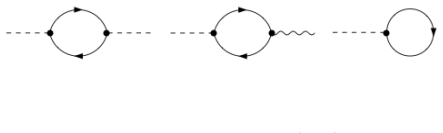
Sector(0,0) The (0,0)-sector is spanned by diagrams with no internalhanda ′ µ-lines. Diagrams involving internalσ ′ andX ′-lines and no vertices of the type of Eq. (4.4) cancel against themselves and thus they can be safely dropped in the subsequent analysis. For instance, diagrams in Fig. 1 cancel out since the interaction vertices are the same while the...
-
[2]
(C11) The form factors in the sectors (0,1), (0,2), (3,0), (0,3) vanish
+ 28M2 A −16M 2]p1 ·p 2 + 72(M4 +M 4 A +M 2 AM 2) o 1 ϵ , 24 E(1;1,1) 1 = 5p 2 1 −4p 1·p2 −16p 2 2 −45M 2 A −61M 2 24π 2 v3 1 ϵ , E(1;1,1) 2 = −16p 2 1 −4p 1·p2 + 5p 2 2 −45M 2 A −61M 2 24π 2 v3 , E(1;1,1) 3 = 5p 2 1 + 14p 1·p2 + 5p 2 2 −25M 2 A −23M 2 12π 2 v3 1 ϵ , E(1;1,1) 4 =− 3p 2 1 + 3p 2 2 + 8M 2 A −20M 2 24π 2 v3 1 ϵ , E(1;2,1) 0 =− 1 24π 2 v3 h p...
- [3]
-
[4]
Frohlich, G
J. Frohlich, G. Morchio, and F. Strocchi, Nucl. Phys. B190, 553 (1981)
1981
- [5]
-
[6]
The Equivalence Theorem at work: manifestly gauge-invariant Abelian Higgs model physics
B. Boeykens, D. Dudal, and T. Oosthuyse, Phys. Rev. D111, 045007 (2025), arXiv:2412.10172 [hep-th]
work page Pith review arXiv 2025
-
[7]
Kamefuchi, L
S. Kamefuchi, L. O’Raifeartaigh, and A. Salam, Nucl. Phys.28, 529 (1961)
1961
Show all 31 references
-
[8]
M. C. Bergere and Y.-M. P. Lam, Phys. Rev. D13, 3247 (1976)
1976
-
[9]
Blasi, N
A. Blasi, N. Maggiore, S. P. Sorella, and L. C. Q. Vilar, Phys. Rev. D59, 121701 (1999), arXiv:hep-th/9812040
1999 arXiv
-
[10]
Ferrari, M
R. Ferrari, M. Picariello, and A. Quadri, JHEP04, 033 (2002), arXiv:hep-th/0203200
2002 arXiv
-
[11]
Cohen, M
T. Cohen, M. Forslund, and A. Helset, (2024), arXiv:2412.12247 [hep-th]
2024
-
[12]
Binosi and A
D. Binosi and A. Quadri, Phys. Rev. D106, 065022 (2022), arXiv:2206.00894 [hep-th]
2022 arXiv
-
[13]
Dudal, D
D. Dudal, D. M. van Egmond, M. S. Guimaraes, O. Holanda, L. F. Palhares, G. Peruzzo, and S. P. Sorella, JHEP02, 188 (2020), arXiv:1912.11390 [hep-th]
2020 arXiv
-
[14]
Dudal, D
D. Dudal, D. M. van Egmond, M. S. Guimaraes, L. F. Palhares, G. Peruzzo, and S. P. Sorella, Eur. Phys. J. C81, 222 (2021), arXiv:2008.07813 [hep-th]
2021 arXiv
-
[16]
Quadri, JHEP05, 051 (2002), arXiv:hep-th/0201122 [hep-th]
A. Quadri, JHEP05, 051 (2002), arXiv:hep-th/0201122 [hep-th]
2002 arXiv
-
[17]
Quadri, Eur
A. Quadri, Eur. Phys. J. C84, 975 (2024), [Erratum: Eur.Phys.J.C 84, 1073 (2024)], arXiv:2402.01016 [hep-th]
2024 arXiv
- [18]
-
[19]
A. A. Slavnov, Theor. Math. Phys.10, 99 (1972), [Teor. Mat. Fiz.10,153(1972)]
1972
-
[20]
J. C. Taylor, Nucl. Phys.B33, 436 (1971)
1971
-
[21]
Weinberg,The quantum theory of fields
S. Weinberg,The quantum theory of fields. Vol. 2: Modern applications(Cambridge University Press, 2013)
2013
-
[22]
Becchi, A
C. Becchi, A. Rouet, and R. Stora, Phys. Lett.B52, 344 (1974). 29
1974
-
[23]
Kugo and I
T. Kugo and I. Ojima, Phys. Lett.B73, 459 (1978)
1978
-
[24]
Curci and R
G. Curci and R. Ferrari, Nuovo Cim.A35, 273 (1976)
1976
-
[25]
Piguet and S
O. Piguet and S. P. Sorella, Lect. Notes Phys. Monogr.28, 1 (1995)
1995
-
[26]
P. A. Grassi, T. Hurth, and M. Steinhauser, Annals Phys.288, 197 (2001), arXiv:hep- ph/9907426 [hep-ph]
2001
-
[27]
B´ elusca-Maito, A
H. B´ elusca-Maito, A. Ilakovac, P. Kuehler, M. Mador-Bovzinovic, D. Stoeckinger, and M. Weisswange, Symmetry15, 622 (2023), arXiv:2303.09120 [hep-ph]
2023 arXiv
-
[28]
Gomis, J
J. Gomis, J. Paris, and S. Samuel, Phys. Rept.259, 1 (1995), arXiv:hep-th/9412228 [hep-th]
1995 arXiv
-
[29]
Binosi and A
D. Binosi and A. Quadri, Eur. Phys. J. C80, 807 (2020), arXiv:1904.06693 [hep-ph]
2020 arXiv
-
[30]
Hahn, Comput
T. Hahn, Comput. Phys. Commun.140, 418 (2001), arXiv:hep-ph/0012260 [hep-ph]
2001 arXiv
-
[31]
Hahn,Zeuthen Workshop on Elementary Particle Theory: Loops and Legs in Quantum Field Theory Koenigstein-Weissig, Germany, April 9-14, 2000, Nucl
T. Hahn,Zeuthen Workshop on Elementary Particle Theory: Loops and Legs in Quantum Field Theory Koenigstein-Weissig, Germany, April 9-14, 2000, Nucl. Phys. Proc. Suppl.89, 231 (2000), arXiv:hep-ph/0005029 [hep-ph]. 30
2000 arXiv
Reviewed August 7, 2026 · model on record in the stance chip above.
Discussion (0). Sign in to comment.