REVIEW 2 major objections 3 minor 2 references
Agnostic Reinforcement Learning: Foundations and Algorithms
T0 review · 2 major / 3 minor · reviewed 2026-08-07 · deepseek-v4-flash
Pith's one-line read This thesis characterizes agnostic policy learning by showing that a single structural quantity of the policy class—the spanning capacity—sets the minimax sample complexity for simulator access, while online reinforcement learning needs…
desk verdict A clean, honest thesis-level synthesis of three strong papers on agnostic policy learning, with no new theorems but real value as a unified reference; the one proof I would ask to patch is Lemma 2.1, and the posted counterexample to it does not hold up. read the letter →
The pith
A machine-rendered reading of the paper's core claim, the machinery that carries it, and where it could break.
The reading
What carries the argument
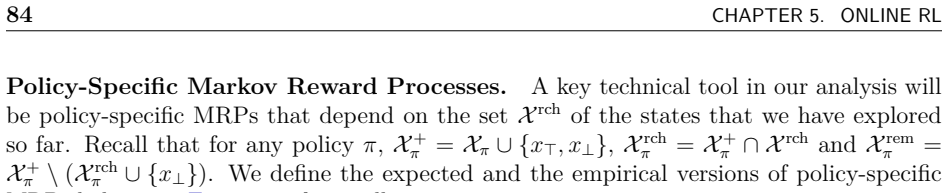
The central object is the spanning capacity C(Π), defined as the maximum, over deterministic MDPs and layers, of the number of state-action pairs reached at that layer by some policy in Π; an equivalent lemma shows it equals worst-case coverability over all stochastic MDPs. The generative-model upper bound uses a modified TrajectoryTree algorithm that samples only Π-reachable state-action pairs, while the lower bound embeds a multi-armed bandit into the reachable set. For online RL, the new machinery is the sunflower property, which decomposes a policy class into a small core Πcore plus per-policy petal states, and the policy-specific Markov reward process, which collapses the MDP into a small tabular process per policy so that importance sampling can estimate all policies' values with controlled bias and variance.
What would settle it
For the online lower bound, instantiate the constructed class at ε = $2^{{-√H}}$ and ℓ = √H and check whether any algorithm can succeed with $2^{{o(H)}}$ trajectories; if one can, the claimed $ε^{{-Ω(log C)}}$ lower bound is false.
Extended reading notes
Core claim
The central claim is that bounded spanning capacity—the largest number of state-action pairs reachable at any layer by any policy in the class, maximized over deterministic MDPs—is necessary and sufficient for agnostic PAC policy learning with generative model or local simulator access. The minimax sample complexity is Θ(C(Π)/ε² · log(1/δ)) up to H log|Π| factors. For online RL, this characterization fails: a lower bound constructs a policy class with C(Π) polynomial in the horizon yet requiring $ε^{{-Ω(log C(Π))}}$ samples, proving that spanning capacity is insufficient for online interaction. When the policy class additionally satisfies the (K,D)-sunflower property, a new algorithm called POPLER achieves poly(C(Π), K, D, 1/ε, log|Π|) sample complexity by evaluating all policies simultaneously through a policy-specific Markov reward process.
Load-bearing premise
For the positive online result, everything rests on the policy class admitting a small sunflower decomposition—a small core of policies plus a few exceptional states per policy—and no polynomial guarantee is known when that decomposition is exponential.
Editorial extensions
If this is right
- With a simulator, learning a policy class needs only enough samples to cover the state-action pairs reachable by the class, not the entire state space.
- Spanning capacity is the right minimax statistic for generative and local-simulator access, settling the sample complexity up to H log|Π| factors.
- Online RL is strictly harder than simulator RL, and stochastic environments are strictly harder than deterministic ones for agnostic policy learning.
- Policy classes with shared structure, such as singleton, ℓ-ton, and active policies, are efficiently learnable online because they satisfy the sunflower property with small parameters.
- Adapting to good coverage is statistically intractable for policy learning even with generative access, in contrast to value-based methods.
Reading between the lines
- If the sunflower property turns out to be necessary as well as sufficient, then online agnostic policy learning algorithms should be designed by first searching over sunflower decompositions of the policy class.
- The lower-bound constructions are Block MDPs with tiny latent state spaces, so the hardness is not an artifact of complex latent dynamics; it persists even when the environment has low intrinsic complexity.
- A practical reading of the generative-versus-online separation is that when resets are unavailable, policy search methods should either explicitly memorize reachable states or switch to value- and model-based function approximation.
- The sunflower frontier suggests a testable design principle: evaluate whether a policy class can be approximated by a small core plus a few exceptional states before committing to an exploration strategy.
Editorial analysis
A structured set of objections, weighed in public.
Referee Report
Summary. This PhD thesis studies agnostic PAC reinforcement learning, in which the learner is given a policy class Π and must return a policy that competes with the best policy in Π without assuming that Π contains an optimal policy. The main contributions are: a new structural complexity measure called spanning capacity C(Π); minimax sample-complexity bounds for the generative model and local simulator (Theorems 4.1 and 4.2); a lower bound showing that adapting to coverability is statistically intractable (Theorem 4.3); a lower bound for online RL showing that bounded spanning capacity alone is insufficient (Theorem 5.1); and a positive online RL result for policy classes satisfying a sunflower property, achieved by the POPLER algorithm (Theorem 5.2). Additional chapters treat imitation learning, µ-resets, and hybrid resets, with a new algorithmic tool called the policy emulator.
Significance. If the results hold, this thesis provides a substantial step toward a learning-theoretic account of agnostic RL with function approximation. It introduces clean, policy-class-only complexity measures, establishes minimax characterizations for simulator access, and demonstrates sharp separations between interaction protocols. Strengths include the detailed information-theoretic lower-bound constructions, the careful treatment of infinite policy classes via Natarajan dimension, and the explicit algorithmic tools (policy-specific MRPs, POPLER, PLHR). The manuscript is also honest about its open problems and its reliance on prior published work. The main reservation is that one foundational lemma used to support the online upper bound has an invalid proof as written; the lemma may be true and repairable, but the current text does not establish it.
major comments (2)
- [Section 2.4.2, Lemma 2.1] The proof of Lemma 2.1 contains a false equality in the final "derandomization" step. After swapping suprema and sums, the proof claims that ∑_{a1} sup_{x2} ∑_{a2} ... sup_{xh} ∑_{ah} 1{∃π: π⇝(x_{1:h},a_{1:h})} equals C_h(Π). This is not correct, because the same state-action pair can be counted multiple times for different action prefixes. For example, take X1={x1}, X2={x2}, A={0,1}, and Π={π0,π1} with π0(x1)=π0(x2)=0 and π1(x1)=1, π1(x2)=0. The displayed expression equals 2, while C_2(Π)=1. This step is load-bearing: Section 5.3.1 uses Lemma 2.1 to argue that the number of petal states discovered by POPLER is at most O(D·C(Π)/ε), an essential ingredient in the Theorem 5.2 sample-complexity bound. The lemma may be true, and a coupling argument may repair it, but the proof as written does not establish it. Please replace the proof with a correct one or cite a correct proof.
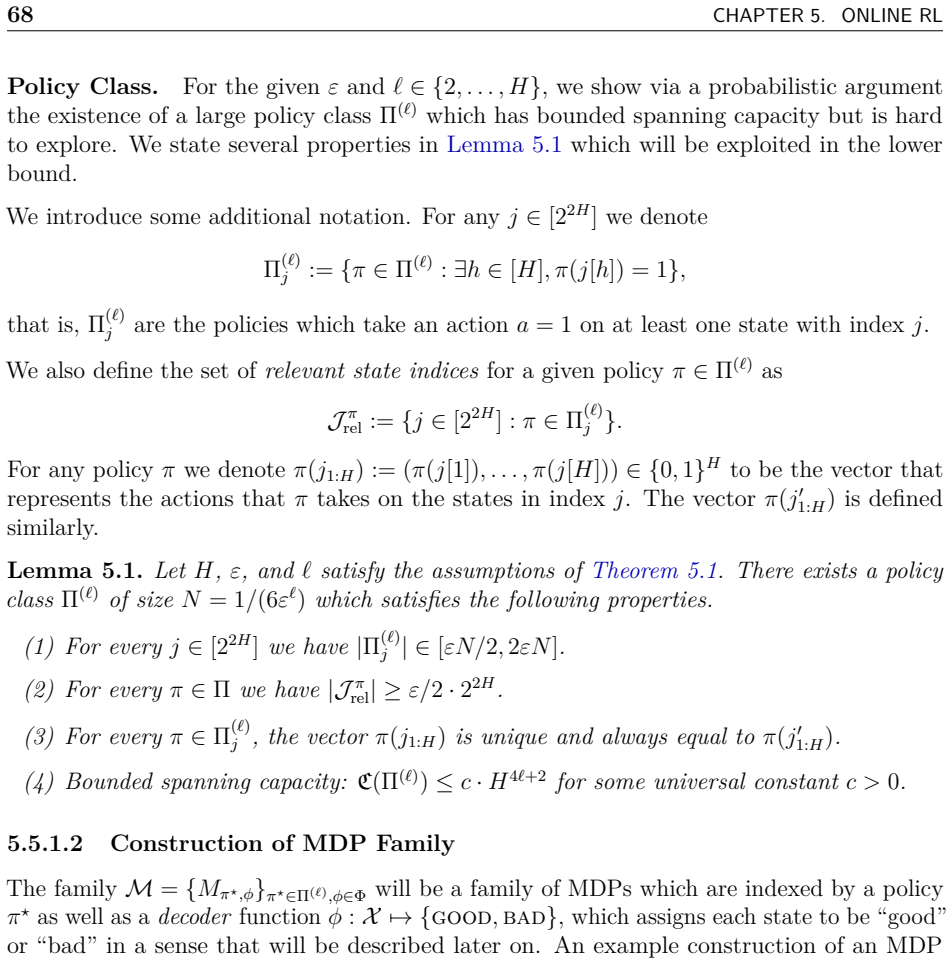
- [Sections 5.3.1 and 5.5.2, Theorem 5.2] The proof of Theorem 5.2 is presented as a deferred proof sketch, and the version of the manuscript does not make all steps verifiable. In particular, the bound on the number of reachable petal states, |T|≤O(D·C(Π)/ε), is stated in Section 5.3.1 as a consequence of Lemma 2.1; since the proof of Lemma 2.1 is currently invalid, this part of the argument is unsupported unless the lemma is repaired. Because Theorem 5.2 is the central positive result of Chapter 5, the deferred proof in Section 5.5.2 should be written out in full and checked carefully for the reachable-state counting step as well as for the bias-variance decomposition of the policy-specific MRP estimates.
minor comments (3)
- [Section 5.4] The displayed formula in Question 5.1 is malformed: "non(Π;ε,δ) ≲ 1/ε^{O(log C(Π)· log|Π|/δ}" is missing a closing parenthesis and the intended dependence is not clear. Please correct the expression.
- [Section 4.2.1] The pseudodimension argument replacing log|Π| with the Natarajan dimension is only sketched. A short formal statement of the relevant shattering bound for trajectory trees would improve readability, though the steps are plausible.
- [Table 1.1] The row for "Gen/Local Sim." writes "≲ C, ≳ C" without explicitly separating upper and lower bounds; this is understandable in context but could be clarified for readers.
Circularity Check
No significant circularity: complexity measures are structural, and the sample-complexity bounds are proven theorems rather than fitted inputs disguised as predictions.
full rationale
The thesis does not exhibit circularity. The central complexity measure, spanning capacity (Definition 2.4), is a purely structural parameter of the policy class, and Theorem 4.1 proves an upper bound by constructing unbiased trajectory-tree estimates whose per-tree query count is bounded by H·C(Π) directly from the definition of C(Π). Theorem 4.2 gives a matching lower bound by embedding a C(Π)-armed bandit into a deterministic MDP witnessing C(Π); neither direction fits a parameter to a subset of data and then 'predicts' a closely related quantity. The sunflower property (Definition 5.3) is introduced as a representational assumption, and Theorem 5.2's POPLER analysis proves the sample-complexity bound rather than assuming it. The disclosed reliance on the author's prior publications in Section 1.3 is not load-bearing in a circular sense: the load-bearing results, such as the spanning-capacity/worst-case-coverability equivalence in Lemma 2.1 and the block-free matrix construction in Lemma 5.1, are proven within the thesis or in externally checkable papers, so the derivation does not reduce to an unverified self-citation. The skeptical observation that the proof of Lemma 2.1 contains a suspect equality after swapping suprema and sums is a correctness risk in the written proof, not a circularity; a repaired proof would still use a C(Π) defined independently of the theorem being proved. No pattern from self-definitional, fitted-input-called-prediction, self-citation-load-bearing, imported uniqueness, ansatz-via-citation, or renaming-known-result applies, so the central claims have independent content.
Assumptions & free parameters
assumptions (5)
- domain assumption Finite-horizon MDP with layered state space and rewards normalized to sum at most 1.
- domain assumption The learner is given the policy class Π and, in algorithms, the sunflower decomposition (Π_core, {X_π}).
- ad hoc to paper The policy class admits a (K,D)-sunflower decomposition for the online RL upper bound.
- domain assumption In lower bounds, the learner has no decoder/emission class Φ containing the true decoder (no decoder realizability).
- standard math Standard concentration inequalities and information-theoretic lower-bound tools (Hoeffding, Chernoff, Le Cam) are valid.
invented entities (2)
-
Policy-specific Markov Reward Process (MRP)
-
Policy emulator
Cite this review
Pith. "Pith review of Agnostic Reinforcement Learning: Foundations and Algorithms." pith.science (2026). https://pith.science/paper/GJSI57FH
@misc{pith2026250601884,
  author       = {Pith},
  title        = {Pith review of: Agnostic Reinforcement Learning: Foundations and Algorithms},
  year         = {2026},
  howpublished = {\url{https://pith.science/paper/GJSI57FH}},
  note         = {Machine review of arXiv:2506.01884}
}
abstract
Reinforcement Learning (RL) has demonstrated tremendous empirical success across numerous challenging domains. However, we lack a strong theoretical understanding of the statistical complexity of RL in environments with large state spaces, where function approximation is required for sample-efficient learning. This thesis addresses this gap by rigorously examining the statistical complexity of RL with function approximation from a learning theoretic perspective. Departing from a long history of prior work, we consider the weakest form of function approximation, called agnostic policy learning, in which the learner seeks to find the best policy in a given class $\Pi$, with no guarantee that $\Pi$ contains an optimal policy for the underlying task. We systematically explore agnostic policy learning along three key axes: environment access -- how a learner collects data from the environment; coverage conditions -- intrinsic properties of the underlying MDP measuring the expansiveness of state-occupancy measures for policies in the class $\Pi$, and representational conditions -- structural assumptions on the class $\Pi$ itself. Within this comprehensive framework, we (1) design new learning algorithms with theoretical guarantees and (2) characterize fundamental performance bounds of any algorithm. Our results reveal significant statistical separations that highlight the power and limitations of agnostic policy learning.
Figures


Figures from the paper (19 more)




Reference graph
Works this paper leans on
-
[1]
[AN04] Pieter Abbeel and Andrew Y Ng. Apprenticeship learning via inverse re- inforcement learning.International Conference on Machine learning, 2004 (cited on page 102). [AHKS20] Alekh Agarwal, Mikael Henaff, Sham Kakade, and Wen Sun. Pc-pg: policy cover directed exploration for provable policy gradient learning.Advances in Neural Information Processing ...
arXiv 2004
-
[101]
Colloq. Math, 1951 (cited on page 76). [ZCHCLC23] Wenhao Zhan, Shicong Cen, Baihe Huang, Yuxin Chen, Jason D Lee, and Yuejie Chi. Policy mirror descent for regularized reinforcement learning: a gen- eralized framework with linear convergence.SIAM Journal on Optimization, 2023 (cited on page 131). 193 BIBLIOGRAPHY [ZHHJL22] Wenhao Zhan, Baihe Huang, Audrey...
arXiv 1951
Reviewed August 7, 2026 · model on record in the stance chip above.
Discussion (0). Sign in to comment.