REVIEW 5 major objections 8 minor 48 references
Graph-Based Adversarial Domain Generalization with Anatomical Correlation Knowledge for Cross-User Human Activity Recognition
T0 review · 5 major / 8 minor · reviewed 2026-08-15 · deepseek-v4-flash
Pith's one-line read The paper claims that encoding three anatomical sensor-relationship graphs and cycling through them during adversarial training lets a GNN generalize to unseen users, reaching 70.95% and 87.31% on OPPORTUNITY and DSADS.
desk verdict A plausible new combination of anatomical graph priors and adversarial DG for HAR, but the training objective and the reported numbers are under-specified; worth referee time, not acceptance as is. read the letter →
The pith
A machine-rendered reading of the paper's core claim, the machinery that carries it, and where it could break.
The reading
What carries the argument
The load-bearing mechanism is a two-layer graph convolutional network whose only task-specific input is the choice of which adjacency matrix is active: $A_I$ with edges between neighboring sensors, $A_A$ with edges between symmetrical or functionally similar body parts, and $A_L$ with edges among sensors on the same side of the body. At epoch $t$ the active matrix is $A(t)=A_{\tau(\lfloor t/N\rfloor \bmod 3)}$, so every $N$ epochs the model's view of body coordination changes. Global mean pooling turns the node embeddings into one vector; an activity classifier optimizes cross-entropy, while a source-user discriminator with a Gradient Reversal Layer—a layer that flips gradient signs before backpropagating from the discriminator—removes user identity from the pooled features. Nothing in the graph is learned from data: the edges are the anatomical priors, and the claim is that these priors are what make features transfer.
What would settle it
Replace, on the same leave-one-subject-out splits, the three hand-defined adjacency matrices with either random graphs of the same density or a fully connected graph, holding the rest of the architecture and loss fixed. If a random or complete graph matches the reported 70.95% and 87.31% averages, then the specific anatomical wiring is not what carries the result; a complementary check is to permute node labels so the graph no longer corresponds to body locations and observe whether accuracy falls.
Extended reading notes
Core claim
On the paper's own terms, the central discovery is that the universal coordination patterns of the human body—neighbors moving together, mirror-symmetric limbs moving in parallel or opposition, and same-side parts cooperating—supply a domain-invariant representation that ordinary deep classifiers miss. The authors operationalize this by placing sensors as nodes of a graph and defining three adjacency matrices $A_I,A_A,A_L$ for Interconnected, Analogous, and Lateral units; a two-layer GCN propagates features along whichever matrix is active, and a cyclic schedule switches the active matrix every $N$ epochs so the model is forced to integrate all three perspectives. A Gradient Reversal Layer then makes the pooled graph features uninformative about which training user produced them. The result, according to the paper, is that the model reaches 70.95% average accuracy on held-out OPPORTUNITY users and 87.31% on held-out DSADS users, improving over each single-graph variant and over the compared domain-generalization baselines.
Load-bearing premise
The load-bearing premise is that the three hand-drawn connection patterns—neighbor, mirror-symmetry, and same-side—capture genuinely universal movement correlations; if those priors are wrong for an activity or a user, the fixed graph injects a misleading inductive bias instead of helping generalization.
Editorial extensions
If this is right
- If the claim is correct, a HAR model can be deployed to an unseen user with zero target-user data, since the edge structure encodes the invariant rather than the data.
- Because each graph type contributes differently—Analogous for full-body bilateral activities and Interconnected for localized upper-body tasks—fusing them raises accuracy over the best single graph by 1.25 to 3.30 points in the reported experiments.
- The cyclic schedule prevents over-specialization: activities that need all three perspectives, such as stair climbing or treadmill running, show the largest gains after fusion, while simple static activities can lose a little accuracy.
- The strong negative correlation between activity classification loss and held-out accuracy, with a smaller but significant contribution from the domain discriminator loss, supports the dual-loss design rather than treating the adversarial component as decorative.
Reading between the lines
- Editorial inference: if the anatomical priors are truly universal, the same three adjacency matrices should transfer across datasets with matching instrumented body sites, so a cross-dataset zero-shot test would directly probe that universality.
- Editorial inference: the paper compares only its own fixed graphs; learning residual edges on top of the anatomical priors would reveal whether the priors act as a useful initialization or as a constraint that limits novel movement patterns.
- Editorial inference: the architecture assumes full body-site coverage with sensors spread over torso and limbs, so single-sensor or wrist-only wearables fall outside its demonstrated scope; testing on such layouts would bound where the method helps.
Signed reviews
Editorial analysis
A structured set of objections, weighed in public.
Referee Report
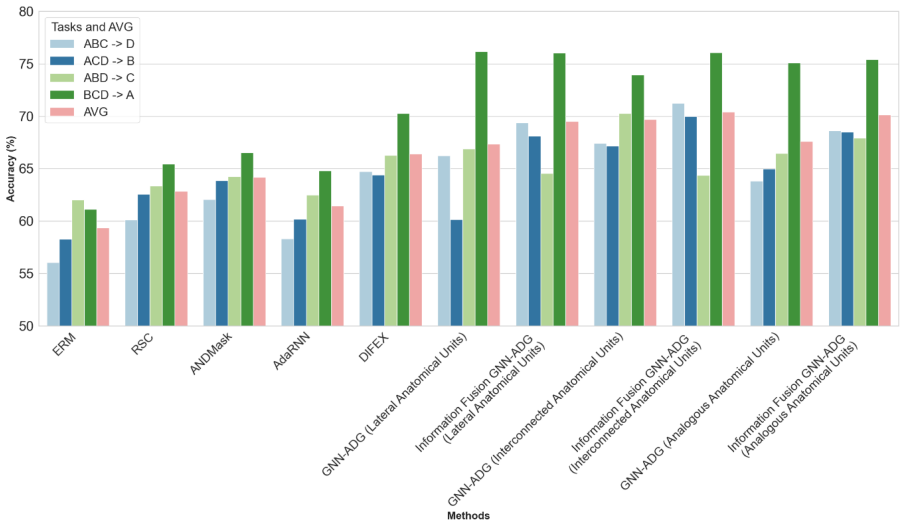
Summary. The paper proposes GNN-ADG and Information Fusion GNN-ADG for cross-user human activity recognition. The method represents body-worn sensors as graph nodes and uses three hand-defined adjacency matrices (Interconnected, Analogous, Lateral anatomical units) to encode biomechanical correlation priors. A GCN extracts graph-structured features, an adversarial domain discriminator with a gradient reversal layer encourages user-invariant representations, and a cyclic training schedule alternates among the three adjacency matrices. The authors evaluate on OPPORTUNITY and DSADS under a leave-one-(cluster)-out protocol and report that the Information Fusion variant outperforms several domain generalization baselines, with best average accuracies of 70.95% and 87.31%.
Significance. If the training objective and experimental configuration are clarified and the results are reproducible, the anatomical-correlation graph prior is a plausible and potentially useful contribution to domain generalization in sensor-based HAR. The evaluation against ERM, RSC, ANDMask, AdaRNN, and DIFEX on two public benchmarks is appropriate, and the interpretability analysis attempts to connect fused graph types to activity categories. However, the paper currently provides no code, no hyperparameter values for the central cyclic schedule, no significance tests, and the stated fusion objective is not actually optimized by the described training procedure. These issues prevent the claimed state-of-the-art results from being verified or attributed to the proposed mechanism.
major comments (5)
- [Section 3.2.5, Eqs. (9)-(11)] The training objective as written is internally inconsistent. Equation (9) selects a single adjacency matrix at epoch t, so the forward pass and the losses in Eq. (10) involve exactly one of AI, AA, AL. Equation (11) then defines Ltotal as the sum of the three phase-specific losses and asserts that cycling 'effectively optimizes' this combined objective. Sequential gradient updates of a nonconvex network on time-varying losses do not minimize the sum of the three losses, and no forward pass that computes all three losses before backpropagation is described. Thus the 'information fusion' claimed in the abstract and Section 5 is not supported by the stated training procedure. Please state explicitly which objective is actually optimized, provide pseudocode or a precise training loop, and if the cyclic schedule is intended as a curriculum, rename it accordingly and remove the sum-objective claim.
- [Tables 2 and 3, Section 4.2] The tables list 'Information Fusion GNN-ADG (Lateral Anatomical Units)', 'Information Fusion GNN-ADG (Interconnected Anatomical Units)', and 'Information Fusion GNN-ADG (Analogous Anatomical Units)' as separate rows, but Section 3.2.5 defines a single fused model that cycles through all three graph types. It is unclear whether these rows represent (a) runs that use only that single graph with some fusion mechanism, or (b) runs that cycle through all three matrices and are then labeled by the graph active at the final epoch. Without clarification, the headline accuracies (87.31% on DSADS, 70.95% on OPPT) cannot be tied to a well-defined configuration, and the information fusion analysis in Section 4.2 is uninterpretable.
- [Section 4, experimental setup and hyperparameters] The cycle interval N and the adversarial loss weight beta, which are central to Eqs. (9)-(11), are never given values, and no optimizer, learning rate, number of epochs, or code is provided. The reported standard deviations are computed across only four folds, and no significance tests are run, so the probability that the observed accuracy gaps arise by chance is unknown. Please report all hyperparameters, include a sensitivity study for at least N and beta, and provide significance tests or per-fold results so that the state-of-the-art claim is statistically grounded.
- [Section 4.4, Table 4] The near-perfect negative correlation between activity classification loss and target accuracy (r = -0.946) is largely tautological: training progress on the source domains and accuracy on held-out users are both driven by the same learned features, so a strong negative correlation is expected even without any domain generalization mechanism. This analysis does not validate the 'dual-loss design' or 'synergistic effects' claimed in the text, nor does it ablate the graph topology or the gradient reversal layer. A proper ablation would remove the domain loss or replace each adjacency matrix with a learned or random graph and report target-user accuracy.
- [Section 3.2.2, Figure 3, Table 1] The three adjacency matrices are asserted to capture universal anatomical correlations, but no evidence is provided that these edges are correct or that cycling through them is superior to alternative edge definitions or learned graphs. In addition, Figure 3 shows seven nodes (a-g) while Table 1 lists five sensor positions for each dataset, so it is unclear how the adjacency matrices are constructed for the actual sensor sets. Please clarify the node-to-sensor mapping and validate the anatomical prior by comparing against learned adjacency matrices or alternative hand-defined topologies.
minor comments (8)
- [Abstract] The phrase 'leverages both the strength from both the Graph Neural Networks' contains a duplicated 'both'; 'fused into an unified graph structure' should read 'a unified graph structure'.
- [Section 3.2.5] The sentence 'if N = 20, the pattern restarts at t = 60, mirroring the original 20-epoch interval design' is unclear; Eq. (9) already specifies the phase boundaries, so the 'mirroring' wording can be removed or rephrased.
- [Section 4.1] The evaluation is described as 'leave-one-subject-out', but Table 1 defines domains as clusters (e.g., DSADS domains A-D each contain two subjects), so the protocol is leave-one-cluster-out; please use consistent terminology.
- [Table 4] The p-values are misformatted as '2 .446 x 10^-74' and '4 .682 x 10^-13'; please use standard scientific notation (e.g., 2.446e-74).
- [Figure 3] The figure labels seven sensor nodes but the datasets use five sensor positions; please align the figure with Table 1 or explain which nodes are omitted and why.
- [References] References [32] and [48] cite the same DIFEX paper; please merge them into a single reference.
- [Figures 6 and 7] The text refers to orange and green rectangles highlighting improved and declined activities, but the figure captions do not describe these annotations; please add a legend or explicit caption entries.
- [Abstract and Section 3.2.5] The name 'Information Fusion' is used as a proper noun before it is defined; consider referring to 'the cyclic information fusion strategy' and defining it precisely in Section 3.2.5.
Circularity Check
No significant circularity: the headline benchmark claims rest on held-out users and external baselines; only the Section 4.4 correlation 'validation' is a tautological, non-load-bearing check.
-
other
[Section 4.4, Table 4 (Ablation Study Analysis)]
"Activity Classification Loss demonstrates a remarkably strong negative correlation with target accuracy. This near-perfect inverse relationship indicates that reductions in activity classification loss directly correspond to accuracy improvements, confirming its role as the primary driver of model performance."
The activity classification loss (Eq. 6) is exactly the objective minimized during training, and target accuracy is the same classifier's prediction correctness on held-out users. A near-perfect negative correlation between these two quantities is therefore a restatement of the training objective rather than independent evidence for the anatomical-graph or adversarial design. It does not distinguish GNN-ADG from any model trained with cross-entropy, so using it as a 'validation' of the dual-loss strategy is tautological. This step is not load-bearing for the main claim, which is supported by leave-one-subject-out benchmark comparisons against external DG methods.
full rationale
The paper's central claim is empirical: Information Fusion GNN-ADG reports 70.95% on OPPORTUNITY and 87.31% on DSADS under leave-one-subject-out evaluation against external domain-generalization baselines. Those numbers come from training on source users and testing on held-out users, so the headline comparison is not circular. The three anatomical adjacency matrices are explicit hand-defined priors in Section 3.2.2 and Figure 3, not quantities fitted from target data or from the reported accuracies; the GRL adversarial component follows Ganin and Lempitsky, an external method. Author self-citations appear only in background remarks about cross-user variability and do not carry the argument. The only step approaching circularity is Section 4.4's correlation 'validation': the near-perfect negative correlation between activity classification loss and target accuracy is a tautological check of the training objective rather than independent evidence for the proposed architecture. It is not load-bearing for the main benchmark claims, so the overall circularity score is low. The skeptic's concern about Eqs. (9)-(11)—that cycling through single adjacency matrices does not literally optimize the summed Ltotal—is a reproducibility and correctness issue, not a circularity, because the paper's evaluation still stands or falls on held-out benchmark accuracy rather than on the algebraic equivalence of the stated objective.
Assumptions & free parameters
free parameters (3)
- Cycle interval N
- Adversarial loss weight beta
- Model and training hyperparameters
assumptions (3)
- domain assumption Anatomical correlations are consistent across users and correctly encoded by the three hand-defined adjacency matrices.
- domain assumption Sensor positions are known and match the anatomical nodes used in the graph.
- ad hoc to paper Cycling through edge topologies approximates simultaneous fusion of anatomical information.
Cite this review
Pith. "Pith review of Graph-Based Adversarial Domain Generalization with Anatomical Correlation Knowledge for Cross-User Human Activity Recognition." pith.science (2026). https://pith.science/paper/J7NIMSIA
@misc{pith2026250601962,
  author       = {Pith},
  title        = {Pith review of: Graph-Based Adversarial Domain Generalization with Anatomical Correlation Knowledge for Cross-User Human Activity Recognition},
  year         = {2026},
  howpublished = {\url{https://pith.science/paper/J7NIMSIA}},
  note         = {Machine review of arXiv:2506.01962}
}
read the original abstract
Cross-user variability poses a significant challenge in sensor-based Human Activity Recognition (HAR) systems, as traditional models struggle to generalize across users due to differences in behavior, sensor placement, and data distribution. To address this, we propose GNN-ADG (Graph Neural Network with Adversarial Domain Generalization), a novel method that leverages both the strength from both the Graph Neural Networks (GNNs) and adversarial learning to achieve robust cross-user generalization. GNN-ADG models spatial relationships between sensors on different anatomical body parts, extracting three types of Anatomical Units: (1) Interconnected Units, capturing inter-relations between neighboring sensors; (2) Analogous Units, grouping sensors on symmetrical or functionally similar body parts; and (3) Lateral Units, connecting sensors based on their position to capture region-specific coordination. These units information are fused into an unified graph structure with a cyclic training strategy, dynamically integrating spatial, functional, and lateral correlations to facilitate a holistic, user-invariant representation. Information fusion mechanism of GNN-ADG occurs by iteratively cycling through edge topologies during training, allowing the model to refine its understanding of inter-sensor relationships across diverse perspectives. By representing the spatial configuration of sensors as an unified graph and incorporating adversarial learning, Information Fusion GNN-ADG effectively learns features that generalize well to unseen users without requiring target user data during training, making it practical for real-world applications.
Figures


Figures from the paper (4 more)



Reference graph
Works this paper leans on
-
[1]
A. Bulling, U. Blanke, B. Schiele, A tutorial on human activity recognition using body-worn inertial sensors, ACM Computing Surveys (CSUR) 46 (3) (2014) 1–33
work page 2014
-
[2]
J. R. Kwapisz, G. M. Weiss, S. A. Moore, Activity recognition using cell phone accelerometers, ACM SigKDD Explorations Newsletter 12 (2) (2011) 74–82
2011
-
[3]
X. Ye, K. Sakurai, N.-K. C. Nair, K. I.-K. Wang, Machine learning techniques for sensor-based human activity recognition with data heterogeneity—a review, Sensors 24 (24) (2024). doi:10. 3390/s24247975
work page 2024
-
[4]
X. Ye, K. I.-K. Wang, Cross-user activity recognition via temporal relation optimal transport, in: International Conference on Mobile and Ubiquitous Systems: Computing, Networking, and Services, Springer, 2023, pp. 355–374
2023
-
[5]
F. J. Ord´ o˜ nez, D. Roggen, Deep convolutional and lstm recurrent neural networks for multimodal wearable activity recognition, Sensors 16 (1) (2016) 115
2016
-
[6]
N. Y. Hammerla, S. Halloran, T. Pl¨ otz, Deep, convolutional, and recurrent models for human activity recognition using wearables, arXiv preprint arXiv:1604.08880 (2016)
arXiv 2016
-
[7]
J. Wang, V. W. Zheng, Y. Chen, M. Huang, Deep transfer learning for cross-domain activity recog- nition, in: proceedings of the 3rd International Conference on Crowd Science and Engineering, 2018, pp. 1–8
2018
-
[8]
D. Li, Y. Yang, Y.-Z. Song, T. M. Hospedales, Learning to generalize: Meta-learning for domain generalization, in: Proceedings of the AAAI Conference on Artificial Intelligence, Vol. 32, 2018
2018
Show all 48 references
-
[9]
Ahmad, L
T. Ahmad, L. Jin, X. Zhang, S. Lai, G. Tang, L. Lin, Graph convolutional neural network for human action recognition: A comprehensive survey, IEEE Transactions on Artificial Intelligence 2 (2) (2021) 128–145
2021
-
[10]
Ganin, V
Y. Ganin, V. Lempitsky, Unsupervised domain adaptation by backpropagation, in: International conference on machine learning, PMLR, 2015, pp. 1180–1189
2015
-
[11]
Gil-Mart´ ın, J
M. Gil-Mart´ ın, J. L´ opez-Iniesta, F. Fern´ andez-Mart´ ınez, R. San-Segundo, Reducing the impact of sensor orientation variability in human activity recognition using a consistent reference system, Sensors 23 (13) (2023) 5845. 27
2023
-
[12]
Soleimani, E
E. Soleimani, E. Nazerfard, Cross-subject transfer learning in human activity recognition systems using generative adversarial networks, Neurocomputing 426 (2021) 26–34
2021
-
[13]
S. Wang, J. Wang, H. Xi, B. Zhang, L. Zhang, H. Wei, Optimization-free test-time adaptation for cross-person activity recognition, Proceedings of the ACM on Interactive, Mobile, Wearable and Ubiquitous Technologies 7 (4) (2024) 1–27
2024
-
[14]
Gupta, S
N. Gupta, S. K. Gupta, R. K. Pathak, V. Jain, P. Rashidi, J. S. Suri, Human activity recognition in artificial intelligence framework: a narrative review, Artificial intelligence review 55 (6) (2022) 4755–4808
2022
-
[15]
J. Guo, U. Kurup, M. Shah, Efficacy of model fine-tuning for personalized dynamic gesture recog- nition, in: International Workshop on Deep Learning for Human Activity Recognition, Springer, 2021, pp. 99–110
2021
-
[16]
X. Ye, K. I.-K. Wang, Cross-user activity recognition using deep domain adaptation with temporal dependency information, IEEE Transactions on Instrumentation and Measurement 74 (2025) 1–15
2025
-
[17]
Bento, J
N. Bento, J. Rebelo, A. V. Carreiro, F. Ravache, M. Barandas, Exploring regularization methods for domain generalization in accelerometer-based human activity recognition, Sensors 23 (14) (2023) 6511
2023
-
[18]
Thukral, H
M. Thukral, H. Haresamudram, T. Ploetz, Cross-domain har: Few-shot transfer learning for human activity recognition, ACM Transactions on Intelligent Systems and Technology 16 (1) (2025) 1–35
2025
-
[19]
X. Ye, K. I.-K. Wang, Deep generative domain adaptation with temporal relation attention mecha- nism for cross-user activity recognition, Pattern Recognition (2024) 110811
2024
-
[20]
Gopalakrishnan, N
T. Gopalakrishnan, N. Wason, R. J. Krishna, N. Krishnaraj, Comparative analysis of fine-tuning i3d and slowfast networks for action recognition in surveillance videos, Engineering Proceedings 59 (1) (2024) 203
2024
-
[21]
E. Genc, M. E. Yildirim, B. S. Yucel, Human activity recognition with fine-tuned cnn-lstm, Journal of Electrical Engineering 75 (1) (2024) 8–13
2024
-
[22]
C. F. S. Leite, Y. Xiao, Resource-efficient continual learning for sensor-based human activity recog- nition, ACM Transactions on Embedded Computing Systems 21 (6) (2022) 1–25
2022
-
[23]
X. Ye, K. Sakurai, N. C. Nair, K. I. Wang, Machine learning techniques for sensor-based human activity recognition with data heterogeneity-a review, Sensors 24 (24) (2024) 7975. doi:10.3390/ s24247975. 28
2024
-
[24]
Farahani, S
A. Farahani, S. Voghoei, K. Rasheed, H. R. Arabnia, A brief review of domain adaptation, Advances in data science and information engineering: proceedings from ICDATA 2020 and IKE 2020 (2021) 877–894
2021
-
[25]
X. Ye, K. I.-K. Wang, Deep generative domain adaptation with temporal relation knowledge for cross-user activity recognition, in: International Conference on Mobile and Ubiquitous Systems: Computing, Networking, and Services, 2024
2024
-
[26]
Chakma, A
A. Chakma, A. Z. M. Faridee, M. A. A. H. Khan, N. Roy, Activity recognition in wearables using adversarial multi-source domain adaptation, Smart Health 19 (2021) 100174
2021
-
[27]
R. Hu, L. Chen, S. Miao, X. Tang, Swl-adapt: An unsupervised domain adaptation model with sample weight learning for cross-user wearable human activity recognition, in: Proceedings of the AAAI Conference on artificial intelligence, Vol. 37, 2023, pp. 6012–6020
2023
-
[28]
Napoli, D
O. Napoli, D. Duarte, P. Alves, D. H. P. Soto, H. E. de Oliveira, A. Rocha, L. Boccato, E. Borin, A benchmark for domain adaptation and generalization in smartphone-based human activity recogni- tion, Scientific Data 11 (1) (2024) 1192
2024
-
[29]
Z. Hong, Z. Li, S. Zhong, W. Lyu, H. Wang, Y. Ding, T. He, D. Zhang, Crosshar: Generalizing cross-dataset human activity recognition via hierarchical self-supervised pretraining, Proceedings of the ACM on Interactive, Mobile, Wearable and Ubiquitous Technologies 8 (2) (2024) 1–26
2024
-
[30]
P. Li, D. Li, W. Li, S. Gong, Y. Fu, T. M. Hospedales, A simple feature augmentation for domain generalization, in: Proceedings of the IEEE/CVF international conference on computer vision, 2021, pp. 8886–8895
2021
-
[31]
Volpi, H
R. Volpi, H. Namkoong, O. Sener, J. Duchi, V. Murino, S. Savarese, Generalizing to unseen domains via adversarial data augmentation, in: Advances in Neural Information Processing Systems, Vol. 31, 2018
2018
-
[32]
W. Lu, J. Wang, H. Li, Y. Chen, X. Xie, Domain-invariant feature exploration for domain general- ization, Transactions on Machine Learning Research (2022)
2022
-
[33]
Parascandolo, A
G. Parascandolo, A. Neitz, A. Orvieto, L. Gresele, B. Sch¨ olkopf, Learning explanations that are hard to vary, in: International Conference on Learning Representations (ICLR 2021), OpenReview, 2021
2021
-
[34]
Y. Du, J. Wang, W. Feng, S. Pan, T. Qin, R. Xu, C. Wang, Adarnn: Adaptive learning and forecasting of time series, in: Proceedings of the 30th ACM international conference on information & knowledge management, 2021, pp. 402–411. 29
2021
-
[35]
Huang, H
Z. Huang, H. Wang, E. P. Xing, D. Huang, Self-challenging improves cross-domain generalization, in: Computer vision–ECCV 2020: 16th European conference, Glasgow, UK, August 23–28, 2020, proceedings, part II 16, Springer, 2020, pp. 124–140
2020
-
[36]
Z. Wu, S. Pan, F. Chen, G. Long, C. Zhang, S. Y. Philip, A comprehensive survey on graph neural networks, IEEE transactions on neural networks and learning systems 32 (1) (2020) 4–24
2020
-
[37]
Y. Seo, M. Defferrard, P. Vandergheynst, X. Bresson, Structured sequence modeling with graph convolutional recurrent networks, in: International Conference on Neural Information Processing, Springer, 2018, pp. 362–373
2018
-
[38]
C. Si, W. Chen, W. Wang, L. Wang, T. Tan, An attention enhanced graph convolutional lstm network for skeleton-based action recognition, in: Proceedings of the IEEE/CVF Conference on Computer Vision and Pattern Recognition, 2019, pp. 1227–1236
2019
-
[39]
L. Shi, Y. Zhang, J. Cheng, H. Lu, Two-stream adaptive graph convolutional networks for skeleton- based action recognition, in: Proceedings of the IEEE/CVF Conference on Computer Vision and Pattern Recognition, 2019, pp. 12026–12035
2019
-
[40]
Wieland, V
C. Wieland, V. Pankratius, Tinygraphhar: Enhancing human activity recognition with graph neural networks, in: 2023 IEEE World AI IoT Congress (AIIoT), IEEE, 2023, pp. 0047–0054
2023
-
[41]
Ganin, E
Y. Ganin, E. Ustinova, H. Ajakan, P. Germain, H. Larochelle, F. Laviolette, M. March, V. Lempitsky, Domain-adversarial training of neural networks, Journal of machine learning research 17 (59) (2016) 1–35
2016
-
[42]
Y. Li, N. Wang, J. Shi, X. Hou, J. Liu, Adaptive batch normalization for practical domain adapta- tion, Pattern Recognition 80 (2018) 109–117
2018
-
[43]
S. Yao, S. Hu, Y. Zhao, A. Zhang, T. Abdelzaher, Deepsense: A unified deep learning framework for time-series mobile sensing data processing, in: Proceedings of the 26th International Conference on World Wide Web, 2017, pp. 351–360
2017
-
[44]
T. N. Kipf, M. Welling, Semi-Supervised Classification with Graph Convolutional Networks, in: Proceedings of the 5th International Conference on Learning Representations, 2017
2017
-
[45]
Chavarriaga, H
R. Chavarriaga, H. Sagha, A. Calatroni, S. T. Digumarti, G. Tr¨ oster, J. d. R. Mill´ an, D. Roggen, The opportunity challenge: A benchmark database for on-body sensor-based activity recognition, Pattern Recognition Letters 34 (15) (2013) 2033–2042
2013
-
[46]
Barshan, M
B. Barshan, M. C. Y¨ uksek, Recognizing daily and sports activities in two open source machine learning environments using body-worn sensor units, The Computer Journal 57 (11) (2014) 1649– 1667. 30
2014
-
[47]
Zhang, M
H. Zhang, M. Cisse, Y. N. Dauphin, D. Lopez-Paz, mixup: Beyond empirical risk minimization, in: International Conference on Learning Representations, 2018
2018
-
[48]
W. Lu, J. Wang, H. Li, Y. Chen, X. Xie, Domain-invariant feature exploration for domain general- ization, arXiv preprint arXiv:2207.12020 (2022). 31
2022 arXiv
Reviewed August 15, 2026 · model on record in the stance chip above.
Discussion (0). Continue with ORCID to comment.