Anyon superconductivity and plateau transitions in doped fractional quantum anomalous Hall insulators
Pith reviewed 2026-05-19 11:04 UTC · model grok-4.3
The pith
Doping anyons in fractional quantum anomalous Hall insulators leads to superconductivity through composite-fermion plateau transitions.
A machine-rendered reading of the paper's core claim, the machinery that carries it, and where it could break.
Core claim
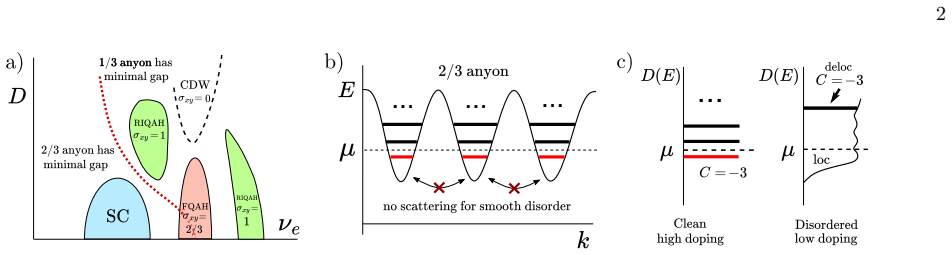
Disorder acting on the Landau-Hofstadter spectrum of anyon-flux composite fermions causes plateau transitions upon doping anyons, which map directly to superconducting or RIQAH states in the electron system, with a dictionary allowing transfer of response functions such as relating superfluid stiffness to composite-fermion polarizability.
What carries the argument
A response-function dictionary between composite-fermion integer quantum Hall plateau transitions and the physical anyon system's phases, specifically equating superfluid stiffness to CF polarizability.
If this is right
- Superfluid stiffness in the superconducting phase is proportional to the polarizability of the composite fermions.
- Longitudinal and Hall conductivities near the transitions follow the critical scaling of integer quantum Hall plateau transitions.
- Response to perpendicular magnetic fields can be inferred from the CF description and agrees with measurements.
- The narrow resistive regions between phases correspond to the critical points of the CF plateau transitions.
Where Pith is reading between the lines
- This suggests that similar doping-driven mechanisms could explain superconductivity near other fractional quantum Hall states in moiré materials.
- Experimental tuning of disorder strength might control the extent of the superconducting region via the CF band structure.
- Analogous mappings could apply to other topological anyon systems beyond twisted bilayer systems.
Load-bearing premise
The composite-fermion description and the associated dictionary remain accurate for anyons that possess a finite effective mass and are subject to statistical magnetic fields at commensurate filling.
What would settle it
If measurements of the superfluid stiffness or the critical exponents for conductivity in the doped system deviate from the expected values derived from integer quantum Hall plateau transitions, the proposed mapping would be invalidated.
Figures


read the original abstract
Recent experiments reported evidence of superconductivity and re-entrant integer quantum anomalous Hall (RIQAH) insulator upon doping the $\nu_e = 2/3$ fractional quantum anomalous Hall states (FQAH) in twisted MoTe${}_2$, separated by narrow resistive regions. Anyons of a FQAH generally have a finite effective mass, and when described by anyon-flux composite fermions (CF), experience statistical magnetic fields with a commensurate filling. Here, we show that most of the experimental observations can be explained by invoking the effects of disorder on the Landau-Hofstadter bands of CFs. In particular, by making minimal assumptions about the anyon energetics and dispersion, we show that doping anyons drives plateau transitions of CFs into integer quantum Hall states, which physically corresponds to either to a superconductor or to a RIQAH phase. We develop a dictionary that allows us to infer the response in these phases and the critical regions from the knowledge of the response functions of the plateau transitions. In particular, this allows us to relate the superfluid stiffness of the superconductor to the polarizability of CFs. As a first step towards a quantitative understanding, we borrow results from the celebrated integer quantum Hall plateau transitions to make quantitative prediction for the critical behavior of the superfluid stiffness, longitudinal and Hall conductivity, and response to out-of-plane magnetic field, all of which agree reasonably well with the experimental observations. Our results provide strong support for anyon superconductivity being the mechanism for the observed superconductor in the vicinity of the $\nu_e = 2/3$ FQAH insulator.
Editorial analysis
A structured set of objections, weighed in public.
Referee Report
Summary. The manuscript claims that doping anyons into the ν_e = 2/3 FQAH state drives composite-fermion (CF) plateau transitions into integer quantum Hall states, which map physically to either a superconductor or a re-entrant integer quantum anomalous Hall (RIQAH) phase. By constructing a dictionary that relates the physical responses (including superfluid stiffness to CF polarizability) to those of standard IQH plateau transitions and borrowing critical exponents from the latter, the authors obtain quantitative predictions for the critical behavior of superfluid stiffness, longitudinal and Hall conductivities, and out-of-plane field response that agree reasonably with recent experiments in twisted MoTe2. The explanation invokes disorder effects on the Landau-Hofstadter bands of CFs under minimal assumptions about anyon energetics and dispersion.
Significance. If the CF-to-physical response dictionary is valid, the work supplies a coherent anyon-based mechanism for the observed superconductivity and RIQAH phases adjacent to FQAH insulators, together with falsifiable predictions derived from established IQH critical phenomena. It emphasizes the role of statistical flux and finite anyon mass in shaping the Landau-Hofstadter spectrum and offers a route to connect microscopic anyon properties to macroscopic transport without introducing new free parameters.
major comments (2)
- [CF description and dictionary construction] In the paragraph introducing the CF description and the subsequent dictionary construction, the mapping from CF plateau transitions to physical superconductor/RIQAH response functions is asserted to remain valid when anyons possess finite effective mass and experience statistical magnetic fields at commensurate filling. Finite mass introduces dispersion that can mix Hofstadter bands or alter disorder-induced localization relative to the zero-mass limit, yet no explicit argument or auxiliary calculation is supplied demonstrating that the correspondence to ordinary IQH plateau-transition response functions (used for the quantitative borrowing) is preserved. This assumption is load-bearing for all critical-behavior predictions.
- [Quantitative predictions section] The quantitative predictions for the critical scaling of superfluid stiffness, σ_xx, and σ_xy are taken directly from the integer quantum Hall plateau-transition literature without an internal derivation or error-bar analysis within the present anyon model. Because the dictionary itself rests on the unverified finite-mass premise, the reported agreement with experiment inherits the same uncertainty; an explicit check against alternative mechanisms (e.g., direct anyon pairing without CF plateau transitions) is absent.
minor comments (2)
- [Introduction of CF description] Notation for the effective anyon mass and statistical flux is introduced without a clear table or equation summarizing the mapping to CF filling factors; adding such a summary would improve readability.
- [Results and comparison with experiment] The abstract states 'reasonable agreement' with experiment but the main text does not tabulate the borrowed critical exponents alongside the experimental values or report uncertainties; a dedicated comparison table would strengthen the quantitative claim.
Simulated Author's Rebuttal
We thank the referee for the detailed and constructive report. The comments help clarify the scope of our assumptions and the presentation of the dictionary. We address each major point below and indicate where revisions will be made.
read point-by-point responses
-
Referee: In the paragraph introducing the CF description and the subsequent dictionary construction, the mapping from CF plateau transitions to physical superconductor/RIQAH response functions is asserted to remain valid when anyons possess finite effective mass and experience statistical magnetic fields at commensurate filling. Finite mass introduces dispersion that can mix Hofstadter bands or alter disorder-induced localization relative to the zero-mass limit, yet no explicit argument or auxiliary calculation is supplied demonstrating that the correspondence to ordinary IQH plateau-transition response functions (used for the quantitative borrowing) is preserved. This assumption is load-bearing for all critical-behavior predictions.
Authors: The manuscript constructs the CFs by attaching statistical flux to anyons of finite mass, resulting in Landau-Hofstadter bands whose dispersion is set by the anyon effective mass. The dictionary maps the CF integer quantum Hall plateau transitions (driven by disorder) to the physical responses by identifying the CF filling factor with the physical anyon density and the statistical flux with the effective magnetic field experienced by the CFs. Because the plateau transitions are controlled by the topological Chern numbers of the Hofstadter bands and by Anderson localization in the presence of disorder, the critical exponents remain those of the ordinary IQH transition provided the bands remain gapped and the disorder is short-ranged; finite-mass dispersion enters only as a renormalization of the bandwidth and does not alter the universality class. We agree that an explicit paragraph spelling out this robustness would strengthen the text. In the revised manuscript we will insert a short subsection after the dictionary construction that recalls the topological protection of the plateau transitions and cites the literature on Hofstadter-band localization to justify the borrowing of exponents. revision: yes
-
Referee: The quantitative predictions for the critical scaling of superfluid stiffness, σ_xx, and σ_xy are taken directly from the integer quantum Hall plateau-transition literature without an internal derivation or error-bar analysis within the present anyon model. Because the dictionary itself rests on the unverified finite-mass premise, the reported agreement with experiment inherits the same uncertainty; an explicit check against alternative mechanisms (e.g., direct anyon pairing without CF plateau transitions) is absent.
Authors: The quantitative estimates are presented explicitly as a first step that borrows established IQH critical exponents once the dictionary is accepted; the manuscript does not claim an ab-initio derivation inside the anyon model. The agreement with experiment is therefore conditional on the validity of the mapping, which we have addressed in the preceding response. An exhaustive comparison with every alternative mechanism (such as direct anyon pairing) lies outside the scope of the present work, whose focus is to demonstrate that the CF-plateau scenario accounts for both the superconducting and RIQAH phases with a single set of assumptions. In the revision we will add a short paragraph in the discussion section that states the conditional nature of the predictions and briefly contrasts the CF-plateau picture with direct-pairing scenarios, noting that the latter would not naturally produce the observed RIQAH phase at the same doping. revision: partial
Circularity Check
No circularity: dictionary constructed from stated assumptions; quantitative content borrowed from external IQH literature
full rationale
The paper explicitly invokes minimal assumptions on anyon energetics/dispersion and constructs a CF-to-physical response dictionary after introducing the composite-fermion description for finite-mass anyons in statistical fields. It then borrows numerical critical exponents and scaling from the established external integer quantum Hall plateau-transition literature rather than deriving or fitting them internally. No equation reduces to its own input by construction, no self-citation chain carries the central claim, and no ansatz is smuggled via prior work by the same authors. The derivation remains self-contained against external benchmarks once the stated assumptions are granted.
Axiom & Free-Parameter Ledger
axioms (2)
- domain assumption Anyons of a FQAH state can be described by anyon-flux composite fermions that experience statistical magnetic fields at commensurate filling.
- domain assumption Disorder broadens these bands such that doping drives the system through integer quantum Hall plateau transitions of the composite fermions.
Forward citations
Cited by 3 Pith papers
-
Dispersion of Anyon Bloch Bands
Anyon Bloch bands in ideal FCIs have m-fold degeneracy in the magnetic BZ and bandwidth controlled by quantum geometry non-uniformity, with higher harmonics strongly suppressing dispersion through emergent symmetries.
-
Anyon superfluidity of excitons in quantum Hall bilayers
Finite density of anyonic excitons in bilayer Laughlin states at total filling 2/3 yields an exciton superfluid with specific bulk topological order, edge spectrum, and stiffness scaling as |δν|^{1/2} near Halperin (1...
-
Pathways from a chiral superconductor to a composite Fermi liquid
For weak attractive interactions the evolution from chiral superconductor to composite Fermi liquid passes through an intermediate stable Landau Fermi liquid, while stronger interactions may route through a non-Abelia...
Reference graph
Works this paper leans on
- [1]
-
[2]
S. A. Parameswaran, R. Roy, and S. L. Sondhi, C. R. Phys. 14, 816 (2013)
work page 2013
-
[3]
E. J. Bergholtz and Z. Liu, Int. J. Mod. Phys. B 27, 1330017 (2013), https://doi.org/10.1142/S021797921330017X
-
[4]
T. Neupert, L. Santos, C. Chamon, and C. Mudry, Phys. Rev. Lett. 106, 236804 (2011). 7
work page 2011
- [5]
- [6]
- [7]
-
[8]
S. A. Parameswaran, R. Roy, and S. L. Sondhi, Phys. Rev. B 85, 241308 (2012)
work page 2012
-
[9]
Y.-L. Wu, N. Regnault, and B. A. Bernevig, Phys. Rev. Lett. 110, 106802 (2013)
work page 2013
-
[10]
Fractional Chern insulators with strong interactions far exceeding bandgaps
S. Kourtis, T. Neupert, C. Chamon, and C. Mudry, Phys- ical Review Letters 112, 126806 (2014), arXiv:1310.6371 [cond-mat]
work page internal anchor Pith review Pith/arXiv arXiv 2014
-
[11]
G. Tarnopolsky, A. J. Kruchkov, and A. Vishwanath, Phys. Rev. Lett. 122, 106405 (2019)
work page 2019
-
[13]
J. Wang, Y. Zheng, A. J. Millis, and J. Cano, Phys. Rev. Research 3, 023155 (2021)
work page 2021
-
[16]
P. J. Ledwith, A. Vishwanath, and E. Khalaf, Phys. Rev. Lett. 128, 176404 (2022)
work page 2022
- [17]
-
[18]
J. Cai, E. Anderson, C. Wang, X. Zhang, X. Liu, W. Holtzmann, Y. Zhang, F. Fan, T. Taniguchi, K. Watanabe, Y. Ran, T. Cao, L. Fu, D. Xiao, W. Yao, and X. Xu, Nature 622, 63 (2023)
work page 2023
-
[19]
Y. Zeng, Z. Xia, K. Kang, J. Zhu, P. Kn¨ uppel, C. Vaswani, K. Watanabe, T. Taniguchi, K. F. Mak, and J. Shan, Nature 622, 69 (2023)
work page 2023
-
[20]
H. Park, J. Cai, E. Anderson, Y. Zhang, J. Zhu, X. Liu, C. Wang, W. Holtzmann, C. Hu, Z. Liu, T. Taniguchi, K. Watanabe, J.-H. Chu, T. Cao, L. Fu, W. Yao, C.-Z. Chang, D. Cobden, D. Xiao, and X. Xu, Nature 622, 74 (2023)
work page 2023
-
[21]
F. Xu, Z. Sun, T. Jia, C. Liu, C. Xu, C. Li, Y. Gu, K. Watanabe, T. Taniguchi, B. Tong, J. Jia, Z. Shi, S. Jiang, Y. Zhang, X. Liu, and T. Li, Phys. Rev. X 13, 031037 (2023)
work page 2023
-
[22]
Z. Lu, T. Han, Y. Yao, A. P. Reddy, J. Yang, J. Seo, K. Watanabe, T. Taniguchi, L. Fu, and L. Ju, Nature626, 759 (2024)
work page 2024
-
[23]
T. Han, Z. Lu, Z. Hadjri, L. Shi, Z. Wu, W. Xu, Y. Yao, A. A. Cotten, O. S. Sedeh, H. Weldeyesus, et al. , Nature , 1 (2025)
work page 2025
- [24]
-
[25]
R. B. Laughlin, Phys. Rev. Lett. 60, 2677 (1988)
work page 1988
-
[26]
R. B. Laughlin, Science 242, 525 (1988), https://www.science.org/doi/pdf/10.1126/science.242.4878.525
- [27]
-
[28]
Y.-H. Chen, F. Wilczek, E. Witten, and B. I. Halperin, International Journal of Modern Physics B 3, 1001 (1989)
work page 1989
- [29]
- [30]
-
[31]
X. G. Wen, F. Wilczek, and A. Zee, Phys. Rev. B 39, 11413 (1989)
work page 1989
- [32]
-
[33]
X. G. Wen and A. Zee, Phys. Rev. B 41, 240 (1990)
work page 1990
-
[34]
D.-H. Lee, International Journal of Modern Physics B 05, 1695 (1991), https://doi.org/10.1142/S0217979291001607
- [35]
- [37]
-
[38]
T. S. Jackson, G. M¨ oller, and R. Roy, Nat Commun 6, 8629 (2015)
work page 2015
-
[39]
M. Claassen, C. H. Lee, R. Thomale, X.-L. Qi, and T. P. Devereaux, Phys. Rev. Lett. 114, 236802 (2015)
work page 2015
-
[40]
C. H. Lee, M. Claassen, and R. Thomale, Phys. Rev. B 96, 165150 (2017)
work page 2017
-
[41]
P. J. Ledwith, G. Tarnopolsky, E. Khalaf, and A. Vish- wanath, Phys. Rev. Research 2, 023237 (2020)
work page 2020
- [42]
- [43]
- [44]
-
[45]
J. Wang, J. Cano, A. J. Millis, Z. Liu, and B. Yang, Phys. Rev. Lett. 127, 246403 (2021)
work page 2021
-
[46]
P. J. Ledwith, A. Vishwanath, and D. E. Parker, Phys. Rev. B 108, 205144 (2023)
work page 2023
-
[47]
J. Dong, J. Wang, P. J. Ledwith, A. Vishwanath, and D. E. Parker, Phys. Rev. Lett. 131, 136502 (2023)
work page 2023
-
[48]
J. Shi, N. Morales-Dur´ an, E. Khalaf, and A. H. MacDon- ald, Phys. Rev. B 110, 035130 (2024)
work page 2024
- [49]
- [50]
- [51]
-
[52]
Tafelmayer, Nuclear Physics B 396, 386 (1993)
R. Tafelmayer, Nuclear Physics B 396, 386 (1993)
work page 1993
- [53]
-
[54]
A. G. Abanov and A. Gromov, Phys. Rev. B 90, 014435 (2014)
work page 2014
-
[55]
The coefficient ( −2) is the chiral central charge c− of the system [8]
-
[56]
Burmistrov, Journal of Experimental and Theoretical Physics 95, 132 (2002)
I. Burmistrov, Journal of Experimental and Theoretical Physics 95, 132 (2002)
work page 2002
- [57]
-
[58]
M. V. Feigel’man, D. A. Ivanov, and E. Cuevas, New Jour- nal of Physics 20, 053045 (2018)
work page 2018
-
[59]
A. B. Harris, Journal of Physics C: Solid State Physics 7, 1671 (1974)
work page 1974
-
[60]
W. Li, G. A. Cs´ athy, D. C. Tsui, L. N. Pfeiffer, and K. W. West, Phys. Rev. Lett. 94, 206807 (2005)
work page 2005
-
[61]
W. Li, C. L. Vicente, J. S. Xia, W. Pan, D. C. Tsui, L. N. Pfeiffer, and K. W. West, Phys. Rev. Lett. 102, 216801 (2009)
work page 2009
-
[62]
R. B. Laughlin, Phys. Rev. Lett. 52, 2304 (1984)
work page 1984
- [63]
- [64]
- [65]
-
[66]
R. B. Laughlin, Phys. Rev. Lett. 50, 1395 (1983)
work page 1983
- [67]
-
[68]
I. S. Burmistrov, Journal of Experimental and Theoreti- cal Physics 129, 669 (2019)
work page 2019
- [69]
-
[70]
S. A. Kivelson, D.-H. Lee, Y. Krotov, and J. Gan, Phys. Rev. B 55, 15552 (1997)
work page 1997
-
[71]
A. G. Aronov, A. D. Mirlin, and P. W¨ olfle, Phys. Rev. B 49, 16609 (1994)
work page 1994
-
[72]
C. Wang, N. R. Cooper, B. I. Halperin, and A. Stern, Phys. Rev. X 7, 031029 (2017)
work page 2017
- [73]
- [74]
-
[75]
A. M. M. Pruisken and M. A. Baranov, Europhysics Let- ters 31, 543 (1995)
work page 1995
- [76]
-
[77]
Z. Wang, M. P. A. Fisher, S. M. Girvin, and J. T. Chalker, Phys. Rev. B 61, 8326 (2000)
work page 2000
-
[78]
I. Burmistrov, S. Bera, F. Evers, I. Gornyi, and A. Mirlin, Annals of Physics 326, 1457 (2011)
work page 2011
-
[79]
A. Punnoose and A. M. Finkel’stein, Science 310, 289 (2005), https://www.science.org/doi/pdf/10.1126/science.1115660
-
[80]
Q. Chen, J. Stajic, S. Tan, and K. Levin, Physics Reports 412, 1 (2005)
work page 2005
-
[81]
B. I. Halperin, Phys. Rev. B 45, 5504 (1992)
work page 1992
-
[82]
Z. D. Shi and T. Senthil, to appear
-
[83]
N. Seiberg, T. Senthil, C. Wang, and E. Witten, Annals of Physics 374, 395 (2016). ANYON SUPERCONDUCTIVITY AND PLA TEAU TRANSITIONS IN DOPED FRACTIONAL QUANTUM ANOMALOUS HALL INSULA TORS: SUPPLEMENT AL MA TERIALS DET AILS OF THE MODEL SETUP Throughout this paper, we adopt the following convention: Greek letters ( µ, ν, . . .) are used for spacetime in- di...
work page 2016
-
[84]
Alexander G. Abanov and Andrey Gromov. Electromagnetic and gravitational responses of two-dimensional noninteracting electrons in a background magnetic field. Phys. Rev. B , 90:014435, Jul 2014
work page 2014
discussion (0)
Sign in with ORCID, Apple, or X to comment. Anyone can read and Pith papers without signing in.