Pathways from a chiral superconductor to a composite Fermi liquid
Pith reviewed 2026-05-18 13:24 UTC · model grok-4.3
The pith
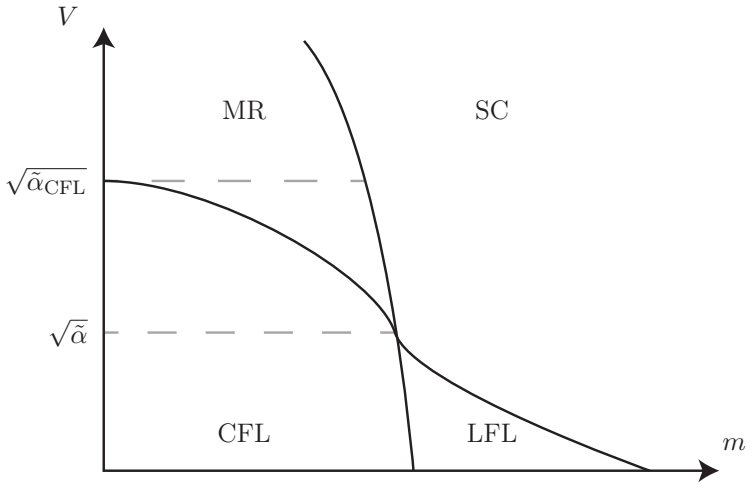
The transition from chiral superconductor to composite Fermi liquid passes through an intermediate stable Landau Fermi liquid for weak attractive interactions.
A machine-rendered reading of the paper's core claim, the machinery that carries it, and where it could break.
Core claim
We show that generically the LFL close to the transition to the CFL is stable against superconductivity. Thus the evolution between the CFL and chiral superconductor goes through an intermediate stable LFL phase for weak attractive interactions. With stronger interactions, the evolution can instead go through a non-Abelian paired quantum Hall state.
What carries the argument
Stability of the Landau Fermi liquid against superconductivity when tuned close to the transition into the composite Fermi liquid.
If this is right
- For weak attractive interactions the path from chiral superconductor to composite Fermi liquid includes an intermediate stable LFL phase.
- The LFL acquires stability against superconductivity specifically when it approaches the CFL transition.
- Stronger attractive interactions open a route through a non-Abelian paired quantum Hall state instead.
Where Pith is reading between the lines
- Tuning interaction strength in graphene devices could expose the predicted intermediate metallic regime between superconductivity and fractional Hall states.
- The same stability mechanism may apply in other platforms where superconducting and composite-fermion orders compete.
- Direct transitions would require either stronger interactions or additional fine-tuning not present in generic models.
Load-bearing premise
The transition between the Landau Fermi liquid and the composite Fermi liquid remains well-defined and continuous even after attractive interactions are introduced.
What would settle it
A direct continuous transition from the chiral superconductor to the CFL without an intervening metallic phase in a weakly attractive system would contradict the claimed stability of the LFL.
Figures


read the original abstract
Recent experiments have reported chiral time-reversal broken superconductivity in $n$-layer rhombohedral graphene for $n = 4,5, 6$. Introducing a moir\'e potential by alignement with a hexagonal boron nitride substrate suppresses the superconductivity but leads instead to various fractional quantum anomalous Hall phenomena. Motivated by these observations, we consider the fate of the phase transition between (a chiral) Landau Fermi liquid (LFL) metal and a Composite Fermi Liquid (CFL) metal in the presence of attractive interactions. These are parent states, respectively, for the superconductor and the fractional quantum Hall states. For weak attractive interactions, the LFL is usually unstable to superconductivity while the CFL is stable. This raises the possibility of a direct continuous phase transition between the chiral superconductor and the CFL. However, we show that generically the LFL close to the transition to the CFL is stable against superconductivity. Thus the evolution between the CFL and chiral superconductor goes through an intermediate stable LFL phase for weak attractive interactions. With stronger interactions, the evolution can instead go through a non-Abelian paired quantum Hall state.
Editorial analysis
A structured set of objections, weighed in public.
Referee Report
Summary. The manuscript examines the phase diagram connecting a chiral superconductor to a composite Fermi liquid (CFL) in the presence of attractive interactions, motivated by experiments on n-layer rhombohedral graphene. It argues that for weak attractions the Landau Fermi liquid (LFL) remains stable against superconductivity sufficiently close to the LFL-CFL transition, implying an intermediate stable LFL phase; stronger attractions instead route the evolution through a non-Abelian paired quantum Hall state. The parent states are taken to be an attractive LFL and a CFL, with the metal-metal transition remaining well-defined.
Significance. If the central stability argument holds, the result supplies a generic route explaining why moiré alignment suppresses superconductivity in favor of fractional quantum anomalous Hall states. It clarifies the role of weak attractions in protecting a metallic window near the CFL boundary and offers a falsifiable prediction for the sequence of phases as interaction strength is tuned.
major comments (2)
- [Abstract and §1 (parent-states discussion)] The load-bearing assumption that the LFL-CFL transition remains a sharp, well-defined boundary once weak attractive interactions are introduced is stated in the abstract and introduction but is not demonstrated. No explicit renormalization-group flow, quasiparticle-weight calculation, or effective-interaction analysis is provided to show that the attractive channel does not cut off or replace the transition before the CFL is reached.
- [Stability argument (near Eq. for pairing instability)] The claim that the LFL is 'generically' stable against superconductivity near the CFL transition (abstract) requires a concrete stability criterion or explicit calculation of the pairing susceptibility; without it, the intermediate-LFL window rests on an unverified extrapolation from the non-interacting or repulsive case.
minor comments (2)
- [Phase-diagram discussion] Clarify the precise definition of 'weak' versus 'strong' attractive interactions and the dimensionless parameter controlling the crossover between the two pathways.
- [Introduction] Add a brief comparison to existing literature on pairing instabilities of composite Fermi liquids to situate the new stability result.
Simulated Author's Rebuttal
We thank the referee for their careful reading of our manuscript and for the constructive comments, which help clarify the presentation of our results. We address each major comment below and indicate the revisions we will make.
read point-by-point responses
-
Referee: [Abstract and §1 (parent-states discussion)] The load-bearing assumption that the LFL-CFL transition remains a sharp, well-defined boundary once weak attractive interactions are introduced is stated in the abstract and introduction but is not demonstrated. No explicit renormalization-group flow, quasiparticle-weight calculation, or effective-interaction analysis is provided to show that the attractive channel does not cut off or replace the transition before the CFL is reached.
Authors: We agree that the robustness of the LFL-CFL transition under weak attractive interactions is a central assumption and merits more explicit support. The manuscript takes the attractive LFL and the CFL as parent states, with the metal-metal transition remaining well-defined by continuity with the repulsive case, since weak attractions do not alter the Fermi-surface topology or the composite-fermion construction at leading order. However, we acknowledge that an explicit RG flow or quasiparticle-weight calculation is not supplied. In the revised manuscript we will add a short paragraph in §1 and the discussion section outlining why the attractive channel remains irrelevant to the location and character of the metal-metal transition for weak coupling, based on the fact that the pairing instability is cut off by the diverging effective mass near the CFL boundary. revision: yes
-
Referee: [Stability argument (near Eq. for pairing instability)] The claim that the LFL is 'generically' stable against superconductivity near the CFL transition (abstract) requires a concrete stability criterion or explicit calculation of the pairing susceptibility; without it, the intermediate-LFL window rests on an unverified extrapolation from the non-interacting or repulsive case.
Authors: The stability criterion is introduced near the equation for the pairing instability, where we show that the effective pairing interaction is suppressed by the renormalization of the Landau parameters and the growth of the effective mass as the CFL transition is approached. This leads to the pairing susceptibility remaining finite (rather than diverging) sufficiently close to the transition, thereby stabilizing the LFL. We recognize that a fully explicit diagrammatic or numerical evaluation of the susceptibility in the presence of both the CFL fluctuations and the attractive interaction is not performed. We will therefore expand the discussion around that equation to include a more detailed derivation of the stability condition and a clearer statement of the extrapolation from the repulsive case. revision: partial
Circularity Check
No significant circularity; central stability claim is independent of inputs
full rationale
The paper derives its main result—that the LFL near the CFL transition remains stable against superconductivity for weak attractions, implying an intermediate LFL phase—from general considerations of pairing instabilities in the two metallic states. No quoted equations or steps reduce the claimed stability or the well-definedness of the LFL-CFL boundary to a self-definition, a fitted parameter renamed as prediction, or a load-bearing self-citation chain. The parent-state assumption is stated explicitly as an input rather than derived from the result itself. The analysis is therefore self-contained against external benchmarks of Fermi-liquid and composite-fermion stability.
Axiom & Free-Parameter Ledger
axioms (1)
- domain assumption The superconducting state descends from a Landau Fermi liquid with attractive interactions while the fractional quantum Hall states descend from a composite Fermi liquid.
Reference graph
Works this paper leans on
-
[1]
H. Park, J. Cai, E. Anderson, Y. Zhang, J. Zhu, X. Liu, C. Wang, W. Holtzmann, C. Hu, Z. Liu, T. Taniguchi, K. Watanabe, J.-H. Chu, T. Cao, L. Fu, W. Yao, C.-Z. Chang, D. Cob- den, D. Xiao, and X. Xu, Nature622, 74 (2023)
work page 2023
-
[2]
J. Cai, E. Anderson, C. Wang, X. Zhang, X. Liu, W. Holtzmann, Y. Zhang, F. Fan, T. Taniguchi, K. Watanabe, Y. Ran, T. Cao, L. Fu, D. Xiao, W. Yao, and X. Xu, Nature 622, 63–68 (2023)
work page 2023
-
[3]
F. Xu, Z. Sun, T. Jia, C. Liu, C. Xu, C. Li, Y. Gu, K. Watanabe, T. Taniguchi, B. Tong, J. Jia, Z. Shi, S. Jiang, Y. Zhang, X. Liu, and T. Li, Phys. Rev. X13, 031037 (2023)
work page 2023
-
[4]
E. Anderson, J. Cai, A. P. Reddy, H. Park, W. Holtzmann, K. Davis, T. Taniguchi, K. Watan- abe, T. Smolenski, A. Imamo˘ glu, T. Cao, D. Xiao, L. Fu, W. Yao, and X. Xu, Nature635, 590 (2024)
work page 2024
-
[5]
Z. Lu, T. Han, Y. Yao, A. P. Reddy, J. Yang, J. Seo, K. Watanabe, T. Taniguchi, L. Fu, and L. Ju, Nature626, 759 (2024)
work page 2024
-
[6]
T. Han, Z. Lu, G. Scuri, J. Sung, J. Wang, T. Han, K. Watanabe, T. Taniguchi, H. Park, and L. Ju, Nature Nanotechnology19, 181 (2024)
work page 2024
-
[7]
T. Han, Z. Lu, Z. Hadjri, L. Shi, Z. Wu, W. Xu, Y. Yao, A. A. Cotten, O. Sharifi Sedeh, H. Weldeyesus, J. Yang, J. Seo, S. Ye, M. Zhou, H. Liu, G. Shi, Z. Hua, K. Watanabe, T. Taniguchi, P. Xiong, D. M. Zumb¨ uhl, L. Fu, and L. Ju, Nature643, 654 (2025)
work page 2025
-
[8]
Superconductivity, anomalous hall effect, and stripe order in rhombohedral hexalayer graphene,
E. Morissette, P. Qin, H.-T. Wu, N. J. Zhang, R. Q. Nguyen, K. Watanabe, T. Taniguchi, and J. I. A. Li, “Striped Superconductor in Rhombohedral Hexalayer Graphene,” (2025), 21 arXiv:2504.05129 [cond-mat.mes-hall]
-
[9]
Z. D. Shi and T. Senthil, Phys. Rev. X15, 031069 (2025)
work page 2025
- [10]
-
[11]
Doping lattice non-abelian quantum hall states,
Z. D. Shi, C. Zhang, and T. Senthil, “Doping lattice non-abelian quantum Hall states,” (2025), arXiv:2505.02893 [cond-mat]
-
[12]
M. Kim, A. Timmel, L. Ju, and X.-G. Wen, Phys. Rev. B111, 014508 (2025)
work page 2025
-
[13]
Anyon delocalization transitions out of a disordered FQAH insula- tor,
Z. D. Shi and T. Senthil, “Anyon delocalization transitions out of a disordered FQAH insula- tor,” (2025), arXiv:2506.02128 [caond-mat.str-el]
-
[14]
P. A. Nosov, Z. Han, and E. Khalaf, “Anyon superconductivity and plateau transitions in doped fractional quantum anomalous Hall insulators,” (2025), arXiv:2506.02108 [cond-mat]
work page internal anchor Pith review Pith/arXiv arXiv 2025
-
[15]
F. Pichler, C. Kuhlenkamp, M. Knap, and A. Vishwanath, “Microscopic Mechanism of Anyon Superconductivity Emerging from Fractional Chern Insulators,” (2025), arXiv:2506.08000 [cond-mat.str-el]
-
[16]
T. Wang and M. P. Zaletel, “Chiral superconductivity near a fractional Chern insulator,” (2025), arXiv:2507.07921 [cond-mat.str-el]
-
[17]
Anyon superfluidity of excitons in quantum Hall bilayers
Z. Han, T. Wang, Z. Dong, M. P. Zaletel, and A. Vishwanath, “Anyon superfluidity of excitons in quantum Hall bilayers,” (2025), arXiv:2508.14894 [cond-mat]
work page internal anchor Pith review Pith/arXiv arXiv 2025
-
[18]
Anyon superfluid in trilayer quantum Hall systems,
T. Wang and Y.-H. Zhang, “Anyon superfluid in trilayer quantum Hall systems,” (2025), arXiv:2508.00058 [cond-mat]
-
[19]
[67] in tMoTe 2 close to the 2/3 FQAH state (see Refs
It may be pertinent to the superconductivity reported in Ref. [67] in tMoTe 2 close to the 2/3 FQAH state (see Refs. [9, 13, 14])
-
[20]
B. I. Halperin, P. A. Lee, and N. Read, Physical Review B47, 7312 (1993)
work page 1993
- [21]
- [22]
-
[23]
It is possible that it originates from what microscopically is a repulsive interaction through the Kohn-Luttinger mechanism, or through some other exotic route [12]
-
[24]
Topological superconductiv- ity from repulsive interactions in twisted WSe 2,
D. Guerci, D. Kaplan, J. Ingham, J. H. Pixley, and A. J. Millis, “Topological superconductiv- ity from repulsive interactions in twisted WSe 2,” (2024), arXiv:2408.16075 [cond-mat.supr- con]
-
[25]
Y.-Z. Chou, J. Zhu, and S. Das Sarma, Phys. Rev. B111, 174523 (2025)
work page 2025
-
[26]
W. Qin, W.-X. Qiu, and F. Wu, “Topological Chiral Superconductivity Mediated by Inter- valley Antiferromagnetic Fluctuations in Twisted Bilayer WSe 2,” (2025), arXiv:2409.16114 [cond-mat.supr-con]
-
[27]
A. Jahin and S.-Z. Lin, “Enhanced Kohn-Luttinger topological superconductivity in bands 22 with nontrivial geometry,” (2025), arXiv:2411.09664 [cond-mat.supr-con]
-
[28]
Chiral super- conductivity from spin polarized Chern band in twisted MoTe 2,
C. Xu, N. Zou, N. Peshcherenko, A. Jahin, T. Li, S.-Z. Lin, and Y. Zhang, “Chiral super- conductivity from spin polarized Chern band in twisted MoTe 2,” (2025), arXiv:2504.07082 [cond-mat.supr-con]
-
[29]
From Fractionalization to Chiral Topological Superconductivity in Flat Chern Band,
D. Guerci, A. Abouelkomsan, and L. Fu, “From Fractionalization to Chiral Topological Superconductivity in Flat Chern Band,” (2025), arXiv:2506.10938 [cond-mat.supr-con]
-
[30]
Finite-momentum superconductivity from chiral bands in twisted MoTe 2,
Y. Chen, C. Xu, Y. Zhang, and C. Schrade, “Finite-momentum superconductivity from chiral bands in twisted MoTe 2,” (2025), arXiv:2506.18886 [cond-mat.supr-con]
-
[31]
Shayegan, in Fractional Quantum Hall Effects (WORLD SCIENTIFIC, 2020) pp
M. Shayegan, in Fractional Quantum Hall Effects (WORLD SCIENTIFIC, 2020) pp. 133–181
work page 2020
-
[32]
J. P. Eisenstein, L. N. Pfeiffer, and K. W. West, Physical Review Letters69, 3804 (1992)
work page 1992
-
[33]
R. L. Willett, R. R. Ruel, K. W. West, and L. N. Pfeiffer, Physical Review Letters71, 3846 (1993)
work page 1993
-
[34]
W. Kang, H. L. Stormer, L. N. Pfeiffer, K. W. Baldwin, and K. W. West, Physical Review Letters71, 3850 (1993)
work page 1993
-
[35]
R. L. Willett, R. R. Ruel, M. A. Paalanen, K. W. West, and L. N. Pfeiffer, Physical Review B47, 7344 (1993)
work page 1993
-
[36]
V. J. Goldman, B. Su, and J. K. Jain, Physical Review Letters72, 2065 (1994)
work page 2065
-
[37]
J. H. Smet, D. Weiss, R. H. Blick, G. L¨ utjering, K. von Klitzing, R. Fleischmann, R. Ketzm- erick, T. Geisel, and G. Weimann, Physical Review Letters77, 2272 (1996)
work page 1996
-
[38]
J. Dong, J. Wang, P. J. Ledwith, A. Vishwanath, and D. E. Parker, Physical Review Letters 131, 136502 (2023)
work page 2023
-
[39]
H. Goldman, A. P. Reddy, N. Paul, and L. Fu, Physical Review Letters131, 136501 (2023)
work page 2023
-
[40]
Z. Lu, T. Han, Y. Yao, Z. Hadjri, J. Yang, J. Seo, L. Shi, S. Ye, K. Watanabe, T. Taniguchi, and L. Ju, Nature637, 1090 (2025)
work page 2025
-
[41]
M. A. Metlitski, D. F. Mross, S. Sachdev, and T. Senthil, Physical Review B91, 115111 (2015)
work page 2015
- [42]
- [43]
-
[44]
R. Willett, J. P. Eisenstein, H. L. St¨ ormer, D. C. Tsui, A. C. Gossard, and J. H. English, Physical Review Letters59, 1776 (1987)
work page 1987
-
[45]
I. P. Radu, J. B. Miller, C. M. Marcus, M. A. Kastner, L. N. Pfeiffer, and K. W. West, Science320, 899 (2008)
work page 2008
- [46]
- [47]
- [48]
-
[49]
The resulting LFL quasiparticle residue will be given byZ∼ |⟨Φ⟩| 2
This is particularly clear in the parton picture, as⟨Φ⟩ ̸= 0 allows us to identifyfandc, as the dynamical gauge fieldais Higgsed. The resulting LFL quasiparticle residue will be given byZ∼ |⟨Φ⟩| 2. One can also understand this phase by going to the dual vortex picture, Ltotal =L F S[f,−a] + i 2π ˜a∧d(a+A) +L[v Φ,˜a] +· · ·,(C10) where Φ carries flux under...
- [50]
-
[51]
E. Lieb, T. Schultz, and D. Mattis, Annals of Physics16, 407 (1961)
work page 1961
- [52]
-
[53]
M. B. Hastings, Phys. Rev. B69, 104431 (2004)
work page 2004
-
[54]
As argued in [22], adding a flavor mass to the critical point leads to a trivial insulator. However, no such insulator of bosons is possible atν= 1/2 unless translation symmetry is broken, leading us to conclude the flavor adjoint masses must break translation
-
[55]
D. F. Mross, J. McGreevy, H. Liu, and T. Senthil, Physical Review B82, 045121 (2010)
work page 2010
- [56]
-
[57]
N. Morales-Dur´ an, N. Wei, J. Shi, and A. H. MacDonald, Phys. Rev. Lett.132, 096602 (2024)
work page 2024
-
[58]
N. Paul, Y. Zhang, and L. Fu, Science Advances9(2023)
work page 2023
-
[59]
A. P. Reddy, F. Alsallom, Y. Zhang, T. Devakul, and L. Fu, Phys. Rev. B108, 085117 (2023)
work page 2023
- [60]
- [61]
-
[62]
This corresponds toϵ= 1, in which the fixed point at ( V ,˜α) = (0,0) splits into fixed points at V=± p ϵ/2. The fixed point V=− p ϵ/2 is unstable and V= p ϵ/2 is a stable fixed point, controlling the CFL phase. Therefore, with short range interactions, the CFL phase is still stable to pairing. Furthermore, the CFL in the proximity of the critical point i...
-
[63]
W. Chen, M. P. A. Fisher, and Y.-S. Wu, Phys. Rev. B48, 13749 (1993)
work page 1993
- [64]
- [65]
-
[66]
A. Mesaros, M. J. Lawler, and E.-A. Kim, Phys. Rev. B95, 125127 (2017). 24
work page 2017
-
[67]
F. Xu, Z. Sun, J. Li, C. Zheng, C. Xu, J. Gao, T. Jia, K. Watanabe, T. Taniguchi, B. Tong, L. Lu, J. Jia, Z. Shi, S. Jiang, Y. Zhang, Y. Zhang, S. Lei, X. Liu, and T. Li, “Signatures of unconventional superconductivity near reentrant and fractional quantum anomalous Hall insulators,” (2025), arXiv:2504.06972 [cond-mat.mes-hall]. 25
discussion (0)
Sign in with ORCID, Apple, or X to comment. Anyone can read and Pith papers without signing in.