REVIEW 4 major objections 4 minor 56 references
Fire360: A Benchmark for Robust Perception and Episodic Memory in Degraded 360-Degree Firefighting Videos
T0 review · 4 major / 4 minor · reviewed 2026-08-07 · deepseek-v4-flash
Pith's one-line read Fire360, a benchmark built from real firefighter training videos, shows that current vision-language models fall tens of points behind human experts when smoke, heat, and 360-degree warping degrade the scene.
desk verdict Fire360 brings real 360-degree firefighting data and a novel TOR task, but the headline human-model gaps rest on an undescribed human protocol and should be re-established before they are quoted. read the letter →
The pith
A machine-rendered reading of the paper's core claim, the machinery that carries it, and where it could break.
The reading
What carries the argument
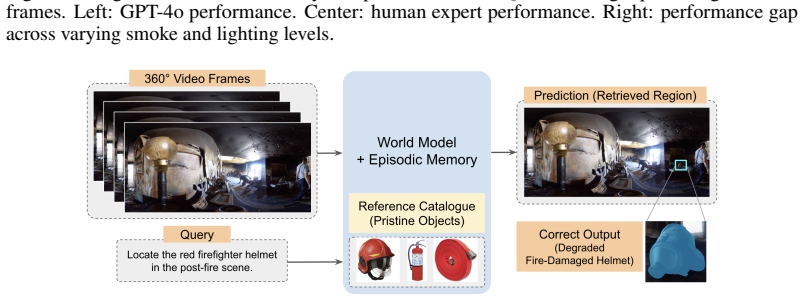
The load-bearing mechanism is the TOR evaluation protocol. For each of 154 degraded object targets in 87 keyframes, Grounding DINO proposes candidate regions, about 36 per frame, and a vision-language encoder (CLIP, BLIP-2, or GPT-4o) embeds each candidate alongside a pristine exemplar; retrieval is scored by cosine similarity, and success requires the top-ranked region to have IoU above 0.5 with the expert-verified box. Around this sits the Fire360 dataset itself: 228 videos with temporal action segments, spatial boxes, smoke and lighting tags, and dual equirectangular and rectilinear renderings, plus a browser-based annotation tool and stratified splits that let failures be attributed to smoke level, lighting, or projection distortion rather than to the task as a whole.
What would settle it
Re-run the human evaluation with the exact inputs given to models, same single frames, same Grounding DINO candidate boxes, same prompts, and no surrounding video context, then compare top-1 retrieval accuracy; if human performance falls toward the model range, the claimed human-model gap collapses.
Extended reading notes
Core claim
The paper's central claim is that state-of-the-art vision-language models collapse under exactly the compound degradation firefighters face, such as dense smoke, low light, thermal distortion, and equirectangular stretching, while human experts hold up much better. Across Fire360's five tasks, the headline result is TOR: retrieving a melted, sooted, or occluded object from a different scene using only a pristine exemplar yields 39.8% top-1 accuracy for GPT-4o and 32.5% for CLIP, against 83.5% for human experts. The paper also reports that VQA accuracy drops below 10% in the most degraded conditions, and that rectilinear input consistently outperforms equirectangular input, showing panoramic distortion is a separable source of failure. The authors conclude that degradation robustness, memory of object identity through transformation, and procedural safety knowledge are missing from current models and must be trained and measured explicitly.
Load-bearing premise
The result depends on the human expert scores being a fair yardstick, meaning humans saw the same single frames, same candidate regions, and same prompts as the models, and the ground-truth boxes are accurate enough that the 40-plus-point gap is not an artifact of asymmetric evaluation.
Editorial extensions
If this is right
- Fire360 gives zero-shot evaluations a common yardstick: a model that cannot hold its own on degraded 360-degree firefighting frames should not be considered deployment-ready for emergency response.
- Because rectilinear input consistently beats equirectangular input, panoramic distortion is separable from smoke and lighting degradation, so progress on each can be measured independently.
- TOR reframes object recognition as transformation-invariant retrieval; any model that reaches human-level accuracy on it must encode material and state information, not just appearance.
- The benchmark's stratified smoke and lighting tags allow robustness claims to be tested per degradation level rather than averaged away.
- The reported average human-model gap of over 57 points on VQA suggests that safety-critical reasoning and procedural compliance need dedicated evaluation, not just general captioning.
Reading between the lines
- If the human baselines were collected with access to full video context or free searching, the reported gap would be an upper bound on model failure; a controlled same-input human run is the natural next experiment.
- The TOR formulation could transfer to other irreversible-degradation domains, such as wildfire damage assessment for insurance or identifying equipment in post-disaster infrastructure, but Fire360's single-site collection means cross-institution generalization remains untested.
- The dataset's report that about 15% of 360-degree boxes are misaligned under projection distortion suggests TOR accuracy numbers have a measurement ceiling near the annotation agreement, so small improvements near 83.5% should be read cautiously.
Editorial analysis
A structured set of objections, weighed in public.
Referee Report
Summary. Fire360 is a benchmark paper introducing a dataset of 228 360-degree firefighter training videos (about 50 hours) annotated with action segments, object bounding boxes, and degradation metadata. It defines five tasks: VQA, Temporal Action Captioning, Object Localization, Safety-Critical Reasoning, and a new Transformed Object Retrieval (TOR) task. The authors evaluate several open-source and API-based vision-language models in zero-shot settings and compare them against claimed human expert scores, reporting large gaps (e.g., GPT-4o at 53.8% vs. 91.4% human on VQA; GPT-4o at 39.8% vs. 83.5% human on TOR). The central claim is that current VLMs are dramatically less robust than human experts under smoke, low light, and distortion in safety-critical firefighting scenes.
Significance. If the human baselines and model numbers are reliable, Fire360 would be a useful resource for a genuinely under-served setting: degraded, panoramic, safety-critical perception. The TOR task, requiring retrieval of fire-damaged objects across unpaired scenes, is a novel and interesting formulation. The paper also provides bootstrapped confidence intervals for TOR results and a clear statement that models are evaluated zero-shot, which is appropriate for a deployment-oriented benchmark. However, the headline conclusion rests almost entirely on human expert scores whose collection protocol is never described. The dataset release itself is valuable, but the comparative claim 'models fail dramatically relative to humans' is not yet supported. The conclusion's 'up to a 52.3% performance drop' is inconsistent with the task-level numbers in Table 3, which further weakens confidence in the internal consistency of the reporting.
major comments (4)
- [Sections 4 and 5; Table 3] The human expert baselines are load-bearing for the paper's central claim, yet no protocol is described: there is no participant count, no interface description, no instruction wording, and no statement that humans saw the same single frames, candidate boxes, and prompts as the models. In TOR (Section 5), models retrieve among Grounding DINO proposals with IoU > 0.5, but a human could plausibly search the full equirectangular frame without such constraints. If humans had access to more information than models, the reported 43.7-point TOR gap and the other human-model gaps in Table 3 would be partly an artifact of asymmetric evaluation. Please provide a complete human study protocol, or re-run the comparison under matched conditions, and state explicitly whether humans used the same candidate set and the same single-frame inputs.
- [Section 6; TOR evaluation in Section 5] The paper's own limitation statement in Section 6 concedes that about 15% of 360-degree boxes are misaligned due to projection distortion. Since TOR success is defined as IoU > 0.5 against these boxes, and localization and VQA also depend on annotated boxes, this noise directly affects the reported gaps. The paper does not quantify how the 15% misalignment is distributed across tasks or whether the human and model scores are affected equally. Please report results after excluding or correcting misaligned boxes, or provide a sensitivity analysis showing that the main conclusions are unchanged.
- [Section 7; Table 3] The conclusion states that models show 'up to a 52.3% performance drop,' but this number does not appear anywhere in the body. The task-level gaps in Table 3 are 37.6 points for VQA, 46.8 points for localization, 65.7 points for safety reasoning, and 43.7 points for TOR. Either the 52.3% figure should be derived and cited to a specific table or row, or the conclusion should be rephrased to match the reported task-level gaps.
- [Appendix A; VQA task in Section 4] VQA is scored with 'exact match accuracy,' but the benchmark includes both multiple-choice and free-text questions. Exact match against a single reference string is a severe metric for free-form answers, especially with domain-specific phrasing, and no paraphrase matching or human adjudication of model answers is described. This could depress model scores and inflate the human-model gap. Please describe how free-text answers are scored and whether alternative metrics (e.g., semantic similarity or human rating) change the conclusions.
minor comments (4)
- [References, Section 4] The paper refers to GLaMM-7B throughout, but the cited reference [4] is 'SpatialRGPT: Grounded Spatial Reasoning in Vision-Language Models,' which does not appear to be the GLaMM model. A proper citation for GLaMM should be added.
- [Table 1] Several entries in Table 1 appear misclassified: Ego4D is listed as having '360°' while the text describes it as egocentric, and HACS++ is listed as egocentric and 360° without clear support. Please verify each dataset's properties.
- [Throughout] The model name is inconsistently typeset as 'LLaV A-v1.5-13B' and 'LLaVA-1.5'; use the conventional 'LLaVA' spelling consistently.
- [Section 5, paragraph 'Evaluation Protocol'] The phrase 'human agreement reaches 83.5%' is ambiguous: it could mean inter-annotator agreement or a human retrieval accuracy. Section 4 and the abstract describe it as accuracy, so the text should be made consistent and the underlying protocol clarified.
Circularity Check
No circularity: Fire360 is a self-contained benchmark; zero-shot model evaluations and external human baselines are independent of the dataset's construction.
full rationale
Fire360 is a dataset/benchmark paper rather than a derivation. The five tasks are evaluated with standard metrics (top-1 accuracy, BLEU-4, mean IoU, checklist accuracy, retrieval accuracy). Model scores come from zero-shot or prompted public APIs/checkpoints with no fine-tuning on Fire360, so the model numbers are external observations, not fitted outputs. The human baselines are external expert judgments; although the paper omits the human evaluation protocol (participant count, interface, and whether humans saw the same candidate proposals as models), that is a transparency/validity limitation, not a circular reduction: no equation defines human performance in terms of the model scores or vice versa. The only self-citation is ACT360 [42] in the related-work section, used to differentiate Fire360 from prior 360-degree action detection, and it is not load-bearing for any claimed result. No self-definitional task construction, fitted-input-as-prediction step, imported uniqueness theorem, or renamed known result is present. The close agreement between human annotators (κ=0.87–0.91, 93.7% external confirmation) and the reported human task accuracy could be questioned on procedural grounds, but that is a benchmark-validity concern external to circularity analysis. Overall score 0.
Assumptions & free parameters
free parameters (2)
- IoU success threshold in TOR and localization =
0.5
- Grounding DINO proposal confidence threshold =
0.4
assumptions (4)
- domain assumption Certified instructor annotations are accurate ground truth
- domain assumption Grounding DINO proposals contain the true target region for every TOR query
- domain assumption Single-institute training drills represent real safety-critical deployment conditions
- domain assumption BLEU-4 is a meaningful proxy for caption quality in this domain
Cite this review
Pith. "Pith review of Fire360: A Benchmark for Robust Perception and Episodic Memory in Degraded 360-Degree Firefighting Videos." pith.science (2026). https://pith.science/paper/DX5TR2QR
@misc{pith2026250602167,
  author       = {Pith},
  title        = {Pith review of: Fire360: A Benchmark for Robust Perception and Episodic Memory in Degraded 360-Degree Firefighting Videos},
  year         = {2026},
  howpublished = {\url{https://pith.science/paper/DX5TR2QR}},
  note         = {Machine review of arXiv:2506.02167}
}
read the original abstract
Modern AI systems struggle most in environments where reliability is critical - scenes with smoke, poor visibility, and structural deformation. Each year, tens of thousands of firefighters are injured on duty, often due to breakdowns in situational perception. We introduce Fire360, a benchmark for evaluating perception and reasoning in safety-critical firefighting scenarios. The dataset includes 228 360-degree videos from professional training sessions under diverse conditions (e.g., low light, thermal distortion), annotated with action segments, object locations, and degradation metadata. Fire360 supports five tasks: Visual Question Answering, Temporal Action Captioning, Object Localization, Safety-Critical Reasoning, and Transformed Object Retrieval (TOR). TOR tests whether models can match pristine exemplars to fire-damaged counterparts in unpaired scenes, evaluating transformation-invariant recognition. While human experts achieve 83.5% on TOR, models like GPT-4o lag significantly, exposing failures in reasoning under degradation. By releasing Fire360 and its evaluation suite, we aim to advance models that not only see, but also remember, reason, and act under uncertainty. The dataset is available at: https://uofi.box.com/v/fire360dataset.
Figures


Figures from the paper (6 more)




Reference graph
Works this paper leans on
-
[1]
Qwen-vl: A frontier large vision-language model with versatile abilities
Jinze Bai, Shuai Bai, Shusheng Yang, Shijie Wang, Sinan Tan, Peng Wang, Junyang Lin, Chang Zhou, and Jingren Zhou. Qwen-vl: A frontier large vision-language model with versatile abilities. arXiv preprint arXiv:2308.12966, 2023
arXiv 2023
-
[2]
Clip retrieval: Easily compute clip embeddings and build a clip retrieval system with them
Romain Beaumont. Clip retrieval: Easily compute clip embeddings and build a clip retrieval system with them. https://github.com/rom1504/clip-retrieval, 2022. GitHub repository
work page 2022
-
[3]
360+x: A panoptic multi-modal scene understanding dataset
Hao Chen, Yuqi Hou, Chenyuan Qu, Irene Testini, Xiaohan Hong, and Jianbo Jiao. 360+x: A panoptic multi-modal scene understanding dataset. In Proceedings of the IEEE/CVF Conference on Computer Vision and Pattern Recognition (CVPR), 2024
work page 2024
-
[4]
Spatialrgpt: Grounded spatial reasoning in vision-language models
An-Chieh Cheng, Hongxu Yin, Yang Fu, Qiushan Guo, Ruihan Yang, Jan Kautz, Xiaolong Wang, and Sifei Liu. Spatialrgpt: Grounded spatial reasoning in vision-language models. In Advances in Neural Information Processing Systems (NeurIPS), 2024
work page 2024
-
[5]
360-indoor: Towards learning real-world objects in 360° indoor equirectangular images
Shih-Han Chou, Cheng Sun, Wen-Yen Chang, Wan-Ting Hsu, Min Sun, and Jianlong Fu. 360-indoor: Towards learning real-world objects in 360° indoor equirectangular images. In 2020 IEEE Winter Confer- ence on Applications of Computer Vision (WACV), pages 834–842, Los Alamitos, CA, USA, 2020. IEEE Computer Society
work page 2020
-
[6]
Instructblip: Towards general-purpose vision-language models with instruction tuning
Wenliang Dai, Junnan Li, Dongxu Li, Anthony Tiong, Junqi Zhao, Weisheng Wang, Boyang Li, Pascale Fung, and Steven Hoi. Instructblip: Towards general-purpose vision-language models with instruction tuning. In Thirty-seventh Conference on Neural Information Processing Systems (NeurIPS), 2023
work page 2023
-
[7]
The epic- kitchens dataset: Collection, challenges and baselines
Dima Damen, Hazel Doughty, Giovanni Maria Farinella, Sanja Fidler, Antonino Furnari, Evangelos Kazakos, Davide Moltisanti, Jonathan Munro, Toby Perrett, Will Price, and Michael Wray. The epic- kitchens dataset: Collection, challenges and baselines. IEEE Transactions on Pattern Analysis and Machine Intelligence (TPAMI), 43(11):4125–4141, 2021
work page 2021
-
[8]
Active fire detection in landsat-8 imagery: A large-scale dataset and a deep-learning study
Gabriel Henrique de Almeida Pereira, Andre Minoro Fusioka, Bogdan Tomoyuki Nassu, and Rodrigo Minetto. Active fire detection in landsat-8 imagery: A large-scale dataset and a deep-learning study. ISPRS Journal of Photogrammetry and Remote Sensing, 178:171–186, 2021
work page 2021
Show all 56 references
-
[9]
Episodic memory in ai agents poses risks that should be studied and mitigated
Chad DeChant. Episodic memory in ai agents poses risks that should be studied and mitigated. arXiv preprint arXiv:2501.11739, 2025
2025 arXiv
-
[10]
Cottrell, and Mai H
Anshuman Dewangan, Yash Pande, Hans-Werner Braun, Frank Vernon, Ismael Perez, Ilkay Altintas, Garrison W. Cottrell, and Mai H. Nguyen. Figlib & smokeynet: Dataset and deep learning model for real-time wildland fire smoke detection. Remote Sensing, 14(4), 2022
2022
-
[11]
Lindeman, and Simon Hoermann
Hendrik Engelbrecht, Robert W. Lindeman, and Simon Hoermann. A swot analysis of the field of virtual reality for firefighter training. Frontiers in Robotics and AI, 6:101, 2019
2019
-
[12]
Wichmann, and Wieland Brendel
Robert Geirhos, Patricia Rubisch, Claudio Michaelis, Matthias Bethge, Felix A. Wichmann, and Wieland Brendel. Imagenet-trained cnns are biased towards texture; increasing shape bias improves accuracy and robustness. In 7th International Conference on Learning Representations (...
2019
-
[13]
Kristen Grauman, Andrew Westbury, Eugene Byrne, Vincent Cartillier, Zachary Chavis, Antonino Furnari, Rohit Girdhar, Jackson Hamburger, Hao Jiang, Devansh Kukreja, Miao Liu, Xingyu Liu, Miguel Martin, Tushar Nagarajan, Ilija Radosavovic, Santhosh Kumar Ramakrishnan, Fiona Ryan...
2025
-
[14]
Alex Graves, Greg Wayne, Malcolm Reynolds, Tim Harley, Ivo Danihelka, Agnieszka Grabska-Barwinska, Sergio Gomez Colmenarejo, Edward Grefenstette, Tiago Ramalho, John P. Agapiou, Adrià Puig- domènech Badia, Karl Moritz Hermann, Yori Zwols, Georg Ostrovski, Adam Cain, Helen King...
2016
-
[15]
World models
David Ha and Jürgen Schmidhuber. World models. arXiv preprint arXiv:1803.10122, 2018
2018 arXiv
-
[16]
Visual language maps for robot navigation
Chenguang Huang, Oier Mees, Andy Zeng, and Wolfram Burgard. Visual language maps for robot navigation. In Proceedings of the IEEE International Conference on Robotics and Automation (ICRA), London, UK, 2023
2023
-
[17]
Episodic memories generation and evaluation benchmark for large language models, 2025
Alexis Huet, Zied Ben Houidi, and Dario Rossi. Episodic memories generation and evaluation benchmark for large language models, 2025
2025
-
[18]
The kinetics human action video dataset
Will Kay, Joao Carreira, Karen Simonyan, Brian Zhang, Chloe Hillier, Sudheendra Vijayanarasimhan, Fabio Viola, Tim Green, Trevor Back, Paul Natsev, et al. The kinetics human action video dataset. InarXiv preprint arXiv:1705.06950, 2017
2017 arXiv
-
[19]
Rush, Douwe Kiela, Matthieu Cord, and Victor Sanh
Hugo Laurençon, Lucile Saulnier, Léo Tronchon, Stas Bekman, Amanpreet Singh, Anton Lozhkov, Thomas Wang, Siddharth Karamcheti, Alexander M. Rush, Douwe Kiela, Matthieu Cord, and Victor Sanh. Obelics: An open web-scale filtered dataset of interleaved image-text documents, 2023
2023
-
[20]
For: Finetuning for object level open vocabulary image retrieval
Hila Levi, Guy Heller, and Dan Levi. For: Finetuning for object level open vocabulary image retrieval. In 2025 IEEE/CVF Winter Conference on Applications of Computer Vision (WACV), pages 8968–8979, Los Alamitos, CA, USA, 2025. IEEE Computer Society
2025
-
[21]
Self-supervised alignment learning for medical image segmentation
Haofeng Li, Yiming Ouyang, and Xiang Wan. Self-supervised alignment learning for medical image segmentation. In 2024 IEEE International Symposium on Biomedical Imaging (ISBI), pages 1–5, 2024
2024
-
[22]
Blip-2: Bootstrapping language-image pre- training with frozen image encoders and large language models
Junnan Li, Dongxu Li, Silvio Savarese, and Steven Hoi. Blip-2: Bootstrapping language-image pre- training with frozen image encoders and large language models. In Proceedings of the 40th International Conference on Machine Learning (ICML). JMLR.org, 2023
2023
-
[23]
Kitti-360: A novel dataset and benchmarks for urban scene understanding in 2d and 3d
Yiyi Liao, Jun Xie, and Andreas Geiger. Kitti-360: A novel dataset and benchmarks for urban scene understanding in 2d and 3d. IEEE Transactions on Pattern Analysis and Machine Intelligence (PAMI), 2022
2022
-
[24]
Visual instruction tuning
Haotian Liu, Chunyuan Li, Qingyang Wu, and Yong Jae Lee. Visual instruction tuning. In Advances in Neural Information Processing Systems, pages 34892–34916. Curran Associates, Inc., 2023
2023
-
[25]
Grounding dino: Marrying dino with grounded pre-training for open-set object detection
Shilong Liu, Zhaoyang Zeng, Tianhe Ren, Feng Li, Hao Zhang, Jie Yang, Chunyuan Li, Jianwei Yang, Hang Su, Jun Zhu, et al. Grounding dino: Marrying dino with grounded pre-training for open-set object detection. arXiv preprint arXiv:2303.05499, 2023
2023 arXiv
-
[26]
Object-centric learning with slot attention, 2020
Francesco Locatello, Dirk Weissenborn, Thomas Unterthiner, Aravindh Mahendran, Georg Heigold, Jakob Uszkoreit, Alexey Dosovitskiy, and Thomas Kipf. Object-centric learning with slot attention, 2020
2020
-
[27]
Enhancing robustness in video recognition models: Sparse adversarial attacks and beyond
Ronghui Mu, Leandro Marcolino, Qiang Ni, and Wenjie Ruan. Enhancing robustness in video recognition models: Sparse adversarial attacks and beyond. Neural Networks, 171(C):127–143, 2024
2024
-
[28]
NFPA 1410: Standard on Training for Emergency Scene Operations
National Fire Protection Association. NFPA 1410: Standard on Training for Emergency Scene Operations. National Fire Protection Association, Quincy, MA, current edition edition, 2020
2020
-
[29]
Firefighter injuries in the united states
National Fire Protection Association. Firefighter injuries in the united states. https: //www.nfpa.org/News-and-Research/Data-research-and-tools/Emergency-Responders/ Firefighter-injuries-in-the-United-States , 2023. Accessed: 2025-05-10
2023
-
[30]
360-degree video of fire at the national fire research laboratory
National Institute of Standards and Technology (NIST). 360-degree video of fire at the national fire research laboratory. https://www.nist.gov/programs-projects/ national-fire-research-laboratory-advanced-metrology/360-degree-video-fire ,
-
[31]
Gpt-4 technical report
OpenAI. Gpt-4 technical report. arXiv preprint arXiv:2303.08774, 2023
2023 arXiv
-
[32]
Maxime Oquab, Timothée Darcet, Théo Moutakanni, Huy V . V o, Marc Szafraniec, Vasil Khalidov, Pierre Fernandez, Daniel HAZIZA, Francisco Massa, Alaaeldin El-Nouby, Mido Assran, Nicolas Ballas, Wojciech Galuba, Russell Howes, Po-Yao Huang, Shang-Wen Li, Ishan Misra, Michael Rab...
2024
-
[33]
Egocentric zone-aware action recognition across environments
Simone Alberto Peirone, Gabriele Goletto, Mirco Planamente, Andrea Bottino, Barbara Caputo, and Giuseppe Averta. Egocentric zone-aware action recognition across environments. Pattern Recognition Letters, 188(C):140–147, 2025. 11
2025
-
[34]
Learning trans- ferable visual models from natural language supervision
Alec Radford, Jong Wook Kim, Chris Hallacy, Aditya Ramesh, Gabriel Goh, Sandhini Agarwal, Girish Sastry, Amanda Askell, Pamela Mishkin, Jack Clark, Gretchen Krueger, and Ilya Sutskever. Learning trans- ferable visual models from natural language supervision. In Proceedings of ...
2021
-
[35]
Evaluation of virtual reality-based first responder training under physiological and cognitive-emotional strain
Lilian Reim, Wolfgang Kallus, Martin Pszeida, Michael Schneeberger, Christian Schönauer, Andreas Peer, Richard Feischl, Georg Aumayr, Dietmar Wallner, Amir Dini, Anna Weber, Stefan Ladstätter, Alexander Almer, and Lucas Paletta. Evaluation of virtual reality-based first respon...
2022
-
[36]
A dataset and framework for learning state-invariant object representations
Rohan Sarkar and Avinash Kak. A dataset and framework for learning state-invariant object representations. arXiv preprint arXiv:2404.06470, 2025
2025 arXiv
-
[37]
First responder situation reporting in virtual reality training with evaluation of cognitive-emotional stress using psychophysiological measures
Michael Schneeberger, Lucas Paletta, Wolfgang Kallus, Lilian Reim, Christian Schönauer, Andreas Peer, Richard Feischl, Georg Aumayr, Martin Pszeida, Amir Dini, Stefan Ladstätter, Anna Weber, Alexander Almer, and Dietmar Wallner. First responder situation reporting in virtual r...
2022
-
[38]
Planning to explore via self-supervised world models
Ramanan Sekar, Oleh Rybkin, Kostas Daniilidis, Pieter Abbeel, Danijar Hafner, and Deepak Pathak. Planning to explore via self-supervised world models. In Proceedings of the International Conference on Machine Learning (ICML), 2020
2020
-
[39]
Panovpr: Towards unified perspective-to-equirectangular visual place recognition via sliding windows across the panoramic view
Ze Shi, Hao Shi, Kailun Yang, Zhe Yin, Yining Lin, and Kaiwei Wang. Panovpr: Towards unified perspective-to-equirectangular visual place recognition via sliding windows across the panoramic view. In 2023 IEEE 26th International Conference on Intelligent Transportation Systems ...
2023
-
[40]
Anomaly detection for people with visual impairments using an egocentric 360-degree camera
Inpyo Song, Sanghyeon Lee, Minjun Joo, and Jangwon Lee. Anomaly detection for people with visual impairments using an egocentric 360-degree camera. In2025 IEEE/CVF Winter Conference on Applications of Computer Vision (WACV), pages 2828–2837, Los Alamitos, CA, USA, 2025. IEEE C...
2025
-
[41]
Liang, Kristen Grauman, Matt Feiszli, and Weiyao Wang
Hao Tang, Kevin J. Liang, Kristen Grauman, Matt Feiszli, and Weiyao Wang. Egotracks: A long-term egocentric visual object tracking dataset. In Proceedings of the 37th International Conference on Neural Information Processing Systems (NeurIPS). Curran Associates Inc., 2023
2023
-
[42]
Act360: An efficient 360-degree action detection and summarization framework for mission-critical training and debriefing, 2025
Aditi Tiwari and Klara Nahrstedt. Act360: An efficient 360-degree action detection and summarization framework for mission-critical training and debriefing, 2025
2025
-
[43]
Andrea Tocchetti, Lorenzo Corti, Agathe Balayn, Mireia Yurrita, Philip Lippmann, Marco Brambilla, and Jie Yang. A.i. robustness: A human-centered perspective on technological challenges and opportunities. ACM Computing Surveys, 57(6):141:1–141:38, 2025
2025
-
[44]
The tensor brain: A unified theory of perception, memory, and semantic decoding
V olker Tresp, Sahand Sharifzadeh, Hang Li, Dario Konopatzki, and Yunpu Ma. The tensor brain: A unified theory of perception, memory, and semantic decoding. Neural Computation, 35(2):156–227, 2023
2023
-
[45]
Fire Administration
U.S. Fire Administration. Immersive learning: An important part of fire service training. https://www.usfa.fema.gov/blog/ immersive-learning-an-important-part-of-fire-service-training/ , 2023. Accessed: 2025-05-04
2023
-
[46]
A hybrid method for fire detection based on spatial and temporal patterns
Pedro Venâncio, Roger Campos, Tamires Rezende, Adriano Lisboa, and Adriano Barbosa. A hybrid method for fire detection based on spatial and temporal patterns. Neural Computing and Applications, 2023
2023
-
[47]
Ai-driven multi-stage computer vision system for defect detection in laser-engraved industrial nameplates, 2025
Adhish Anitha Vilasan, Stephan Jäger, and Noah Klarmann. Ai-driven multi-stage computer vision system for defect detection in laser-engraved industrial nameplates, 2025
2025
-
[48]
Fasdd: An open-access 100,000-level flame and smoke detection dataset for deep learning in fire detection
Ming Wang, Peng Yue, Liangcun Jiang, Dayu Yu, Tianyu Tuo, and Jian Li. Fasdd: An open-access 100,000-level flame and smoke detection dataset for deep learning in fire detection. Scientific Data, 2024
2024
-
[49]
Lifelongmemory: Leveraging llms for answering queries in long-form egocentric videos, 2024
Ying Wang, Yanlai Yang, and Mengye Ren. Lifelongmemory: Leveraging llms for answering queries in long-form egocentric videos, 2024
2024
-
[50]
A dataset for fire and smoke object detection
Siyuan Wu, Xinrong Zhang, Ruqi Liu, and Binhai Li. A dataset for fire and smoke object detection. Multimedia Tools and Applications, pages 1–20, 2022
2022
-
[51]
The best vr training simulations for firefighters
XpertVR. The best vr training simulations for firefighters. https://xpertvr.ca/ the-best-vr-training-simulations-for-firefighters/ , 2024. Accessed: 2025-05-10. 12
2024
-
[52]
Re- act: Synergizing reasoning and acting in language models
Shunyu Yao, Jeffrey Zhao, Dian Yu, Nan Du, Izhak Shafran, Karthik Narasimhan, and Yuan Cao. Re- act: Synergizing reasoning and acting in language models. In International Conference on Learning Representations (ICLR), 2023
2023
-
[53]
Exploiting spatio-temporal knowledge for video action recognition
Huigang Zhang, Liuan Wang, and Jun Sun. Exploiting spatio-temporal knowledge for video action recognition. IET Computer Vision, 17, 2022
2022
-
[54]
Hacs: Human action clips and segments dataset for recognition and temporal localization
Hang Zhao, Zhicheng Yan, Lorenzo Torresani, and Antonio Torralba. Hacs: Human action clips and segments dataset for recognition and temporal localization. arXiv preprint arXiv:1712.09374, 2019
2019 arXiv
-
[55]
frame_path
Yu Zhao, Sebastian Gerard, and Yifang Ban. Ts-satfire: A multi-task satellite image time-series dataset for wildfire detection and prediction, 2024. 13 Appendix A Model Setup and Evaluation Protocols This subsection delineates the experimental framework for the Fire360 benchma...
2024
-
[2024]
Accessed: 2025-05-12
2025
Reviewed August 7, 2026 · model on record in the stance chip above.
Discussion (0). Sign in to comment.