REVIEW 3 major objections 4 minor 33 references
Atomic-scale mapping of interfacial phonon modes in epitaxial YBa2Cu3O7-{\delta} / (La,Sr)(Al,Ta)O3 thin films: The role of surface phonons
T0 review · 3 major / 4 minor · reviewed 2026-08-07 · deepseek-v4-flash
Pith's one-line read Vibrational electron spectroscopy isolates two interfacial phonon modes in an epitaxial YBCO/LSAT thin film after subtracting surface phonon contributions that otherwise dominate the signal.
desk verdict First atomic-scale vibrational EELS of a YBCO/LSAT interface with real spatial evidence for interface phonons, but the surface-subtraction method rests on a questionable symmetry assumption. read the letter →
The pith
A machine-rendered reading of the paper's core claim, the machinery that carries it, and where it could break.
The reading
What carries the argument
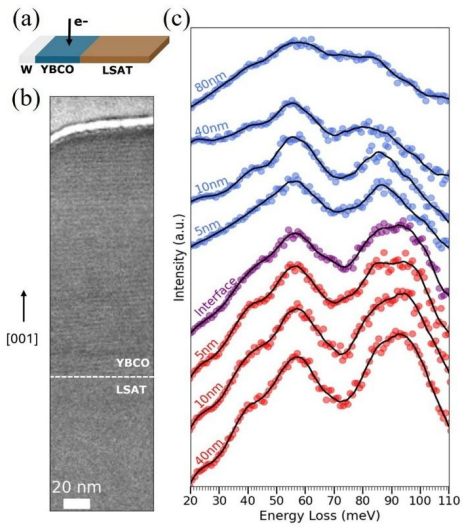
The engine of the argument is the two-step subtracted interface spectrum. The first step uses the spatial symmetry of the surface-scattering profile across the YBCO rod: by the Begrenzung effect—the depletion of bulk scattering near a surface in favor of surface modes—the spectrum very close to an edge is dominated by surface phonons, and the authors assume this surface contribution is the same at the W-coated side and the LSAT side, so subtraction of equidistant spectra cancels it. The second step estimates the LSAT surface phonon polariton contribution from an aloof-mode EELS measurement of an LSAT wedge with the same geometry, scaled by screening effects of the YBCO. The paper also computes an energy-loss function for long-wavelength LO interface phonons, which places three calculated peaks inside the experimental bands and supports the assignment of the measured features to interface bulk phonon modes.
What would settle it
A decisive test would be to repeat the measurement on a YBCO film whose two faces are capped with the same material, making the surface subtraction symmetric; if the 40 and 75 meV peaks survive in that subtracted interface spectrum they are genuine interface modes, while their shift or disappearance would show the original subtraction leaked surface signal.
Extended reading notes
Core claim
On the paper's own terms, the central discovery is that the YBCO/LSAT interface sustains vibrational modes that are neither bulk YBCO nor bulk LSAT modes, and that these modes become visible only after delocalized surface phonon scattering is removed. The subtraction proceeds in two steps: spectra at equidistant positions on the YBCO/W side and the YBCO/LSAT side are subtracted to cancel the YBCO surface contribution, then an aloof-mode spectrum of an isolated LSAT wedge, corrected for screening by YBCO, estimates the LSAT surface contribution to be subtracted. The resulting interface spectrum is dominated by two broad peaks centered near 40 and 75 meV, and the paper reports that the removed surface contributions accounted for up to 60–70% of the original signal. Atomic-scale EELS maps then show that the 35–45 meV scattering oscillates with the Y-123 layered structure, peaking at CuO2 planes and suppressed at CuO chains, while the 70–80 meV scattering is enhanced at the interface and suppressed specifically at the first CuO chain. These modes are presented as inaccessible to traditional phonon spectroscopy because of its limited spatial sensitivity.
Load-bearing premise
The load-bearing premise is that the surface phonon scattering from YBCO is the same at its tungsten-coated side and its LSAT side, so subtracting equidistant spectra from the two sides cancels all YBCO surface contributions; if the two interfaces scatter differently, the residual peaks at 40 and 75 meV contain uncancelled surface signal.
Editorial extensions
If this is right
- Interface EELS studies of heterostructures should remove surface phonon polariton contributions before assigning interface modes; in this geometry they accounted for up to 60–70% of the raw interface scattering.
- The two residual peaks near 40 and 75 meV constitute a spectral signature of the YBCO/LSAT interface that future electron–phonon coupling calculations for cuprate interfaces should reproduce.
- Atomic-scale maps show that the first CuO2-plane and CuO-chain layers adjacent to the interface have vibrational responses distinct from the bulk, implying local lattice dynamics change within a few unit cells of the interface.
- The same two-step subtraction procedure can be applied to other complex-oxide heterostructures to isolate interface phonons from surface background.
- The delocalized scattering in the 80–90 meV range around the interface is consistent with an LO-type interface bulk phonon, giving a concrete prediction for future scattering-cross-section calculations.
Reading between the lines
- Beyond the paper, the same subtraction logic could be applied to FeSe/SrTiO3 interface data, where interfacial phonons have been linked to enhanced superconductivity; comparing corrected and raw spectra would reveal whether surface polariton contamination was also present there.
- Beyond the paper, a boundary-element simulation of the actual W/YBCO/LSAT wedge geometry would quantify how much residual surface signal survives the symmetric subtraction, testing the assumption that the two YBCO surfaces are equivalent scatterers.
- Beyond the paper, the observed shift of the 40 meV band toward the interface and the suppression of the 75 meV band at the first CuO chain suggest these phonon signatures track local oxygen content or strain; a joint EELS measurement of oxygen K-edge and phonon maps on the same specimen could test that correlation.
- Beyond the paper, because the EELS collection angle spans the full Brillouin zone, the mismatch between the measured subtracted spectrum and the q→0 energy-loss function implies that short-wavelength impact-scattering phonons contribute at the interface; computing those cross sections, as the authors suggest, is the natural next step.
Editorial analysis
A structured set of objections, weighed in public.
Referee Report
Summary. The manuscript reports atomic-scale vibrational electron energy loss spectroscopy (EELS) mapping across an epitaxial YBa2Cu3O7-δ/(La,Sr)(Al,Ta)O3 (YBCO/LSAT) interface. The authors identify delocalized and localized phonon scattering contributions near the interface and propose a subtraction procedure to remove surface phonon polariton contributions from the surrounding environment. After subtracting a YBCO surface contribution via a spatial symmetry argument and an LSAT surface contribution estimated from an isolated wedge, the residual interface spectrum exhibits two broad peaks near 40 and 75 meV. The paper also presents atomically resolved maps showing distinct scattering modulations at CuO2 planes and CuO chains, and argues that these features are unique to the interface region.
Significance. If the subtraction assumptions are valid, the work would provide the first local vibrational spectroscopy of a YBCO/LSAT interface and a methodological template for isolating interfacial phonons in complex oxide heterostructures, with potential implications for understanding electron-phonon coupling at cuprate interfaces. The authors deserve credit for explicitly addressing delocalized surface phonon polariton contributions, which are often neglected in interface EELS studies, and for providing detailed experimental data along with a transparent statement of the method's limitations. However, the central result—the 40 and 75 meV interface peaks—rests on two unverified or approximate subtraction steps, and the manuscript itself acknowledges that short-wavelength interface contributions cannot be separated from remaining surface contributions. The significance is therefore conditional on additional validation.
major comments (3)
- [Section C, Figure 3(b)] The spatial subtraction step assumes that surface phonon scattering is identical at the YBCO/W and YBCO/LSAT edges so that subtracting an equidistant spectrum from the opposite side cancels YBCO surface contributions. The two interfaces are not physically symmetric: one edge is adjacent to a tungsten metal layer and the other to a polar dielectric LSAT substrate whose Reststrahlen bands lie in the 35–100 meV range. The surface-loss function of the YBCO rod depends on the full dielectric boundary condition of the cross-section, and a metal cladding modifies the surface-loss spectrum even when plasmon–phonon hybridization is detuned. The paper's dismissal of coupled phonon-plasmon modes due to energy detuning does not establish equality of the bare surface contributions; it only excludes one coupling channel. The residual difference between the two surface spectra can be of the same order as the claimed interface signal. This is the load-bearing assumption for the extracted 40 and 75 meV peaks, and it needs a direct test, for example by comparing subtraction of spectra taken at equidistant positions far from the interface, or by including simulations with the actual W and LSAT claddings.
- [Section C and Supplementary Material, Figure 3(c)] The LSAT surface contribution is estimated from an isolated LSAT wedge spectrum scaled by a screening factor to account for the YBCO presence. The scaling factor is effectively a free parameter, and no uncertainty analysis is provided. The manuscript states that the LSAT surface contributions account for up to 60–70% of the original scattering at the interface, so the final subtracted spectrum is highly sensitive to the choice of this scaling factor and to spectral alignment errors. The authors should provide a sensitivity analysis, such as varying the scaling factor by a reasonable range and showing that the positions and relative intensities of the 40 and 75 meV peaks remain within the experimental uncertainty, or else quantifying the uncertainty on the residual spectrum. Without such analysis, the existence of the two interface peaks is not quantitatively robust.
- [Section C, final paragraph] The manuscript explicitly states that short-wavelength interface contributions 'cannot be distinguished from remaining surface contributions.' This acknowledged degeneracy means that the residual spectrum (green curve in Fig. 3(c)) cannot be uniquely assigned to interfacial phonon modes; it is at best a mixture of interface and uncancelled surface signals. Given that the subtraction steps involve an approximate LSAT estimate and an unverified spatial symmetry, the conclusions should be tempered accordingly. The claim of 'unveiling interfacial phonon modes' is overstated unless additional evidence—such as momentum-resolved measurements or full scattering calculations including impact scattering—is provided to break the degeneracy.
minor comments (4)
- [Section C, Figure 3(c)] The text contains a typo: '60-70%%' should be '60–70%'.
- [Figure 2 caption] The caption lists '(a)' twice; the schematic and the HAADF image appear to be labeled inconsistently with the in-text references.
- [Methods and Figures 2–4] No error bars or confidence intervals are shown on any of the EELS spectra or maps. While the paper notes that noise is preserved, a quantitative statement of signal-to-noise ratio or repeated-measurement variability would help assess the significance of the reported peak positions and map contrasts.
- [Section D, paragraph 7] The discussion of phonon hardening in Y-124 structures cites reference [24] for YBa2Cu4O8, which is appropriate, but the connection to the observed spectral similarities between double CuO chains and CuO2 planes would benefit from a more explicit quantitative comparison.
Circularity Check
No significant circularity: the interface spectrum is a measured difference under a stated symmetry assumption, independently corroborated by atomic-scale maps; self-citations are methodological rather than load-bearing.
full rationale
The central derivation is the subtraction used to isolate interfacial phonon modes (Section C). The paper removes YBCO surface contributions by subtracting a spectrum near the YBCO/LSAT interface from an equidistant spectrum near the YBCO/W edge, relying on the spatial symmetry of the surface-scattering profile. This is a physical identifiability assumption, not a tautology: the input spectra are measured at different positions, and the equality of the two surface terms is a substantive premise that could fail, as the paper itself acknowledges by limiting the method's validity to regions close to the interface and calling the resulting values 'estimates.' No parameter is fitted to the interface spectrum to produce the 40 and 75 meV features; the residual is a direct difference of measured spectra. The LSAT contribution is estimated from an aloof-mode measurement plus screening considerations, not by tuning to match the interface result. Moreover, the 40 and 75 meV features are independently visible in the atomically resolved EELS maps of Section D and are consistent with the calculated loss function (Fig. S3), so the claim does not reduce to the subtraction by construction. The self-citations ([11], [14], [22], [23]) support standard EELS physics and methodology evidence, and are not invoked as a uniqueness theorem to forbid alternative interpretations. The main scientific risk is the symmetry assumption itself, which is a correctness concern rather than circularity. The paper is self-contained against external benchmarks such as known phonon DOS and LSAT phonon energies. Minor self-citation and the strong reliance on the symmetry assumption motivate a score of 2, but no circular step is present.
Assumptions & free parameters
free parameters (1)
- LSAT surface contribution scaling factor =
not specified
assumptions (4)
- domain assumption Begrenzung effect: bulk phonon scattering is reduced near surfaces while surface phonon scattering increases
- domain assumption Surface phonon polaritons are excited via dipole scattering and contribute delocalized signals over long ranges
- ad hoc to paper Spatial symmetry of the YBCO rod ensures equal surface scattering at the YBCO/W and YBCO/LSAT interfaces
- domain assumption Literature phonon mode assignments for YBCO and LSAT (refs 19,21,24) are accurate
Cite this review
Pith. "Pith review of Atomic-scale mapping of interfacial phonon modes in epitaxial YBa2Cu3O7-{\delta} / (La,Sr)(Al,Ta)O3 thin films: The role of surface phonons." pith.science (2026). https://pith.science/paper/JTQ3FTUE
@misc{pith2026250602237,
  author       = {Pith},
  title        = {Pith review of: Atomic-scale mapping of interfacial phonon modes in epitaxial YBa2Cu3O7-\delta / (La,Sr)(Al,Ta)O3 thin films: The role of surface phonons},
  year         = {2026},
  howpublished = {\url{https://pith.science/paper/JTQ3FTUE}},
  note         = {Machine review of arXiv:2506.02237}
}
read the original abstract
We investigate the behavior of phonons at the epitaxial interface between YBa2Cu3O7-{\delta} thin film and (La,Sr)(Al,Ta)O3 substrate using vibrational electron energy loss spectroscopy. Interfacial phonon modes with different degrees of scattering localization were identified. We find evidence that surface contributions from the surrounding environment can impose additional scattering modulation into local EELS measurements at the interface. A method to remove those contributions is then used to isolate the phonon information at the interface. This work unveils interfacial phonon modes in a high-Tc cuprate superconductor, that are not accessible with traditional phonon spectroscopy techniques, and provides a method for probing interfacial phonons in complex oxide heterostructures.
Figures


Reference graph
Works this paper leans on
-
[1]
K. Conder, Material aspects of oxygen isotope effect studies in high-temperature superconductors, Physica C: Superconductivity and Its Applications 614, 1354376 (2023)
work page 2023
-
[2]
K. A. Müller, The Unique Properties of Superconductivity in Cuprates, J Supercond Nov Magn 27, 2163 (2014)
work page 2014
- [3]
-
[4]
M. J. Lagos, I. C. Bicket, S. S. Mousavi M., and G. A. Botton, Advances in ultrahigh- energy resolution EELS: phonons, infrared plasmons and strongly coupled modes, Microscopy 71, i174 (2022)
work page 2022
-
[5]
Z. Cheng et al., Experimental observation of localized interfacial phonon modes, Nat Commun 12, 6901 (2021)
work page 2021
-
[6]
Qi et al., Measuring phonon dispersion at an interface, Nature 599, 399 (2021)
R. Qi et al., Measuring phonon dispersion at an interface, Nature 599, 399 (2021)
work page 2021
-
[7]
Li et al., Atomic-scale probing of heterointerface phonon bridges in nitride semiconductor, Proc
Y.-H. Li et al., Atomic-scale probing of heterointerface phonon bridges in nitride semiconductor, Proc. Natl. Acad. Sci. U.S.A. 119, e2117027119 (2022)
work page 2022
-
[8]
M. Wu et al., Effects of Localized Interface Phonons on Heat Conductivity in Ingredient Heterogeneous Solids, Chinese Phys. Lett. 40, 036801 (2023)
work page 2023
Show all 33 references
-
[9]
Shi et al., Atomic-scale observation of localized phonons at FeSe/SrTiO3 interface, Nat Commun 15, 3418 (2024)
R. Shi et al., Atomic-scale observation of localized phonons at FeSe/SrTiO3 interface, Nat Commun 15, 3418 (2024)
2024
-
[10]
Yang et al., Phonon modes and electron–phonon coupling at the FeSe/SrTiO3 interface, Nature 635, 332 (2024)
H. Yang et al., Phonon modes and electron–phonon coupling at the FeSe/SrTiO3 interface, Nature 635, 332 (2024)
2024
-
[11]
M. J. Lagos, A. Trügler, U. Hohenester, and P. E. Batson, Mapping vibrational surface and bulk modes in a single nanocube, Nature 543, 529 (2017)
2017
-
[12]
E. R. Hoglund et al., Emergent interface vibrational structure of oxide superlattices, Nature 601, 556 (2022)
2022
-
[13]
E. R. Hoglund et al., Nonequivalent Atomic Vibrations at Interfaces in a Polar Superlattice, Advanced Materials 36, 2402925 (2024)
2024
-
[14]
M. J. Lagos and P. E. Batson, Thermometry with Subnanometer Resolution in the Electron Microscope Using the Principle of Detailed Balancing, Nano Lett. 18, 4556 (2018)
2018
-
[15]
Virtanen et al., SciPy 1.0: fundamental algorithms for scientific computing in Python, Nature Methods 17, 261 (2020)
P. Virtanen et al., SciPy 1.0: fundamental algorithms for scientific computing in Python, Nature Methods 17, 261 (2020)
2020
-
[16]
Gauquelin, H
N. Gauquelin, H. Zhang, G. Zhu, J. Y . T. Wei, and G. A. Botton, Atomic-scale identification of novel planar defect phases in heteroepitaxial YBa2Cu3O7− δ thin films, AIP Advances 8, 055022 (2018)
2018
-
[17]
Zhang, N
H. Zhang, N. Gauquelin, C. McMahon, D. G. Hawthorn, G. A. Botton, and J. Y . T. Wei, Synthesis of high-oxidation Y-Ba-Cu-O phases in superoxygenated thin films, Phys. Rev. Materials 2, 033803 (2018)
2018
-
[18]
Frano et al., Long-range charge-density-wave proximity effect at cuprate/manganate interfaces, Nature Mater 15, 831 (2016)
A. Frano et al., Long-range charge-density-wave proximity effect at cuprate/manganate interfaces, Nature Mater 15, 831 (2016)
2016
-
[19]
Renker, F
B. Renker, F. Gompf, H. Rietschel, and H. Mutka, Phonon density-of-states for high- (Y , RE) BazCu307 superconductors and non-superconducting reference systems, Z. Phys. B - Condensed Matter 71, 437 (1988)
1988
-
[20]
P. E. Batson and M. J. Lagos, Interpretation of meV Resolution Phonon EELS Data, Microsc Microanal 24, 412 (2018)
2018
-
[21]
T. N. Nunley, T. I. Willett-Gies, J. A. Cooke, F. S. Manciu, P. Marsik, C. Bernhard, and S. Zollner, Optical constants, band gap, and infrared-active phonons of (LaAlO3)0.3(Sr2AlTaO6)0.35 (LSAT) from spectroscopic ellipsometry, Journal of Vacuum Science & Technology A: Vacuum,...
2016
-
[22]
M. J. Lagos, P. E. Batson, Z. Lyu, and U. Hohenester, Imaging Strongly Coupled Plasmon– Phonon Modes in Mid-Infrared Double Antennas, ACS Photonics 8, 1293 (2021)
2021
-
[23]
Hohenester, A
U. Hohenester, A. Trügler, P. E. Batson, and M. J. Lagos, Inelastic vibrational bulk and surface losses of swift electrons in ionic nanostructures, Phys. Rev. B 97, 165418 (2018)
2018
-
[24]
E. T. Heyen, R. Liu, C. Thomsen, R. Kremer, M. Cardona, J. Karpinski, E. Kaldis, and S. Rusiecki, Optical phonons in YBa 2 Cu 4 O 8 and Y 2 Ba 4 Cu 7 O 15 − δ, Phys. Rev. B 41, 11058 (1990)
1990
-
[25]
Bianconi, N
A. Bianconi, N. L. Saini, A. Lanzara, M. Missori, T. Rossetti, H. Oyanagi, H. Yamaguchi, K. Oka, and T. Ito, Determination of the Local Lattice Distortions in the Cu${\mathrm{O}}_{2}$ Plane of L${\mathrm{a}}_{1.85}$S${\mathrm{r}}_{0.15}$Cu${\mathrm{O}}_{4}$, Phys. Rev. Lett. 7...
1996
-
[26]
N. L. Saini, A. Lanzara, H. Oyanagi, H. Yamaguchi, K. Oka, T. Ito, and A. Bianconi, Local lattice instability and stripes in the ${\mathrm{CuO}}_{2}$ plane of the ${\mathrm{La}}_{1.85}$${\mathrm{Sr}}_{0.15}$${\mathrm{CuO}}_{4}$ system by polarized XANES and EXAFS, Phys. Rev. B...
1997
-
[27]
Kang et al., Discovery of charge order in a cuprate Mott insulator, Proc
M. Kang et al., Discovery of charge order in a cuprate Mott insulator, Proc. Natl. Acad. Sci. U.S.A. 120, e2302099120 (2023)
2023
-
[28]
Bussmann-Holder and H
A. Bussmann-Holder and H. Keller, Multiband Superconductivity, Polarons, Jahn-Teller Polarons, Heterogeneity, and High-Temperature Superconductivity, Condensed Matter 9, 56 (2024)
2024
-
[29]
See Supplementary Material at [ URL] for technical information and simulations, which includes Refs. [30-33]
-
[30]
O. L. Krivanek et al., Vibrational spectroscopy in the electron microscope, Nature 514, 209 (2014)
2014
-
[31]
C. C. Homes, T. Timusk, D. A. Bonn, R. Liang, and W. N. Hardy, Optical properties along the c-axis of YBa2Cu3O6+x, for x = 0.50 → 0.95 evolution of the pseudogap, Physica C: Superconductivity 254, 265 (1995)
1995
-
[32]
Barnes, H
A. Barnes, H. Haneef, D. G. Schlom, and N. J. Podraza, Optical band gap and infrared phonon modes of (La_029Sr_071)(Al_065Ta_036)O_3 (LSAT) single crystal from infrared to ultraviolet range spectroscopic ellipsometry, Opt. Mater. Express 6, 3210 (2016)
2016
-
[33]
Hohenester and A
U. Hohenester and A. Trügler, MNPBEM – A Matlab toolbox for the simulation of plasmonic nanoparticles, Computer Physics Communications 183, 370 (2012). Figure 1. Superconductivity and structural properties of epitaxially -grown YBCO film . (a) Resistivity versus temperature me...
2012
Reviewed August 7, 2026 · model on record in the stance chip above.
Discussion (0). Sign in to comment.