REVIEW 4 major objections 5 minor 1 cited by
RoadFormer : Local-Global Feature Fusion for Road Surface Classification in Autonomous Driving
T0 review · 4 major / 5 minor · reviewed 2026-08-07 · deepseek-v4-flash
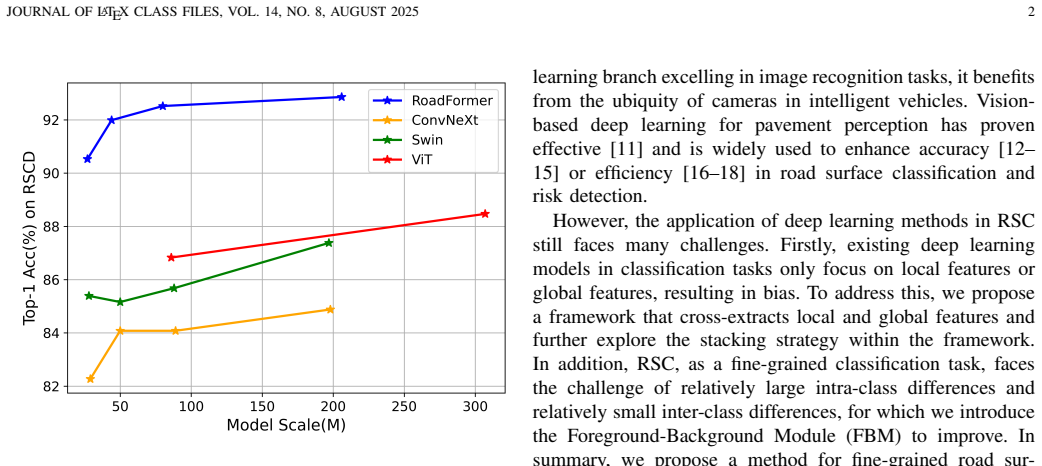
Pith's one-line read RoadFormer, a hybrid convolution-transformer network with a foreground-background auxiliary loss, claims 92.52% top-1 accuracy on the 27-class RSCD road surface benchmark, beating ConvNeXt, Swin, and ViT by 5.69 to 12.84 points.
desk verdict Plausible hybrid architecture with honest ablations, but the SOTA claim rests on an under-specified baseline protocol and missing reproducibility artifacts. read the letter →
The pith
A machine-rendered reading of the paper's core claim, the machinery that carries it, and where it could break.
The reading
What carries the argument
The central object is the four-stage hybrid backbone with a Foreground-Background Module (FBM). The backbone passes features through a Stem, then Stage1-L (conv blocks only), Stage2-M and Stage3-M (mixed conv and transformer blocks), and Stage4-G (transformer blocks only), with patch embedding between stages, so local texture detail and global pixel relationships are both represented at multiple resolutions. The FBM attaches a linear classifier to each stage's feature map, softmaxes it into a classification map, takes the max score per spatial position, selects the top-K positions as foreground (with K decreasing from 256 to 32 across stages), and trains a Hardtanh-mapped background prediction toward -1 with a mean-squared-error loss. This loss is meant to expand the separation between road-relevant and road-irrelevant regions without requiring segmentation labels.
What would settle it
Retrain ConvNeXt, Swin, and ViT under the paper's exact protocol, or use the baselines' official pretrained weights fine-tuned on RSCD, and compare on the official RSCD test split; if the accuracy gaps shrink to near zero, the claimed advantage is not architectural. A second check is to overlay FBM's selected foreground regions on input images and measure whether they align with actual road pixels via a segmentation mask.
Extended reading notes
Core claim
The central discovery is that a four-stage hybrid backbone composed of a local stage, two mixed stages, and a global stage combined with an auxiliary foreground-background separation loss is enough to lift fine-grained road surface classification accuracy well above pure CNN and pure transformer models of comparable size. On RSCD, RoadFormer-B reaches 92.52% top-1 accuracy, beating ConvNeXt-B by 8.44 points, Swin-B by 6.84 points, and ViT-B by 5.69 points, with fewer parameters. The ablation shows the hybrid stacking alone raises accuracy from 91.90% to 92.34%, the FBM alone to 92.23%, and both together to 92.52%, indicating the two contributions combine. The FBM also transfers: adding it to ConvNeXt, Swin, and ViT improves their top-1 accuracy by about 0.1 points, showing the foreground-background prior is not architecture-specific.
Load-bearing premise
The accuracy comparisons assume the baseline models were trained to a comparable state using the same untuned 40-epoch recipe and the same RSCD train/test split; if the baselines were undertrained or the split differs, the reported gains could come from training protocol or data selection rather than from RoadFormer's architecture.
Editorial extensions
If this is right
- At the base size, RoadFormer reaches 92.52% top-1 accuracy on the 27-class RSCD and 96.50% on the 5-class simple-RSCD, with 80M parameters.
- RoadFormer-L reaches 92.86% on RSCD, the best result the paper reports.
- The FBM is transferable: adding it to ConvNeXt, Swin, and ViT raises their top-1 accuracy by about 0.1 points, suggesting the auxiliary separation loss is a plug-in module.
- Confusion-matrix analysis shows residual confusion between dry-wet and wet-water label pairs, pointing to label ambiguity as a remaining bottleneck.
- The hybrid stacking structure outperforms pure-CNN and pure-transformer orderings, supporting the paper's claim that local-global mixing at multiple scales is beneficial for fine-grained texture tasks.
Reading between the lines
- If the FBM's foreground-background prior generalizes, the same auxiliary-loss trick could transfer to other fine-grained classification tasks such as material recognition or terrain type classification, which the paper does not test.
- The small FBM gains on other models (~0.1 points) relative to the stacking-structure gain (~0.4 points in the ablation) suggest that the local-global stacking, not the FBM, carries most of RoadFormer's advantage; the paper does not draw this conclusion.
- The decreasing foreground selection K values (256, 128, 64, 32) were chosen heuristically; a learned or resolution-adaptive selection rule could be tested and might yield further gains.
- Because label pairs such as dry-wet and wet-water are inherently ambiguous, the reported accuracy may partly reflect annotation consistency rather than perceptual separability; a re-annotation study could quantify this.
Editorial analysis
A structured set of objections, weighed in public.
Referee Report
Summary. The paper proposes RoadFormer, a hybrid CNN-Transformer architecture for fine-grained road surface classification, combining local convolutional stages, mixed stages, and a global transformer stage. A Foreground-Background Module (FBM) selects high-scoring spatial locations from intermediate classifiers and pushes the remaining locations toward a background target value via an auxiliary MSE loss. Experiments on the RSCD dataset report 92.52% top-1 accuracy on the 27-class version and 96.50% on a simplified 5-class version, with claimed improvements of 5.69% to 12.84% over ConvNeXt, Swin Transformer, and ViT trained for 40 epochs at 224x224 resolution. The paper also includes stacking-structure comparisons, ablations, and confusion-matrix analyses.
Significance. If the reported results hold, RoadFormer would be a strong practical result for road-surface classification, and the systematic exploration of local-global stacking plus a plug-in foreground-background module is a useful contribution. The paper has several strengths: it evaluates four model variants across two dataset granularities, provides ablations separating the contributions of the stacking structure and the FBM, and includes confusion-matrix analyses that point to the dry-wet and wet-water confusions. However, the empirical support for the headline superiority claim is conditional on the fairness of the baseline training protocol, which is not fully specified, and the FBM's self-referential patch-selection mechanism raises a validity concern that the current experiments do not resolve. The absence of error bars, repeated runs, and code also limits the reliability and reproducibility of the quantitative claims.
major comments (4)
- [Section IV (Comparative experiment)] The central claim of 5.69% to 12.84% improvements over SOTA rests entirely on a single 40-epoch training protocol with no stated pretraining for the baselines, no per-model hyperparameter tuning, and no repeated seeds. ConvNeXt, Swin, and ViT are known to require substantially longer schedules or ImageNet-pretrained initialization to reach representative accuracy, so the reported gaps may reflect training-recipe artifacts rather than architectural superiority. Please report results from the original RSCD paper [62], add a longer-schedule or pretrained-initialization calibration for the baselines, and give per-model hyperparameters and augmentation details so that the comparison is demonstrably fair.
- [Section IV (Dataset and Table II)] The paper cites the RSCD dataset paper [62] but never compares against the results reported there, so the 'SOTA' label is not grounded in the published literature on this dataset. If the original paper uses a different train/test split or protocol, the discrepancy must be reconciled; if it does not, those numbers should be included in Table II or discussed explicitly. Without this comparison, readers cannot assess whether the reported accuracy is an advance over established results or merely an artifact of the local evaluation setup.
- [Section III (Foreground Background Module, Eq. (5))] The FBM loss selects the top-K_i spatial locations according to the stage classifier's own maximum score and then trains those locations toward the foreground while pushing all others toward -1. This creates a self-referential training signal that may reinforce the classifier's existing biases rather than learn a meaningful foreground-background separation. Please add a control experiment that ablates the selection mechanism, for example random selection or selection based on a fixed center crop, and show visualizations of the selected regions to demonstrate that they correspond to pavement rather than to arbitrary high-confidence patches.
- [Tables II-VI] All accuracy, precision, recall, and F1 numbers are single-run point estimates with no error bars, no number of seeds, and no significance tests. The FBM gains in Table IV are about 0.1% in top-1 accuracy, which is within the typical run-to-run variation for this type of model, so the claim that FBM generalizes to other architectures is not statistically supported. Please provide mean and standard deviation over at least three seeds, or otherwise justify that the reported differences exceed training noise.
minor comments (5)
- [Eq. (3)] The definition of Hardtanh appears incorrect or misformatted: the standard Hardtanh is a clamp function, while Eq. (3) resembles a double-angle identity for tanh rather than a hard tanh. Please correct the equation and the surrounding description, as the current text undermines confidence in the methods write-up.
- [Table V caption] The caption reads 'F represents Front Background Module'; this should be 'Foreground-Background Module' for consistency with the rest of the paper.
- [Fig. 2 caption] The caption 'Comparison among RoadFormer and efficient Networks' is vague and the figure is not referenced in the main text; please either reference it or remove it.
- [Section IV (Stacking Structure)] The sentence 'the number of satges is kept constant at 4' contains a typo ('satges' should be 'stages').
- [Section IV (Experimental Setup)] The definitions of Mean Precision, Mean Recall, and Mean F1 are given in prose but not as explicit formulas, and it is unclear whether they are macro-averaged or weighted by class frequency; please state the averaging scheme explicitly.
Circularity Check
No significant circularity: the central claim is an empirical benchmark result with ablations, not a reduction to input definitions.
full rationale
RoadFormer's central contribution is a hybrid CNN-transformer stacking structure plus a foreground-background module (FBM), evaluated on the RSCD dataset. The paper reports top-1 accuracy improvements overConvNeXt, Swin, and ViT. These are empirical results from a fixed experimental protocol; no quantity is fitted to the test set and then reported as a prediction. The FBM selects high-confidence regions using the model's own softmax outputs, which is a self-referential training signal, but it is an auxiliary loss during training, not a definitional equivalence; its effectiveness is separately ablated (Table V shows a 0.3% gain, and Table IV shows ~0.1% gains on other models). The stacking strategy is chosen by comparing configurations in Table III, not derived from a prior theorem. Self-citations [15,17,18] appear only in the related-work survey and are not load-bearing for the headline results. No uniqueness theorem is imported, and no ansatz is smuggled in via citation. The comparison protocol may be fairness-questionable (40 epochs, no pretraining detail), but that is a correctness risk, not circularity. The derivation chain is self-contained with respect to its inputs.
Assumptions & free parameters
free parameters (3)
- Foreground selection counts K_i =
256, 128, 64, 32 for stages 1-4
- Background target value -1 =
-1
- Stage block counts (N1, n2, N2, etc.) =
Configured per variant T/S/B/L (e.g., 3 Conv + 1 Trans in Stage 2)
assumptions (4)
- domain assumption Road surface condition can be reliably estimated from 2D camera images alone.
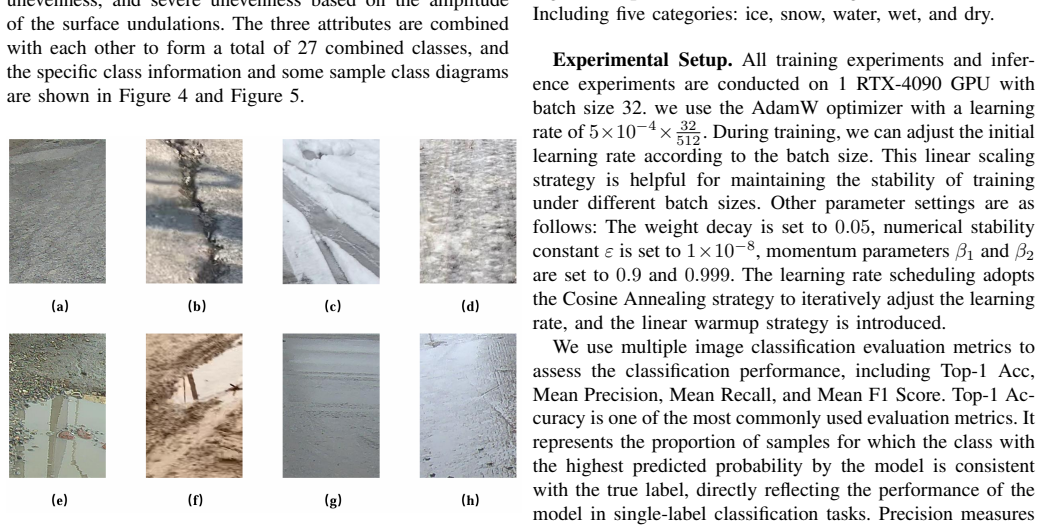
- domain assumption The RSCD dataset annotations (27-class and simplified 5-class) are accurate and the official split is used consistently.
- domain assumption A single 40-epoch training schedule with default hyperparameters is sufficient for all baseline models to reach comparable performance.
- ad hoc to paper The FBM's linear classifier produces a meaningful foreground-background separation.
invented entities (1)
-
Foreground-Background Module (FBM)
Cite this review
Pith. "Pith review of RoadFormer : Local-Global Feature Fusion for Road Surface Classification in Autonomous Driving." pith.science (2026). https://pith.science/paper/FFN7KQ7X
@misc{pith2026250602358,
  author       = {Pith},
  title        = {Pith review of: RoadFormer : Local-Global Feature Fusion for Road Surface Classification in Autonomous Driving},
  year         = {2026},
  howpublished = {\url{https://pith.science/paper/FFN7KQ7X}},
  note         = {Machine review of arXiv:2506.02358}
}
read the original abstract
The classification of the type of road surface (RSC) aims to utilize pavement features to identify the roughness, wet and dry conditions, and material information of the road surface. Due to its ability to effectively enhance road safety and traffic management, it has received widespread attention in recent years. In autonomous driving, accurate RSC allows vehicles to better understand the road environment, adjust driving strategies, and ensure a safer and more efficient driving experience. For a long time, vision-based RSC has been favored. However, existing visual classification methods have overlooked the exploration of fine-grained classification of pavement types (such as similar pavement textures). In this work, we propose a pure vision-based fine-grained RSC method for autonomous driving scenarios, which fuses local and global feature information through the stacking of convolutional and transformer modules. We further explore the stacking strategies of local and global feature extraction modules to find the optimal feature extraction strategy. In addition, since fine-grained tasks also face the challenge of relatively large intra-class differences and relatively small inter-class differences, we propose a Foreground-Background Module (FBM) that effectively extracts fine-grained context features of the pavement, enhancing the classification ability for complex pavements. Experiments conducted on a large-scale pavement dataset containing one million samples and a simplified dataset reorganized from this dataset achieved Top-1 classification accuracies of 92.52% and 96.50%, respectively, improving by 5.69% to 12.84% compared to SOTA methods. These results demonstrate that RoadFormer outperforms existing methods in RSC tasks, providing significant progress in improving the reliability of pavement perception in autonomous driving systems.
Figures


Figures from the paper (5 more)




Forward citations
Cited by 1 Pith paper
-
RoadMamba: A Dual Branch Visual State Space Model for Road Surface Classification
A dual-branch state space model combining whole-image and windowed local scanning with attention fusion achieves 92.81% top-1 accuracy on the 27-class RSCD road surface dataset, ahead of the compared Mamba, Transforme...
Reference graph
Works this paper leans on
-
[62]
T. Zhao, J. He, J. Lv, D. Min, and Y . Wei, “A compre- hensive implementation of road surface classification for vehicle driving assistance: Dataset, models, and deploy- ment,” IEEE Transactions on Intelligent Transportation Systems, vol. 24, no. 8, pp. 8361–8370, 2023
work page 2023
-
[1]
Speed-independent vibration-based terrain classification for passenger vehi- cles,
C. C. Ward and K. Iagnemma, “Speed-independent vibration-based terrain classification for passenger vehi- cles,” Vehicle System Dynamics, vol. 47, no. 9, pp. 1095– 1113, 2009
work page 2009
-
[2]
Y . Qin, M. Dong, F. Zhao, R. Langari, and L. Gu, “Road profile classification for vehicle semi-active suspension system based on adaptive neuro-fuzzy inference system,” in 2015 54th IEEE Conference on Decision and Control (CDC), pp. 1533–1538, IEEE, 2015
work page 2015
-
[3]
Road segmen- tation for classification of road weather conditions,
E. J. Almazan, Y . Qian, and J. H. Elder, “Road segmen- tation for classification of road weather conditions,” in Computer Vision–ECCV 2016 Workshops: Amsterdam, The Netherlands, October 8-10 and 15-16, 2016, Pro- ceedings, Part I 14 , pp. 96–108, Springer, 2016
work page 2016
-
[4]
Evaluating features and classifiers for road weather condition anal- ysis,
Y . Qian, E. J. Almazan, and J. H. Elder, “Evaluating features and classifiers for road weather condition anal- ysis,” in 2016 IEEE International Conference on Image Processing (ICIP), pp. 4403–4407, IEEE, 2016
work page 2016
-
[5]
Road surface state recog- nition based on svm optimization and image segmen- tation processing,
J. Zhao, H. Wu, and L. Chen, “Road surface state recog- nition based on svm optimization and image segmen- tation processing,” Journal of Advanced Transportation , vol. 2017, no. 1, p. 6458495, 2017
work page 2017
-
[6]
B. Leng, D. Jin, L. Xiong, X. Yang, and Z. Yu, “Estima- tion of tire-road peak adhesion coefficient for intelligent electric vehicles based on camera and tire dynamics information fusion,” Mechanical Systems and Signal Pro- cessing, vol. 150, p. 107275, 2021
work page 2021
-
[7]
M. A. Bekhti and Y . Kobayashi, “Prediction of vibrations as a measure of terrain traversability in outdoor structured and natural environments,” in Image and Video Technol- ogy: 7th Pacific-Rim Symposium, PSIVT 2015, Auckland, New Zealand, November 25-27, 2015, Revised Selected Papers 7, pp. 282–294, Springer, 2016
work page 2015
Show all 64 references
-
[8]
Kinetics of heal- ing of asphalt mixtures,
X. Luo, B. Birgisson, and R. L. Lytton, “Kinetics of heal- ing of asphalt mixtures,” Journal of Cleaner Production, vol. 252, p. 119790, 2020
2020
-
[9]
A kinetics-based model of fatigue crack growth rate in bituminous material,
H. Li, X. Luo, and Y . Zhang, “A kinetics-based model of fatigue crack growth rate in bituminous material,” International Journal of Fatigue , vol. 148, p. 106185, 2021
2021
-
[10]
Molecular dynamics investigation of interfacial adhe- sion between oxidised bitumen and mineral surfaces,
Y . Gao, Y . Zhang, Y . Yang, J. Zhang, and F. Gu, “Molecular dynamics investigation of interfacial adhe- sion between oxidised bitumen and mineral surfaces,” Applied Surface Science , vol. 479, pp. 449–462, 2019
2019
-
[11]
Assessment of deep convolutional neural networks for road surface classification,
M. Nolte, N. Kister, and M. Maurer, “Assessment of deep convolutional neural networks for road surface classification,” in 2018 21st International Conference on Intelligent Transportation Systems (ITSC) , pp. 381–386, IEEE, 2018
2018
-
[12]
Deep learning- based crack damage detection using convolutional neural networks,
Y .-J. Cha, W. Choi, and O. B¨uy¨uk¨ozt¨urk, “Deep learning- based crack damage detection using convolutional neural networks,” Computer-Aided Civil and Infrastructure En- gineering, vol. 32, no. 5, pp. 361–378, 2017
2017
-
[13]
Cross-scene pavement distress detection by a novel transfer learning framework,
Y . Li, P. Che, C. Liu, D. Wu, and Y . Du, “Cross-scene pavement distress detection by a novel transfer learning framework,” Computer-Aided Civil and Infrastructure Engineering, vol. 36, no. 11, pp. 1398–1415, 2021
2021
-
[14]
Deep metric learning-based for multi-target few-shot pavement distress classification,
H. Dong, K. Song, Q. Wang, Y . Yan, and P. Jiang, “Deep metric learning-based for multi-target few-shot pavement distress classification,” IEEE Transactions on Industrial Informatics, vol. 18, no. 3, pp. 1801–1810, 2021
2021
-
[15]
Heightformer: Learning height prediction in voxel features for roadside vision centric 3d object detec- tion via transformer,
Z. Zhang, C. Sun, C. Yue, D. Wen, Y . Chen, T. Wang, and J. Leng, “Heightformer: Learning height prediction in voxel features for roadside vision centric 3d object detec- tion via transformer,” arXiv preprint arXiv:2503.10777 , 2025
2025 arXiv
-
[16]
Pavement anomaly detec- tion based on transformer and self-supervised learning,
Z. Lin, H. Wang, and S. Li, “Pavement anomaly detec- tion based on transformer and self-supervised learning,” Automation in Construction , vol. 143, p. 104544, 2022
2022
-
[17]
Pillarmamba: Learning local-global context for roadside point cloud via hybrid state space model,
Z. Zhang, C. Sun, C. Yue, D. Wen, T. Wang, and J. Leng, “Pillarmamba: Learning local-global context for roadside point cloud via hybrid state space model,” arXiv preprint arXiv:2505.05397, 2025
2025 arXiv
-
[18]
Height3d: A roadside visual framework based on height prediction in real 3-d space,
Z. Zhang, C. Sun, B. Wang, B. Guo, D. Wen, T. Zhu, and Q. Ning, “Height3d: A roadside visual framework based on height prediction in real 3-d space,” IEEE Transac- tions on Intelligent Transportation Systems , 2025
2025
-
[19]
Gradient-based learning applied to document recogni- tion,
Y . LeCun, L. Bottou, Y . Bengio, and P. Haffner, “Gradient-based learning applied to document recogni- tion,” Proceedings of the IEEE, vol. 86, no. 11, pp. 2278– 2324, 1998
1998
-
[20]
Imagenet classification with deep convolutional neural networks,
A. Krizhevsky, I. Sutskever, and G. E. Hinton, “Imagenet classification with deep convolutional neural networks,” Advances in neural information processing systems , vol. 25, 2012
2012
-
[21]
Very deep convolu- tional networks for large-scale image recognition,
K. Simonyan and A. Zisserman, “Very deep convolu- tional networks for large-scale image recognition,” arXiv preprint arXiv:1409.1556, 2014
2014 arXiv
-
[22]
Going deeper with convolutions,
C. Szegedy, W. Liu, Y . Jia, P. Sermanet, S. Reed, D. Anguelov, D. Erhan, V . Vanhoucke, and A. Rabi- novich, “Going deeper with convolutions,” in Proceed- ings of the IEEE conference on computer vision and pattern recognition, pp. 1–9, 2015
2015
-
[23]
Deep residual learning for image recognition,
K. He, X. Zhang, S. Ren, and J. Sun, “Deep residual learning for image recognition,” in Proceedings of the IEEE conference on computer vision and pattern recog- nition, pp. 770–778, 2016
2016
-
[24]
Densely connected convolutional networks,
G. Huang, Z. Liu, L. Van Der Maaten, and K. Q. Wein- berger, “Densely connected convolutional networks,” in Proceedings of the IEEE conference on computer vision and pattern recognition , pp. 4700–4708, 2017
2017
-
[25]
Squeeze-and-excitation networks,
J. Hu, L. Shen, and G. Sun, “Squeeze-and-excitation networks,” in Proceedings of the IEEE conference on computer vision and pattern recognition, pp. 7132–7141, 2018
2018
-
[26]
Winter road sur- face condition recognition using a pretrained deep con- volutional network,
G. Pan, L. Fu, R. Yu, and M. Muresan, “Winter road sur- face condition recognition using a pretrained deep con- volutional network,” arXiv preprint arXiv:1812.06858 , 2018. JOURNAL OF LATEX CLASS FILES, VOL. 14, NO. 8, AUGUST 2025 10
2018 arXiv
-
[27]
Machine learning models for road surface and friction estimation using front-camera images,
S. Roychowdhury, M. Zhao, A. Wallin, N. Ohlsson, and M. Jonasson, “Machine learning models for road surface and friction estimation using front-camera images,” in 2018 International Joint Conference on Neural Networks (IJCNN), pp. 1–8, IEEE, 2018
2018
-
[28]
Road surface con- dition classification using deep learning,
L. Cheng, X. Zhang, and J. Shen, “Road surface con- dition classification using deep learning,” Journal of Vi- sual Communication and Image Representation , vol. 64, p. 102638, 2019
2019
-
[29]
Rcnet: road clas- sification convolutional neural networks for intelligent vehicle system,
D. K. Dewangan and S. P. Sahu, “Rcnet: road clas- sification convolutional neural networks for intelligent vehicle system,” Intelligent Service Robotics , vol. 14, no. 2, pp. 199–214, 2021
2021
-
[30]
Design of efficient deep learning models for determining road sur- face condition from roadside camera images and weather data,
J. Carrillo, M. Crowley, G. Pan, and L. Fu, “Design of efficient deep learning models for determining road sur- face condition from roadside camera images and weather data,” arXiv preprint arXiv:2009.10282 , 2020
2009 arXiv
-
[31]
Rethinking the inception architecture for computer vision,
C. Szegedy, V . Vanhoucke, S. Ioffe, J. Shlens, and Z. Wojna, “Rethinking the inception architecture for computer vision,” in Proceedings of the IEEE conference on computer vision and pattern recognition , pp. 2818– 2826, 2016
2016
-
[32]
Xception: Deep learning with depthwise separable convolutions,
F. Chollet, “Xception: Deep learning with depthwise separable convolutions,” in Proceedings of the IEEE conference on computer vision and pattern recognition , pp. 1251–1258, 2017
2017
-
[33]
Inverted residuals and linear bottlenecks: Mobile networks for classification, detection and seg- mentation,
A. Howard, A. Zhmoginov, L.-C. Chen, M. Sandler, and M. Zhu, “Inverted residuals and linear bottlenecks: Mobile networks for classification, detection and seg- mentation,” in Proc. CVPR, pp. 4510–4520, 2018
2018
-
[34]
Learning transferable architectures for scalable image recognition,
B. Zoph, V . Vasudevan, J. Shlens, and Q. V . Le, “Learning transferable architectures for scalable image recognition,” in Proceedings of the IEEE conference on computer vision and pattern recognition, pp. 8697–8710, 2018
2018
-
[35]
Attention is all you need,
A. Vaswani, N. Shazeer, N. Parmar, J. Uszkoreit, L. Jones, A. N. Gomez, Ł. Kaiser, and I. Polosukhin, “Attention is all you need,” Advances in neural informa- tion processing systems , vol. 30, 2017
2017
-
[36]
An image is worth 16x16 words: Transformers for image recognition at scale,
A. Dosovitskiy, L. Beyer, A. Kolesnikov, D. Weis- senborn, X. Zhai, T. Unterthiner, M. Dehghani, M. Min- derer, G. Heigold, S. Gelly, et al. , “An image is worth 16x16 words: Transformers for image recognition at scale,” arXiv preprint arXiv:2010.11929 , 2020
2010 arXiv
-
[37]
Swin transformer: Hierarchical vi- sion transformer using shifted windows,
Z. Liu, Y . Lin, Y . Cao, H. Hu, Y . Wei, Z. Zhang, S. Lin, and B. Guo, “Swin transformer: Hierarchical vi- sion transformer using shifted windows,” in Proceedings of the IEEE/CVF international conference on computer vision, pp. 10012–10022, 2021
2021
-
[38]
Swin transformer v2: Scaling up capacity and resolution,
Z. Liu, H. Hu, Y . Lin, Z. Yao, Z. Xie, Y . Wei, J. Ning, Y . Cao, Z. Zhang, L. Dong,et al., “Swin transformer v2: Scaling up capacity and resolution,” inProceedings of the IEEE/CVF conference on computer vision and pattern recognition, pp. 12009–12019, 2022
2022
-
[39]
Deep learning with attention mechanisms for road weather detection,
M. Samo, J. M. Mafeni Mase, and G. Figueredo, “Deep learning with attention mechanisms for road weather detection,” Sensors, vol. 23, no. 2, p. 798, 2023
2023
-
[40]
Training data-efficient image transformers & distillation through attention,
H. Touvron, M. Cord, M. Douze, F. Massa, A. Sablay- rolles, and H. J ´egou, “Training data-efficient image transformers & distillation through attention,” in Inter- national conference on machine learning , pp. 10347– 10357, PMLR, 2021
2021
-
[41]
Going deeper with image transformers,
H. Touvron, M. Cord, A. Sablayrolles, G. Synnaeve, and H. J ´egou, “Going deeper with image transformers,” in Proceedings of the IEEE/CVF international conference on computer vision , pp. 32–42, 2021
2021
-
[42]
Tokens-to-token vit: Training vision transformers from scratch on imagenet,
L. Yuan, Y . Chen, T. Wang, W. Yu, Y . Shi, Z.-H. Jiang, F. E. Tay, J. Feng, and S. Yan, “Tokens-to-token vit: Training vision transformers from scratch on imagenet,” in Proceedings of the IEEE/CVF international conference on computer vision , pp. 558–567, 2021
2021
-
[43]
Pyramid vision transformer: A versatile backbone for dense prediction without convo- lutions,
W. Wang, E. Xie, X. Li, D.-P. Fan, K. Song, D. Liang, T. Lu, P. Luo, and L. Shao, “Pyramid vision transformer: A versatile backbone for dense prediction without convo- lutions,” in Proceedings of the IEEE/CVF international conference on computer vision , pp. 568–578, 2021
2021
-
[44]
Unext: Mlp- based rapid medical image segmentation network,
J. M. J. Valanarasu and V . M. Patel, “Unext: Mlp- based rapid medical image segmentation network,” in International conference on medical image computing and computer-assisted intervention, pp. 23–33, Springer, 2022
2022
-
[45]
Uformer: A general u-shaped transformer for image restoration,
Z. Wang, X. Cun, J. Bao, W. Zhou, J. Liu, and H. Li, “Uformer: A general u-shaped transformer for image restoration,” in Proceedings of the IEEE/CVF conference on computer vision and pattern recognition , pp. 17683– 17693, 2022
2022
-
[46]
U-net: Con- volutional networks for biomedical image segmenta- tion,
O. Ronneberger, P. Fischer, and T. Brox, “U-net: Con- volutional networks for biomedical image segmenta- tion,” in Medical image computing and computer-assisted intervention–MICCAI 2015: 18th international confer- ence, Munich, Germany, October 5-9, 2015, proceedings, part III...
2015
-
[47]
Cswin transformer: A general vi- sion transformer backbone with cross-shaped windows,
X. Dong, J. Bao, D. Chen, W. Zhang, N. Yu, L. Yuan, D. Chen, and B. Guo, “Cswin transformer: A general vi- sion transformer backbone with cross-shaped windows,” in Proceedings of the IEEE/CVF conference on computer vision and pattern recognition , pp. 12124–12134, 2022
2022
-
[48]
Hrformer: High-resolution transformer for dense prediction,
Y . Yuan, R. Fu, L. Huang, W. Lin, C. Zhang, X. Chen, and J. Wang, “Hrformer: High-resolution transformer for dense prediction,” arXiv preprint arXiv:2110.09408 , 2021
2021 arXiv
-
[49]
End-to-end object detection with transformers,
N. Carion, F. Massa, G. Synnaeve, N. Usunier, A. Kir- illov, and S. Zagoruyko, “End-to-end object detection with transformers,” in European conference on computer vision, pp. 213–229, Springer, 2020
2020
-
[50]
Toward transformer-based object detection,
J. Beal, E. Kim, E. Tzeng, D. H. Park, A. Zhai, and D. Kislyuk, “Toward transformer-based object detection,” arXiv preprint arXiv:2012.09958 , 2020
2012 arXiv
-
[51]
Conformer: Local features coupling global representations for visual recognition,
Z. Peng, W. Huang, S. Gu, L. Xie, Y . Wang, J. Jiao, and Q. Ye, “Conformer: Local features coupling global representations for visual recognition,” in Proceedings of the IEEE/CVF international conference on computer vision, pp. 367–376, 2021
2021
-
[52]
Mobile-former: Bridging mobilenet and trans- former,
Y . Chen, X. Dai, D. Chen, M. Liu, X. Dong, L. Yuan, and Z. Liu, “Mobile-former: Bridging mobilenet and trans- former,” in Proceedings of the IEEE/CVF conference on JOURNAL OF LATEX CLASS FILES, VOL. 14, NO. 8, AUGUST 2025 11 computer vision and pattern recognition, pp. 5270–5...
2025
-
[53]
Early convolutions help transformers see better,
T. Xiao, M. Singh, E. Mintun, T. Darrell, P. Doll ´ar, and R. Girshick, “Early convolutions help transformers see better,” Advances in neural information processing systems, vol. 34, pp. 30392–30400, 2021
2021
-
[54]
Localvit: Bringing locality to vision transformers,
Y . Li, K. Zhang, J. Cao, R. Timofte, and L. Van Gool, “Localvit: Bringing locality to vision transformers,” arXiv preprint arXiv:2104.05707 , 2021
2021 arXiv
-
[55]
Convit: Improving vision transformers with soft convolutional inductive biases,
S. d’Ascoli, H. Touvron, M. L. Leavitt, A. S. Morcos, G. Biroli, and L. Sagun, “Convit: Improving vision transformers with soft convolutional inductive biases,” in International conference on machine learning, pp. 2286– 2296, PMLR, 2021
2021
-
[56]
Picking deep filter responses for fine-grained image recognition,
X. Zhang, H. Xiong, W. Zhou, W. Lin, and Q. Tian, “Picking deep filter responses for fine-grained image recognition,” in Proceedings of the IEEE conference on computer vision and pattern recognition, pp. 1134–1142, 2016
2016
-
[57]
Learning multi- attention convolutional neural network for fine-grained image recognition,
H. Zheng, J. Fu, T. Mei, and J. Luo, “Learning multi- attention convolutional neural network for fine-grained image recognition,” in Proceedings of the IEEE inter- national conference on computer vision , pp. 5209–5217, 2017
2017
-
[58]
Subset feature learning for fine-grained category classification,
Z. Ge, C. McCool, C. Sanderson, and P. Corke, “Subset feature learning for fine-grained category classification,” in Proceedings of the IEEE Conference on Computer Vision and Pattern Recognition Workshops , pp. 46–52, 2015
2015
-
[59]
Multiple granularity descriptors for fine- grained categorization,
D. Wang, Z. Shen, J. Shao, W. Zhang, X. Xue, and Z. Zhang, “Multiple granularity descriptors for fine- grained categorization,” in Proceedings of the IEEE inter- national conference on computer vision , pp. 2399–2406, 2015
2015
-
[60]
Are we ready for autonomous driving? the kitti vision benchmark suite,
A. Geiger, P. Lenz, and R. Urtasun, “Are we ready for autonomous driving? the kitti vision benchmark suite,” in 2012 IEEE conference on computer vision and pattern recognition, pp. 3354–3361, IEEE, 2012
2012
-
[61]
The cityscapes dataset for semantic urban scene un- derstanding,
M. Cordts, M. Omran, S. Ramos, T. Rehfeld, M. En- zweiler, R. Benenson, U. Franke, S. Roth, and B. Schiele, “The cityscapes dataset for semantic urban scene un- derstanding,” in Proceedings of the IEEE conference on computer vision and pattern recognition, pp. 3213–3223, 2016
2016
-
[63]
A road surface image dataset with detailed annotations for driving assistance applications,
T. Zhao and Y . Wei, “A road surface image dataset with detailed annotations for driving assistance applications,” Data in brief , vol. 43, p. 108483, 2022
2022
-
[64]
A convnet for the 2020s,
Z. Liu, H. Mao, C.-Y . Wu, C. Feichtenhofer, T. Darrell, and S. Xie, “A convnet for the 2020s,” in Proceedings of the IEEE/CVF conference on computer vision and pattern recognition, pp. 11976–11986, 2022
2022
Reviewed August 7, 2026 · model on record in the stance chip above.
Discussion (0). Sign in to comment.