REVIEW 3 major objections 6 minor 28 references
Dynamic real-time multi-UAV cooperative mission planning method under multiple constraints
T0 review · 3 major / 6 minor · reviewed 2026-08-07 · deepseek-v4-flash
Pith's one-line read This paper claims that replacing Euclidean distances with Dubins path lengths in the task-allocation cost couples task assignment and path planning, enabling sub-millisecond replanning for fixed-wing UAV swarms at a 9.57% longer total path.
desk verdict Useful integration of known pieces with real speed gains, but the 9.57% optimality claim is not backed by the experiments because the SA baseline optimizes Euclidean, not Dubins, cost. read the letter →
The pith
A machine-rendered reading of the paper's core claim, the machinery that carries it, and where it could break.
The reading
What carries the argument
The load-bearing object is the Dubins path distance $L^k_{i,j}$ used as the cost function for task assignment. Two simplified path types are used: a CS-type path (arc-straight) when only the starting heading is constrained, and a CSC-type path (arc-straight-arc) for the Markov-Dubins problem with heading constraints at both endpoints. The paper constructs these paths with analytic geometry, reducing solution types so the distance cost can be computed in roughly $10^{-4}$ seconds; because the path used for decision is identical to the path flown, task assignment and path planning are coupled in one step.
What would settle it
Run the same four-UAV, 20-25 task scenarios in a simulated environment with a few polygon no-fly zones or buildings, replacing the pure Dubins cost with obstacle-avoiding path lengths; if the single planning time rises well above 0.0003 seconds or the path-length gap versus simulated annealing grows substantially, the real-time claim would not transfer to cluttered environments. A more direct check is to replay the 50-run experiment with time-varying wind or speed and verify that the same task allocations remain flyable.
Extended reading notes
Core claim
The paper's central discovery is that replacing the Euclidean distance cost in the task-allocation phase with the exact Dubins path distance between configurations couples the two traditionally separate problems: the distance used to decide which UAV takes which task is the same flyable path the UAV will follow. It provides analytic-geometry formulas for two simplified Dubins path types (CS with starting heading constraint only, and CSC with both endpoints constrained) that bring path generation to the same roughly $10^{-4}$ second order as Euclidean distance. Coupled with K-means clustering of tasks into per-UAV subspaces and a deliberately low-complexity greedy or Hungarian allocation, the resulting preprocessing-enabled real-time Dubins-distance planner achieves single planning times around 0.0003 seconds and total mission planning times 4-5 orders below simulated annealing, while staying within 9.57% of the simulated-annealing path length. The same mechanism handles new tasks by assigning them to the nearest cluster centroid and handles UAV loss by releasing and reassigning unfinished tasks to the remaining UAVs, including when both emergencies occur together.
Load-bearing premise
The load-bearing premise is that the mission area is clean: no obstacles or hazard zones, so the Dubins path length used for assigning tasks is also the path the UAV can actually fly.
Editorial extensions
If this is right
- Fixed-wing UAV swarms could replan in under a millisecond when a new task appears, a UAV is lost, or both occur simultaneously, making in-flight reassignment practical.
- The 9.57% average path-length penalty versus simulated annealing would be the price of real-time operation, while the differential clustering also avoids the over-averaged task splits of Euclidean-cost baselines.
- Because heading-angle constraints enter at the assignment stage, heterogeneous target types (point, line, circle, area) can be handled without a separate path-smoothing step.
- The same kinematics-aware cost logic could be embedded in other assignment methods beyond greedy and Hungarian, potentially improving their realism without changing their structure.
Reading between the lines
- Beyond the paper, adding obstacles or no-fly zones would break the identity between decision cost and flown path, so the 9.57% figure and sub-millisecond times would need re-benchmarking with obstacle-aware Dubins lengths.
- Beyond the paper, the method's speed relies on the decision space being small enough for greedy or Hungarian after clustering; for very large, highly uneven task sets, which the paper flags as future work, the reported timings would need re-measurement.
- Beyond the paper, a natural extension is to inject time-varying winds or speed changes and compare planned versus actual path lengths, since constant-speed flight is assumed and real fixed-wing flight rarely holds speed exactly.
- Beyond the paper, the nearest-centroid rule for assigning new tasks is myopic; re-solving the full allocation for the affected cluster when a new task appears could improve path length further, at the cost of some latency.
Editorial analysis
A structured set of objections, weighed in public.
Referee Report
Summary. The paper proposes a multi-UAV mission planning algorithm (PRBDDG) that uses Dubins path distances as assignment costs, K-means clustering preprocessing, and low-complexity greedy or Hungarian allocation to achieve real-time planning. It also presents response strategies for new tasks, UAV damage, and their simultaneous occurrence. The headline claims are a 9.57% path-length penalty relative to simulated annealing and a single planning time of about 0.0003 s, corresponding to a speed improvement of 4-5 orders of magnitude.
Significance. If the results hold, the paper makes a useful engineering contribution: a simple, reproducible algorithm for real-time coupled task assignment and path planning for fixed-wing UAV swarms, with explicit handling of emergencies. The fast CS-type Dubins distance computation and the clustering-based decision-space reduction are sensible and clearly described. The direct experimental comparisons and the explicit statement of modeling assumptions are strengths. However, the fairness of the optimality baseline and an internal timing inconsistency must be resolved before the central claims can be accepted.
major comments (3)
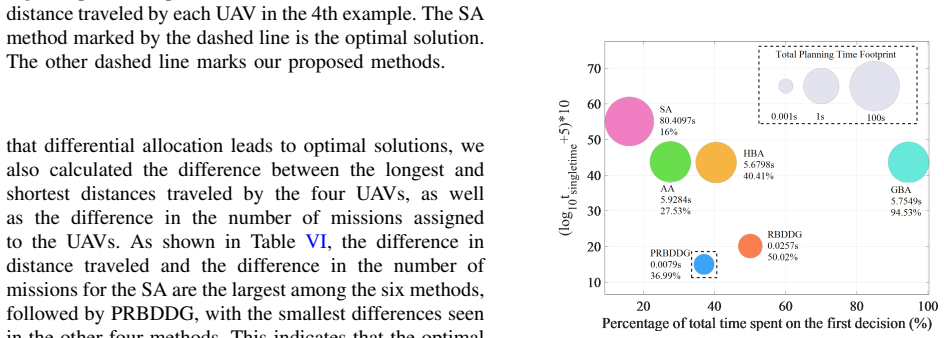
- [Section VI.B.3, Table VI] The 9.57% average gap between PRBDDG and SA is computed against an SA benchmark that optimizes Euclidean distance during the search and applies Dubins smoothing only after the allocation is fixed. Since the optimization objective in Eq. (11) is expressed in terms of Dubins connection lengths and coverage costs, the reported gap is not the suboptimality gap of PRBDDG for the actual problem; a fair comparison would use an SA variant with Dubins distances in its cost matrix, or an exact solver, as the baseline. Without that, the 'only sacrifices 9.57% of the path length' claim is not established.
- [Tables IV and VII] Table IV reports that computing one CS-type Dubins distance takes 0.00053 s on average, while Table VII reports a single PRBDDG planning time of 0.0003 s. Because every PRBDDG assignment decision builds a cost matrix that contains at least one CS-type Dubins distance (and typically many), the single planning time cannot be smaller than the cost of one such distance unless the two tables were measured under different implementations or vectorization conditions. The authors need to reconcile this inconsistency or clarify how the timings were obtained.
- [Abstract and Table VII] The abstract's 'speed improvement of 4-5 orders of magnitude' is not supported by the data. The ratios of average single planning times (3.2164/0.0003) and average total planning times (80.4097/0.0079) are both approximately 10^4, i.e., four orders of magnitude. A five-order figure is obtained only by mixing the total SA time with the single PRBDDG time, which is not a like-for-like comparison. Please correct the wording or specify the exact quantities compared.
minor comments (6)
- [Section III.B] 'Double-exponential integer linear programming' appears to be a typo; the formulation is a standard integer linear program with binary variables.
- [Section VI.A and VI.B.3] The abbreviation PRBDDH appears in the text after Fig. 10 but is never defined; presumably it denotes the Hungarian variant of PRBDD. Please define it in Section VI.A or in Table VII.
- [Section IV.A and Algorithm 2] The algorithm is described as distributed, but Algorithm 2 appears to be a sequential decision loop with global clustering and no communication or consensus mechanism. The authors should clarify whether the implementation is centralized or distributed, and if distributed, specify the coordination protocol.
- [Section VII and Assumptions 1-2] The results are explicitly limited to obstacle-free environments with constant-speed, collision-free altitude-layering (Assumptions 1 and 2). This limitation is acknowledged in Section VII, but the title and abstract's 'under multiple constraints' may overstate the generality; the 9.57% trade-off and the sub-millisecond times should be interpreted within this scope.
- [Section VI.B.3] The text mentions 'seven methods' in the discussion of Fig. 10, but only six methods are listed in Table VII and Section VI.A; please make the count consistent.
- [Section VI.C.1] The phrase 'has a confidential relationship with both the task generation time and the task generation location' appears to be a typo; 'confidential' should likely be 'correlation' or 'correspondence.'
Circularity Check
No significant circularity: the reported results are direct benchmark measurements; the sole self-citation is an upstream, self-contained path-construction ingredient.
full rationale
The paper's central claims are empirical: the 9.57% path-length gap and the sub-millisecond planning times are measured against external baselines (SA, GBA, HBA, AA) in Tables VI and VII, not derived from fitted parameters or from the algorithm's own definitions. The gap is computed as a direct ratio of measured total distances, so it is not circular. The concern that SA optimizes Euclidean cost and then smooths with Dubins paths is a baseline-fairness or correctness issue, not circularity, because PRBDDG's reported result is not defined in terms of SA's output. The only self-citation, reference [27], supplies a Dubins-path construction and a CS-type optimality statement; the construction is reproduced in the paper's own Eqs. (19)-(26), and neither is derived from the claimed performance results, so it is independent support rather than a load-bearing self-citation. The paper's limitations are stated explicitly, including Assumption 2 ('obstacles and hazardous areas are currently not taken into account') and Section VII's 'Future work will focus on resolving potential conflicts caused by obstacles,' but these scope restrictions do not make any derived quantity equal to its input by construction. The apparent timing inconsistency between Table IV's 0.00053 s CS-Dubins cost and Table VII's 0.0003 s single planning time is a possible measurement-reconciliation issue, not a circular step. Therefore no circular step can be exhibited, and the appropriate circularity score is 0.
Assumptions & free parameters
free parameters (5)
- Number of task clusters in K-means (k) =
equal to number of UAVs (K=4 in main simulations)
- Minimum turning radius R =
80 m
- SA cooling schedule (T0, alpha, stop threshold, Markov chain length, max iterations) =
T0=50, alpha=0.99, stop below 10, 500 runs per Markov chain, 1000 max iterations
- Arrival criterion and mission completion criteria =
not specified
- New-task occurrence criteria =
not specified ('probof occ < Occurrence criteria')
assumptions (5)
- domain assumption Fixed-wing UAVs are modeled as planar unicycle vehicles flying at constant speed, with sufficient fuel and collision-free flight via altitude layering (Assumption 1)
- domain assumption Obstacles and hazardous areas are not considered (Assumption 2)
- standard math The optimal two-point path with no terminal heading constraint is a CS-type Dubins path, as asserted from the authors' prior work [27]
- domain assumption New tasks are non-urgent, simple point targets, appearing within a fixed time window (Section V.A)
- domain assumption All UAVs are homogeneous and every UAV can perform every task (Section III.A, simulations)
Cite this review
Pith. "Pith review of Dynamic real-time multi-UAV cooperative mission planning method under multiple constraints." pith.science (2026). https://pith.science/paper/OJXNPBSF
@misc{pith2026250602365,
  author       = {Pith},
  title        = {Pith review of: Dynamic real-time multi-UAV cooperative mission planning method under multiple constraints},
  year         = {2026},
  howpublished = {\url{https://pith.science/paper/OJXNPBSF}},
  note         = {Machine review of arXiv:2506.02365}
}
read the original abstract
As UAV popularity soars, so does the mission planning associated with it. The classical approaches suffer from the triple problems of decoupled of task assignment and path planning, poor real-time performance and limited adaptability. Aiming at these challenges, this paper proposes a dynamic real-time multi-UAV collaborative mission planning algorithm based on Dubins paths under a distributed formation structure. Dubins path with multiple advantages bridges the gap between task assignment and path planning, leading to a coupled solution for mission planning. Then, a series of acceleration techniques, task clustering preprocessing, highly efficient distance cost functions, low-complexity and less iterative task allocation strategies, are employed to guarantee the real-time performance of the algorithms. To cope with different emergencies and their simultaneous extremes, real-time planning of emerging tasks and mission replanning due to the reduction of available UAVs are appropriately handled. Finally, the developed algorithm is comprehensively exemplified and studied through simulations, highlighting that the proposed method only sacrifices 9.57% of the path length, while achieving a speed improvement of 4-5 orders of magnitude over the simulated annealing method, with a single mission planning of about 0.0003s.
Figures


Figures from the paper (12 more)




Reference graph
Works this paper leans on
-
[1]
Yun, Won Joon and Park, Soohyun and Kim, Joongheon and Shin, MyungJae and Jung, Soyi and Mohaisen, David A and Kim, Jae-Hyun Cooperative multiagent deep reinforcement learning for reliable surveillance via autonomous multi-UA V control InIEEE Transactions on Industrial Informatics, 2022, pp.7086–7096, doi: 10.1109/TII.2022.3143175
- [2]
-
[3]
Qadir, Zakria and Zafar, Muhammad Hamza and Moosavi, Syed Kumayl Raza and Le, Khoa N and Mahmud, MA Parvez Autonomous UA V path-planning optimization us- ing metaheuristic approach for predisaster assessment In IEEE Internet of Things Journal, 2021, pp 12505–12514, doi: 10.1109/JIOT.2021.3137331
arXiv 2021
-
[4]
Cui, Qingshan Multi-target points path planning for fixed-wing unmanned aerial vehicle performing reconnaissance missions In 5th International Conference on Information Science, Electrical, and Automation Engineering (ISEAE 2023), 2023, pp 713–723, doi: 10.1117/12.2689384
-
[5]
Liu, Zhihong and Wang, Xiangke and Shen, Lincheng and Zhao, Shulong and Cong, Yirui and Li, Jie and Yin, Dong and Jia, Shengde and Xiang, Xiaojia Mission-oriented miniature fixed- wing UA V swarms: A multilayered and distributed architecture InIEEE Transactions on Systems, Man, and Cybernetics: Sys- tems, 2020, pp 1588–1602, doi: 10.1109/TSMC.2020.3033935
arXiv 2020
-
[6]
Zhang, Jian and Huang, Hailong Occlusion-aware UA V path planning for reconnaissance and surveillance InDrones, 2021, pp 98, doi: 10.3390/drones5030098
-
[7]
Sawadsitang, Suttinee and Niyato, Dusit and Tan, Puay Siew and Wang, Ping and Nutanong, Sarana Shipper cooperation in stochastic drone delivery: A dynamic Bayesian game approach InIEEE Transactions on V ehicular Technology, 2021, pp 7437– 7452, doi: 10.1109/TVT.2021.3090992
arXiv 2021
-
[8]
Li, Shuang and Fang, Xi A modified adaptive formation of UA V swarm by pigeon flock behavior within local visual field InAerospace Science and Technology, 2021, pp 106736, doi: 10.1016/j.ast.2021.106736
arXiv 2021
Show all 28 references
-
[9]
Jiang, Chao and Wan, Zhongping and Peng, Zhenhua A new efficient hybrid algorithm for large scale multiple traveling salesman problems InExpert Systems with Applications, 2020, pp 112867, doi: 10.1016/j.eswa.2019.112867
2020
-
[10]
Zhou, Honglu and Song, Mingli and Pedrycz, Witold A com- parative study of improved GA and PSO in solving multiple traveling salesmen problem InApplied Soft Computing, 2018, pp 564–580, doi: 10.1016/j.asoc.2017.12.031
2018 doi
-
[11]
Savuran, Halil and Karakaya, Murat Efficient route planning for an unmanned air vehicle deployed on a moving carrier In Soft Computing, 2016, pp 2905–2920, doi: 10.1007/s00500-015- 1970-4
2016 doi
-
[12]
Jiang, Xiaowei and Zhou, Qiang and Ye, Ying Method of task assignment for UA V based on particle swarm optimization in logistics InProceedings of the 2017 international conference on intelligent systems, metaheuristics & swarm intelligence, 2017, pp 113–117, doi: 10.1145/30593...
2017
-
[13]
Xiong, Jing and Li, Jie and Li, Juan and Kang, Senbo and Liu, Chang and Yang, Chengwei Probability-tuned market-based allocations for UA V swarms under unreliable observations In IEEE Transactions on Cybernetics, 2022, pp 6803–6814, doi: 10.1109/TCYB.2022.3162907
2022
-
[14]
Liao, Yuan and Friderikos, Vasilis Energy and age Pareto optimal trajectories in UA V-assisted wireless data collection InIEEE Transactions on V ehicular Technology, 2022, pp 9101–9106, doi: 10.1109/TVT.2022.3175318
2022
-
[15]
Cho, Doo-Hyun and Jang, Dae-Sung and Choi, Han- Lim Memetic algorithm-based path generation for multi- ple Dubins vehicles performing remote tasks InInterna- tional Journal of Systems Science, 2020, pp 608–630, doi: 10.1080/00207721.2020.1737263
2020
-
[16]
Rasmussen, Steven J and Shima, Tal Branch and bound tree search for assigning cooperating UA Vs to multiple tasks In2006 American Control Conference, 2006, pp 6, doi: 10.1109/ACC.2006.1656541
2006 arXiv
-
[17]
Alighanbari, Mehdi and How, Jonathan P Cooperative task assignment of unmanned aerial vehicles in adversarial environ- ments InProceedings of the 2005, American Control Conference, 2005, pp 4661–4666, doi: 10.1109/ACC.2005.1470731
2005 arXiv
-
[18]
Samiei, Arezoo and Ismail, Sarah and Sun, Liang Cluster- based hungarian approach to task allocation for unmanned aerial vehicles In2019 IEEE National Aerospace and Electronics Conference (NAECON), 2019, pp 148–154, doi: 10.1109/NAE- CON46414.2019.9057847
2019
-
[19]
Wang, Chao and Mu, Dong and Zhao, Fu and Sutherland, John W A parallel simulated annealing method for the vehicle routing problem with simultaneous pickup–delivery and time windows InComputers & Industrial Engineering, 2015, pp 111–122, doi: 10.1016/j.cie.2015.02.005
2015 doi
-
[20]
Zhu, W ANG and Li, LIU and Teng, LONG and Yonglu, WEN Multi-UA V reconnaissance task allocation for heterogeneous targets using an opposition-based genetic algorithm with double- chromosome encoding InChinese Journal of Aeronautics, 2018, pp 339–350, doi: 10.1016/j.cja.2017.09.005
2018 doi
-
[21]
Zhang, Jing and Cui, Yani and Ren, Jia Dynamic mission planning algorithm for UA V formation in battlefield environment InIEEE Transactions on Aerospace and Electronic Systems, 2022, pp 3750–3765, doi: 10.1109/TAES.2022.3231244
2022
-
[22]
Choi, Han-Lim and Whitten, Andrew K and How, Jonathan P Decentralized task allocation for heterogeneous teams with cooperation constraints InProceedings of the 2010 American Control Conference, 2010, pp 3057–3062, doi: 10.1109/ACC.2010.5530496
2010
-
[23]
Wu, Weinan and Xu, Jie and Sun, Yiming Integrate assignment of multiple heterogeneous unmanned aerial vehicles performing dynamic disaster inspection and validation task with Dubins path InIEEE Transactions on Aerospace and Electronic Systems, 2023, pp 4018–4032, doi: 10.1109/...
2023
-
[24]
Wu, Jiehong and Zhang, Jingchuan and Li, Xianwei and Gao, Lijun and Han, Guangjie and others Multi-UA V Collaborative Dynamic Task Allocation Method Based on ISOM and Attention Mechanism InIEEE Transactions on V ehicular Technology, 2023, doi: 10.1109/TVT.2023.3341878
2023
-
[25]
Gao, Xiaohua and Wang, Lei and Su, Xichao and Lu, Chen and Ding, Yu and Wang, Chao and Peng, Haijun and Wang, Xinwei A Unified Multi-Objective Optimization Framework for UA V Cooperative Task Assignment and Re-Assignment In Mathematics, 2022, pp 4241, doi: 10.3390/math10224241
2022 doi
-
[26]
Chen, Yongbo and Yang, Di and Yu, Jianqiao Multi-UA V task assignment with parameter and time-sensitive uncertainties using modified two-part wolf pack search algorithm InIEEE Transactions on Aerospace and Electronic Systems, 2018, pp 2853–2872, doi: 10.1109/TAES.2018.2831138
2018
-
[27]
Liu, Chenglou and Xie, Fangfang and Ji, Tingwei Fixed- Wing UA V Formation Path Planning Based on Formation Con- trol: Theory and Application InAerospace, 2023, pp 1, doi: 10.3390/aerospace11010001
2023 doi
-
[28]
Manyam, Satyanarayana G and Rathinam, Sivakumar and Cas- beer, David and Garcia, Eloy Tightly bounding the shortest du- bins paths through a sequence of points InJournal of Intelligent & Robotic Systems, 2017, pp 495–511, doi: 10.1007/s10846-016- 0459-4
2017 doi
Reviewed August 7, 2026 · model on record in the stance chip above.
Discussion (0). Sign in to comment.