REVIEW 4 major objections 5 minor 64 references
Towards Explicit Geometry-Reflectance Collaboration for Generalized LiDAR Segmentation in Adverse Weather
T0 review · 4 major / 5 minor · reviewed 2026-08-07 · deepseek-v4-flash
Pith's one-line read GRCNet separates geometry and reflectance during encoding and recombines them under a noise-suppressing information constraint, achieving state-of-the-art LiDAR segmentation in fog, rain, and snow without weather simulation or augmentation.
desk verdict Strong empirical results undermined by an ill-posed loss: Eq. 6 is unbounded below, so the claimed noise-suppression mechanism is not valid as written. read the letter →
The pith
A machine-rendered reading of the paper's core claim, the machinery that carries it, and where it could break.
The reading
What carries the argument
The load-bearing mechanism is the Robust Multi-level Feature Collaboration (RMFC) module inside the Geometry-Reflectance Collaboration (GRC) framework. GRCNet's geometric branch is a sparse 3D ConvNet on voxelized coordinates; its reflectance branch is a depthwise-separable 2D ConvNet on the spherical range-view image of reflectance. RMFC contains the Complementarity-aware Information Constraint (CIC), which reparameterizes each feature vector as a Gaussian via mean and variance heads and minimizes two KL terms toward a standard Gaussian prior plus two KL terms between the branches, so each branch is pushed to be robust and non-redundant. Local fusion then blends the branches with weight $\alpha=\frac{e^{1/\bar\sigma_{\text{geo}}}}{e^{1/\bar\sigma_{\text{geo}}}+e^{1/\bar\sigma_{\text{ref}}}}$, and global fusion uses a two-stage cross-attention in which a few learnable query tokens first aggregate range-view context and voxel features then attend to it. The invertible spherical projection is what lets range-view reflectance features be retrieved at exact 3D voxel locations for local fusion.
What would settle it
Run a round-trip alignment check on a 64-beam scan: project each 3D point into the range-view image and unproject the resulting pixel back to 3D, then count how many points do not fall in the same voxel they started from. If a non-negligible fraction, say over a few percent, fail to round-trip exactly, Equation (7) is fusing features from mismatched locations and the paper's explanation of the gain is undermined; as a control, retrain GRCNet at coarser range-view resolutions and check whether the accuracy gain tracks the loss of invertibility.
Extended reading notes
Core claim
The central discovery is that the heterogeneous domain shift between geometry and reflectance, not weather corruption as a single phenomenon, is the main thing breaking LiDAR segmentation generalization, and that it can be countered by architectural decoupling. GRCNet feeds only coordinates to a 3D sparse-convolution encoder and only reflectance to a 2D range-view encoder, then applies the Complementarity-aware Information Constraint (CIC), a variational-information-bottleneck-style loss that makes each branch's reparameterized features discard domain-specific noise while pushing the two feature distributions apart to reduce redundancy. Fusion happens at two levels: local fusion weights the branches by inverse averaged standard deviations, and global fusion compresses range-view context into learnable query tokens before cross-attending into voxel space. The paper reports state-of-the-art results on all three transfer settings and shows the gains hold when the framework is mounted on SPVCNN and MinkNet18/32 backbones.
Load-bearing premise
The load-bearing premise is that the spherical projection from 3D points to range-view pixels is exactly invertible, so every reflectance feature can be returned to the precise 3D voxel it came from; if quantization, occlusion, or the sensor's beam pattern breaks that one-to-one match, the local fusion pairs features from different locations and the claimed benefit of clean separation is lost.
Editorial extensions
If this is right
- Weather-robust LiDAR segmentation can be achieved without weather simulation or augmentation: GRCNet trains on clear-weather data only and outperforms RL-based augmentation (RDA) by +3.0 mIoU on SemanticKITTI to SemanticSTF while requiring a single RTX 4090 instead of four A6000 GPUs.
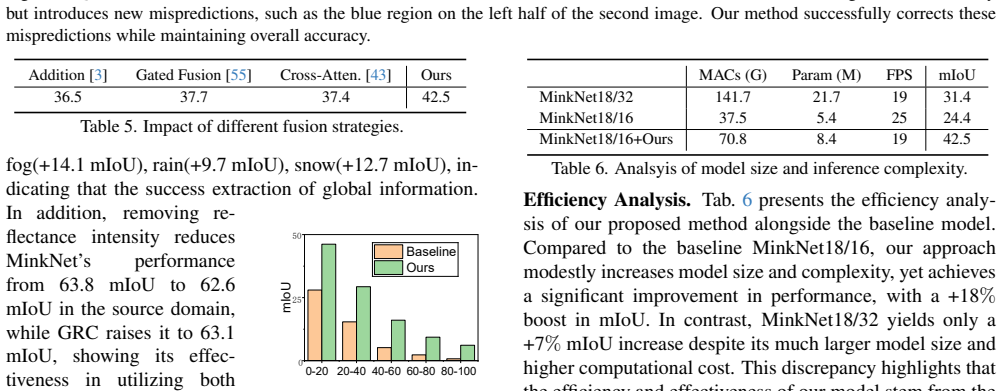
- The reflectance channel is worth keeping despite adverse-weather corruption: simply dropping reflectance already improves the MinkNet baseline by +12.9 mIoU, but the full GRC framework, which keeps reflectance under the information constraint, reaches +18.1 mIoU, showing the corrupted channel still carries usable signal.
- The framework transfers across backbones: mounting it on SPVCNN and MinkNet18/32 improves both SemanticSTF and SemanticKITTI-C accuracy over the same backbones with RDA augmentation.
- The gains are not bought by sacrificing source-domain accuracy: GRC reaches 63.1 mIoU on the clear-weather SemanticKITTI validation set, close to the full baseline's 63.8 and above the no-reflectance baseline's 62.6.
- The efficiency analysis in the paper shows +18 mIoU for roughly double the MACs of the small baseline, while scaling the baseline to MinkNet18/32 buys only +7 mIoU for much larger cost.
Reading between the lines
- If the invertible-projection assumption is the operative ingredient, the local fusion's benefit should be sensitive to range-view resolution and beam density: coarser quantization or sparser beams should degrade the alignment and shrink the gap between GRCNet and a simple addition fusion, which is testable with the same codebase by varying projection resolution.
- The geometry-versus-intensity split is a general principle that could extend beyond LiDAR weather robustness: any sensor modality where one channel degrades faster than another under domain shift, such as camera depth or radar reflectivity, could reuse the same dual-branch-plus-bottleneck recipe, though the paper does not demonstrate this.
- The CIC loss is one instance of a variational information bottleneck; replacing the pairwise KL penalties with a tighter mutual-information estimator, or conditioning the prior on scene context, might reduce the number of loss terms while preserving the robustness gain, but this is an extension the paper does not explore.
- The near-tie with UniMix in the synthetic-to-real setting suggests the decoupling advantage may shrink as the source-target gap grows; testing on additional synthetic-to-real pairs, such as SynLiDAR to SemanticKITTI-C, would show whether the +0.1 margin is stable.
Editorial analysis
A structured set of objections, weighed in public.
Referee Report
Summary. The paper proposes GRCNet, a dual-branch architecture for domain-generalized LiDAR semantic segmentation under adverse weather. A voxel-based 3D encoder processes geometry only, while a range-view 2D encoder processes reflectance only. The two branches are fused through a Robust Multi-level Feature Collaboration (RMFC) module, which pairs geometric and reflectance features via a claimed invertible spherical projection, applies a Complementarity-aware Information Constraint (CIC) loss built from KL divergences, and performs local and global fusion. Experiments on SemanticKITTI→SemanticSTF, SynLiDAR→SemanticSTF, and SemanticKITTI→SemanticKITTI-C report large gains over existing methods, including +18.1 mIoU over MinkNet and +3.0 over RDA on the first setting, as well as an efficiency analysis.
Significance. The paper addresses a practically important problem—generalizing LiDAR segmentation to unseen adverse weather—and demonstrates substantial empirical gains with a relatively simple architecture that avoids complex weather simulation or RL-based augmentation. The strength of the paper is its experimental coverage: multiple source-target settings, a clear component ablation (Table 4), comparisons against strong baselines (RDA, UniMix), and an efficiency table. If the technical mechanism is sound and reproducible, the dual-branch separation with explicit geometry/reflectance collaboration is a meaningful contribution to the domain-generalization literature. However, the correctness of the CIC objective and the claimed invertibility of spherical projection need to be established before the reported results can be attributed to the stated mechanism.
major comments (4)
- [Sec. 3.3.1, Eq. (6)]
- [Sec. 3.2.2 and Sec. 3.3.2, Eq. (7)]
- [Sec. 4.2, Table 2]
- [Sec. 4.3, Table 4 (discussion)]
minor comments (5)
- [Sec. 4.1, Implementation details]
- [Table 2]
- [Sec. 3.3.1]
- [Sec. 4.3]
- [Abstract and Sec. 1]
Circularity Check
No significant circularity: GRCNet is an empirical architecture validated against external benchmarks, and no predicted quantity reduces by construction to a fitted input or to a load-bearing self-citation.
full rationale
GRCNet does not derive a closed-form prediction from first principles; its claims are architectural and empirical. The geometry branch inherits MinkNet/SPVCNN backbones, the reflectance branch uses standard inverted residual blocks, and all headline numbers are comparisons on held-out adverse-weather benchmarks (SemanticSTF, SemanticKITTI-C) against published methods. The complementarity-aware information constraint in Eq. 6 is motivated by prior variational information bottleneck work [1,2,31], but the paper does not import a uniqueness theorem or an ansatz from the same authors to force its conclusion. The only tunable coefficient, beta in Eq. 9, is not reported, and Eq. 6 as written is unbounded below because the negative cross-KL terms can dominate; these are training-objective and reproducibility concerns, not circularity. The statement that 'the spherical projection is invertible' is an idealization rather than a re-description of the method's success. The self-citation [38] in related work is not load-bearing. No fitted parameter is renamed as a prediction, no definition is mutually dependent on the claimed outcome, and no external result is replaced by self-citation. The paper's central claim therefore stands on independent experimental evidence.
Assumptions & free parameters
free parameters (1)
- beta (CIC loss weight) =
not reported
assumptions (4)
- domain assumption Geometric structure is largely domain-invariant across clear and adverse weather, while reflectance intensity shifts strongly.
- domain assumption Spherical projection is invertible and preserves correspondence between each geometric voxel feature and its reflectance feature.
- domain assumption Range-view reflectance alone retains sufficient appearance semantics for segmentation even under weather corruption.
- standard math Variational information bottleneck theory transfers to domain generalization: pushing features toward a standard Gaussian prior removes domain-specific noise.
Cite this review
Pith. "Pith review of Towards Explicit Geometry-Reflectance Collaboration for Generalized LiDAR Segmentation in Adverse Weather." pith.science (2026). https://pith.science/paper/FTUPJD4B
@misc{pith2026250602396,
  author       = {Pith},
  title        = {Pith review of: Towards Explicit Geometry-Reflectance Collaboration for Generalized LiDAR Segmentation in Adverse Weather},
  year         = {2026},
  howpublished = {\url{https://pith.science/paper/FTUPJD4B}},
  note         = {Machine review of arXiv:2506.02396}
}
read the original abstract
Existing LiDAR semantic segmentation models often suffer from decreased accuracy when exposed to adverse weather conditions. Recent methods addressing this issue focus on enhancing training data through weather simulation or universal augmentation techniques. However, few works have studied the negative impacts caused by the heterogeneous domain shifts in the geometric structure and reflectance intensity of point clouds. In this paper, we delve into this challenge and address it with a novel Geometry-Reflectance Collaboration (GRC) framework that explicitly separates feature extraction for geometry and reflectance. Specifically, GRC employs a dual-branch architecture designed to independently process geometric and reflectance features initially, thereby capitalizing on their distinct characteristic. Then, GRC adopts a robust multi-level feature collaboration module to suppress redundant and unreliable information from both branches. Consequently, without complex simulation or augmentation, our method effectively extracts intrinsic information about the scene while suppressing interference, thus achieving better robustness and generalization in adverse weather conditions. We demonstrate the effectiveness of GRC through comprehensive experiments on challenging benchmarks, showing that our method outperforms previous approaches and establishes new state-of-the-art results.
Figures


Figures from the paper (2 more)

Reference graph
Works this paper leans on
-
[1]
Invariance principle meets in- formation bottleneck for out-of-distribution generalization
Kartik Ahuja, Ethan Caballero, Dinghuai Zhang, Jean- Christophe Gagnon-Audet, Yoshua Bengio, Ioannis Mitliagkas, and Irina Rish. Invariance principle meets in- formation bottleneck for out-of-distribution generalization. Adv. Neural Inform. Process. Syst., 34:3438–3450, 2021. 4
work page 2021
-
[2]
Deep variational information bottleneck.arXiv preprint arXiv:1612.00410, 2016
Alexander A Alemi, Ian Fischer, Joshua V Dillon, and Kevin Murphy. Deep variational information bottleneck.arXiv preprint arXiv:1612.00410, 2016. 4
arXiv 2016
-
[3]
Multi projection fusion for real-time seman- tic segmentation of 3d lidar point clouds
Yara Ali Alnaggar, Mohamed Afifi, Karim Amer, and Mo- hamed ElHelw. Multi projection fusion for real-time seman- tic segmentation of 3d lidar point clouds. InWACV, 2021. 4, 8
work page 2021
-
[4]
Rangevit: Towards vision transformers for 3d semantic segmentation in au- tonomous driving
Angelika Ando, Spyros Gidaris, Andrei Bursuc, Gilles Puy, Alexandre Boulch, and Renaud Marlet. Rangevit: Towards vision transformers for 3d semantic segmentation in au- tonomous driving. InCVPR, 2023. 2
work page 2023
-
[5]
Se- mantickitti: A dataset for semantic scene understanding of lidar sequences
Jens Behley, Martin Garbade, Andres Milioto, Jan Quen- zel, Sven Behnke, Cyrill Stachniss, and Jurgen Gall. Se- mantickitti: A dataset for semantic scene understanding of lidar sequences. InICCV, 2019. 1, 6
work page 2019
-
[6]
Seeing through fog without seeing fog: Deep multimodal sensor fu- sion in unseen adverse weather
Mario Bijelic, Tobias Gruber, Fahim Mannan, Florian Kraus, Werner Ritter, Klaus Dietmayer, and Felix Heide. Seeing through fog without seeing fog: Deep multimodal sensor fu- sion in unseen adverse weather. InCVPR, 2020. 1, 2, 6
work page 2020
-
[7]
4d spatio-temporal convnets: Minkowski convolutional neural networks
Christopher Choy, JunYoung Gwak, and Silvio Savarese. 4d spatio-temporal convnets: Minkowski convolutional neural networks. InCVPR, 2019. 1, 2, 4, 6, 7
work page 2019
-
[8]
Salsanext: Fast, uncertainty-aware semantic segmentation of lidar point clouds
Tiago Cortinhal, George Tzelepis, and Eren Erdal Aksoy. Salsanext: Fast, uncertainty-aware semantic segmentation of lidar point clouds. InISVC, 2020. 2
work page 2020
Show all 64 references
-
[9]
Incorporating second-order func- tional knowledge for better option pricing.Adv
Charles Dugas, Yoshua Bengio, Franc ¸ois B ´elisle, Claude Nadeau, and Ren´e Garcia. Incorporating second-order func- tional knowledge for better option pricing.Adv. Neural In- form. Process. Syst., 13, 2000. 5
2000
-
[10]
Are we ready for autonomous driving? the kitti vision benchmark suite
Andreas Geiger, Philip Lenz, and Raquel Urtasun. Are we ready for autonomous driving? the kitti vision benchmark suite. InCVPR, 2012. 6
2012
-
[11]
3d semantic segmentation with submanifold sparse convolutional networks
Benjamin Graham, Martin Engelcke, and Laurens Van Der Maaten. 3d semantic segmentation with submanifold sparse convolutional networks. InCVPR, 2018. 2
2018
-
[12]
Deep learning for 3d point clouds: A survey.IEEE Trans
Yulan Guo, Hanyun Wang, Qingyong Hu, Hao Liu, Li Liu, and Mohammed Bennamoun. Deep learning for 3d point clouds: A survey.IEEE Trans. Pattern Anal. Mach. Intell., 43(12):4338–4364, 2020. 1
2020
-
[13]
Fog simulation on real lidar point clouds for 3d object detection in adverse weather
Martin Hahner, Christos Sakaridis, Dengxin Dai, and Luc Van Gool. Fog simulation on real lidar point clouds for 3d object detection in adverse weather. InICCV, 2021. 1, 2
2021
-
[14]
Lidar snowfall simulation for robust 3d object detection
Martin Hahner, Christos Sakaridis, Mario Bijelic, Felix Heide, Fisher Yu, Dengxin Dai, and Luc Van Gool. Lidar snowfall simulation for robust 3d object detection. InCVPR,
-
[15]
Domain generalization-aware uncertainty introspective learning for 3d point clouds segmentation
Pei He, Licheng Jiao, Lingling Li, Xu Liu, Fang Liu, Wen- ping Ma, Shuyuan Yang, and Ronghua Shang. Domain generalization-aware uncertainty introspective learning for 3d point clouds segmentation. InACMMM, 2024. 2
2024
-
[16]
Dual-graph attention convolution network for 3-d point cloud classifi- cation.IEEE Trans
Chang-Qin Huang, Fan Jiang, Qiong-Hao Huang, Xi-Zhe Wang, Zhong-Mei Han, and Wei-Yu Huang. Dual-graph attention convolution network for 3-d point cloud classifi- cation.IEEE Trans. Neural Networks Learn. Syst., 35(4): 4813–4825, 2022. 2
2022
-
[17]
Single domain generalization for lidar semantic segmentation
Hyeonseong Kim, Yoonsu Kang, Changgyoon Oh, and Kuk- Jin Yoon. Single domain generalization for lidar semantic segmentation. InCVPR, 2023. 1, 2
2023
-
[18]
Domain generalization in lidar semantic segmenta- tion leveraged by density discriminative feature embedding
Jaeyeul Kim, Jungwan Woo, Jeonghoon Kim, and Sunghoon Im. Domain generalization in lidar semantic segmenta- tion leveraged by density discriminative feature embedding. arXiv preprint arXiv:2312.12098, 2023. 1, 2
2023 arXiv
-
[19]
Rethinking range view representation for lidar segmentation
Lingdong Kong, Youquan Liu, Runnan Chen, Yuexin Ma, Xinge Zhu, Yikang Li, Yuenan Hou, Yu Qiao, and Ziwei Liu. Rethinking range view representation for lidar segmentation. InICCV, 2023. 1
2023
-
[20]
Robo3d: Towards robust and reliable 3d perception against corruptions
Lingdong Kong, Youquan Liu, Xin Li, Runnan Chen, Wen- wei Zhang, Jiawei Ren, Liang Pan, Kai Chen, and Ziwei Liu. Robo3d: Towards robust and reliable 3d perception against corruptions. InICCV, 2023. 1, 2, 6
2023
-
[21]
Stratified trans- former for 3d point cloud segmentation
Xin Lai, Jianhui Liu, Li Jiang, Liwei Wang, Hengshuang Zhao, Shu Liu, Xiaojuan Qi, and Jiaya Jia. Stratified trans- former for 3d point cloud segmentation. InCVPR, 2022. 2
2022
-
[22]
Spherical transformer for lidar-based 3d recognition
Xin Lai, Yukang Chen, Fanbin Lu, Jianhui Liu, and Jiaya Jia. Spherical transformer for lidar-based 3d recognition. In CVPR, 2023. 2
2023
-
[23]
Large-scale point cloud semantic segmentation with superpoint graphs
Loic Landrieu and Martin Simonovsky. Large-scale point cloud semantic segmentation with superpoint graphs. In CVPR, 2018. 2
2018
-
[24]
3d- vfield: Adversarial augmentation of point clouds for domain generalization in 3d object detection
Alexander Lehner, Stefano Gasperini, Alvaro Marcos- Ramiro, Michael Schmidt, Mohammad-Ali Nikouei Mahani, Nassir Navab, Benjamin Busam, and Federico Tombari. 3d- vfield: Adversarial augmentation of point clouds for domain generalization in 3d object detection. InCVPR, 2022. 1, 2
2022
-
[25]
Domain generalization with adversarial feature learning
Haoliang Li, Sinno Jialin Pan, Shiqi Wang, and Alex C Kot. Domain generalization with adversarial feature learning. In CVPR, 2018. 7
2018
-
[26]
Rapid-seg: Range-aware pointwise distance distribution networks for 3d lidar segmentation
Li Li, Hubert PH Shum, and Toby P Breckon. Rapid-seg: Range-aware pointwise distance distribution networks for 3d lidar segmentation. InECCV, 2025. 2
2025
-
[27]
Cpgnet: Cascade point-grid fusion network for real-time li- dar semantic segmentation
Xiaoyan Li, Gang Zhang, Hongyu Pan, and Zhenhua Wang. Cpgnet: Cascade point-grid fusion network for real-time li- dar semantic segmentation. InICRA, 2022. 4
2022
-
[28]
Pointcnn: Convolution on x-transformed points.Adv
Yangyan Li, Rui Bu, Mingchao Sun, Wei Wu, Xinhan Di, and Baoquan Chen. Pointcnn: Convolution on x-transformed points.Adv. Neural Inform. Process. Syst., 31, 2018. 2
2018
-
[29]
Rangenet++: Fast and accurate lidar semantic segmentation
Andres Milioto, Ignacio Vizzo, Jens Behley, and Cyrill Stachniss. Rangenet++: Fast and accurate lidar semantic segmentation. InIROS, 2019. 2
2019
-
[30]
Rethinking data augmentation for robust lidar seman- tic segmentation in adverse weather.arXiv preprint arXiv:2407.02286, 2024
Junsung Park, Kyungmin Kim, and Hyunjung Shim. Rethinking data augmentation for robust lidar seman- tic segmentation in adverse weather.arXiv preprint arXiv:2407.02286, 2024. 1, 2, 6, 7
2024 arXiv
-
[31]
Variational discriminator bottleneck: Im- proving imitation learning, inverse rl, and gans by constrain- ing information flow.arXiv preprint arXiv:1810.00821,
Xue Bin Peng, Angjoo Kanazawa, Sam Toyer, Pieter Abbeel, and Sergey Levine. Variational discriminator bottleneck: Im- proving imitation learning, inverse rl, and gans by constrain- ing information flow.arXiv preprint arXiv:1810.00821,
-
[32]
V olumetric and multi-view cnns for object classification on 3d data
Charles R Qi, Hao Su, Matthias Nießner, Angela Dai, Mengyuan Yan, and Leonidas J Guibas. V olumetric and multi-view cnns for object classification on 3d data. In CVPR, 2016. 2
2016
-
[33]
Pointnet: Deep learning on point sets for 3d classification and segmentation
Charles R Qi, Hao Su, Kaichun Mo, and Leonidas J Guibas. Pointnet: Deep learning on point sets for 3d classification and segmentation. InCVPR, 2017. 1, 2
2017
-
[34]
Pointnet++: Deep hierarchical feature learning on point sets in a metric space.Adv
Charles Ruizhongtai Qi, Li Yi, Hao Su, and Leonidas J Guibas. Pointnet++: Deep hierarchical feature learning on point sets in a metric space.Adv. Neural Inform. Process. Syst., 30, 2017
2017
-
[35]
Pointnext: Revisiting pointnet++ with improved training and scaling strategies.Adv
Guocheng Qian, Yuchen Li, Houwen Peng, Jinjie Mai, Hasan Hammoud, Mohamed Elhoseiny, and Bernard Ghanem. Pointnext: Revisiting pointnet++ with improved training and scaling strategies.Adv. Neural Inform. Process. Syst., 35:23192–23204, 2022. 2
2022
-
[36]
Mobilenetv2: Inverted residuals and linear bottlenecks
Mark Sandler, Andrew Howard, Menglong Zhu, Andrey Zh- moginov, and Liang-Chieh Chen. Mobilenetv2: Inverted residuals and linear bottlenecks. InCVPR, 2018. 4, 6
2018
-
[37]
Super-convergence: Very fast training of neural networks using large learning rates
Leslie N Smith and Nicholay Topin. Super-convergence: Very fast training of neural networks using large learning rates. InArtificial intelligence and machine learning for multi-domain operations applications, pages 369–386, 2019. 6
2019
-
[38]
On efficient variants of segment anything model: A survey.arXiv preprint arXiv:2410.04960, 2024
Xiaorui Sun, Jun Liu, Heng Tao Shen, Xiaofeng Zhu, and Ping Hu. On efficient variants of segment anything model: A survey.arXiv preprint arXiv:2410.04960, 2024. 2
2024 arXiv
-
[39]
Searching efficient 3d architec- tures with sparse point-voxel convolution
Haotian Tang, Zhijian Liu, Shengyu Zhao, Yujun Lin, Ji Lin, Hanrui Wang, and Song Han. Searching efficient 3d architec- tures with sparse point-voxel convolution. InECCV, 2020. 2, 6
2020
-
[40]
Mean teachers are better role models: Weight-averaged consistency targets improve semi-supervised deep learning results.NeurIPS, 2017
Antti Tarvainen and Harri Valpola. Mean teachers are better role models: Weight-averaged consistency targets improve semi-supervised deep learning results.NeurIPS, 2017. 7
2017
-
[41]
Kpconv: Flexible and deformable convolution for point clouds
Hugues Thomas, Charles R Qi, Jean-Emmanuel Deschaud, Beatriz Marcotegui, Franc ¸ois Goulette, and Leonidas J Guibas. Kpconv: Flexible and deformable convolution for point clouds. InICCV, 2019. 2
2019
-
[42]
Instance normalization: The missing ingredient for fast stylization.arXiv preprint arXiv:1607.08022, 2016
D Ulyanov. Instance normalization: The missing ingredient for fast stylization.arXiv preprint arXiv:1607.08022, 2016. 4, 6
2016 arXiv
-
[43]
Attention is all you need.Adv
A Vaswani. Attention is all you need.Adv. Neural Inform. Process. Syst., 2017. 5, 8
2017
-
[44]
Generalizing to unseen domains: A survey on do- main generalization.IEEE Trans
Jindong Wang, Cuiling Lan, Chang Liu, Yidong Ouyang, Tao Qin, Wang Lu, Yiqiang Chen, Wenjun Zeng, and S Yu Philip. Generalizing to unseen domains: A survey on do- main generalization.IEEE Trans. Knowl. Data Eng., 35(8): 8052–8072, 2022. 1, 2
2022
-
[45]
Dynamic graph cnn for learning on point clouds.ACM Trans
Yue Wang, Yongbin Sun, Ziwei Liu, Sanjay E Sarma, Michael M Bronstein, and Justin M Solomon. Dynamic graph cnn for learning on point clouds.ACM Trans. Graph., 38(5):1–12, 2019. 2
2019
-
[46]
Squeezeseg: Convolutional neural nets with recurrent crf for real-time road-object segmentation from 3d lidar point cloud
Bichen Wu, Alvin Wan, Xiangyu Yue, and Kurt Keutzer. Squeezeseg: Convolutional neural nets with recurrent crf for real-time road-object segmentation from 3d lidar point cloud. InICRA, 2018. 4
2018
-
[47]
Pointconv: Deep convolutional networks on 3d point clouds
Wenxuan Wu, Zhongang Qi, and Li Fuxin. Pointconv: Deep convolutional networks on 3d point clouds. InCVPR, 2019. 2
2019
-
[48]
Point transformer v2: Grouped vector atten- tion and partition-based pooling.Adv
Xiaoyang Wu, Yixing Lao, Li Jiang, Xihui Liu, and Heng- shuang Zhao. Point transformer v2: Grouped vector atten- tion and partition-based pooling.Adv. Neural Inform. Pro- cess. Syst., 35:33330–33342, 2022. 1, 2
2022
-
[49]
Point transformer v3: Simpler faster stronger
Xiaoyang Wu, Li Jiang, Peng-Shuai Wang, Zhijian Liu, Xi- hui Liu, Yu Qiao, Wanli Ouyang, Tong He, and Hengshuang Zhao. Point transformer v3: Simpler faster stronger. In CVPR, 2024. 1, 2
2024
-
[50]
3d shapenets: A deep representation for volumetric shapes
Zhirong Wu, Shuran Song, Aditya Khosla, Fisher Yu, Lin- guang Zhang, Xiaoou Tang, and Jianxiong Xiao. 3d shapenets: A deep representation for volumetric shapes. In CVPR, 2015. 2
2015
-
[51]
Polarmix: A general data augmen- tation technique for lidar point clouds.Adv
Aoran Xiao, Jiaxing Huang, Dayan Guan, Kaiwen Cui, Shi- jian Lu, and Ling Shao. Polarmix: A general data augmen- tation technique for lidar point clouds.Adv. Neural Inform. Process. Syst., 35:11035–11048, 2022. 7
2022
-
[52]
Transfer learning from synthetic to real lidar point cloud for semantic segmentation
Aoran Xiao, Jiaxing Huang, Dayan Guan, Fangneng Zhan, and Shijian Lu. Transfer learning from synthetic to real lidar point cloud for semantic segmentation. InAAAI, 2022. 6
2022
-
[53]
3d semantic segmentation in the wild: Learning generalized models for adverse-condition point clouds
Aoran Xiao, Jiaxing Huang, Weihao Xuan, Ruijie Ren, Kangcheng Liu, Dayan Guan, Abdulmotaleb El Saddik, Shi- jian Lu, and Eric P Xing. 3d semantic segmentation in the wild: Learning generalized models for adverse-condition point clouds. InCVPR, 2023. 1, 2, 6, 7
2023
-
[54]
A survey of label-efficient deep learning for 3d point clouds
Aoran Xiao, Xiaoqin Zhang, Ling Shao, and Shijian Lu. A survey of label-efficient deep learning for 3d point clouds. IEEE Trans. Pattern Anal. Mach. Intell., 2024. 1
2024
-
[55]
Rpvnet: A deep and efficient range-point- voxel fusion network for lidar point cloud segmentation
Jianyun Xu, Ruixiang Zhang, Jian Dou, Yushi Zhu, Jie Sun, and Shiliang Pu. Rpvnet: A deep and efficient range-point- voxel fusion network for lidar point cloud segmentation. In CVPR, 2021. 4, 8
2021
-
[56]
Benchmarking the robustness of lidar se- mantic segmentation models.Int
Xu Yan, Chaoda Zheng, Ying Xue, Zhen Li, Shuguang Cui, and Dengxin Dai. Benchmarking the robustness of lidar se- mantic segmentation models.Int. J. Comput. Vis., pages 1– 24, 2024. 1, 2
2024
-
[57]
Realistic rainy weather simulation for lidars in carla simulator.arXiv preprint arXiv:2312.12772, 2023
Donglin Yang, Zhenfeng Liu, Wentao Jiang, Guohang Yan, Xing Gao, Botian Shi, Si Liu, and Xinyu Cai. Realistic rainy weather simulation for lidars in carla simulator.arXiv preprint arXiv:2312.12772, 2023. 1, 2
2023 arXiv
-
[58]
Swin3d: A pretrained transformer backbone for 3d indoor scene understanding.arXiv preprint arXiv:2304.06906,
Yu-Qi Yang, Yu-Xiao Guo, Jian-Yu Xiong, Yang Liu, Hao Pan, Peng-Shuai Wang, Xin Tong, and Baining Guo. Swin3d: A pretrained transformer backbone for 3d indoor scene understanding.arXiv preprint arXiv:2304.06906,
-
[59]
Pcl: Proxy-based contrastive learning for domain generalization
Xufeng Yao, Yang Bai, Xinyun Zhang, Yuechen Zhang, Qi Sun, Ran Chen, Ruiyu Li, and Bei Yu. Pcl: Proxy-based contrastive learning for domain generalization. InCVPR,
-
[60]
Point transformer
Hengshuang Zhao, Li Jiang, Jiaya Jia, Philip HS Torr, and Vladlen Koltun. Point transformer. InICCV, 2021. 2
2021
-
[61]
Unimix: Towards domain adaptive and gener- alizable lidar semantic segmentation in adverse weather
Haimei Zhao, Jing Zhang, Zhuo Chen, Shanshan Zhao, and Dacheng Tao. Unimix: Towards domain adaptive and gener- alizable lidar semantic segmentation in adverse weather. In CVPR, 2024. 1, 2, 6, 7
2024
-
[62]
Cylinder3d: An effective 3d framework for driving-scene lidar semantic segmentation
Hui Zhou, Xinge Zhu, Xiao Song, Yuexin Ma, Zhe Wang, Hongsheng Li, and Dahua Lin. Cylinder3d: An effective 3d framework for driving-scene lidar semantic segmentation. In ICCV, 2021. 1
2021
-
[63]
Domain generalization: A survey.IEEE Trans
Kaiyang Zhou, Ziwei Liu, Yu Qiao, Tao Xiang, and Chen Change Loy. Domain generalization: A survey.IEEE Trans. Pattern Anal. Mach. Intell., 45(4):4396–4415, 2022. 1, 2
2022
-
[64]
Cylindrical and asymmetrical 3d convolution networks for lidar segmenta- tion
Xinge Zhu, Hui Zhou, Tai Wang, Fangzhou Hong, Yuexin Ma, Wei Li, Hongsheng Li, and Dahua Lin. Cylindrical and asymmetrical 3d convolution networks for lidar segmenta- tion. InCVPR, 2021. 2
2021
Reviewed August 7, 2026 · model on record in the stance chip above.
Discussion (0). Sign in to comment.