REVIEW 4 major objections 5 minor 58 references
SingaKids: A Multilingual Multimodal Dialogic Tutor for Language Learning
T0 review · 4 major / 5 minor · reviewed 2026-08-07 · deepseek-v4-flash
Pith's one-line read A four-language picture-dialogue tutor for young learners claims real gains in descriptive language, vocabulary, and conversational fluency.
desk verdict Solid system paper with useful low-resource speech results, but the effectiveness claim in the abstract and Section 1 is not backed by the user study, which measures scaffolding patterns, not learning outcomes. read the letter →
The pith
A machine-rendered reading of the paper's core claim, the machinery that carries it, and where it could break.
The reading
What carries the argument
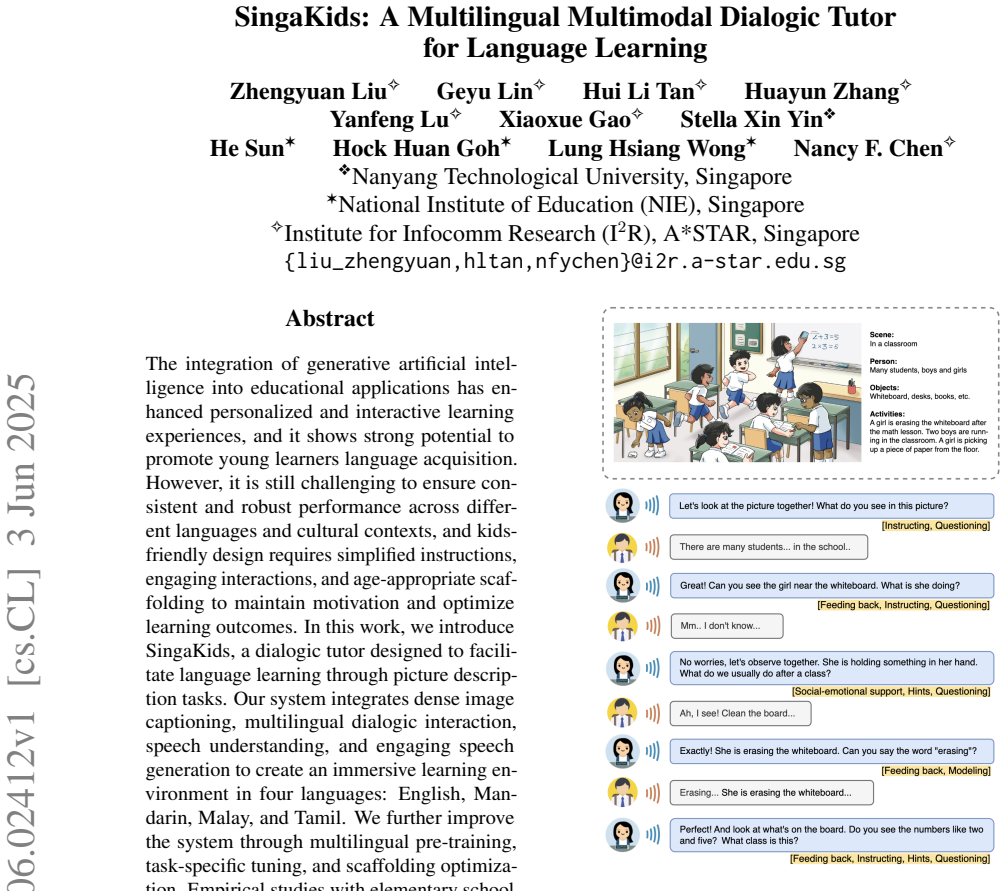
The load-bearing mechanism is the scaffolding-guided dialogue model. A small language model (Qwen1.5-4B) is first strengthened for four languages through continued pre-training and cross-lingual alignment, then trained on synthetic tutoring dialogues produced by a stronger teacher model under the guidance of dialogic teaching theory and personality-aware student simulation. During a session, the model chooses among seven scaffolding moves, such as feedback, hints, explanations, and social-emotional support, based on the learner's utterance and the educational objective, so that support can be gradually withdrawn as the child becomes able to produce target language on their own.
What would settle it
Run a randomized controlled trial with a pre-test and post-test in which first- and second-grade children describe pictures before and after using SingaKids for several sessions, and compare their vocabulary, fluency, and descriptive sentence complexity against a no-tutor control group; no significantly greater gain would mean the claimed improvement is not established.
Extended reading notes
Core claim
The paper claims that one multimodal dialogue system, built from a small multilingual language model and optimized for Malay and Tamil alongside English and Mandarin, can deliver dialogic teaching that adapts to each learner's level. It argues that the system's dynamic scaffolding is the mechanism behind learning: high-performing students received more feedback and explanations, while low-performing students received more hints and social-emotional support. The authors further claim that scaffolding-guided training made the dialogue model better able to keep conversations on educational goals, even when faced with off-topic or unexpected student input.
Load-bearing premise
The learning-benefit claim collapses if the distribution of scaffolding types does not actually reflect gains in children's language ability, because the study reports only how the system interacted with students, not measured improvement.
Editorial extensions
If this is right
- If the learning claim holds, a single tutor can serve classrooms where several home languages coexist, because the same dialogue flow now runs in English, Mandarin, Malay, and Tamil with adapted speech components.
- The observed split in scaffolding types indicates the system is at least learner-sensitive; whether that sensitivity produces learning is the next test.
- The fine-tuned Malay and Tamil speech recognition and synthesis components reduce the barrier to using spoken dialogue with children in these languages.
- The training recipe, synthetic dialogues from a stronger teacher plus personality-aware student simulation, is a reusable way to embed pedagogical principles into a small language model.
Reading between the lines
- Read strictly, the paper does not yet show learning gains: no pre/post proficiency test, control group, or statistical comparison is reported, so the improvement claim is a promise supported by observed interaction patterns rather than a demonstrated outcome.
- If the scaffolding-type distributions were linked to external measures of later proficiency, the system's own logs could become a low-cost assessment instrument.
- The Singapore-specific language set suggests a general recipe: for any new low-resource language, the main cost is collecting modest amounts of adult and child speech; the dialogue model itself can be adapted with far less data.
- The authors' note that some children exited sessions under persistent difficulty points to a testable design improvement: triggering a 'modeling' scaffolding move earlier could reduce dropout, and that hypothesis is directly measurable.
Editorial analysis
A structured set of objections, weighed in public.
Referee Report
Summary. The paper presents SingaKids, a multilingual multimodal dialogic tutor for picture-description language learning aimed at early elementary students. The system combines dense image captioning, multilingual dialogue modeling with scaffolding-based augmentation, speech recognition, and speech synthesis across English, Mandarin, Malay, and Tamil. The authors report module-level optimizations and evaluations, including ASR WER improvements for Malay and Tamil, an LLM-as-a-judge evaluation of the dialogue model, MOS/intelligibility results for TTS, and a user study with 35 grade 1-2 students analyzed by scaffolding-type distributions. The abstract and introduction claim that empirical studies demonstrate effective dialogic teaching and that students at various performance levels improved in descriptive language skills, vocabulary usage, and conversational fluency.
Significance. If the module-level results hold, the paper is a useful engineering contribution to low-resource educational speech and dialogue technology: it provides concrete recipes for fine-tuning Whisper for Malay/Tamil child speech, for training multilingual TTS with limited child-speaker data, and for augmenting a small dialogue LLM with GPT-4-generated scaffolding dialogues. The four-language deployment in a Singapore context is also of practical interest. However, the central learning-effectiveness claim is not supported by the reported evaluation. The user study measures only tutoring-process variables, not learning outcomes, and the module evaluations have important methodological gaps. The paper should be credited for reporting IRB approval and for including limitations/ethics statements, but the evidence does not currently match the strength of the claims made in the abstract and Section 1.
major comments (4)
- [Section 1 and Section 5] The claim that students 'showed improvements in descriptive language skills, vocabulary usage, and conversational fluency' is not supported by the user study. Section 5 reports only the distribution of scaffolding types across 35 students (Figure 10) and anecdotal observations. There is no pre/post measure of language proficiency, no control condition, and no statistical comparison of learning outcomes. The observed pattern can only show that the tutor's behavior differed by performance level, not that any measured skill improved. Either add an outcome-based evaluation (e.g., pre/post oral proficiency assessments) or substantially weaken the conclusions to describe a feasibility/process study.
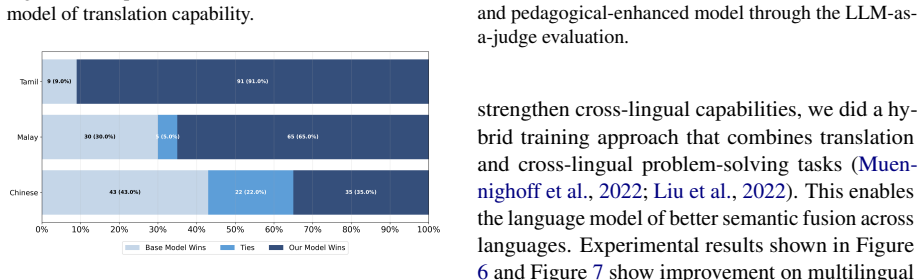
- [Section 4.3.2 and Figure 8] The dialogue model evaluation uses an unspecified LLM-as-a-judge. This is a load-bearing issue because the dialogue model was trained on GPT-4-generated scaffolding data, so an evaluation by a judge from the same model family creates a potential self-referential loop for the quality claim. The paper must specify the judge model, the evaluation prompt and sample size, and ideally provide agreement with human ratings. Figure 8 also reports only an unlabeled comparison with no quantitative values or test-set description.
- [Section 4.1] The dense captioning module reports 'a 75% sentence-level accuracy in our image testbed,' but the testbed is undefined: no number of images, domains, annotation procedure, or scoring criteria are given. Without this information, the claim of 'reasonable content for the conversational process' cannot be assessed. The authors should describe the testbed and evaluation protocol, and ideally compare with a baseline MLLM without the two-stage approach.
- [Section 4.2 and Figures 4-5] The ASR improvements are reported as point WER reductions (e.g., 40.5% to 28.4% on Malay conversational speech) without confidence intervals, significance tests, or details about the test-set composition. The children's speech test sets are referenced only to (Zhang et al., 2021), with no description of their size, recording conditions, or speaker demographics. Please provide these details so the improvements can be evaluated as more than anecdotal.
minor comments (5)
- [Abstract] The phrase 'young learners language acquisition' is missing a possessive; it should be 'young learners' language acquisition.'
- [Section 5] The text says 'significant differences are in some scaffolding types,' which implies statistical testing, but no significance test or effect size is reported for Figure 10. Please either report the test or remove the word 'significant.'
- [References] The reference list contains a duplicated entry: Achiam et al. 2023a and 2023b are identical. Please merge or differentiate them.
- [Section 4.4 and Figure 9] The MOS evaluation reports only that the average score exceeds 3.50, without per-sample distributions, variance, or a comparison condition. Reporting the full MOS distribution and confidence intervals would make the result more informative.
- [Limitations] The limitations section is generic and does not mention the lack of learning-gain measurement, the small sample size of the user study, or the absence of a control condition, despite these being the most consequential limitations of the reported effectiveness claims.
Circularity Check
No load-bearing circularity found; the effectiveness claim is under-supported by evidence, but it is not circular.
full rationale
No circular step can be exhibited from the paper's text under the hard rules. The technical modules are evaluated against external or independently named benchmarks: Malay and Tamil ASR are compared with Whisper-large-V3 baselines and the Bloom Speech Tamil test set, and TTS is assessed with MOS from native listeners plus CER via pretrained ASR models. The dialogue model is trained from GPT-4-generated scaffolding samples and then evaluated by an unspecified LLM-as-a-judge (Figure 8); if the judge were from the same model family, this could form a self-referential loop, but the paper does not identify the judge, so the reduction is not established and cannot be flagged without speculation. The central effectiveness claim in Section 1 ('students at various performance levels showed improvements in descriptive language skills, vocabulary usage, and conversational fluency') is not derived from Section 5's evidence: Section 5 reports only scaffolding-type distributions across high- and low-performing students (Figure 10) and anecdotal observations, with no pre/post proficiency measure, control group, or statistical comparison. That is an evidence gap rather than a circular derivation. Self-citations such as Liu et al. (2024c) and Liu et al. (2024d) provide the scaffolding taxonomy and personality-aware student-simulation framework from prior published work; they are methodological provenance rather than a conclusion forced by definition or by an imported uniqueness theorem. Accordingly, the paper's derivation chain is not circular, though the pedagogical effectiveness claim would need stronger empirical support to be fully substantiated.
Assumptions & free parameters
assumptions (4)
- domain assumption Pre-trained foundation models (InternVL2.5, Whisper-large-V3, Qwen1.5-4B, VITS) provide reliable base capabilities for the modules.
- domain assumption The seven scaffolding types (e.g., feeding back, explaining, hinting, social-emotional support) form a valid and complete taxonomy for analyzing tutor behavior.
- domain assumption LLM-as-a-judge evaluation is a reliable proxy for pedagogical quality for the dialogue model.
- domain assumption A 75% sentence-level accuracy on the internal image testbed is sufficient to support conversational tutoring.
Cite this review
Pith. "Pith review of SingaKids: A Multilingual Multimodal Dialogic Tutor for Language Learning." pith.science (2026). https://pith.science/paper/UE64IN77
@misc{pith2026250602412,
  author       = {Pith},
  title        = {Pith review of: SingaKids: A Multilingual Multimodal Dialogic Tutor for Language Learning},
  year         = {2026},
  howpublished = {\url{https://pith.science/paper/UE64IN77}},
  note         = {Machine review of arXiv:2506.02412}
}
read the original abstract
The integration of generative artificial intelligence into educational applications has enhanced personalized and interactive learning experiences, and it shows strong potential to promote young learners language acquisition. However, it is still challenging to ensure consistent and robust performance across different languages and cultural contexts, and kids-friendly design requires simplified instructions, engaging interactions, and age-appropriate scaffolding to maintain motivation and optimize learning outcomes. In this work, we introduce SingaKids, a dialogic tutor designed to facilitate language learning through picture description tasks. Our system integrates dense image captioning, multilingual dialogic interaction, speech understanding, and engaging speech generation to create an immersive learning environment in four languages: English, Mandarin, Malay, and Tamil. We further improve the system through multilingual pre-training, task-specific tuning, and scaffolding optimization. Empirical studies with elementary school students demonstrate that SingaKids provides effective dialogic teaching, benefiting learners at different performance levels.
Figures


Figures from the paper (4 more)



Reference graph
Works this paper leans on
-
[2]
Josh Achiam, Steven Adler, Sandhini Agarwal, Lama Ahmad, Ilge Akkaya, Florencia Leoni Aleman, Diogo Almeida, Janko Altenschmidt, Sam Altman, Shyamal Anadkat, et al. 2023 b . Gpt-4 technical report. arXiv preprint arXiv:2303.08774
arXiv 2023
-
[3]
Shazia Afzal, Tejas Dhamecha, Nirmal Mukhi, Renuka Sindhgatta, Smit Marvaniya, Matthew Ventura, and Jessica Yarbro. 2019. https://doi.org/10.18653/v1/N19-2015 Development and deployment of a large-scale dialog-based intelligent tutoring system . In Proceedings of the NAACL 2019, pages 114--121, Minneapolis, Minnesota. Association for Computational Linguistics
-
[4]
Robin Alexander. 2006. https://books.google.com.sg/books?id=DRoctAEACAAJ Education as Dialogue: Moral and Pedagogical Choices for a Runaway World . Hong Kong Institute of Education
work page 2006
-
[5]
Pablo Arnau-Gonz \'a lez, Miguel Arevalillo-Herr \'a ez, Romina Albornoz-De Luise, and David Arnau. 2023. A methodological approach to enable natural language interaction in an intelligent tutoring system. Computer Speech & Language, 81:101516
work page 2023
-
[6]
Ahmed Adel Attia, Jing Liu, Wei Ai, Dorottya Demszky, and Carol Espy-Wilson. 2024. Kid-whisper: Towards bridging the performance gap in automatic speech recognition for children vs. adults. In Proceedings of the AAAI/ACM Conference on AI, Ethics, and Society, volume 7, pages 74--80
work page 2024
-
[7]
Jinze Bai, Shuai Bai, Yunfei Chu, Zeyu Cui, Kai Dang, Xiaodong Deng, Yang Fan, Wenbin Ge, Yu Han, Fei Huang, Binyuan Hui, Luo Ji, Mei Li, Junyang Lin, Runji Lin, Dayiheng Liu, Gao Liu, Chengqiang Lu, Keming Lu, Jianxin Ma, Rui Men, Xingzhang Ren, Xuancheng Ren, Chuanqi Tan, Sinan Tan, Jianhong Tu, Peng Wang, Shijie Wang, Wei Wang, Shengguang Wu, Benfeng X...
arXiv 2023
-
[8]
Shariq Farooq Bhat, Reiner Birkl, Diana Wofk, Peter Wonka, and Matthias M \"u ller. 2023. Zoedepth: Zero-shot transfer by combining relative and metric depth. arXiv preprint arXiv:2302.12288
arXiv 2023
-
[9]
Soumaya Chaffar and Claude Frasson. 2004. Inducing optimal emotional state for learning in intelligent tutoring systems. In International Conference on Intelligent Tutoring Systems, pages 45--54. Springer
work page 2004
Show all 58 references
-
[10]
Zhe Chen, Jiannan Wu, Wenhai Wang, Weijie Su, Guo Chen, Sen Xing, Muyan Zhong, Qinglong Zhang, Xizhou Zhu, Lewei Lu, et al. 2024. Internvl: Scaling up vision foundation models and aligning for generic visual-linguistic tasks. In Proceedings of the IEEE/CVF conference on comput...
2024
-
[11]
Paul T Costa and Robert R McCrae. 1999. A five-factor theory of personality. The five-factor model of personality: Theoretical perspectives, 2:51--87
1999
-
[12]
Luciana C de Oliveira, Loren Jones, and Sharon L Smith. 2023. Interactional scaffolding in a first-grade classroom through the teaching--learning cycle. International Journal of Bilingual Education and Bilingualism, 26(3):270--288
2023
-
[13]
Dorottya Demszky and Heather Hill. 2023. The ncte transcripts: A dataset of elementary math classroom transcripts. In Proceedings of the 18th Workshop on Innovative Use of NLP for Building Educational Applications (BEA 2023), pages 528--538
2023
-
[14]
Myroslava Dzikovska, Natalie Steinhauser, Elaine Farrow, Johanna Moore, and Gwendolyn Campbell. 2014. https://doi.org/10.1007/s40593-014-0017-9 BEETLE II: Deep Natural Language Understanding and Automatic Feedback Generation for Intelligent Tutoring in Basic Electricity and El...
2014 doi
-
[15]
Celia Genishi and Anne Haas Dyson. 2015. Children, language, and literacy: Diverse learners in diverse times. Teachers College Press
2015
-
[16]
Arthur C Graesser, Xiangen Hu, and Robert Sottilare. 2018. Intelligent tutoring systems. In International handbook of the learning sciences, pages 246--255. Routledge
2018
-
[17]
Beate Grawemeyer, Manolis Mavrikis, Wayne Holmes, Sergio Gutierrez-Santos, Michael Wiedmann, and Nikol Rummel. 2016. https://doi.org/10.1145/2883851.2883936 Affecting off-task behaviour: how affect-aware feedback can improve student learning . In Proceedings of the Sixth Inter...
2016
-
[18]
Foteini Grivokostopoulou, Isidoros Perikos, and Ioannis Hatzilygeroudis. 2017. https://doi.org/10.1007/s40593-016-0116-x An Educational System for Learning Search Algorithms and Automatically Assessing Student Performance . International Journal of Artificial Intelligence in E...
2017 doi
-
[19]
Harley, François Bouchet, M
Jason M. Harley, François Bouchet, M. Sazzad Hussain, Roger Azevedo, and Rafael Calvo. 2015. https://doi.org/https://doi.org/10.1016/j.chb.2015.02.013 A multi-componential analysis of emotions during complex learning with an intelligent multi-agent system . Computers in Human ...
2015 doi
-
[20]
Hyangeun Ji, Insook Han, and Yujung Ko. 2023. A systematic review of conversational ai in language education: Focusing on the collaboration with human teachers. Journal of Research on Technology in Education, 55(1):48--63
2023
-
[21]
Justin Johnson, Andrej Karpathy, and Li Fei-Fei. 2016. Densecap: Fully convolutional localization networks for dense captioning. In Proceedings of the IEEE Conference on Computer Vision and Pattern Recognition
2016
-
[22]
Jaehyeon Kim, Jungil Kong, and Juhee Son. 2021. Conditional variational autoencoder with adversarial learning for end-to-end text-to-speech. In International Conference on Machine Learning, pages 5530--5540. PMLR
2021
-
[23]
Alexander Kirillov, Eric Mintun, Nikhila Ravi, Hanzi Mao, Chloe Rolland, Laura Gustafson, Tete Xiao, Spencer Whitehead, Alexander C Berg, Wan-Yen Lo, et al. 2023. Segment anything. In Proceedings of the IEEE/CVF international conference on computer vision, pages 4015--4026
2023
-
[24]
Kulik and J
James A. Kulik and J. D. Fletcher. 2016. https://doi.org/10.3102/0034654315581420 Effectiveness of Intelligent Tutoring Systems: A Meta-Analytic Review . Review of Educational Research, 86(1):42--78
2016 doi
-
[25]
Colin Leong, Joshua Nemecek, Jacob Mansdorfer, Anna Filighera, Abraham Owodunni, and Daniel Whitenack. 2022. Bloom library: Multimodal datasets in 300+ languages for a variety of downstream tasks. arXiv preprint arXiv:2210.14712
2022 arXiv
-
[26]
Geyu Lin, Bin Wang, Zhengyuan Liu, and Nancy Chen. 2025. Crossin: An efficient instruction tuning approach for cross-lingual knowledge alignment. In Proceedings of the Second Workshop on Scaling Up Multilingual & Multi-Cultural Evaluation, pages 12--23
2025
-
[27]
Shilong Liu, Zhaoyang Zeng, Tianhe Ren, Feng Li, Hao Zhang, Jie Yang, Qing Jiang, Chunyuan Li, Jianwei Yang, Hang Su, et al. 2024 a . Grounding dino: Marrying dino with grounded pre-training for open-set object detection. In European Conference on Computer Vision, pages 38--55...
2024
-
[28]
Zhengyuan Liu, Shikang Ni, Aiti Aw, and Nancy Chen. 2022. Singlish message paraphrasing: A joint task of creole translation and text normalization. In Proceedings of the 29th International Conference on Computational Linguistics, pages 3924--3936
2022
-
[29]
Zhengyuan Liu, Stella Xin Yin, and Nancy Chen. 2024 b . https://doi.org/10.18653/v1/2024.sigdial-1.43 Optimizing code-switching in conversational tutoring systems: A pedagogical framework and evaluation . In Proceedings of the 25th Annual Meeting of the Special Interest Group ...
2024 doi
-
[30]
Zhengyuan Liu, Stella Xin Yin, Carolyn Lee, and Nancy F Chen. 2024 c . Scaffolding language learning via multi-modal tutoring systems with pedagogical instructions. In 2024 IEEE Conference on Artificial Intelligence (CAI), pages 1258--1265. IEEE
2024
-
[31]
Zhengyuan Liu, Stella Xin Yin, Geyu Lin, and Nancy F. Chen. 2024 d . https://doi.org/10.18653/v1/2024.emnlp-main.37 Personality-aware student simulation for conversational intelligent tutoring systems . In Proceedings of the 2024 Conference on Empirical Methods in Natural Lang...
2024 doi
-
[32]
Jakub Macina, Nico Daheim, Sankalan Chowdhury, Tanmay Sinha, Manu Kapur, Iryna Gurevych, and Mrinmaya Sachan. 2023 a . Mathdial: A dialogue tutoring dataset with rich pedagogical properties grounded in math reasoning problems. In Findings of EMNLP 2023, pages 5602--5621
2023
-
[33]
Jakub Macina, Nico Daheim, Lingzhi Wang, Tanmay Sinha, Manu Kapur, Iryna Gurevych, and Mrinmaya Sachan. 2023 b . Opportunities and challenges in neural dialog tutoring. In Proceedings of the 17th Conference of the European Chapter of the Association for Computational Linguisti...
2023
-
[34]
Christopher J MacLellan and Kenneth R Koedinger. 2022. Domain-general tutor authoring with apprentice learner models. International Journal of Artificial Intelligence in Education, 32(1):76--117
2022
-
[35]
Niklas Muennighoff, Thomas Wang, Lintang Sutawika, Adam Roberts, Stella Biderman, Teven Le Scao, M Saiful Bari, Sheng Shen, Zheng Xin Yong, Hailey Schoelkopf, et al. 2023. Crosslingual generalization through multitask finetuning. In Proceedings of the 61st Annual Meeting of th...
2023
-
[36]
Niklas Muennighoff, Thomas Wang, Lintang Sutawika, Adam Roberts, Stella Biderman, Teven Le Scao, M Saiful Bari, Sheng Shen, Zheng-Xin Yong, Hailey Schoelkopf, et al. 2022. Crosslingual generalization through multitask finetuning. arXiv preprint arXiv:2211.01786
2022 arXiv
-
[37]
Elghouch Nihad, En-naimi El Mokhtar, and Yassine Zaoui Seghroucheni. 2017. https://doi.org/10.3991/ijet.v12i03.6377 Analysing the outcome of a learning process conducted within the system als\_corr(lp) . International Journal of Emerging Technologies in Learning (iJET), 12(03)...
2017 doi
-
[38]
B Nye, Dillon Mee, and Mark G Core. 2023. Generative large language models for dialog-based tutoring: An early consideration of opportunities and concerns. In AIED Workshops
2023
-
[39]
Benjamin D Nye, Arthur C Graesser, and Xiangen Hu. 2014. Autotutor and family: A review of 17 years of natural language tutoring. International Journal of Artificial Intelligence in Education, 24:427--469
2014
-
[40]
Jos \'e Paladines and Jaime Ramirez. 2020. A systematic literature review of intelligent tutoring systems with dialogue in natural language. IEEE Access, 8:164246--164267
2020
-
[41]
Guilherme Penedo, Hynek Kydl \' c ek, Loubna Ben allal, Anton Lozhkov, Margaret Mitchell, Colin Raffel, Leandro Von Werra, and Thomas Wolf. 2024. https://openreview.net/forum?id=n6SCkn2QaG The fineweb datasets: Decanting the web for the finest text data at scale . In The Thirt...
2024
-
[42]
Silvia Pokriv c \'a kov \'a . 2019. Preparing teachers for the application of ai-powered technologies in foreign language education. Journal of language and cultural education
2019
- [43]
-
[44]
Sherry Ruan, Liwei Jiang, Justin Xu, Bryce Joe-Kun Tham, Zhengneng Qiu, Yeshuang Zhu, Elizabeth L Murnane, Emma Brunskill, and James A Landay. 2019. Quizbot: A dialogue-based adaptive learning system for factual knowledge. In Proceedings of the 2019 CHI conference on human fac...
2019
-
[45]
Shashank Sonkar, Naiming Liu, Debshila Mallick, and Richard Baraniuk. 2023. Class: A design framework for building intelligent tutoring systems based on learning science principles. In Findings of EMNLP 2023, pages 1941--1961
2023
-
[46]
Katherine Stasaski, Kimberly Kao, and Marti A Hearst. 2020. Cima: A large open access dialogue dataset for tutoring. In Proceedings of the Fifteenth Workshop on Innovative Use of NLP for Building Educational Applications, pages 52--64
2020
-
[47]
Yuchong Sun, Che Liu, Kun Zhou, Jinwen Huang, Ruihua Song, Wayne Xin Zhao, Fuzheng Zhang, Di Zhang, and Kun Gai. 2024. Parrot: Enhancing multi-turn instruction following for large language models. In Proceedings of the 62nd Annual Meeting of the Association for Computational L...
2024
-
[48]
Gemini Team, Rohan Anil, Sebastian Borgeaud, Yonghui Wu, Jean-Baptiste Alayrac, Jiahui Yu, Radu Soricut, Johan Schalkwyk, Andrew M Dai, Anja Hauth, et al. 2023. Gemini: a family of highly capable multimodal models. arXiv preprint arXiv:2312.11805
2023 arXiv
-
[49]
Teknium. 2023. https://huggingface.co/datasets/teknium/OpenHermes-2.5 Openhermes 2.5: An open dataset of synthetic data for generalist llm assistants
2023
-
[50]
Bin Wang, Zhengyuan Liu, Xin Huang, Fangkai Jiao, Yang Ding, Ai Ti Aw, and Nancy F Chen. 2023 a . Seaeval for multilingual foundation models: From cross-lingual alignment to cultural reasoning. arXiv preprint arXiv:2309.04766
2023 arXiv
-
[51]
Rose E Wang, Qingyang Zhang, Carly Robinson, Susanna Loeb, and Dorottya Demszky. 2023 b . Step-by-step remediation of students' mathematical mistakes. arXiv preprint arXiv:2310.10648
2023 arXiv
-
[52]
Jeremy Heng Meng Wong, Huayun Zhang, and Nancy F Chen. 2022. Variations of multi-task learning for spoken language assessment. In Interspeech, pages 4456--4460
2022
-
[53]
Zhihong Xu, Kausalai Wijekumar, Gilbert Ramirez, Xueyan Hu, and Robin Irey. 2019. https://doi.org/10.1111/bjet.12758 The effectiveness of intelligent tutoring systems on K-12 students' reading comprehension: A meta-analysis . British Journal of Educational Technology, 50(6):3119--3137
2019 doi
-
[54]
L. Yan, L. Sha, L. Zhao, Y. Li, R. Martinez-Maldonado, G. Chen, X. Li, Y. Jin, and D. Gašević. 2024. https://doi.org/10.1111/bjet.13370 Practical and ethical challenges of large language models in education: A systematic scoping review . British Journal of Educational Technolo...
2024 doi
-
[55]
Xuesong Zhai, Xiaoyan Chu, Ching Sing Chai, Morris Siu Yung Jong, Andreja Istenic, Michael Spector, Jia-Bao Liu, Jing Yuan, and Yan Li. 2021. A review of artificial intelligence (ai) in education from 2010 to 2020. Complexity, 2021(1):8812542
2021
-
[56]
Huayun Zhang, Ke Shi, and Nancy F Chen. 2021. Multilingual speech evaluation: Case studies on english, malay and tamil. In Proc. Interspeech 2021, pages 4443--4447
2021
-
[57]
Ke Zhang and Ayse Begum Aslan. 2021. Ai technologies for education: Recent research & future directions. Computers and education: Artificial intelligence, 2:100025
2021
-
[58]
URL: " 'urlintro :=
ENTRY address author booktitle chapter edition editor howpublished institution journal key month note number organization pages publisher school series title type volume year eprint doi pubmed url lastchecked label extra.label sort.label short.list INTEGERS output.state before...
-
[59]
write newline
" write newline "" before.all 'output.state := FUNCTION n.dashify 't := "" t empty not t #1 #1 substring "-" = t #1 #2 substring "--" = not "--" * t #2 global.max substring 't := t #1 #1 substring "-" = "-" * t #2 global.max substring 't := while if t #1 #1 substring * t #2 gl...
Reviewed August 7, 2026 · model on record in the stance chip above.
Discussion (0). Sign in to comment.