REVIEW 5 major objections 5 minor 17 references
A Novel Deep Reinforcement Learning Method for Computation Offloading in Multi-User Mobile Edge Computing with Decentralization
T0 review · 5 major / 5 minor · reviewed 2026-08-07 · deepseek-v4-flash
Pith's one-line read Twin Delayed DDPG outperforms DDPG as a decentralized offloading policy in multi-user MEC.
desk verdict A routine TD3-vs-DDPG benchmark in a borrowed MEC model, with a plausible reward claim that the reported single unseeded run does not actually support. read the letter →
The pith
A machine-rendered reading of the paper's core claim, the machinery that carries it, and where it could break.
The reading
What carries the argument
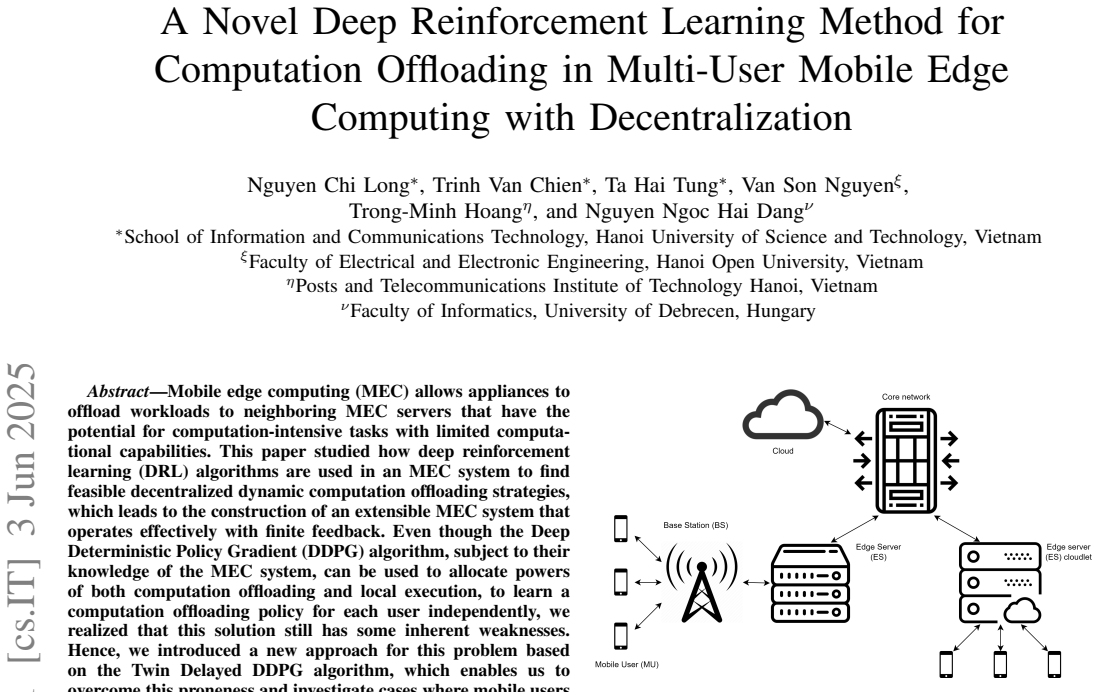
The central object is the Twin Delayed DDPG (TD3) algorithm, an actor-critic deep reinforcement learning method that maintains two Q-value networks and uses the smaller of their target values when computing Bellman errors, updates the policy less frequently than the critics, and adds clipped noise to target actions. It operates within a per-user reward $r_{m,t} = -w_{m,1}(p_{l,m}(t)+p_{o,m}(t)) - w_{m,2}B_m(t)$ and a state $s_{m,t} = [B_m(t), \phi_m(t-1), h_m(t)]$, where $B_m(t)$ is the task buffer queue length, $\phi_m(t-1)$ is the estimated power ratio after zero-forcing detection, and $h_m(t)$ is the user's channel vector. This machinery carries the argument by giving each user a more stable critic target, mitigating the overestimation that the paper identifies as DDPG's weakness, and thereby producing the reported reward gains in the portable-user simulations.
What would settle it
Run the exact Table I setup (three users, $w_m = 0.8$, 2000 episodes, 200 steps per episode) with ten or more independent random seeds for both algorithms, and compare distributions of per-user average reward, power, and delay. If TD3's per-user reward advantage does not persist with non-overlapping confidence intervals, or if average power is not lower for the majority of users, the paper's superiority claim is falsified.
Extended reading notes
Core claim
On the paper's own terms, the central discovery is that in the decentralized multi-user MEC framework introduced in [7], replacing the DDPG agent with TD3 yields better learned computation offloading policies, especially when mobile users are portable. Concretely, the reported per-user average rewards improve from -9.52 to -3.09, from -14.08 to -3.71, and from -19.49 to -3.89 while users move; average power decreases for two of the three users and average delay decreases for two of the three users. The paper attributes the improvement to TD3's remedies for DDPG's Q-value overestimation, namely clipped double-Q learning and delayed policy updates, which stabilize training and lead to higher-reward policies.
Load-bearing premise
The paper's conclusion that TD3 is better rests on a single set of simulation runs with one reward weighting, one movement pattern, and unstated random seeds; if the reported gaps shrink or flip under different seeds or hyperparameters, the superiority claim collapses.
Editorial extensions
If this is right
- Each portable user can learn an offloading policy independently from its own local state, without knowing the total number of users or the statistics of task arrivals and channels.
- Replacing DDPG with TD3 improves the average reward per episode for all three simulated users, and the paper interprets the overall results as showing that TD3 exceeds the DDPG-based power control strategy.
- The learned policies operate with finite feedback: each user observes only its buffer queue, the estimated power ratio after zero-forcing detection, and its own channel vector.
- Because TD3 uses two Q-networks and delayed policy updates, its runtime stays close to DDPG's while reducing Q-value overestimation, making it a practical drop-in replacement in this simulator.
Reading between the lines
- If the reported advantage is robust to random seeds and hyperparameter choices, the same TD3 recipe (clipped double-Q targets and delayed policy updates) could be applied to other decentralized resource-allocation problems in MEC, such as channel assignment or split inference, without changing the local-state architecture.
- The reward weight $w_m$ is fixed at 0.8 for all users; varying it would trace the energy-delay Pareto frontier, and TD3's edge over DDPG may depend on the operating point, which the paper does not explore.
- A natural extension is to test the same decentralized learning rule with more than three users, since the scalability argument in the paper is not yet backed by simulations with larger $M$.
Editorial analysis
A structured set of objections, weighed in public.
Referee Report
Summary. The paper applies Twin Delayed DDPG (TD3) to the decentralized multi-user mobile edge computing (MEC) problem studied by [7], with the added feature that users are portable and their distances to the base station change over time. Each user is an independent DRL agent with state comprising queue length, estimated zero-forcing power ratio, and channel vector; the action is the continuous local-execution and offloading power pair; and the reward is a negatively weighted sum of power consumption and queue length. The paper reports a simulation with three users over 2000 episodes, comparing TD3 against DDPG and claiming that TD3 achieves better average reward, average power, and average delay. The contribution is entirely empirical: no theoretical analysis is offered, and the central claim rests on the reported experimental comparison.
Significance. If the reported advantage were actually established, the paper would offer a simple, practical improvement over DDPG for decentralized MEC with moving users, and the system model in Section II is coherent and closely follows a known benchmark. Credit is due for providing explicit pseudocode for both DDPG and TD3 and for specifying the simulation setup in some detail. However, the significance is severely limited by the fact that the only evidence is a single unseeded run, the numerical table contradicts the qualitative text, and key metrics and hyperparameters are left undefined. As it stands, the central claim is not supported to the standard expected for an empirical comparison.
major comments (5)
- [Section IV-A and IV-B] The paper's central claim that TD3 'has much better results than DDPG' (Abstract) and 'exceeded the conventional DDPG-based power control strategy' is based on a single unseeded run per algorithm. There are no standard deviations, random seeds, confidence intervals, or statistical tests. With only three users and one realization of the random channel, task, and mobility processes, the observed reward gap (mean about -3.6 versus -14.4) cannot be separated from run-to-run variance. The authors should report multiple independent seeds with per-user and aggregate means and standard deviations, and ideally a paired statistical test, or temper the superiority claim accordingly.
- [Table I and Section IV-B] Table I contradicts the qualitative statements in Section IV-B. For User 3, the average power for TD3 is 0.30 versus 0.20 for DDPG, meaning DDPG is better on this metric, yet the text states that 'regarding average power per episode, TD3 also achieved better results compared with DDPG.' Similarly, for User 1, the average delay for TD3 is 4.67 versus 1.95 for DDPG, while the surrounding text implies better delay performance. If the intended claim is only about the average over users or only about some users, that is not stated. The table and the qualitative summary must be reconciled.
- [Table I and Section IV-A] Table I reports 'Average delay' but no definition of this metric is given in Section IV-A or elsewhere. The reward function (17) uses the queue length B_m(t), not delay; Section III-A mentions Little's theorem, but the exact empirical quantity reported in the table (mean queue length over time, steady-state queue length, or an actual delay) is never specified. Without this definition, the delay column is uninterpretable and cannot be used to support the superiority claim.
- [Algorithm 2, line 14] The TD3 pseudocode computes the target next action as clip(μ(s'|θ^μ) + clip(ε,-c,c), a_low, a_high), using the current actor parameters θ^μ. In standard TD3, the target action must be computed with the target actor parameters θ^{μ'}, which are defined in line 1 but are never used in line 14. If the implementation follows this pseudocode, the algorithm is not TD3, and the reported improvement over DDPG could be an artifact of a different exploration and update scheme. This must be corrected, and if the experiments were run with the incorrect version, they should be rerun.
- [Section IV-A] The simulation setup is incomplete with respect to the DRL hyperparameters. The text says the networks use 'almost the same settings as in [7]' and cites [17] for initialization, but it omits the learning rates α_Q and α_μ, the minibatch size, the soft-update rate τ, the policy-delay parameter update_every, the number of gradient updates per step, and the layer sizes, widths, and activations. The mobility model is also only sketched: distances are 'added by a value drawn randomly from the standard normal distribution, such that the absolute value of the cumulative sum of these distances is lower than 10.' These omissions prevent reproduction and make it impossible to judge whether the result is robust to hyperparameter choices, which is critical because the whole claim rests on one comparison.
minor comments (5)
- [Equation (1)] The summation index is j, but the channel, power, and data symbol inside the sum are all indexed by m; in addition, the noise term n(t) appears inside the summation. This should be h_j(t), p_{o,j}(t), and s_j(t), with n(t) outside the sum.
- [Section II-A] The text 'variances 2 = 1' is garbled; it should state, for example, that E[|s_m(t)|^2] = 1.
- [Section III] The symbol γ is used both for SINR in (4) and for the discount factor in (15) and in the algorithms. These two uses should be distinguished to avoid confusion.
- [Algorithms 1 and 2] The symbol B is used both for the task buffer queue length in (5) and for the experience replay buffer in Algorithms 1 and 2. The notation should be changed.
- [Section IV-B and Figures 3-5] The figures are described in terms of orange and black lines, but no legend or axis-label description is provided in the text; including legends and defining what is averaged (over episodes or over users) would improve readability.
Circularity Check
No circularity: the TD3-vs-DDPG comparison is an independent empirical benchmark, not a derivation that presupposes its conclusion.
full rationale
The paper's central claim is an empirical superiority of TD3 over DDPG in a specific MEC simulator. The MEC model, state/action/reward definitions, and DRL algorithms are either taken from prior work (Chen-Wang [7] and Lillicrap et al. [17]) or stated directly in the paper, and TD3 is a standard, externally described algorithm. No parameter is fitted to a subset of data and then reported as a prediction of a closely related quantity: the reward weights (w_m = 0.8) are chosen once for both algorithms, and the comparison uses the same environment, episode count, and initialization. The single-seed/no-error-bar issue is an empirical robustness concern, not circularity. There are no load-bearing self-citations: the authors cite [7] for the framework and compare against it, but the DDPG baseline and environment are reproducible from the cited description, and the TD3 implementation is standard. No uniqueness theorem or prior result by the same authors is invoked to forbid alternatives. The observed performance gap is an empirical outcome of the simulator, not an identity, a renamed known result, or a consequence of the definitions. Therefore the derivation chain is self-contained with respect to circularity.
Assumptions & free parameters
free parameters (6)
- Reward balance factor w_m =
0.8
- Movement noise standard deviation =
1 (standard normal)
- Ornstein-Uhlenbeck exploration noise parameters =
theta=0.15, sigma=0.12
- Experience replay buffer size =
2.5e5
- Training episodes and episode length =
Kmax=2000, Tmax=200
- Unspecified DRL hyperparameters =
not specified
assumptions (5)
- domain assumption The MEC server has abundant computation resources, so edge processing latency and feedback delay are negligible; all offloaded bits are served in the same slot.
- domain assumption Each user has perfect knowledge of its own channel vector h_m(t) and queue length B_m(t) at each slot without communication overhead.
- domain assumption Users move according to a random walk with standard-normal step sizes, truncated so that cumulative absolute displacement stays below 10 m.
- domain assumption The task arrival processes are i.i.d. with means lambda_m, and the zero-forcing detector behaves as modeled in Eq. (4).
- domain assumption The DDPG baseline from [7] is implemented faithfully and tuned fairly relative to TD3.
Cite this review
Pith. "Pith review of A Novel Deep Reinforcement Learning Method for Computation Offloading in Multi-User Mobile Edge Computing with Decentralization." pith.science (2026). https://pith.science/paper/WOPO6J2L
@misc{pith2026250602458,
  author       = {Pith},
  title        = {Pith review of: A Novel Deep Reinforcement Learning Method for Computation Offloading in Multi-User Mobile Edge Computing with Decentralization},
  year         = {2026},
  howpublished = {\url{https://pith.science/paper/WOPO6J2L}},
  note         = {Machine review of arXiv:2506.02458}
}
read the original abstract
Mobile edge computing (MEC) allows appliances to offload workloads to neighboring MEC servers that have the potential for computation-intensive tasks with limited computational capabilities. This paper studied how deep reinforcement learning (DRL) algorithms are used in an MEC system to find feasible decentralized dynamic computation offloading strategies, which leads to the construction of an extensible MEC system that operates effectively with finite feedback. Even though the Deep Deterministic Policy Gradient (DDPG) algorithm, subject to their knowledge of the MEC system, can be used to allocate powers of both computation offloading and local execution, to learn a computation offloading policy for each user independently, we realized that this solution still has some inherent weaknesses. Hence, we introduced a new approach for this problem based on the Twin Delayed DDPG algorithm, which enables us to overcome this proneness and investigate cases where mobile users are portable. Numerical results showed that individual users can autonomously learn adequate policies through the proposed approach. Besides, the performance of the suggested solution exceeded the conventional DDPG-based power control strategy.
Figures


Figures from the paper (2 more)


Reference graph
Works this paper leans on
-
[7]
Zhao Chen and Xiaodong Wang. Decentralized computation offloading for multi-user mobile edge computing: a deep reinforcement learning approach.EURASIP J. Wirel. Commun. Netw., 2020(1), sep 2020
work page 2020
-
[17]
Timothy P. Lillicrap, Jonathan J. Hunt, Alexander Pritzel, Nicolas Manfred Otto Heess, Tom Erez, Yuval Tassa, David Silver, and Daan Wierstra. Continuous control with deep reinforcement learning.CoRR, abs/1509.02971, 2015
arXiv 2015
-
[1]
Weiwen Zhang, Yonggang Wen, Jun Wu, and Hui Li. Toward a unified elastic computing platform for smartphones with cloud support.IEEE Network, 27(5):34–40, 2013
work page 2013
-
[2]
The emergence of edge computing.Com- puter, 50(1):30–39, 2017
Mahadev Satyanarayanan. The emergence of edge computing.Com- puter, 50(1):30–39, 2017
work page 2017
-
[3]
Online learning for offloading and autoscaling in energy harvesting mobile edge computing, 2017
Jie Xu, Lixing Chen, and Shaolei Ren. Online learning for offloading and autoscaling in energy harvesting mobile edge computing, 2017
work page 2017
-
[4]
Thinh Quang Dinh, Quang Duy La, Tony Q. S. Quek, and Hyundong Shin. Learning for computation offloading in mobile edge computing. IEEE Transactions on Communications, 66(12):6353–6367, 2018
work page 2018
-
[5]
Richard S Sutton and Andrew G Barto.Reinforcement learning: An introduction. 2018
work page 2018
-
[6]
Rusu, Joel Veness, Marc G
V olodymyr Mnih, Koray Kavukcuoglu, David Silver, Andrei A. Rusu, Joel Veness, Marc G. Bellemare, Alex Graves, Martin A. Riedmiller, Andreas Kirkeby Fidjeland, Georg Ostrovski, Stig Petersen, Charlie Beattie, Amir Sadik, Ioannis Antonoglou, Helen King, Dharshan Ku- maran, Daan Wierstra, Shane Legg, and Demis Hassabis. Human-level control through deep rein...
2015
Show all 17 references
-
[8]
Mobile edge computing: A survey on architecture and computation offloading.CoRR, abs/1702.05309, 2017
Pavel Mach and Zdenek Becvar. Mobile edge computing: A survey on architecture and computation offloading.CoRR, abs/1702.05309, 2017
2017 arXiv
-
[9]
Power- delay tradeoff in multi-user mobile-edge computing systems.2016 IEEE Global Communications Conference (GLOBECOM), pages 1–6, 2016
Yuyi Mao, Jun Zhang, Shenghui Song, and Khaled Ben Letaief. Power- delay tradeoff in multi-user mobile-edge computing systems.2016 IEEE Global Communications Conference (GLOBECOM), pages 1–6, 2016
2016
-
[10]
Zhao Chen, Lei Zhang, Yukui Pei, Chunxiao Jiang, and Liuguo Yin. Noma-based multi-user mobile edge computation offloading via coop- erative multi-agent deep reinforcement learning.IEEE Transactions on Cognitive Communications and Networking, 8(1):350–364, 2022
2022
-
[11]
Prasobh Sankar and Sundeep Prabhakar Chepuri
R.S. Prasobh Sankar and Sundeep Prabhakar Chepuri. Channel esti- mation in mimo systems with one-bit spatial sigma-delta adcs.IEEE Transactions on Signal Processing, 70:4681–4696, 2022
2022
-
[12]
Larsson, and Thomas L
Hien Quoc Ngo, Erik G. Larsson, and Thomas L. Marzetta. Energy and spectral efficiency of very large multiuser mimo systems.IEEE Transactions on Communications, 61(4):1436–1449, 2013
2013
-
[13]
Dream: Dynamic resource and task allocation for energy minimization in mobile cloud systems.IEEE Journal on Selected Areas in Communications, 33(12):2510–2523, 2015
Jeongho Kwak, Yeongjin Kim, Joohyun Lee, and Song Chong. Dream: Dynamic resource and task allocation for energy minimization in mobile cloud systems.IEEE Journal on Selected Areas in Communications, 33(12):2510–2523, 2015
2015
-
[14]
Burd and Robert W
Thomas D. Burd and Robert W. Brodersen. Processor design for portable systems.Journal of VLSI signal processing systems for signal, image and video technology, 13:203–221, 1996
1996
-
[15]
Miettinen and Jukka K
Antti P. Miettinen and Jukka K. Nurminen. Energy efficiency of mobile clients in cloud computing. InProceedings of the 2nd USENIX Conference on Hot Topics in Cloud Computing, HotCloud’10, page 4, USA, 2010. USENIX Association
2010
-
[16]
Shortle, James M
Donald Gross, John F. Shortle, James M. Thompson, and Carl M. Harris.Fundamentals of Queueing Theory. Wiley-Interscience, USA, 4th edition, 2008
2008
Reviewed August 7, 2026 · model on record in the stance chip above.
Discussion (0). Sign in to comment.