REVIEW 3 major objections 6 minor 36 references
A Hybrid Approach to Indoor Social Navigation: Integrating Reactive Local Planning and Proactive Global Planning
T0 review · 3 major / 6 minor · reviewed 2026-08-07 · deepseek-v4-flash
Pith's one-line read A hybrid planner that re-routes around pedestrians beats both classical and learned baselines in indoor social navigation, especially when people ignore the robot.
desk verdict Sensible modular hybrid planner with a new benchmark, but the headline success-rate win over A* is inside one standard error and the ablation table has a duplicate row. read the letter →
The pith
A machine-rendered reading of the paper's core claim, the machinery that carries it, and where it could break.
The reading
What carries the argument
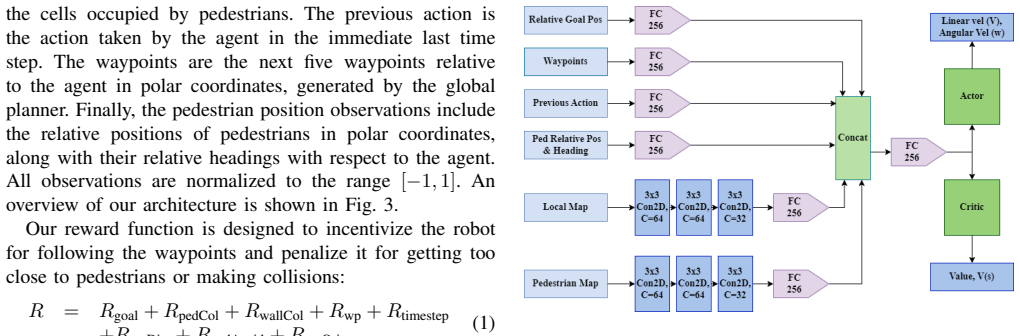
The load-bearing mechanism is the Proactive Path Planner (PPP), which maintains a 2D costmap and inflates each visible pedestrian with a rotated 2D Gaussian $g(p,\theta)=A\exp\left(-\frac{1}{2}\left[(d_p\cos\theta/\sigma_x)^2+(d_p\sin\theta/\sigma_y)^2\right]\right)$, with the Gaussian center shifted two units along the pedestrian's heading and $σ_x>σ_y$ so that more cost lies in front of the person than behind. Replanning through this inflated costmap yields waypoints that steer the robot around anticipated future positions. A SAC-trained local planner, RRL, consumes those waypoints along with an egocentric occupancy map, pedestrian positions, and the previous action, and outputs velocity commands $(v,\omega)$; its reward function couples waypoint-following terms (distance and orientation progress) with pedestrian-avoidance and collision penalties. The two modules communicate by dynamic replanning whenever a pedestrian appears within 50 cm of the current waypoint path, with the robot falling back to the local planner alone when no feasible replanned path exists.
What would settle it
Run the same 50-episode benchmark with real pedestrians, or with a learned pedestrian model trained on real human trajectory data, in the six test layouts; if RRL+PPP does not keep its success-rate edge over RRL+A* under uncooperative behavior, the proactive-planner claim loses its real-world grounding. A cheaper check: disable the heading dependence of the Gaussian inflation (set $\sigma_x=\sigma_y$ and remove the forward shift) and re-measure the uncooperative success rate; if it stays at roughly 65.70%, the proactive mechanism is not what carries the gain.
Extended reading notes
Core claim
The paper claims that a modular hybrid system, which pairs a non-learned Proactive Path Planner (PPP) with a Soft Actor-Critic (SAC) trained reactive local planner (RRL), achieves higher navigation success rates than either approach alone and than several baselines in cluttered indoor scenes. The decisive evidence is in uncooperative-pedestrian settings, where RRL+PPP reaches 65.70% success versus 63.75% for RRL with a static A* global planner, and in mixed scenarios the hybrid has fewer collisions and personal-space violations than the baselines. The global planner's contribution is a heading-oriented Gaussian inflation around each visible pedestrian, which shifts the inflated region forward along the pedestrian's motion and forces the planner to choose paths that avoid likely future positions. The reactive local planner contributes waypoint-following rewards and a pedestrian-avoidance reward that reduce collisions dramatically compared with an RL baseline lacking those rewards (17.30% vs. 44.09% in mixed scenarios). The paper concludes that modular hybrid architectures balance long-horizon planning with real-time responsiveness better than either classical or end-to-end learning systems alone.
Load-bearing premise
The entire evaluation assumes that ORCA-simulated pedestrians, in cooperative and uncooperative modes, behave enough like real indoor humans that success rates here predict real-world performance, but the paper never validates this against actual pedestrian motion data.
Editorial extensions
If this is right
- Combining a proactive global planner with a reactive RL local planner raises success rates over both traditional planners (DWA) and end-to-end RL baselines in cluttered indoor maps, with the biggest margin when pedestrians are uncooperative.
- The heading-oriented Gaussian inflation, rather than symmetric static inflation, is what distinguishes PPP from A* and reduces personal-space violations in uncooperative scenarios.
- Adding waypoint-orientation and pedestrian-avoidance rewards to the RL local planner cuts collisions roughly by half compared with an RL baseline lacking those rewards, even when waypoints are fixed.
- Using the PPP during training (RRL+PPP) yields better test-time performance with the same local planner than training without proactive replanning (RRL'+PPP), suggesting the local policy learns to exploit planner updates.
- The new 2D indoor benchmark with cooperative and uncooperative ORCA pedestrians provides a reusable evaluation protocol for social navigation beyond open-space settings.
Reading between the lines
- If the simulation-fidelity assumption holds even approximately, the same modular design could be ported to real robots by replacing ORCA pedestrian state with a real-time tracker, since the global planner only needs positions and headings of visible people.
- The Gaussian-heading mechanism is a lightweight, interpretable substitute for learned human-motion prediction; it would be natural to test whether replacing it with a learned predictor preserves or improves the uncooperative-scenario gains.
- The uncooperative-pedestrian setting is a stress test for the global planner's foresight: if the advantage over A* persists, it implies that path shape itself, not just local braking, is what prevents collisions with oblivious humans.
- The benchmark could be extended to include heterogeneous pedestrian behaviors (e.g., groups, distracted walkers, or people who react after a delay) to see whether the hybrid retains its edge when the cooperative/uncooperative dichotomy is replaced by a spectrum.
Editorial analysis
A structured set of objections, weighed in public.
Referee Report
Summary. The paper proposes a modular hybrid navigation system for indoor social navigation, combining a classical global planner (PPP) that generates waypoints and inflates pedestrian positions with Gaussian costs, and a SAC-based reactive local planner (RRL) that follows waypoints while avoiding collisions. The authors introduce a 2D benchmark built on iGibson maps with ORCA pedestrian simulation and report experiments comparing RRL+PPP against RRL+A*, RRL alone, an RL baseline, and DWA, under cooperative and uncooperative pedestrian behaviors. The main empirical claim is that RRL+PPP achieves higher success rates than the baselines, especially in uncooperative scenarios, and that ablations demonstrate benefits of both the global and local components.
Significance. If the empirical claims were statistically established, the modular architecture would be a reasonable and potentially useful combination of classical and learned planning, and the released benchmark and code would be a practical contribution. The paper is strongest in its clear system description, explicit reward design, and the decision to release simulator code. However, the central comparison is not yet supported: the headline differences are small, no uncertainty quantification is provided, and one ablation row appears internally inconsistent. The real-world applicability claim also rests entirely on unvalidated simulation.
major comments (3)
- [Sec. VI-D, Table I] The central claim that RRL+PPP outperforms RRL+A* is not statistically established. The evaluation uses 50 episodes per scene over 6 test scenes, so n=300 per planner. The headline uncooperative success rates are 65.70% vs. 63.75%, a difference of 1.95 percentage points. A two-proportion z-test gives a standard error of about 3.9 percentage points, so the difference is roughly 0.5 standard errors (p >> 0.05). The mixed-scenario success rates are essentially identical (78.86% vs. 78.77%). No confidence intervals, standard deviations, or repeated-seed results are reported anywhere. Please report per-seed results, error bars, and significance tests for all pairwise comparisons, or explicitly frame the results as preliminary.
- [Table I, Ablations: Local] The DWA+PPP row is numerically identical to the DWA row in every reported metric (SR 81.65/49.13, TS 229.62, PSV 2.83, CO 23.43, TO 6.17). Since PPP is supposed to replan waypoints during execution, identical results suggest either the global planner was not actually enabled for DWA+PPP or the table contains a copy/paste error. This row directly supports the ablation claim in Sec. VI-E, so it must be corrected and the ablation experiments re-run or clarified.
- [Secs. V and VII] The paper's 'real-world applicability' claim rests entirely on ORCA simulation with iGibson maps. No validation against real pedestrian trajectory data or a real robot deployment is provided, and the authors themselves note in Sec. VII that future work should include 'more diverse and realistic pedestrian behaviors.' Please either soften the conclusion to state applicability within the simulator or add evidence that ORCA-based evaluation transfers to real human motion.
minor comments (6)
- [Sec. VI-D] The text cites 'slightly higher PSV (0.6% vs. 0.9%)' and 'more timeouts (6.67% vs. 4.92%)' for the cooperative comparison, but Table I reports PSV 2.05 vs. 2.45 and TO 4.46 vs. 3.19 for mixed scenarios; these numbers should be reconciled.
- [Secs. II, IV-B, VII] There are several typos and spacing issues: 'hyrbid', 'inlation', 'acively', 'uncertainity', 'orienation', and 'DW A' should be fixed.
- [Sec. IV-B, Eq. (5)] The symbol theta is used both for the pedestrian heading and for the angle between the pedestrian heading and the point p; please use distinct symbols to avoid ambiguity.
- [Sec. VI-B] The description of CO as 'average number of episodes with collisions' is unclear because the values in Table I are percentages; please define the units of SR, TS, PSV, CO, and TO precisely.
- [Sec. VI-D] The sentence 'the system performs consistently better with uncooperative pedestrians' is likely a wording error, since absolute success rates are lower in uncooperative scenarios; presumably the intended meaning is that the relative advantage over baselines is larger.
- [Sec. V] The introduced benchmark would be easier to reuse if the authors specified the exact scene splits, pedestrian count distributions per episode, and how the 3-10 pedestrian range is allocated across scenarios.
Circularity Check
No significant circularity: the paper's performance claims are empirical measurements, not derivations from their own inputs.
full rationale
The paper's central claims (RRL+PPP outperforming baselines in Sec. VI-D and Table I) are empirical outcomes of simulation experiments. The Gaussian soft-cost parameters (A=1, w_x=1, w_y=0.7), reward weights (w1=0.3, w2=0.3), and dense/sparse rewards are design choices; success rates, collisions, and timeouts are measured after training, not algebraically implied by these choices. The benchmark is newly introduced by the authors, but using one's own benchmark is not circular unless the claimed quantity is defined by that benchmark in a way that forces the result; here the baselines are run on the same episodes and the reported advantage is a measurement. The cited prior work [13,25] motivates the architecture but is not used as an authority to forbid alternatives, and there are no load-bearing self-citations. The identical DWA and DWA+PPP rows and the lack of error bars/significance tests are statistical/reporting concerns, not circularity: they do not show that any predicted quantity equals an input by construction. No circular step can be exhibited with a specific equation or definitional reduction, so the appropriate score is 0.
Assumptions & free parameters
free parameters (7)
- Gaussian amplitude A =
1
- Gaussian std dev scaling w_x =
1 m
- Gaussian std dev scaling w_y =
0.7 m
- Waypoint distance reward weight w1 =
0.3
- Waypoint orientation reward weight w2 =
0.3
- Sparse rewards (goal, ped collision, wall collision, waypoint, timestep) =
20, -20, -10, 0.8, -0.001
- Pedestrian avoidance threshold d_thresh =
1 m
assumptions (3)
- domain assumption The robot can precisely localize itself and knows the static 2D layout of the environment.
- domain assumption ORCA simulation, with cooperative or uncooperative settings, adequately models real pedestrian behavior in indoor environments.
- domain assumption A distance of 0.3 m defines both collision and success thresholds for social navigation.
Cite this review
Pith. "Pith review of A Hybrid Approach to Indoor Social Navigation: Integrating Reactive Local Planning and Proactive Global Planning." pith.science (2026). https://pith.science/paper/UC37HJED
@misc{pith2026250602593,
  author       = {Pith},
  title        = {Pith review of: A Hybrid Approach to Indoor Social Navigation: Integrating Reactive Local Planning and Proactive Global Planning},
  year         = {2026},
  howpublished = {\url{https://pith.science/paper/UC37HJED}},
  note         = {Machine review of arXiv:2506.02593}
}
read the original abstract
We consider the problem of indoor building-scale social navigation, where the robot must reach a point goal as quickly as possible without colliding with humans who are freely moving around. Factors such as varying crowd densities, unpredictable human behavior, and the constraints of indoor spaces add significant complexity to the navigation task, necessitating a more advanced approach. We propose a modular navigation framework that leverages the strengths of both classical methods and deep reinforcement learning (DRL). Our approach employs a global planner to generate waypoints, assigning soft costs around anticipated pedestrian locations, encouraging caution around potential future positions of humans. Simultaneously, the local planner, powered by DRL, follows these waypoints while avoiding collisions. The combination of these planners enables the agent to perform complex maneuvers and effectively navigate crowded and constrained environments while improving reliability. Many existing studies on social navigation are conducted in simplistic or open environments, limiting the ability of trained models to perform well in complex, real-world settings. To advance research in this area, we introduce a new 2D benchmark designed to facilitate development and testing of social navigation strategies in indoor environments. We benchmark our method against traditional and RL-based navigation strategies, demonstrating that our approach outperforms both.
Figures


Figures from the paper (1 more)

Reference graph
Works this paper leans on
-
[1]
Human-centered navigation and person-following with omnidirectional robot for indoor assistance and monitoring,
A. Eirale, M. Martini, and M. Chiaberge, “Human-centered navigation and person-following with omnidirectional robot for indoor assistance and monitoring,”Robotics, vol. 11, no. 5, p. 108, 2022
2022
-
[2]
Service robots in the healthcare sector,
J. Holland, L. Kingston, C. McCarthy, E. Armstrong, P. O’Dwyer, F. Merz, and M. McConnell, “Service robots in the healthcare sector,” Robotics, vol. 10, no. 1, p. 47, 2021
2021
-
[3]
Autonomous delivery robots: A literature review,
M. Hossain, “Autonomous delivery robots: A literature review,”IEEE Engineering Management Review, 2023
work page 2023
-
[4]
Decentralized non- communicating multiagent collision avoidance with deep reinforce- ment learning,
Y . F. Chen, M. Liu, M. Everett, and J. P. How, “Decentralized non- communicating multiagent collision avoidance with deep reinforce- ment learning,” in2017 IEEE international conference on robotics and automation (ICRA). IEEE, 2017, pp. 285–292
2017
-
[5]
Socially aware motion planning with deep reinforcement learning,
Y . F. Chen, M. Everett, M. Liu, and J. P. How, “Socially aware motion planning with deep reinforcement learning,” in2017 IEEE/RSJ International Conference on Intelligent Robots and Systems (IROS). IEEE, 2017, pp. 1343–1350
2017
-
[6]
To- wards optimally decentralized multi-robot collision avoidance via deep reinforcement learning,
P. Long, T. Fan, X. Liao, W. Liu, H. Zhang, and J. Pan, “To- wards optimally decentralized multi-robot collision avoidance via deep reinforcement learning,” in2018 IEEE international conference on robotics and automation (ICRA). IEEE, 2018, pp. 6252–6259
2018
-
[7]
M. G. Park, J. H. Jeon, and M. C. Lee, “Obstacle avoidance for mobile robots using artificial potential field approach with simulated anneal- ing,” inISIE 2001. 2001 IEEE International Symposium on Industrial Electronics Proceedings (Cat. No. 01TH8570), vol. 3. IEEE, 2001, pp. 1530–1535
work page 2001
-
[8]
Reciprocal velocity obsta- cles for real-time multi-agent navigation,
J. Van den Berg, M. Lin, and D. Manocha, “Reciprocal velocity obsta- cles for real-time multi-agent navigation,” in2008 IEEE international conference on robotics and automation. Ieee, 2008, pp. 1928–1935
2008
Show all 36 references
-
[9]
Reciprocal collision avoidance with acceleration-velocity obstacles,
J. Van Den Berg, J. Snape, S. J. Guy, and D. Manocha, “Reciprocal collision avoidance with acceleration-velocity obstacles,” in2011 IEEE International Conference on Robotics and Automation. IEEE, 2011, pp. 3475–3482
2011
-
[10]
The dynamic window approach to collision avoidance,
D. Fox, W. Burgard, and S. Thrun, “The dynamic window approach to collision avoidance,”IEEE Robotics & Automation Magazine, vol. 4, no. 1, pp. 23–33, 1997
1997
-
[11]
Timed-elastic-bands for time-optimal point-to-point nonlinear model predictive control,
C. Rösmann, F. Hoffmann, and T. Bertram, “Timed-elastic-bands for time-optimal point-to-point nonlinear model predictive control,” in 2015 european control conference (ECC). IEEE, 2015, pp. 3352– 3357
2015
-
[12]
Exploiting socially-aware tasks for embodied social navigation,
E. Cancelli, T. Campari, L. Serafini, A. X. Chang, and L. Ballan, “Exploiting socially-aware tasks for embodied social navigation,” arXiv preprint arXiv:2212.00767, 2022
2022 arXiv
-
[13]
Robot navigation in constrained pedestrian environments using reinforcement learning,
C. Pérez-D’Arpino, C. Liu, P. Goebel, R. Martín-Martín, and S. Savarese, “Robot navigation in constrained pedestrian environments using reinforcement learning,” in2021 IEEE International Conference on Robotics and Automation (ICRA). IEEE, 2021, pp. 1140–1146
2021
-
[14]
Benchmarking aug- mentation methods for learning robust navigation agents: the winning entry of the 2021 iGibson challenge,
N. Yokoyama, Q. Luo, D. Batra, and S. Ha, “Benchmarking aug- mentation methods for learning robust navigation agents: the winning entry of the 2021 iGibson challenge,” in2022 IEEE/RSJ International Conference on Intelligent Robots and Systems (IROS). IEEE, 2022, pp. 1748–1755
2021
-
[15]
Machine learning methods for local motion planning: A study of end-to-end vs. parameter learning,
Z. Xu, X. Xiao, G. Warnell, A. Nair, and P. Stone, “Machine learning methods for local motion planning: A study of end-to-end vs. parameter learning,” in2021 IEEE International Symposium on Safety, Security, and Rescue Robotics (SSRR). IEEE, 2021, pp. 217– 222
2021
-
[16]
Adaptive social force window planner with reinforce- ment learning,
M. Martini, N. Pérez-Higueras, A. Ostuni, M. Chiaberge, F. Caballero, and L. Merino, “Adaptive social force window planner with reinforce- ment learning,”arXiv preprint arXiv:2404.13678, 2024
2024 arXiv
-
[17]
Dynami- cally feasible deep reinforcement learning policy for robot navigation in dense mobile crowds,
U. Patel, N. Kumar, A. J. Sathyamoorthy, and D. Manocha, “Dynami- cally feasible deep reinforcement learning policy for robot navigation in dense mobile crowds,”arXiv preprint arXiv:2010.14838, 2020
2010 arXiv
-
[18]
Optimal reciprocal collision avoidance for multiple non- holonomic robots,
J. Alonso-Mora, A. Breitenmoser, M. Rufli, P. Beardsley, and R. Sieg- wart, “Optimal reciprocal collision avoidance for multiple non- holonomic robots,” inDistributed autonomous robotic systems: The 10th international symposium. Springer, 2013, pp. 203–216
2013
-
[19]
Interactive gibson benchmark: A benchmark for interactive navigation in cluttered environments,
F. Xia, W. B. Shen, C. Li, P. Kasimbeg, M. E. Tchapmi, A. Toshev, R. Martín-Martín, and S. Savarese, “Interactive gibson benchmark: A benchmark for interactive navigation in cluttered environments,”IEEE Robotics and Automation Letters, vol. 5, no. 2, pp. 713–720, 2020
2020
-
[20]
Real-time obstacle avoidance for fast mobile robots,
J. Borenstein and Y . Koren, “Real-time obstacle avoidance for fast mobile robots,”IEEE Transactions on systems, Man, and Cybernetics, vol. 19, no. 5, pp. 1179–1187, 1989
1989
-
[21]
Probabilistic algorithms and the interactive museum tour-guide robot minerva,
S. Thrun, M. Beetz, M. Bennewitz, W. Burgard, A. B. Cremers, F. Dellaert, D. Fox, D. Haehnel, C. Rosenberg, N. Royet al., “Probabilistic algorithms and the interactive museum tour-guide robot minerva,”The international journal of robotics research, vol. 19, no. 11, pp. 972–999, 2000
2000
-
[22]
The museum tour-guide robot rhino,
W. Burgard, A. B. Cremers, D. Fox, D. Hähnel, G. Lakemeyer, D. Schulz, W. Steiner, and S. Thrun, “The museum tour-guide robot rhino,” inAutonome Mobile Systeme 1998: 14. Fachgespräch Karl- sruhe, 30. November–1. Dezember 1998. Springer, 1999, pp. 245– 254
1998
-
[23]
Real-time obstacle avoidance for fast mobile robots in cluttered environments,
J. Borenstein and Y . Koren, “Real-time obstacle avoidance for fast mobile robots in cluttered environments,” inProceedings., IEEE International Conference on Robotics and Automation. IEEE, 1990, pp. 572–577
1990
-
[24]
The vector field histogram-fast obstacle avoidance for mobile robots,
J. Borenstein, Y . Korenet al., “The vector field histogram-fast obstacle avoidance for mobile robots,”IEEE transactions on robotics and automation, vol. 7, no. 3, pp. 278–288, 1991
1991
-
[25]
Dynamic path planning of a mobile robot adopting a costmap layer approach in ROS2,
P. D. C. Cheng, M. Indri, F. Sibona, M. De Rose, and G. Prato, “Dynamic path planning of a mobile robot adopting a costmap layer approach in ROS2,” in2022 IEEE 27th International Conference on Emerging Technologies and Factory Automation (ETF A). IEEE, 2022, pp. 1–8
2022
-
[26]
Socially compliant mobile robot navigation via inverse reinforcement learning,
H. Kretzschmar, M. Spies, C. Sprunk, and W. Burgard, “Socially compliant mobile robot navigation via inverse reinforcement learning,” The International Journal of Robotics Research, vol. 35, no. 11, pp. 1289–1307, 2016
2016
-
[27]
Socially adaptive path planning in human envi- ronments using inverse reinforcement learning,
B. Kim and J. Pineau, “Socially adaptive path planning in human envi- ronments using inverse reinforcement learning,”International Journal of Social Robotics, vol. 8, pp. 51–66, 2016
2016
-
[28]
Socially compliant navi- gation through raw depth inputs with generative adversarial imitation learning,
L. Tai, J. Zhang, M. Liu, and W. Burgard, “Socially compliant navi- gation through raw depth inputs with generative adversarial imitation learning,” in2018 IEEE international conference on robotics and automation (ICRA). IEEE, 2018, pp. 1111–1117
2018
-
[29]
Deep-learned collision avoidance policy for distributed multiagent navigation,
P. Long, W. Liu, and J. Pan, “Deep-learned collision avoidance policy for distributed multiagent navigation,”IEEE Robotics and Automation Letters, vol. 2, no. 2, pp. 656–663, 2017
2017
-
[30]
Map-based deep imitation learning for obstacle avoidance,
Y . Liu, A. Xu, and Z. Chen, “Map-based deep imitation learning for obstacle avoidance,” in2018 IEEE/RSJ International Conference on Intelligent Robots and Systems (IROS). IEEE, 2018, pp. 8644–8649
2018
-
[31]
Motion planning among dynamic, decision-making agents with deep reinforcement learning. in 2018 ieee,
M. Everett, Y . F. Chen, and P. Jonathan, “Motion planning among dynamic, decision-making agents with deep reinforcement learning. in 2018 ieee,” inRSJ International Conference on Intelligent Robots and Systems (IROS), pp. 3052–3059
2018
-
[32]
Crowd-robot interaction: Crowd-aware robot navigation with attention-based deep reinforce- ment learning,
C. Chen, Y . Liu, S. Kreiss, and A. Alahi, “Crowd-robot interaction: Crowd-aware robot navigation with attention-based deep reinforce- ment learning,” in2019 international conference on robotics and automation (ICRA). IEEE, 2019, pp. 6015–6022
2019
-
[33]
Rethinking social robot navigation: Leveraging the best of two worlds,
A. H. Raj, Z. Hu, H. Karnan, R. Chandra, A. Payandeh, L. Mao, P. Stone, J. Biswas, and X. Xiao, “Rethinking social robot navigation: Leveraging the best of two worlds,” in2024 IEEE International Conference on Robotics and Automation (ICRA). IEEE, 2024
2024
-
[34]
Local path planning: Dynamic window approach with Q-learning considering congestion environments for mobile robot,
M. Kobayashi, H. Zushi, T. Nakamura, and N. Motoi, “Local path planning: Dynamic window approach with Q-learning considering congestion environments for mobile robot,”IEEE Access, vol. 11, pp. 96 733–96 742, 2023
2023
-
[35]
Soft actor-critic: Off- policy maximum entropy deep reinforcement learning with a stochastic actor,
T. Haarnoja, A. Zhou, P. Abbeel, and S. Levine, “Soft actor-critic: Off- policy maximum entropy deep reinforcement learning with a stochastic actor,” inInternational conference on machine learning. PMLR, 2018, pp. 1861–1870
2018
-
[36]
iGibson 1.0: A simulation environment for interactive tasks in large realistic scenes,
B. Shen, F. Xia, C. Li, R. Martín-Martín, L. Fan, G. Wang, C. Pérez- D’Arpino, S. Buch, S. Srivastava, L. Tchapmiet al., “iGibson 1.0: A simulation environment for interactive tasks in large realistic scenes,” in2021 IEEE/RSJ International Conference on Intelligent Robots and ...
2021
Reviewed August 7, 2026 · model on record in the stance chip above.
Discussion (0). Sign in to comment.