REVIEW 3 major objections 6 minor 3 references
HGOT: Self-supervised Heterogeneous Graph Neural Network with Optimal Transport
T0 review · 3 major / 6 minor · reviewed 2026-08-07 · deepseek-v4-flash
Pith's one-line read HGOT forces a graph encoder's embeddings to copy the optimal-transport matching plan between meta-path views and a central view, replacing augmentation and positive/negative sampling with a transport-plan alignment objective, and reports…
desk verdict A plausible OT-based self-supervised method for heterogeneous graphs whose headline accuracy gain is unverifiable because Table 1 is empty in the manuscript, and whose optimal configuration discards the edge term the method narrative emphasizes. read the letter →
The pith
A machine-rendered reading of the paper's core claim, the machinery that carries it, and where it could break.
The reading
What carries the argument
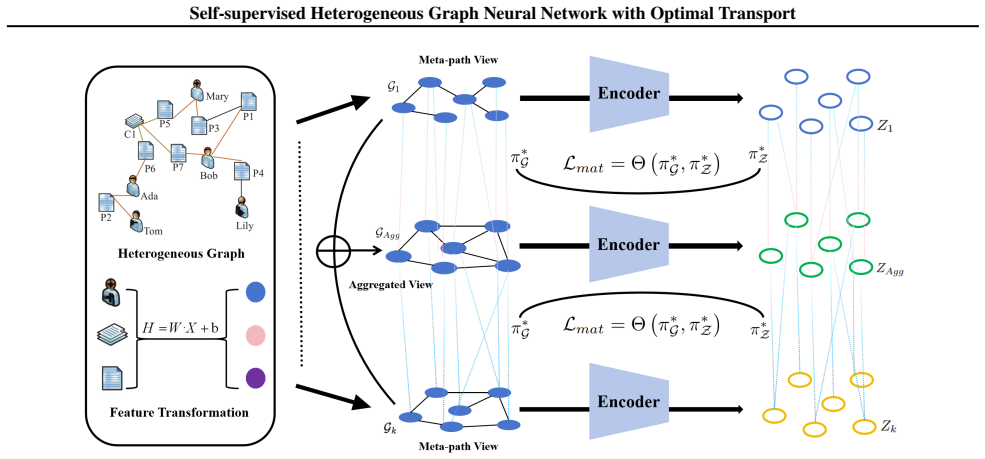
The load-bearing object is the fused optimal transport plan $\pi^*_G$ between a meta-path view and the aggregated view, defined as the minimizer of a fused Gromov-Wasserstein distance that balances a node-feature Wasserstein term and an edge-structure Gromov-Wasserstein term through a trade-off parameter $\sigma$. A second Wasserstein plan $\pi^*_Z$ is computed between the corresponding node embeddings. The actual learning mechanism is the matching loss $\mathcal{L}_{\text{mat}}=\Theta(\pi^*_G,\pi^*_Z)$ and the structure loss $\mathcal{L}_{\text{str}}$ that pushes the representation cost matrix toward the graph-space cost; the total loss is $\mathcal{L}=\mathcal{L}_{\text{mat}}+\rho\mathcal{L}_{\text{str}}$. In plain terms, the optimal transport plan is the teacher signal: it says which nodes should correspond across views, and the encoder is trained to make its embeddings agree with that correspondence.
What would settle it
On the same four datasets, replace the graph-side plan $\pi^*_G$ used in Equation (17) with a randomly permuted version of itself; if node classification accuracy stays at the HGOT level, the specific transport plan is not the source of the reported gain.
Extended reading notes
Core claim
The central claim is that the matching relationship between a heterogeneous graph and its learned representations is itself a usable supervisory signal. For each meta-path view $G_p$ and the aggregated central view $G_{\text{agg}}$, the method computes a fused Gromov-Wasserstein optimal transport plan $\pi^*_G$ that mixes node-feature cost and adjacency-structure cost, and a Wasserstein plan $\pi^*_Z$ between the corresponding node embeddings. The encoder is trained to align $\pi^*_G$ with $\pi^*_Z$ and to correct the representation cost matrix toward the graph-space cost. The authors argue that this alignment makes node representations preserve the matching structure of the original graph, and they report that it beats contrastive and generative self-supervised baselines, most notably an average node-classification accuracy gain of more than 6% over state-of-the-art methods on DBLP, ACM, IMDB, and Yelp.
Load-bearing premise
The method assumes that the optimal-transport matching plan computed from the projected node features and adjacency structure is a trustworthy learning signal, so that forcing the encoder's embeddings to copy that plan genuinely improves them; if the plan is nearly uniform, dominated by the learned projection, or semantically meaningless, the alignment loss cannot help.
Editorial extensions
If this is right
- If the central claim is correct, self-supervised heterogeneous graph learning no longer needs hand-designed augmentation or explicit positive/negative sampling; the transport plan supplies the contrastive signal directly from the graph space.
- Node classification accuracy would improve by an average of more than 6% over previously published methods on the four studied benchmarks, with clustering accuracy improving by roughly 2.5% on DBLP, IMDB, and Yelp.
- The approach is cheaper to run than contrastive baselines: it avoids augmentation and sampling, and the paper reports the lowest training time per epoch among seven self-supervised methods on DBLP with the best Micro-F1 score.
- Because the best performance in the sensitivity study occurs at $\sigma=1$, only the node-feature part of the transport plan is needed for these datasets, so the edge-structure Gromov-Wasserstein term can be dropped to simplify the model without hurting accuracy.
Reading between the lines
- We infer that the dominant learning signal is the node-feature Wasserstein plan, since the paper's $\sigma=1$ result and its ablation showing the aggregated-view module contributes little both point the same way; a clean test would be a Wasserstein-only variant with no Gromov-Wasserstein term at all.
- We infer that the method's success depends on the graph-side plan being informative; if $\pi^*_G$ were nearly uniform or dominated by the learned projection matrices $W_{\phi_i}$, aligning embeddings to it could not help. Computing the entropy of $\pi^*_G$ or replacing it with a random permutation teacher on the same datasets would test this.
- We infer that the same plan-alignment objective could transfer to homogeneous graphs or to unsupervised graph-level and link-prediction tasks, since a graph-space plan can be defined from features and adjacency alone; the paper does not explore these settings.
- We infer that the authors' interpretation of the $\sigma=1$ outcome as license to discard edge information is dataset-specific; on graphs where edges carry most of the signal, the fused term may matter, and the hyperparameter should be tuned per graph rather than fixed.
Editorial analysis
A structured set of objections, weighed in public.
Referee Report
Summary. The paper proposes HGOT, a self-supervised heterogeneous graph neural network that replaces contrastive learning with optimal transport (OT). The method constructs multiple meta-path views and an aggregated central view, computes a fused node-and-edge OT plan between each meta-path view and the aggregated view using Wasserstein and Gromov-Wasserstein distances (Eqs. 8-15), and then aligns this graph-space plan with the OT plan computed between the corresponding node representations (Eqs. 16-18). The claimed contributions are that HGOT avoids graph augmentation and positive/negative sampling while achieving state-of-the-art node classification and clustering performance, with an average accuracy improvement of more than 6% over existing methods.
Significance. If the empirical claims are substantiated, HGOT would be a meaningful contribution: it offers a principled OT-based alternative to contrastive self-supervision for heterogeneous graphs, with a simple objective that does not require augmentation or negative sampling. The underlying OT formulation is standard and the overall framework is coherent. However, the significance is currently not assessable because the paper's central experimental results are missing from the manuscript: the only node-classification table (Table 1) and clustering table (Table 2) are empty captions, and all figures (Figures 2-6) are absent. Moreover, the reported optimal hyperparameter setting (σ=1) deactivates the edge term that is central to the method's stated novelty. The paper also ships no code, no numerical results, and no analysis of the OT plan's informativeness, so the reader cannot verify either the magnitude of the improvements or the mechanism by which the alignment loss improves representations.
major comments (3)
- [Section 5.2, Table 1; Section 5.3, Table 2] The central empirical claims of the paper—the more than 6% average accuracy improvement in node classification and the approximately 2.5% clustering improvement—are unverifiable because Tables 1 and 2 contain only captions with no data. Every figure referenced in the evaluation (Figures 2-6) is also missing from the manuscript. This is a load-bearing omission: the abstract, introduction, and Section 5.2 all rest on numerical results that the reader cannot inspect. The paper cannot be accepted in this form; the authors must provide the full tables, figures, and standard deviations for all datasets and baselines.
- [Section 5.6, Figure 4; Eq. (15)] The sensitivity analysis reports that the model performs best at σ=1, which sets the edge coefficient (1−σ) in Eq. (15) to zero. This means the graph-side fused optimal transport plan π*_G is computed solely from the node-feature Wasserstein term (Eq. 8), discarding the Gromov-Wasserstein edge term (Eq. 11) that the introduction and Section 4.3 emphasize as a distinguishing component. The paper's own results therefore indicate that the edge-aware variant is not the best configuration. This undermines the claim that edge structure is a key part of the proposed alignment, and it raises a substantial concern about the informativeness of the graph-side plan: at σ=1, π*_G is computed from H_p and H_agg, which are outputs of the learned projections and attention aggregation (Eqs. 1-6), so the alignment in Eq. (17) may be a form of self-distillation rather than a structurally grounded graph-to-representation alignment. The authors should report results for the fused plan (σ<1), analyze the OT plan (e.g., its entropy, sparsity, or match to known node correspondences), and justify why the node-only plan is preferred.
- [Section 4.3, Eqs. (15)-(18)] The optimization of the fused objective in Eq. (15) is non-convex due to the Gromov-Wasserstein term, and the paper states that a conditional gradient solver is used with cubic time complexity. However, no runtime or convergence results are reported, and the interaction between the two losses L_mat and L_str in Eq. (19) is not analyzed. More importantly, the paper never assesses whether the computed transport plan π*_G is informative; if the plan is nearly uniform, dominated by the learned projection, or misaligned with semantically meaningful node matching, then enforcing alignment in Eq. (17) cannot improve downstream tasks. The authors should provide a quantitative analysis of the plans on the datasets used, and should discuss the risk of trivial solutions when the graph-side plan is derived from the same feature transformation that produces the representations.
minor comments (6)
- [Section 5.2 / Section 5.3] The text following the Table 1 caption reads "ablation study and parameter sensitivity analysis," which appears to be a leftover fragment from a template; similarly, Table 2 has only a caption with no accompanying content. Please fix the formatting.
- [Section 4.3, Eqs. (8), (15)] The notation H_p and H_agg is ambiguous: it is unclear whether these matrices refer to the projected node features from Eq. (1) or to the aggregated representations from Eqs. (2)-(4). The paper should clearly distinguish these from the backbone representations Z_p and Z_agg used in Eq. (16), since the OT plans depend on which features are used.
- [Section 4.3, Eq. (18)] The structural loss L_str uses the same π*_G that appears in L_mat, which couples the two terms and may lead to a trivial solution where the loss is minimized by making the representation cost equal to the graph cost. The authors should clarify the intended role of this term and whether it is essential.
- [Section 5.7 / Appendix B] Figure numbering is inconsistent: Section 5.7 refers to Figure 5 for time consumption, while Appendix B refers to Figure 5 for dimension analysis and then Figure 6 for the same analysis. Since the figures are absent, the reader cannot determine which result corresponds to which figure.
- [References] Several references are incomplete or malformed (e.g., "C ´edric Villani et al. 2009" lacks a title and venue, and several arXiv entries do not include identifiers). Please ensure all references are complete and formatted consistently.
- [Abstract / Introduction] The claim that HGOT is the first to apply optimal transport to heterogeneous graphs is too strong given the cited reference GALOPA (Wang et al. 2024, "Graph transport learning with optimal plan alignment"), which also uses OT plan alignment and is not included in the baseline comparisons. The authors should either substantiate the novelty claim or temper it.
Circularity Check
No circular dependency found: the OT-plan alignment target is input-derived and label-free, so the downstream accuracy claim is not forced by construction.
full rationale
HGOT's training objective aligns the graph-space fused OT plan (Eq. 15: pi*_G = argmin <sigma F(Hp,Hagg) + (1-sigma) E(Ap,Aagg) (x) pi_G, pi_G>) with the representation-space plan (Eq. 16: pi*_Z = argmin <R(Zp,Zagg), pi_Z>) via Lmat = Theta(pi*_G, pi*_Z) (Eq. 17) and the structure-cost loss Lstr (Eq. 18). The target plan is computed from projected input features and meta-path adjacency matrices, not from downstream labels; node-classification accuracy is measured on held-out labels after self-supervised training. The objective is therefore a self-supervised consistency loss, not a fitted re-statement of the reported accuracy. The plan-alignment idea is attributed to the external GALOPA work, but borrowing an objective from prior work is not circularity. Section 5.6's finding that sigma=1 (node features only, edge term discarded) is optimal weakens the paper's edge-based novelty claim, but it does not make the derivation circular, because the plan target is still input-derived. One verification defect is noted separately: Table 1 in Section 5.2 appears as a caption with no data, so the headline '>6% average improvement' cannot be checked from the manuscript; this is missing evidence, not circularity, and does not raise the circularity score.
Assumptions & free parameters
free parameters (5)
- sigma =
1 (optimal in sensitivity analysis; 0.5 used for rho analysis)
- rho =
1 (optimal in sensitivity analysis)
- hidden dimension =
64 in main experiments; 256/512 suggested as best in Appendix B
- Sinkhorn regularization epsilon =
not reported
- learning rate =
searched from 1e-4 to 5e-3
assumptions (5)
- standard math Optimal transport theory (Wasserstein and Gromov-Wasserstein distances) as formulated in Equations 8-13 is applicable and its solutions are well-defined for the constructed views.
- domain assumption Meta-path views capture meaningful complementary semantics, and the attention-based central view (Equations 4-6) adequately integrates them.
- domain assumption The type-specific linear projection (Equation 1) brings all node types into a common feature space so that cross-node transport costs are semantically meaningful.
- domain assumption The logical OR operation in Equation 7 produces an aggregated adjacency matrix that preserves the structural semantics of all meta-paths.
- ad hoc to paper Aligning the representation-space OT plan to the graph-space OT plan improves downstream representation quality.
Cite this review
Pith. "Pith review of HGOT: Self-supervised Heterogeneous Graph Neural Network with Optimal Transport." pith.science (2026). https://pith.science/paper/MLFFJUND
@misc{pith2026250602619,
  author       = {Pith},
  title        = {Pith review of: HGOT: Self-supervised Heterogeneous Graph Neural Network with Optimal Transport},
  year         = {2026},
  howpublished = {\url{https://pith.science/paper/MLFFJUND}},
  note         = {Machine review of arXiv:2506.02619}
}
read the original abstract
Heterogeneous Graph Neural Networks (HGNNs), have demonstrated excellent capabilities in processing heterogeneous information networks. Self-supervised learning on heterogeneous graphs, especially contrastive self-supervised strategy, shows great potential when there are no labels. However, this approach requires the use of carefully designed graph augmentation strategies and the selection of positive and negative samples. Determining the exact level of similarity between sample pairs is non-trivial.To solve this problem, we propose a novel self-supervised Heterogeneous graph neural network with Optimal Transport (HGOT) method which is designed to facilitate self-supervised learning for heterogeneous graphs without graph augmentation strategies. Different from traditional contrastive self-supervised learning, HGOT employs the optimal transport mechanism to relieve the laborious sampling process of positive and negative samples. Specifically, we design an aggregating view (central view) to integrate the semantic information contained in the views represented by different meta-paths (branch views). Then, we introduce an optimal transport plan to identify the transport relationship between the semantics contained in the branch view and the central view. This allows the optimal transport plan between graphs to align with the representations, forcing the encoder to learn node representations that are more similar to the graph space and of higher quality. Extensive experiments on four real-world datasets demonstrate that our proposed HGOT model can achieve state-of-the-art performance on various downstream tasks. In particular, in the node classification task, HGOT achieves an average of more than 6% improvement in accuracy compared with state-of-the-art methods.
Figures


Figures from the paper (1 more)

Reference graph
Works this paper leans on
-
[3]
Optimal transport for structured data with application on graphs
Flamary. Optimal transport for structured data with application on graphs. InICML. C´edric Vincent-Cuaz, R ´emi Flamary, Marco Corneli, Titouan. 2022. Vayer, and Nicolas Courty. Semi- relaxed gromov-wasserstein divergence and applications on graphs. InICLR. Hongteng Xu, Dixin Luo, and Lawrence Carin. 2019. Scal- able gromov-wasserstein learning for graph ...
arXiv 2016
-
[338]
Nicolas Bonneel, Michiel Van De Panne, Sylvain Paris, and Wolfgang Heidrich
Springer, 2009. Nicolas Bonneel, Michiel Van De Panne, Sylvain Paris, and Wolfgang Heidrich. Displacement interpolation using lagrangian mass transport. InProceedings of the 2011 SIGGRAPH Asia Conference, pages 1–12, 2011. Jiezhang Cao, Langyuan Mo, Yifan Zhang, Kui Jia, Chun- hua Shen.2019. and Mingkui Tan. Multi-marginal wasser- stein gan. InNeurIPS. Xi...
work page 2009
-
[2019]
Symmetric graph convolutional autoencoder for unsupervised graph representation learning. InICCV. Wang Z, Li Q, Yu D, et al. 2023. Heterogeneous graph contrastive multi-view learning. In SDM. Tian Y , Dong K, Zhang C, et al. 2023. Heterogeneous graph masked autoencoders. InAAAI. C´edric Villani et al.Optimal transport: old and new, volume
work page 2023
Reviewed August 7, 2026 · model on record in the stance chip above.
Discussion (0). Sign in to comment.