REVIEW 4 major objections 4 minor 19 references
Spatially Correlated multi-RIS Communication: The Effect of Inter-Operator Interference
T0 review · 4 major / 4 minor · reviewed 2026-08-07 · deepseek-v4-flash
Pith's one-line read This paper establishes closed-form bounds and an asymptotic law for spectral efficiency in multi-operator RIS systems with uncontrolled inter-operator interference, showing the interference vanishes and SNR grows only linearly with array…
desk verdict The finite-array analysis and simulation study are worth a look, but the headline asymptotic claim (linear SNR scaling, IOI vanishing) is contradicted by the paper's own moment formulas and needs fixing before the results are used. read the letter →
The pith
A machine-rendered reading of the paper's core claim, the machinery that carries it, and where it could break.
The reading
What carries the argument
The argument rests on two distributional approximations. The desired combined channel $X = |\mathbf{h}_0^T\mathbf{g}_0|e^{j\theta}$ is approximated by a Gamma distribution with shape $\alpha = E[X]^2/\mathrm{Var}[X]$ and scale $\beta = \mathrm{Var}[X]/E[X]$; the interference term $Y$ is approximated as zero-mean circularly symmetric complex Gaussian with variance $\sigma^2 = \sum_i M_i/4$ via the Lyapunov central limit theorem. These feed a conditional noncentral chi-square model for $|X+Y|^2$, yielding an outage integral, Jensen-based spectral-efficiency bounds, and a Meijer-G expression for the lower bound.
What would settle it
Run a Monte Carlo simulation of the exact model with a small array such as $M_0=4$ and high spatial correlation $\rho=0.9$, comparing the empirical distribution of $X$ with the Gamma fit of Eqs. (9)-(10) using a Kolmogorov-Smirnov test; a clear mismatch would show the bounds in (14) and (16) do not follow from the true channel statistics.
Extended reading notes
Core claim
The main discovery is that the large-array behavior of the system is governed by the second moment of the coherently combined reference channel, $E[X^2] = M_0(1-\bar{\theta}^2) + \mathrm{Tr}[\mathbf{R}_h\mathbf{R}_g]\bar{\theta}^2$, so the received SNR tends to $\gamma \to p[M_0(1-\bar{\theta}^2) + \mathrm{Tr}[\mathbf{R}_h\mathbf{R}_g]\bar{\theta}^2]$. Inter-operator interference disappears in this limit because the uncontrolled phases average out, and the SNR scales linearly with $M_0$ rather than quadratically, the quadratic scaling being impossible when random inter-operator phases are present. Spatial correlation enters only through the trace term, which explains why correlation has a small effect, particularly under near-line-of-sight propagation.
Load-bearing premise
All closed-form results rest on treating the coherently combined desired channel as a Gamma random variable with only its mean and variance matched, an approximation the paper does not prove; if the true distribution differs materially, the claimed tight bounds are not guaranteed.
Editorial extensions
If this is right
- In the large-array regime, inter-operator interference vanishes and the received SNR grows linearly with the number of RIS elements, not quadratically as in classical single-operator RIS systems without such interference.
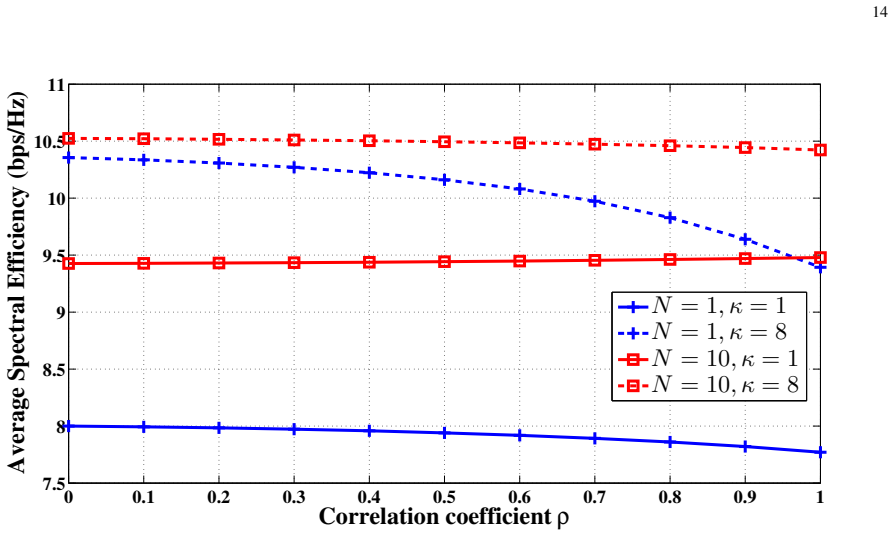
- Spatial correlation at the RIS has only a minor effect on spectral efficiency, and the gap between correlated and independent fading becomes marginal when propagation approaches line-of-sight conditions.
- Increasing the number of distinct uncontrolled interference sources can improve the reference user's spectral efficiency, because the extra sources enrich the scattered environment and add degrees of freedom.
- The derived bounds are valid for correlated Nakagami-m fading and for asynchronous inter-operator interference with random on-off timing; for the opposite timing case the presented results serve as lower bounds.
- Imperfect channel estimation, captured by the phase-mismatch concentration parameter $\kappa$, degrades performance, but the bounds remain tight in the large-array regime even under notable CSI errors.
Reading between the lines
- If the Gamma approximation for $X$ is replaced by the exact distribution, the same Jensen-based bounding technique would still apply and would likely tighten the lower and upper bounds for small arrays; the paper's numerical tests suggest this direction but do not prove it.
- The linear SNR scaling may be a general ceiling for any RIS-assisted link perturbed by uncontrolled phase changes, not only those caused by other operators; testing with a single RIS whose own phase noise is random would separate the multi-operator effect from a pure phase-noise limit.
- A direct extension would be to replace the moment-matched Gamma with a numerically evaluated characteristic function to obtain exact outage and spectral-efficiency curves; the paper's asymptotic claim would remain unchanged, but the small-array bounds could be made rigorous.
- The beneficial effect of many interference sources suggests a possible design principle: intentionally randomizing phases at secondary RISs could add beneficial scattering for nearby users, though the paper does not optimize such a scheme.
Editorial analysis
A structured set of objections, weighed in public.
Referee Report
Summary. The paper studies a point-to-point link assisted by a reference RIS in the presence of N independently operated RISs, which create inter-operator interference (IOI). The desired cascade is modeled over spatially correlated Nakagami-m fading with coherent phase alignment and a von-Mises phase error, while the interfering cascades are modeled via a CLT as zero-mean complex Gaussian. The desired channel amplitude is approximated by a Gamma distribution matched to its first two moments. Closed-form approximations are derived for the outage CDF, for lower and upper bounds on spectral efficiency, and for an asymptotic large-array expression. Monte Carlo simulations are used to validate the analytical curves. The advertised conclusions are that IOI vanishes as RIS arrays grow and that the SNR scales linearly with the number of elements.
Significance. If the moment-based analysis were rigorous, the finite-array part would be a useful extension of the authors' previous work to correlated Nakagami-m channels and asynchronous, multiple IOI sources. The derivations of the first two moments of the desired channel are explicit, no parameters are fitted to simulations, and the closed-form bounds are numerically supported in Figs. 3-6. The central weakness is that the asymptotic section contains an internal inconsistency that invalidates two headline claims, and all closed-form results are proven for a Gamma approximation rather than for the true channel distribution. These issues are load-bearing because the paper's stated engineering insights depend on them.
major comments (4)
- [Section III, Eq. (20)] Eq. (20) contradicts the paper's own moment formulas. For perfect CSI (theta_bar=1), Eq. (6) gives E[X^2]=Tr[R_h R_g]. Using Eq. (7) with the stated Nakagami model, the diagonal entries of R_u are 1 (E[u_i^2]=1) and the off-diagonal entries are E[u_i]E[u_j]=E[u]^2>0, so in the independent case Tr[R_h R_g]=M0+M0(M0-1)E[h]^2 E[g]^2=O(M0^2). Eq. (5) gives E[X]=M0 E[h] E[g], so for large M0 the desired term grows quadratically, and the inequality gamma->pTr<pM0 in Eq. (20) is false. If, alternatively, one takes R_h=R_g=I so that Tr=M0, then E[X^2]=M0 is incompatible with the nonzero mean in Eq. (5) because Var[X] would become negative for large M0. Thus the asymptotic expression, and the linear-scaling/IOI-vanishing interpretation attached to it, is not supported by the model.
- [Section III, asymptotic paragraph above Eq. (20)] The step 'Y->E[Y]=0' is not valid. Eq. (11) states that Y is approximately CN(0, sum_i M_i/2); as M_i grows, the variance of Y grows, so a zero-mean random variable does not converge to zero in distribution. At best one could argue that Y is negligible relative to a desired term that grows faster, but Eq. (20) explicitly claims only linear growth of the desired term, so the inference that IOI vanishes is unsupported. The variance of Y is instead incorporated correctly in the finite-array expressions (14) and (19), and those parts should be retained if the asymptotic claims are reworked.
- [Section III, Eqs. (9)-(10) and (13)-(19)] All closed-form results (outage CDF, bounds, and the Meijer G expression) are derived for the Gamma distribution obtained by matching only E[X] and E[X^2]. No analytical argument is given that this moment-matched Gamma approximates the true distribution of X to sufficient accuracy, nor that the resulting 'bounds' are actual bounds for the true spectral efficiency. The Monte Carlo agreement in Figs. 3-6 supports practical usefulness, but for the advertised claim of tight lower and upper bounds, an error bound or an alternative justification is needed, especially in the small-array (M0=4) and strong-correlation regimes.
- [Section III, Eqs. (5)-(6)] The definition of X as |h0^T g0| e^{j theta} (a single global phase error) is not consistent with the derivation of E[X^2] in Eq. (6), which expands sums of cos(phi_i) and sin(phi_i) as though there were independent per-element phase errors. With a single global phase, E[X^2] = E[(h0^T g0)^2] E[e^{2j theta}], which depends on E[e^{2j theta}], not on theta_bar^2 as in Eq. (6). The notation should be aligned before the moment expressions can be regarded as self-consistent.
minor comments (4)
- [Section IV, Fig. 3] The curve labeled Casy in the figure is never defined in the text; either define it as the asymptotic expression following Eq. (20) or relabel it.
- [Section III, Eq. (13)] The substitution 'e^{-x/beta} <- x' is unclear; write t=e^{-x/beta} (or x=beta ln(1/t)) explicitly.
- [Section III, Eq. (18)] The symbol Gamma(.) is overloaded (Gamma function versus exponential integral or incomplete Gamma); define the intended special function at first use.
- [Section II, channel model] The phrase 'unit scale' should be stated as Omega=1 with E[u_i^2]=1, since Eq. (7) relies on this normalization.
Circularity Check
No circularity found: the finite-array bounds are derived from stated Nakagami-m and interference assumptions without fitted parameters; the Eq. (20) asymptote has an algebraic/correctness defect, not a circular reduction.
full rationale
The derivation chain is self-contained. The desired RIS gain X has its first two moments computed directly from the Nakagami-m and correlation assumptions in Eqs. (5)-(6); the Gamma approximation in Eq. (9) is a moment-matched statistical model with parameters given in Eq. (10), not a parameter fit to the simulations. The interference term Y is modeled through a zero-mean, variance-Mi/2 component and a Lyapunov CLT approximation in Eq. (11), which is again an external probabilistic input. Equations (13)-(19) then propagate these approximations into an outage CDF and closed-form spectral-efficiency bounds; no predicted quantity is an input relabeled and no curve is fitted to the Monte-Carlo results. The self-citations to the authors' prior work [9] concern the IOI terminology and the qualitative remark that linear scaling was 'also observed' in [8], [9]; neither is load-bearing because the derivations in this paper do not rely on an unverified theorem imported from [9]. The more serious concern is correctness, not circularity: Eq. (20) claims 'gamma -> p[M0(1-theta_bar^2)+Tr[R_h R_g]theta_bar^2] < pM0', but under the paper's own moment formulas the off-diagonal entries of R_h and R_g are positive for independent Nakagami-m entries, making Tr[R_h R_g] > M0 for large M0 and contradicting the '< pM0' step. That internal inconsistency is a mathematical defect in the asymptotic claim, not a reduction of a prediction to its own inputs, so it does not raise the circularity score.
Assumptions & free parameters
assumptions (6)
- ad hoc to paper The desired RIS channel X can be approximated by a Gamma distribution with shape and scale matched to its first two moments.
- domain assumption Per-element channel envelopes follow Nakagami-m with spatial correlation matrix entries given by (2) and (7).
- domain assumption The phase of each interfering RIS contribution is uniformly distributed over [-pi, pi), so E[Y_i]=0 and Var[Y_i]=M_i/2.
- standard math The Lyapunov central limit theorem applies to the sum of independent interference terms, yielding a complex Gaussian approximation for finite M_i.
- domain assumption The direct transmitter-to-receiver link is negligible.
- domain assumption Interference durations q_i are independent and uniformly distributed in [0,1], so E[q_i]=1/2.
Cite this review
Pith. "Pith review of Spatially Correlated multi-RIS Communication: The Effect of Inter-Operator Interference." pith.science (2026). https://pith.science/paper/SGLSB5T2
@misc{pith2026250602666,
  author       = {Pith},
  title        = {Pith review of: Spatially Correlated multi-RIS Communication: The Effect of Inter-Operator Interference},
  year         = {2026},
  howpublished = {\url{https://pith.science/paper/SGLSB5T2}},
  note         = {Machine review of arXiv:2506.02666}
}
abstract
A multi-operator wireless communication system is studied where each operator is equipped with a reconfigurable intelligent surface (RIS) to enhance its communication quality. RISs controlled by different operators affect the system performance of one another due to the inherently rapid phase shift adjustments that occur on an independent basis. The system performance of such a communication scenario is analytically studied for the practical case where spatial correlation occurs at RIS of arbitrary size. The proposed framework is quite general since it is analyzed under Nakagami-$m$ channel fading conditions. Finally, the derived analytical results are verified via numerical and simulation trials as well as some new and useful engineering outcomes are revealed.
Figures


Figures from the paper (4 more)


Reference graph
Works this paper leans on
-
[1]
H. Zhou, M. Erol-Kantarci, Y . Liu, and H. V . Poor, “A survey on model-based, heuristic, and machine learning optimization approaches in RIS-aided wireless networks,” IEEE Commun. Surveys Tuts. , vol. 26, no. 2, pp. 781–823, 2024
work page 2024
-
[2]
X. Mu, J. Xu, Z. Wang, and N. Al-Dhahir, “Simultaneously transmitting and reflecting surfaces for ubiquitous next generation multiple access in 6G and beyond,” Proc. IEEE, vol. 112, no. 9, pp. 1346–1371, Sep. 2024
work page 2024
-
[3]
Spatially correlated RIS-aided secure massive MIMO under CSI and hardware imperfections,
D. Yang, J. Xu, W. Xu, B. Sheng, X. You, C. Yuen, and M. D. Renzo, “Spatially correlated RIS-aided secure massive MIMO under CSI and hardware imperfections,” IEEE Trans. Wireless Commun. , vol. 23, no. 9, pp. 11 461–11 475, Sep. 2024
work page 2024
-
[4]
IRS-assisted multicell multiband systems: Practical reflection model and joint beamforming design,
W. Cai, R. Liu, M. Li, Y . Liu, Q. Wu, and Q. Liu, “IRS-assisted multicell multiband systems: Practical reflection model and joint beamforming design,” IEEE Trans. Commun. , vol. 70, no. 6, pp. 3897–3911, Jun. 2022
work page 2022
-
[5]
Gambling on reconfigurable intelligent surfaces,
S. Schwarz, “Gambling on reconfigurable intelligent surfaces,” IEEE Commun. Lett. , vol. 28, no. 4, pp. 957–961, Apr. 2024
work page 2024
-
[6]
D. G ¨urg¨uno˘glu, E. Bj ¨ornson, and G. Fodor, “Combating inter-operator pilot contamination in reconfigurable intelligent surfaces assisted multi-operator networks,” IEEE Trans. Commun. , vol. 72, no. 9, pp. 5884–5895, Sep. 2024
work page 2024
-
[7]
On the impact of an IRS on the out-of-band performance in sub-6 Ghz & mmWave frequencies,
L. Yashvanth and C. R. Murthy, “On the impact of an IRS on the out-of-band performance in sub-6 Ghz & mmWave frequencies,” IEEE Trans. Commun. , vol. 72, no. 12, pp. 7417–7434, Dec. 2024
work page 2024
-
[8]
Distributed IRSs always benefit every mobile operator,
——, “Distributed IRSs always benefit every mobile operator,” IEEE Wireless Commun. Lett. , vol. 13, no. 11, pp. 2975– 2979, Nov. 2024
work page 2024
Show all 19 references
-
[9]
Impact of inter-operator interference via reconfigurable intelligent surfaces,
N. I. Miridakis, T. A. Tsiftsis, P. A. Karkazis, H. C. Leligou, and P. Popovski, “Impact of inter-operator interference via reconfigurable intelligent surfaces,” IEEE Wireless Commun. Lett. , vol. 13, no. 9, pp. 2536–2540, Sep. 2024
2024
-
[10]
I. S. Gradshteyn and I. M. Ryzhik, Table of Integrals, Series, and Products . Academic Press, 2007
2007
-
[11]
Rayleigh fading modeling and channel hardening for reconfigurable intelligent surfaces,
E. Bj ¨ornson and L. Sanguinetti, “Rayleigh fading modeling and channel hardening for reconfigurable intelligent surfaces,” IEEE Wireless Commun. Lett. , vol. 10, no. 4, pp. 830–834, Apr. 2021
2021
-
[12]
Performance analysis of RIS-assisted full-duplex communication over correlated Nakagami-m fading channel,
T. Wang, G. Chen, and J. P. Coon, “Performance analysis of RIS-assisted full-duplex communication over correlated Nakagami-m fading channel,” IEEE Trans. V eh. Technol., vol. 73, no. 3, pp. 3430–3444, Mar. 2024
2024
-
[13]
Intelligent reflecting surface enhanced wireless network via joint active and passive beamforming,
Q. Wu and R. Zhang, “Intelligent reflecting surface enhanced wireless network via joint active and passive beamforming,” IEEE Trans. Wireless Commun. , vol. 18, no. 11, pp. 5394–5409, Nov. 2019
2019
-
[14]
Communication through a large reflecting surface with phase errors,
M.-A. Badiu and J. P. Coon, “Communication through a large reflecting surface with phase errors,” IEEE Wireless Commun. Lett., vol. 9, no. 2, pp. 184–188, Feb. 2020
2020
-
[15]
Zero forcing uplink detection through large-scale RIS: System performance and phase shift design,
N. I. Miridakis, T. A. Tsiftsis, and R. Yao, “Zero forcing uplink detection through large-scale RIS: System performance and phase shift design,” IEEE Trans. Commun. , vol. 71, no. 1, pp. 569–579, Jan. 2023. 16
2023
-
[16]
Expectations of a noncentral chi-square distribution with application to IID MIMO gaussian fading,
S. M. Moser, “Expectations of a noncentral chi-square distribution with application to IID MIMO gaussian fading,” in IEEE Int. Symposium Inf. Theory and Applications , Dec. 2008, pp. 1–6
2008
-
[17]
A. P. Prudnikov, Y . A. Brychkov, and O. Marichev, Integrals and Series, vol 3: more special functions . Gordon and Breach science publishers, 1986
1986
-
[18]
Couillet and M
R. Couillet and M. Debbah, Random Matrix Methods for Wireless Communications . Cambridge University Press, 2011
2011
-
[19]
Exact coverage analysis of intelligent reflecting surfaces with Nakagami- m channels,
H. Ibrahim, H. Tabassum, and U. T. Nguyen, “Exact coverage analysis of intelligent reflecting surfaces with Nakagami- m channels,” IEEE Trans. V eh. Technol., vol. 70, no. 1, pp. 1072–1076, Jan. 2021
2021
Reviewed August 7, 2026 · model on record in the stance chip above.
Discussion (0). Sign in to comment.