REVIEW 5 major objections 5 minor 12 references
Solving the Pod Repositioning Problem with Deep Reinforced Adaptive Large Neighborhood Search
T0 review · 5 major / 5 minor · reviewed 2026-08-07 · deepseek-v4-flash
Pith's one-line read A learned controller for a large-neighborhood search heuristic gives lower pod-storage costs than existing warehouse methods and transfers across instance sizes without retraining.
desk verdict Solid adaptation of DR-ALNS to pod repositioning, but the headline numbers rest on single runs and the abstract overclaims against BIP. read the letter →
The pith
A machine-rendered reading of the paper's core claim, the machinery that carries it, and where it could break.
The reading
What carries the argument
The central object is a Markov decision process wrapped around each ALNS iteration. The state is a nine-component vector containing normalized temperature, previous cost change, gap to the best solution found, normalized destroy-operator weights, normalized repair-operator weights, current cost ratio, best cost, cost gap, and progress through the search budget. The action is a single integer decoded into a triple: choose one destroy operator, one repair operator, and a degree of destruction. The domain-specific operators carry the search: Random and High-Cost destruction, and Tetris-inspired, lowest-cost, random, and ABC-priority repair (pods split into A, B, C usage-frequency classes), with feasibility checked by the functions RecallPlaces, IsPlaceFeasible, and FeasibleLocations. The transition applies simulated-annealing acceptance and updates operator weights, and a shaped reward combines cost improvement, new-best bonuses, fluctuation penalties, infeasibility and rejection penalties, and an exploration bonus. This machinery replaces static weight-based roulette with context-dependent decisions, so the search can switch operators and intensity as the annealer cools.
What would settle it
Run DR_ALNS and plain ALNS on the same medium instance for ten random seeds and compare the cost distributions; if DR_ALNS's costs overlap ALNS's 65.24% rather than centering near 59.9%, the reported gain is a single-trajectory result rather than a stable learned-control effect. Also log the policy's chosen actions on the medium instance and check whether they differ from what ALNS weight-based roulette would choose; if the action distributions match, any improvement would come from the new destroy and repair heuristics, not from the learned controller.
Extended reading notes
Core claim
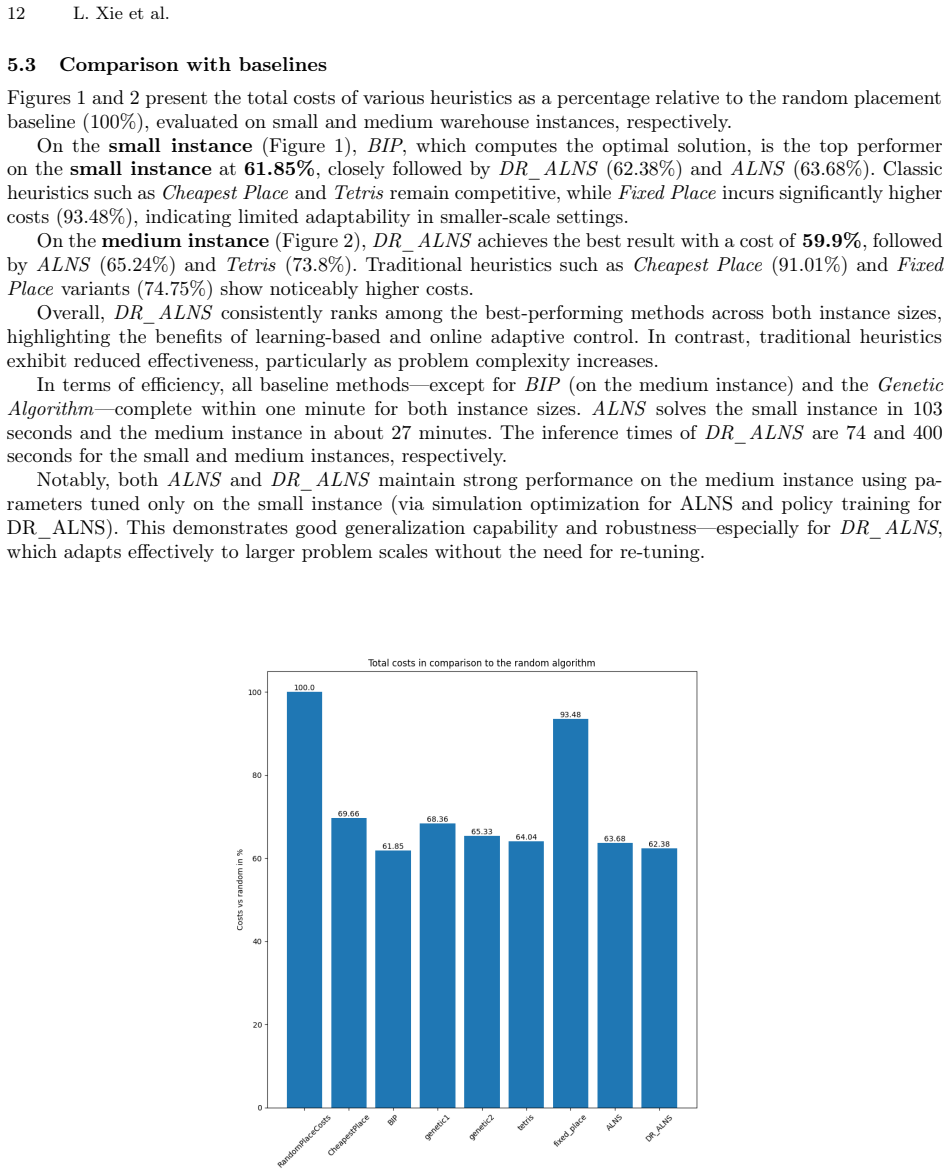
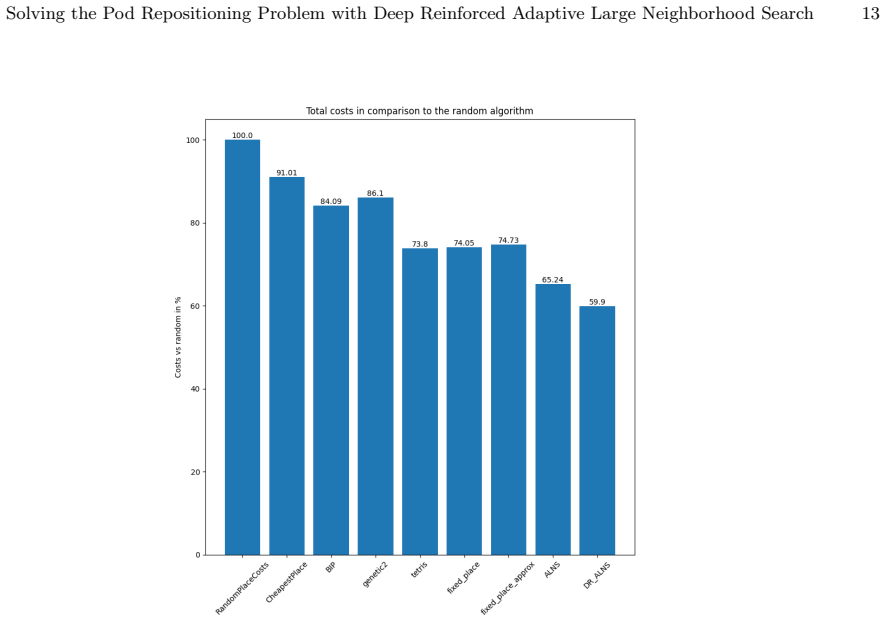
On the paper's own terms, the discovery is that learning-driven control of adaptive large neighborhood search finds lower-cost pod-to-location plans on both benchmark instances than the deterministic heuristics proposed in the prior formulation of the problem. The reported costs, stated as percentages of a random-placement baseline, are 59.9% on the medium instance (ahead of plain ALNS at 65.24% and the Tetris heuristic at 73.8%) and 62.38% on the small instance (between exact binary integer programming at 61.85% and plain ALNS at 63.68%). The authors further claim that the policy used to select operators was trained exclusively on the 10-location, 1,000-step small instance and applied to the 504-location, 20,000-step medium instance without re-training. The distinct contribution is treating each ALNS iteration as a Markov decision step so that the search's operator choices and destruction intensity adapt to the current temperature, cost gap, and remaining budget, rather than following fixed weight-based roulette selection.
Load-bearing premise
The policy was trained only on the small instance, and the transfer claim assumes that after normalization the medium instance's search states look enough like the small instance's that the same operator choices remain good; the paper reports a single medium run and gives no distributional check of that similarity.
Editorial extensions
If this is right
- On the medium instance, the reported 59.9% relative cost is below plain ALNS (65.24%) and Tetris (73.8%), so learned operator selection would be the best tested method at larger scale.
- A policy trained on 10 pods and 1,000 time steps would transfer to 441 pods and 20,000 time steps, implying that control policies for search operators can be learned in small, cheap experiments and deployed in larger warehouses.
- Inference on the medium instance took 400 seconds, versus about 27 minutes for ALNS, so the learned controller would not add runtime burden.
- On the small instance DR_ALNS is about half a percentage point behind the exact solver, so it could serve as a near-optimal alternative where exact solving is impractical.
Reading between the lines
- The paper leaves implicit that the same policy could carry across warehouse layouts, not just instance sizes, because the state vector does not encode geometry or pod-frequency distributions; this can be tested by training on one layout and evaluating on another.
- Only one medium-instance run is reported, so a natural next experiment is to rerun with multiple random seeds and report the spread; the 59.9% figure would be much more load-bearing as a median over seeds.
- The reward function actively penalizes fluctuating cost trajectories, so a side effect of the method may be smoother search behavior, which matters if DR_ALNS is embedded in a real-time warehouse control loop where jumpy costs are operationally undesirable.
Editorial analysis
A structured set of objections, weighed in public.
Referee Report
Summary. The paper adapts the DR-ALNS framework (ALNS controlled by a PPO-based deep reinforcement learning agent) to the deterministic Pod Repositioning Problem in robotic mobile fulfillment systems. It defines an MDP in which the agent chooses destroy operators, repair operators, and the degree of destruction, and it introduces several PRP-specific destroy/repair heuristics. The authors evaluate the method on the small and medium benchmark instances of Krenzler et al., reporting cost ratios relative to random placement, and claim that DR-ALNS outperforms BIP, Tetris, and other baselines, and that a policy trained on the small instance generalizes to the medium instance without retraining.
Significance. If the reported advantages are real, the paper would make a useful contribution by showing that learned operator selection can improve ALNS for a deterministic warehouse-storage problem, and the domain-specific heuristics are a reasonable adaptation. The comparison against an exact BIP baseline is a positive feature that gives an independent reference point. However, the central quantitative claims currently rest on single unseeded runs of stochastic algorithms and on hyperparameter selection performed on the same instance used for the final comparison. These issues are load-bearing: the paper's headline result, the medium-instance advantage of DR_ALNS over ALNS, cannot be distinguished from run-to-run noise on the evidence presented.
major comments (5)
- [Section 5.3, Figures 1 and 2] The reported costs are single values with no repeated runs, standard deviations, confidence intervals, or seed information. The algorithms are explicitly stochastic: DestroyRandom picks a uniform random interval (Algorithm 2), RepairRandom assigns uniformly at random (Algorithm 7), the SA acceptance rule uses rand() (Section 3.5), and the PPO policy samples actions during inference (Section 4.1). The medium-instance gap of 59.9% vs. 65.24% could easily be due to variance. The authors should run multiple independent trials with different random seeds, report dispersion, and ideally provide a statistical test or at least a clear statement of run-to-run spread before claiming superiority or generalization.
- [Section 5.2 and Figure 1] The ALNS hyperparameters were selected by testing 50 random combinations on the small instance, and then the same small instance is used for the final comparison in Figure 1. This is a form of selection on the evaluation set, which optimistically biases the ALNS small-instance result and undermines the 'fair comparison' claim. A clean evaluation would tune on a separate validation instance (or use nested cross-validation) and then report performance on a held-out test instance.
- [Abstract and Section 5.3] The abstract states that DRL-guided ALNS outperforms binary integer programming, but the paper's own Figure 1 text reports BIP at 61.85% and DR_ALNS at 62.38% on the small instance. Thus DR_ALNS does not outperform BIP on that instance. The claim should be qualified as 'comparable or better on some instances' or corrected to reflect the actual data.
- [Section 5.3 and Section 6] The generalization claim that the policy 'successfully generalized to larger instances without re-training' rests on one medium instance and one inference run. There is no comparison of state-feature distributions between training and inference, no variation of instance parameters, and no repeated medium-instance runs. At minimum, the authors should report multiple medium-instance runs and ideally test on more than one larger instance before drawing a transferability conclusion.
- [Algorithm 4, line 7] The Tetris-inspired repair assigns the pod in Phase 1 to the 'highest-cost location in Pi', which appears to contradict the stated intent of placing the most problematic iterations first in cost-effective locations. If this is a typo (and 'lowest-cost' was intended), the pseudocode must be corrected; if it is literal, the behavior should be explained and justified. As written, the algorithm is ambiguous and affects reproducibility of the reported results.
minor comments (5)
- [Section 5.3] The efficiency statement says 'all baseline methods—except for BIP (on the medium instance) and the Genetic Algorithm—complete within one minute for both instance sizes,' but the next sentence reports that ALNS solves the small instance in 103 seconds. This is internally inconsistent; clarify which methods count as baselines and which runtimes are meant.
- [Section 3.2] The quantity N in the destroy heuristics is not defined precisely; it is called 'total number of iterations' but the paper also uses ALNS iterations and time steps. Define N as the number of time steps in the planning horizon (or the number of pod-assignment decisions) to avoid ambiguity.
- [Algorithm 5] The ABC repair heuristic refers to 'second-best' and 'third-best' locations without defining the ranking criterion or tie-breaking rule. This should be specified for reproducibility.
- [Abstract and Keywords] There are several typographical issues, including 'neightborhood' in the keywords, 'illustrating' in the abstract, and inconsistent capitalization of 'Tetris' versus 'tetris-like'. These should be cleaned up.
- [Figures 1 and 2] The figures contain only a caption in the text; the numerical values are reported in prose rather than in a table. A table with all reported costs, and ideally the number of runs and standard deviations, would improve readability and verifiability.
Circularity Check
No significant circularity: the DR-ALNS comparison rests on independent optimization baselines and a held-out medium instance; the only self-citation supplies problem definition and benchmarks, not the result.
full rationale
The paper's derivation chain is experimental rather than analytic: it defines PRP, adapts ALNS/DR-ALNS, and compares against exact/heuristic baselines. The reported costs are computed from the model, not defined as the method's inputs. BIP is an exact optimization on the small instance and provides an independent reference; the medium-instance result is obtained after training/tuning only on the small instance, so the main transfer claim is not forced by construction. The self-citation to Krenzler, Xie and Li (arXiv:1810.05514) supplies the deterministic PRP formulation and the benchmark instances, but that is a legitimate reuse of a previously published, externally specified testbed rather than a load-bearing premise that assumes the conclusion. Statistical weaknesses (single stochastic runs, no confidence intervals, and the abstract's overstatement regarding BIP) are correctness/reporting concerns, not circularity. No equation or fitted parameter is renamed as a prediction, so the circularity score is 0.
Assumptions & free parameters
free parameters (2)
- Best ALNS configuration (Tstart, Tstop, MLength, DecreaseFactor) =
(12.5, 0.1, 30, 0.95)
- Reward shaping coefficients =
+1.0 new-best, -0.5 fluctuation, -0.2 repair-failure, -0.1 rejection, +0.1 exploration, -1.0 no-removal penalty
assumptions (3)
- domain assumption The PRP is deterministic and uses passive repositioning only
- domain assumption Travel costs are Manhattan distances between storage locations and stations
- domain assumption The small-instance dynamics are representative enough for policy transfer to the medium instance
Cite this review
Pith. "Pith review of Solving the Pod Repositioning Problem with Deep Reinforced Adaptive Large Neighborhood Search." pith.science (2026). https://pith.science/paper/TJ6HKYXL
@misc{pith2026250602746,
  author       = {Pith},
  title        = {Pith review of: Solving the Pod Repositioning Problem with Deep Reinforced Adaptive Large Neighborhood Search},
  year         = {2026},
  howpublished = {\url{https://pith.science/paper/TJ6HKYXL}},
  note         = {Machine review of arXiv:2506.02746}
}
read the original abstract
The Pod Repositioning Problem (PRP) in Robotic Mobile Fulfillment Systems (RMFS) involves selecting optimal storage locations for pods returning from pick stations. This work presents an improved solution method that integrates Adaptive Large Neighborhood Search (ALNS) with Deep Reinforcement Learning (DRL). A DRL agent dynamically selects destroy and repair operators and adjusts key parameters such as destruction degree and acceptance thresholds during the search. Specialized heuristics for both operators are designed to reflect PRP-specific characteristics, including pod usage frequency and movement costs. Computational results show that this DRL-guided ALNS outperforms traditional approaches such as cheapest-place, fixed-place, binary integer programming, and static heuristics. The method demonstrates strong solution quality and illustrating the benefit of learning-driven control within combinatorial optimization for warehouse systems.
Figures
Reference graph
Works this paper leans on
-
[1]
Computers & Industrial Engineering156, 107221 (2021)
Cals, B., Zhang, Y., Dijkman, R., van Dorst, C.: Solving the online batching problem using deep reinforcement learning. Computers & Industrial Engineering156, 107221 (2021). https://doi.org/10.1016/j.cie.2021.107221
-
[2]
Deterministic Pod Repositioning Problem in Robotic Mobile Fulfillment Systems
Krenzler, R., Xie, L., Li, H.: Deterministic pod repositioning problem in robotic mobile fulfillment systems. arXiv preprint arXiv:1810.05514 (2018), https://arxiv.org/abs/1810.05514
work page Pith review arXiv 2018
-
[3]
In: Proceedings of the International Conference on Automated Planning and Scheduling (ICAPS)
Luttmann, L., Xie, L.: Neural combinatorial optimization on heterogeneous graphs: An application to the picker routing problem in mixed-shelves warehouses. In: Proceedings of the International Conference on Automated Planning and Scheduling (ICAPS). vol. 34, pp. 351–359 (2024). https://doi.org/10.1609/icaps.v34i1.31494
-
[4]
Luttmann, L., Xie, L.: Learning to solve the min-max mixed-shelves picker-routing problem via hierarchical and parallel decoding (2025), https://arxiv.org/abs/2502.10233 14 L. Xie et al
work page Pith review arXiv 2025
-
[5]
Transportation Research Part E: Logistics and Transportation Review 111, 1–16 (2018)
Merschformann, M., Boysen, N., Briskorn, D.: Active repositioning of storage units in robotic mobile ful- fillment systems. Transportation Research Part E: Logistics and Transportation Review 111, 1–16 (2018). https://doi.org/10.1016/j.tre.2018.03.011
-
[6]
Artificial Intelligence319 (2024)
Reijnen, R., Zhang, Y., Lau, H.C., Bukhsh, Z.: Online control of adaptive large neighborhood search using deep reinforcement learning. Artificial Intelligence319 (2024)
work page 2024
-
[7]
European Journal of Operational Research 291(1), 123–134 (2021)
Rimélé, J., Courtois, A., Risso, J.: E-commerce warehousing: Learning a storage policy. European Journal of Operational Research 291(1), 123–134 (2021). https://doi.org/10.1016/j.ejor.2020.08.038
-
[8]
Transportation Science40(4), 455–472 (2006)
Ropke, S., Pisinger, D.: An adaptive large neighborhood search heuristic for the pickup and delivery problem with time windows. Transportation Science40(4), 455–472 (2006). https://doi.org/10.1287/trsc.1050.0135
arXiv 2006
Show all 12 references
-
[9]
To appear in European Journal of Operational Research (2025)
Teck, K., Li, Y., Lin, Z.: Deep reinforcement learning for the real-time inventory rack storage assignment and replenishment problem. To appear in European Journal of Operational Research (2025)
2025
-
[10]
Transportation Science 52(5), 1479–1495 (2018)
Weidinger, F., Boysen, N., Briskorn, D.: Storage assignment with rack-moving mobile robots in kiva warehouses. Transportation Science 52(5), 1479–1495 (2018). https://doi.org/10.1287/trsc.2017.0766
2018
-
[11]
Pro- duction and Operations Management28(2), 354–373 (2019)
Yuan, R., Graves, S.C., Cezik, T.: Velocity-based storage assignment in semi-automated storage systems. Pro- duction and Operations Management28(2), 354–373 (2019). https://doi.org/10.1111/poms.12937
2019 doi
-
[12]
Transportation Research Part E: Logistics and Transportation Review167, 102920 (2022)
Zhuang, Y., Zhou, Y., Hassini, E., Yuan, Y., Hu, X.: Rack retrieval and repositioning optimization problem in robotic mobile fulfillment systems. Transportation Research Part E: Logistics and Transportation Review167, 102920 (2022). https://doi.org/10.1016/j.tre.2022.102920
2022
Reviewed August 7, 2026 · model on record in the stance chip above.
Discussion (0). Sign in to comment.