REVIEW 5 major objections 5 minor 15 references
Farm-LightSeek: An Edge-centric Multimodal Agricultural IoT Data Analytics Framework with Lightweight LLMs
T0 review · 5 major / 5 minor · reviewed 2026-08-07 · deepseek-v4-flash
Pith's one-line read Farm-LightSeek claims that a three-stage knowledge-distillation pipeline shrinks a 7-billion-parameter agricultural multimodal model to about 1 billion parameters while losing only 2.9 points of GPT-4-scored dialogue quality and 3.4…
desk verdict Plausible benchmark numbers for a distilled 1B agricultural MLLM, but the edge-deployment claim is asserted, not measured. read the letter →
The pith
A machine-rendered reading of the paper's core claim, the machinery that carries it, and where it could break.
The reading
What carries the argument
The load-bearing mechanism is the three-stage knowledge-distillation pipeline. In distillation pre-training (DPT), the student's projector is trained to match the teacher's visual-textual outputs by minimizing KL divergence and maximizing cosine similarity between visual feature autocorrelation matrices. In supervised fine-tuning (SFT), the projector and the small language model are jointly trained on high-quality agricultural dialogue data. In distilled fine-tuning (DFT), the same alignment objectives are reapplied to transfer complex reasoning and visual representation abilities from teacher to student. The student architecture is LLaVA-style: a CLIP-ViT visual encoder, a Qwen2.5-0.5B language model, and a projection layer that maps image patches into language-model tokens.
What would settle it
Run the distilled ~1B model on an NVIDIA Jetson NANO 4GB and Qualcomm QCS610 with a 336×336 agricultural image and record per-query latency and peak memory; if latency exceeds the real-time detection window or memory exceeds device capacity, the central claim fails. A complementary field test comparing closed-set accuracy on in-field images against the 85.9% benchmark would test the generalization premise.
Extended reading notes
Core claim
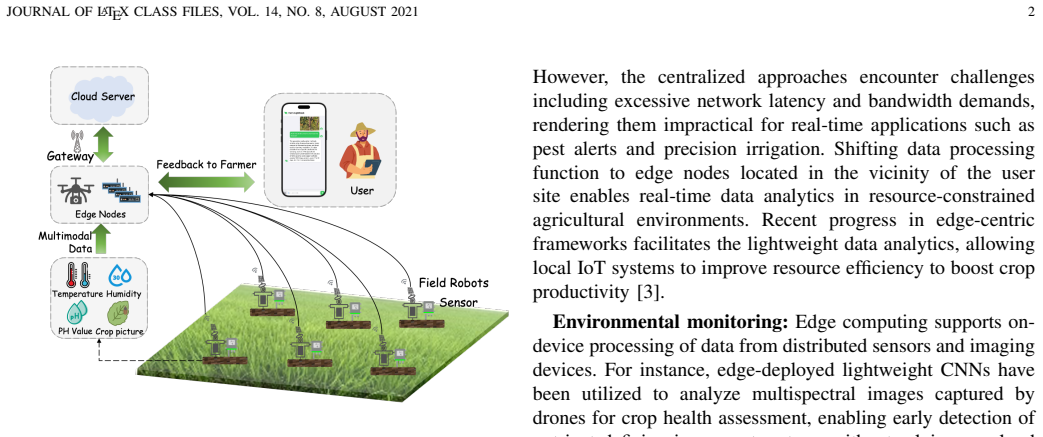
The paper proposes Farm-LightSeek as a perception-decision-action closed loop in which sensors collect images, weather, and location data, an edge-deployed MLLM performs disease detection and generates management recommendations, and cloud servers update the model during idle periods. Its technical heart is the claim that three stages of knowledge distillation—distillation pre-training, supervised fine-tuning, and distilled fine-tuning—transfer the visual-language alignment and reasoning of a 7B teacher model into a roughly 1B student built on the LLaVA architecture with a Qwen2.5-0.5B language model. The reported numbers on agricultural benchmarks support near-parity with the proprietary 7B Agri-LLaVA: a chatbot score of 51.5 versus 54.4, closed-set VQA accuracy of 85.9% versus 89.3%, and open-set F1 of 28.7 versus 30.8. The framework's edge orientation is the point: by keeping inference local, it avoids cloud latency and privacy costs while retaining enough accuracy for pest classification and anomaly feedback.
Load-bearing premise
The whole edge-deployment promise rests on the unmeasured assumption that the ~1B model fits within the latency and memory budgets of the named edge devices and that scores on laboratory and public datasets reflect real farmland conditions.
Editorial extensions
If this is right
- A ~1B multimodal agricultural model can close most of the performance gap with a 7B model, so edge deployment of agricultural MLLMs is no longer blocked by model size alone.
- Pest and disease diagnosis plus management recommendations can run on local edge nodes, removing the need to send farmland images to the cloud for every query.
- The framework's cloud collaboration is reserved for model updates during idle communication periods, which lowers bandwidth demands compared with cloud-centric analytics.
- Because the student retains closed-set accuracy near 86%, closed-set pest classification is reliable enough for practical edge use, while open-set symptom description remains the weaker spot.
- If deployed as described, the same perception-decision-action loop could be extended to irrigation, fertilization, and anomaly alerts, turning edge nodes into farm-level decision hubs.
Reading between the lines
- The paper does not report measured latency or memory usage on the named edge hardware; the actual frame rate and power draw of the ~1B model on a Jetson NANO 4GB remain an open question that would decide practical deployment.
- The dataset concession in Section V-D implies that benchmark scores may overstate field performance; a field trial with uncontrolled lighting, occlusion, and novel pest species would be the natural next test.
- The same three-stage distillation recipe could transfer to other specialized MLLMs such as crop nutrition or soil analysis, but the open-set F1 gap of about 7% suggests rare-class generalization will need extra data augmentation or self-supervised learning rather than distillation alone.
Editorial analysis
A structured set of objections, weighed in public.
Referee Report
Summary. The paper proposes Farm-LightSeek, an edge-centric multimodal agricultural IoT analytics framework built around a lightweight multimodal large language model (MLLM). The model is obtained by replacing LLaVA's language model with Qwen2.5-0.5B and applying a three-stage knowledge distillation pipeline (DPT, SFT, DFT) to transfer capabilities from a larger teacher MLLM. The framework is described as closing a perception-decision-action loop at edge nodes, with cloud collaboration for model updates. Experiments on two agricultural datasets from the Agri-LLaVA paper report a GPT-4 score of 51.5 (vs. Agri-LLaVA's 54.4), a closed-set VQA accuracy of 85.9% (vs. 89.3%), and an open-set F1 of 28.7 (vs. 30.8). The paper claims a parameter reduction to approximately 1B and asserts real-time edge deployment, supported primarily by an illustrative mobile application screenshot.
Significance. If the benchmark results are taken at face value, the work demonstrates that a small MLLM can approach the performance of a much larger agricultural VQA model on the evaluated benchmarks, which is a useful data point for edge-oriented agricultural AI. The use of external benchmarks from Agri-LLaVA with held-out categories for generalization is a positive design, as it reduces circularity. However, the central claim of edge-centric deployment is not measured: the paper contains no latency, throughput, memory, or energy measurements on the named edge hardware, and the three KD stages are not ablated. The paper's significance is therefore conditional on additional measurements and ablations, and the manuscript currently overstates the strength of the evidence relative to its claims.
major comments (5)
- [Section IV-B, Fig. 3] The central claim that Farm-LightSeek is edge-deployable is not supported by measurements. Section IV-B states the framework 'is expected to achieve real-time detection' and Fig. 3 shows a screenshot, but the paper reports no latency, throughput, memory footprint, or power consumption on the named edge devices (NVIDIA Jetson NANO 4GB, Qualcomm QCS610) mentioned in Section III. Without such measurements, the title's 'edge-centric' claim and the conclusion's 'fast real-time response on edge nodes' are unsupported. I request deployment metrics on the identified hardware, including model size in MB and inference time per query.
- [Section III-B, Tables II and III] The three-stage distillation (DPT, SFT, DFT) is presented as the key methodological contribution, but no ablation isolates the contribution of each stage. Tables II and III report only the final model. I request an ablation that trains the student without each stage (or with stages in different orders) to show that all three stages are necessary and to quantify their individual contributions.
- [Table III, Section IV-A] The open-set F1 comparison is not verifiable without a scoring rubric. The paper does not state how free-form symptom explanations are matched to reference answers, whether exact or semantic matching is used, what prompt is used to elicit open-set responses, or how the F1 is computed (token-level, entity-level, etc.). Since the open-set F1 (28.7) is close to Agri-LLaVA's (30.8), the comparison's validity depends on the answer extraction and scoring procedure. I request a precise description of the open-set evaluation protocol, including the matching algorithm and any thresholds.
- [Table III, Section III-B] The reported parameter scale 'approximately 1B' is not quantified. The student uses Qwen2.5-0.5B as the language model, but the total parameter count of the full MLLM, including the CLIP-ViT visual encoder and projection layer, is not given. This matters because the claimed ability to run on a 4GB device (Jetson NANO) depends on the total memory footprint, not the LLM alone. I request the exact total parameter count and peak memory consumption during inference.
- [Section IV-A, Section V-D] The paper's own limitations section, Section V-D, states that most training data originate from public platforms and laboratory environments, providing inadequate representation of real-world farmland conditions. This is a load-bearing concession: it undercuts the claim of applicability to 'real agricultural scenarios' in the abstract and conclusion. While the held-out categories in the benchmarks are a positive feature, they do not address distributional shift from lab to field. I request either field evaluation or a clear separation between benchmark performance and field deployment claims.
minor comments (5)
- [Section III-A] The paper states that a 336×336 pixel image is split into 16×16 patches and encoded into 576 tokens; 16×16 patches would produce 256 tokens, not 576. Please correct the patch arithmetic (e.g., 24×24 patches of size 14×14 for CLIP ViT).
- [Table III] The model name 'Qwn-VL-Chat' appears to be a typo for 'Qwen-VL-Chat'.
- [Section I] The contribution list claims 'the first article' for the edge-centric LLM-based agricultural IoT framework; please either provide a more comprehensive related-work comparison or soften the claim to avoid unfalsifiability.
- [References] Reference [10] lists 'Proceedings of the International Conference on Machine Learning (ICLR)'; the conference name and acronym do not match. Please verify and correct.
- [Fig. 3] Figure 3 is described as a test sample but lacks captions or annotations identifying what anomaly is detected and what the edge node computes locally; adding these details would strengthen the deployment illustration.
Circularity Check
No significant circularity: the reported scores are measurements on the external Agri-LLaVA benchmarks [15] with held-out categories, the paper contains no fitted constants or equations, and its reference list has no self-citations; the only residual concern is that training and benchmark data share the same source.
full rationale
Farm-LightSeek's empirical claims are evaluated on benchmarks taken from the Agri-LLaVA paper [15], which is authored by a disjoint author set, with held-out pest/disease categories excluded from training (Section IV-A: '25 categories ... are excluded from the training set'). The paper contains no equations, no fitted constants, and no parameter estimated on the test set; the reported GPT-4 score, closed-set accuracy (85.9%), and open-set F1 (28.7) are run results on externally constructed benchmarks, so no 'prediction' reduces to an input by construction. No self-citations appear anywhere in the reference list; [13], [14], and [15] are external works used as architectural inspiration and benchmark source, not as load-bearing justification. The central comparison (51.5 vs 54.4 GPT-4 score; 85.9 vs 89.3 accuracy) is against an external baseline: the paper never states Agri-LLaVA was the distillation teacher, and defines the teacher only as the Section III-A large MLLM. Section V-D does concede that 'most data originate from public platforms and laboratory environments' and that 'dependence on GPT-4 for data generation may introduce synthetic biases,' and GPT-4 is also used as the dialogue scorer in Chatbot-Bench; this is a real evaluation-design and generalization limitation inherited from the borrowed benchmark, but it is an external benchmark property, not a reduction of this paper's own derivation to its inputs. The edge real-time claim is explicitly tentative ('our framework is expected to achieve real-time detection') with no latency or memory measurements, which is a missing-evidence problem rather than a circular one. Under the proportionality rule, the slight same-source training/benchmark overlap justifies only a minimal score.
Assumptions & free parameters
assumptions (3)
- domain assumption The teacher model's outputs provide a sufficient supervision signal for agricultural multimodal reasoning.
- domain assumption The Agri-LLaVA benchmark datasets and GPT-4 scoring reflect real-world agricultural decision quality.
- domain assumption Standard LLaVA architecture with Qwen2.5-0.5B is a valid base for edge agricultural inference.
Cite this review
Pith. "Pith review of Farm-LightSeek: An Edge-centric Multimodal Agricultural IoT Data Analytics Framework with Lightweight LLMs." pith.science (2026). https://pith.science/paper/XF66XMG2
@misc{pith2026250603168,
  author       = {Pith},
  title        = {Pith review of: Farm-LightSeek: An Edge-centric Multimodal Agricultural IoT Data Analytics Framework with Lightweight LLMs},
  year         = {2026},
  howpublished = {\url{https://pith.science/paper/XF66XMG2}},
  note         = {Machine review of arXiv:2506.03168}
}
read the original abstract
Amid the challenges posed by global population growth and climate change, traditional agricultural Internet of Things (IoT) systems is currently undergoing a significant digital transformation to facilitate efficient big data processing. While smart agriculture utilizes artificial intelligence (AI) technologies to enable precise control, it still encounters significant challenges, including excessive reliance on agricultural expert knowledge, difficulties in fusing multimodal data, poor adaptability to dynamic environments, and bottlenecks in real-time decision-making at the edge. Large language models (LLMs), with their exceptional capabilities in knowledge acquisition and semantic understanding, provide a promising solution to address these challenges. To this end, we propose Farm-LightSeek, an edge-centric multimodal agricultural IoT data analytics framework that integrates LLMs with edge computing. This framework collects real-time farmland multi-source data (images, weather, geographic information) via sensors, performs cross-modal reasoning and disease detection at edge nodes, conducts low-latency management decisions, and enables cloud collaboration for model updates. The main innovations of Farm-LightSeek include: (1) an agricultural "perception-decision-action" closed-loop architecture; (2) cross-modal adaptive monitoring; and (3)a lightweight LLM deployment strategy balancing performance and efficiency. Experiments conducted on two real-world datasets demonstrate that Farm-LightSeek consistently achieves reliable performance in mission-critical tasks, even under the limitations of edge computing resources. This work advances intelligent real-time agricultural solutions and highlights the potential for deeper integration of agricultural IoT with LLMs.
Figures


Reference graph
Works this paper leans on
-
[1]
A survey on LoRa for smart agriculture: Current trends and future perspectives,
A. Pagano, D. Croce, I. Tinnirello, and G. Vitale, “A survey on LoRa for smart agriculture: Current trends and future perspectives,” IEEE Internet of Things Journal , vol. 10, no. 4, pp. 3664–3679, 2023
work page 2023
-
[2]
D. Muhammed, E. Ahvar, S. Ahvar, M. Trocan, M.-J. Montpetit, and R. Ehsani, “Artificial intelligence of things (AIoT) for smart agriculture: A review of architectures, technologies and solutions,” Journal of Network and Computer Applications , vol. 228, p. 103905, 2024
work page 2024
-
[3]
Edge intelligence: Empowering intelligence to the edge of network,
D. Xu, T. Li, Y . Li, X. Su, S. Tarkoma, T. Jiang, J. Crowcroft, and P. Hui, “Edge intelligence: Empowering intelligence to the edge of network,” Proceedings of the IEEE , vol. 109, no. 11, pp. 1778–1837, 2021
work page 2021
-
[4]
H. Liu, C. Li, Q. Wu, and Y . J. Lee, “Visual instruction tuning,” in Proceedings of the Advances in Neural Information Processing Systems (NeurIPS), vol. 36, pp. 34892–34916, 2023
work page 2023
-
[5]
Uni-MoE: Scaling unified multimodal LLMs with Mixture of Experts,
Y . Li, S. Jiang, B. Hu, L. Wang, W. Zhong, W. Luo, L. Ma, and M. Zhang, “Uni-MoE: Scaling unified multimodal LLMs with Mixture of Experts,” IEEE Transactions on Pattern Analysis and Machine Intelligence, pp. 1–15, 2025
work page 2025
-
[6]
V . Vivanco Cepeda, G. K. Nayak, and M. Shah, “Geoclip: Clip-inspired alignment between locations and images for effective worldwide geo- localization,” in Proceedings of the Advances in Neural Information Processing Systems (NeurIPS) , vol. 36, pp. 8690–8701, 2023
work page 2023
-
[7]
Feature normalized knowledge distillation for image classification,
K. Xu, L. Rui, Y . Li, and L. Gu, “Feature normalized knowledge distillation for image classification,” in Proceedings of the European Conference on Computer Vision (ECCV) , pp. 664–680, 2020
work page 2020
-
[8]
Densely guided knowl- edge distillation using multiple teacher assistants,
W. Son, J. Na, J. Choi, and W. Hwang, “Densely guided knowl- edge distillation using multiple teacher assistants,” in Proceedings of the IEEE/CVF International Conference on Computer Vision (ICCV) , pp. 9395–9404, 2021
work page 2021
Show all 15 references
-
[9]
MiniLLM: Knowledge dis- tillation of large language models,
Y . Gu, L. Dong, F. Wei, and M. Huang, “MiniLLM: Knowledge dis- tillation of large language models,” in Proceedings of the International Conference on Learning Representations (ICLR) , 2024
2024
-
[10]
DistiLLM: Towards streamlined distillation for large language models,
J. Ko, S. Kim, T. Chen, and S.-Y . Yun, “DistiLLM: Towards streamlined distillation for large language models,” in Proceedings of the Interna- tional Conference on Machine Learning (ICLR) , pp. 24872 – 24895, 2024
2024
-
[11]
Beyond Answers: Transferring Reasoning Capabilities to Smaller LLMs Using Multi-Teacher Knowledge Distillation,
Y . Tian, Y . Han, X. Chen, W. Wang, and N. V . Chawla, “Beyond Answers: Transferring Reasoning Capabilities to Smaller LLMs Using Multi-Teacher Knowledge Distillation,” in International Conference on Web Search and Data Mining (WSDM) , 2024
2024
-
[12]
LLaV A-MoD: Making LLaV A tiny via MoE knowledge distillation,
F. Shu, Y . Liao, L. Zhuo, C. Xu, L. Zhang, G. Zhang, H. Shi, L. Chen, T. Zhong, W. He, S. Fu, H. Li, B. Li, Z. Yu, S. Liu, H. Li, and H. Jiang, “LLaV A-MoD: Making LLaV A tiny via MoE knowledge distillation,” in Proceedings of the International Conference on Learning Represen...
2025
-
[13]
LLaV A-KD: A framework of distilling multimodal large language models,
Y . Cai, J. Zhang, H. He, X. He, A. Tong, Z. Gan, C. Wang, and X. Bai, “LLaV A-KD: A framework of distilling multimodal large language models,” arXiv preprint arXiv:2410.16236 , 2024
2024 arXiv
-
[14]
TinyLLaV A: A framework of small-scale large multimodal models,
B. Zhou, Y . Hu, X. Weng, J. Jia, J. Luo, X. Liu, J. Wu, and L. Huang, “TinyLLaV A: A framework of small-scale large multimodal models,” arXiv preprint arXiv:2402.14289 , 2024
2024 arXiv
-
[15]
Agri- LLaV A: Knowledge-infused large multimodal assistant on agricultural pests and diseases,
L. Wang, T. Jin, J. Yang, A. Leonardis, F. Wang, and F. Zheng, “Agri- LLaV A: Knowledge-infused large multimodal assistant on agricultural pests and diseases,” arXiv preprint arXiv:2412.02158 , 2024
2024 arXiv
Reviewed August 7, 2026 · model on record in the stance chip above.
Discussion (0). Sign in to comment.