REVIEW 5 major objections 4 minor 31 references
EdgeVidSum: Real-Time Personalized Video Summarization at the Edge
T0 review · 5 major / 4 minor · reviewed 2026-08-07 · deepseek-v4-flash
Pith's one-line read EdgeVidSum claims that thumbnail-container analysis lets a resource-limited edge device generate personalized fast-forward summaries of 90-minute videos in seconds, with all preference data staying on-device.
desk verdict A plausible demo whose central claims are unmeasured and whose headline numbers don't add up; not ready for research peer review. read the letter →
The pith
A machine-rendered reading of the paper's core claim, the machinery that carries it, and where it could break.
The reading
What carries the argument
The load-bearing object is the thumbnail container: a 160x90 pixel, roughly 4 KB image sampled at intervals throughout a video (6,734 containers per 112-minute football video versus about 202,036 frames), with intelligent selection algorithms claimed to preserve semantic integrity. This object shrinks the input to the neural network by orders of magnitude, making on-device inference feasible. The second mechanism is hierarchical temporal narrowing: the client first scores coarse thumbnails for preferred classes, then re-examines thumbnail containers inside candidate intervals at finer granularity until it can emit precise timestamps. The third is the Triplet Attention Module, three parallel branches that pool along height, width, and channel dimensions and reweight the feature maps; the authors credit it with a 4.2% accuracy gain over channel-only attention for 0.3M extra parameters.
What would settle it
Take a video with a known user-preferred event that is shorter than the thumbnail sampling interval or visible only at full resolution, run EdgeVidSum's thumbnail pipeline on a Jetson Nano, and check whether the generated summary includes the event; a miss would show that the semantic-integrity assumption fails at the claimed sampling density.
Extended reading notes
Core claim
EdgeVidSum's central claim is that thumbnail containers can replace full-frame analysis as the substrate for personalized video summarization without sacrificing semantic relevance. A classifier built on an EfficientNetV2-S backbone followed by a Triplet Attention Module predicts user-preferred content categories from 160x90 thumbnails; a hierarchical timestamp-generation step then refines coarse detections into segment-level boundaries; a client-side player plays preferred segments at normal speed and accelerates the rest. The authors state that this pipeline produces fast-forward summaries of 90-minute videos in 2 to 5 seconds on a Jetson Nano, processes 97.8% less data than frame-by-frame approaches, and keeps all preference inference local.
Load-bearing premise
The load-bearing premise is that a sparse set of 160x90 thumbnails, sampled about once per second, preserves every semantically relevant moment; the paper asserts this via thumbnail selection algorithms that maintain semantic integrity but does not test it.
Editorial extensions
If this is right
- On a Jetson Nano-class device, personalized summaries of 90-minute videos can be generated in 2 to 5 seconds, making interactive on-device summarization feasible.
- User preferences and viewing history stay local, since thumbnail classification and timestamp generation run on the edge; only thumbnails and requested video segments cross the network.
- The 97.8% reduction in processed data means bandwidth and memory requirements drop by roughly two orders of magnitude relative to frame-by-frame analysis.
- Hierarchical narrowing lets the system convert coarse preferred-content detections into precise playback timestamps, so the final video is a continuous fast-forward rather than a discontinuous keyframe montage.
- Variable-speed playback preserves narrative continuity, addressing the fragmentation problem of keyframe and keyshot summaries.
Reading between the lines
- The thumbnail-container trick is general: any frame-based video-understanding task that can be posed as image classification could inherit the same speedup, at the price of the same sampling-resolution ceiling.
- The reported 2-5 second processing time likely assumes thumbnails are already generated and stored on the video service provider; end-to-end latency would also include thumbnail transfer and segment requests, so the real-time claim concerns computation, not network round-trips.
- If sampling is roughly one thumbnail per second, events shorter than that interval are invisible; an adaptive sampling rate tied to motion or audio salience would test and likely improve the semantic-preservation assumption.
- The personalization ceiling is the classifier's label set; moving from categorical preferences to free-form natural-language queries would need a larger model and would likely exceed the Jetson Nano's budget.
Editorial analysis
A structured set of objections, weighed in public.
Referee Report
Summary. This manuscript proposes EdgeVidSum, a client-driven personalized fast-forward video summarization framework for edge devices. The system assumes that a video service provider supplies pre-generated 160x90 thumbnail containers; a lightweight EfficientNetV2 backbone with a Triplet Attention Module classifies thumbnails according to user preferences, and timestamps are generated by narrowing temporal periods at increasing granularity. The authors report real-time operation on a Jetson Nano, 2-5 second processing for 90-minute videos, a 97.8% reduction in data processing volume, a 98.2% memory reduction, and a 4.2% accuracy improvement from the attention module. The evaluation consists of an interactive demo; no datasets, baselines, benchmarks, ablations, or reproducibility details are provided.
Significance. If substantiated, the system would be practically relevant for on-device, privacy-preserving personalized video summarization, and the use of thumbnail containers is a sensible way to cut computational cost. The manuscript also references a broad related-work landscape and builds on established components, namely EfficientNetV2 and the Triplet Attention Module. However, the central claims are not currently supportable: the semantic-relevance assertion is never measured, the headline efficiency numbers are internally inconsistent, the only accuracy number lacks any experimental protocol, and the core sampling assumption is untested. The contribution is thus best described as a system sketch with a demo, and the quantitative claims cannot be verified from the paper.
major comments (5)
- [Abstract and Section 4] The claim that thumbnail containers reduce computational complexity 'without sacrificing semantic relevance' is never evaluated. Section 4 reports only an interactive demo and states processing times of 2 to 5 seconds for 90-minute videos without describing the measurement procedure, hardware conditions, error bars, or content complexity metric. No comparison is made to standard summarization benchmarks such as SumMe or TVSum, or to fast-forward baselines such as FFNet and SpeedNet, so the paper's main promise remains unverified.
- [Sections 3.1 and 3.3] The method assumes that roughly one 160x90 thumbnail per 1.2 seconds (202,036 frames versus 6,734 thumbnails) preserves every user-relevant event and permits segment-level timestamp precision. Section 3.3, step 3, says the client narrows temporal periods by analyzing thumbnail containers at increasing temporal granularity, but no finer-grained thumbnail layer is described or evaluated; if an event occurs between adjacent thumbnails or is unrecognizable at that resolution, the entire pipeline cannot recover it. The 'semantic integrity' claim is attributed to reference [11] and is not supported by any experiment, ablation, or dataset in this manuscript.
- [Section 3.1] The headline efficiency numbers are arithmetically inconsistent. A 30x reduction in thumbnail count corresponds to a 96.7% reduction, not the stated 97.8%; and 160x90 versus 1920x1080 corresponds to a 99.3% memory reduction, not the stated 98.2%. No derivation or measurement is given for either figure, which suggests the numbers are estimates rather than results of a controlled experiment.
- [Section 3.2.1] The only quantitative accuracy result, a 4.2% improvement from adding the Triplet Attention Module, is stated in a single sentence as coming from 'our experimental evaluation' with no dataset, training protocol, baseline definition, or statistical significance. Since this number is used to justify the core architecture, it is load-bearing and must be supported by a reproducible experimental section.
- [Section 3.3 and Figure 1] The claimed on-device efficiency depends on the video service provider having already generated thumbnail containers, a component that is not described, measured, or evaluated beyond a citation to the authors' prior work [11]. The preprocessing, storage, and transfer costs of thumbnail generation are therefore excluded from the reported savings; an end-to-end accounting should include these steps before claiming a reduction in total computational complexity.
minor comments (4)
- [Section 1, reference [24]] Reference [24] is cited as an example of keyshot-based summarization, but the cited paper is about automatic thumbnail selection from videos; please verify and correct the citation.
- [Section 3.2.1] The sentence comparing TAM to 'channel attention [6] and convolutional block attention modules [6]' cites the same reference twice; the CBAM paper should be cited correctly, and the comparison should name the datasets used.
- [Equations (1)-(2)] The notation for the convolution operation is inconsistent: equation (1) writes concatenated pooling, while the text says 'convolutional layer with 7x7 kernels' but equation (2) simply uses an undefined operator rho; please define all operators precisely.
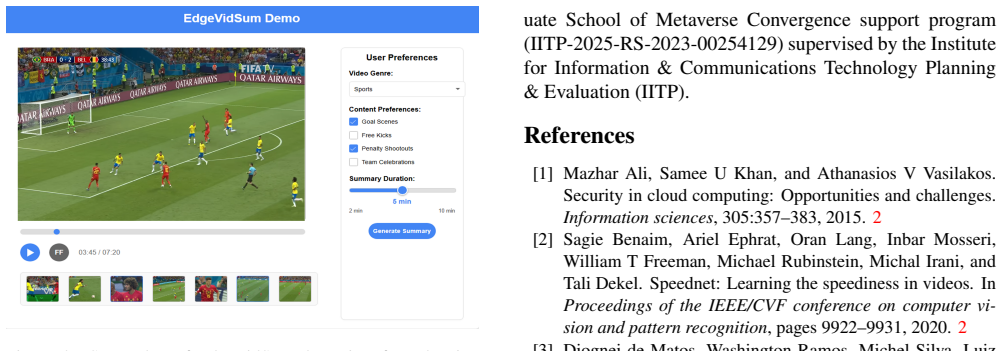
- [Section 4] The demo description would be clearer if it stated which videos were used, how user preferences were selected, and how the generated summaries were verified to match user expectations.
Circularity Check
Central 'no semantic loss' claim rests on same-author citation [11]; the pipeline is prior work plus an external attention module, with no independent benchmark.
-
self citation load bearing
[Section 3.1 (Thumbnail-Based Approach), supported by Section 3.3 step 1]
"Third, thumbnails provide higher quality representation through intelligent selection algorithms that maintain semantic integrity [11]."
The paper's headline trade-off is 'significantly reduce computational complexity without sacrificing semantic relevance' (Abstract), yet the only evidence that thumbnails preserve semantics is this citation to [11], a prior paper by the same two authors that introduced thumbnail containers. No dataset, ground-truth comparison, or ablation in the present paper tests whether the 160x90, roughly one-thumbnail-per-second containers retain user-relevant events. Every downstream step (preference classification, timestamp narrowing, fast-forward boundaries) inherits that assumption, so the central claim reduces to trusting the authors' own previous framework rather than an independent result.
-
ansatz smuggled in via citation
[Section 3.3, System Architecture, step 1]
"The VSP transmits pre-generated thumbnail containers representing the entire video at a very low bitrate [11]."
The paper presents EdgeVidSum as a novel method, but the thumbnail-container representation, including the semantic-integrity assumption and the client-driven narrowing protocol, is imported from [11] (and [12]) without re-derivation or fresh validation. The only genuinely external piece, TAM [10], is an off-the-shelf module; the 'pre-generated thumbnail containers' that make the method work are taken as given by the same authors' earlier work. Thus the novelty claim is a restatement of the prior pipeline plus an attention swap, with the load-bearing ansatz supplied by self-citation.
full rationale
The paper's strongest assertion, that thumbnail containers cut computation 'without sacrificing semantic relevance', is not derived or measured in this manuscript. It is assigned to reference [11], a same-author paper that defined exactly this thumbnail-container approach, making the core premise a load-bearing self-citation rather than independent evidence. This matches the self_citation_load_bearing pattern and warrants a partial-circularity score. A second, overlapping issue is that the client-driven architecture is essentially the authors' prior LTC-SUM/thumbnail-container framework with an external Triplet Attention Module inserted; the 'novel' contribution is therefore largely a restatement of the authors' own published pipeline. I do not treat the 4.2% accuracy improvement as a circular step: it is an unsupported claim about an external module, not an equation that reduces to its inputs. Similarly, the inconsistent arithmetic (97.8% reduction vs. 30x fewer thumbnails, which is 96.7%; 98.2% memory reduction vs. 99.3% for 160x90 over 1920x1080) and the unvalidated 2-5 second processing time are correctness and consistency concerns, not circularity. Because the central 'semantic relevance' guarantee is carried entirely by a same-author citation and never independently tested, the score is 6 rather than 0-2; it is not 8-10 because the efficiency arithmetic and the external TAM component give the paper some independent content.
Assumptions & free parameters
free parameters (3)
- thumbnail resolution (160x90)
- thumbnail sampling rate =
approximately 1 per second for the football example
- number of preference categories
assumptions (3)
- domain assumption Thumbnails preserve the semantic content of the video sufficiently to identify all user-relevant segments.
- domain assumption User preferences are representable as a fixed set of activity classes detectable from single images.
- ad hoc to paper The video service provider has pre-generated thumbnail containers for all videos.
Cite this review
Pith. "Pith review of EdgeVidSum: Real-Time Personalized Video Summarization at the Edge." pith.science (2026). https://pith.science/paper/7YYZ64JP
@misc{pith2026250603171,
  author       = {Pith},
  title        = {Pith review of: EdgeVidSum: Real-Time Personalized Video Summarization at the Edge},
  year         = {2026},
  howpublished = {\url{https://pith.science/paper/7YYZ64JP}},
  note         = {Machine review of arXiv:2506.03171}
}
read the original abstract
EdgeVidSum is a lightweight method that generates personalized, fast-forward summaries of long-form videos directly on edge devices. The proposed approach enables real-time video summarization while safeguarding user privacy through local data processing using innovative thumbnail-based techniques and efficient neural architectures. Unlike conventional methods that process entire videos frame by frame, the proposed method uses thumbnail containers to significantly reduce computational complexity without sacrificing semantic relevance. The framework employs a hierarchical analysis approach, where a lightweight 2D CNN model identifies user-preferred content from thumbnails and generates timestamps to create fast-forward summaries. Our interactive demo highlights the system's ability to create tailored video summaries for long-form videos, such as movies, sports events, and TV shows, based on individual user preferences. The entire computation occurs seamlessly on resource-constrained devices like Jetson Nano, demonstrating how EdgeVidSum addresses the critical challenges of computational efficiency, personalization, and privacy in modern video consumption environments.
Figures


Figures from the paper (1 more)
Reference graph
Works this paper leans on
-
[11]
Client-driven person- alized trailer framework using thumbnail containers
Ghulam Mujtaba and Eun-Seok Ryu. Client-driven person- alized trailer framework using thumbnail containers. IEEE Access, 8:60417–60427, 2020. 3, 4
work page 2020
-
[1]
Security in cloud computing: Opportunities and challenges
Mazhar Ali, Samee U Khan, and Athanasios V Vasilakos. Security in cloud computing: Opportunities and challenges. Information sciences, 305:357–383, 2015. 2
work page 2015
-
[2]
Speednet: Learning the speediness in videos
Sagie Benaim, Ariel Ephrat, Oran Lang, Inbar Mosseri, William T Freeman, Michael Rubinstein, Michal Irani, and Tali Dekel. Speednet: Learning the speediness in videos. In Proceedings of the IEEE/CVF conference on computer vi- sion and pattern recognition, pages 9922–9931, 2020. 2
work page 2020
-
[3]
A multimodal hy- perlapse method based on video and songs’ emotion align- ment
Diognei de Matos, Washington Ramos, Michel Silva, Luiz Romanhol, and Erickson R Nascimento. A multimodal hy- perlapse method based on video and songs’ emotion align- ment. Pattern Recognition Letters, 166:174–181, 2023. 2
work page 2023
-
[4]
Imagenet: A large-scale hierarchical image database
Jia Deng, Wei Dong, Richard Socher, Li-Jia Li, Kai Li, and Li Fei-Fei. Imagenet: A large-scale hierarchical image database. In 2009 IEEE conference on computer vision and pattern recognition, pages 248–255, 2009. 3
work page 2009
-
[5]
Video summarization by learning submodular mixtures of objec- tives
Michael Gygli, Helmut Grabner, and Luc Van Gool. Video summarization by learning submodular mixtures of objec- tives. In Proceedings of the IEEE conference on computer vision and pattern recognition, pages 3090–3098, 2015. 2
work page 2015
-
[6]
Squeeze-and-excitation net- works
Jie Hu, Li Shen, and Gang Sun. Squeeze-and-excitation net- works. In Proceedings of the IEEE Conference on Computer Vision and Pattern Recognition (CVPR) , pages 7132–7141,
-
[7]
C. Huang and H. Wang. A novel key-frames selection frame- work for comprehensive video summarization. IEEE Trans- actions on Circuits and Systems for Video Technology, 30(2): 577–589, 2020. 1
work page 2020
Show all 31 references
-
[8]
Ffnet: Video fast-forwarding via reinforcement learning
Shuyue Lan, Rameswar Panda, Qi Zhu, and Amit K Roy- Chowdhury. Ffnet: Video fast-forwarding via reinforcement learning. In Proceedings of the IEEE Conference on Com- puter Vision and Pattern Recognition , pages 6771–6780,
-
[9]
A generic framework of user attention model and its application in video summarization
Yu-Fei Ma, Xian-Sheng Hua, Lie Lu, and Hong-Jiang Zhang. A generic framework of user attention model and its application in video summarization. IEEE transactions on multimedia, 7(5):907–919, 2005. 2
2005
-
[10]
Rotate to attend: Convolutional triplet attention module
Diganta Misra, Trikay Nalamada, Ajay Uppili Aransani- palai, and Qibin Hou. Rotate to attend: Convolutional triplet attention module. In Proceedings of the IEEE/CVF Win- ter Conference on Applications of Computer Vision (WACV), pages 3139–3148, 2021. 3
2021
-
[12]
Ltc- sum: Lightweight client-driven personalized video summa- rization framework using 2d cnn
Ghulam Mujtaba, Adeel Malik, and Eun-Seok Ryu. Ltc- sum: Lightweight client-driven personalized video summa- rization framework using 2d cnn. IEEE access, 10:103041– 103055, 2022. 1
2022
-
[13]
Frc-gif: Frame 5 ranking-based personalized artistic media generation method for resource constrained devices
Ghulam Mujtaba, Sunder Ali Khowaja, Muhammad Aslam Jarwar, Jaehyuk Choi, and Eun-Seok Ryu. Frc-gif: Frame 5 ranking-based personalized artistic media generation method for resource constrained devices. IEEE Transactions on Big Data, 10(4):343–355, 2023. 2
2023
-
[14]
Per- sonalized semantic fast-forward videos for next generation streaming platforms, 2025
Ghulam Mujtaba, Eun Seok Ryu, and Reda Harb. Per- sonalized semantic fast-forward videos for next generation streaming platforms, 2025. US Patent App. 18/942,257. 1, 2
2025
-
[15]
Generating personalized summaries of day long egocentric videos
Pravin Nagar, Anuj Rathore, CV Jawahar, and Chetan Arora. Generating personalized summaries of day long egocentric videos. IEEE Transactions on Pattern Analysis and Machine Intelligence, 45(6):6832–6845, 2021. 2
2021
-
[16]
Video summarization and scene detection by graph modeling.IEEE Transactions on circuits and systems for video technology , 15(2):296–305, 2005
Chong-Wah Ngo, Yu-Fei Ma, and Hong-Jiang Zhang. Video summarization and scene detection by graph modeling.IEEE Transactions on circuits and systems for video technology , 15(2):296–305, 2005. 2
2005
-
[17]
Clip-based similarity measure for query-dependent clip retrieval and video sum- marization
Yuxin Peng and Chong-Wah Ngo. Clip-based similarity measure for query-dependent clip retrieval and video sum- marization. IEEE Transactions on Circuits and Systems for Video Technology, 16(5):612–627, 2006. 2
2006
-
[18]
Enhancing video summarization via vision-language embed- ding
Bryan A Plummer, Matthew Brown, and Svetlana Lazebnik. Enhancing video summarization via vision-language embed- ding. In Proceedings of the IEEE conference on computer vision and pattern recognition, pages 5781–5789, 2017. 2
2017
-
[19]
Category-specific video summarization
Danila Potapov, Matthijs Douze, Zaid Harchaoui, and Cordelia Schmid. Category-specific video summarization. In Computer Vision–ECCV 2014: 13th European Confer- ence, Zurich, Switzerland, September 6-12, 2014, Proceed- ings, Part VI 13, pages 540–555. Springer, 2014. 2
2014
-
[20]
Personalizing fast-forward videos based on visual and textual features from social net- work
Washington Ramos, Michel Silva, Edson Araujo, Alan Neves, and Erickson Nascimento. Personalizing fast-forward videos based on visual and textual features from social net- work. In Proceedings of the IEEE/CVF Winter Confer- ence on Applications of Computer Vision, pages 3271–3280,
-
[21]
Query- focused video summarization: Dataset, evaluation, and a memory network based approach
Aidean Sharghi, Jacob S Laurel, and Boqing Gong. Query- focused video summarization: Dataset, evaluation, and a memory network based approach. In Proceedings of the IEEE conference on computer vision and pattern recogni- tion, pages 4788–4797, 2017. 2
2017
-
[22]
A sparse sampling-based framework for semantic fast-forward of first-person videos.IEEE Trans- actions on Pattern Analysis and Machine Intelligence, 43(4): 1438–1444, 2020
Michel Silva, Washington Ramos, Mario Campos, and Er- ickson R Nascimento. A sparse sampling-based framework for semantic fast-forward of first-person videos.IEEE Trans- actions on Pattern Analysis and Machine Intelligence, 43(4): 1438–1444, 2020. 2
2020
-
[23]
Tvsum: Summarizing web videos using titles
Yale Song, Jordi Vallmitjana, Amanda Stent, and Alejandro Jaimes. Tvsum: Summarizing web videos using titles. In Proceedings of the IEEE conference on computer vision and pattern recognition, pages 5179–5187, 2015. 2
2015
-
[24]
To click or not to click: Automatic selection of beautiful thumbnails from videos
Yale Song, Miriam Redi, Jordi Vallmitjana, and Alejandro Jaimes. To click or not to click: Automatic selection of beautiful thumbnails from videos. In Proceedings of the 25th ACM International on Conference on Information and Knowledge Management , page 659–668, New York, NY ,...
2016
-
[25]
Efficientnetv2: Smaller mod- els and faster training
Mingxing Tan and Quoc Le. Efficientnetv2: Smaller mod- els and faster training. In Proceedings of the 38th Inter- national Conference on Machine Learning , pages 10096– 10106. PMLR, 2021. 3
2021
-
[26]
Per- sonalized egocentric video summarization of cultural tour on user preferences input
Patrizia Varini, Giuseppe Serra, and Rita Cucchiara. Per- sonalized egocentric video summarization of cultural tour on user preferences input. IEEE Transactions on Multimedia , 19(12):2832–2845, 2017. 2
2017
-
[27]
Future of tv distribution: A report prepared by the university of exeter with the university of leeds, mtm, 3 reasons and real wireless
J Vernon, C Johnson, J Evans, R Collier, R Ellis, A Sumanasena, G Mills, A Kumar, T Jacks, B Moullier, et al. Future of tv distribution: A report prepared by the university of exeter with the university of leeds, mtm, 3 reasons and real wireless. 2024. 1
2024
-
[28]
Video personalization in resource-constrained multimedia environ- ments
Yong Wei, Suchendra M Bhandarkar, and Kang Li. Video personalization in resource-constrained multimedia environ- ments. In Proceedings of the 15th ACM international con- ference on Multimedia, pages 902–911, 2007. 2
2007
-
[29]
Gaze-enabled egocentric video summarization via constrained submodular maximiza- tion
Jia Xu, Lopamudra Mukherjee, Yin Li, Jamieson Warner, James M Rehg, and Vikas Singh. Gaze-enabled egocentric video summarization via constrained submodular maximiza- tion. In Proceedings of the IEEE conference on computer vision and pattern recognition, pages 2235–2244, 2015. 2
2015
-
[30]
Personalized video adaptation based on video content analysis
Min Xu, Jesse S Jin, and Suhuai Luo. Personalized video adaptation based on video content analysis. In Proceedings of the 9th International Workshop on Multimedia Data Min- ing: held in conjunction with the ACM SIGKDD 2008, pages 26–35, 2008. 2
2008
-
[31]
En- coded semantic tree for automatic user profiling applied to personalized video summarization
Yifang Yin, Roshan Thapliya, and Roger Zimmermann. En- coded semantic tree for automatic user profiling applied to personalized video summarization. IEEE Transactions on Circuits and Systems for Video Technology, 28(1):181–192,
Reviewed August 7, 2026 · model on record in the stance chip above.
Discussion (0). Sign in to comment.