REVIEW 3 major objections 5 minor 1 cited by
FOLIAGE: Towards Physical Intelligence World Models Via Unbounded Surface Evolution
T0 review · 3 major / 5 minor · reviewed 2026-08-07 · deepseek-v4-flash
Pith's one-line read This paper claims that a single multimodal latent world state can predict accretive surface growth better than task-specific baselines and remain robust under sensor and physics stress.
desk verdict SURF-GARDEN is the real contribution; FOLIAGE is competent but leans on oracle correspondences that no experiment removes. read the letter →
The pith
A machine-rendered reading of the paper's core claim, the machinery that carries it, and where it could break.
The reading
What carries the argument
The central object is the Accretive Graph Network (AGN) together with Geometry-Correspondence Fusion (GCF), the pair that lets a single latent state carry growth and modality alignment. AGN is a graph encoder over the evolving mesh: Age Positional Encoding (APE) gives each vertex a sinusoidal encoding of its birth time, and Energy-Gated Message-Passing (EGMP) modulates the first graph-ODE step with a gate built from per-vertex stretch and bending energy, so high-stress regions propagate information faster during training. GCF builds a heterogeneous graph whose nodes are all image-patch, point, and mesh-vertex tokens and whose edges are the simulator-provided correspondences $E_{pix}$, $E_{pt}$, and $E_{mesh}$, restricting attention to those edges and reducing cost from $O(|V|^2)$ to $O(|E|)$. The machinery's job is to make the latent state invariant to vertex count, sensitive to accretion, and aligned across modalities, and to do it without privileged information at test time, since the gating path uses detached energies and the auxiliary energy head is dropped.
What would settle it
Run a trained FOLIAGE model on the SURF-BENCH tasks with the correspondence edges $E_{pix}$ and $E_{pt}$ deleted at inference, so each modality is encoded in isolation; if cross-modal retrieval mAP and sensor-dropout balanced accuracy fall to the level of simple concatenation baselines, the claim that Geometry-Correspondence Fusion is the mechanism of robustness would be falsified.
Extended reading notes
Core claim
On its own terms, FOLIAGE claims that accretive surface growth reduces to a problem of learning a Modality-Agnostic Growth Embedding (MAGE). The perception encoder maps whichever sensors are present (RGB patches, LiDAR-style points, mesh vertices) into shared 768-dimensional tokens, and Geometry-Correspondence Fusion lets those tokens exchange information only along edges that the synthetic platform provides between pixels, points, and mesh vertices. The Accretive Graph Network tags each vertex by its birth time and, during training only, gates its graph-diffusion steps by per-vertex membrane and flexural energy; at inference the privileged path is detached and the auxiliary head is dropped. A four-layer Transformer predictor then advances the pooled embedding by a requested horizon, conditioned on the action vector (stretch, shear, bending stiffness), and the same advanced embedding feeds critics for six tasks. The claim is that this one latent state, rather than any task-specific architecture, delivers the reported accuracy, and that the counterfactual branching of SURF-GARDEN lets the model learn distinct futures from identical pasts conditioned on action.
Load-bearing premise
The load-bearing premise is that exact links between pixels, points, and mesh vertices are available whenever the model is used, because the cross-modal fusion mechanism cannot be built without them; the paper never tests a setting where those links are absent.
Editorial extensions
If this is right
- A single learned latent state can substitute for running the physics simulator at deployment: counterfactual futures are obtained by swapping the action token, with no simulator calls.
- The same embedding serves many tasks at once, so downstream physical-intelligence systems could share one perception-prediction backbone instead of training separate encoders for recognition, regression, retrieval, and correspondence.
- Training under Cross-Patch Masking makes sensor loss graceful: the model keeps working with images only, point clouds only, or different modality combinations, and transfers to unseen modality pairs in zero-shot retrieval.
- Long-horizon predictions stay stable beyond the training horizon ($\Delta t$ up to 8) in the paper's experiments, with slower error growth than the mesh-prediction baselines, indicating the latent dynamics are not just memorized short transitions.
- Privileged physics signals can be injected during training and detached afterwards, so a deployed model never needs per-vertex energies or material coefficients, only learnable proxies such as color gradients, depth discontinuities, and vertex age.
Reading between the lines
- Editorial inference: the correspondence dependence is the natural next stress test; feeding real camera or LiDAR data with no known vertex association, or deleting the correspondence edges at test time, would separate the value of learned cross-modal fusion from the value of the provided supervision.
- Editorial inference: counterfactual branching could be pushed toward interpolation and extrapolation in action space; if the model can predict outcomes for unseen combinations of the three elastic coefficients, that would quantify whether the latent dynamics are genuinely physical rather than retrieval-based.
- Editorial inference: the same age-encoding and energy-gating recipe could transfer to deformable-object and cloth settings where connectivity changes by tearing or re-meshing, though the simulator-level supervision in SURF-GARDEN would have to be recreated for those domains.
- Editorial inference: the reported knee in autoregressive rollout error around $\Delta t = 4$ suggests a testable stability question, whether error growth is exponential with horizon and whether re-encoding from observations periodically would bound it.
Editorial analysis
A structured set of objections, weighed in public.
Referee Report
Summary. FOLIAGE is a multimodal latent world model for unbounded accretive surface growth, trained and evaluated entirely in a new synthetic platform. The perception encoder maps RGB images, LiDAR-style point clouds, and meshes into a shared token space; a graph-based Accretive Graph Network with Age Positional Encoding and Energy-Gated Message-Passing produces a Modality-Agnostic Growth Embedding (MAGE); and a transformer predictor conditioned on material-coefficient actions advances the latent state in time. The paper introduces SURF-GARDEN, a counterfactual physics simulator with exact cross-modal correspondences and evolution tracing, and SURF-BENCH, a suite of six core tasks and four stress tests. The authors report that FOLIAGE outperforms specialized baselines on all tasks and degrades gracefully under sensor dropout, long-horizon roll-out, and ablations of privileged signals.
Significance. If the claims hold, this paper would make a useful contribution to an understudied regime: surface growth with unbounded accretion, topology change, and multimodal sensing. The paper does several things carefully: it detaches the privileged energy signals in the gating path, drops the auxiliary energy head at inference, uses counterfactual branching to make action conditioning meaningful, and provides extensive ablations and hyperparameter sweeps in the appendix. The SURF-GARDEN benchmark itself is potentially valuable for future world-model research. However, the headline claim of a general multimodal pathway to physical intelligence is currently supported only inside a simulator where exact pixel/point-to-vertex correspondences are supplied at both training and test time. The significance is therefore conditional on establishing behavior when those correspondences are absent or must be estimated, and on strengthening the statistical and reproducibility basis of the reported comparisons.
major comments (3)
- [§3.1, §4.2, §6.2] Geometry-Correspondence Fusion builds the entire cross-modal interaction graph from exact simulator-provided edges E_pix and E_pt (Section 3.1), produced by the Multimodal Correspondence Extractor (Section 4.2). These oracle edges are available both when training and on the SURF-BENCH test split, including under the S1 sensor-subsets stress test, where every retained modality still carries ground-truth correspondences. The ablation in Table 2 shows that removing GCF drops retrieval mAP from 0.60 to 0.46, i.e., the 14-point T5 gain is exactly the oracle-edge contribution. Since real cameras and LiDAR do not provide vertex associations, the claimed multimodal pathway to physical intelligence is not actually tested: at inference on unregistered data the cross-modal attention graph cannot be built. Please add experiments with (i) all correspondence edges removed at train and test, (ii) correspondences estimated by an off-the-shelf matcher or predicted by the model, and/or (iii) a real or realistically unregistered multimodal dataset; alternatively, restrict the claims and title to the simulator setting.
- [Table 1; §6.1] The core results in Table 1 are reported as point estimates without error bars, while error estimates appear only in the ablation table (Table 2). Several of the reported differences are small (e.g., T1 0.97 vs 0.94, T6 3.2 vs 2.8), so the claim that FOLIAGE 'outperforms specialized baselines across all tasks' is not statistically supported as presented. In addition, the paper does not explain how the physics-simulator baselines in T2 (NeuralClothSim, DiffPD, BDP, DiffCloth) are adapted to the stated single-RGB-view setting, nor does it provide training protocols, code, or data for any baseline. Please report mean±std over at least three seeds for every task, describe the baseline input representations and optimization procedures, and release code, data, and evaluation scripts.
- [§7; §3.4] The Limitations section states that the framework captures possible future states probabilistically, but the method chapter describes a deterministic predictor trained with L2 regression on a single target latent (Section 3.4: L = ||s_hat - s_target||^2) and contains no sampling scheme, stochastic latent dynamics, or distributional loss. Please either specify the probabilistic mechanism actually used or remove the claim; as written, the uncertainty-aware aspect of the paper is unsupported.
minor comments (5)
- [§3.2] There is an extra closing parenthesis in 'This produces the action token a_t ∈ R^768).'
- [§5, Table 2 (S3)] The notation 'k=1, k=3, k=5, k=10' for long-horizon roll-outs is not defined; please state whether k is the number of autoregressive steps and give the corresponding time units.
- [Table 1 (T4)] The 'Chamfer↓/Vertex Drift↓' column reports values such as '0.065/4133' without units; specify the units for both Chamfer distance and vertex-drift counts.
- [§14.3] There is a typo 'Tb. 4' that should read 'Tab. 4', and the appendix heading in Section 10 is 'Cross-Model Retrieval' rather than 'Cross-Modal Retrieval'.
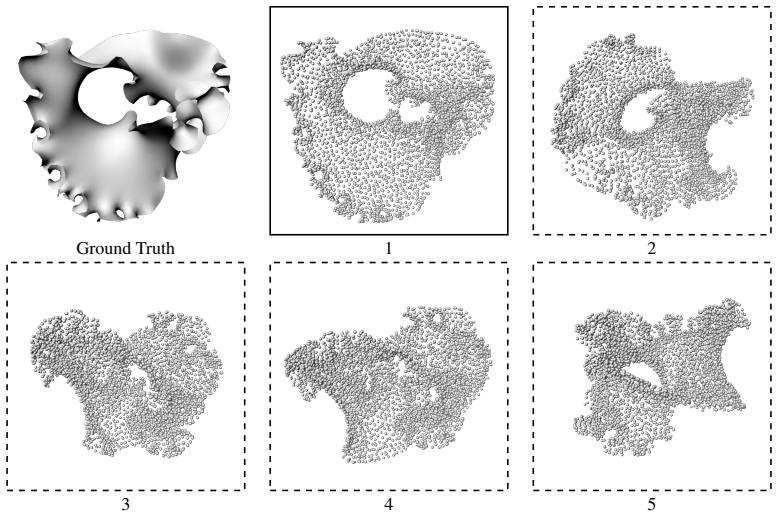
- [Figure 10 caption] The caption contains stray text 'mesh att= 100' and 'mesh att= 108(FOLIAGE)'; please clean up the caption and clarify what the turquoise vertex feature is.
Circularity Check
T5 cross-modal retrieval is partially circular: the model is given simulator-provided pixel-to-vertex correspondence edges as input to GCF, and the retrieval task measures exactly this image-to-mesh alignment; the core predictor derivation is otherwise self-contained.
-
self definitional
[Sec. 3.1 (Geometry-Correspondence Fusion) and Sec. 6.1 (T5 Cross-Modal Retrieval)]
"Directed edges encode simulator-provided correspondences: Epix={(p,r v)}, Ept={(q,r v)}, Emesh={(r v,r u)|u∈ N(v)} ... By welding pixel tokens to their source vertices during GCF, FOLIAGEcollapses the image-to-mesh gap and delivers a 25% relative boost in mAP@100 over the strongest retrieval baseline."
The T5 retrieval task is defined as 'embedding alignment between images and meshes', i.e., recovering which image belongs to which mesh. The model's GCF input includes Epix, a set of exact pixel-to-vertex correspondences supplied by SURF-GARDEN. At inference on the benchmark, the positive image-mesh pair therefore carries the correspondence edges that encode the answer to the retrieval query, while negative pairs do not. The reported mAP gain is thus attributable to the provided alignment rather than to an emergent, learned multimodal world state. This is a partial reduction of a benchmark 'prediction' to its input by construction, although the latent rollout and other tasks remain independent evidence.
full rationale
The paper's central derivation is not circular in its training objective: the context encoder and action-conditioned predictor are trained to match latent targets produced by an EMA target encoder, with privileged energy signals injected only into the target branch via a detach and the auxiliary head dropped at inference. The action coefficients condition the predictor rather than being fitted to the future state, and the counterfactual simulator provides external supervisory data. There is no load-bearing self-citation, no imported uniqueness theorem, and no ansatz smuggled via citation; the ablations compare against external baselines and standard components. The one genuine reduction is in the cross-modal retrieval claim (T5). GCF builds its entire cross-modal graph from SURF-GARDEN-supplied correspondences Epix and Ept between image patches/points and mesh vertices, and T5 measures exactly this image-to-mesh alignment. Giving the model those correspondences as input edges means the reported 25% mAP boost reflects the provided alignment rather than a learned emergent property. The limitation section does not disclose that these exact correspondences are unavailable in real deployment. This is partial circularity: T1-T4, T6, and the stress tests remain informative, and the predictor's latent roll-out logic is internally consistent.
Assumptions & free parameters
free parameters (10)
- Latent dimension d =
768
- Token dropout ratio =
25%
- Modality dropout ratio =
30%
- Action drop probability =
10%
- Energy loss weight lambda_E =
0.02
- Variance-covariance loss weight lambda_vc =
0.04
- EMA update rate for target encoder =
0.998
- Edge split threshold (rest length multiplier) =
1.5
- Young-region age threshold =
0.2
- Training delta_t range =
1 to 8
assumptions (4)
- domain assumption The Discrete Shells energy model [29] is an adequate model of real physical surface growth and deformation.
- domain assumption The three scalar coefficients k_stretch, k_shear, k_bend form a sufficient action space for controlling surface evolution.
- domain assumption Synthetic 400-frame sequences with vertex counts 20 to 105 represent 'unbounded' surface growth.
- ad hoc to paper Rest length update rule ell*_e = ((g(vi)+g(vj))/2 + 1) ||e|| and the 1.5x edge split threshold are reasonable growth mechanisms.
Cite this review
Pith. "Pith review of FOLIAGE: Towards Physical Intelligence World Models Via Unbounded Surface Evolution." pith.science (2026). https://pith.science/paper/TSIPVUC6
@misc{pith2026250603173,
  author       = {Pith},
  title        = {Pith review of: FOLIAGE: Towards Physical Intelligence World Models Via Unbounded Surface Evolution},
  year         = {2026},
  howpublished = {\url{https://pith.science/paper/TSIPVUC6}},
  note         = {Machine review of arXiv:2506.03173}
}
read the original abstract
Physical intelligence -- anticipating and shaping the world from partial, multisensory observations -- is critical for next-generation world models. We propose FOLIAGE, a physics-informed multimodal world model for unbounded accretive surface growth. In its Action-Perception loop, a unified context encoder maps images, mesh connectivity, and point clouds to a shared latent state. A physics-aware predictor, conditioned on physical control actions, advances this latent state in time to align with the target latent of the surface, yielding a Modality-Agnostic Growth Embedding (MAGE) that interfaces with critic heads for downstream objectives. FOLIAGE's Accretive Graph Network (AGN) captures dynamic connectivity through Age Positional Encoding and Energy-Gated Message-Passing. Geometry-Correspondence Fusion and Cross-Patch Masking enhance MAGE's expressiveness, while Hierarchical Pooling balances global context with local dynamics. We create SURF-GARDEN, a world model learning platform comprising a Counterfactual Physics Simulator, a Multimodal Correspondence Extractor, and Evolution Tracing, which generates 7,200 diverse surface-growth sequences. SURF-BENCH, our physical-intelligence evaluation suite, evaluates six core tasks -- topology recognition, inverse material estimation, growth-stage classification, latent roll-out, cross-modal retrieval, and dense correspondence -- and four stress tests -- sensor dropout, zero-shot modality transfer, long-horizon prediction, and physics ablation -- to probe resilience. FOLIAGE outperforms specialized baselines while remaining robust across dynamic environments, establishing a new world-model based, multimodal pathway to physical intelligence.
Figures


Figures from the paper (13 more)




Forward citations
Cited by 1 Pith paper
-
A Comprehensive Survey on World Models for Embodied AI
A unified three-axis taxonomy — functionality, temporal modeling, spatial representation — organizes the world-model literature for embodied AI.
Reference graph
Works this paper leans on
-
[1]
Layer normalization.arXiv preprint arXiv:1607.06450, 2016
Jimmy Lei Ba, Jamie Ryan Kiros, and Geoffrey E Hinton. Layer normalization.arXiv preprint arXiv:1607.06450, 2016. URLhttps://arxiv.org/abs/1607.06450
arXiv 2016
-
[2]
Vicreg: Variance-invariance-covariance regular- ization for self-supervised learning
Adrien Bardes, Jean Ponce, and Yann LeCun. Vicreg: Variance-invariance-covariance regular- ization for self-supervised learning. InInternational Conference on Learning Representations (ICLR), 2022. URLhttps://arxiv.org/abs/2105.04906
arXiv 2022
-
[3]
H. G. Barrow, J. M. Tenenbaum, A. R. Hanson, and E. M. Riseman. Parametric correspondence and chamfer matching: Two new techniques for image matching. InProceedings of the 5th International Joint Conference on Artificial Intelligence (IJCAI), pages 659–663, 1977
1977
-
[4]
Battaglia, Jessica B
Peter W. Battaglia, Jessica B. Hamrick, and Joshua B. Tenenbaum. Simulation as an engine of physical scene understanding.Proceedings of the National Academy of Sciences, 110(45): 18327–18332, 2013
2013
-
[5]
E(n) equivariant topological neural networks.arXiv preprint arXiv:2405.15429, 2023
Claudio Battiloro et al. E(n) equivariant topological neural networks.arXiv preprint arXiv:2405.15429, 2023
arXiv 2023
-
[6]
Growth and instability in elastic tissues.Journal of the Mechanics and Physics of Solids, 53(10):2284–2319, 2005
Martine Ben Amar and Alain Goriely. Growth and instability in elastic tissues.Journal of the Mechanics and Physics of Solids, 53(10):2284–2319, 2005
2005
-
[7]
Is space-time attention all you need for video understanding? InProceedings of the International Conference on Machine Learning, 2021
Gedas Bertasius, Heng Wang, and Lorenzo Torresani. Is space-time attention all you need for video understanding? InProceedings of the International Conference on Machine Learning, 2021
2021
-
[8]
Johan Bjorck, Fernando Castañeda, Nikita Cherniadev, Xingye Da, Runyu Ding, Linxi Fan, Yu Fang, Dieter Fox, Fengyuan Hu, Spencer Huang, et al. Gr00t n1: An open foundation model for generalist humanoid robots.arXiv preprint arXiv:2503.14734, 2025
arXiv 2025
Show all 84 references
-
[9]
π0: A vision-language-action flow model for general robot control.arXiv preprint arXiv:2410.24164, 2024
Kevin Black, Noah Brown, Danny Driess, Adnan Esmail, Michael Equi, Chelsea Finn, Niccolo Fusai, Lachy Groom, Karol Hausman, Brian Ichter, et al. π0: A vision-language-action flow model for general robot control.arXiv preprint arXiv:2410.24164, 2024
-
[10]
Blender - a 3d modelling and rendering package.Blender Foundation, 2023
Blender Online Community. Blender - a 3d modelling and rendering package.Blender Foundation, 2023. URLhttps://www.blender.org
2023
-
[11]
Federica Bogo, Nishan Mahmood, Javier Romero, Gerard Pons-Moll, and Michael J. Black. D-faust: Dataset and evaluation for 4d human body registration. InProceedings of the IEEE Conference on Computer Vision and Pattern Recognition, pages 3524–3533. IEEE, 2017
2017
-
[12]
Projective dynamics: Fusing constraint projections for fast simulation
Sofien Bouaziz, Murray Martin, Mark Pauly, Ladislav Kavan, and Maks Ovsjanikov. Projective dynamics: Fusing constraint projections for fast simulation. InSIGGRAPH Asia 2014 Technical Papers, pages 1–10. ACM, 2014
2014
-
[13]
CRC Press, 2nd edition, 2015
Robert Bridson.Fluid Simulation for Computer Graphics. CRC Press, 2nd edition, 2015
2015
-
[14]
Spectral meets spatial: Harmonising 3d shape matching and interpolation
Dongliang Cao, Marvin Eisenberger, Nafie El Amrani, Daniel Cremers, and Florian Bernard. Spectral meets spatial: Harmonising 3d shape matching and interpolation. InProceedings of the IEEE/CVF Conference on Computer Vision and Pattern Recognition, 2024
2024
-
[15]
Motion2vecsets: 4d latent vector set diffusion for non-rigid shape reconstruction and tracking
Wei Cao, Chang Luo, Biao Zhang, Matthias Nießner, and Jiapeng Tang. Motion2vecsets: 4d latent vector set diffusion for non-rigid shape reconstruction and tracking. InProceedings of the IEEE/CVF Conference on Computer Vision and Pattern Recognition (CVPR), 2024. URL https://arx...
2024 arXiv
-
[16]
Chamberlain, James Rowbottom, Maria Gorinova, Stefan Webb, Emanuele Rossi, and Michael M
Benjamin P. Chamberlain, James Rowbottom, Maria Gorinova, Stefan Webb, Emanuele Rossi, and Michael M. Bronstein. Grand: Graph neural diffusion. In Marina Meila and Tong Zhang, editors,Proceedings of the 38th International Conference on Machine Learning, volume 139 of Proceedin...
2021
-
[17]
Pimae: Point cloud and image interactive masked autoencoders for 3d object detection
Anthony Chen, Kevin Zhang, Renrui Zhang, Zihan Wang, Yuheng Lu, Yandong Guo, and Shanghang Zhang. Pimae: Point cloud and image interactive masked autoencoders for 3d object detection. InProceedings of the IEEE/CVF Conference on Computer Vision and Pattern Recognition (CVPR), 2...
2023 arXiv
-
[18]
Svformer: Semi-supervised video transformer for action recognition
Jingjing Chen et al. Svformer: Semi-supervised video transformer for action recognition. In Proceedings of the IEEE/CVF Conference on Computer Vision and Pattern Recognition, 2023
2023
-
[19]
Mesh smoothing schemes based on optimal delaunay triangulations
Long Chen. Mesh smoothing schemes based on optimal delaunay triangulations. InProceedings of the 13th International Meshing Roundtable, pages 109–120. Springer, 2004
2004
-
[20]
Learning phrase representations using rnn encoder– decoder for statistical machine translation.arXiv preprint arXiv:1406.1078, 2014
Kyunghyun Cho, Bart van Merriënboer, Caglar Gulcehre, Dzmitry Bahdanau, Fethi Bougares, Holger Schwenk, and Yoshua Bengio. Learning phrase representations using rnn encoder– decoder for statistical machine translation.arXiv preprint arXiv:1406.1078, 2014. URL https://arxiv.org...
2014 arXiv
-
[21]
Facing off world model backbones: Rnns, transformers, and s4
Fei Deng, Junyeong Park, and Sungjin Ahn. Facing off world model backbones: Rnns, transformers, and s4. InAdvances in Neural Information Processing Systems, volume 36, 2023
2023
-
[22]
Improved regularization of convolutional neural networks with cutout
Terrance DeVries and Graham W Taylor. Improved regularization of convolutional neural networks with cutout. InarXiv preprint arXiv:1708.04552, 2017. URL https://arxiv.org/ abs/1708.04552
2017 arXiv
-
[23]
An image is worth 16x16 words: Transformers for image recognition at scale
Alexey Dosovitskiy, Lucas Beyer, Alexander Kolesnikov, Dirk Weissenborn, Xiaohua Zhai, Thomas Unterthiner, Mostafa Dehghani, Matthias Minderer, Georg Heigold, Sylvain Gelly, Jakob Uszkoreit, and Neil Houlsby. An image is worth 16x16 words: Transformers for image recognition at...
2021
-
[24]
Elastic theory of unconstrained non-euclidean plates.Journal of the Mechanics and Physics of Solids, 57(4):762–775, 2009
Efi Efrati, Eran Sharon, and Raz Kupferman. Elastic theory of unconstrained non-euclidean plates.Journal of the Mechanics and Physics of Solids, 57(4):762–775, 2009
2009
-
[25]
Growth patterns for shape-shifting elastic bilayers
Efi Efrati, Eran Sharon, and Raz Kupferman. Growth patterns for shape-shifting elastic bilayers. Proceedings of the National Academy of Sciences, 114(12):3095–3100, 2017
2017
-
[26]
G-msm: Unsuper- vised multi-shape matching with graph-based affinity priors
Marvin Eisenberger, Aysim Toker, Laura Leal-Taixé, and Daniel Cremers. G-msm: Unsuper- vised multi-shape matching with graph-based affinity priors. InProceedings of the IEEE/CVF Conference on Computer Vision and Pattern Recognition, pages 22762–22772, 2023
2023
-
[27]
Bayesian differentiable physics for cloth digitaliza- tion
Deshan Gong, Ningtao Mao, and He Wang. Bayesian differentiable physics for cloth digitaliza- tion. InProceedings of the IEEE/CVF Conference on Computer Vision and Pattern Recognition, pages 11841–11851, 2024
2024
-
[28]
Ffjord: Free-form continuous dynamics for scalable reversible generative models.arXiv preprint arXiv:1810.01367, 2018
Will Grathwohl, Ricky TQ Chen, Jesse Bettencourt, Ilya Sutskever, and David Duvenaud. Ffjord: Free-form continuous dynamics for scalable reversible generative models.arXiv preprint arXiv:1810.01367, 2018
2018 arXiv
-
[29]
Discrete shells
Eitan Grinspun, Ari Finkelstein, Daniel Gingold, and Peter Schröder. Discrete shells. In Proceedings of the 2003 ACM SIGGRAPH/Eurographics Symposium on Computer Animation, pages 62–67. Eurographics Association, 2003
2003
-
[30]
World models
David Ha and Jürgen Schmidhuber. World models. InAdvances in Neural Information Processing Systems, volume 31, pages 2464–2476, 2018
2018
-
[31]
Learning latent dynamics for planning from pixels
Danijar Hafner, Timothy Lillicrap, Ian Fischer, Ruben Villegas, David Ha, Honglak Lee, and James Davidson. Learning latent dynamics for planning from pixels. InProceedings of the 36th International Conference on Machine Learning, volume 97 ofProceedings of Machine Learning Res...
2019
-
[32]
Mastering diverse domains through world models.arXiv preprint arXiv:2301.04104, 2023
Danijar Hafner, Jurgis Pasukonis, Jimmy Ba, and Timothy Lillicrap. Mastering diverse domains through world models.arXiv preprint arXiv:2301.04104, 2023
2023 arXiv
-
[33]
Tenenbaum, and Chuang Gan
Jiaqi Han, Wenbing Huang, Hengbo Ma, Jiachen Li, Joshua B. Tenenbaum, and Chuang Gan. Learning physical dynamics with subequivariant graph neural networks. InAdvances in Neural Information Processing Systems, volume 35, 2022. 22
2022
-
[34]
Meshcnn: A network with an edge
Rana Hanocka, Amit Hertz, Noa Fish, Raja Giryes, Shachar Fleishman, and Daniel Cohen-Or. Meshcnn: A network with an edge. InACM Transactions on Graphics (TOG), volume 38, page 90. ACM, 2019
2019
-
[35]
Gaussian error linear units (gelus).arXiv preprint arXiv:1606.08415, 2016
Dan Hendrycks and Kevin Gimpel. Gaussian error linear units (gelus).arXiv preprint arXiv:1606.08415, 2016. URLhttps://arxiv.org/abs/1606.08415
2016 arXiv
-
[36]
Diffpd: Differentiable projective dynamics
Yufeng Hu, Yifei Li, Tao Du, and Wojciech Matusik. Diffpd: Differentiable projective dynamics. ACM Transactions on Graphics (TOG), 40(4):1–13, 2021
2021
-
[37]
Jimmy Hsia
Changjin Huang, Zilu Wang, David Quinn, Subra Suresh, and K. Jimmy Hsia. Differential growth and shape formation in plant organs.Proceedings of the National Academy of Sciences, 115(49):12359–12364, 2018. doi: 10.1073/pnas.1811296115. URL https://www.pnas.org/ doi/10.1073/pnas...
2018 doi
-
[38]
Neural deformation fields meet the thin shell theory
Navami Kairanda, Marc Habermann, Christian Theobalt, and Vladislav Golyanik. Neural deformation fields meet the thin shell theory. InAdvances in Neural Information Processing Systems, volume 37, 2024
2024
-
[39]
Kingma and Max Welling
Diederik P. Kingma and Max Welling. Auto-encoding variational bayes. InInternational Conference on Learning Representations, 2014
2014
-
[40]
Semi-supervised classification with graph convolutional networks
Thomas N Kipf and Max Welling. Semi-supervised classification with graph convolutional networks. InInternational Conference on Learning Representations (ICLR), 2017. URL https://arxiv.org/abs/1609.02907
2017 arXiv
-
[41]
Cadex: Learning canonical deformation coordinate space for dynamic surface representation via neural homeomorphism
Jiahui Lei and Kostas Daniilidis. Cadex: Learning canonical deformation coordinate space for dynamic surface representation via neural homeomorphism. InProceedings of the IEEE/CVF Conference on Computer Vision and Pattern Recognition (CVPR), 2022. URL https://www. cis.upenn.ed...
2022
-
[42]
Learning physical intuition of block towers by example
Adam Lerer, Sam Gross, and Rob Fergus. Learning physical intuition of block towers by example. InInternational conference on machine learning, pages 430–438. PMLR, 2016
2016
-
[43]
End-to-end training of deep visuomotor policies.Journal of Machine Learning Research, 17(39):1–40, 2016
Sergey Levine, Peter Pastor, Alex Krizhevsky, and Deirdre Quillen. End-to-end training of deep visuomotor policies.Journal of Machine Learning Research, 17(39):1–40, 2016
2016
-
[44]
Video- mamba: State space model for efficient video understanding
Kunchang Li, Xinhao Li, Yi Wang, Yinan He, Yali Wang, Limin Wang, and Yu Qiao. Video- mamba: State space model for efficient video understanding. InProceedings of the European Conference on Computer Vision, 2024
2024
-
[45]
Ulip-2: Towards scalable multimodal pre-training for 3d understanding
Xinyu Li et al. Ulip-2: Towards scalable multimodal pre-training for 3d understanding. In Proceedings of the IEEE/CVF Conference on Computer Vision and Pattern Recognition, 2023
2023
-
[46]
Diffcloth: Differentiable cloth simulation with dry frictional contact.ACM Transactions on Graphics (TOG), 41(4):1–15, 2022
Yifei Li, Tao Du, Kui Wu, Jie Xu, and Wojciech Matusik. Diffcloth: Differentiable cloth simulation with dry frictional contact.ACM Transactions on Graphics (TOG), 41(4):1–15, 2022
2022
-
[47]
Physics-informed neural operator for learning partial differential equations.ACM/JMS Journal of Data Science, 1(3):1–27, 2024
Zongyi Li, Hongkai Zheng, Nikola Kovachki, David Jin, Haoxuan Chen, Burigede Liu, Kamyar Azizzadenesheli, and Anima Anandkumar. Physics-informed neural operator for learning partial differential equations.ACM/JMS Journal of Data Science, 1(3):1–27, 2024
2024
-
[48]
Mahadevan
Haiyi Liang and L. Mahadevan. Growth, geometry, and mechanics of a blooming lily.Pro- ceedings of the National Academy of Sciences, 108(14):5516–5521, 2011. doi: 10.1073/pnas. 1007808108. URLhttps://www.pnas.org/doi/10.1073/pnas.1007808108
2011 doi
-
[49]
Softgym: Benchmarking deep reinforce- ment learning for deformable object manipulation
Xingyu Lin, Yufei Wang, Jake Olkin, and David Held. Softgym: Benchmarking deep reinforce- ment learning for deformable object manipulation. InConference on Robot Learning, pages 432–448. PMLR, 2021
2021
-
[50]
Decoupled weight decay regularization
Ilya Loshchilov and Frank Hutter. Decoupled weight decay regularization. InInternational Conference on Learning Representations (ICLR), 2019. URL https://arxiv.org/abs/ 1711.05101. 23
2019 arXiv
-
[51]
Garmentlab: A unified simulation and benchmark for garment manipulation
Haoran Lu, Ruihai Wu, Yitong Li, Sijie Li, Ziyu Zhu, Chuanruo Ning, Yan Shen, Longzan Luo, Yuanpei Chen, and Hao Dong. Garmentlab: A unified simulation and benchmark for garment manipulation. InAdvances in Neural Information Processing Systems, volume 37, 2024
2024
-
[52]
Zoomout: Spectral upsampling for efficient shape correspondence.ACM Transactions on Graphics (TOG), 38(6):155, 2019
Simone Melzi, Jing Ren, Emanuele Rodolà, Abhishek Sharma, Peter Wonka, and Maks Ovs- janikov. Zoomout: Spectral upsampling for efficient shape correspondence.ACM Transactions on Graphics (TOG), 38(6):155, 2019
2019
-
[53]
Robocasa: Large-scale simulation of everyday tasks for generalist robots
Soroush Nasiriany, Abhiram Maddukuri, Lance Zhang, Adeet Parikh, Aaron Lo, Abhishek Joshi, Ajay Mandlekar, and Yuke Zhu. Robocasa: Large-scale simulation of everyday tasks for generalist robots. InRobotics: Science and Systems, 2024
2024
-
[54]
Adaptive topological feature via persistent homology: Filtration learning for point clouds
Naoki Nishikawa, Yuichi Ike, and Kenji Yamanishi. Adaptive topological feature via persistent homology: Filtration learning for point clouds. InAdvances in Neural Information Processing Systems, 2023
2023
-
[55]
Functional maps: A flexible representation of maps between shapes.ACM Transactions on Graphics (TOG), 31(4):30, 2012
Maks Ovsjanikov, Mirela Ben-Chen, Justin Solomon, Adrian Butscher, and Leonidas Guibas. Functional maps: A flexible representation of maps between shapes.ACM Transactions on Graphics (TOG), 31(4):30, 2012
2012
-
[56]
Battaglia
Tobias Pfaff, Meire Fortunato, Alvaro Sanchez-Gonzalez, and Peter W. Battaglia. Learn- ing mesh-based simulation with graph networks. InInternational Conference on Learning Representations, 2021
2021
-
[57]
Pointnet++: Deep hierarchical feature learning on point sets in a metric space.Advances in neural information processing systems, 30, 2017
Charles Ruizhongtai Qi, Li Yi, Hao Su, and Leonidas J Guibas. Pointnet++: Deep hierarchical feature learning on point sets in a metric space.Advances in neural information processing systems, 30, 2017
2017
-
[58]
Pointnext: Revisiting pointnet++ with improved training and scaling strategies.Advances in neural information processing systems, 35:23192–23204, 2022
Guocheng Qian, Yuchen Li, Houwen Peng, Jinjie Mai, Hasan Hammoud, Mohamed Elhoseiny, and Bernard Ghanem. Pointnext: Revisiting pointnet++ with improved training and scaling strategies.Advances in neural information processing systems, 35:23192–23204, 2022
2022
-
[59]
Partial functional correspondence
Emanuele Rodolà, Luca Cosmo, Michael M Bronstein, Andrea Torsello, and Daniel Cremers. Partial functional correspondence. InComputer graphics forum, volume 36, pages 222–236. Wiley Online Library, 2017
2017
-
[60]
Gerard Salton and Michael J. McGill. Introduction to modern information retrieval.McGraw- Hill Book Company, 1983
1983
-
[61]
Learning to simulate complex physics with graph networks
Antonio Sanchez-Gonzalez, Justin Godwin, Thomas Pfaff, Rex Ying, Jure Leskovec, and Peter Battaglia. Learning to simulate complex physics with graph networks. InProceedings of the 37th International Conference on Machine Learning, 2020
2020
-
[62]
Implicit neural surface deformation with explicit velocity fields.arXiv preprint arXiv:2501.14038, 2025
Lu Sang, Zehranaz Canfes, Dongliang Cao, Florian Bernard, and Daniel Cremers. Implicit neural surface deformation with explicit velocity fields.arXiv preprint arXiv:2501.14038, 2025
2025 arXiv
-
[63]
Time-contrastive networks: Self-supervised learning from video
Pierre Sermanet, Chelsea Lynch, Yevgen Chebotar, Julian Hsu, Stefan Schaal, and Sergey Levine. Time-contrastive networks: Self-supervised learning from video. InProceedings of the 2018 IEEE International Conference on Robotics and Automation (ICRA), pages 1134–1141. IEEE, 2018
2018
-
[64]
Multi time scale world models
Vaisakh Shaj, Saleh Gholam Zadeh, Ozan Demir, Luiz Ricardo Douat, and Gerhard Neumann. Multi time scale world models. InAdvances in Neural Information Processing Systems, volume 36, 2023
2023
-
[65]
A Laplacian for Nonmanifold Triangle Meshes.Computer Graphics Forum (SGP), 39(5), 2020
Nicholas Sharp and Keenan Crane. A Laplacian for Nonmanifold Triangle Meshes.Computer Graphics Forum (SGP), 39(5), 2020
2020
-
[66]
Diffusionnet: Dis- cretization agnostic learning on surfaces.ACM Transactions on Graphics, 41(3):1–16, 2022
Nicholas Sharp, Souhaib Attaiki, Keenan Crane, and Maks Ovsjanikov. Diffusionnet: Dis- cretization agnostic learning on surfaces.ACM Transactions on Graphics, 41(3):1–16, 2022. doi: 10.1145/3507905
2022 doi
-
[67]
Meshgpt: Generating triangle meshes with decoder-only transformers
Yawar Siddiqui, Antonio Alliegro, Alexey Artemov, and Tatiana Tommasi. Meshgpt: Generating triangle meshes with decoder-only transformers. InProceedings of the IEEE/CVF Conference on Computer Vision and Pattern Recognition, 2024. 24
2024
-
[68]
Discrete bending forces and their jacobians.Graph- ical Models, 75(6):362–370, 2013
Rasmus Tamstorf and Eitan Grinspun. Discrete bending forces and their jacobians.Graph- ical Models, 75(6):362–370, 2013. doi: 10.1016/j.gmod.2013.07.001. URL https://www. sciencedirect.com/science/article/abs/pii/S1524070313000209
2013 doi
-
[69]
Mean teachers are better role models: Weight-averaged consistency targets improve semi-supervised deep learning results
Antti Tarvainen and Harri Valpola. Mean teachers are better role models: Weight-averaged consistency targets improve semi-supervised deep learning results. InAdvances in Neural Information Processing Systems, volume 30, 2017. URL https://papers.nips.cc/paper_ files/paper/2017/...
2017
-
[70]
Grand++: Graph neural diffusion with a source term
Matthew Thorpe, Tan Minh Nguyen, Hedi Xia, Thomas Strohmer, Andrea Bertozzi, Stanley Osher, and Bao Wang. Grand++: Graph neural diffusion with a source term. InInternational Conference on Learning Representations, 2022
2022
-
[71]
Representation learning with contrastive predictive coding
Aäron van den Oord, Yazhe Li, and Oriol Vinyals. Representation learning with contrastive predictive coding. InAdvances in Neural Information Processing Systems, volume 31, pages 1–12, 2018
2018
-
[72]
Attention is all you need
Ashish Vaswani, Noam Shazeer, Niki Parmar, Jakob Uszkoreit, Llion Jones, Aidan N Gomez, Łukasz Kaiser, and Illia Polosukhin. Attention is all you need. InAdvances in Neural Informa- tion Processing Systems, volume 30, 2017. URL https://papers.nips.cc/paper_files/ paper/2017/fi...
2017
-
[73]
Ray tracing deformable scenes using dynamic bounding volume hierarchies
Ingo Wald, Solomon Boulos, and Peter Shirley. Ray tracing deformable scenes using dynamic bounding volume hierarchies. InIEEE Symposium on Interactive Ray Tracing, pages 101–108. IEEE, 2007. doi: 10.1109/RT.2007.4342590
2007
-
[74]
Videomae v2: Scaling video masked autoencoders with dual masking
Limin Wang, Bingkun Huang, Zhiyu Zhao, Zhan Tong, Yinan He, Yi Wang, Yali Wang, and Yu Qiao. Videomae v2: Scaling video masked autoencoders with dual masking. InProceedings of the IEEE/CVF Conference on Computer Vision and Pattern Recognition, 2023
2023
-
[75]
Embed to control: A locally linear latent dynamics model for control from raw images.Advances in neural information processing systems, 28, 2015
Manuel Watter, Jost Springenberg, Joschka Boedecker, and Martin Riedmiller. Embed to control: A locally linear latent dynamics model for control from raw images.Advances in neural information processing systems, 28, 2015
2015
-
[76]
Freeman, and Joshua B
Jiajun Wu, Chengkai Zhang, Tianfan Xue, William T. Freeman, and Joshua B. Tenenbaum. Galileo: Perceiving physical object properties by integrating a physics engine with deep learning. InAdvances in Neural Information Processing Systems, volume 28, pages 127–135, 2015
2015
-
[77]
Pre-training contextualized world models with in-the-wild videos for reinforcement learning
Jialong Wu, Haoyu Ma, Chaoyi Deng, and Mingsheng Long. Pre-training contextualized world models with in-the-wild videos for reinforcement learning. InAdvances in Neural Information Processing Systems, volume 36, 2025
2025
-
[78]
3d shapenets: A deep representation for volumetric shapes
Zhirong Wu, Shuran Song, Aditya Khosla, Fisher Yu, Linguang Zhang, Xiaoou Tang, and Jianxiong Xiao. 3d shapenets: A deep representation for volumetric shapes. In2015 IEEE Conference on Computer Vision and Pattern Recognition (CVPR), pages 1912–1920. IEEE, 2015
1912
-
[79]
Surf-d: Generating high-quality surfaces of arbitrary topologies using diffusion models
Zhengming Yu, Zhiyang Dou, Xiaoxiao Long, Cheng Lin, Zekun Li, Yuan Liu, Norman Müller, Taku Komura, Marc Habermann, Christian Theobalt, Xin Li, and Wenping Wang. Surf-d: Generating high-quality surfaces of arbitrary topologies using diffusion models. InEuropean Conference on ...
2024
-
[80]
Deep sets
Manzil Zaheer, Satwik Kottur, Saheer Ravanbakhsh, Barnabas Poczos, Ruslan Salakhutdinov, and Alexander J Smola. Deep sets. InAdvances in Neural Information Processing Systems, pages 3391–3401, 2017
2017
-
[81]
Storm: Efficient stochastic transformer based world models for reinforcement learning
Weipu Zhang, Gang Wang, Jian Sun, Yetian Yuan, and Gao Huang. Storm: Efficient stochastic transformer based world models for reinforcement learning. InAdvances in Neural Information Processing Systems, volume 36, 2023
2023
-
[82]
Crosspoint: Self-supervised cross- modal pre-training for 3d point cloud and image
Zaiwei Zhang, Yifan Wang, Bo Zhang, and Qixing Huang. Crosspoint: Self-supervised cross- modal pre-training for 3d point cloud and image. InProceedings of the IEEE/CVF Conference on Computer Vision and Pattern Recognition, 2021. 25
2021
-
[83]
Clip2point: Transfer clip to point cloud classification with image-depth pretraining
Zaiwei Zhang, Yifan Wang, Bo Zhang, and Qixing Huang. Clip2point: Transfer clip to point cloud classification with image-depth pretraining. InProceedings of the IEEE/CVF Conference on Computer Vision and Pattern Recognition, 2023
2023
-
[84]
Pointclip: Point cloud understanding by clip
Xumin Zhu et al. Pointclip: Point cloud understanding by clip. InProceedings of the IEEE/CVF Conference on Computer Vision and Pattern Recognition, 2022. 26
2022
Reviewed August 7, 2026 · model on record in the stance chip above.
Discussion (0). Sign in to comment.