REVIEW 5 major objections 4 minor 41 references
TerraIncognita: A Dynamic Benchmark for Species Discovery Using Frontier Models
T0 review · 5 major / 4 minor · reviewed 2026-08-07 · deepseek-v4-flash
Pith's one-line read The paper introduces TerraIncognita, a benchmark that pairs images of well-known insect species with field-collected images of rare, possibly undescribed species, and asks twelve frontier vision-language models to classify each image down…
desk verdict Useful new benchmark with a robust coarse-to-fine performance drop, but the discovery-accuracy metric needs precise definition and released code before the headline spread is credible. read the letter →
The pith
A machine-rendered reading of the paper's core claim, the machinery that carries it, and where it could break.
The reading
What carries the argument
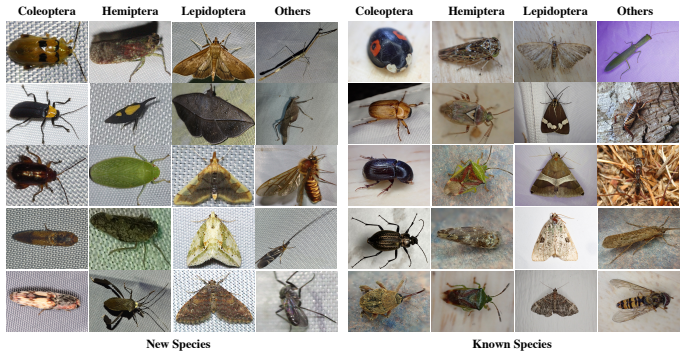
The central object is the TerraIncognita dataset itself: 200 species (100 known, 100 novel) with roughly 450 high-resolution images, where known images come from iNaturalist research-grade entries and novel images come from light-trap field collection in Central and South America with partial expert labels. Evaluation uses a fixed zero-shot prompt asking for the four-level hierarchy with 'Unknown' for uncertain levels; metrics include discovery accuracy (correct abstention on novel and confident species-level on known), hierarchical F1, and expert-reviewed explanation categories such as morphological hallucination and taxonomic overreach.
What would settle it
Conduct a reverse image search of the 237 novel images against public and commercial image corpora likely used in model training; if a substantial fraction return near-duplicate matches, the discovery accuracy results would measure memorization. Alternatively, run the identical prompt on an open-weight model whose training data is known to exclude these species and compare its discovery accuracy to the API models; if the open model performs similarly, the claim of open-world generalization is strengthened, but if it performs much worse, the API models' scores may reflect training contamination.
Extended reading notes
Core claim
On its own terms, the paper establishes that current frontier vision-language models possess coarse taxonomic competence but not fine-grained species identification under zero-shot conditions. Across 100 known species and 100 novel, field-collected species, the same models that exceed 90 percent Order-level F1 score below 2 percent Species-level F1, and on novel specimens they either overcommit to unsupported genus or species labels or abstain, with no consistent strategy across model families. The paper interprets this as evidence that open-world species discovery is beyond current models, while coarse-level triage is feasible.
Load-bearing premise
The load-bearing premise is that the 100 field-collected Novel specimens are effectively unseen by the evaluated models; the paper acknowledges it cannot verify the training data of closed API models, so the discovery accuracy results could partly reflect familiarity instead of open-world generalization.
Editorial extensions
If this is right
- Frontier models could serve as automatic pre-screeners that flag likely novel specimens for expert review, but cannot yet replace taxonomists at the species level.
- The sharp order-to-species drop suggests model representations encode coarse morphological or contextual cues but not diagnostic fine-grained traits.
- The wide variance in discovery accuracy (55-88 percent) shows abstention behavior is not reliable and needs targeted training or calibration.
- Quarterly dataset refresh with new field specimens provides a way to longitudinally track whether future models improve or simply memorize familiar images.
- The qualitative failure modes (hallucination, overreach) argue for explanation-aware evaluation in addition to label accuracy.
Reading between the lines
- If the novel images are indeed absent from training corpora, the 55-88 percent discovery accuracy reflects genuine open-set detection; for closed API models that assumption remains unverifiable.
- The contrast between near-perfect Order accuracy and near-zero Species accuracy on the same images suggests models rely on global shape or background cues rather than diagnostic anatomy, a hypothesis that could be tested with occlusion or cropping experiments.
- The benchmark's design could be extended beyond insects to other hyperdiverse taxa, and its quarterly updates could double as a contamination monitor for future model releases.
- A testable extension is to fine-tune an open model on iNaturalist species and re-evaluate on the same known set; if the Species-level gap does not close, the 2 percent result points to dataset bias rather than model limits.
Editorial analysis
A structured set of objections, weighed in public.
Referee Report
Summary. The paper introduces TerraIncognita, a benchmark for evaluating vision-language models on hierarchical taxonomic classification of insects, using two subsets: Known species (iNaturalist images with full labels) and Novel species (field-collected images of rare, potentially undescribed taxa with only partial labels). The authors evaluate 12 frontier multimodal models under a unified zero-shot prompting protocol, reporting order-level F1 above 90% for some models, species-level F1 below 2% for most, and a discovery-accuracy range of 55–88% on novel specimens. They also provide a qualitative expert review of model explanations, identifying failure modes such as morphological hallucination and taxonomic overreach, and commit to quarterly dataset updates.
Significance. If the reported numbers hold, TerraIncognita is a valuable addition to biodiversity AI evaluation: it uses real field-collected images of rare taxa rather than simulated novelty, involves expert entomological curation, evaluates a broad set of frontier models under a controlled prompt, and includes a structured qualitative analysis of model reasoning. The sharp drop from coarse- to fine-grained taxonomic accuracy is a clinically clear finding, and the public dataset plus longitudinal update plan are concrete strengths. However, the central quantitative claims currently rest on an underspecified metric and an unverifiable novelty assumption, so the benchmark's immediate usefulness depends on whether these issues are resolved.
major comments (5)
- [§4.1, Table 3] The discovery-accuracy metric is not precisely defined. The text says that for Novel images, 'the correct behavior is abstention (i.e., predicting “Unknown”) at the Species or higher levels, depending on label availability.' Because Table 1 reports that the Novel set has 43 distinct genera and only 12 species-level labels, it is unclear whether a model must abstain at the finest available label or only at Species. Without a per-image scoring rule, the reported values (55.27–87.76) cannot be reproduced. Please provide the exact algorithm, the raw per-image predictions, and code that maps predictions to the reported numbers.
- [§3.1, §5] The claim that the Novel specimens are 'unseen by the model' is asserted rather than verified. Since the evaluated models are closed API systems, the paper cannot rule out that the 100 Novel images or near-duplicates appeared in training data. The Section 3.1 clarification appropriately softens the language to 'very rare, and for which almost surely few (or no) labeled images exist,' but the abstract and Section 5 still interpret the 55–88% numbers as open-world discovery accuracy. This is a load-bearing assumption for the paper's central message. I recommend reframing the results as measuring behavior on rare, expert-curated specimens, and adding a control experiment, such as testing on iNaturalist species that were collected after model training cutoffs, to bound the contamination risk.
- [Abstract, Table 4] The abstract's statement that species-level F1 drops 'below 2%' is contradicted by Table 4, where Gemini-2.5-Flash achieves 3.00% Species F1. The accurate claim is that all models are below 3%, and only one exceeds 2%. Please correct the abstract and the corresponding sentence in Section 5 so that the quantitative summary matches the reported data.
- [Tables 3 and 4] The evaluation reports point estimates without confidence intervals or significance tests. Given that the Novel subset has only 237 images and the Known subset 200, the spread among mid-range discovery-accuracy values (e.g., 75.11 vs. 75.53) is within binomial noise, and even the reported range of 55.27–87.76 would benefit from interval estimates. The paper states that 'All TerraIncognita data, results, and future updates are available,' but the current supplement does not include the raw per-image model outputs, the scoring script, or code to reproduce Tables 3 and 4. Please release these artifacts to make the benchmark reproducible.
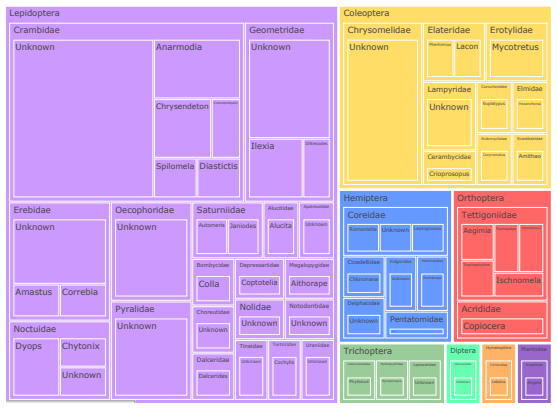
- [Table 1, §7.3] There is an internal inconsistency about the number of Novel specimens with genus-level labels. Table 1 reports 43 distinct genera and 12 species-level labels in the Unknown category, while Section 7.3 states that 'we include five examples labeled up to Genus.' Since the discovery-accuracy rubric depends on available label depth, this discrepancy affects the denominator of the metric and must be reconciled.
minor comments (4)
- [Table 3] The column header 'F1.' is unexplained; please define how the F1 value combines Known and Novel discovery accuracy, or rename it to something unambiguous.
- [Figure 3] The figure caption includes the stray text 'Loading [MathJax]/extensions/MathMenu.js', which appears to be a rendering artifact and should be removed.
- [§5, Comparative trends] The observation 'Gemini 2.5 models' is inaccurate because only one Gemini model (Gemini-2.5-Flash) is evaluated.
- [§4 and §7.2] The prompt description in Figure 4 asks for explanations of 50–60 words per level, while Prompt 1 in Section 7.2 requests no explanations and Prompt 2 requests a comma-separated format. Please clarify which prompt was used for which quantitative result, since both are referenced as the evaluation framework.
Circularity Check
No significant circularity: the paper is an empirical benchmark evaluation with no fitted parameters or derived predictions; the acknowledged unverifiable novelty assumption is a construct-validity caveat, not a circular derivation.
full rationale
This paper introduces a dataset and reports measured performance of frontier VLMs. There is no derivation chain, no fitted parameter renamed as a prediction, and no equation whose output is defined by its input. The only potentially circular-looking move is the definition of 'novel' in Section 3.1 as 'species that are unseen by the model — that is, species that are very rare, and for which almost surely few (or no) labeled images exist in the model’s training data,' followed by interpreting abstention as discovery accuracy. However, this is not a formal reduction: the benchmark's claim is conditional on that assumption, and the paper explicitly disclaims 'new to science' status and acknowledges that rigorous verification is outside its scope. If the assumption fails, the results would be less informative, but the evaluation is not constructed so that the desired outcome is forced by definition. A few citations involve overlapping authors (e.g., BioTrove [10] and OOD work [23]), but they are used as related work and are not load-bearing for the headline results, which come from newly collected field images and live API queries. No self-definitional, fitted-input, or self-citation circularity is exhibited, so the appropriate score is 0.
Assumptions & free parameters
assumptions (5)
- domain assumption Novel species are almost surely absent from VLM training data.
- domain assumption iNaturalist research-grade labels are accurate ground truth for known species.
- domain assumption Expert Order and Family labels for novel specimens are reliable enough for scoring.
- domain assumption Closed API model outputs are zero-shot and untainted by benchmark-specific fine-tuning.
- domain assumption The small, Lepidoptera-skewed sample supports reported aggregate F1 differences.
Cite this review
Pith. "Pith review of TerraIncognita: A Dynamic Benchmark for Species Discovery Using Frontier Models." pith.science (2026). https://pith.science/paper/6QB6LDC7
@misc{pith2026250603182,
  author       = {Pith},
  title        = {Pith review of: TerraIncognita: A Dynamic Benchmark for Species Discovery Using Frontier Models},
  year         = {2026},
  howpublished = {\url{https://pith.science/paper/6QB6LDC7}},
  note         = {Machine review of arXiv:2506.03182}
}
abstract
The rapid global loss of biodiversity, particularly among insects, represents an urgent ecological crisis. Current methods for insect species discovery are manual, slow, and severely constrained by taxonomic expertise, hindering timely conservation actions. We introduce TerraIncognita, a dynamic benchmark designed to evaluate state-of-the-art multimodal models for the challenging problem of identifying unknown, potentially undescribed insect species from image data. Our benchmark dataset combines a mix of expertly annotated images of insect species likely known to frontier AI models, and images of rare and poorly known species, for which few/no publicly available images exist. These images were collected from underexplored biodiversity hotspots, realistically mimicking open-world discovery scenarios faced by ecologists. The benchmark assesses models' proficiency in hierarchical taxonomic classification, their capability to detect and abstain from out-of-distribution (OOD) samples representing novel species, and their ability to generate explanations aligned with expert taxonomic knowledge. Notably, top-performing models achieve over 90\% F1 at the Order level on known species, but drop below 2\% at the Species level, highlighting the sharp difficulty gradient from coarse to fine taxonomic prediction (Order $\rightarrow$ Family $\rightarrow$ Genus $\rightarrow$ Species). TerraIncognita will be updated regularly, and by committing to quarterly dataset expansions (of both known and novel species), will provide an evolving platform for longitudinal benchmarking of frontier AI methods. All TerraIncognita data, results, and future updates are available \href{https://baskargroup.github.io/TerraIncognita/}{here}.
Figures

Figures from the paper (3 more)


Reference graph
Works this paper leans on
-
[1]
Numbers of insects (species and individuals)
Smithsonian Institution. Numbers of insects (species and individuals). https://www.si.edu/ spotlight/buginfo/bugnos. Accessed: 2025-05-06
work page 2025
-
[2]
Nigel E Stork, Michael JW Boyle, Carl Wardhaugh, and Roger A Beaver. What can an analysis of australian tropical rainforest bark beetles suggest about the missing millions of earth’s insect species? Insect Conservation and Diversity, 17(6):1156–1166, 2024
work page 2024
-
[3]
Terry L. Erwin. Tropical forests: Their richness in coleoptera and other arthropod species. The Coleopterists Bulletin, 36(1):74–75, 1982
work page 1982
-
[4]
Smithsonian Institution. Forces of change. Website, 2025. Accessed: May 14, 2025
work page 2025
-
[5]
Xprize rainforest names limelight rainforest winner of biodi- versity tech competition
XPRIZE Foundation. Xprize rainforest names limelight rainforest winner of biodi- versity tech competition. https://www.xprize.org/prizes/rainforest/articles/ xprize-rainforest-names-limelight-rainforest-winner-of-biodiversity-tech-competition ,
-
[6]
Our team | limelight rainforest
Limelight Rainforest Team. Our team | limelight rainforest. https://www. limelightrainforest.org/ourteam, 2024. Accessed: 2025-05-15
work page 2024
-
[7]
From bugs and birds to drones and dna
Wake Forest Magazine. From bugs and birds to drones and dna. https://magazine.wfu. edu/2025/01/27/from-bugs-and-birds-to-drones-and-dna , 2025. Accessed: 2025- 05-15
work page 2025
-
[8]
Experts in insect taxonomy threat- ened with extinction, reveals first european red list
International Union for Conservation of Nature. Experts in insect taxonomy threat- ened with extinction, reveals first european red list. https://iucn.org/news/202212/ experts-insect-taxonomy-threatened-extinction-reveals-first-european-red-list , 12 2022. IUCN news article. Accessed: 2025-05-15
work page 2022
Show all 41 references
-
[9]
BioCLIP: A vision foundation model for the tree of life
Samuel Stevens, Jiaman Wu, Matthew J Thompson, Elizabeth G Campolongo, Chan Hee Song, David Edward Carlyn, Li Dong, Wasila M Dahdul, Charles Stewart, Tanya Berger-Wolf, Wei- Lun Chao, and Yu Su. BioCLIP: A vision foundation model for the tree of life. In Proceedings of the IEE...
2024
-
[10]
Chih-Hsuan Yang, Benjamin Feuer, Zaki Jubery, Zi K. Deng, Andre Nakkab, Md Zahid Hasan, Shivani Chiranjeevi, Kelly Marshall, Nirmal Baishnab, Asheesh K Singh, Arti Singh, Soumik Sarkar, Nirav Merchant, Chinmay Hegde, and Baskar Ganapathysubramanian. Biotrove: A large curated i...
2024
-
[11]
Wang, Xiaoliang Huo, Joakim Bruslund Haurum, Scott C
ZeMing Gong, Austin T. Wang, Xiaoliang Huo, Joakim Bruslund Haurum, Scott C. Lowe, Graham W. Taylor, and Angel X. Chang. CLIBD: Bridging vision and genomics for biodiversity monitoring at scale. arXiv preprint, 2024
2024
-
[12]
The inaturalist species classification and detection dataset
Grant Van Horn, Oisin Mac Aodha, Yang Song, Yin Cui, Chen Sun, Alex Shepard, Hartwig Adam, Pietro Perona, and Serge Belongie. The inaturalist species classification and detection dataset. In 2018 IEEE/CVF Conference on Computer Vision and Pattern Recognition, pages 8769–8778, 2018
2018
-
[13]
What is gbif? https://www.gbif.org/ what-is-gbif
GBIF: The Global Biodiversity Information Facility. What is gbif? https://www.gbif.org/ what-is-gbif. Accessed: 2025-05-05
2025
-
[14]
Benchmarking Representation Learning for Natural World Image Collections
Grant Van Horn, Elijah Cole, Sara Beery, Kimberly Wilber, Serge Belongie, and Oisin MacAodha. Benchmarking Representation Learning for Natural World Image Collections . In 2021 IEEE/CVF Conference on Computer Vision and Pattern Recognition (CVPR), pages 12879–12888, Los Alamit...
2021
-
[15]
Scheirer, Anderson de Rezende Rocha, Archana Sapkota, and Terrance E
Walter J. Scheirer, Anderson de Rezende Rocha, Archana Sapkota, and Terrance E. Boult. Toward open set recognition. IEEE Transactions on Pattern Analysis and Machine Intelligence, 35(7):1757–1772, 2013. 10
2013
-
[16]
Yanayacu biological station and center for creative studies.https: //www.facebook.com/Yanayacustation/, 2025
Yanayacu Biological Station. Yanayacu biological station and center for creative studies.https: //www.facebook.com/Yanayacustation/, 2025. Biological research station located in Cosanga, Napo, Ecuador. Accessed: 2025-05-15
2025
-
[17]
Pitkin, Nadine Hilt, and Konrad Fiedler
Gunnar Brehm, Linda M. Pitkin, Nadine Hilt, and Konrad Fiedler. Montane andean rain forests are a global diversity hotspot of geometrid moths. Journal of Biogeography, 32(9):1621–1627, 2005
2005
-
[18]
A new led lamp for the collection of nocturnal lepidoptera and a spectral comparison of light-trapping lamps
Gunnar Brehm. A new led lamp for the collection of nocturnal lepidoptera and a spectral comparison of light-trapping lamps. Nota Lepidopterologica, 40:87–108, 2017
2017
-
[19]
Moths are strongly attracted to ultraviolet and blue radiation
Gunnar Brehm, Julia Niermann, Luisa Maria Jaimes Nino, David Enseling, Thomas Jüstel, Jan Christoph Axmacher, Eric Warrant, and Konrad Fiedler. Moths are strongly attracted to ultraviolet and blue radiation. Insect Conservation and Diversity, 14(2):188–198, 2021
2021
-
[20]
Lowe, Jaclyn T.A
Zahra Gharaee, ZeMing Gong, Nicholas Pellegrino, Iuliia Zarubiieva, Joakim Bruslund Haurum, Scott C. Lowe, Jaclyn T.A. McKeown, Chris C.Y . Ho, Joschka McLeod, Yi-Yun C Wei, Jireh Agda, Sujeevan Ratnasingham, Dirk Steinke, Angel X. Chang, Graham W. Taylor, and Paul Fieguth. A ...
2023
-
[21]
Lowe, ZeMing Gong, Pablo Millan Arias, Nicholas Pellegrino, Austin T
Zahra Gharaee, Scott C. Lowe, ZeMing Gong, Pablo Millan Arias, Nicholas Pellegrino, Austin T. Wang, Joakim Bruslund Haurum, Iuliia Zarubiieva, Lila Kari, Dirk Steinke, Graham W. Taylor, Paul Fieguth, and Angel X. Chang. BIOSCAN-5M: A multimodal dataset for insect biodiversity....
2024
-
[22]
A baseline for detecting misclassified and out-of-distribution examples in neural networks
Dan Hendrycks and Kevin Gimpel. A baseline for detecting misclassified and out-of-distribution examples in neural networks. CoRR, abs/1610.02136, 2016
2016 arXiv
-
[23]
Singh, Soumik Sarkar, Arti Singh, and Baskar Ganapathysubramanian
Mojdeh Saadati, Aditya Balu, Shivani Chiranjeevi, Talukder Zaki Jubery, Asheesh K. Singh, Soumik Sarkar, Arti Singh, and Baskar Ganapathysubramanian. Out-of-distribution detection algorithms for robust insect classification. Plant Phenomics, 6:0170, 2024
2024
-
[24]
Abhijit Bendale and Terrance E. Boult. Towards Open Set Deep Networks . In 2016 IEEE Conference on Computer Vision and Pattern Recognition (CVPR) , pages 1563–1572, Los Alamitos, CA, USA, June 2016. IEEE Computer Society
2016
-
[25]
Out-of-distribution detection via deep multi-comprehension ensemble, 2024
Chenhui Xu, Fuxun Yu, Zirui Xu, Nathan Inkawhich, and Xiang Chen. Out-of-distribution detection via deep multi-comprehension ensemble, 2024
2024
-
[26]
Dietterich
Dan Hendrycks, Mantas Mazeika, and Thomas G. Dietterich. Deep anomaly detection with outlier exposure. CoRR, abs/1812.04606, 2018
2018 arXiv
-
[27]
Feed two birds with one scone: Exploiting wild data for both out-of-distribution generalization and detection, 2023
Haoyue Bai, Gregory Canal, Xuefeng Du, Jeongyeol Kwon, Robert Nowak, and Yixuan Li. Feed two birds with one scone: Exploiting wild data for both out-of-distribution generalization and detection, 2023
2023
-
[28]
Neco: Neural collapse based out-of-distribution detection, 2024
Mouïn Ben Ammar, Nacim Belkhir, Sebastian Popescu, Antoine Manzanera, and Gianni Franchi. Neco: Neural collapse based out-of-distribution detection, 2024
2024
-
[29]
Christian Schmidt, Aditya Jain, Yves Basset, Sara Beery, Maxim Larrivée, and David Rolnick
Yuyan Chen, Nico Lang, B. Christian Schmidt, Aditya Jain, Yves Basset, Sara Beery, Maxim Larrivée, and David Rolnick. Open-set recognition of novel species in biodiversity monitoring, 2025
2025
-
[30]
Insectset459: an open dataset of insect sounds for bioacoustic machine learning, 2025
Marius Faiß, Burooj Ghani, and Dan Stowell. Insectset459: an open dataset of insect sounds for bioacoustic machine learning, 2025
2025
-
[31]
Taxonomic bias in biodiversity data and societal preferences
Julien Troudet, Philippe Grandcolas, Amandine Blin, Régine Vignes Lebbe, and Frédéric Legendre. Taxonomic bias in biodiversity data and societal preferences. Scientific Reports, 7, 12 2017. 11
2017
-
[32]
Shiyu Liang, Yixuan Li, and R. Srikant. Principled detection of out-of-distribution examples in neural networks. CoRR, abs/1706.02690, 2017
2017 arXiv
-
[33]
Owens, and Yixuan Li
Weitang Liu, Xiaoyun Wang, John D. Owens, and Yixuan Li. Energy-based out-of-distribution detection. CoRR, abs/2010.03759, 2020
2010 arXiv
-
[34]
Long-tailed out-of-distribution detection via normalized outlier distribution adaptation, 2024
Wenjun Miao, Guansong Pang, Jin Zheng, and Xiao Bai. Long-tailed out-of-distribution detection via normalized outlier distribution adaptation, 2024
2024
-
[35]
Learning multiple layers of features from tiny images
Alex Krizhevsky. Learning multiple layers of features from tiny images. University of Toronto, 05 2012
2012
-
[36]
Open-set recognition in the age of vision-language models
Dimity Miller, Niko Sünderhauf, Alex Kenna, and Keita Mason. Open-set recognition in the age of vision-language models. In ECCV, page 1–18, Berlin, Heidelberg, 2024. Springer-Verlag
2024
-
[37]
Benchmarking out-of-distribution detection in visual question answering
Xiangxi Shi and Stefan Lee. Benchmarking out-of-distribution detection in visual question answering. In 2024 IEEE/CVF Winter Conference on Applications of Computer Vision (WACV), pages 5473–5483, 2024
2024
-
[38]
Classifying the unknown: Insect identification with deep hierarchical bayesian learning
Sarkhan Badirli, Christine Johanna Picard, George Mohler, Frannie Richert, Zeynep Akata, and Murat Dundar. Classifying the unknown: Insect identification with deep hierarchical bayesian learning. Methods in Ecology and Evolution, 14(6):1515–1530, 2023
2023
-
[39]
Open-set recognition: a good closed-set classifier is all you need?, 2022
Sagar Vaze, Kai Han, Andrea Vedaldi, and Andrew Zisserman. Open-set recognition: a good closed-set classifier is all you need?, 2022
2022
-
[40]
From coarse to fine-grained open-set recognition
Nico Lang, Vésteinn Snæbjarnarson, Elijah Cole, Oisin Mac Aodha, Christian Igel, and Serge Belongie. From coarse to fine-grained open-set recognition. In Proceedings of the IEEE/CVF Conference on Computer Vision and Pattern Recognition (CVPR), pages 17804–17814, June 2024. 7 S...
2024
-
[2024]
Accessed: 2025-05-15
2025
Reviewed August 7, 2026 · model on record in the stance chip above.
Discussion (0). Sign in to comment.