REVIEW 6 major objections 5 minor 34 references
Unleashing the Reasoning Potential of Pre-trained LLMs by Critique Fine-Tuning on One Problem
T0 review · 6 major / 5 minor · reviewed 2026-08-07 · deepseek-v4-flash
Pith's one-line read One problem's critiques lift math reasoning by 15 points
desk verdict One-shot CFT on a single problem is a real, surprisingly effective post-training recipe, but the paper needs a decontamination check and confidence intervals before the gains can be taken at face value. read the letter →
The pith
A machine-rendered reading of the paper's core claim, the machinery that carries it, and where it could break.
The reading
What carries the argument
The central object is the one-shot CFT dataset: for a seed problem, 100 candidate solutions from 10 generators (Qwen, MiMo, DeepSeek-R1-Distill, Phi-4 variants), each critiqued by 7 teacher models (Claude, GPT-4.1, GPT-4o, O3-Mini, O1), filtered to 600 examples. Training is full-parameter instruction tuning with a fixed recipe (learning rate 5e-6, batch size 512, cosine schedule), where the loss supervises generation of the critique given the problem plus candidate solution. This contrasts with SFT, which supervises generating the answer itself; the critique format forces the model to analyze steps, catch errors, and reason about correctness, which the paper argues transfers across tasks and domains.
What would settle it
Run a decontamination scan comparing the four seed problems (pi1, pi2, pi13, pi1209) and their paraphrases against the test sets of AMC23, AIME24, AIME25, and OlympiadBench, then re-evaluate one-shot CFT on the subset of items with no near-duplicate; if the gains collapse to near zero on the clean subset, the central claim of transferred reasoning is falsified. A complementary test is to train on one seed problem from a completely disjoint source, such as a fresh competition problem published after the benchmark's cutoff, and check whether the same average gain of about 15 points reappears.
Extended reading notes
Core claim
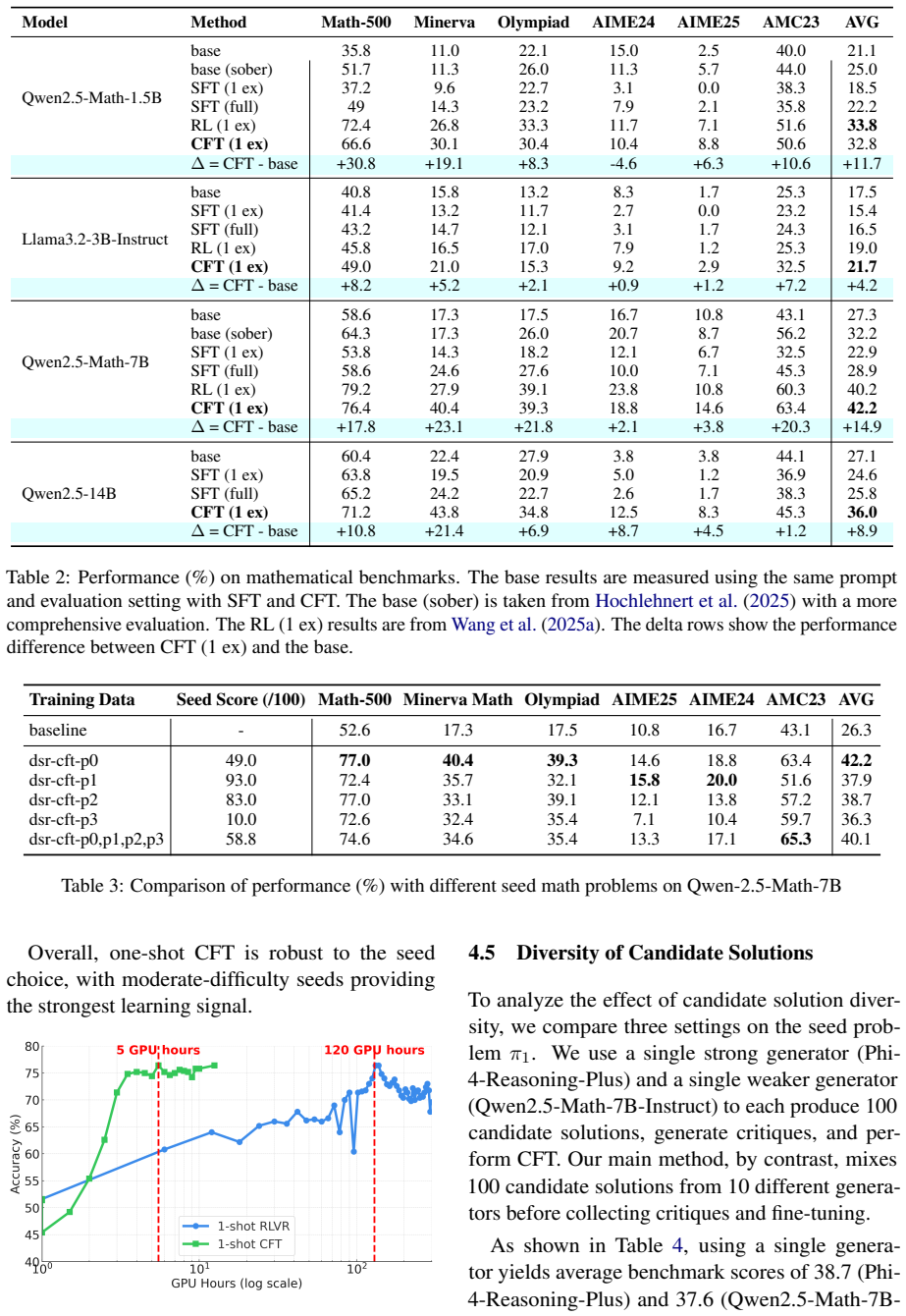
For a fixed seed problem, the authors generate 100 candidate solutions from ten open-source models, have seven proprietary teacher models write detailed critiques of each solution, filter out inconsistent critiques, and keep 600 (problem, solution) to critique training pairs. Fine-tuning a base model on these pairs, learning to critique rather than to solve, produces large gains on six math benchmarks (MATH-500, Minerva, OlympiadBench, AIME24, AIME25, AMC23) and three BIG-Bench Extra Hard logic subtasks. The strongest result is Qwen2.5-Math-7B rising from a re-evaluated baseline of 32.2% to 42.2% average accuracy, with the method beating one-shot SFT, full-data SFT, and roughly matching one-shot RLVR while using 1/15 to 1/20 of the compute. The paper interprets this as evidence that pre-trained models already contain the reasoning skills and that critique supervision, with its exposure to diverse errors, is a particularly effective way to unleash them.
Load-bearing premise
The four seed problems are assumed to be absent from the evaluation benchmarks; if a seed or a near-variant appears in AMC23, AIME24, AIME25, or OlympiadBench, the reported gains partly measure memorization rather than transferred reasoning.
Editorial extensions
If this is right
- One-shot CFT can serve as a drop-in post-training step for base math models, raising Qwen2.5-Math-7B from 27.3% to 42.2% average accuracy in five GPU hours.
- Because the method beats SFT trained on the full 40.9K-example DeepScaleR set, critique supervision appears to be a more data-efficient training signal than imitation of reference solutions.
- The 1/15 to 1/20 compute advantage over one-shot RLVR suggests that dense critique feedback can substitute for trial-and-error reward search in low-data regimes.
- The gains extend beyond math: fine-tuning on one logic example improves all three BBEH subtasks, including cross-task transfer, so the effect is not specific to arithmetic.
- Moderate-difficulty seeds yield the richest critiques; seed pi1 (score 49/100) outperforms both trivial and very hard seeds, so data selection matters even at one-example scale.
Reading between the lines
- A decontamination check between the four DeepScaleR seed problems and evaluation sets like AMC23 and AIME24 would settle how much of the +20-point jumps reflect memorization versus transferred reasoning; the paper does not report one.
- If the mechanism is that critique training teaches self-verification, one-shot CFT might combine with test-time verifiers or self-consistency to push accuracy further, an extension the paper does not test.
- The same pipeline could be applied to non-math reasoning domains such as code or scientific QA, where large curated SFT datasets are scarce; the BBEH results hint at generality but do not establish it.
- The paper's stated limitation is that gains concentrate on weaker, less-aligned base models; applying CFT after strong alignment gives mixed results, suggesting the method is an unleashing step rather than a general capability adder.
Editorial analysis
A structured set of objections, weighed in public.
Referee Report
Summary. The paper proposes one-shot critique fine-tuning (CFT) as a compute-efficient alternative to reinforcement learning with verifiable rewards (RLVR). For each of four math seed problems from DeepScaleR, the authors collect 100 candidate solutions from 10 open-weight generators and 700 teacher critiques from 7 proprietary models, filter the data to 600 critiques per seed, and full-parameter fine-tune Qwen and Llama backbones (1.5B-14B) in about 5 GPU hours. They report average gains of up to 15 points on six math benchmarks and 16 points on three BBEH logic subtasks, claiming that one-shot CFT matches or exceeds one-shot RLVR at 1/15 to 1/20 of the training compute. The paper also includes ablations on seed choice, candidate-solution diversity, and model scale.
Significance. If the central claim holds, one-shot CFT is practically important: it suggests that a single carefully annotated problem can activate latent reasoning abilities with a cheaper and more stable training signal than RLVR. The paper has notable strengths: systematic evaluation across model families and scales, a comparison against full SFT on 40.9K examples, ablations on seed difficulty and generator diversity, and use of the sober baseline scores of Hochlehnert et al. (2025). However, the main generalization claim currently rests on an unverified disjointness assumption between the single training problem and the evaluation benchmarks, and the paper provides no confidence intervals for most small benchmarks. A mathematical error in the paper's own appendix training example further weakens confidence in the data-quality filtering. The result is plausible, but the evidence as presented does not yet fully support the strong generalization claim.
major comments (6)
- [§3.1, Appendix A.3, §4.1, §5.1] The four seed problems are drawn from the public DeepScaleR math-problem subset, and the evaluation benchmarks (MATH-500, Minerva, OlympiadBench, AIME24, AIME25, AMC23) come from the same public problem ecosystem. The paper reports no decontamination check, either exact-match or near-duplicate, between the seed problems and any evaluation benchmark; likewise, Section 5.1 does not state that the single BBEH training example is held out from the BBEH test set. Because a seed problem or a paraphrased near-variant appearing in a test set would inflate the reported gains by memorization rather than reasoning, the central generalization claim is not yet established. Please report exact and paraphrase overlap statistics for all seed problems against all evaluation sets, and rerun the evaluations after excluding any overlapping items.
- [Appendix A.1] The worked training example in Appendix A.1 is mathematically incorrect. For P = 32, A = 4, and k = 1/256, the equation P = k A V^3 gives V^3 = 2048 and V ≈ 12.70 mph, but the candidate solution and the teacher critique both give V = 12, and the critique's verification substitutes 12^3 = 1728 and incorrectly concludes that P = 32 (the correct value is 27). Since the method's entire signal is the teacher critique, a published example that endorses a wrong solution raises serious concerns about the quality of the critique data and the filtering process. Please correct the example, clarify its provenance, and audit the training data for similar endorsement errors.
- [§4.2, Table 2; §5.2, Table 5] No confidence intervals or standard deviations are reported for the benchmark averages. The paper says AIME24, AIME25, and AMC23 are evaluated 32 times, but Table 2 gives only the mean; the BBEH subtasks have 120-200 examples and appear to be single runs. In such small test sets, a difference of one or two points corresponds to one or two questions, so the claimed cross-model and cross-benchmark gains cannot be distinguished from noise without intervals. Please report standard deviations or bootstrap confidence intervals for all reported averages, and include per-problem breakdowns for the small benchmarks.
- [Abstract; §4.2, Table 2] The headline claim of a 15% average improvement for Qwen2.5-Math-7B is computed against the base average of 27.3, not against the base (sober) average of 32.2 that the paper itself adopts as the more rigorous reference point. Against the sober baseline, the CFT gain is +10.0 points, not +14.9. The paper should report all deltas consistently with respect to the sober baseline, or explicitly label the non-sober deltas and explain why they are used in the abstract.
- [§4.2, Table 2] The comparison between CFT and one-shot RLVR is not protocol-matched. The RL (1 ex) numbers are taken from Wang et al. (2025a), while the CFT and base numbers are produced under the sober evaluation protocol of Hochlehnert et al. (2025). Unless the RL checkpoints were re-evaluated under exactly the same prompt, sampling, and scoring scheme, the claim that CFT 'matches or exceeds RLVR' may conflate method differences with evaluation differences. Please re-evaluate the RL checkpoints under the same protocol, or add an explicit caveat that the comparison is cross-protocol.
- [§4.3, Figure 4] The '5 GPU hours' and '20x less compute' claims count only the fine-tuning phase. The method also requires generating 100 candidate solutions per seed with 10 models and 700 teacher critiques from proprietary APIs, which is a substantial, mostly uncounted cost. Please state the full end-to-end computational and data-acquisition budget, or explicitly scope the efficiency claim to the training phase.
minor comments (5)
- [§4.5, Table 4] The text and Table 4 are inconsistent: the text says the Phi-4 generator achieves 38.7 and the Qwen2.5 generator achieves 37.6, while the table rows show the opposite values.
- [§5.4, Table 7] The table and Section 5.4 refer to 'BBEH Mini' but this set is not defined in Section 5.1; please clarify how BBEH Mini was constructed and whether it is used in the main BBEH results.
- [§A.10, Table 8] The case study contains garbled LaTeX and a numerical typo: 'frac34 + 792' should be (34+79)/2, and the text says the true solutions are u = 39 and u = 895, but the correct second solution is 89, not 895.
- [Limitations] The Limitations paragraph states that CFT yields mixed results on already strong, well-aligned models; this caveat is important and should be reflected in the title and abstract, which currently state the generalization claim without this scope restriction.
- [Figure 1] The Figure 1 caption says 'average accuracy on six math benchmarks' but does not specify which backbone model is shown; please state the model and the baseline version (base or base sober) used for the reported averages.
Circularity Check
No circularity: one-shot CFT results are measured on external benchmarks; self-citations are provenance only.
full rationale
I walked the claimed derivation chain: the paper's central claim is that one-shot CFT, trained on 600 teacher critiques of candidate solutions to a single seed problem, improves accuracy on six math and three logic benchmarks. The chain contains no equation-level derivation that would make an output equal to an input. The training targets (critiques from proprietary teacher models) are generated from the seed problem alone and are independent of evaluation answers. Evaluation is on external benchmarks (MATH-500, Minerva, OlympiadBench, AIME24/25, AMC23, BBEH) with reported base and sober baselines from an independent group (Hochlehnert et al., 2025). The self-citations to Wang et al. (2025b) for CFT and Wang et al. (2025a) for 1-shot RLVR are provenance and comparison references, not load-bearing arguments: the reported gains are measured, not derived from those papers. The strongest validity threat—absence of a decontamination check between DeepScaleR seed problems and the public benchmarks—is an empirical leakage risk, not a circularity of the derivation. No fitted parameter is renamed as a prediction, and no uniqueness theorem is imported. Therefore no significant circularity: score 0.
Assumptions & free parameters
free parameters (4)
- learning rate =
5e-6
- global batch size =
512
- critique samples per seed =
600
- candidate solutions per seed =
100 (10 models x 10 solutions)
assumptions (3)
- domain assumption Teacher critiques generated by 7 proprietary LLMs are accurate and diverse enough to serve as a training signal.
- domain assumption The 500-problem MATH validation split is a valid proxy for selecting checkpoints without leaking into evaluation benchmarks.
- domain assumption The four DeepScaleR seed problems are disjoint from the evaluation benchmarks.
Cite this review
Pith. "Pith review of Unleashing the Reasoning Potential of Pre-trained LLMs by Critique Fine-Tuning on One Problem." pith.science (2026). https://pith.science/paper/63RDQTHZ
@misc{pith2026250603295,
  author       = {Pith},
  title        = {Pith review of: Unleashing the Reasoning Potential of Pre-trained LLMs by Critique Fine-Tuning on One Problem},
  year         = {2026},
  howpublished = {\url{https://pith.science/paper/63RDQTHZ}},
  note         = {Machine review of arXiv:2506.03295}
}
read the original abstract
We have witnessed that strong LLMs like Qwen-Math, MiMo, and Phi-4 possess immense reasoning potential inherited from the pre-training stage. With reinforcement learning (RL), these models can improve dramatically on reasoning tasks. Recent studies have shown that even RL on a single problem can unleash these models' reasoning capabilities. However, RL is not only expensive but also unstable. Even one-shot RL requires hundreds of GPU hours. This raises a critical question: Is there a more efficient way to unleash the reasoning potential of these powerful base LLMs? In this work, we demonstrate that Critique Fine-Tuning (CFT) on only one problem can effectively unleash the reasoning potential of LLMs. Our method constructs critique data by collecting diverse model-generated solutions to a single problem and using teacher LLMs to provide detailed critiques. We fine-tune Qwen and Llama family models, ranging from 1.5B to 14B parameters, on the CFT data and observe significant performance gains across diverse reasoning tasks. For example, with just 5 GPU hours of training, Qwen-Math-7B-CFT show an average improvement of 15% on six math benchmarks and 16% on three logic reasoning benchmarks. These results are comparable to or even surpass the results from RL with 20x less compute. Ablation studies reveal the robustness of one-shot CFT across different prompt problems. These results highlight one-shot CFT as a simple, general, and compute-efficient approach to unleashing the reasoning capabilities of modern LLMs.
Figures


Figures from the paper (1 more)
Reference graph
Works this paper leans on
-
[1]
online" 'onlinestring :=
ENTRY address archivePrefix author booktitle chapter edition editor eid eprint eprinttype howpublished institution journal key month note number organization pages publisher school series title type volume year doi pubmed url lastchecked label extra.label sort.label short.list INTEGERS output.state before.all mid.sentence after.sentence after.block STRING...
-
[2]
write newline
" write newline "" before.all 'output.state := FUNCTION n.dashify 't := "" t empty not t #1 #1 substring "-" = t #1 #2 substring "--" = not "--" * t #2 global.max substring 't := t #1 #1 substring "-" = "-" * t #2 global.max substring 't := while if t #1 #1 substring * t #2 global.max substring 't := if while FUNCTION word.in bbl.in capitalize " " * FUNCT...
-
[3]
Marah Abdin, Sahaj Agarwal, Ahmed Awadallah, Vidhisha Balachandran, Harkirat Behl, Lingjiao Chen, Gustavo de Rosa, Suriya Gunasekar, Mojan Javaheripi, Neel Joshi, and 1 others. 2025. Phi-4-reasoning technical report. arXiv preprint arXiv:2504.21318
arXiv 2025
-
[4]
Josh Achiam, Steven Adler, Sandhini Agarwal, Lama Ahmad, Ilge Akkaya, Florencia Leoni Aleman, Diogo Almeida, Janko Altenschmidt, Sam Altman, Shyamal Anadkat, and 1 others. 2023. Gpt-4 technical report. arXiv preprint arXiv:2303.08774
arXiv 2023
-
[5]
Anthropic. 2025. Claude 3.7 sonnet. https://www.anthropic.com/claude/sonnet. Accessed: 2025-05-18
work page 2025
-
[6]
Quy-Anh Dang and Chris Ngo. 2025. Reinforcement learning for reasoning in small llms: What works and what doesn't. arXiv preprint arXiv:2503.16219
arXiv 2025
-
[7]
Xinrun Du, Yifan Yao, Kaijing Ma, Bingli Wang, Tianyu Zheng, King Zhu, Minghao Liu, Yiming Liang, Xiaolong Jin, Zhenlin Wei, and 1 others. 2025. Supergpqa: Scaling llm evaluation across 285 graduate disciplines. arXiv preprint arXiv:2502.14739
arXiv 2025
-
[8]
Alexander D Goldie, Chris Lu, Matthew T Jackson, Shimon Whiteson, and Jakob Foerster. 2024. Can learned optimization make reinforcement learning less difficult? Advances in Neural Information Processing Systems, 37:5454--5497
work page 2024
Show all 34 references
-
[9]
Daya Guo, Dejian Yang, Haowei Zhang, Junxiao Song, Ruoyu Zhang, Runxin Xu, Qihao Zhu, Shirong Ma, Peiyi Wang, Xiao Bi, and 1 others. 2025. Deepseek-r1: Incentivizing reasoning capability in llms via reinforcement learning. arXiv preprint arXiv:2501.12948
2025 arXiv
-
[10]
Chaoqun He, Renjie Luo, Yuzhuo Bai, Shengding Hu, Zhen Thai, Junhao Shen, Jinyi Hu, Xu Han, Yujie Huang, Yuxiang Zhang, and 1 others. 2024. Olympiadbench: A challenging benchmark for promoting agi with olympiad-level bilingual multimodal scientific problems. In Proceedings of ...
2024
-
[11]
Dan Hendrycks, Collin Burns, Saurav Kadavath, Akul Arora, Steven Basart, Eric Tang, Dawn Song, and Jacob Steinhardt. 2021. Measuring mathematical problem solving with the math dataset. arXiv preprint arXiv:2103.03874
2021 arXiv
-
[12]
Andreas Hochlehnert, Hardik Bhatnagar, Vishaal Udandarao, Samuel Albanie, Ameya Prabhu, and Matthias Bethge. 2025. A sober look at progress in language model reasoning: Pitfalls and paths to reproducibility. arXiv preprint arXiv:2504.07086
2025
-
[13]
Maximilian Igl, Gregory Farquhar, Jelena Luketina, Wendelin Boehmer, and Shimon Whiteson. 2020. Transient non-stationarity and generalisation in deep reinforcement learning. arXiv preprint arXiv:2006.05826
2020 arXiv
-
[14]
Aaron Jaech, Adam Kalai, Adam Lerer, Adam Richardson, Ahmed El-Kishky, Aiden Low, Alec Helyar, Aleksander Madry, Alex Beutel, Alex Carney, and 1 others. 2024. Openai o1 system card. arXiv preprint arXiv:2412.16720
2024 arXiv
-
[15]
Mehran Kazemi, Bahare Fatemi, Hritik Bansal, John Palowitch, Chrysovalantis Anastasiou, Sanket Vaibhav Mehta, Lalit K Jain, Virginia Aglietti, Disha Jindal, Peter Chen, and 1 others. 2025. Big-bench extra hard. arXiv preprint arXiv:2502.19187
2025 arXiv
-
[16]
Aitor Lewkowycz, Anders Andreassen, David Dohan, Ethan Dyer, Henryk Michalewski, Vinay Ramasesh, Ambrose Slone, Cem Anil, Imanol Schlag, Theo Gutman-Solo, and 1 others. 2022. Solving quantitative reasoning problems with language models. Advances in Neural Information Processin...
2022
-
[17]
Zihan Liu, Yang Chen, Mohammad Shoeybi, Bryan Catanzaro, and Wei Ping. 2024. Acemath: Advancing frontier math reasoning with post-training and reward modeling. arXiv preprint arXiv:2412.15084
2024 arXiv
-
[18]
Xueguang Ma, Qian Liu, Dongfu Jiang, Ge Zhang, Zejun Ma, and Wenhu Chen. 2025. General-reasoner: Advancing llm reasoning across all domains. arXiv preprint arXiv:2505.14652
2025 arXiv
-
[19]
Niklas Muennighoff, Zitong Yang, Weijia Shi, Xiang Lisa Li, Li Fei-Fei, Hannaneh Hajishirzi, Luke Zettlemoyer, Percy Liang, Emmanuel Cand \`e s, and Tatsunori Hashimoto. 2025. s1: Simple test-time scaling. arXiv preprint arXiv:2501.19393
2025 arXiv
-
[20]
OpenAI. 2025 a . Gpt-4.1. https://openai.com/index/gpt-4-1/. Accessed: 2025-05-18
2025
-
[21]
OpenAI. 2025 b . Introducing o3 and o4 mini. https://openai.com/index/introducing-o3-and-o4-mini/. Accessed: 2025-05-18
2025
-
[22]
Long Ouyang, Jeffrey Wu, Xu Jiang, Diogo Almeida, Carroll Wainwright, Pamela Mishkin, Chong Zhang, Sandhini Agarwal, Katarina Slama, Alex Ray, and 1 others. 2022. Training language models to follow instructions with human feedback. Advances in neural information processing sys...
2022
-
[23]
Rulin Shao, Shuyue Stella Li, Rui Xin, Scott Geng, Yiping Wang, Sewoong Oh, Simon Shaolei Du, Nathan Lambert, Sewon Min, Ranjay Krishna, Yulia Tsvetkov, Hannaneh Hajishirzi, Pang Wei Koh, and Luke Zettlemoyer. 2025. Spurious rewards: Rethinking training signals in rlvr. Notion Blog
2025
-
[24]
Zhihong Shao, Peiyi Wang, Qihao Zhu, Runxin Xu, Junxiao Song, Xiao Bi, Haowei Zhang, Mingchuan Zhang, YK Li, Y Wu, and 1 others. 2024. Deepseekmath: Pushing the limits of mathematical reasoning in open language models. arXiv preprint arXiv:2402.03300
2024 arXiv
-
[25]
Shubham Toshniwal, Ivan Moshkov, Sean Narenthiran, Daria Gitman, Fei Jia, and Igor Gitman. 2024. Openmathinstruct-1: A 1.8 million math instruction tuning dataset. Advances in Neural Information Processing Systems, 37:34737--34774
2024
-
[26]
Yiping Wang, Qing Yang, Zhiyuan Zeng, Liliang Ren, Lucas Liu, Baolin Peng, Hao Cheng, Xuehai He, Kuan Wang, Jianfeng Gao, and 1 others. 2025 a . Reinforcement learning for reasoning in large language models with one training example. arXiv preprint arXiv:2504.20571
2025 arXiv
-
[27]
Yubo Wang, Xueguang Ma, Ge Zhang, Yuansheng Ni, Abhranil Chandra, Shiguang Guo, Weiming Ren, Aaran Arulraj, Xuan He, Ziyan Jiang, and 1 others. 2024. Mmlu-pro: A more robust and challenging multi-task language understanding benchmark. In The Thirty-eight Conference on Neural I...
2024
-
[28]
Yubo Wang, Xiang Yue, and Wenhu Chen. 2025 b . Critique fine-tuning: Learning to critique is more effective than learning to imitate. arXiv preprint arXiv:2501.17703
2025 arXiv
-
[29]
Bingquan Xia, Bowen Shen, Dawei Zhu, Di Zhang, Gang Wang, Hailin Zhang, Huaqiu Liu, Jiebao Xiao, Jinhao Dong, Liang Zhao, and 1 others. 2025. Mimo: Unlocking the reasoning potential of language model--from pretraining to posttraining. arXiv preprint arXiv:2505.07608
2025 arXiv
-
[30]
An Yang, Anfeng Li, Baosong Yang, Beichen Zhang, Binyuan Hui, Bo Zheng, Bowen Yu, Chang Gao, Chengen Huang, Chenxu Lv, and 1 others. 2025. Qwen3 technical report. arXiv preprint arXiv:2505.09388
2025 arXiv
-
[31]
An Yang, Beichen Zhang, Binyuan Hui, Bofei Gao, Bowen Yu, Chengpeng Li, Dayiheng Liu, Jianhong Tu, Jingren Zhou, Junyang Lin, and 1 others. 2024. Qwen2. 5-math technical report: Toward mathematical expert model via self-improvement. arXiv preprint arXiv:2409.12122
2024 arXiv
-
[32]
Yixin Ye, Zhen Huang, Yang Xiao, Ethan Chern, Shijie Xia, and Pengfei Liu. 2025. Limo: Less is more for reasoning. arXiv preprint arXiv:2502.03387
2025 arXiv
-
[33]
Xiang Yue, Xingwei Qu, Ge Zhang, Yao Fu, Wenhao Huang, Huan Sun, Yu Su, and Wenhu Chen. 2024. Mammoth: Building math generalist models through hybrid instruction tuning. In The Twelfth International Conference on Learning Representations
2024
-
[34]
Weihao Zeng, Yuzhen Huang, Qian Liu, Wei Liu, Keqing He, Zejun Ma, and Junxian He. 2025. Simplerl-zoo: Investigating and taming zero reinforcement learning for open base models in the wild. arXiv preprint arXiv:2503.18892
2025 arXiv
Reviewed August 7, 2026 · model on record in the stance chip above.
Discussion (0). Sign in to comment.