REVIEW 3 major objections 4 minor 55 references
An 11-qubit atom processor in silicon
T0 review · 3 major / 4 minor · reviewed 2026-08-07 · deepseek-v4-flash
Pith's one-line read Two phosphorus-atom spin registers in silicon are coupled through electron exchange into a fully controlled 11-qubit processor, with two-qubit gate fidelities above 99.5% and GHZ entanglement across up to eight nuclear spins.
desk verdict A real experimental advance—two donor spin registers coherently linked by exchange—with an abstract that overstates the GHZ result by one qubit. read the letter →
The pith
A machine-rendered reading of the paper's core claim, the machinery that carries it, and where it could break.
The reading
What carries the argument
The load-bearing objects are multi-nuclear spin registers: small clusters of phosphorus atoms (4P and 5P) in isotopically purified silicon-28, in which each phosphorus nucleus is hyperfine-coupled to one shared electron. The electron acts as an ancilla for quantum-non-demolition readout and as the mediator of native multi-qubit gates; the two electrons are exchange-coupled, giving a voltage-tunable interconnect between registers. The essential identities are the electron-spin CROT gate, whose fidelity depends on the ratio $\Delta E_z / J$ and is kept high by operating at $J \approx 1.55$ MHz, far below the Larmor splitting, and the nuclear geometric CZ gate formed by a $2\pi$ ESR rotation. The argument is carried by scalable calibration: because ESR frequencies within a register shift collectively, all 96 resonance frequencies can be recalibrated with two reference measurements.
What would settle it
Perform full $3^N$-projection quantum state tomography on the $N=4$, 5, 6, 7 and 8 GHZ states and compare the reconstructed fidelities with the $N+1$-basis estimates. If the reconstructed fidelity for any $N \ge 4$ falls at or below 50%, or if it differs from the reduced estimate by more than the quoted uncertainties, the claim that entanglement persists for up to eight nuclear spins would fail.
Extended reading notes
Core claim
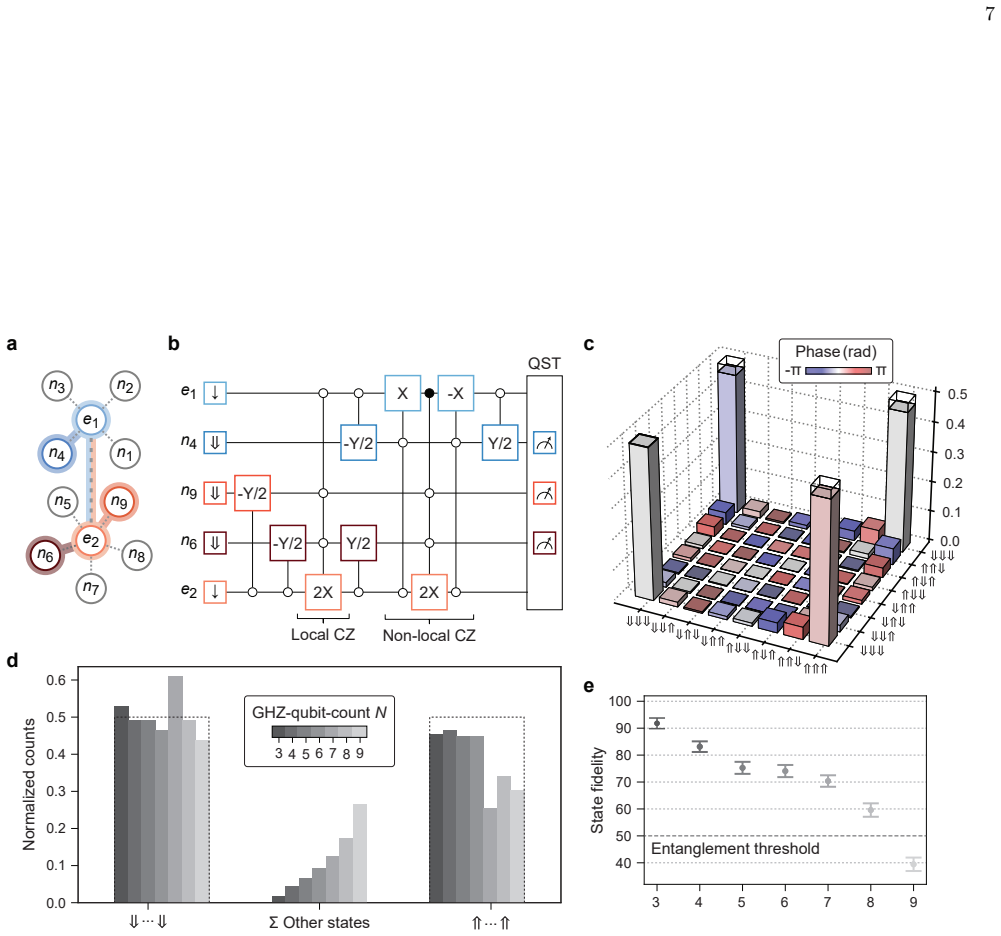
The central claim is that two physically separate donor spin registers can be integrated into one fully controlled quantum processor without degrading qubit performance. Each nuclear spin is hyperfine-coupled to a shared electron ancilla, and the two electrons are exchange-coupled with strength $J \approx 1.55$ MHz, tunable by voltage detuning. The authors use calibrated electron-spin-resonance and nuclear-magnetic-resonance drives to implement CROT gates on the electrons and geometric CZ gates on the nuclei, achieving two-qubit fidelities of 99.64(8)% for the electron-electron CROT and 99.90(4)% for a nuclear CZ. They verify all-to-all connectivity by preparing local Bell states with fidelity up to 99.5(1)% and non-local Bell states up to 97.0(2)%, and they report GHZ-state fidelities of 90.8(3)% for three nuclei and above 50% for up to eight nuclei, which is sufficient to witness genuine $N$-qubit entanglement.
Load-bearing premise
The claim of genuine entanglement for four to eight nuclear spins rests on the assumption that the reduced $N+1$-basis fidelity estimate is unbiased for these states and that the 50% fidelity threshold correctly witnesses genuine multipartite entanglement; full quantum state tomography was performed only for the three-qubit GHZ state.
Editorial extensions
If this is right
- A coherent exchange link now connects donor nuclear-spin registers without dropping below the 99% gate-fidelity threshold, so register-to-register operations can be used inside larger circuits.
- All nine nuclear data qubits can be pairwise entangled, so the processor supports all-to-all connectivity across both registers.
- GHZ states with up to eight entangled nuclear spins are witnessed, giving a multipartite-entanglement resource that extends beyond a single register.
- The recalibration protocol that scales linearly with the number of registers makes the control overhead tractable as registers are added.
- The paper reports the first silicon-spin two-qubit gate fidelity above 99.9%, reaching 99.90(4)% for a nuclear CZ gate.
Reading between the lines
- A modular scaling path follows if each additional register pair can be linked by the same exchange mechanism: the number of fully connected qubits grows by adding registers rather than by increasing cluster size, and the recalibration protocol already scales linearly with register count.
- The $N+1$-basis fidelity estimate used for $N \ge 4$ GHZ states could be validated directly by full tomography on a mid-size state; this would test whether the 50% entanglement witness is being applied to an unbiased fidelity.
- Because the off-resonant microwave power budget is compensated by fixed-frequency dummy drives, the protocol suggests a general method for keeping qubit frequencies stable during idle periods in any multi-qubit donor device.
- If exchange coupling can be made faster while preserving $J \ll \Delta E_z$, the interconnect speed would rise without sacrificing CROT fidelity, pointing toward faster inter-register gates.
Editorial analysis
A structured set of objections, weighed in public.
Referee Report
Summary. The paper reports an 11-qubit atom processor in silicon comprising two multi-nuclear phosphorus registers (a 4P register with nuclei n1–n4 and a 5P register with nuclei n5–n9), each with a shared ancilla electron, connected via tunable electron-exchange coupling. The authors demonstrate single-qubit randomized benchmarking fidelities above 99.9% for most qubits, a two-qubit CROT gate fidelity of 99.64(8)%, a nuclear CZ gate fidelity of 99.90(4)%, Bell-state preparation for all local and non-local nuclear pairs (with the best local Bell fidelity 99.5(1)% and best non-local 97.0(2)%), and GHZ states with fidelities above the 50% genuine-multipartite-entanglement witness for up to eight nuclear spins. The central claims are an effective interconnect between registers via exchange, scalable calibration, and high-fidelity operation across a fully connected 11-qubit system.
Significance. If the results hold, this is a notable advance for donor-based silicon quantum processors: it is the largest fully-connected donor spin system to date, the first exchange-based interconnect between multi-nuclear registers operating above the fault-tolerance threshold for the two-qubit gate, and it demonstrates genuine multipartite entanglement across a two-register architecture. Strengths include full quantum state tomography for local and non-local Bell states and a 3-qubit GHZ state, bootstrapped error bars on the RB fidelities, and public availability of raw data and analysis code via Zenodo.
major comments (3)
- [Abstract and Conclusion] The abstract states that the work demonstrates "GHZ states over all data qubits," but the Results state that "entanglement is maintained for up to 8 nuclear spins" and the Conclusion repeats "up to 8 nuclear spins." Since the processor contains nine nuclear data qubits (n1–n9), the phrase "over all data qubits" overstates the demonstrated capability. This is load-bearing because the abstract's central claim is the extension of entanglement to the full register. Please revise the wording to match the demonstrated 8-qubit GHZ states, or remove the claim of "all data qubits."
- [Abstract] The abstract also says "preparing both local and non-local Bell states with a record state fidelity beyond 99%." This is misleading: the local Bell states reach 99.5(1)% (Fig. 3d), but the non-local Bell states have fidelities ranging from 87.0(4)% to 97.0(2)% (Fig. 3h) with an average of 97.2(9)% for the fully-tomographed pair (Fig. 3g). As written, the sentence attributes a >99% fidelity to the non-local states as well. Please clarify that the >99% record applies to the local Bell states, or qualify the statement.
- [Results, Figure 4e and Methods] The GHZ fidelities for N=4 to N=8 are extracted with "a reduced measurement strategy that requires only N + 1 bases" (Results, Figure 4e), but the estimator's explicit form, the bases used, and its statistical properties are not given. The strategy is cited to refs. [35,36] and is cross-checked against full QST only at N=3. Since the 8-qubit genuine-entanglement claim rests on these fidelity values and on the 50% threshold, the authors should specify the estimator in the Methods and state whether it is an unbiased fidelity estimate or a rigorous lower bound for arbitrary states. Without this, the N>3 claims cannot be fully evaluated from the manuscript.
minor comments (4)
- [Supplementary Materials III] The phrase "we can increase increase the number" contains a duplicated word; please correct to "we can increase the number."
- [Supplementary Materials VI] The phrase "withing the multi-nuclear spin registers" should read "within the multi-nuclear spin registers."
- [Figure 4e] The horizontal axis extends to N=9, but no data point is shown for N=9; adding an explicit note or symbol clarifying that no nine-qubit GHZ is claimed would prevent misreading.
- [Figure 3b/f and Figure 4b] The term "2X gate" is used in circuits without a definition; please define it in the text or caption (e.g., as a 2π ESR rotation) so that readers not familiar with the donor-spin literature can follow the circuits.
Circularity Check
No circularity: all headline fidelities and entanglement results are measured via RB/QST, and the cross-register interconnect claim rests on new data rather than on a fitted or self-cited premise.
full rationale
The paper's quantitative claims are measured, not derived from the claim itself. Gate fidelities come from interleaved randomized benchmarking fits to decay curves (Methods, 'Randomised benchmarking'); Bell-state fidelities come from quantum state tomography; and the non-local Bell/GHZ data are newly acquired single-shot counts. The exchange link is characterized by measuring J about 1.55 MHz from the ESR spectrum and then independently benchmarking the CROT gate with 2Q-RB, yielding 99.64(8)%: the Rabi-frequency optimization is derived from J and the sinc node condition and then checked against the RB result, so there is no fitted-parameter-as-prediction loop. The GHZ fidelities for N greater than 3 use a reduced N+1-basis estimator cited to external references [35,36] and are cross-checked against full QST at N=3 (92(2)% versus 90.8(3)%); the 50% genuine-entanglement witness is cited to [37]. Self-citations to the group's prior work [3,4] supply the established CZ/Toffoli, readout and initialization methods, but the present interconnect result is not justified by those citations alone: the same gates are re-benchmarked here and the cross-register Bell/GHZ states are new data. Thus no circular reduction is present. Separately, the abstract's phrase 'GHZ states over all data qubits' is stronger than the Results' demonstrated 'up to 8 nuclear spins' of the nine data qubits; that is an internal-consistency/overclaim concern, not a circularity.
Assumptions & free parameters
assumptions (4)
- domain assumption The spin dynamics of each register are governed by the hyperfine interaction between the shared electron and all P nuclei, and the two electron spins are coupled by an exchange interaction J≈1.55 MHz that is tunable by gate detuning.
- domain assumption Randomized benchmarking extracts gate fidelity under the assumption of Markovian, gate-independent noise.
- standard math A GHZ-state fidelity above 50% witnesses genuine N-qubit entanglement.
- standard math The reduced N+1-basis fidelity estimator of refs [35,36] faithfully estimates GHZ fidelity without full 3^N tomography.
Cite this review
Pith. "Pith review of An 11-qubit atom processor in silicon." pith.science (2026). https://pith.science/paper/G7TKXICP
@misc{pith2026250603567,
  author       = {Pith},
  title        = {Pith review of: An 11-qubit atom processor in silicon},
  year         = {2026},
  howpublished = {\url{https://pith.science/paper/G7TKXICP}},
  note         = {Machine review of arXiv:2506.03567}
}
read the original abstract
Phosphorus atoms in silicon are an outstanding platform for quantum computing as their nuclear spins exhibit coherence time over seconds. By placing multiple phosphorus atoms within a radius of a few nanometers, they couple via the hyperfine interaction to a single, shared electron. Such a nuclear spin register enables multi-qubit control above the fault-tolerant threshold and the execution of small-scale quantum algorithms. To achieve quantum error correction, fast and efficient interconnects have to be implemented between spin registers while maintaining high fidelity across all qubit metrics. Here, we demonstrate such integration with a fully controlled 11-qubit atom processor composed of two multi-nuclear spin registers which are linked via electron exchange interaction. Through the development of scalable calibration and control protocols, we achieve coherent coupling between nuclear spins using a combination of single- and multi-qubit gates with all fidelities ranging from 99.5% to 99.99%. We verify the efficient all-to-all connectivity by preparing both local and non-local Bell states with a record state fidelity beyond 99% and extend entanglement through the generation of Greenberger-Horne-Zeilinger (GHZ) states over all data qubits. By establishing high-fidelity operation across interconnected nuclear-spin registers, we realise a key milestone towards fault-tolerant quantum computation with atom processors.
Figures


Figures from the paper (1 more)
Reference graph
Works this paper leans on
-
[16]
S. G. J. Philips et al. , Universal control of a six- qubit quantum processor in silicon, Nature 609, 919–924 (2022)
work page 2022
-
[1]
B. E. Kane, A silicon-based nuclear spin quantum com- puter, Nature 393, 133–137 (1998)
work page 1998
-
[2]
P. Stano and D. Loss, Review of performance metrics of spin qubits in gated semiconducting nanostructures, Nature Reviews Physics 4, 672–688 (2022)
work page 2022
-
[3]
M. T. Mądzik et al. , Precision tomography of a three- qubit donor quantum processor in silicon, Nature 601, 348–353 (2022)
work page 2022
-
[4]
I. Thorvaldson et al. , Grover’s algorithm in a four- qubit silicon processor above the fault-tolerant threshold, Nature Nanotechnology 20, 472–477 (2025)
work page 2025
-
[5]
Burkard, T
G. Burkard, T. D. Ladd, A. Pan, J. M. Nichol, and J. R. Petta, Semiconductor spin qubits, Rev. Mod. Phys. 95, 025003 (2023)
2023
-
[6]
Takeda, A
K. Takeda, A. Noiri, T. Nakajima, T. Kobayashi, and S. Tarucha, Quantum error correction with silicon spin qubits, Nature 608, 682–686 (2022)
2022
-
[7]
S. Neyens et al. , Probing single electrons across 300-mm spin qubit wafers, Nature 629, 80–85 (2024)
work page 2024
Show all 55 references
-
[8]
Google Quantum AI and Collaborators , Quantum error correction below the surface code threshold, Nature 638, 920–926 (2024)
2024
-
[9]
Arute et al
F. Arute et al. , Quantum supremacy using a program- mable superconducting processor, Nature 574, 505–510 (2019)
2019
- [10]
-
[11]
Bluvstein et al
D. Bluvstein et al. , Logical quantum processor based on reconfigurable atom arrays, Nature 626, 58–65 (2023)
2023
-
[12]
A. M. J. Zwerver et al. , Qubits made by advanced semi- conductor manufacturing, Nature Electronics 5, 184–190 (2022)
2022
-
[13]
H. C. George et al. , 12-spin-qubit arrays fabricated on a 300 mm semiconductor manufacturing line, Nano Letters 25, 793–799 (2024)
2024
-
[14]
Borsoi et al
F. Borsoi et al. , Shared control of a 16 semiconductor quantum dot crossbar array, Nature Nanotechnology 19, 21–27 (2023)
2023
-
[15]
N. W. Hendrickx et al. , A four-qubit germanium quantum processor, Nature 591, 580–585 (2021)
2021
-
[17]
Zhang et al
X. Zhang et al. , Universal control of four singlet–triplet qubits, Nature Nanotechnology 20, 209–215 (2024)
2024
-
[18]
J. T. Muhonen et al. , Storing quantum information for 30 seconds in a nanoelectronic device, Nature Nanotech- nology 9, 986 (2014)
2014
-
[19]
Hsueh et al
Y.-L. Hsueh et al. , Hyperfine-mediated spin relaxation in donor-atom qubits in silicon, Phys. Rev. Res. 5, 023043 (2023)
2023
-
[20]
Fuechsle et al
M. Fuechsle et al. , A single-atom transistor, Nature Na- notechnology 7, 242–246 (2012)
2012
-
[21]
Reiner et al
J. Reiner et al. , High-fidelity initialization and control of electron and nuclear spins in a four-qubit register, Nature Nanotechnology 19, 605 (2024)
2024
-
[22]
L. M. K. Vandersypen et al. , Interfacing spin qubits in quantum dots and donors—hot, dense, and coherent, npj Quantum Information 3, 34 (2017)
2017
-
[23]
Sarkar et al
A. Sarkar et al. , Optimisation of electron spin qubits in electrically driven multi-donor quantum dots, npj Quantum Information 8, 127 (2022)
2022
-
[24]
Dijkema et al
J. Dijkema et al. , Cavity-mediated iswap oscillations between distant spins, Nature Physics 21, 168–174 (2024)
2024
-
[25]
He et al
Y. He et al. , A two-qubit gate between phosphorus donor electrons in silicon, Nature 571, 371 (2019)
2019
-
[26]
Noiri et al
A. Noiri et al. , Fast universal quantum gate above the fault-tolerance threshold in silicon, Nature 601, 338 (2022)
2022
-
[27]
A. R. Mills et al. , Two-qubit silicon quantum processor with operation fidelity exceeding 99%, Science Advances 8, eabn5130 (2022)
2022
-
[28]
Xue et al
X. Xue et al. , Quantum logic with spin qubits crossing the surface code threshold, Nature 601, 343 (2022)
2022
-
[30]
H. G. Stemp et al. , Tomography of entangling two-qubit logic operations in exchange-coupled donor electron spin qubits, Nature Communications 15 (2024)
2024
-
[31]
Kranz et al
L. Kranz et al. , The use of exchange coupled atom qubits as atomic-scale magnetic field sensors, Advanced Mater- ials 35, 2201625 (2023)
2023
-
[32]
Kalra, A
R. Kalra, A. Laucht, C. D. Hill, and A. Morello, Robust two-qubit gates for donors in silicon controlled by hyper- fine interactions, Physical Review X 4, 021044 (2014)
2014
-
[33]
, High-fidelity CNOT gate for donor elec- tron spin qubits in silicon, Physical Review Applied 19, 024068 (2023)
Kranz et al. , High-fidelity CNOT gate for donor elec- tron spin qubits in silicon, Physical Review Applied 19, 024068 (2023)
2023
-
[34]
H. G. Stemp et al. , (2025), arXiv:2503.06872 [quant-ph]
2025
-
[35]
Gühne, C.-Y
O. Gühne, C.-Y. Lu, W.-B. Gao, and J.-W. Pan, Toolbox for entanglement detection and fidelity estimation, Phys. Rev. A 76, 030305 (2007)
2007
-
[36]
S. A. Moses et al. , A race-track trapped-ion quantum processor, Physical Review X 13, 041052 (2023)
2023
-
[37]
Gühne and M
O. Gühne and M. Seevinck, Separability criteria for genu- ine multiparticle entanglement, New Journal of Physics 12, 053002 (2010)
2010
-
[38]
Nielsen et al
E. Nielsen et al. , Gate set tomography, Quantum 5, 557 (2021)
2021
-
[39]
G. A. L. White, C. D. Hill, F. A. Pollock, L. C. L. Hol- lenberg, and K. Modi, Demonstration of non-markovian process characterisation and control on a quantum pro- cessor, Nature Communications 11, 6301 (2020)
2020
-
[40]
Undseth et al
B. Undseth et al. , Hotter is easier: Unexpected temper- ature dependence of spin qubit frequencies, Physical Re- view X 13, 041015 (2023)
2023
-
[41]
S. J. Hile et al., Addressable electron spin resonance using donors and donor molecules in silicon, Science Advances 4, eaaq1459 (2018)
2018
-
[42]
Huang et al., Fidelity benchmarks for two-qubit gates in silicon, Nature 569, 532–536 (2019)
W. Huang et al., Fidelity benchmarks for two-qubit gates in silicon, Nature 569, 532–536 (2019)
2019
-
[43]
Barends et al
R. Barends et al. , Superconducting quantum circuits at the surface code threshold for fault tolerance, Nature 508, 500–503 (2014)
2014
-
[44]
ESR on NMR
T. F. Watson et al. , A programmable two-qubit quantum 10 processor in silicon, Nature 555, 633–637 (2018). SUPPLEMENTARY MATERIALS An 11-qubit atom processor in silicon Hermann Edlbauer, 1, 2 Junliang Wang, 1, 2 A. M. Saffat-Ee Huq, 1 Ian Thorvaldson, 1 Michael T. Jones, 1 Sai...
2018
-
[45]
Keith et al
D. Keith et al. , Ramped measurement technique for robust high-fidelity spin qubit readout, Science Advances 8, 0455 (2022)
2022
-
[46]
S. J. Hile et al. , Addressable electron spin resonance using donors and donor molecules in silicon, Science Advances 4, eaaq1459 (2018)
2018
-
[47]
Thorvaldson et al
I. Thorvaldson et al. , Grover’s algorithm in a four-qubit silicon processor above the fault-tolerant threshold, Nature Nan- otechnology 20, 472–477 (2025)
2025
-
[48]
Holmes et al
D. Holmes et al. , Improved placement precision of donor spin qubits in silicon using molecule ion implantation, Advanced Quantum Technologies 7, 2300316 (2024)
2024
-
[49]
J. J. Pla et al. , High-fidelity readout and control of a nuclear spin qubit in silicon, Nature 496, 334–338 (2013)
2013
-
[50]
Waldherr et al
G. Waldherr et al. , Quantum error correction in a solid-state hybrid spin register, Nature 506, 204–207 (2014)
2014
-
[51]
S. G. J. Philips et al. , Universal control of a six-qubit quantum processor in silicon, Nature 609, 919–924 (2022)
2022
-
[52]
Undseth et al
B. Undseth et al. , Hotter is easier: Unexpected temperature dependence of spin qubit frequencies, Physical Review X 13, 041015 (2023)
2023
-
[53]
Tanttu et al
T. Tanttu et al. , Assessment of the errors of high-fidelity two-qubit gates in silicon quantum dots, Nature Physics 20, 1804–1809 (2024)
2024
-
[54]
Kalra, A
R. Kalra, A. Laucht, C. D. Hill, and A. Morello, Robust two-qubit gates for donors in silicon controlled by hyperfine interactions, Physical Review X 4, 021044 (2014)
2014
-
[55]
, High-fidelity CNOT gate for donor electron spin qubits in silicon, Physical Review Applied 19, 024068 (2023)
Kranz et al. , High-fidelity CNOT gate for donor electron spin qubits in silicon, Physical Review Applied 19, 024068 (2023)
2023
-
[56]
Wu et al
Y.-H. Wu et al. , Hamiltonian phase error in resonantly driven CNOT gate above the fault-tolerant threshold, npj Quantum Information 10, 8 (2024)
2024
Reviewed August 7, 2026 · model on record in the stance chip above.
Discussion (0). Sign in to comment.