REVIEW 4 major objections 5 minor 44 references
GCFL: A Gradient Correction-based Federated Learning Framework for Privacy-preserving CPSS
T0 review · 4 major / 5 minor · reviewed 2026-08-07 · deepseek-v4-flash
Pith's one-line read GCFL claims that a server-side gradient projection—removing the component of one noisy client gradient that points along another—strips differential-privacy noise from federated updates and aligns clients toward the global optimum…
desk verdict GCFL applies the PCGrad projection from multi-task learning to DP-FL, but the paper's central denoising justification fails under its own assumptions, and the experiments are too narrow to rescue the claim. read the letter →
The pith
A machine-rendered reading of the paper's core claim, the machinery that carries it, and where it could break.
The reading
What carries the argument
The load-bearing mechanism is the gradient correction rule of Eq. (12): $\hat{g}_i^{\mathrm{cor}} = \hat{g}_i - \frac{\hat{g}_i \cdot \hat{g}_j}{\|\hat{g}_j\|^2}\hat{g}_j$, applied whenever the cosine similarity $\cos\phi_{ij}$ between two client gradients is negative. This projects $\hat{g}_i$ onto the normal plane of $\hat{g}_j$, eliminating the component of $\hat{g}_i$ that points along $\hat{g}_j$. The paper's justification is geometric: the uploaded gradient is a superposition of a true gradient and Gaussian DP noise; because all clients solve the same task their true gradients are nearly parallel, while the noise in high dimension is almost never aligned with any true gradient and often opposes it, so the projection deletes a noise-dominated component. The same operation also reduces the angle between client gradients, which the paper identifies as the mechanism for escaping local optima and correcting local drift under non-IID data.
What would settle it
Run GCFL with the correction step enabled versus disabled under identical DP noise on a family of models with decreasing width (e.g., 512, 128, 32 hidden units). The paper's geometric justification predicts the correction's accuracy benefit should shrink as dimensionality drops, because Gaussian noise becomes less orthogonal to the true gradient; if the benefit does not shrink — or if correction actually hurts on the wide model — the claimed orthogonality mechanism is not what drives the results.
Extended reading notes
Core claim
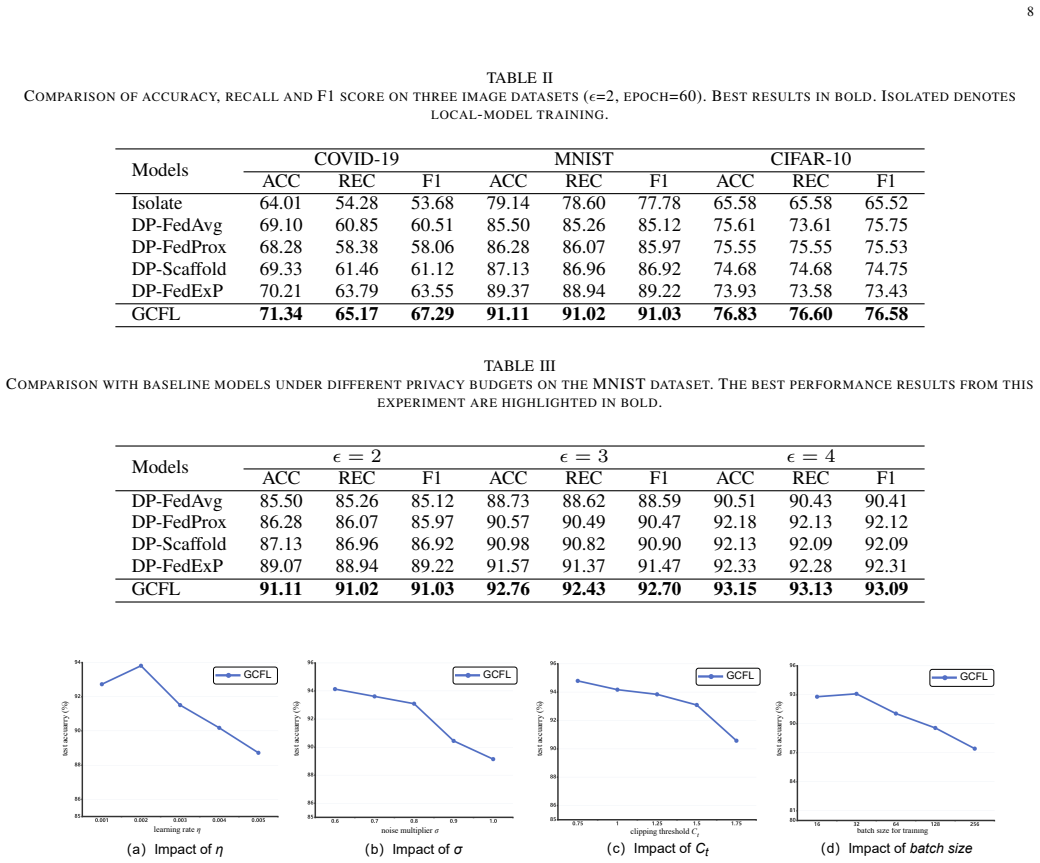
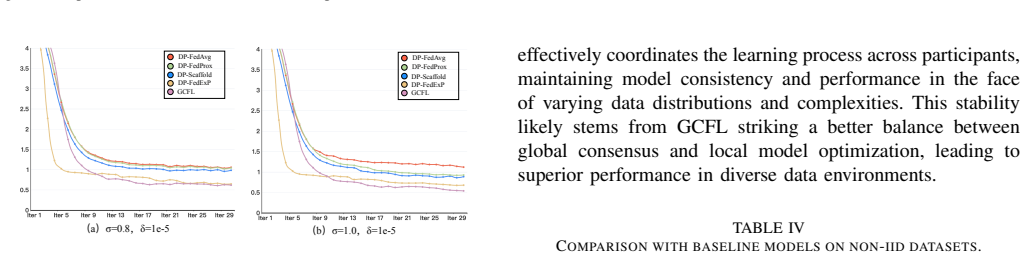
The central discovery is that a single geometric operation — subtracting the projection of one client's noisy gradient onto another client's gradient — acts simultaneously as a denoiser and as an alignment regularizer. Writing each uploaded gradient as a true gradient plus Gaussian DP noise, the paper argues that true gradients from different clients occupy similar directions, whereas the noise component in a high-dimensional parameter space is effectively random and may oppose the true direction. Projecting a conflicting gradient onto the normal plane of a reference gradient therefore removes the opposing component of the noise while leaving the shared signal nearly intact, and as a side effect it reduces the angle between client gradients, steering the averaged update toward the global optimum. The paper reports that at $\epsilon=2$ on MNIST, GCFL reaches 91.11% accuracy against 89.37% for the strongest baseline, and that its loss keeps decreasing at a noise multiplier of $\sigma=1.0$ where baseline loss curves plateau or oscillate.
Load-bearing premise
The method assumes that, before noise is added, all clients' true gradients point in roughly the same direction, and that Gaussian DP noise in a high-dimensional model is almost never aligned with those directions — so projecting a noisy gradient onto another client's gradient removes noise while leaving the true signal almost untouched; the paper states this in Section IV.B but never quantifies how aligned the true gradients must be or how orthogonal the noise actually is.
Editorial extensions
If this is right
- Under the same privacy budget, differentially private federated learning can be made more accurate by a server-side projection step that does not touch the DP guarantee, because post-processing of already-perturbed gradients preserves privacy.
- Training becomes stable under high noise: with noise multiplier $\sigma=1.0$, GCFL's loss keeps falling while baseline methods plateau or oscillate, so the framework extends usable privacy regimes for edge CPSS.
- Gradient alignment reduces the cost of data heterogeneity: on a two-client non-IID MNIST split, GCFL exceeds DP-FedAvg by 4.45 percentage points of accuracy.
- The added computation is modest, $O(M(N-M)D + KD)$ per round, making the correction affordable on resource-constrained servers.
- The benefit is largest on simpler datasets and strict privacy budgets, so the method is best suited to tasks where gradients are naturally well aligned.
Reading between the lines
- Because the correction is server-side post-processing, the same projection rule could be attached to any DP-FL aggregator — including FedProx, SCAFFOLD, or FedExP — without recomputing the privacy accountant; the gains over plain averaging in the paper suggest the rule is a transferable add-on.
- The geometric story implies a boundary condition the paper does not test: as model dimension shrinks or as client gradients genuinely conflict (beyond noise), the projection will begin deleting real signal, so GCFL's advantage should shrink for small models or extreme non-IID splits.
- The algorithm corrects each gradient sequentially against every conflicting peer, so the final corrected vector depends on the order in which pairs are processed; choosing a robust reference gradient (for example a median or averaged gradient) is a natural variant the paper leaves open.
- If a corrupted or Byzantine client supplies a misleading reference gradient, the projection could remove legitimate components from honest gradients; a robustness analysis against malicious references would be needed before deployment in untrusted CPSS settings.
Editorial analysis
A structured set of objections, weighed in public.
Referee Report
Summary. The paper proposes GCFL, a differentially private federated learning framework for CPSS. Clients train locally with DP-SGD (gradient clipping plus Gaussian noise) and upload noisy gradients; the server detects pairwise negative cosine similarity between client gradients and projects one gradient onto the normal plane of the other (Eq. 12) to 'denoise' and align updates. The authors claim state-of-the-art accuracy under the same privacy budget, based on experiments on COVID-19 Radiography, MNIST, and CIFAR-10 with two clients and an extreme label-partitioned non-IID split. The paper includes an algorithm pseudocode, parameter settings, and comparisons against DP-FedAvg, DP-FedProx, DP-Scaffold, and DP-FedExP.
Significance. If the central claim were correct, the paper would offer a simple server-side heuristic for mitigating DP noise in federated learning, which is a practically relevant problem. However, the theoretical justification for the projection mechanism is fundamentally flawed, and the experimental evidence is too limited and under-reported to support the state-of-the-art claim. The manuscript is clearly written and the algorithmic idea is easy to follow, but the load-bearing premise is not quantified and appears to be incorrect under standard vector analysis. The work does not, in its current form, provide a reliable contribution to the DP-FL literature.
major comments (4)
- [§IV.B, Eq. (12)] The claim that the projection 'does not significantly affect the original gradients' while removing noise is not supported by vector algebra. Let the true client gradients be a_i u and a_j u for a unit vector u, with independent isotropic Gaussian noises n_i and n_j. Projecting g_i = a_i u + n_i onto the normal plane of g_j = a_j u + n_j leaves a component along u approximately equal to a_i ||n_j||^2 / (a_j^2 + ||n_j||^2). When the reference gradient's noise is small (||n_j|| << a_j), the projection almost cancels the true gradient; when the reference noise is large, the correction removes only a negligible O(1/sqrt(d)) fraction of the independent noise because high-dimensional isotropic noises are nearly orthogonal. Thus the mechanism either destroys the useful update or is essentially inert, reversing the paper's stated intuition. Since this premise is the sole justification for the correction step, the central denoising claim is not established.
- [§V.A, Table I, non-IID description] All experiments use only N=2 clients, and the non-IID split for MNIST assigns labels 0-4 to client 1 and labels 5-9 to client 2. Under such label-disjoint heterogeneity, the assumption in §IV.B that 'original gradient directions usually do not have significant discrepancies' is implausible; true gradients on disjoint label sets can point in very different directions. Moreover, with N=2, Algorithm 1's nested loop reduces to a mutual orthogonalization of the two noisy gradients, which does not test the claimed multi-client denoising or alignment behavior. The paper's generalizations about multi-client FL are therefore not supported by the presented experimental design.
- [§V, Tables II and III] The paper claims comparisons 'under the same privacy budget' with epsilon = 2, 3, and 4, but it never provides the privacy accounting that maps the algorithm's parameters (noise multiplier sigma = 0.8, clipping threshold C_t = 1.5, delta = 1e-5, sampling rate, number of steps, and number of epochs) to those epsilon values. RDP composition is mentioned in §III but never applied to the reported settings. Without this accounting, the 'same privacy budget' comparisons are unverifiable, and the core privacy-utility trade-off claim is not substantiated. The privacy guarantee of the server-side projection itself is also not analyzed, despite the threat model in Definition 3.7 assuming a curious-but-honest server that sees individual noisy gradients.
- [§V.B, Tables II and IV; Figure 6] The experimental evidence is not statistically grounded. Section V.A states that reported results are the average of three independent runs, but no standard deviations or confidence intervals are given anywhere. The accuracy gaps between GCFL and the best baseline are small (e.g., 71.34 vs 70.21 on COVID-19, 76.83 vs 75.61 on CIFAR-10 in Table II; 88.98 vs 87.69 in Table IV) and may easily fall within run-to-run variance. Additionally, Table II's header says 'EPOCH=60' while Table I lists total epochs {30, 35, 80}, and the text does not clarify which setting produced Tables II and IV; the convergence plots in Figures 4-6 similarly lack error bars or repeated-run information.
minor comments (5)
- [Introduction, first paragraph] The acronym is introduced inconsistently: the text says 'Cyber-Physical Systems (CPSS)' in the Introduction, while the abstract and title use 'Cyber-Physical-Social Systems (CPSS)'. The correct expansion should be used consistently.
- [§III, Eq. (5)] The phrase 'w_i presents the model parameters' should be 'represents the model parameters'; the sentence is grammatically unclear as written.
- [Algorithm 1, lines 22-31] In the nested loop, the variable \hat g_i^{cor} is assigned inside the inner loop without being reset or accumulated for each i. If multiple j satisfy cos(phi_ij) < 0, the final assignment overwrites earlier projections, which is unlikely to be the intended correction. The pseudocode should be revised to make the update rule explicit.
- [Figures 3-6] Several figure labels contain the typo 'test accuarry' instead of 'test accuracy', and the axis labels are inconsistent across panels. The figures are difficult to read in the current rendering; please regenerate them.
- [§V.A, Datasets] The description of the COVID-19 Radiography dataset states a total of 21,165 images but lists 10,192 + 6,012 + 1,345 + 3,172 = 20,721; the arithmetic should be corrected.
Circularity Check
No derivation-chain circularity; the only circular flavor is test-set hyperparameter selection that partially inflates the MNIST state-of-the-art claim.
-
fitted input called prediction
[Section V-A (Experimental Setting) and Section V-B (Figure 3, MNIST test-accuracy sweeps)]
"Specifically, ... the learning rate η was tuned amongst {0.001,0.002,0.005}, and the gradient clipping threshold was set to 1.5. ... Figure 3 illustrates the impact of various hyperparameters on the GCFL framework. A peak accuracy of 93.81% is achieved with a learning rate η of 0.002."
The hyperparameters, including the learning rate, are selected by maximizing the MNIST test accuracy shown in Figure 3, and the same MNIST test set is then used to report GCFL's state-of-the-art accuracy in Tables II and III. Thus the reported MNIST result is not an independent prediction but the maximum of a test-set search; it is a fitted value relative to the evaluation set. This partially inflates the state-of-the-art claim on MNIST. The comparisons on COVID-19 and CIFAR-10, the non-IID experiments, and the projection heuristic itself are not forced by this fit, so the circularity is partial and localized to the MNIST evaluation.
full rationale
The paper's central contribution is an empirical federated-learning framework with a server-side gradient projection correction. No load-bearing result is derived from a fitted parameter or from a self-citation chain: the DP-SGD/FL setup is standard, the projection rule (Eq. 12) is an explicitly stated heuristic justified by an alignment assumption rather than by a theorem that presupposes the outcome, and the headline numbers come from experiments rather than from a derivation that assumes the conclusion. The only circularity-like element is in the evaluation protocol: learning-rate and other hyperparameters are selected using MNIST test accuracy (Figure 3), and the same MNIST test set is then used to report GCFL's headline comparisons (Tables II and III), so the MNIST SOTA is partially a test-set-selected value rather than an independent prediction. This does not undermine the independent comparisons on COVID-19/CIFAR-10 or the non-IID and speed experiments. There are no load-bearing self-citations; the projection-based denoising premise is a correctness/robustness concern, not a circular reduction.
Assumptions & free parameters
free parameters (5)
- learning_rate =
0.001, 0.002, or 0.005 (best 0.002)
- clipping_threshold C_t =
1.5
- noise_multiplier sigma =
0.8
- batch_size =
32 or 48
- number_of_clients =
2
assumptions (3)
- domain assumption Noise-free client gradients are aligned across clients
- domain assumption Gaussian DP noise is nearly orthogonal to true gradient directions in high-dimensional space
- standard math The server can apply arbitrary post-processing to noisy gradients without affecting the DP guarantee
Cite this review
Pith. "Pith review of GCFL: A Gradient Correction-based Federated Learning Framework for Privacy-preserving CPSS." pith.science (2026). https://pith.science/paper/M3O2KWEJ
@misc{pith2026250603618,
  author       = {Pith},
  title        = {Pith review of: GCFL: A Gradient Correction-based Federated Learning Framework for Privacy-preserving CPSS},
  year         = {2026},
  howpublished = {\url{https://pith.science/paper/M3O2KWEJ}},
  note         = {Machine review of arXiv:2506.03618}
}
read the original abstract
Federated learning, as a distributed architecture, shows great promise for applications in Cyber-Physical-Social Systems (CPSS). In order to mitigate the privacy risks inherent in CPSS, the integration of differential privacy with federated learning has attracted considerable attention. Existing research mainly focuses on dynamically adjusting the noise added or discarding certain gradients to mitigate the noise introduced by differential privacy. However, these approaches fail to remove the noise that hinders convergence and correct the gradients affected by the noise, which significantly reduces the accuracy of model classification. To overcome these challenges, this paper proposes a novel framework for differentially private federated learning that balances rigorous privacy guarantees with accuracy by introducing a server-side gradient correction mechanism. Specifically, after clients perform gradient clipping and noise perturbation, our framework detects deviations in the noisy local gradients and employs a projection mechanism to correct them, mitigating the negative impact of noise. Simultaneously, gradient projection promotes the alignment of gradients from different clients and guides the model towards convergence to a global optimum. We evaluate our framework on several benchmark datasets, and the experimental results demonstrate that it achieves state-of-the-art performance under the same privacy budget.
Figures


Figures from the paper (3 more)


Reference graph
Works this paper leans on
-
[1]
Deep reinforce- ment learning for solving the trip planning query,
C. Zhao, Y . Zhao, J. Li, N. Guo, R. Zhu, and T. Qiu, “Deep reinforce- ment learning for solving the trip planning query,” inAdvanced Data Mining and Applications, 2023, pp. 569–583
work page 2023
-
[2]
X. Zhou, W. Liang, A. Kawai, K. Fueda, J. She, and K. I.-K. Wang, “Adaptive segmentation enhanced asynchronous federated learning for sustainable intelligent transportation systems,”IEEE Transactions on Intelligent Transportation Systems, vol. 25, no. 7, pp. 6658–6666, 2024
work page 2024
-
[3]
Y . Sun, C. Liu, X. Tong, and B. Hu, “An integrated medical rec- ommendation mechanism combining promote product singular value decomposition and knowledge graph,” inAdvanced Data Mining and Applications, 2022, pp. 67–78
work page 2022
-
[4]
C2lrec: Causal contrastive learning for user cold-start rec- ommendation with social variable,
X. Xu, H. Dong, H. Xiang, X. Hu, X. Li, X. Xia, X. Zhang, L. Qi, and W. Dou, “C2lrec: Causal contrastive learning for user cold-start rec- ommendation with social variable,”ACM Transactions on Information Systems, 2025
work page 2025
-
[5]
W. Ding, M. Qian, C. Lu, J. Yi, H. Pu, and J. Luo, “Differential evolution with joint adaptation of mutation strategies and control parameters via distributed proximal policy optimization,”Tsinghua Science and Technology, 2024
work page 2024
-
[6]
A. Yao, G. Li, X. Li, F. Jiang, J. Xu, and X. Liu, “Differential privacy in edge computing-based smart city applications: Security issues, solutions and future directions,”Array, vol. 19, 2023
work page 2023
-
[7]
X. Zhou, Q. Yang, Q. Liu, W. Liang, K. Wang, Z. Liu, J. Ma, and Q. Jin, “Spatial–temporal federated transfer learning with multi-sensor data fusion for cooperative positioning,”Information Fusion, vol. 105, 2024
work page 2024
-
[8]
X. Xu, F. Wu, M. Bilal, X. Xia, W. Dou, L. Yao, and W. Zhong, “Xrl-shap-cache: an explainable reinforcement learning approach for intelligent edge service caching in content delivery networks,”Science China Information Sciences, vol. 67, no. 7, 2024
work page 2024
Show all 44 references
-
[9]
Decentralized federated graph learning with lightweight zero trust architecture for next-generation networking security,
X. Zhou, W. Liang, I. Kevin, K. Wang, K. Yada, L. T. Yang, J. Ma, and Q. Jin, “Decentralized federated graph learning with lightweight zero trust architecture for next-generation networking security,”IEEE Journal on Selected Areas in Communications, 2025
2025
-
[10]
Cyber attack detection in iot networks with small samples: Implementation and analysis,
V . A. Kanthuru, S. Rajasegarar, P. Rathore, R. R. M. Doss, L. Pan, B. Ray, M. Chowdhury, C. Srimathi, and M. A. S. Durai, “Cyber attack detection in iot networks with small samples: Implementation and analysis,” inAdvanced Data Mining and Applications, 2022, pp. 118–130
2022
-
[11]
Digital twin enhanced federated reinforcement learning with lightweight knowledge distillation in mobile networks,
X. Zhou, X. Zheng, X. Cui, J. Shi, W. Liang, Z. Yan, L. T. Yang, S. Shimizu, and K. I.-K. Wang, “Digital twin enhanced federated reinforcement learning with lightweight knowledge distillation in mobile networks,”IEEE Journal on Selected Areas in Communications, vol. 41, no. 10...
2023
-
[12]
Research on medical image classification based on improved fedavg algorithm,
R. Li, H. Wang, Q. Lu, J. Yan, S. Ji, and Y . Ma, “Research on medical image classification based on improved fedavg algorithm,”Tsinghua Science and Technology, 2025
2025
-
[13]
Federated anomaly detection with isolation forest for iot network traffics,
J. Li, X. Zhang, H. Xiang, and A. Beheshti, “Federated anomaly detection with isolation forest for iot network traffics,” in2023 IEEE 29th International Conference on Parallel and Distributed Systems (ICPADS), 2023, pp. 2622–2629
2023
-
[14]
Machine learning models that remember too much,
C. Song, T. Ristenpart, and V . Shmatikov, “Machine learning models that remember too much,” inProceedings of the 2017 ACM SIGSAC Conference on Computer and Communications Security, 2017, pp. 587– 601
2017
-
[15]
Pairing based anonymous and secure key agreement protocol for smart grid edge computing infrastructure,
K. Mahmood, X. Li, S. A. Chaudhry, H. Naqvi, S. Kumari, A. K. Sangaiah, and J. J. Rodrigues, “Pairing based anonymous and secure key agreement protocol for smart grid edge computing infrastructure,” Future Generation Computer Systems, vol. 88, pp. 491–500, 2018
2018
-
[16]
Information theoretic learning-enhanced dual-generative adversarial networks with causal representation for robust ood general- ization,
X. Zhou, X. Zheng, T. Shu, W. Liang, K. I.-K. Wang, L. Qi, S. Shimizu, and Q. Jin, “Information theoretic learning-enhanced dual-generative adversarial networks with causal representation for robust ood general- ization,”IEEE Transactions on Neural Networks and Learning System...
2023
-
[17]
Exploiting unintended feature leakage in collaborative learning,
L. Melis, C. Song, E. De Cristofaro, and V . Shmatikov, “Exploiting unintended feature leakage in collaborative learning,” in2019 IEEE Symposium on Security and Privacy, 2019, pp. 691–706
2019
-
[18]
Differentially private system for residential energy management via markov decision process,
Y . Tian, Y . Shi, and Y . Zhang, “Differentially private system for residential energy management via markov decision process,”Tsinghua Science and Technology, 2024
2024
-
[19]
Adap dp-fl: Differentially private federated learning with adaptive noise,
J. Fu, Z. Chen, and X. Han, “Adap dp-fl: Differentially private federated learning with adaptive noise,” in2022 IEEE International Conference on Trust, Security and Privacy in Computing and Communications, 2022, pp. 656–663
2022
-
[20]
Reconstructed graph neural network with knowledge distillation for lightweight anomaly detection,
X. Zhou, J. Wu, W. Liang, K. I.-K. Wang, Z. Yan, L. T. Yang, and Q. Jin, “Reconstructed graph neural network with knowledge distillation for lightweight anomaly detection,”IEEE Transactions on Neural Networks and Learning Systems, 2024
2024
-
[21]
Hierarchical federated learning with social context clustering-based participant selection for internet of medical things applications,
X. Zhou, X. Ye, I. Kevin, K. Wang, W. Liang, N. K. C. Nair, S. Shimizu, Z. Yan, and Q. Jin, “Hierarchical federated learning with social context clustering-based participant selection for internet of medical things applications,”IEEE Transactions on Computational Social System...
2023
-
[22]
A systematic review of homomorphic encryption and its contributions in healthcare industry,
K. Munjal and R. Bhatia, “A systematic review of homomorphic encryption and its contributions in healthcare industry,”Complex & Intelligent Systems, vol. 9, no. 4, pp. 3759–3786, 2023
2023
-
[23]
Communication-efficient learning of deep networks from decentralized data,
B. McMahan, E. Moore, D. Ramage, S. Hampson, and B. A. y. Arcas, “Communication-efficient learning of deep networks from decentralized data,” inArtificial Intelligence and Statistics, 2017, pp. 1273–1282
2017
-
[24]
Federated optimization in heterogeneous networks,
T. Li, A. K. Sahu, M. Zaheer, M. Sanjabi, A. Talwalkar, and V . Smith, “Federated optimization in heterogeneous networks,”Proceedings of Machine Learning and Systems, vol. 2, pp. 429–450, 2020
2020
-
[25]
Scaffold: Stochastic controlled averaging for federated learn- ing,
S. P. Karimireddy, S. Kale, M. Mohri, S. Reddi, S. Stich, and A. T. Suresh, “Scaffold: Stochastic controlled averaging for federated learn- ing,” inInternational conference on machine learning, 2020, pp. 5132– 5143
2020
-
[26]
Federated learning-based anomaly detection with isolation forest in the iot-edge continuum,
H. Xiang, X. Zhang, X. Xu, A. Beheshti, L. Qi, Y . Hong, and W. Dou, “Federated learning-based anomaly detection with isolation forest in the iot-edge continuum,”ACM Transactions on Multimedia Computing, Communications, and Applications, vol. 19, no. 11, 2024
2024
-
[27]
Blockchain- enabled secure, fair and scalable data sharing in zero-trust edge-end environment,
X. Xu, K. Meng, H. Xiang, G. Cui, X. Xia, and W. Dou, “Blockchain- enabled secure, fair and scalable data sharing in zero-trust edge-end environment,”IEEE Journal on Selected Areas in Communications, 2025
2025
-
[28]
Fedexp: Speeding up federated averaging via extrapolation,
D. Jhunjhunwala, S. Wang, and G. Joshi, “Fedexp: Speeding up federated averaging via extrapolation,” inProceedings of the 2023 International Conference on Learning Representations, 2023
2023
-
[29]
Model inversion attacks that exploit confidence information and basic countermeasures,
M. Fredrikson, S. Jha, and T. Ristenpart, “Model inversion attacks that exploit confidence information and basic countermeasures,” in Proceedings of the 22nd ACM SIGSAC Conference on Computer and Communications Security, 2015, pp. 1322–1333
2015
-
[30]
Inverting gra- dients—how easy is it to break privacy in federated learning?
J. Geiping, H. Bauermeister, H. Dr ¨oge, and M. Moeller, “Inverting gra- dients—how easy is it to break privacy in federated learning?”Advances in Neural Information Processing Systems, vol. 33, pp. 16 937–16 947, 2020
2020
-
[31]
Differential privacy,
C. Dwork, “Differential privacy,” inInternational Colloquium on Au- tomata, Languages, and Programming, 2006, pp. 1–12
2006
-
[32]
Data release for machine learning via correlated differential privacy,
H. Shen, J. Li, G. Wu, and M. Zhang, “Data release for machine learning via correlated differential privacy,”Information Processing & Management, vol. 60, no. 3, 2023
2023
-
[33]
Gaussian differential privacy,
J. Dong, A. Roth, and W. J. Su, “Gaussian differential privacy,”Journal of the Royal Statistical Society: Series B (Statistical Methodology), vol. 84, no. 1, pp. 3–37, 2022
2022
-
[34]
R ´enyi differential privacy,
I. Mironov, “R ´enyi differential privacy,” in2017 IEEE 30th Computer Security Foundations Symposium, 2017, pp. 263–275
2017
-
[35]
Practicing differential privacy in health care: A review,
F. K. Dankar and K. El Emam, “Practicing differential privacy in health care: A review,”Transactions on Data Privacy, vol. 6, no. 1, pp. 35–67, 2013
2013
-
[36]
Comparative analysis of local differential privacy schemes in healthcare datasets,
A. Hernandez-Matamoros and H. Kikuchi, “Comparative analysis of local differential privacy schemes in healthcare datasets,”Applied Sci- ences, vol. 14, no. 7, 2024
2024
-
[37]
Dpsur: Accelerating differentially private stochastic gradient descent using selective update and release,
J. Fu, Q. Ye, H. Hu, Z. Chen, L. Wang, K. Wang, and X. Ran, “Dpsur: Accelerating differentially private stochastic gradient descent using selective update and release,” inProceedings of the 50th International Conference on Very Large Data Bases, 2024, pp. 1175–1181
2024
-
[38]
Sa-dpsgd: Differentially private stochastic gradient descent based on simulated annealing,
J. Fu, Z. Chen, and X. Ling, “Sa-dpsgd: Differentially private stochastic gradient descent based on simulated annealing,”CoRR, 2022
2022
-
[39]
Personalized federated learning with model-contrastive learning for multi-modal user modeling in human-centric metaverse,
X. Zhou, Q. Yang, X. Zheng, W. Liang, K. I.-K. Wang, J. Ma, Y . Pan, and Q. Jin, “Personalized federated learning with model-contrastive learning for multi-modal user modeling in human-centric metaverse,” IEEE Journal on Selected Areas in Communications, vol. 42, no. 4, pp. 81...
2024
-
[40]
Federated distillation and blockchain empowered secure knowledge sharing for internet of medical things,
X. Zhou, W. Huang, W. Liang, Z. Yan, J. Ma, Y . Pan, and K. I.-K. Wang, “Federated distillation and blockchain empowered secure knowledge sharing for internet of medical things,”Information Sciences, vol. 662, 2024
2024
-
[41]
The algorithmic foundations of differential privacy,
C. Dwork, A. Rothet al., “The algorithmic foundations of differential privacy,”Foundations and Trends® in Theoretical Computer Science, vol. 9, no. 3–4, pp. 211–407, 2014. 12
2014
-
[42]
Higher order fractal belief r´enyi divergence with its applications in pattern classification,
Y . Huang, F. Xiao, Z. Cao, and C.-T. Lin, “Higher order fractal belief r´enyi divergence with its applications in pattern classification,”IEEE Transactions on Pattern Analysis and Machine Intelligence, 2023
2023
-
[43]
Hypothesis testing interpretations and r ´enyi differential privacy,
B. Balle, G. Barthe, M. Gaboardi, J. Hsu, and T. Sato, “Hypothesis testing interpretations and r ´enyi differential privacy,” inInternational Conference on Artificial Intelligence and Statistics, 2020, pp. 2496– 2506
2020
-
[44]
The advantages of the matthews correlation coefficient (mcc) over f1 score and accuracy in binary classification evaluation,
D. Chicco and G. Jurman, “The advantages of the matthews correlation coefficient (mcc) over f1 score and accuracy in binary classification evaluation,”BMC genomics, vol. 21, pp. 1–13, 2020. Jiayi Wanis currently pursuing a B.S. degree in Software Engineering at the School of S...
2020
Reviewed August 7, 2026 · model on record in the stance chip above.
Discussion (0). Sign in to comment.