REVIEW 2 major objections 4 minor 2 cited by
YOND: Practical Blind Raw Image Denoising Free from Camera-Specific Data Dependency
T0 review · 2 major / 4 minor · reviewed 2026-08-07 · deepseek-v4-flash
Pith's one-line read Trained only on synthetic noise, YOND generalizes to raw images from unknown cameras by combining coarse-to-fine noise estimation, expectation-matched variance stabilization, and an SNR-guided denoiser.
desk verdict Solid blind raw denoiser with genuinely useful modules, but the σSNR guidance mapping is under-specified and internally inconsistent; the results are plausible but the paper needs a major revision to document the actual scaling. read the letter →
The pith
A machine-rendered reading of the paper's core claim, the machinery that carries it, and where it could break.
The reading
What carries the argument
The load-bearing object is the reduction of arbitrary camera noise to a standard AWGN denoising problem. CNE fits $V=\alpha I+\sigma^2$ by least squares over flat-region masks, first on the noisy image and then on the noisy image with the variance of the coarse denoised image subtracted, giving the fine estimate $(\alpha_f,\sigma_f)$. EM-VST applies $f_{\hat\sigma}(z)=2\sqrt{z+3/8+\hat\sigma^2}$ and subtracts the bias function $e_{\hat\sigma}(x)=E(f_{\hat\sigma}(z)\mid x)-f_{\hat\sigma}(x)$ evaluated on the noisy image, so bias is corrected before denoising. SNR-Net is a UNet with residual SNR-Blocks that take the noise level $\sigma_{\mathrm{SNR}}$; because the stabilized noise has unit variance, $\sigma_{\mathrm{SNR}}$ is the reciprocal of the peak-to-noise ratio, giving the network an explicit dial for denoising strength. A DDIM-style iteration over SNR-Net (YOND-p) extends the same weights to generate detail when perceptual quality is wanted.
What would settle it
Synthesize raw images with known Poisson-Gaussian parameters across a wide signal range, run CNE+EM-VST, and measure the variance of transformed flat patches; if it deviates from 1, or if the estimated $\sigma_{\mathrm{SNR}}$ disagrees with the reciprocal of the measured SNR, the asserted reduction to AWGN fails and with it the blind generalization.
Extended reading notes
Core claim
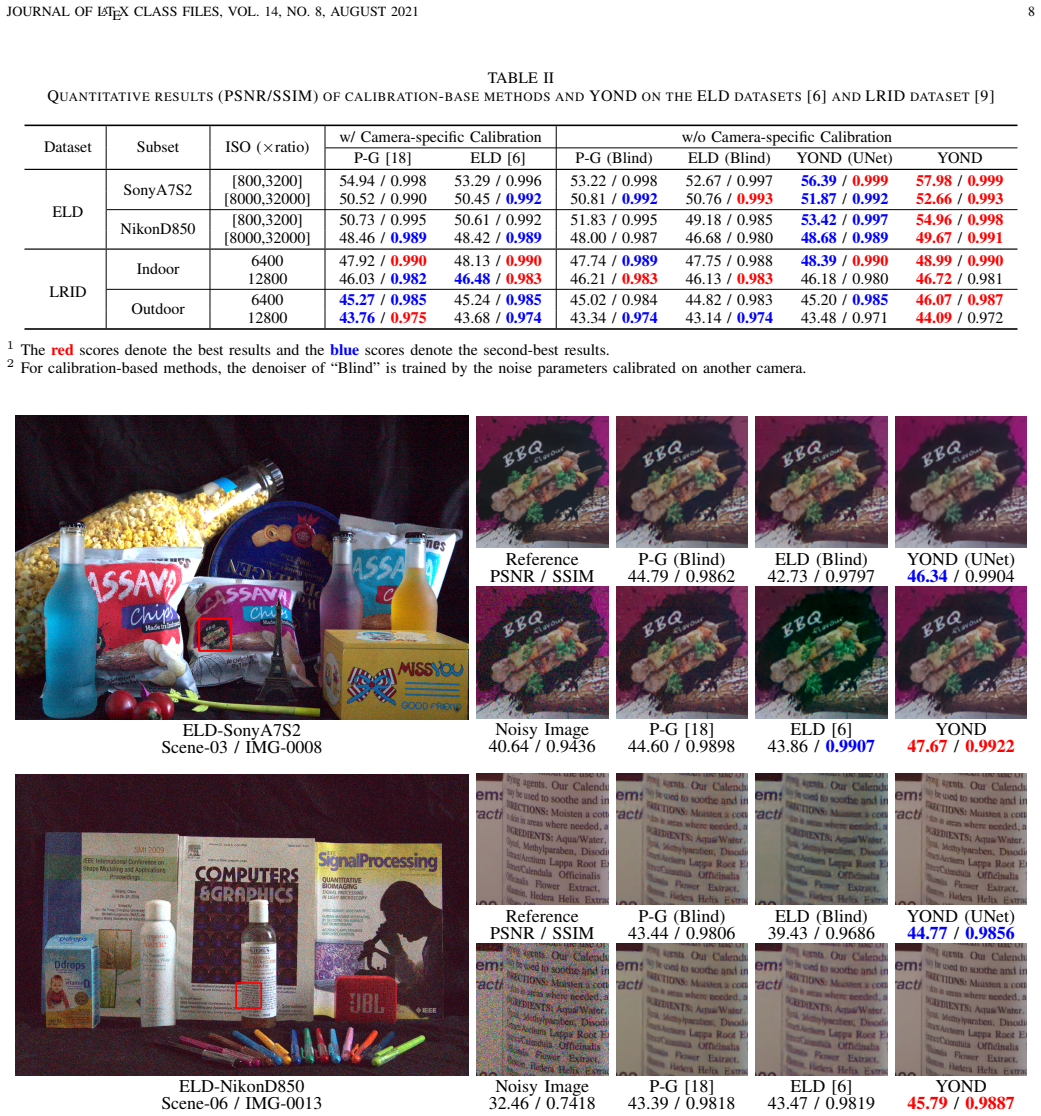
The central claim is that camera-specific data dependency in raw denoising can be broken by a 'denoise after you stabilize' strategy. YOND assumes each camera's noise is Poisson-Gaussian, estimates the two parameters ($\alpha$ and $\sigma$) from flat regions of the noisy image, then refines that estimate by subtracting the variance of a coarse denoised version; it then applies a generalized Anscombe transform whose expectation bias is corrected against the noisy image itself; and finally it feeds the resulting near-AWGN image, plus a noise level equal to the reciprocal of its SNR, to a UNet-style denoiser trained once on synthetic AWGN. The paper argues this removes the need for camera-specific training, and supports the claim with blind results on unknown cameras from ELD, LRID, SIDD, and DND that are higher in PSNR than calibration-based and self-supervised baselines in most tested configurations.
Load-bearing premise
The load-bearing premise is that an arbitrary camera's noise is Poisson-Gaussian and that after CNE and EM-VST it becomes additive white Gaussian noise whose standard deviation is the reciprocal of the SNR, and that this value lies in the range SNR-Net was trained on; if any part fails, the blind generalization claim collapses.
Editorial extensions
If this is right
- A single training run on synthetic AWGN suffices for deployment on cameras never seen in training, removing the standard per-camera calibration and paired-data collection steps.
- Users can trade noise removal against detail by adjusting $\sigma_{\mathrm{SNR}}$, so the same network serves multiple noise levels instead of needing one model per level.
- Because bias correction happens before denoising, EM-VST prevents low-light color bias even when the downstream denoiser is a diffusion model, not just a regressive UNet.
- The coarse-to-fine refinement improves noise parameter accuracy over single-step estimators, which the ablations show transfers into higher downstream PSNR on SIDD.
Reading between the lines
- Editorial inference: CNE plus EM-VST could be packaged as a camera-agnostic front end for any pretrained AWGN denoiser, making the blind-generalization claim testable independently of SNR-Net.
- Editorial inference: The same expectation-matching trick should transfer to other variance-stabilizing transformations with smooth bias functions, which would widen YOND's scope beyond Poisson-Gaussian noise while keeping the pre-correction logic.
- Editorial inference: The failure mode the paper identifies - texture-rich scenes where flat-region masks are unreliable - points to uncertainty-aware noise estimation as the most promising next step; manual $\sigma_{\mathrm{SNR}}$ adjustment handles the failure but leaves automation open.
Editorial analysis
A structured set of objections, weighed in public.
Referee Report
Summary. The paper proposes YOND, a blind raw-image denoising pipeline that combines coarse-to-fine noise estimation (CNE), an expectation-matched variance-stabilizing transform (EM-VST), and a controllable AWGN denoiser (SNR-Net) trained once on synthetic data. The pipeline estimates per-image Poisson-Gaussian noise parameters, transforms the noisy raw image to approximately Gaussian noise, corrects the VST bias before denoising, and feeds the transformed image and an SNR-derived noise level to a lightweight UNet. The authors report superior PSNR/SSIM over camera-specific calibration-based and self-supervised baselines on ELD, LRID, SIDD, and DND datasets, and they propose an optional DDIM-based iterative extension (YOND-p) for generative detail synthesis. The central claim is that YOND generalizes to unseen cameras without camera-specific training data.
Significance. If the result holds, YOND would be a practically important step toward camera-agnostic raw denoising. The method is evaluated on multiple external benchmarks with per-image noise estimation, which avoids the circularity of fitting noise parameters to the test set, and the paper explicitly discusses challenging cases and model limitations. The proposed EM-VST bias correction is a sensible and well-motivated improvement over UIAT for low-light regions, and the pipeline-level design makes the method amenable to manual control. The main weakness is that the mapping from the VST output to the conditioning input of SNR-Net is unspecified, which currently prevents reproduction and, if taken literally, contradicts both the unit-variance assumption and the network's training range. With a precise specification of this scaling, the central claims would be substantially supported.
major comments (2)
- [Section III-D, Algorithm 1, Section V-A3] The definition of σ_SNR is internally inconsistent and the actual conditioning procedure is not described. Section III-D states that after VST the noise variance is approximately 1 and defines σ_SNR as the reciprocal of the SNR, i.e., 1/peak of the transformed image. For typical VST outputs with peak values of 10–100, this yields σ_SNR ≈ 0.01–0.1, far below the training range σ∈[5,50] reported in Section IV-A1. Yet Section V-A3 reports a concrete instance with σ_SNR=32.87 'after VST'—a value unreachable from the reciprocal-of-SNR rule (it would require a transformed peak of ≈0.03) and incompatible with a unit-variance VST. The paper never specifies whether the VST output is rescaled before being fed to SNR-Net, how σ_SNR is computed in the actual code, or how the conditioning is normalized to match the training distribution. Since the entire blind-deployment claim rests on SNR-Net correctly processing VST-transformed data under the stated guidance mapping, this missing normalization/scaling must be specified and validated, e.g., by reporting the distribution of σ_SNR values on the evaluated datasets.
- [Section V-A1] The paper reports that YOND achieves state-of-the-art results on 68.44% of SIDD patches and acknowledges 'noticeable degradation' in texture-rich scenarios, but does not report the average PSNR/SSIM on the remaining 31.56% or how the baselines behave on those patches. Because the abstract claims robust generalization, a quantitative breakdown of the failure cases (e.g., comparison of the worst-decile performance against baselines) would help the reader calibrate the scope of the central claim.
minor comments (4)
- [Section V-A1] In the paragraph beginning 'Next, we will we introduce', the duplicated word 'we' should be removed for readability.
- [Section IV-A1] The sentence 'The learning rate will vary with each epoch in a cosine annealing manner' is grammatically awkward; consider rewording to 'The learning rate follows a cosine annealing schedule across epochs.'
- [Figure 6 caption] The units 'e-' and 'read noise (e-)' are not defined, and the horizontal axis is logarithmic but this is not stated in the caption; please clarify the axis labels and units.
- [Table V caption] The parenthetical percentages represent deviations from the true noise parameters, but this is not stated; please add a note to the caption explaining the notation.
Circularity Check
No significant circularity: the central claim is supported by an externally trained AWGN denoiser and external benchmarks, with only non-load-bearing self-citations.
full rationale
YOND's derivation chain is self-contained rather than circular. CNE estimates the noise parameters (alpha, sigma) from the input image by least-squares fitting on flat-region mean and variance maps (Section III-B), EM-VST applies a bias-corrected Anscombe transform using those estimates (Section III-C), and SNR-Net is a separately trained AWGN denoiser trained on synthetic noise with sigma in [5,50] (Section IV-A1). No parameter is fitted to the test targets, and no prediction is renamed from a fit: the denoised output is produced by a fixed network evaluated on external benchmarks (SIDD, DND, ELD, LRID). The self-citations (DMID [37], PNNP [74], LRID [9]) are either dataset sources or support for the optional YOND-p diffusion extension, neither of which is load-bearing for the main blind raw denoising claim. The sigma_SNR guidance mapping in Section III-D (reciprocal of SNR after unit-variance VST) is internally inconsistent with SNR-Net's training range and with the reported sigma_SNR=32.87 in Section V-A3, but this is a correctness or normalization risk, not a circular reduction: the guidance value is neither fitted to the ground-truth outputs nor derived from the quantity being predicted.
Assumptions & free parameters
free parameters (3)
- SNR-Net training noise range =
sigma in [5,50]
- CNE kernel sizes =
p=29, p'=19
- ATS quantile search count and objective =
20 quantiles; minimize theta/(q(theta)n(theta))
assumptions (7)
- domain assumption Raw sensor noise follows a Poisson-Gaussian model y ~ alpha P(x/alpha) + N(0, sigma^2)
- domain assumption Noise has zero mean after black level correction
- standard math The VST output is approximately additive white Gaussian noise
- standard math Higher-order terms in the Taylor expansion of the bias function are negligible
- domain assumption Flat regions in natural images have low spatial variance and sufficient pixel diversity
- domain assumption The coarse denoised image can stand in for the clean image when estimating fine noise parameters
- domain assumption SNR-Net trained on raw-domain AWGN with sigma in [5,50] can denoise VST-transformed images
Cite this review
Pith. "Pith review of YOND: Practical Blind Raw Image Denoising Free from Camera-Specific Data Dependency." pith.science (2026). https://pith.science/paper/SNZUWDX4
@misc{pith2026250603645,
  author       = {Pith},
  title        = {Pith review of: YOND: Practical Blind Raw Image Denoising Free from Camera-Specific Data Dependency},
  year         = {2026},
  howpublished = {\url{https://pith.science/paper/SNZUWDX4}},
  note         = {Machine review of arXiv:2506.03645}
}
read the original abstract
The rapid advancement of photography has created a growing demand for a practical blind raw image denoising method. Recently, learning-based methods have become mainstream due to their excellent performance. However, most existing learning-based methods suffer from camera-specific data dependency, resulting in performance drops when applied to data from unknown cameras. To address this challenge, we introduce a novel blind raw image denoising method named YOND, which represents You Only Need a Denoiser. Trained solely on synthetic data, YOND can generalize robustly to noisy raw images captured by diverse unknown cameras. Specifically, we propose three key modules to guarantee the practicality of YOND: coarse-to-fine noise estimation (CNE), expectation-matched variance-stabilizing transform (EM-VST), and SNR-guided denoiser (SNR-Net). Firstly, we propose CNE to identify the camera noise characteristic, refining the estimated noise parameters based on the coarse denoised image. Secondly, we propose EM-VST to eliminate camera-specific data dependency, correcting the bias expectation of VST according to the noisy image. Finally, we propose SNR-Net to offer controllable raw image denoising, supporting adaptive adjustments and manual fine-tuning. Extensive experiments on unknown cameras, along with flexible solutions for challenging cases, demonstrate the superior practicality of our method. The source code will be publicly available at the \href{https://fenghansen.github.io/publication/YOND}{project homepage}.
Figures


Figures from the paper (13 more)




Forward citations
Cited by 2 Pith papers
-
Why Low-Light Cameras Go Color Blind: Removing Color Bias in Raw Denoising
A global black-level-error predictor removes color bias in blind low-light raw denoising and yields a color-corrected SIDD ground-truth set (SIDD-CC).
-
DarkVRAI: Capture-Condition Conditioning and Burst-Order Selective Scan for Low-light RAW Video Denoising
DarkVRAI combines capture-condition conditioning and a burst-order selective scan to win the AIM 2025 low-light RAW video denoising challenge.
Reference graph
Works this paper leans on
-
[1]
Google, “Android camera2 api,” 2018, [Online; accessed: 6-November- 2024]. [Online]. Available: https://developer.android.com/reference/ android/hardware/camera2/package-summary.html
work page 2018
-
[2]
C. Chen, Q. Chen, J. Xu, and V . Koltun, “Learning to see in the dark,” in IEEE/CVF Conference on Computer Vision and Pattern Recognition (CVPR), 2018, pp. 3291–3300
work page 2018
-
[3]
Unprocessing images for learned raw denoising,
T. Brooks, B. Mildenhall, T. Xue, J. Chen, D. Sharlet, and J. T. Barron, “Unprocessing images for learned raw denoising,” in IEEE/CVF Conference on Computer Vision and Pattern Recognition (CVPR), 2019, pp. 11 036–11 045
work page 2019
-
[4]
Practical deep raw image denoising on mobile devices,
Y . Wang, H. Huang, Q. Xu, J. Liu, Y . Liu, and J. Wang, “Practical deep raw image denoising on mobile devices,” in European Conference on Computer Vision (ECCV) , 2020, pp. 1–16
work page 2020
-
[5]
A physics-based noise formation model for extreme low-light raw denoising,
K. Wei, Y . Fu, J. Yang, and H. Huang, “A physics-based noise formation model for extreme low-light raw denoising,” in IEEE/CVF Conference on Computer Vision and Pattern Recognition (CVPR) , 2020, pp. 2755– 2764
work page 2020
-
[6]
Physics-based noise modeling for extreme low-light photography,
K. Wei, Y . Fu, Y . Zheng, and J. Yang, “Physics-based noise modeling for extreme low-light photography,” IEEE Transactions on Pattern Analysis and Machine Intelligence (TPAMI) , pp. 1–18, 2021
work page 2021
-
[7]
Rethinking noise synthesis and modeling in raw denoising,
Y . Zhang, H. Qin, X. Wang, and H. Li, “Rethinking noise synthesis and modeling in raw denoising,” in IEEE/CVF International Conference on Computer Vision (ICCV) , 2021, pp. 4573–4581
work page 2021
-
[8]
Efficient burst raw denoising with variance stabilization and multi-frequency denoising network,
D. Li, Y . Zhang, K. L. Law, X. Wang, H. Qin, and H. Li, “Efficient burst raw denoising with variance stabilization and multi-frequency denoising network,” International Journal of Computer Vision (IJCV) , vol. 130, no. 8, pp. 2060–2080, 2022
work page 2022
Show all 76 references
-
[9]
Learnability en- hancement for low-light raw image denoising: A data perspective,
H. Feng, L. Wang, Y . Wang, H. Fan, and H. Huang, “Learnability en- hancement for low-light raw image denoising: A data perspective,” IEEE Transactions on Pattern Analysis and Machine Intelligence (TPAMI) , vol. 46, no. 1, pp. 370–387, 2024
2024
-
[10]
Lighting every darkness in two pairs: A calibration-free pipeline for raw denoising,
X. Jin, J.-W. Xiao, L.-H. Han, C. Guo, R. Zhang, X. Liu, and C. Li, “Lighting every darkness in two pairs: A calibration-free pipeline for raw denoising,” in IEEE/CVF International Conference on Computer Vision (ICCV), 2023, pp. 13 275–13 284
2023
-
[11]
Physics- guided iso-dependent sensor noise modeling for extreme low-light photography,
Y . Cao, M. Liu, S. Liu, X. Wang, L. Lei, and W. Zuo, “Physics- guided iso-dependent sensor noise modeling for extreme low-light photography,” inIEEE/CVF Conference on Computer Vision and Pattern Recognition (CVPR), 2023, pp. 5744–5753
2023
-
[12]
Idr: Self- supervised image denoising via iterative data refinement,
Y . Zhang, D. Li, K. L. Law, X. Wang, H. Qin, and H. Li, “Idr: Self- supervised image denoising via iterative data refinement,” in IEEE/CVF Conference on Computer Vision and Pattern Recognition (CVPR), 2022
2022
-
[13]
Deep variational network toward blind image restoration,
Z. Yue, H. Yong, Q. Zhao, L. Zhang, D. Meng, and K.-Y . K. Wong, “Deep variational network toward blind image restoration,” IEEE Trans- actions on Pattern Analysis and Machine Intelligence (TPAMI) , vol. 46, no. 11, pp. 7011–7026, 2024
2024
-
[14]
A high-quality denoising dataset for smartphone cameras,
A. Abdelhamed, S. Lin, and M. S. Brown, “A high-quality denoising dataset for smartphone cameras,” in IEEE/CVF Conference on Computer Vision and Pattern Recognition (CVPR) , 2018, pp. 1692–1700
2018
-
[15]
Blind2unblind: Self-supervised image denoising with visible blind spots,
Z. Wang, J. Liu, G. Li, and H. Han, “Blind2unblind: Self-supervised image denoising with visible blind spots,” in IEEE/CVF Conference on Computer Vision and Pattern Recognition (CVPR) , 2022, pp. 2027– 2036
2022
-
[16]
Benchmarking denoising algorithms with real photographs,
T. Pl ¨otz and S. Roth, “Benchmarking denoising algorithms with real photographs,” in IEEE/CVF Conference on Computer Vision and Pattern Recognition (CVPR), 2017, pp. 2750–2759
2017
-
[17]
Real-world mobile image denoising dataset with efficient baselines,
R. Flepp, A. Ignatov, R. Timofte, and L. Van Gool, “Real-world mobile image denoising dataset with efficient baselines,” in IEEE/CVF Conference on Computer Vision and Pattern Recognition (CVPR), 2024, pp. 22 368–22 377
2024
-
[18]
Practical poissonian-gaussian noise modeling and fitting for single-image raw- data,
A. Foi, M. Trimeche, V . Katkovnik, and K. Egiazarian, “Practical poissonian-gaussian noise modeling and fitting for single-image raw- data,” IEEE Transactions on Image Processing (TIP) , vol. 17, no. 10, pp. 1737–1754, 2008
2008
-
[19]
Rethinking noise modeling in extreme low-light environments,
J. Wang, Y . Yu, S. Wu, C. Lei, and K. Xu, “Rethinking noise modeling in extreme low-light environments,” in IEEE International Conference on Multimedia and Expo (ICME) , 2021, pp. 1–6
2021
-
[20]
Noise2noise: Learning image restoration without clean data,
J. Lehtinen, J. Munkberg, J. Hasselgren, S. Laine, T. Karras, M. Aittala, and T. Aila, “Noise2noise: Learning image restoration without clean data,” in International Conference on Machine Learning (ICML) , 2018, pp. 2971–2980
2018
-
[21]
Fbi-denoiser: Fast blind image denoiser for poisson-gaussian noise,
J. Byun, S. Cha, and T. Moon, “Fbi-denoiser: Fast blind image denoiser for poisson-gaussian noise,” in IEEE/CVF Conference on Computer Vision and Pattern Recognition (CVPR) , 2021, pp. 5768–5777
2021
-
[22]
Neighbor2neighbor: Self-supervised denoising from single noisy images,
T. Huang, S. Li, X. Jia, H. Lu, and J. Liu, “Neighbor2neighbor: Self-supervised denoising from single noisy images,” in IEEE/CVF Conference on Computer Vision and Pattern Recognition (CVPR), 2021, pp. 14 781–14 790
2021
-
[23]
Masked image training for generalizable deep image denoising,
H. Chen, J. Gu, Y . Liu, S. A. Magid, C. Dong, Q. Wang, H. Pfister, and L. Zhu, “Masked image training for generalizable deep image denoising,” in IEEE/CVF Conference on Computer Vision and Pattern Recognition (CVPR), 2023, pp. 1692–1703
2023
-
[24]
Estimation of signal dependent noise parameters from a single image,
X. Liu, M. Tanaka, and M. Okutomi, “Estimation of signal dependent noise parameters from a single image,” inIEEE International Conference on Image Processing (ICIP) . IEEE, 2013, pp. 79–82
2013
-
[25]
The transformation of poisson, binomial, and negative-binomial data,
F. J. ANSCOMBE, “The transformation of poisson, binomial, and negative-binomial data,” Biometrika, vol. 35, no. 3–4, p. 246–254, 1948
1948
-
[26]
Starck, F
J.-L. Starck, F. D. Murtagh, and A. Bijaoui, Image processing and data analysis: the multiscale approach . Cambridge University Press, 1998
1998
-
[27]
A closed-form approximation of the exact unbiased inverse of the anscombe variance-stabilizing transformation,
M. Makitalo and A. Foi, “A closed-form approximation of the exact unbiased inverse of the anscombe variance-stabilizing transformation,” IEEE Transactions on Image Processing (TIP), vol. 20, no. 9, pp. 2697– 2698, 2011. JOURNAL OF LATEX CLASS FILES, VOL. 14, NO. 8, AUGUST 2021 16
2011
-
[28]
Optimal inversion of the anscombe transformation in low-count poisson image denoising,
——, “Optimal inversion of the anscombe transformation in low-count poisson image denoising,” IEEE Transactions on Image Processing (TIP), vol. 20, no. 1, pp. 99–109, 2011
2011
-
[29]
Poisson-gaussian denoising using the exact unbiased inverse of the generalized anscombe transformation,
——, “Poisson-gaussian denoising using the exact unbiased inverse of the generalized anscombe transformation,” in IEEE International Conference on Acoustics, Speech and Signal Processing (ICASSP), 2012
2012
-
[30]
Optimal inversion of the generalized anscombe transformation for poisson-gaussian noise,
——, “Optimal inversion of the generalized anscombe transformation for poisson-gaussian noise,” IEEE Transactions on Image Processing (TIP), vol. 22, no. 1, pp. 91–103, 2013
2013
-
[31]
Deep network interpolation for continuous imagery effect transition,
X. Wang, K. Yu, C. Dong, X. Tang, and C. C. Loy, “Deep network interpolation for continuous imagery effect transition,” in IEEE/CVF Conference on Computer Vision and Pattern Recognition (CVPR), 2019, pp. 1692–1701
2019
-
[32]
Modulating image restoration with continual levels via adaptive feature modification layers,
J. He, C. Dong, and Y . Qiao, “Modulating image restoration with continual levels via adaptive feature modification layers,” in IEEE/CVF Conference on Computer Vision and Pattern Recognition (CVPR), 2019, pp. 11 056–11 064
2019
-
[33]
Interactive multi-dimension modulation with dynamic control- lable residual learning for image restoration,
——, “Interactive multi-dimension modulation with dynamic control- lable residual learning for image restoration,” in European Conference on Computer Vision (ECCV) , 2020, pp. 53–68
2020
-
[34]
Flexible image de- noising model with multi-layer conditional feature modulation,
J. Du, X. Qiao, Z. Yan, H. Zhang, and W. Zuo, “Flexible image de- noising model with multi-layer conditional feature modulation,” Pattern Recognition (PR), vol. 152, p. 110372, 2024
2024
-
[35]
Denoising diffusion probabilistic models,
J. Ho, A. Jain, and P. Abbeel, “Denoising diffusion probabilistic models,” Advances in Neural Information Processing Systems (NeurIPS) , vol. 33, pp. 6840–6851, 2020
2020
-
[36]
Denoising diffusion implicit models,
J. Song, C. Meng, and S. Ermon, “Denoising diffusion implicit models,” in International Conference on Learning Representations (ICLR) , 2021, pp. 1–12
2021
-
[37]
Stimulating the diffusion model for image denoising via adaptive embedding and ensem- bling,
T. Li, H. Feng, L. Wang, Z. Xiong, and H. Huang, “Stimulating the diffusion model for image denoising via adaptive embedding and ensem- bling,” IEEE Transactions on Pattern Analysis and Machine Intelligence (TPAMI), pp. 1–18, 2024
2024
-
[38]
Toward convolutional blind denoising of real photographs,
S. Guo, Z. Yan, K. Zhang, W. Zuo, and L. Zhang, “Toward convolutional blind denoising of real photographs,” in IEEE/CVF Conference on Computer Vision and Pattern Recognition (CVPR) , 2019, pp. 1712– 1722
2019
-
[39]
Pseudo-isp: Learning pseudo in-camera signal processing pipeline from a color image denoiser,
Y . Cao, X. Wu, S. Qi, X. Liu, Z. Wu, and W. Zuo, “Pseudo-isp: Learning pseudo in-camera signal processing pipeline from a color image denoiser,” Neurocomputing, vol. 605, p. 128316, 2024
2024
-
[40]
Deep image prior,
D. Ulyanov, A. Vedaldi, and V . Lempitsky, “Deep image prior,” in IEEE/CVF Conference on Computer Vision and Pattern Recognition (CVPR), 2018, pp. 9446–9454
2018
-
[41]
The devil is in the upsampling: Architectural decisions made simpler for denoising with deep image prior,
Y . Liu, J. Li, Y . Pang, D. Nie, and P.-T. Yap, “The devil is in the upsampling: Architectural decisions made simpler for denoising with deep image prior,” in IEEE/CVF International Conference on Computer Vision (ICCV), 2023, pp. 12 408–12 417
2023
-
[42]
Rethinking deep image prior for denoising,
Y . Jo, S. Y . Chun, and J. Choi, “Rethinking deep image prior for denoising,” in IEEE/CVF International Conference on Computer Vision (ICCV), 2021, pp. 5087–5096
2021
-
[43]
Zero-shot noise2noise: Efficient image denoising without any data,
Y . Mansour and R. Heckel, “Zero-shot noise2noise: Efficient image denoising without any data,” in IEEE/CVF Conference on Computer Vision and Pattern Recognition (CVPR) , 2023, pp. 14 018–14 027
2023
-
[44]
Iterative denoiser and noise estimator for self-supervised image denoising,
Y . Zou, C. Yan, and Y . Fu, “Iterative denoiser and noise estimator for self-supervised image denoising,” in IEEE/CVF International Confer- ence on Computer Vision (ICCV) , 2023, pp. 13 265–13 274
2023
-
[45]
Noise2void-learning denoising from single noisy images,
A. Krull, T.-O. Buchholz, and F. Jug, “Noise2void-learning denoising from single noisy images,” inIEEE/CVF Conference on Computer Vision and Pattern Recognition (CVPR) , 2019, pp. 2129–2137
2019
-
[46]
Ap-bsn: Self-supervised denoising for real-world images via asymmetric pd and blind-spot network,
W. Lee, S. Son, and K. M. Lee, “Ap-bsn: Self-supervised denoising for real-world images via asymmetric pd and blind-spot network,” in IEEE/CVF Conference on Computer Vision and Pattern Recognition (CVPR), 2022, pp. 17 725–17 734
2022
-
[47]
Lg-bpn: Local and global blind- patch network for self-supervised real-world denoising,
Z. Wang, Y . Fu, J. Liu, and Y . Zhang, “Lg-bpn: Local and global blind- patch network for self-supervised real-world denoising,” in IEEE/CVF Conference on Computer Vision and Pattern Recognition (CVPR), 2023, pp. 18 156–18 165
2023
-
[48]
Exploring efficient asymmetric blind-spots for self-supervised denoising in real-world scenarios,
S. Chen, J. Zhang, Z. Yu, and T. Huang, “Exploring efficient asymmetric blind-spots for self-supervised denoising in real-world scenarios,” in IEEE/CVF Conference on Computer Vision and Pattern Recognition (CVPR), 2024, pp. 2814–2823
2024
-
[49]
Complementary blind-spot network for self-supervised real image denoising,
L. Fan, J. Cui, H. Li, X. Yan, H. Liu, and C. Zhang, “Complementary blind-spot network for self-supervised real image denoising,” IEEE Transactions on Circuits and Systems for Video Technology (TCSVT) , vol. 34, no. 10, pp. 10 107–10 120, 2024
2024
-
[50]
High-quality self- supervised deep image denoising,
S. Laine, T. Karras, J. Lehtinen, and T. Aila, “High-quality self- supervised deep image denoising,” Advances in Neural Information Processing Systems (NeurIPS) , pp. 6970—-6980, 2019
2019
-
[51]
An unsupervised deep learning approach for real-world image denoising,
D. Zheng, S. H. Tan, X. Zhang, Z. Shi, K. Ma, and C. Bao, “An unsupervised deep learning approach for real-world image denoising,” in International Conference on Learning Representations (ICLR) , 2020, pp. 1–11
2020
-
[52]
Radiometric ccd camera calibration and noise estimation,
G. E. Healey and R. Kondepudy, “Radiometric ccd camera calibration and noise estimation,” IEEE Transactions on Pattern Analysis and Machine Intelligence (TPAMI), vol. 16, no. 3, pp. 267–276, 1994
1994
-
[53]
Improved denoising via poisson mixture modeling of image sensor noise,
J. Zhang and K. Hirakawa, “Improved denoising via poisson mixture modeling of image sensor noise,” IEEE Transactions on Image Process- ing (TIP), vol. 26, no. 4, pp. 1565–1578, 2017
2017
-
[54]
A non-local algorithm for image denoising,
A. Buades, B. Coll, and J.-M. Morel, “A non-local algorithm for image denoising,” in IEEE/CVF Conference on Computer Vision and Pattern Recognition (CVPR), 2005, pp. 60–65
2005
-
[55]
Image denoising by sparse 3-d transform-domain collaborative filtering,
K. Dabov, A. Foi, V . Katkovnik, and K. Egiazarian, “Image denoising by sparse 3-d transform-domain collaborative filtering,” IEEE Transactions on Image Processing (TIP) , vol. 16, pp. 2080–2095, 2007
2007
-
[56]
Ffdnet: Toward a fast and flexible solution for cnn-based image denoising,
K. Zhang, W. Zuo, and L. Zhang, “Ffdnet: Toward a fast and flexible solution for cnn-based image denoising,” IEEE Transactions on Image Processing (TIP), vol. 27, no. 9, pp. 4608–4622, 2018
2018
-
[57]
A fast parallel algorithm for blind estimation of noise variance,
P. Meer, J.-M. Jolion, and A. Rosenfeld, “A fast parallel algorithm for blind estimation of noise variance,” IEEE Transactions on Pattern Analysis and Machine Intelligence (TPAMI), vol. 12, no. 2, pp. 216–223, 1990
1990
-
[58]
Fast noise variance estimation,
J. Immerkaer, “Fast noise variance estimation,” Computer vision and image understanding, vol. 64, no. 2, pp. 300–302, 1996
1996
-
[59]
Image noise level estimation by principal component analysis,
S. Pyatykh, J. Hesser, and L. Zheng, “Image noise level estimation by principal component analysis,” IEEE Transactions on Image Processing (TIP), vol. 22, no. 2, pp. 687–699, 2012
2012
-
[60]
Estimation of signal-dependent noise parameters from a single image,
X. Liu, M. Tanaka, and M. Okutomi, “Estimation of signal-dependent noise parameters from a single image,” inIEEE International Conference on Image Processing (ICIP) , 2013, pp. 79–82
2013
-
[61]
Digital image noise estimation using dwt coefficients,
V . A. Pimpalkhute, R. Page, A. Kothari, K. M. Bhurchandi, and V . M. Kamble, “Digital image noise estimation using dwt coefficients,” IEEE Transactions on Image Processing , vol. 30, pp. 1962–1972, 2021
1962
-
[62]
Estimating fine-grained noise model via contrastive learning,
Y . Zou and Y . Fu, “Estimating fine-grained noise model via contrastive learning,” in IEEE/CVF Conference on Computer Vision and Pattern Recognition (CVPR), 2022, pp. 12 682–12 691
2022
-
[63]
Emva 1288 standard for machine vision: Objective specifica- tion of vital camera data,
B. J ¨ahne, “Emva 1288 standard for machine vision: Objective specifica- tion of vital camera data,” Optik & Photonik , vol. 5, no. 1, pp. 53–54, 2010
2010
-
[64]
Fast mean filtering technique (fmft),
S. Rakshit, A. Ghosh, and B. U. Shankar, “Fast mean filtering technique (fmft),” Pattern Recognition (PR), vol. 40, no. 3, pp. 890–897, 2007
2007
-
[65]
U-net: Convolutional networks for biomedical image segmentation,
O. Ronneberger, P. Fischer, and T. Brox, “U-net: Convolutional networks for biomedical image segmentation,” in Medical Image Computing and Computer-Assisted Intervention (MICCAI) , 2015, pp. 234–241
2015
-
[66]
Sigmoid-weighted linear units for neural network function approximation in reinforcement learning,
S. Elfwing, E. Uchibe, and K. Doya, “Sigmoid-weighted linear units for neural network function approximation in reinforcement learning,” Neural Networks (NN) , vol. 107, pp. 3–11, 2018
2018
-
[67]
L. H. Sullivan, The tall office building artistically considered . Lippin- cott’s Magazine, 1896
-
[68]
Sinsr: diffusion-based image super- resolution in a single step,
Y . Wang, W. Yang, X. Chen, Y . Wang, L. Guo, L.-P. Chau, Z. Liu, Y . Qiao, A. C. Kot, and B. Wen, “Sinsr: diffusion-based image super- resolution in a single step,” in IEEE/CVF Conference on Computer Vision and Pattern Recognition (CVPR) , 2024, pp. 25 796–25 805
2024
-
[69]
Ntire 2017 challenge on single image super-resolution: Dataset and study,
E. Agustsson and R. Timofte, “Ntire 2017 challenge on single image super-resolution: Dataset and study,” in IEEE/CVF Conference on Com- puter Vision and Pattern Recognition Workshops (CVPRW) , 2017, pp. 126–135
2017
-
[70]
Learning raw image denoising with bayer pattern unification and bayer preserving augmentation,
J. Liu, C. Wu, Y . Wang, Q. Xu, Y . Zhou, H. Huang, C. Wang, S. Cai, Y . Ding, H. Fan, and J. Wang, “Learning raw image denoising with bayer pattern unification and bayer preserving augmentation,” in IEEE/CVF Conference on Computer Vision and Pattern Recognition Workshops (CVP...
2019
-
[71]
Adam: A method for stochastic optimization,
D. P. Kingma and J. Ba, “Adam: A method for stochastic optimization,” in International Conference on Learning Representations (ICLR) , 2015, pp. 1–15
2015
-
[72]
SGDR: stochastic gradient descent with warm restarts,
I. Loshchilov and F. Hutter, “SGDR: stochastic gradient descent with warm restarts,” in International Conference on Learning Representations (ICLR), 2017, pp. 1–16
2017
-
[73]
Box plot — Wikipedia, the free encyclopedia,
Wikipedia contributors, “Box plot — Wikipedia, the free encyclopedia,” 2023, [Online; accessed 27-November-2023]. [Online]. Available: https: //en.wikipedia.org/w/index.php?title=Box plot&oldid=1185842553 JOURNAL OF LATEX CLASS FILES, VOL. 14, NO. 8, AUGUST 2021 17
2023
-
[74]
Physics- guided noise neural proxy for practical low-light raw image denoising,
H. Feng, L. Wang, Y . Huang, Y . Wang, L. Zhu, and H. Huang, “Physics- guided noise neural proxy for practical low-light raw image denoising,” arXiv preprint arXiv:2310.09126 , 2023
2023
-
[75]
Score-based generative modeling through stochastic differen- tial equations,
Y . Song, J. Sohl-Dickstein, D. P. Kingma, A. Kumar, S. Ermon, and B. Poole, “Score-based generative modeling through stochastic differen- tial equations,” in International Conference on Learning Representations (ICLR), 2021, pp. 1–12. Hansen Feng received the BS degree from t...
2021
-
[2020]
student with the School of Computer Science and Technology, Beijing Insti- tute of Technology
He is currently a Ph.D. student with the School of Computer Science and Technology, Beijing Insti- tute of Technology. His research interests include computational photography and image processing. He received the Best Paper Runner-Up Award of ACM MM 2022. Lizhi Wang (M’17) re...
2022
Reviewed August 7, 2026 · model on record in the stance chip above.
Discussion (0). Sign in to comment.