REVIEW 3 major objections 5 minor 48 references
Low-light cameras go color-blind mainly from black-level error; a small global estimator corrects it before denoising and restores natural colors without camera calibration.
Reviewed by Pith at T0; open to challenge. T0 means a machine referee read the full paper against a public rubric. the ladder, T0–T4 →
T0 review · grok-4.5
2026-07-14 07:07 UTC pith:VFIEICSC
load-bearing objection Solid systems paper that isolates black-level error as a fixable global color-bias source in blind low-light raw denoising and ships a corrected SIDD variant. the 3 major comments →
Why Low-Light Cameras Go Color Blind: Removing Color Bias in Raw Denoising
The pith
A machine-rendered reading of the paper's core claim, the machinery that carries it, and where it could break.
Core claim
Black-level error is the primary source of the color bias that appears in low-light raw denoising. Modeling that error as a single global per-channel offset, predicting it from the noisy image alone, and correcting it before any denoising step yields state-of-the-art color fidelity among calibration-free methods and frequently matches methods that require sensor-specific dark frames or paired data.
What carries the argument
The black-level bias estimator (BLBE): a shared-encoder network that outputs one residual offset per RGBG channel. The predicted offset is added to the metadata black level, the image is re-normalized, and only then is the result passed to the denoiser.
Load-bearing premise
That a single global per-channel offset estimated from one noisy image is enough to capture the main dark-shading artifact, and that residual fixed-pattern noise can be left unmodeled without spoiling the offset estimate.
What would settle it
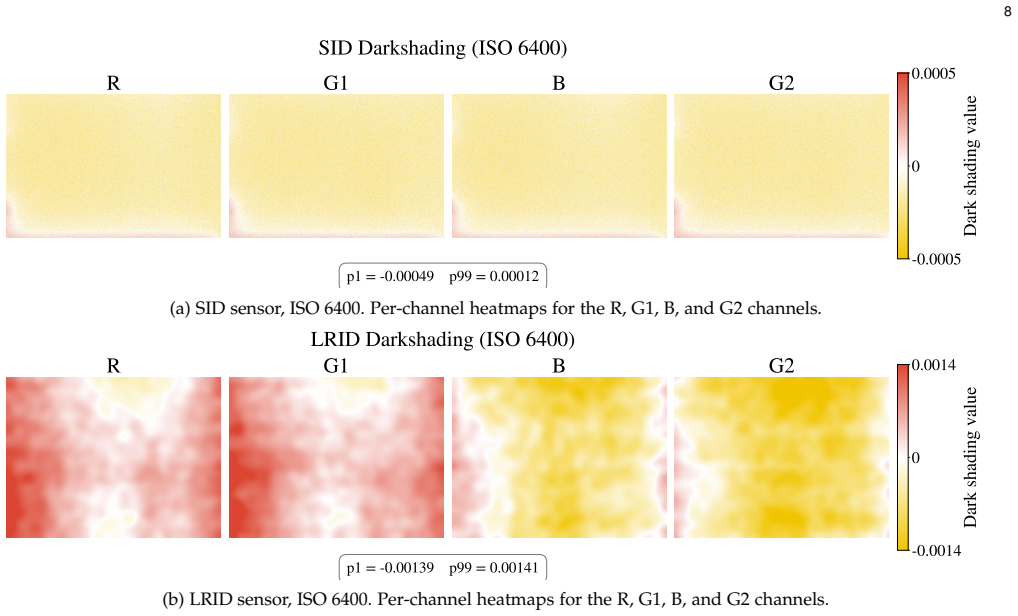
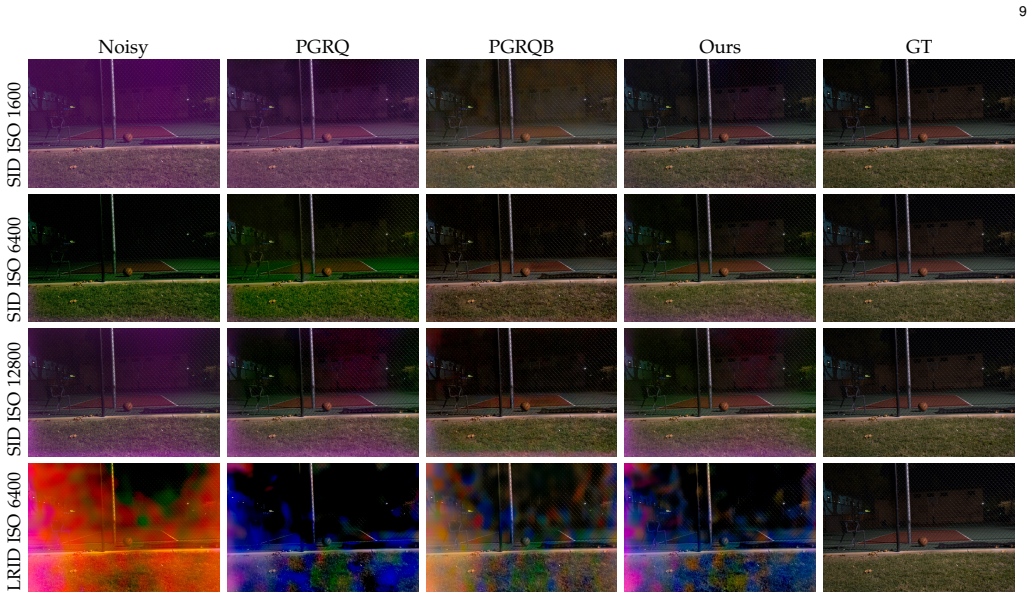
On a sensor whose dark-shading is dominated by strong spatially varying fixed-pattern noise (for example LRID at 1024 imes amplification), the method should lose its color-accuracy advantage over plain PGRQ baselines; residual green or purple casts should remain after BLE correction.
Editorial analysis
A structured set of objections, weighed in public.
Referee Report
Summary. The paper argues that black-level error (BLE) is a primary driver of color bias (unnatural chromatic shifts, especially in dark regions) in low-light raw denoising. It proposes a camera-agnostic, calibration-free pipeline: a black-level bias estimator (BLBE) network (shared U-Net encoder + MLP head) predicts a global per-channel offset E_bl ~ U(-M_bl, M_bl) from the noisy input; this corrects the metadata black-level before a standard U-Net denoiser. Training uses only clean SID-Sony images plus synthetic PGRQB noise (shot/read/row/quantization + BLE) with broad, uncorrelated parameter ranges. Evaluations on real ELD (Sony/Nikon), SID, and LRID report superior PSNR/SSIM/CIEDE2000 among blind methods and competitiveness with calibrated/paired baselines (Tables 1, 6, 7), with qualitative color recovery. Separately, the authors diagnose clipping-before-averaging bias in SIDD ground-truth construction, release a corrected SIDD-CC pipeline and split, and benchmark existing methods on it.
Significance. If the scoped claim holds, the work meaningfully advances practical blind low-light raw denoising by isolating a simple, globally correctable artifact (BLE) that prior physics-based and learning-based synthesizers under-address without per-sensor dark frames or paired data. The progressive noise-model ablations (PG o PGRQ o PGRQB), the PGRQ+BLBE isolation experiment, capacity/resolution/clipping/per-channel controls (Table 2), and multi-metric multi-sensor results constitute solid, reproducible evidence. Explicit FPN limitation discussion (Appendix G) and the SIDD-CC contribution (new GT extraction + initial benchmark) are community assets. Strengths include end-to-end training with auxiliary L1 on BLE, broad noise sampling for generalization, and honest residual-error analysis on high-ratio LRID.
major comments (3)
- [Tables 1, 6, 7 / Sec. 5.3] Tables 1, 6 and 7 report single-run point estimates with no standard deviations, multiple random seeds, or bootstrap intervals, despite stochastic noise synthesis and random cropping. The headline gains (e.g., +2.62 dB PSNR over PGRQB on ELD-Nikon imes200, +2.57 dB on SID imes100) are therefore difficult to judge for statistical reliability; at minimum a 3-seed mean/std or paired significance test on the same test images is needed to support the 'superior among blind / competitive with calibrated' claims.
- [Sec. 5.5 / Appendix D] Appendix D states that only five of the original 40 SIDD validation scenes retain the full 150-frame RAW stacks required for the corrected GT pipeline, yielding a 29-scene / 928-patch validation set after filtering. This is too small and device-skewed (S6 Edge heavily pruned) to serve as a stable community benchmark; either expand the set (or release the raw stacks if recoverable) or clearly qualify SIDD-CC results as preliminary and report per-device breakdowns.
- [Eq. (7) / Sec. 3.2 / Appendix C, G] The central modeling assumption (Eq. 7 + Sec. 3.2) treats BLE as a single global per-channel offset while leaving fixed-pattern noise (FPN) unmodeled. Appendix C and G correctly flag residual color errors when FPN dominates (high-ratio LRID, high-ISO SID), yet the main-text claim that BLE is 'a primary source' is not accompanied by a quantitative breakdown of BLE vs. FPN variance across the evaluated exposure ratios; without it the reader cannot verify that the reported gains are not partly confounded by residual FPN that the BLBE inadvertently absorbs.
minor comments (5)
- [Figs. 3, 5] Fig. 3 and Fig. 5 captions claim 'most closely matches the ground-truth color' but do not report per-image CIEDE2000 or channel-wise mean offsets; adding these numbers would make the visual claim quantitative.
- [Appendix A] The BLE predictor head (Appendix A) uses Tanh followed by rescaling; the exact mapping from normalized output to physical E_bl units is not stated, which hinders re-implementation.
- [Table 2f] Table 2f 'sensor adaptation' mixes ELD-Sony calibrated PGRQ ranges with blind BLE; clarify whether the same ranges were used for the PGRQB baseline or only for the adapted variant.
- [Sec. 3.4 / Fig. 2] Minor notation inconsistency: E_bl vs. Ebl' vs. E_bl' appears in text, equations and Fig. 2; standardize.
- [Sec. 5.2] The illumination-correction step (footnote 1) is applied post-denoising for all methods; confirm it does not interact with residual BLE offsets and report uncorrected PSNR as a sensitivity check.
Circularity Check
No significant circularity: BLE estimator is standard supervised recovery of a synthetically injected offset, validated externally on real multi-sensor benchmarks.
full rationale
The paper's central chain is empirical, not a first-principles derivation that collapses to its inputs. Clean SID-Sony images receive synthetic noise (shot/read/row/quantization + independent per-channel BLE drawn from a broad uniform range, Sec. 3.1–3.2 and Tab. 5) with no target-sensor calibration. The BLBE head is trained with an ordinary L1 loss against the known injected E_bl (Eq. 9); the corrected black-level is then fed to a U-Net whose L1 image loss (Eq. 10) is the only other term. At test time the same network is applied, without re-fitting, to real noisy captures from ELD-Sony, ELD-Nikon, SID and LRID; gains are measured by PSNR/SSIM/CIEDE2000 against the datasets’ own ground truth (Tabs. 1, 6, 7). Progressive ablations (PG → PGRQ → PGRQB → full model) and the isolation experiment that attaches a frozen BLBE to an off-the-shelf PGRQ baseline further show that the performance lift is not forced by construction. The SIDD-CC reprocessing merely changes the order of averaging versus clipping and is likewise externally falsifiable. No self-citation supplies a uniqueness theorem, no fitted constant is renamed a prediction, and no ansatz is smuggled in. The only residual limitation (unmodeled FPN) is explicitly scoped as future work (App. G) and does not underwrite the reported BLE claim. Hence the derivation is self-contained against external benchmarks.
Axiom & Free-Parameter Ledger
free parameters (4)
- alpha (BLE loss weight) =
1.0
- M_bl (max BLE magnitude) =
2
- noise-parameter ranges (K, sigma_read, sigma_row, exposure ratio) =
K in [0.05,30], log-sigma_read in [-2,3], etc.
- training crop size / epochs / lr =
1536^2 / 750 / 2e-4
axioms (4)
- domain assumption Recorded raw intensity equals clean signal plus additive shot/read/banding/quantization noise (Eqs. 1-6).
- ad hoc to paper Black-level error can be modeled as a single global offset drawn from U(-M_bl, M_bl) and applied uniformly per RGBG channel (Eq. 7).
- ad hoc to paper Fixed-pattern noise is secondary to BLE for the evaluated exposure ratios and can be left unmodeled.
- domain assumption Illumination mismatch between noisy and clean captures can be corrected by a single multiplicative factor after denoising.
invented entities (2)
-
Black-level bias estimator (BLBE) network
no independent evidence
-
SIDD-CC ground-truth extraction pipeline
no independent evidence
read the original abstract
Raw images inherently suffer from noise due to the stochastic nature of light and sensor hardware imperfections. As real photon counts fall, the ratio of this noise to the signal degrades; consequently, for low-light conditions, robust denoising is especially vital for high-quality results. While recent data-driven methods achieve strong performance, they typically rely on large-scale noisy-clean image pairs that are costly and difficult to collect. Alternatively, parametric noise models can generate synthetic training data, but this necessitates precise camera calibration, which is often impractical for unknown devices. In this work, we propose a camera-agnostic, calibration-free paradigm for low-light raw denoising. We identify that color bias from black-level error is a primary source of performance degradation and causes severe color shifts. To mitigate this, we introduce a bias estimator network that predicts the black-level error as a global feature of the noisy input. We evaluate our approach across the ELD, SID, and LRID datasets, demonstrating superior performance among blind denoisers, particularly in terms of color correction. In many cases, we are competitive with-or can even surpass-methods with stronger supervision. Furthermore, we reveal that the widely used SIDD dataset contains significant color bias in its ground-truth images, which yields unrealistic color reproduction in trained models. We introduce a new ground-truth extraction framework to resolve this issue and provide a benchmark of existing methods on the corrected dataset.
Figures




Reference graph
Works this paper leans on
-
[1]
Ma ˆıtre,From photon to pixel: the digital camera hand- book
H. Ma ˆıtre,From photon to pixel: the digital camera hand- book. John Wiley & Sons, 2017
2017
-
[2]
Deep joint demosaicking and denoising,
M. Gharbi, G. Chaurasia, S. Paris, and F. Durand, “Deep joint demosaicking and denoising,”ACM Trans- actions on Graphics (TOG), vol. 35, no. 6, pp. 1–12, 2016
2016
-
[3]
Practical blind image denoising via Swin-Conv-UNet and data synthesis,
K. Zhang, Y. Li, J. Liang, J. Cao, Y. Zhang, H. Tang, D.-P . Fan, R. Timofte, and L. V . Gool, “Practical blind image denoising via Swin-Conv-UNet and data synthesis,” Machine Intelligence Research, vol. 20, no. 6, pp. 822–836, 2023
2023
-
[4]
Joint HDR denoising and fusion: A real- world mobile HDR image dataset,
S. Liu, X. Zhang, L. Sun, Z. Liang, H. Zeng, and L. Zhang, “Joint HDR denoising and fusion: A real- world mobile HDR image dataset,” inIEEE Conference on Computer Vision and Pattern Recognition (CVPR), 2023
2023
-
[5]
Rethinking learning- based demosaicing, denoising, and super-resolution pipeline,
G. Qian, Y. Wang, J. Gu, C. Dong, W. Heidrich, B. Ghanem, and J. S. Ren, “Rethinking learning- based demosaicing, denoising, and super-resolution pipeline,” inProceedings of the IEEE International Con- ference on Computational Photography (ICCP), 2022
2022
-
[6]
DNF: Decouple and feedback network for seeing in the dark,
X. Jin, L.-H. Han, Z. Li, C.-L. Guo, Z. Chai, and C. Li, “DNF: Decouple and feedback network for seeing in the dark,” inIEEE Conference on Computer Vision and Pattern Recognition (CVPR), 2023
2023
-
[7]
IDF: Iterative dynamic filtering networks for generalizable image de- noising,
D. Kim, J. Ko, M. K. Ali, and T. H. Kim, “IDF: Iterative dynamic filtering networks for generalizable image de- noising,” inInternational Conference on Computer Vision (ICCV), 2025
2025
-
[8]
Fast and high quality image denoising via malleable convolution,
Y. Jiang, B. Wronski, B. Mildenhall, J. T. Barron, Z. Wang, and T. Xue, “Fast and high quality image denoising via malleable convolution,” inEuropean Con- ference on Computer Vision (ECCV), 2022
2022
-
[9]
Plug-and-play image restoration with deep denoiser prior,
K. Zhang, Y. Li, W. Zuo, L. Zhang, L. Van Gool, and R. Timofte, “Plug-and-play image restoration with deep denoiser prior,”IEEE Transactions on Pattern Anal- ysis and Machine Intelligence (TP AMI), 2021
2021
-
[10]
Restormer: Efficient transformer for high-resolution image restoration,
S. W. Zamir, A. Arora, S. Khan, M. Hayat, F. S. Khan, and M.-H. Yang, “Restormer: Efficient transformer for high-resolution image restoration,” inIEEE Conference on Computer Vision and Pattern Recognition (CVPR), 2022
2022
-
[11]
Simple base- lines for image restoration,
L. Chen, X. Chu, X. Zhang, and J. Sun, “Simple base- lines for image restoration,” inEuropean Conference on Computer Vision (ECCV), 2022
2022
-
[12]
Noise flow: Noise modeling with conditional normal- izing flows,
A. Abdelhamed, M. A. Brubaker, and M. S. Brown, “Noise flow: Noise modeling with conditional normal- izing flows,” inInternational Conference on Computer Vision (ICCV), 2019
2019
-
[13]
Dark noise diffusion: Noise synthesis for low-light image denois- ing,
L. Lu, R. Achddou, and S. Susstrunk, “Dark noise diffusion: Noise synthesis for low-light image denois- ing,”IEEE Transactions on Pattern Analysis and Machine Intelligence (TP AMI), 2025
2025
-
[14]
Physics-guided ISO-dependent sensor noise modeling for extreme low-light photography,
Y. Cao, M. Liu, S. Liu, X. Wang, L. Lei, and W. Zuo, “Physics-guided ISO-dependent sensor noise modeling for extreme low-light photography,” inIEEE Conference on Computer Vision and Pattern Recognition (CVPR), 2023
2023
-
[15]
Towards general low-light raw noise syn- thesis and modeling,
F. Zhang, B. Xu, Z. Li, X. Liu, Q. Lu, C. Gao, and N. Sang, “Towards general low-light raw noise syn- thesis and modeling,” inInternational Conference on Computer Vision (ICCV), 2023
2023
-
[16]
Calibration-free raw image denoising via fine- grained noise estimation,
Y. Zou, Y. Fu, Y. Zhang, T. Zhang, C. Yan, and R. Tim- ofte, “Calibration-free raw image denoising via fine- grained noise estimation,”IEEE Transactions on Pattern Analysis and Machine Intelligence (TP AMI), 2025
2025
-
[17]
Rethinking noise synthesis and modeling in raw denoising,
Y. Zhang, H. Qin, X. Wang, and H. Li, “Rethinking noise synthesis and modeling in raw denoising,” in International Conference on Computer Vision (ICCV), 2021
2021
-
[18]
Physics-based noise modeling for extreme low-light photography,
K. Wei, Y. Fu, Y. Zheng, and J. Yang, “Physics-based noise modeling for extreme low-light photography,” IEEE Transactions on Pattern Analysis and Machine In- telligence (TP AMI), 2021
2021
-
[19]
Learnabil- ity enhancement for low-light raw denoising: Where paired real data meets noise modeling,
H. Feng, L. Wang, Y. Wang, and H. Huang, “Learnabil- ity enhancement for low-light raw denoising: Where paired real data meets noise modeling,” inProceedings of the ACM International Conference on Multimedia, 2022
2022
-
[20]
MSFA image denoising using physics-based noise model and noise- decoupled network,
Y. Jiang, Y. Fu, Q. Liu, and J. Zhang, “MSFA image denoising using physics-based noise model and noise- decoupled network,”IEEE Transactions on Pattern Anal- ysis and Machine Intelligence (TP AMI), 2025
2025
-
[21]
Learning physics-informed noise models from dark frames for low-light raw image denoising,
H. Feng, L. Wang, Y. Huang, Y. Wang, L. Zhu, and H. Huang, “Learning physics-informed noise models from dark frames for low-light raw image denoising,” IEEE Transactions on Pattern Analysis and Machine Intel- ligence (TP AMI), 2026
2026
-
[22]
2-shots in the dark: Low-light denoising with minimal data acquisi- tion,
L. Lu, R. Achddou, and S. S ¨usstrunk, “2-shots in the dark: Low-light denoising with minimal data acquisi- tion,”IEEE Conference on Computer Vision and Pattern Recognition (CVPR), 2026
2026
-
[23]
Noise2Noise: Learning image restoration without clean data,
J. Lehtinen, J. Munkberg, J. Hasselgren, S. Laine, T. Kar- ras, M. Aittala, and T. Aila, “Noise2Noise: Learning image restoration without clean data,”International Conference on Machine Learning (ICML), 2018
2018
-
[24]
Noise2Self: Blind denoising by self-supervision,
J. Batson and L. Royer, “Noise2Self: Blind denoising by self-supervision,” inInternational Conference on Machine Learning (ICML), 2019
2019
-
[25]
Noise2void- learning denoising from single noisy images,
A. Krull, T.-O. Buchholz, and F. Jug, “Noise2void- learning denoising from single noisy images,” inIEEE Conference on Computer Vision and Pattern Recognition (CVPR), 2019
2019
-
[26]
Noise2Score: Tweedie’s approach to self-supervised image denoising without clean im- ages,
K. Kim and J. C. Ye, “Noise2Score: Tweedie’s approach to self-supervised image denoising without clean im- ages,”Neural Information Processing Systems (NeurIPS), 2021
2021
-
[27]
Noise2Same: Optimizing a self-supervised bound for image denoising,
Y. Xie, Z. Wang, and S. Ji, “Noise2Same: Optimizing a self-supervised bound for image denoising,”Neural Information Processing Systems (NeurIPS), 2020
2020
-
[28]
Noise2Info: Noisy image to information of noise for self-supervised image denoising,
J. Wang, S. Di, L. Chen, and C. W. W. Ng, “Noise2Info: Noisy image to information of noise for self-supervised image denoising,” inInternational Conference on Com- puter Vision (ICCV), 2023
2023
-
[29]
Self2Self with dropout: Learning self-supervised denoising from sin- gle image,
Y. Quan, M. Chen, T. Pang, and H. Ji, “Self2Self with dropout: Learning self-supervised denoising from sin- gle image,” inIEEE Conference on Computer Vision and Pattern Recognition (CVPR), 2020
2020
-
[30]
Blind2Unblind: Self-supervised image denoising with visible blind spots,
Z. Wang, J. Liu, G. Li, and H. Han, “Blind2Unblind: Self-supervised image denoising with visible blind spots,” inIEEE Conference on Computer Vision and Pat- 10 tern Recognition (CVPR), 2022
2022
-
[31]
Zero-shot Noise2Mean: Gap minimization for efficient denoising from a single noisy image,
D. Liu, Y. Shi, G. Zhang, S. Li, and L. Zhang, “Zero-shot Noise2Mean: Gap minimization for efficient denoising from a single noisy image,” inProceedings of the National Conference on Artificial Intelligence (AAAI), 2025
2025
-
[32]
Zero-shot Noise2Noise: Efficient image denoising without any data,
Y. Mansour and R. Heckel, “Zero-shot Noise2Noise: Efficient image denoising without any data,” inIEEE Conference on Computer Vision and Pattern Recognition (CVPR), 2023
2023
-
[33]
AP-BSN: Self- supervised denoising for real-world images via asym- metric pd and blind-spot network,
W. Lee, S. Son, and K. M. Lee, “AP-BSN: Self- supervised denoising for real-world images via asym- metric pd and blind-spot network,” inIEEE Conference on Computer Vision and Pattern Recognition (CVPR), 2022
2022
-
[34]
CVF-SID: Cyclic multi-variate function for self- supervised image denoising by disentangling noise from image,
R. Neshatavar, M. Yavartanoo, S. Son, and K. M. Lee, “CVF-SID: Cyclic multi-variate function for self- supervised image denoising by disentangling noise from image,” inIEEE Conference on Computer Vision and Pattern Recognition (CVPR), 2022
2022
-
[35]
YOND: Practical blind raw image denois- ing free from camera-specific data dependency,
H. Feng, L. Wang, Y. Huang, T. Li, L. Zhu, and H. Huang, “YOND: Practical blind raw image denois- ing free from camera-specific data dependency,”arXiv preprint arXiv:2506.03645, 2025
Pith/arXiv arXiv 2025
-
[36]
A high- quality denoising dataset for smartphone cameras,
A. Abdelhamed, S. Lin, and M. S. Brown, “A high- quality denoising dataset for smartphone cameras,” in IEEE Conference on Computer Vision and Pattern Recogni- tion (CVPR), 2018
2018
-
[37]
Noise modeling in one hour: Minimizing preparation efforts for self-supervised low- light raw image denoising,
F. Li, H. Jiang, and D. Iso, “Noise modeling in one hour: Minimizing preparation efforts for self-supervised low- light raw image denoising,” inIEEE Conference on Com- puter Vision and Pattern Recognition (CVPR), 2025
2025
-
[38]
Lighting every darkness in two pairs: A calibration-free pipeline for raw denoising,
X. Jin, J.-W. Xiao, L.-H. Han, C. Guo, R. Zhang, X. Liu, and C. Li, “Lighting every darkness in two pairs: A calibration-free pipeline for raw denoising,” inInterna- tional Conference on Computer Vision (ICCV), 2023
2023
-
[39]
Image denoising in mixed Poisson–Gaussian noise,
F. Luisier, T. Blu, and M. Unser, “Image denoising in mixed Poisson–Gaussian noise,”IEEE Transactions on Image Processing (TIP), vol. 20, no. 3, pp. 696–708, 2010
2010
-
[40]
Clipped noisy images: Heteroskedastic model- ing and practical denoising,
A. Foi, “Clipped noisy images: Heteroskedastic model- ing and practical denoising,”Signal Processing, vol. 89, no. 12, pp. 2609–2629, 2009
2009
-
[41]
Practical Poissonian-Gaussian noise modeling and fit- ting for single-image raw-data,
A. Foi, M. Trimeche, V . Katkovnik, and K. Egiazarian, “Practical Poissonian-Gaussian noise modeling and fit- ting for single-image raw-data,”IEEE Transactions on Image Processing (TIP), vol. 17, no. 10, pp. 1737–1754, 2008
2008
-
[42]
Learning to see in the dark,
C. Chen, Q. Chen, J. Xu, and V . Koltun, “Learning to see in the dark,” inIEEE Conference on Computer Vision and Pattern Recognition (CVPR), 2018
2018
-
[43]
U-Net: Convo- lutional networks for biomedical image segmentation,
O. Ronneberger, P . Fischer, and T. Brox, “U-Net: Convo- lutional networks for biomedical image segmentation,” inProceedings of the International Conference on Medi- cal Image Computing and Computer Assisted Intervention (MICCAI), 2015
2015
-
[44]
Adam: A method for stochastic optimization,
D. P . Kingma and J. Ba, “Adam: A method for stochastic optimization,” inInternational Conference on Learning Representations (ICLR), 2015
2015
-
[45]
The ciede2000 color-difference formula: Implementation notes, sup- plementary test data, and mathematical observations,
G. Sharma, W. Wu, and E. N. Dalal, “The ciede2000 color-difference formula: Implementation notes, sup- plementary test data, and mathematical observations,” Color Research & Application, vol. 30, no. 1, pp. 21–30, 2005
2005
-
[46]
Im- age denoising by sparse 3-D transform-domain collab- orative filtering,
K. Dabov, A. Foi, V . Katkovnik, and K. Egiazarian, “Im- age denoising by sparse 3-D transform-domain collab- orative filtering,”IEEE Transactions on Image Processing (TIP), vol. 16, no. 8, pp. 2080–2095, 2007
2080
-
[47]
Exploring efficient asymmetric blind-spots for self-supervised de- noising in real-world scenarios,
S. Chen, J. Zhang, Z. Yu, and T. Huang, “Exploring efficient asymmetric blind-spots for self-supervised de- noising in real-world scenarios,” inIEEE Conference on Computer Vision and Pattern Recognition (CVPR), 2024. 1 APPENDIXA IMPLEMENTATIONDETAILS We provide additional implementation details for our model and the baselines—PG (Poisson–Gaussian), PGRQ (...
arXiv 2024
-
[48]
Combined (c), our method reaches a footprint comparable to the patch-based PGRQB (d) while keeping a∼2.8 dB PSNR advantage
Downsampling the BLBE input cuts its cost by an order of magnitude with no loss in accuracy, and tiling the denoiser trades runtime for memory. Combined (c), our method reaches a footprint comparable to the patch-based PGRQB (d) while keeping a∼2.8 dB PSNR advantage. with default settings; results are in Sec. 5.5. In raw, we again use BM3D as a non-learni...
discussion (0)
Sign in with ORCID, Apple, or X to comment. Anyone can read and Pith papers without signing in.