REVIEW 3 major objections 4 minor 41 references
Critical transport behavior in quantum dot solids
T0 review · 3 major / 4 minor · reviewed 2026-08-07 · deepseek-v4-flash
Pith's one-line read The paper claims that weak hopping disorder moves the metal-insulator transition in quantum-dot solids from the Anderson universality class into the chiral orthogonal class, with critical exponent ν ≈ 1.12 over a wide parameter region.
desk verdict A useful phase diagram for doubly-disordered QD solids, but the BDI-exponent claim is likely a finite-size crossover rather than a true universality class. read the letter →
The pith
A machine-rendered reading of the paper's core claim, the machinery that carries it, and where it could break.
The reading
What carries the argument
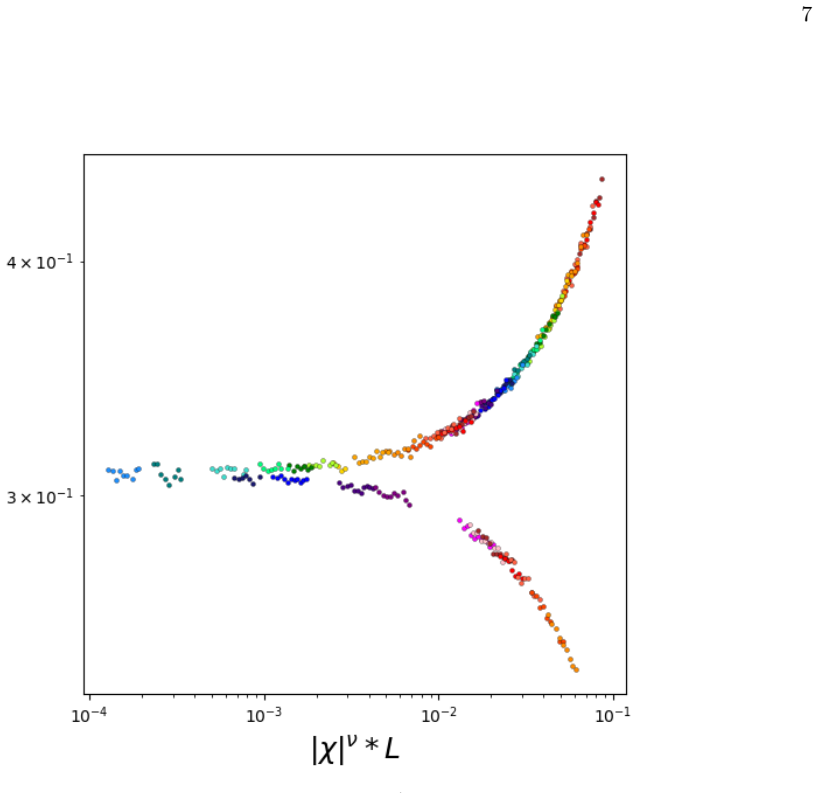
The load-bearing object is the doubly disordered tight-binding Hamiltonian $H = \sum_i \varepsilon_i c_i^\dagger c_i + \sum_{\langle ij\rangle} t_{ij} c_j^\dagger c_i + \text{h.c.}$, with on-site energies $\varepsilon_i$ drawn uniformly from $[-W/2, W/2]$ and hopping integrals $t_{ij} = t_H = 1$ with probability $c$ and $t_L = 0.3$ otherwise. Critical properties are extracted with the transfer-matrix method, computing the quasi-one-dimensional localization length $\xi$ as the inverse of the smallest positive Lyapunov exponent, and then applying single-parameter finite-size scaling to the dimensionless ratio $\Gamma = L/\xi$ over transverse sizes $L = 17\text{--}30$. The scaling collapse yields the critical concentration $c_c$ and the critical exponent $\nu$, and the symmetry classification is imposed by comparing $\nu$ with the known AI value 1.57 and BDI value 1.12.
What would settle it
A concrete check: reanalyze the same transfer-matrix data with a two-parameter scaling fit, or run the calculation at transverse sizes above 30; if the fitted exponent at low energy and low on-site disorder moves from about 1.12 toward 1.57, the claimed chiral-class behavior is not asymptotic. In a real fused-dot solid, measuring the exponent with which conductivity vanishes at the transition and finding it near 1.57 rather than 1.12 would likewise falsify the claim.
Extended reading notes
Core claim
The paper's central claim is that a tight-binding Hamiltonian with both on-site energy disorder and binary hopping disorder supports a metal-insulator transition whose critical behavior is, over a wide region of parameter space, that of the chiral orthogonal (BDI) universality class rather than the ordinary Anderson (AI) class. Concretely, the fitted localization-length exponent is ν ≈ 1.12 ± 0.06 for low on-site disorder W and low energy E, and it crosses over to ν ≈ 1.57 as W or E grows, matching the known AI value. The model also produces a phase diagram in (W, c, E) showing that increasing the fraction c of high-conductance couplings drives the system through the transition at on-site disorder below the conventional Anderson critical value, and that kinetic disorder expands the insulating phase. The authors interpret the wide 1.12 plateau as evidence that adding weak kinetic disorder changes the universality class of the transition even though particle-hole symmetry is formally absent, and they note that the same exponent governs conductivity in three dimensions, making the prediction experimentally accessible.
Load-bearing premise
The argument's load-bearing premise is that the single-parameter scaling fit to transverse sizes 17 through 30 gives the true asymptotic critical exponent; the paper itself notes that a two-parameter scaling analysis could yield a more accurate value, so if the 1.12 plateau is a size-dependent artifact rather than the asymptotic exponent, the claimed change of universality class would collapse.
Editorial extensions
If this is right
- Over most of the studied (W, E) space the predicted critical exponent is about 1.12, so transport measurements in quantum-dot solids at low energy and low size disorder should see an effective transition exponent near 1.12 rather than 1.57.
- Because the localization-length and conductivity exponents are equal in three dimensions, the predicted 1.12 is directly measurable as the vanishing of conductivity at the transition.
- The phase diagram shows that the metal-insulator transition can be crossed by increasing the fraction c of high-conductance fused dot pairs even when on-site disorder is below the traditional Anderson limit of W = 16.53.
- Kinetic disorder expands the insulating phase into the region where pure on-site disorder would predict delocalization, so metallicity requires both limited size disorder and enough fused couplings.
- Excluding transverse sizes L ≤ 16 from the scaling analysis removes visible degradation without changing ν much, supporting the robustness of the 1.12 result at the studied sizes.
Reading between the lines
- The binary choice of hopping values (t_H = 1 with probability c and t_L = 0.3 otherwise) is a modeling choice; a natural extension would vary the high-conductance value continuously and check whether the 1.12 plateau survives, which would show whether the crossover is tied to the binary nature of the neck distribution or to kinetic disorder generally.
- The paper's observation that low transverse sizes degrade the scaling suggests the fitted exponent may still drift with system size; extending the same analysis to L = 34–40 at low W and E would either confirm the BDI plateau or reveal it as a finite-size crossover.
- If the crossover is genuine, the model implies that the exponent should vary smoothly between 1.12 and 1.57 as W or E increases, so a fine scan of the plateau boundary in the paper's exponent map would give a testable prediction for where transport crosses from chiral to ordinary Anderson behavior.
Editorial analysis
A structured set of objections, weighed in public.
Referee Report
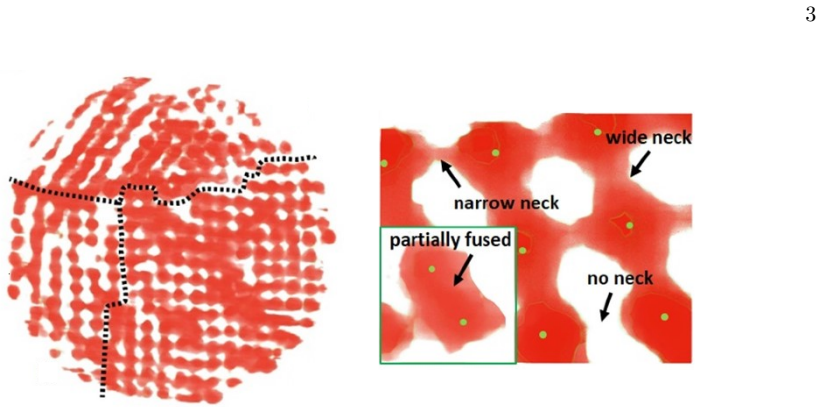
Summary. The paper studies a tight-binding model of epitaxially fused quantum dot solids with both on-site (W) and binary nearest-neighbor hopping (c, tL/tH) disorder, motivated by tomography of experimental samples. Using the transfer matrix method and single-parameter finite-size scaling, the authors extract the critical concentration c_c of high-conductivity bonds and the localization-length critical exponent ν across a (W, E, c) parameter space. Their central claim is that for a broad region of low W and E the fitted exponent ν ≈ 1.12, consistent with the chiral orthogonal (BDI) universality class, while at larger W or E the exponent crosses over toward the Anderson (AI) value ν ≈ 1.57. They also present a phase diagram showing that kinetic disorder expands the insulating region relative to the standard Anderson picture.
Significance. If the exponent plateau is truly asymptotic, the result is significant: it would identify a wide parameter region in a three-dimensional doubly disordered system where the MIT appears to belong to a different universality class than the usual Anderson transition, with an experimentally measurable exponent ν = s = 1.12. The paper has clear strengths: the model is directly motivated by experimental tomographic data; the use of finite-size scaling follows an established methodology; and the pure-diagonal-disorder control reproducing the known AI exponent ν = 1.57 is a useful positive check. However, the central claim is conditional on whether the fitted ν ≈ 1.12 represents an asymptotic critical exponent rather than a finite-size crossover effect, and the current evidence does not fully establish that distinction.
major comments (3)
- [Sec. II.B and Sec. III] The central identification of the BDI universality class rests on single-parameter finite-size scaling of Γ = L/ξ using Eq. (6) over the narrow range L = 17–30, with L < 16 excluded after reporting that those data degrade the scaling. The manuscript also states that only 20–45 disorder realizations were averaged per point. This is not sufficient to distinguish an asymptotic ν ≈ 1.12 from an effective exponent produced by a crossover scale longer than L ≈ 30. I ask the authors to provide explicit stability evidence: fits over further restricted L ranges (e.g., L ≥ 20 and L ≥ 25), an analysis of ν as a function of the minimum L, and, if feasible, a two-parameter scaling analysis that includes the symmetry-breaking field as a scaling variable. Without such evidence, the abstract's claim of a critical exponent 'distinct from the expected value for the Anderson transition' is not established.
- [Sec. II, symmetry discussion; Sec. III, Fig. 5] The paper's own symmetry analysis states that particle-hole symmetry, and hence chiral symmetry, exists only at E = 0 and W = 0; any nonzero on-site disorder or energy places the Hamiltonian in class AI. At a BDI critical point, a chiral-symmetry-breaking perturbation is generically relevant, so the asymptotic critical behavior at fixed nonzero W or E should be AI. The observed plateau ν ≈ 1.12 over W ≈ 8–12 is therefore compatible with a finite-size crossover rather than a genuine BDI critical point. The single-parameter FSS in Eq. (6), with W and E fixed and only c varied, cannot measure the scaling dimension of the PHS-breaking field. I recommend that the authors either perform a two-parameter FSS including W (or E) as a scaling variable, or compute how the effective ν varies with L. If ν drifts toward 1.57 with increasing L, the conclusion should be reframed as an effective exponent/crossover rather than a universality-class identification.
- [Sec. III, Fig. 5] Figure 5 reports ν across parameter space without visible confidence intervals or the number of disorder realizations used at each point. Given that the exponent values discriminate between ν ≈ 1.12 and ν ≈ 1.57, the absence of statistical error bars makes it difficult to judge whether the plateau and crossover are significant. The authors should provide a table or figure with ν, its 95% confidence interval, the L range used, and the number of c values and disorder realizations for each (W, E) point. This is a load-bearing point because the classification rests on the fitted value of ν.
minor comments (4)
- [References] Reference [2] contains a typo: 'G. Qian, Caroline an Zimanyi' should likely be 'C. Qian and G. T. Zimanyi' (or similar). Please correct the author list.
- [Sec. II] The sentence 'we used values of W such that W/tH < Wc/t < W/tL' is ambiguous and appears to have a typo. Clarify the intended inequality, presumably W tL < Wc < W tH or W/tH < W_c < W/tL after setting tH = 1.
- [Sec. II, Eq. (2)] The matrices H_n, H_{n,n±1} are not explicitly defined. A brief definition of their dimensions and contents would improve reproducibility.
- [Sec. III, Fig. 3] The caption states that data points represent 'at least ≥ 10 DR, with most representing > 30DR'; this wording is awkward, and the number of realizations should be stated precisely in the text or caption.
Circularity Check
No meaningful circularity: the BDI/AI exponent claims are free outputs of the scaling fit compared against external universality-class values, not built into the model or fit.
full rationale
The central derivation is self-contained. The critical exponent ν is produced as a free parameter of the finite-size scaling fit to the transfer-matrix localization lengths via Eqs. (6)-(8), and is then compared with the independently known values ν=1.57±0.003 (AI) and ν=1.12±0.06 (BDI) quoted from Slevin/Ohtsuki and Wang/Ohtsuki/Shindou. Nothing in the Hamiltonian (Eq. 1), the disorder distributions, or the scaling ansatz encodes the target exponent, and no parameter is tuned to make the result land on 1.12. The pure-diagonal-disorder check reproducing ν=1.57 is a positive control, confirming that the analysis pipeline is not biased toward the BDI value. The citations to the authors' own prior work (refs. [2] and [27]) motivate the binary hopping disorder and the on-site-disorder interpretation, but neither is load-bearing for the scaling derivation. The paper's own symmetry analysis concedes that particle-hole symmetry, hence strict BDI symmetry, exists only at W=0 and E=0; the robustness of the ν≈1.12 plateau at nonzero W/E is a finite-size/crossover concern about asymptotic exponents, but it is a scientific risk rather than circular reasoning. The hand-set value tL=0.3 is a modeling choice made before the fits and does not define the predicted exponent. Overall, no step of the derivation reduces by construction to its own input.
Assumptions & free parameters
free parameters (4)
- tL (low hopping amplitude) =
0.3
- Lz (longitudinal length) =
10^5
- FSS expansion orders (nR, nI, mR, mI) =
3, 1, 2, 1
- Transverse sizes L used in FSS =
17-30
assumptions (5)
- domain assumption The real spinless tight-binding Hamiltonian has time-reversal symmetry, so in the absence of chiral symmetry it belongs to the orthogonal (AI) class.
- domain assumption The binary distribution of hopping integrals (tH with probability c, tL otherwise) faithfully represents the experimental distribution of epitaxial necks in QD solids.
- domain assumption Single-parameter finite-size scaling is valid for this model.
- standard math The transfer matrix method with periodic transverse boundary conditions and QR decomposition yields unbiased estimates of the localization length for the system sizes used.
- standard math At E=0 and W=0 the Hamiltonian has chiral (sublattice) symmetry and belongs to class BDI.
Cite this review
Pith. "Pith review of Critical transport behavior in quantum dot solids." pith.science (2026). https://pith.science/paper/J6DJEQ7X
@misc{pith2026250603676,
  author       = {Pith},
  title        = {Pith review of: Critical transport behavior in quantum dot solids},
  year         = {2026},
  howpublished = {\url{https://pith.science/paper/J6DJEQ7X}},
  note         = {Machine review of arXiv:2506.03676}
}
read the original abstract
Due to recent advances, silicon solar cells are rapidly approaching the Shockley-Queisser limit of 33% efficiency. Quantum Dot (QD) solar cells have the potential to surpass this limit and enable a new generation of photovoltaic technologies beyond the capabilities of any existing solar energy modalities. The creation of the first epitaxially-fused quantum dot solids showing broad phase coherence and metallicity necessary for solar implementation has not yet been achieved, and the metal-insulator transition in these materials needs to be explored. We have created a new model of electron transport through QD solids, informed by 3D-tomography of QD solid samples, which considers disorder in both the on-site and hopping terms of the commonly studied Anderson Hamiltonian. We used the transfer matrix method and finite-size scaling to create a dynamic metal-insulator transition phase diagram. For a surprisingly large portion of the parameter space, our model shows a critical exponent distinct from the expected value for the Anderson transition. We show the existence of a crossover region from the universality class of the Anderson transition (AI) to the Chiral Orthogonal class (BDI) due to the addition of weak kinetic (hopping) disorder.
Figures

Figures from the paper (3 more)


Reference graph
Works this paper leans on
-
[1]
Y. Liu, M. Gibbs, J. Puthussery, S. Gaik, R. Ihly, H. W. Hillhouse, and M. Law, Nano Letters 10, 1960–1969 (2010)
work page 2010
-
[2]
X. Chu, H. Heidari, A. Abelson, D. Unruh, C. Hansen, G. Qian, Caroline an Zimanyi, M. Law, and A. J. Moul´ e, J. Mater. Chem. A8, 18254 (2020)
work page 2020
-
[3]
J. M. An, A. Franceschetti, and A. Zunger, Phys. Rev. B 76, 045401 (2007)
work page 2007
- [4]
-
[5]
M. Scheele, J. H. Engel, V. E. Ferry, D. Hanifi, Y. Liu, and A. P. Alivisatos, ACS Nano 7, 6774–6781 (2013)
work page 2013
-
[6]
D. V. Talapin, J.-S. Lee, M. V. Kovalenko, and E. V. Shevchenko, Chem. Rev. 110, 389 (2010)
work page 2010
-
[7]
M. V. Kovalenko, L. Manna, A. Cabot, Z. Hens, D. V. Talapin, C. R. Kagan, V. I. Klimov, A. L. Rogach, P. Reiss, and D. J. Milliron et al., ACS Nano 9, 1012 (2015)
work page 2015
-
[8]
A. J. Nozik, Physica E: Low-dimensional Systems and Nanostructures 14, 115 (2002)
work page 2002
Show all 41 references
-
[9]
P. V. Kamat, J. Phys. Chem. C 112, 18737 (2008)
2008
-
[10]
Shirasaki, G
Y. Shirasaki, G. J. Supran, M. G. Bawendi, and V. Bulovi´ c, Nat. Photonics 7, 13 (2013)
2013
-
[11]
D. V. Talapin and C. B. Murray, Science 310, 86 (2005)
2005
-
[12]
Hetsch, N
F. Hetsch, N. Zhao, S. V. Kershaw, and A. L. Rogach, Mater. Today 16, 312 (2013)
2013
-
[13]
Shockley and H
W. Shockley and H. J. Queisser, Journal of Applied Physics 32, 510–519 (1961)
1961
-
[14]
M. Hao, Y. Bai, S. Zeiske, L. Ren, J. Liu, Y. Yuan, N. Zarrabi, N. Cheng, M. Ghasemi, P. Chen, M. Lyu, D. He, J.-H. Yun, Y. Du, Y. Wang, S. Ding, A. Armin, P. Meredith, G. Liu, H.-M. Cheng, and L. Wang, Nature Energy 5, 79 (2020)
2020
-
[15]
E. M. Sanehira, A. R. Marshall, J. A. Christians, S. P. Harvey, P. N. Ciesielski, L. M. Wheeler, P. Schulz, L. Y. Lin, M. C. Beard, and J. M. Luther, Sci. Adv. 3 (2017)
2017
-
[16]
Whitham, J
K. Whitham, J. Yang, B. H. Savitzky, L. F. Kourkoutis, F. Wise, and T. Hanrath, Nat. Mater. 15, 557 (2016)
2016
-
[17]
W. H. Evers, J. M. Schins, M. Aerts, A. Kulkarni, P. Capiod, M. Berthe, B. Grandidier, C. Delerue, H. S. J. van der Zant, and C. van Overbeek et al., Nat. Commun. 6, 8195 (2015). 11
2015
-
[18]
B. T. Diroll, N. J. Greybush, C. R. Kagan, and C. B. Murray, Chemistry of Materials 27, 2998 (2015)
2015
-
[19]
Altamura, T
D. Altamura, T. Sibillano, D. Siliqi, L. D. Caro, and C. Giannini, Nanomaterials and Nanotechnology 2, 16 (2012)
2012
-
[20]
Y. Liu, J. Tolentino, M. Gibbs, R. Ihly, C. L. Perkins, Y. Liu, N. Crawford, J. C. Hemminger, and M. Law, Nano Letters 13, 1578 (2013)
2013
-
[21]
Abelson, C
A. Abelson, C. Qian, T. Salk, Z. Luan, K. Fu, J.-G. Zheng, J. L. Wardini, and M. Law, Nature Materials 19, 49 (2019)
2019
-
[22]
O. L. Lazarenkova and A. A. Balandin, Journal of Applied Physics 89, 5509–5515 (2001)
2001
-
[23]
J. W. K los and M. Krawczyk, Materials Science-Poland 26 (2008)
2008
-
[24]
MacKinnon and B
A. MacKinnon and B. Kramer, Zeitschrift f¨ ur Physik B Condensed Matter 53, 1–13 (1983)
1983
-
[25]
Slevin and T
K. Slevin and T. Ohtsuki, New Journal of Physics 16, 015012 (2014)
2014
-
[26]
Slevin, Y
K. Slevin, Y. Asada, and L. I. Deych, Physical Review B 70, 10.1103/physrevb.70.054201 (2004)
2004 doi
-
[27]
L. Qu, D. Unruh, and G. T. Zimanyi, Phys. Rev. B 103, 195303 (2021)
2021
-
[29]
Grussbach and M
H. Grussbach and M. Schreiber, Physical Review B 51, 663–666 (1995)
1995
-
[30]
Kroha, T
J. Kroha, T. Kopp, and P. W¨ olfle, Physical Review B 41, 888–891 (1990)
1990
-
[31]
Kramer, A
B. Kramer, A. MacKinnon, T. Ohtsuki, and K. Slevin, International Journal of Modern Physics B 24, 1841 (2010)
2010
-
[32]
Slevin and T
K. Slevin and T. Ohtsuki, Physical Review Letters 82, 382 (1999)
1999
-
[33]
Biscani and D
F. Biscani and D. Izzo, Journal of Open Source Software 5, 2338 (2020)
2020
-
[34]
Efron, R
B. Efron, R. Tibshirani, and R. J. Tibshirani, An introduction to the bootstrap, Chapman & Hall/CRC Monographs on Statistics and Applied Probability (Chapman & Hall/CRC, Philadelphia, PA, 1994)
1994
-
[35]
Evers and A
F. Evers and A. D. Mirlin, Reviews of Modern Physics 80, 1355 (2008)
2008
-
[36]
C.-K. Chiu, J. C. Teo, A. P. Schnyder, and S. Ryu, Reviews of Modern Physics 88, 10.1103/revmod- phys.88.035005 (2016)
2016 doi
-
[37]
T. Wang, T. Ohtsuki, and R. Shindou, Physical Review B 104, 10.1103/physrevb.104.014206 (2021)
2021 doi
-
[38]
M. S. Foster and A. W. W. Ludwig, Physical Review B 73, 10.1103/physrevb.73.155104 (2006)
2006 doi
-
[39]
E. J. K¨ onig, P. M. Ostrovsky, I. V. Protopopov, and A. D. Mirlin, Physical Review B85, 10.1103/phys- revb.85.195130 (2012)
2012 doi
-
[40]
B. K. Nikoli´ c, Physical Review B 64, 10.1103/physrevb.64.014203 (2001)
2001 doi
-
[41]
Kasturirangan, A
S. Kasturirangan, A. Kamenev, and F. J. Burnell, Physical Review B 105, 10.1103/physrevb.105.174204 (2022)
2022 doi
-
[42]
F. J. Wegner, Zeitschrift fur Physik B Condensed Matter and Quanta 25, 327 (1976)
1976
Reviewed August 7, 2026 · model on record in the stance chip above.
Discussion (0). Sign in to comment.