REVIEW 4 major objections 6 minor 36 references
MFLA: Monotonic Finite Look-ahead Attention for Streaming Speech Recognition
T0 review · 4 major / 6 minor · reviewed 2026-08-07 · deepseek-v4-flash
Pith's one-line read Whisper can be fine-tuned into a streaming recognizer whose wait-k decoding trades 0.53% word-error increase for a 43.63% delay cut.
desk verdict A practical Whisper-to-streaming adaptation with a tunable latency-quality knob; the experiments are consistent, but the CIF predictor's role is undertested and the DAL formulas need derivation. read the letter →
The pith
A machine-rendered reading of the paper's core claim, the machinery that carries it, and where it could break.
The reading
What carries the argument
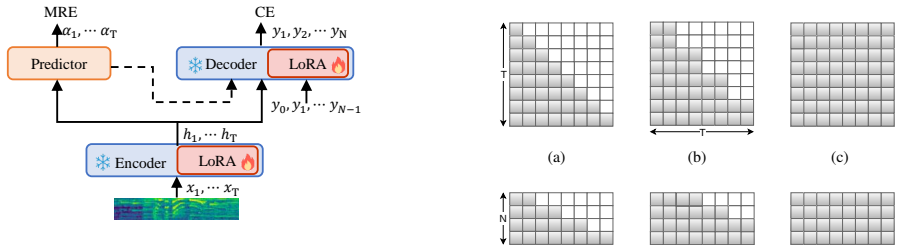
The load-bearing object is Monotonic Finite Look-ahead Attention (MFLA), whose boundaries are set by the Continuous Integrate-and-Fire (CIF) predictor. The predictor outputs a weight for each encoded speech frame; accumulating those weights triggers the next token when the running sum crosses an integer. MFLA then restricts decoder attention to all previous hidden states plus a finite look-ahead window of future hidden states, with the span drawn from a Poisson distribution with mean 3 during training. The same accumulated weights drive the online read-write policy in Algorithm 1, which writes a token whenever the running weight exceeds k. Causal convolution on the encoder and hybrid full/monotonic attention training keep the model consistent between offline and streaming use, while wait-k decoding makes latency a simple function of the tunable k.
What would settle it
Take a test utterance with known word or phonetic boundaries and compare the CIF firing points (where the accumulated frame weight crosses each integer) against those boundaries; a systematic offset or drift between firing points and true boundaries would falsify the alignment claim. Independently, measure Differentiable Average Lagging on artificially slowed and sped-up speech: if observed latency does not follow the paper's formula $\frac{1}{2}N_c + (k-\frac{1}{2})d$, the wait-k latency model fails.
Extended reading notes
Core claim
The paper's central claim is that a pre-trained offline encoder-decoder can be converted into an online recognizer by changing only the attention geometry: each target token attends to infinite left context and a finite right context, with the right-context width controlled by a Continuous Integrate-and-Fire (CIF) predictor rather than by fixed chunks. This makes training prefix-to-prefix and lets the same wait-k policy used in simultaneous interpretation control the latency-quality trade-off at inference. Concretely, the experiments show monotonic quality gains as k grows (wait-1, wait-2, wait-3 WERs of 7.59, 7.25, and 7.17 versus 7.06 for the Local Agreement baseline), while the Differentiable Average Lagging falls by 43.63%, 29.09%, and 14.54% for those same k values. The framework is reported to transfer to a speech-LLM decoder, where online decoding trails offline by 0.98% WER.
Load-bearing premise
The load-bearing premise is that the small counting module produces accurate weights for each sound frame, so that the moment its running total crosses a whole number really marks the boundary between two recognized tokens; the paper's own closing discussion admits those weights are biased, and if that bias is large the monotonic alignment and the firing rule stop tracking true token boundaries.
Editorial extensions
If this is right
- Changing k at inference repositions the same model along the latency-quality curve, so one fine-tune can serve several real-time products.
- Wait-k decoding has a lower computational footprint than Local Agreement, and continuing from the buffered decoder state cuts redundant decoder computation by about 60.86%.
- Across model scales from Small to Large-V3-Turbo, online decoding stays within 1.18%-1.72% WER of offline decoding, showing the degradation is roughly scale-independent.
- The same attention and decoding scheme carries over to a speech-LLM decoder, where online WER trails offline by 0.98%.
Reading between the lines
- Because the paper's own limitation paragraph concedes that the predictor's frame-level weights are biased, the alignment boundaries may be noisier than the token-count loss suggests; a direct frame-level supervision signal or a second-pass boundary refinement is a plausible next step that the paper does not take.
- The theoretical latency expression for wait-k includes the speaking rate d, so on speech with silence or variable tempo a fixed k will not keep a constant delay; making k adaptive to the accumulated CIF weight could stabilize latency.
- The extra 0.53% WER at k=1 comes from the smallest right-context window, so a hybrid that applies a Local-Agreement-style consensus check only to the most recent token could recover accuracy without taking back all 43.63% of the delay.
Editorial analysis
A structured set of objections, weighed in public.
Referee Report
Summary. The paper proposes Streaming-Whisper, a prefix-to-prefix fine-tuning framework that adapts Whisper for streaming speech recognition. The approach combines a CIF-based predictor that estimates token counts, Monotonic Finite Look-ahead Attention (MFLA) that gives each token infinite left context and finite right context, and wait-k decoding for controllable latency. Experiments are reported on multi-lingual test sets across four Whisper scales, with ablations comparing wait-1/2/3/5/∞ against a Local Agreement baseline in Table 2, and an extension to a SpeechLLM variant in Table 3.
Significance. If correct, the paper offers a practical low-cost route from offline Whisper to streaming ASR through LoRA fine-tuning, with a tunable latency-quality knob and a simple decoding procedure. The breadth of evaluation—multiple model scales, four languages, and an LLM-based variant—is a strength, and the paper states its architecture, losses, and decoding algorithm in enough detail to be reimplemented. However, the central claim of a controllable trade-off currently depends on an under-derived latency model and on the frame-level accuracy of a predictor that the paper itself concedes is biased; these points need to be resolved before the trade-off claim is fully supported.
major comments (4)
- [§2.4, Algorithm 1] The firing condition α > k is not formally connected to the wait-k lag in the text. Because α is also decremented by 1 after each write, the effective lag depends on the accumulated predictor weights as well as on k, and the mapping from the integer k in Algorithm 1 to the look-ahead span distribution of §3.2 and to the DAL formula in Eq. (4) is not specified. Please provide the derivation or calibration; without it the latency numbers in Table 2 are not reproducible.
- [§2.2, §5, Algorithm 1] The predictor is trained only with an MRE loss on the total token count, yet MFLA's finite right-context windows and Algorithm 1's write times are determined by frame-level cumulative weights. The conclusion explicitly states that the predictor gives biased frame-level estimates of token weights, and biased weights can shift firing times earlier or later without changing the total count. The reported WER and DAL numbers in Table 2 do not settle this issue because the decoder may tolerate poor boundaries, and the final loop in Algorithm 1 (lines 10-12) generates the tail of the utterance with full h_{1:T} context, which can mask end-of-utterance failures. An oracle-boundary ablation or frame-level alignment analysis is needed to establish that the trade-off is controlled by k rather than by predictor boundary errors.
- [§4.2.2, Eqs. (3)-(4)] The DAL expressions for the Local Agreement and wait-k policies are asserted without derivation, and the definitions of N_c, d, and k are ambiguous. Please derive or cite the formulas and explain how they produce the relative latency reductions of 43.63%, 29.09%, and 14.54% reported in Table 2. Since the likelihood of the latency-quality trade-off claim depends on these numbers, this missing derivation is load-bearing.
- [§4.2, Tables 1-3] The paper reports average WER and DAL values without variance, test-set sizes, or significance tests. Several key comparisons are separated by less than 0.2% absolute WER (e.g., wait-3 vs. wait-2 in Table 2), so it is unclear whether the monotonic WER trend as a function of k is stable or within noise. Please add error bars or a statistical test for the central comparisons.
minor comments (6)
- [§3.1] The dataset name appears as 'V oxPopuli' with a spacing artifact; it should read VoxPopuli.
- [§4.2.2] The sentence 'This demonstrate that our approach...' should read 'This demonstrates that our approach...'.
- [Figure 2] The panels in Figure 2 are hard to interpret without labels or a legend for the chunk and look-ahead windows; please add annotations or a caption that explains each panel.
- [§2.4] The text states that k is highly flexible and can even take decimals, but Algorithm 1 uses an integer threshold with α as a scalar; please clarify whether fractional k is conceptual or actually implemented.
- [§2.2] The Mean Relative Error loss is named but its formula is not given; please define the loss explicitly and state how α is scaled by the target length during training.
- [§4.2] The Local Agreement baseline implementation is not described beyond referencing [11]; please specify the chunk length, agreement criterion, and commitment policy used for the comparison in Table 2.
Circularity Check
No significant circularity: the reported WER and DAL numbers are held-out measurements, hyperparameters are fixed before evaluation, and self-citations are background only.
full rationale
The paper's central empirical claims are not constructed from their inputs. WER is computed on held-out test sets (Section 3.1 and Table 1: WenetSpeech4TTS Premium/Standard, LibriSpeech test, MLS, VoxPopuli) using the edit-distance library, and DAL is measured via Equations (1)-(2) and reported in Table 2. The hyperparameters (lambda=3 for the MFLA look-ahead span, gamma=5 loss weight, chunk range [32,128]) are fixed in Section 3.2 before evaluation, and the wait-k parameter is swept as a decoding knob rather than fitted to the target metrics. The DAL formulas in Equations (3)-(4) are stated analytic expressions, not fitted to the table's values; the table's DAL values are measured quantities under the stated decoding policies. No prediction is derived from the same data it is supposed to predict. The only self-citations in the manuscript (e.g., [3] and [12]) are background references to prior distillation and streaming-Whisper work; they are not load-bearing for the MFLA derivation or the latency-quality trade-off claim. The paper's own limitation statement, 'the network structure and loss constraints of the predictor are overly simplistic, leading to biased estimation of frame-level token weights,' is a genuine robustness concern for Algorithm 1's firing condition, but it is a correctness risk, not circularity: the predictor is trained with an MRE loss independent of the reported WER/DAL, and biased frame weights would weaken the method rather than make the claimed trade-off equivalent to the method's inputs. No circular step can be exhibited from the text, so the appropriate finding is no significant circularity.
Assumptions & free parameters
free parameters (4)
- MFLA look-ahead span distribution lambda =
3
- MRE loss weight gamma =
5
- MoChA chunk size interval =
[32, 128] frames
- Online decoding chunk length =
1 second
assumptions (4)
- domain assumption Frame-level token weights from the predictor are accurate enough to segment speech into tokens monotonically.
- ad hoc to paper The DAL formulas in Eq. 3 and 4 are correct descriptions of average lagging for Local Agreement and wait-k.
- domain assumption A frozen Whisper encoder adapted with LoRA can become causal by replacing front convolutions with causal ones and using MoChA chunking without damaging pretrained representations.
- domain assumption The training hyperparameters and the 1-second chunk size transfer across Chinese, English, German, and Spanish without per-language tuning.
Cite this review
Pith. "Pith review of MFLA: Monotonic Finite Look-ahead Attention for Streaming Speech Recognition." pith.science (2026). https://pith.science/paper/O5BV2L5H
@misc{pith2026250603722,
  author       = {Pith},
  title        = {Pith review of: MFLA: Monotonic Finite Look-ahead Attention for Streaming Speech Recognition},
  year         = {2026},
  howpublished = {\url{https://pith.science/paper/O5BV2L5H}},
  note         = {Machine review of arXiv:2506.03722}
}
read the original abstract
Applying large pre-trained speech models like Whisper has shown promise in reducing training costs for various speech tasks. However, integrating these models into streaming systems remains a challenge. This paper presents a novel prefix-to-prefix training framework for streaming recognition by fine-tuning the Whisper. We introduce the Continuous Integrate-and-Fire mechanism to establish a quasi-monotonic alignment between continuous speech sequences and discrete text tokens. Additionally, we design Monotonic Finite Look-ahead Attention, allowing each token to attend to infinite left-context and finite right-context from the speech sequences. We also employ the wait-k decoding strategy to simplify the decoding process while ensuring consistency between training and testing. Our theoretical analysis and experiments demonstrate that this approach achieves a controllable trade-off between latency and quality, making it suitable for various streaming applications.
Figures
Reference graph
Works this paper leans on
-
[1]
Introduction As a framework for weakly supervised pre-training on large- scale datasets, Whisper [1] has shown strong performance in multilingual recognition, but reveals a significant inference de- lay. Although methods such as knowledge distillation [2, 3] and speculative decoding [4], have been proposed to improve infer- ence speed, they do not alter t...
-
[2]
We introduce a predictor based on the Continuous Integrate- and-Fire (CIF) mechanism to estimate the number of target tokens, thereby establishing a quasi-monotonic alignment be- tween continuous speech sequences and discrete tokens
-
[3]
We develop Monotonic Finite Look-ahead Atten- tion (MFLA) to enable each token to dynamically attend to both the infinite left-context and the finite right-context windows, which transforms the training paradigm from conventional sequence-to-sequence to a more efficient prefix-to-prefix framework
-
[4]
We adopt the efficient wait- k decoding strategy, which not only eliminates the complexity associated with additional de- coding processes but also achieves a superior trade-off be- tween latency and recognition quality compared to the state- of-the-art Local Agreement policy. arXiv:2506.03722v1 [cs.CL] 4 Jun 2025 Predictor LoRADecoder LoRAEncoder 𝑥1, ⋯ 𝑥...
work page Pith review arXiv 2025
-
[5]
Methods 2.1. Overview As shown in Figure 1, the proposed Streaming-Whisper in- cludes three modules: encoder, decoder, and predictor. The en- coder converts the input speech sequenceX = {x1, x2, ..., xT } into a hidden state sequence H = {h1, h2, ..., hT }, and de- fines h1:T = f (x1:T ); the decoder employs the hidden states to produce the output sequenc...
-
[6]
Experimental Setup 3.1. Data Our training and evaluation data are constructed from vari- ous open-source datasets, including WenetSpeech4TTS [16] (where a portion of each subset is reserved for the testset), LibriSpeech [17], Multilingual Librispeech (MLS) [18], and V oxPopuli [19], covering four languages: Chinese (cn), En- glish (en), German (de) and Sp...
-
[7]
Experimental Results 4.1. Architecture Experiment We implement the Streaming-Whisper framework in various scale architectures, including Small, Medium, Large-V3 and Large-V3-Turbo. Table 1 presents the WERs(%) of different decoding methods in different models. The experimental re- sults indicate that online decoding method exhibits consistent performance ...
-
[8]
Conclusions and Discussions In this paper, we propose MFLA, an attention mechanism that enables each token to attend to both the infinite left-context and finite right-context in the speech sequence. This mecha- nism allows the training approach to shift from a sequence-to- sequence paradigm to a prefix-to-prefix paradigm, thereby facil- itating real-time...
Show all 36 references
-
[9]
Acknowledgements This work was supported in part by China NSFC projects under Grants 62122050 and 62071288, in part by Shanghai Munici- pal Science and Technology Commission Project under Grant 2021SHZDZX0102
-
[10]
Robust speech recognition via large-scale weak supervision,
A. Radford, J. W. Kim, T. Xu, G. Brockman, C. McLeavey, and I. Sutskever, “Robust speech recognition via large-scale weak supervision,” in International conference on machine learning . PMLR, 2023, pp. 28 492–28 518
2023
-
[11]
Distil-whisper: Robust knowledge distillation via large-scale pseudo labelling,
S. Gandhi, P. von Platen, and A. M. Rush, “Distil-whisper: Robust knowledge distillation via large-scale pseudo labelling,” arXiv preprint arXiv:2311.00430, 2023
2023 arXiv
-
[12]
Whisper-kdq: A lightweight whisper via guided knowledge distillation and quantization for efficient asr,
H. Shao, W. Wang, B. Liu, X. Gong, H. Wang, and Y . Qian, “Whisper-kdq: A lightweight whisper via guided knowledge distillation and quantization for efficient asr,” arXiv preprint arXiv:2305.10788, 2023
2023 arXiv
-
[13]
Whisper in medusa’s ear: Multi-head efficient decod- ing for transformer-based asr,
Y . Segal-Feldman, A. Shamsian, A. Navon, G. Hetz, and J. Keshet, “Whisper in medusa’s ear: Multi-head efficient decod- ing for transformer-based asr,” arXiv preprint arXiv:2409.15869, 2024
2024 arXiv
-
[14]
Synchronous transformers for end-to-end speech recognition,
Z. Tian, J. Yi, Y . Bai, J. Tao, S. Zhang, and Z. Wen, “Synchronous transformers for end-to-end speech recognition,” inICASSP 2020- 2020 IEEE International Conference on Acoustics, Speech and Signal Processing (ICASSP). IEEE, 2020, pp. 7884–7888
2020
-
[15]
Online and linear-time attention by enforcing monotonic alignments,
C. Raffel, M.-T. Luong, P. J. Liu, R. J. Weiss, and D. Eck, “Online and linear-time attention by enforcing monotonic alignments,” in International conference on machine learning. PMLR, 2017, pp. 2837–2846
2017
-
[16]
Monotonic infinite lookback attention for simultaneous machine translation,
N. Arivazhagan, C. Cherry, W. Macherey, C.-C. Chiu, S. Yavuz, R. Pang, W. Li, and C. Raffel, “Monotonic infinite lookback attention for simultaneous machine translation,” arXiv preprint arXiv:1906.05218, 2019
1906 arXiv
-
[17]
Monotonic chunkwise attention,
C.-C. Chiu and C. Raffel, “Monotonic chunkwise attention,” arXiv preprint arXiv:1712.05382, 2017
2017 arXiv
-
[18]
Monotonic multi- head attention,
X. Ma, J. Pino, J. Cross, L. Puzon, and J. Gu, “Monotonic multi- head attention,” arXiv preprint arXiv:1909.12406, 2019
1909 arXiv
-
[19]
Stacl: Simultaneous trans- lation with implicit anticipation and controllable latency using prefix-to-prefix framework,
M. Ma, L. Huang, H. Xiong, R. Zheng, K. Liu, B. Zheng, C. Zhang, Z. He, H. Liu, X. Li et al., “Stacl: Simultaneous trans- lation with implicit anticipation and controllable latency using prefix-to-prefix framework,” arXiv preprint arXiv:1810.08398 , 2018
-
[20]
Low-latency sequence-to- sequence speech recognition and translation by partial hypothesis selection,
D. Liu, G. Spanakis, and J. Niehues, “Low-latency sequence-to- sequence speech recognition and translation by partial hypothesis selection,” arXiv preprint arXiv:2005.11185, 2020
2005 arXiv
-
[21]
Simul-whisper: Attention-guided streaming whisper with truncation detection,
H. Wang, G. Hu, G. Lin, W.-Q. Zhang, and J. Li, “Simul-whisper: Attention-guided streaming whisper with truncation detection,” arXiv preprint arXiv:2406.10052, 2024
2024 arXiv
-
[22]
A transcrip- tion prompt-based efficient audio large language model for robust speech recognition,
Y . Li, X. Wang, S. Cao, Y . Zhang, L. Ma, and L. Xie, “A transcrip- tion prompt-based efficient audio large language model for robust speech recognition,” arXiv preprint arXiv:2408.09491, 2024
2024 arXiv
-
[23]
Cif: Continuous integrate-and-fire for end- to-end speech recognition,
L. Dong and B. Xu, “Cif: Continuous integrate-and-fire for end- to-end speech recognition,” in ICASSP 2020-2020 IEEE Interna- tional Conference on Acoustics, Speech and Signal Processing (ICASSP). IEEE, 2020, pp. 6079–6083
2020
-
[24]
Paraformer: Fast and accurate parallel transformer for non-autoregressive end-to- end speech recognition,
Z. Gao, S. Zhang, I. McLoughlin, and Z. Yan, “Paraformer: Fast and accurate parallel transformer for non-autoregressive end-to- end speech recognition,” arXiv preprint arXiv:2206.08317, 2022
2022 arXiv
-
[25]
Wenetspeech4tts: A 12,800-hour mandarin tts corpus for large speech generation model bench- mark,
L. Ma, D. Guo, K. Song, Y . Jiang, S. Wang, L. Xue, W. Xu, H. Zhao, B. Zhang, and L. Xie, “Wenetspeech4tts: A 12,800-hour mandarin tts corpus for large speech generation model bench- mark,” arXiv preprint arXiv:2406.05763, 2024
2024 arXiv
-
[26]
Lib- rispeech: an asr corpus based on public domain audio books,
V . Panayotov, G. Chen, D. Povey, and S. Khudanpur, “Lib- rispeech: an asr corpus based on public domain audio books,” in 2015 IEEE international conference on acoustics, speech and signal processing (ICASSP). IEEE, 2015, pp. 5206–5210
2015
-
[27]
Mls: A large-scale multilingual dataset for speech research,
V . Pratap, Q. Xu, A. Sriram, G. Synnaeve, and R. Collobert, “Mls: A large-scale multilingual dataset for speech research,” arXiv preprint arXiv:2012.03411, 2020
2012 arXiv
-
[28]
V oxpopuli: A large-scale multilingual speech corpus for representation learn- ing, semi-supervised learning and interpretation,
C. Wang, M. Riviere, A. Lee, A. Wu, C. Talnikar, D. Haz- iza, M. Williamson, J. Pino, and E. Dupoux, “V oxpopuli: A large-scale multilingual speech corpus for representation learn- ing, semi-supervised learning and interpretation,” arXiv preprint arXiv:2101.00390, 2021
2021 arXiv
-
[29]
Lora: Low-rank adaptation of large lan- guage models,
E. J. Hu, Y . Shen, P. Wallis, Z. Allen-Zhu, Y . Li, S. Wang, L. Wang, and W. Chen, “Lora: Low-rank adaptation of large lan- guage models,” arXiv preprint arXiv:2106.09685, 2021
2021 arXiv
-
[30]
Wenet: Production oriented stream- ing and non-streaming end-to-end speech recognition toolkit,
Z. Yao, D. Wu, X. Wang, B. Zhang, F. Yu, C. Yang, Z. Peng, X. Chen, L. Xie, and X. Lei, “Wenet: Production oriented stream- ing and non-streaming end-to-end speech recognition toolkit,” in Proc. Interspeech. Brno, Czech Republic: IEEE, 2021
2021
-
[31]
A normalized levenshtein distance metric,
L. Yujian and L. Bo, “A normalized levenshtein distance metric,” IEEE transactions on pattern analysis and machine intelligence , vol. 29, no. 6, pp. 1091–1095, 2007
2007
-
[32]
Thinking slow about latency eval- uation for simultaneous machine translation,
C. Cherry and G. Foster, “Thinking slow about latency eval- uation for simultaneous machine translation,” arXiv preprint arXiv:1906.00048, 2019
1906 arXiv
-
[33]
Bestow: Efficient and streamable speech language model with the best of two worlds in gpt and t5,
Z. Chen, H. Huang, O. Hrinchuk, K. C. Puvvada, N. R. Koluguri, P. ˙Zelasko, J. Balam, and B. Ginsburg, “Bestow: Efficient and streamable speech language model with the best of two worlds in gpt and t5,” arXiv preprint arXiv:2406.19954, 2024
2024 arXiv
-
[34]
Qwen2. 5 technical report,
A. Yang, B. Yang, B. Zhang, B. Hui, B. Zheng, B. Yu, C. Li, D. Liu, F. Huang, H. Weiet al., “Qwen2. 5 technical report,”arXiv preprint arXiv:2412.15115, 2024
2024 arXiv
-
[35]
Efficient streaming llm for speech recognition,
J. Jia, G. Keren, W. Zhou, E. Lakomkin, X. Zhang, C. Wu, F. Seide, J. Mahadeokar, and O. Kalinli, “Efficient streaming llm for speech recognition,” arXiv preprint arXiv:2410.03752, 2024
2024 arXiv
-
[36]
Decoder-only architecture for streaming end-to-end speech recognition,
E. Tsunoo, H. Futami, Y . Kashiwagi, S. Arora, and S. Watan- abe, “Decoder-only architecture for streaming end-to-end speech recognition,” arXiv preprint arXiv:2406.16107, 2024
2024 arXiv
Reviewed August 7, 2026 · model on record in the stance chip above.
Discussion (0). Sign in to comment.