REVIEW 4 major objections 4 minor 1 cited by
ComRoPE: Scalable and Robust Rotary Position Embedding Parameterized by Trainable Commuting Angle Matrices
T0 review · 4 major / 4 minor · reviewed 2026-08-07 · deepseek-v4-flash
Pith's one-line read Pairwise commuting angle matrices are exactly what makes rotary position embeddings offset-robust.
desk verdict Clean theorem, modest gains, but the ImageNet attribution to commutativity overreaches. read the letter →
The pith
A machine-rendered reading of the paper's core claim, the machinery that carries it, and where it could break.
The reading
What carries the argument
The carrying object is the parameterized rotation matrix $R(x;A)=\exp(\sum_i A_i x_i)$ built from skew-symmetric angle matrices, together with the RoPE Equation that requires the attention similarity $q^{\top} R(x)^{\top}R(y) k$ to be expressible as a function of the relative position $y-x$ alone. The proof machinery is the matrix exponential identity under commutativity: $e^{Ax}e^{By}=e^{Ax+By}$ if and only if $AB=BA$, extended to $N$ matrices by induction. The two trainable constructions are sufficient conditions for pairwise commutativity: axis-partitioned block-diagonal matrices (ComRoPE-AP) and linearly dependent matrices $B_i=\theta_i(P-P^{\top})$ sharing one base rotation (ComRoPE-LD).
What would settle it
Train a non-commuting trainable-angle RoPE (LieRE-style) with the coordinate-offset protocol of Section 4.3.1: if accuracy stops degrading as the offset standard deviation grows, or matches ComRoPE-LD under those offsets, then pairwise commutativity is not necessary for practical offset robustness. A direct algebraic check is also available: for random skew-symmetric $A,B$, verify that $\exp(Ax)^{\top}\exp(By)=\exp(By-Ax)$ holds exactly when $AB=BA$.
Extended reading notes
Core claim
The central discovery is a characterization: a rotation-matrix positional encoding $R(x;A)=\exp(\sum_i A_i x_i)$ with skew-symmetric angle matrices $A_i$ satisfies the RoPE Equation — meaning $q^{\top} R(x)^{\top}R(y) k = q^{\top} R(y-x) k$, so attention similarity depends only on the offset $y-x$ — exactly when the $A_i$ pairwise commute. The paper states this as a necessary and sufficient condition (Theorem 1), with the RoPE Equation formalized as the definition of offset robustness. On the constructive side, it shows two sufficient families: ComRoPE-AP, where each axis owns disjoint diagonal blocks of rotation parameters, and ComRoPE-LD, where all axis matrices are scalar multiples of a single trainable skew-symmetric base matrix $P-P^{\top}$. Empirically, ComRoPE-LD outperforms prior trainable and fixed RoPE variants on ImageNet-1K, MS COCO object detection, and UCF-101 3D classification, and — unlike the non-commuting LieRE baseline — retains accuracy when all coordinates receive a common random offset.
Load-bearing premise
The argument defines 'robust' to mean exact translation invariance — attention similarity must equal $q^{\top} R(y-x)k$ — and the theorem's necessity is relative to that formal definition; if approximate invariance suffices in practice, strict pairwise commutativity may be stronger than needed, as the paper's own Appendix H concedes.
Editorial extensions
If this is right
- Any RoPE variant whose rotations are written as $\exp(\sum_i A_i x_i)$ must have pairwise commuting $A_i$ to satisfy the RoPE Equation; non-commuting trainable rotations such as LieRE cannot guarantee offset invariance.
- With block size $b=2$ and fixed angles, ComRoPE-AP reduces to vanilla RoPE, and with zero angle matrices it reduces to standard attention, so a pretrained model using either can be fine-tuned under ComRoPE without architectural changes.
- Larger block sizes place the rotation matrices in a larger subgroup of $SO(d)$ and improve ImageNet accuracy, at an extra time cost of $O(ndb^2)$ for the matrix exponential.
- ComRoPE-LD needs far fewer extra parameters than LieRE — $d(b+N/b)$ versus $Ndb$ — while reporting higher accuracy and better stability under resolution changes.
Reading between the lines
- The paper's commutativity condition implies all learned rotations share a common eigenbasis; this suggests ComRoPE effectively learns per-axis frequency-like scalings rather than truly independent rotations, so its expressiveness is bounded in a way that approximate commutation might relax.
- The position-perturbation trick in Section 3.4.2 can be read as coordinate jitter augmentation that teaches the model to ignore continuous-position noise; combining it with the offset test could serve as a regularizer for near-commuting variants, an extension the paper does not explore.
- If the matrix-exponential bottleneck described in the appendices is removed, the same commuting-angle parameterization should transfer to language models, where single-axis sequences make commutativity automatic; the paper leaves that full-scale transfer as future work.
Editorial analysis
A structured set of objections, weighed in public.
Referee Report
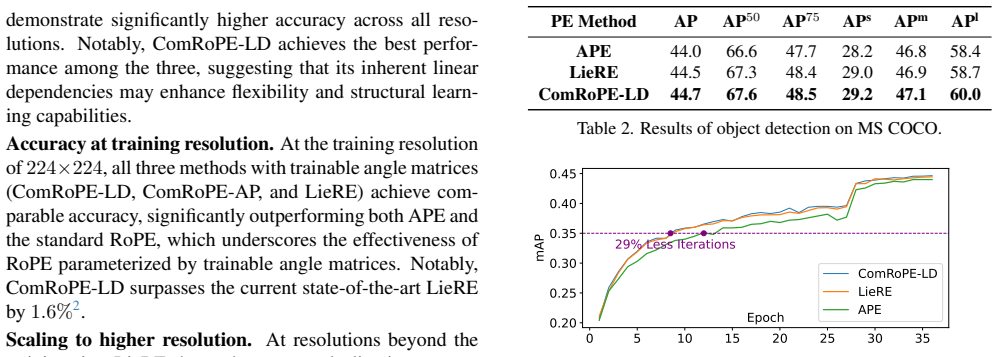
Summary. The paper proposes ComRoPE, a rotary position embedding variant in which the position-dependent rotation is exp(Σ_i A_i x_i) with trainable skew-symmetric matrices A_i constrained to pairwise commute. The authors formalize RPE and RoPE equations, prove (Theorem 1) that the rotation difference R(x)^T R(y) is a function of y−x iff the A_i pairwise commute, and instantiate this with two sufficient constructions: ComRoPE-AP (axial partition, one active block per axis) and ComRoPE-LD (linearly dependent blocks B_i = θ_i(P−P^T)). Experiments on ImageNet-1K classification, MS COCO detection, UCF-101 3D classification, and CLIP fine-tuning report consistent gains over LieRE, including a 1.6% (relative) gain at 224×224 and 2.9% at 512×512. Ablations cover coordinate-offset robustness, block size, and position perturbation.
Significance. If the claims hold, the paper makes a useful contribution: it gives a clean formal condition under which a trainable rotation-family position encoding remains exactly translation-invariant, and it shows empirically that enforcing this condition can improve ImageNet accuracy and offset robustness. The appendix proof of Theorem 1 is coherent and complete, the offset ablation in §4.3.1 is the right kind of experiment for commutativity, and source code is provided. The main weaknesses are that the headline accuracy gains are not isolated from other design choices by a matched non-commuting control, the results are single-seed with no confidence intervals, and the abstract's 'essential for scalability and robustness' claim goes beyond what the theorem (which is conditional on a definitional exact-invariance equation) establishes. These weaknesses are fixable without changing the core theoretical result.
major comments (4)
- [Section 4.1.2 and Figure 5] The 'Significance of commutativity' paragraph attributes ComRoPE-LD's ImageNet gains, including the 1.6% relative gain at 224×224, to commutativity. This is not supported by the experiments as designed: at 224×224 no coordinate offset is applied, so Theorem 1's equivalence (which concerns whether R(x)^T R(y) can be written as a function of y−x) is vacuous for that comparison. The direct test in §4.3.1 is the right experiment, but Figure 5 plots only the LieRE degradation and does not actually show the claimed ComRoPE invariance, since the ComRoPE curves are 'unpainted.' Please add the ComRoPE offset curves (or a table of numbers) and add a matched non-commuting control—for example, LieRE with the same block size, relative scaling, and position perturbation, or a non-commuting variant of ComRoPE-LD—to separate commutativity from the linearly-dependent parameterization (Proposition 3), relative scaling (§3.4.1), and position perturbation (§3.4.2). Appendix H also concedes that strict commutativity restricts expressiveness, so the construction carries independent effects.
- [Table 1 and Footnote 2] The main empirical claims are reported without uncertainty quantification, and the 1.6% figure is a relative improvement, which is easy to misread as an absolute accuracy gap. Table 1 contains one run per condition with no error bars or significance tests, yet the text says ComRoPE-LD 'significantly outperforms' LieRE. Footnote 2 defines improvement relative to the baseline, so the 224×224 gap is about one absolute point (65.49 vs. 64.36) and the 512×512 gap is about 1.5 absolute points (55.29 vs. 53.74). The abstract and §4.1.2 should state absolute gaps and either provide multiple seeds with confidence intervals for the main comparisons or soften the significance language.
- [Table 1 vs. Appendix Table 10] The state-of-the-art comparison is incomplete in the main table. Table 1 compares APE, vanilla RoPE, LieRE, and ComRoPE, but RoPE-Mixed—a strong 2D-RoPE baseline that the paper itself discusses in §2.2—appears only in the appendix under a different training recipe (Table 10). Since the abstract and §4.1.2 claim to surpass the current state of the art, the main table should either include RoPE-Mixed under the same protocol or the claim should be explicitly restricted to LieRE.
- [Definition 4, Section 3.2, Abstract] The abstract and Section 3.2 say pairwise commutativity is 'essential' for scalability and positional robustness, but the formal result is conditional on Definition 4, which postulates exact translation invariance of the attention similarity, and on the parameterization R(x;A)=exp(Σ_i A_i x_i). The theorem does not cover approximate robustness or resolution extrapolation, and Appendix H acknowledges that strict commutativity restricts expressiveness. Please qualify the necessity claim as exact offset invariance within this parameterized family, and discuss whether weaker conditions (e.g., approximate commutativity) might suffice for practical robustness. This is a framing issue, not a flaw in the proof, but it affects the paper's central claim as stated.
minor comments (4)
- [Table 3] Table 3 contains malformed entries (e.g., '50.1455.63' and '79.2194.2480.27'), and the APE row reports 93.10 at 224 but 76.70 at 256, which is implausible and needs correction or explanation.
- [Section 4.2 and Table 7] Section 4.2 says ComRoPE-LD uses 'nearly half the number of extra parameters' compared with LieRE, but Table 7 gives a ratio of (b+N/b)/(Nb); for N=2,b=8 this is 9/16≈0.56, not nearly half. Please rephrase the claim.
- [Equation (11)] In Eq. (11), the notation diag(σΔX_1,...,σΔX_N)^2 is ambiguous; please clarify whether the square applies elementwise to the diagonal and state the units of σ.
- [References] Reference [29] duplicates [28] (Raffel et al.), and in §2.2 the citation 'EV A-02 [8], FiT [8]' should be split into separate entries or the shared [8] should be corrected.
Circularity Check
No significant circularity: Theorem 1 is a genuine iff result, the constructions are derived sufficient conditions, and the empirical gains are direct measurements rather than fitted predictions.
full rationale
The paper's central derivation is self-contained. Definition 4 sets out the target property that a parameterized RoPE function should satisfy, namely that the attention similarity depends only on the relative position via R_f(y-x); it does not assume commutativity. Theorem 1 then proves, using the matrix-exponential identities in Lemmas 1-3, that within the family R(x;A)=exp(Σ_i A_i x_i) this target property holds if and only if the angle matrices A_i pairwise commute. The 'if' and 'only if' directions are both argued from the algebra of matrix exponentials, so commutativity is concluded rather than assumed. Propositions 2 and 3 are explicit sufficient constructions (axial-partitioned blocks and linearly dependent matrices) whose commutativity follows directly from the stated algebraic conditions. The experimental results are direct measurements of ImageNet accuracy and ablations against LieRE and other baselines; the trainable angle matrices are fitted by training, but no fitted parameter is renamed as a prediction, and the higher-resolution evaluations are genuine generalization tests. The few self-citations in the paper appear only in the related-work enumeration and are not load-bearing for the theoretical or empirical claims. The main caveat is one of scope, not circularity: Theorem 1 characterizes exact translation invariance within the chosen parameterized family, and the paper's interpretation that commutativity explains the ImageNet gains is an empirical attribution that could be confounded by other design choices, but that is a correctness or experimental-design concern rather than a circularity concern.
Assumptions & free parameters
free parameters (3)
- perturbation intensity sigma =
1 (default), explored in {0, 0.2, 0.5, 1.0}
- block size b =
8
- learned angle-matrix parameters P_j and scaling factors theta_i =
Learned on ImageNet-1K; final values not reported
assumptions (4)
- domain assumption RoPE should satisfy exact translation invariance R_f(x)^T R_f(y)=R_f(y-x) as stated in Definition 4, Eq. 2.
- standard math exp(A) is orthogonal for skew-symmetric A, and every rotation matrix has a skew-symmetric logarithm (Proposition 4).
- standard math e^A e^B = e^(A+B) if and only if A and B commute (Lemma 1).
- domain assumption Image patch positions are continuous coordinates normalized to the unit square, with the patch center as the aggregation point.
Cite this review
Pith. "Pith review of ComRoPE: Scalable and Robust Rotary Position Embedding Parameterized by Trainable Commuting Angle Matrices." pith.science (2026). https://pith.science/paper/YLB74XUM
@misc{pith2026250603737,
  author       = {Pith},
  title        = {Pith review of: ComRoPE: Scalable and Robust Rotary Position Embedding Parameterized by Trainable Commuting Angle Matrices},
  year         = {2026},
  howpublished = {\url{https://pith.science/paper/YLB74XUM}},
  note         = {Machine review of arXiv:2506.03737}
}
read the original abstract
The Transformer architecture has revolutionized various regions since it was proposed, and its effectiveness largely depends on the ability to encode positional information. Traditional position encoding methods exhibit significant limitations due to lack of robustness and flexibility of position. Therefore, Rotary Positional Encoding (RoPE) was proposed to alleviate these issues, which integrates positional information by rotating the embeddings in the attention mechanism. However, RoPE requires manually defined rotation matrices with limited transformation space, constraining the model's capacity. In this work, we propose ComRoPE, which generalizes RoPE by defining it in terms of trainable commuting angle matrices. Specifically, we demonstrate that pairwise commutativity of these matrices is essential for RoPE to achieve scalability and positional robustness. We formally define the RoPE Equation, which is an essential condition that ensures consistent performance with position offsets. Based on the theoretical analysis, we present two types of trainable commuting angle matrices as sufficient solutions to the RoPE equation, which significantly improve performance, surpassing the current state-of-the-art method by 1.6% at training resolution and 2.9% at higher resolution on the ImageNet-1K dataset. Furthermore, our framework shows versatility in generalizing to existing RoPE formulations and offering new insights for future positional encoding research. To ensure reproducibility, the source code and instructions are available at https://github.com/Longin-Yu/ComRoPE
Figures


Figures from the paper (4 more)


Forward citations
Cited by 1 Pith paper
-
Robust Filter Attention: Self-Attention as Precision-Weighted State Estimation
Robust Filter Attention models self-attention as consistency-based state estimation under a linear SDE for token trajectories, matching standard attention complexity while showing lower perplexity and better zero-shot...
Reference graph
Works this paper leans on
-
[1]
Philipp Bader, Sergio Blanes, and Fernando Casas. Comput- ing the matrix exponential with an optimized taylor polyno- mial approximation.Mathematics, 7:1174, 2019. 4
work page 2019
-
[2]
Language models are few-shot learners
Tom B Brown. Language models are few-shot learners. arXiv preprint arXiv:2005.14165, 2020. 1
arXiv 2005
-
[3]
Yirui Chen, Xudong Huang, Quan Zhang, Wei Li, Mingjian Zhu, Qiangyu Yan, Simiao Li, Hanting Chen, Hailin Hu, Jie Yang, et al. Gim: A million-scale benchmark for genera- tive image manipulation detection and localization.arXiv preprint arXiv:2406.16531, 2024. 1
arXiv 2024
-
[4]
Vicuna: An open-source chatbot impressing gpt-4 with 90%* chatgpt quality, march 2023.URL https://lmsys
Wei-Lin Chiang, Zhuohan Li, Zi Lin, Ying Sheng, Zhanghao Wu, Hao Zhang, Lianmin Zheng, Siyuan Zhuang, Yonghao Zhuang, Joseph E Gonzalez, et al. Vicuna: An open-source chatbot impressing gpt-4 with 90%* chatgpt quality, march 2023.URL https://lmsys. org/blog/2023-03-30-vicuna, 3(5),
2023
-
[5]
Jia Deng, Wei Dong, Richard Socher, Li-Jia Li, K. Li, and Li Fei-Fei. Imagenet: A large-scale hierarchical image database.2009 IEEE Conference on Computer Vision and Pattern Recognition, pages 248–255, 2009. 6
work page 2009
-
[6]
Bert: Pre-training of deep bidirectional trans- formers for language understanding
Jacob Devlin, Ming-Wei Chang, Kenton Lee, and Kristina Toutanova. Bert: Pre-training of deep bidirectional trans- formers for language understanding. InNorth American Chapter of the Association for Computational Linguistics,
-
[7]
Alexey Dosovitskiy. An image is worth 16x16 words: Transformers for image recognition at scale.arXiv preprint arXiv:2010.11929, 2020. 1
arXiv 2010
-
[8]
Eva-02: A visual representation for neon genesis.Image and Vision Computing, 149:105171,
Yuxin Fang, Quan Sun, Xinggang Wang, Tiejun Huang, Xin- long Wang, and Yue Cao. Eva-02: A visual representation for neon genesis.Image and Vision Computing, 149:105171,
Show all 45 references
-
[9]
Jean H. Gallier. Basics of classical lie groups: The exponen- tial map, lie groups, and lie algebras. 2001. 3
2001
-
[10]
Chatglm: A family of large language models from glm-130b to glm-4 all tools.arXiv preprint arXiv:2406.12793, 2024
Team GLM, Aohan Zeng, Bin Xu, Bowen Wang, Chenhui Zhang, Da Yin, Dan Zhang, Diego Rojas, Guanyu Feng, Hanlin Zhao, et al. Chatglm: A family of large language models from glm-130b to glm-4 all tools.arXiv preprint arXiv:2406.12793, 2024. 1
2024 arXiv
-
[11]
Larry C. Grove. Classical groups and geometric algebra
-
[12]
Rotary position embedding for vision transformer
Byeongho Heo, Song Park, Dongyoon Han, and Sangdoo Yun. Rotary position embedding for vision transformer. arXiv preprint arXiv:2403.13298, 2024. 2
2024 arXiv
-
[13]
Translational equivariance in kernel- izable attention.arXiv preprint arXiv:2102.07680, 2021
Max Horn, Kumar Shridhar, Elrich Groenewald, and Philipp FM Baumann. Translational equivariance in kernel- izable attention.arXiv preprint arXiv:2102.07680, 2021. 2
2021 arXiv
-
[14]
The impact of positional encoding on length generalization in transform- ers.Advances in Neural Information Processing Systems, 36: 24892–24928, 2023
Amirhossein Kazemnejad, Inkit Padhi, Karthikeyan Nate- san Ramamurthy, Payel Das, and Siva Reddy. The impact of positional encoding on length generalization in transform- ers.Advances in Neural Information Processing Systems, 36: 24892–24928, 2023. 1
2023
-
[15]
Autowebglm: A large language model-based web navigating agent
Hanyu Lai, Xiao Liu, Iat Long Iong, Shuntian Yao, Yux- uan Chen, Pengbo Shen, Hao Yu, Hanchen Zhang, Xiaohan Zhang, Yuxiao Dong, et al. Autowebglm: A large language model-based web navigating agent. InProceedings of the 30th ACM SIGKDD Conference on Knowledge Discovery and Dat...
2024
-
[16]
Llava-st: A multimodal large language model for fine-grained spatial- temporal understanding.arXiv preprint arXiv:2501.08282,
Hongyu Li, Jinyu Chen, Ziyu Wei, Shaofei Huang, Tianrui Hui, Jialin Gao, Xiaoming Wei, and Si Liu. Llava-st: A multimodal large language model for fine-grained spatial- temporal understanding.arXiv preprint arXiv:2501.08282,
-
[17]
Lawrence Zitnick, and Piotr Doll ´ar
Tsung-Yi Lin, Michael Maire, Serge Belongie, Lubomir Bourdev, Ross Girshick, James Hays, Pietro Perona, Deva Ramanan, C. Lawrence Zitnick, and Piotr Doll ´ar. Microsoft coco: Common objects in context.arXiv preprint arXiv: 1405.0312, 2014. 7
2014 arXiv
-
[18]
We- bglm: towards an efficient web-enhanced question answer- ing system with human preferences
Xiao Liu, Hanyu Lai, Hao Yu, Yifan Xu, Aohan Zeng, Zhengxiao Du, Peng Zhang, Yuxiao Dong, and Jie Tang. We- bglm: towards an efficient web-enhanced question answer- ing system with human preferences. InProceedings of the 29th ACM SIGKDD conference on knowledge discovery and da...
2023
-
[19]
Agentbench: Evaluating llms as agents
Xiao Liu, Hao Yu, Hanchen Zhang, Yifan Xu, Xuanyu Lei, Hanyu Lai, Yu Gu, Hangliang Ding, Kaiwen Men, Kejuan Yang, et al. Agentbench: Evaluating llms as agents. InThe Twelfth International Conference on Learning Representa- tions, 2024. 1
2024
-
[20]
Swin transformer: Hierarchical vision transformer using shifted windows
Ze Liu, Yutong Lin, Yue Cao, Han Hu, Yixuan Wei, Zheng Zhang, Stephen Lin, and Baining Guo. Swin transformer: Hierarchical vision transformer using shifted windows. In Proceedings of the IEEE/CVF international conference on computer vision, pages 10012–10022, 2021. 2
2021
-
[21]
Relative positional encoding for transformers with linear complexity
Antoine Liutkus, Ond ˇrej Cıfka, Shih-Lun Wu, Umut Sim- sekli, Yi-Hsuan Yang, and Gael Richard. Relative positional encoding for transformers with linear complexity. InInterna- tional Conference on Machine Learning, pages 7067–7079. PMLR, 2021. 2
2021
-
[22]
Unified-io 2: Scaling autoregressive multimodal models with vision language audio and action
Jiasen Lu, Christopher Clark, Sangho Lee, Zichen Zhang, Savya Khosla, Ryan Marten, Derek Hoiem, and Aniruddha Kembhavi. Unified-io 2: Scaling autoregressive multimodal models with vision language audio and action. InProceed- ings of the IEEE/CVF Conference on Computer Vision a...
2024
-
[23]
Liere: Generalizing rotary position encodings.arXiv preprint arXiv:2406.10322,
Sophie Ostmeier, Brian Axelrod, Michael E Moseley, Ak- shay Chaudhari, and Curtis Langlotz. Liere: Generalizing rotary position encodings.arXiv preprint arXiv:2406.10322,
-
[24]
Train short, test long: Attention with linear biases enables input length extrapolation.arXiv preprint arXiv:2108.12409, 2021
Ofir Press, Noah A Smith, and Mike Lewis. Train short, test long: Attention with linear biases enables input length extrapolation.arXiv preprint arXiv:2108.12409, 2021. 2
2021 arXiv
-
[25]
Improving language understanding by generative pre-training
A Radford. Improving language understanding by generative pre-training. 2018. 1
2018
-
[26]
Language models are unsu- pervised multitask learners.OpenAI blog, 1(8):9, 2019
Alec Radford, Jeffrey Wu, Rewon Child, David Luan, Dario Amodei, Ilya Sutskever, et al. Language models are unsu- pervised multitask learners.OpenAI blog, 1(8):9, 2019. 1
2019
-
[27]
Ramesh, Gabriel Goh, Sandhini Agarwal, Girish Sastry, Amanda Askell, Pamela Mishkin, Jack Clark, Gretchen Krueger, and I
Alec Radford, Jong Wook Kim, Chris Hallacy, A. Ramesh, Gabriel Goh, Sandhini Agarwal, Girish Sastry, Amanda Askell, Pamela Mishkin, Jack Clark, Gretchen Krueger, and I. Sutskever. Learning transferable visual models from nat- ural language supervision.International Conference ...
2021
-
[29]
Exploring the limits of transfer learning with a unified text-to-text transformer.Journal of machine learning research, 21(140):1–67, 2020
Colin Raffel, Noam Shazeer, Adam Roberts, Katherine Lee, Sharan Narang, Michael Matena, Yanqi Zhou, Wei Li, and Peter J Liu. Exploring the limits of transfer learning with a unified text-to-text transformer.Journal of machine learning research, 21(140):1–67, 2020. 2
2020
-
[30]
Self- attention with relative position representations.arXiv preprint arXiv:1803.02155, 2018
Peter Shaw, Jakob Uszkoreit, and Ashish Vaswani. Self- attention with relative position representations.arXiv preprint arXiv:1803.02155, 2018. 2
2018 arXiv
-
[31]
Ucf101: A dataset of 101 human actions classes from videos in the wild.arXiv preprint arXiv: 1212.0402, 2012
Khurram Soomro, Amir Roshan Zamir, and Mubarak Shah. Ucf101: A dataset of 101 human actions classes from videos in the wild.arXiv preprint arXiv: 1212.0402, 2012. 3
2012 arXiv
-
[32]
Roformer: Enhanced transformer with rotary position embedding.Neurocomputing, 568:127063,
Jianlin Su, Murtadha Ahmed, Yu Lu, Shengfeng Pan, Wen Bo, and Yunfeng Liu. Roformer: Enhanced transformer with rotary position embedding.Neurocomputing, 568:127063,
-
[33]
End- to-end memory networks.Advances in neural information processing systems, 28, 2015
Sainbayar Sukhbaatar, Jason Weston, Rob Fergus, et al. End- to-end memory networks.Advances in neural information processing systems, 28, 2015. 2
2015
-
[34]
Llama: Open and efficient foundation language models
Hugo Touvron, Thibaut Lavril, Gautier Izacard, Xavier Martinet, Marie-Anne Lachaux, Timoth´ee Lacroix, Baptiste Rozi`ere, Naman Goyal, Eric Hambro, Faisal Azhar, et al. Llama: Open and efficient foundation language models. arXiv preprint arXiv:2302.13971, 2023. 2
2023 arXiv
-
[35]
Attention is all you need.Advances in Neural Information Processing Systems, 2017
A Vaswani. Attention is all you need.Advances in Neural Information Processing Systems, 2017. 1, 2
2017
-
[36]
Rethinking and improving relative posi- tion encoding for vision transformer
Kan Wu, Houwen Peng, Minghao Chen, Jianlong Fu, and Hongyang Chao. Rethinking and improving relative posi- tion encoding for vision transformer. InProceedings of the IEEE/CVF International Conference on Computer Vision, pages 10033–10041, 2021. 2
2021
-
[37]
Vit-comer: Vision transformer with convolu- tional multi-scale feature interaction for dense predictions
Chunlong Xia, Xinliang Wang, Feng Lv, Xin Hao, and Yifeng Shi. Vit-comer: Vision transformer with convolu- tional multi-scale feature interaction for dense predictions. Computer Vision and Pattern Recognition, 2024. 7
2024
-
[38]
Can mllms guide weakly- supervised temporal action localization tasks?arXiv preprint arXiv:2411.08466, 2024
Quan Zhang and Yuxin Qi. Can mllms guide weakly- supervised temporal action localization tasks?arXiv preprint arXiv:2411.08466, 2024. 1
2024 arXiv
-
[39]
Distilling semantic priors from sam to efficient image restoration models
Quan Zhang, Xiaoyu Liu, Wei Li, Hanting Chen, Jun- chao Liu, Jie Hu, Zhiwei Xiong, Chun Yuan, and Yunhe Wang. Distilling semantic priors from sam to efficient image restoration models. InProceedings of the IEEE/CVF Con- ference on Computer Vision and Pattern Recognition, pages...
2024
-
[40]
IMDPrompter: Adapting SAM to image manipulation detection by cross-view automated prompt learning
Quan Zhang, Yuxin Qi, Xi Tang, Jinwei Fang, Xi Lin, Ke Zhang, and Chun Yuan. IMDPrompter: Adapting SAM to image manipulation detection by cross-view automated prompt learning. InThe Thirteenth International Conference on Learning Representations, 2025
2025
-
[41]
Rethinking pseudo-label guided learning for weakly supervised temporal action localization from the perspective of noise correction.arXiv preprint arXiv:2501.11124, 2025
Quan Zhang, Yuxin Qi, Xi Tang, Rui Yuan, Xi Lin, Ke Zhang, and Chun Yuan. Rethinking pseudo-label guided learning for weakly supervised temporal action localization from the perspective of noise correction.arXiv preprint arXiv:2501.11124, 2025. 1 ComRoPE: Scalable and Robust R...
2025 arXiv
-
[42]
(13) SubstitutingA,BwithAx,By, we obtain: eAx+By =e AxeBy
Necessity (⇒).By the definition ofe A, we have: eA+B = ∞X n=0 (A+B) n n! = ∞X n=0 Pn k=0 n k AkBn−k n! = ∞X n=0 nX k=0 AkBn−k k!(n−k)! = ∞X k=0 Ak k! ! ∞X m=0 Bm m! ! =e AeB. (13) SubstitutingA,BwithAx,By, we obtain: eAx+By =e AxeBy. (14)
-
[43]
(16) Lett 2f(t)be the difference between the two expressions above
Sufficiency (⇐).We have: eAteBt = ∞X n=0 tnAn n! ! ∞X m=0 tmBm m! ! =I+t(A+B) +t 2 · A2 + 2AB+B 2 4 +o(t 2), (15) and e(A+B)t = ∞X n=0 ((A+B)t) n n! =I+t(A+B) +t 2 · (A+B) 2 4 +o(t 2). (16) Lett 2f(t)be the difference between the two expressions above. Thus, we obtain: f(t) = ...
-
[44]
(21) SinceA 1,A 2,
Necessity (⇒).Assuming: eA1x1 eA2x2 · · ·eAkxk =e A1x1+A2x2+···+Akxk , (20) we splitA 1x1 +A 2x2 +· · ·+Ak+1xk+1 into two parts: A1x1 +A 2x2 +· · ·+Ak+1xk+1 = (A1x1 +A 2x2 +· · ·+Akxk) + (Ak+1xk+1). (21) SinceA 1,A 2, . . . ,Ak+1 commute in pairs,A 1x1 + A2x2 +· · ·+Akxk andA ...
-
[45]
Then: eA1x1 eA2x2 · · ·eAkxk =e A1x1+A2x2+···+Akxk , (23) implying thatA 1,A 2,
Sufficiency (⇐).Letx k+1 = 0. Then: eA1x1 eA2x2 · · ·eAkxk =e A1x1+A2x2+···+Akxk , (23) implying thatA 1,A 2, . . . ,Ak commute in pairs. Position Encoding Method Perturbation Intensity Evaluation Resolution 112 128 192 224 256 320 384 448 512 APE 1 48.10 55.25 76.50 93.10 76....
-
[46]
We obtain: f(x 1 +y 1, x2 +y 2,
Sufficiency (⇐).From Equation 31, letx k be replaced withx k +y k andy k with0. We obtain: f(x 1 +y 1, x2 +y 2, . . . , xm +y m) =e A1(x1+y1)+···+Am(xm+ym)eA1·0+···+Am·0 =e A1(x1+y1)+···+Am(xm+ym). (27) Comparing this with Equation equation 31, we get: eA1x1+A2x2+···+AmxmeA1y1...
Reviewed August 7, 2026 · model on record in the stance chip above.
Discussion (0). Sign in to comment.