REVIEW 4 major objections 5 minor 11 references
Knockout LLM Assessment: Using Large Language Models for Evaluations through Iterative Pairwise Comparisons
T0 review · 4 major / 5 minor · reviewed 2026-08-07 · deepseek-v4-flash
Pith's one-line read This paper claims that scoring answers through a knockout tournament of pairwise LLM judgments raises the correlation between LLM scores and human expert scores by 0.07 on average over grading each answer alone.
desk verdict A clean, well-specified knockout-tournament extension of LLM pairwise grading with a plausible mechanism, but the headline 0.07 gain is not firmly backed by the numbers as reported and the scoring-invariance assumption is untested. read the letter →
The pith
A machine-rendered reading of the paper's core claim, the machinery that carries it, and where it could break.
The reading
What carries the argument
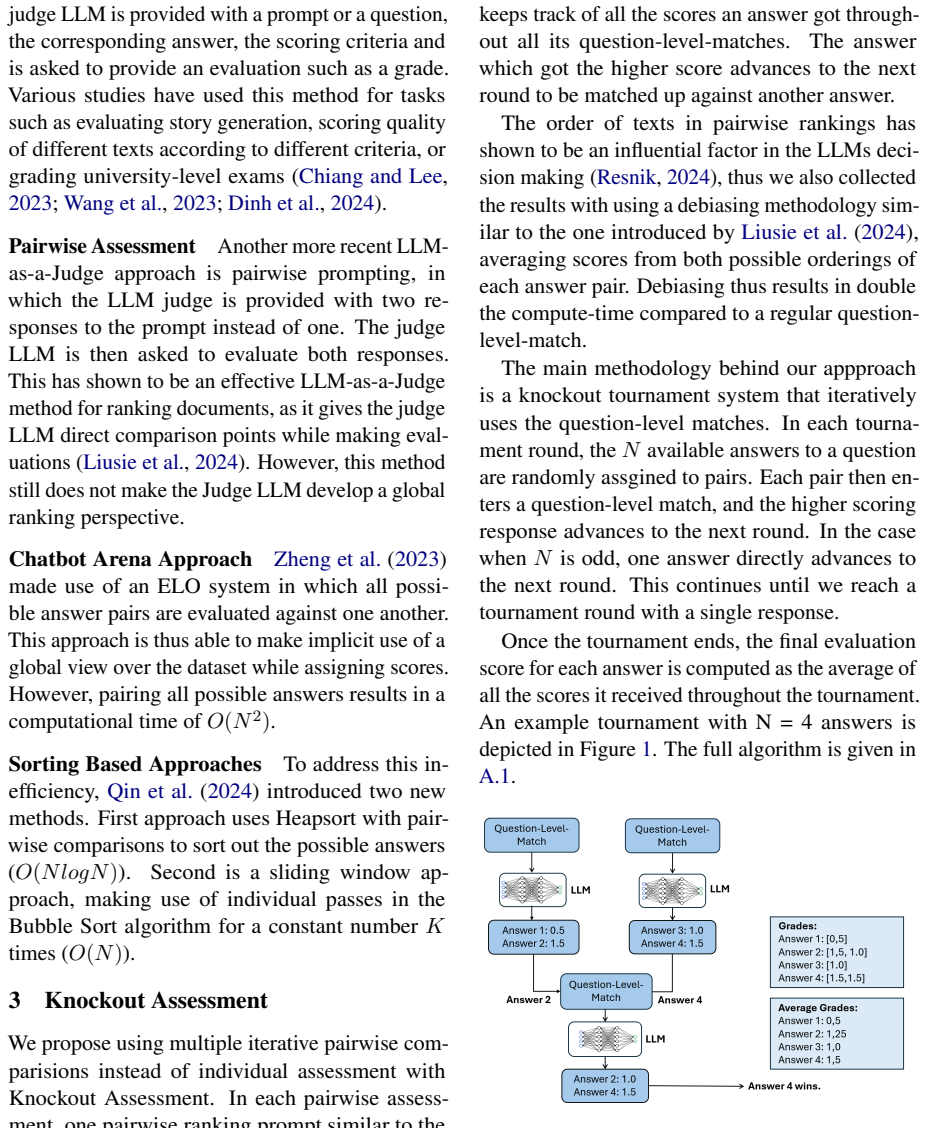
The central mechanism is a knockout tournament of question-level matches: in each match the judge LLM sees the question and two answers, scores both, and the higher-scoring answer advances to the next round; the process repeats until one answer remains. The final score for each answer is the average of all scores it received across all its matches, and a debiasing step averages the two possible orderings of each pair to counter position bias. This machinery accumulates multiple pairwise judgments per surviving answer and forces stronger answers to compete in later rounds, building a global perspective without placing all answers in a single prompt.
What would settle it
Take a set of answers and pair the same answer twice: once against the weakest answer in the pool and once against the strongest; if the score it receives moves systematically by more than one point, then tournament scores depend on the opponent, and the averaging procedure is not measuring absolute quality.
Extended reading notes
Core claim
On the paper's own terms, the central discovery is that requiring the judge LLM to compare answers in a knockout tournament, rather than score each answer by itself, produces final scores whose linear correlation with human expert scores is higher. Table 1 shows an average increase of 0.07 in Pearson correlation with expert evaluations across three LLM judges (Llama 3.2 1B, 3B, and 3.1 70B) and two datasets (SciEx university exams and WMT machine translations) when the debiased variant is used. The improvement is larger on the harder scientific exam task, and it holds for the smaller models on translation, while the largest model loses a bit on translation. The authors interpret this as evidence that iterative pairwise comparisons give the judge a global ranking perspective that isolated scoring lacks.
Load-bearing premise
The method assumes that when the judge LLM gives a number to an answer, that number reflects the answer's quality on its own rather than the opponent it happened to face, so averaging scores from different matches is a fair way to get a final grade.
Editorial extensions
If this is right
- Knockout Assessment yields higher Pearson correlation with human expert scores than individual assessment, by 0.07 on average across three LLMs and two datasets.
- The gain is concentrated on the harder scientific-exam task, and on easy questions within that task, where extra comparative context helps the judge most.
- Answers that survive more rounds receive more accurate scores on SciEx, showing that repeated pairwise comparisons, not just one comparison, improve the grade.
- The method is purely prompt-based and works with the same judge LLM, so it can be dropped into existing LLM-as-a-Judge pipelines without retraining.
Reading between the lines
- A hidden fragility: the averaging step assumes a judge's number for an answer is independent of the opponent, which the paper does not test; if scores shift with opponent strength, bracket pairings bias the final grade.
- Because initial pairings are random, an answer can advance by beating weak opponents; the final averaged score would then reflect draw luck, suggesting a robustness test across random seeds.
- The tournament format could transfer to other ranking tasks (document ranking, code review) where pairwise prompts are already used, as a cheaper route to global perspective than all-pairs evaluations.
- A direct stress test would be to compare the same answer's score when matched against the weakest versus the strongest answer in the pool.
Editorial analysis
A structured set of objections, weighed in public.
Referee Report
Summary. The paper proposes Knockout Assessment, an LLM-as-a-judge procedure in which candidate answers to a question are paired in a knockout bracket; in each question-level match the judge LLM scores both answers, the higher-scoring answer advances, and the final grade for every answer is the average of all scores it received. The authors compare this method with individual assessment and one-round pairwise assessment on the SciEx dataset and a filtered WMT Metrics dataset, using Llama 3.2 1B, Llama 3.2 3B, and Llama 3.1 70B as judges. They report an average Pearson-correlation improvement of 0.07 over individual assessment, with larger gains on SciEx and gains mainly from smaller models on WMT. The appendix provides the tournament algorithm, prompts, and additional per-model and per-language breakdowns.
Significance. If the claimed improvement were supported by the evidence, this would be a useful practical contribution: a simple way to give an LLM judge more global context without the O(N^2) cost of full pairwise comparison, and the method has no fitted parameters and does not use human scores to set constants. The paper is transparent about prompts and algorithm, and it reports per-model, per-dataset, and per-language breakdowns. However, the central numerical claim is not fully supported by the reported table, and the evaluation lacks the stability checks and statistical grounding needed to make the improvement credible.
major comments (4)
- [Table 1 / Section 4.1] Table 1 reports an Overall value of 0.475 for debiased knockout assessment, but averaging the nine cell entries gives 0.464; the mean improvement over the individual-assessment row is then 0.058, not 0.07, and the abstract and conclusion repeat the 0.07 figure. Because this improvement is the paper's central claim, the authors must clarify how Overall is computed, report the correct aggregate, and revise the headline claim if needed.
- [Section 3 / Algorithm 1] The final score for each answer is the mean of the scores from all its question-level matches, but the paper does not test whether a judge LLM's numeric score for an answer is stable across different opponents. LLM judges are known to exhibit contrast effects in pairwise settings, and in a knockout bracket later-round answers face stronger opponents on average than first-round losers do. If scores are even partly relative, the final average depends on the random pairing. The authors should add a direct stability check, such as scoring the same answer against weak versus strong opponents or permuting the bracket, and report variance over repeated random seeds, since Section 4.1 reports only single-run correlations.
- [Section 4.1 / Table 1] No confidence intervals, significance tests, or repeated-seed variance are reported for the Pearson correlations. Several of the per-cell improvements are small in magnitude (0.033, 0.030, 0.037), and the WMT 70B cell moves in the opposite direction (-0.129). The statement that knockout assessment improves performance on all datasets and model judges is therefore not established. At minimum, the authors should report bootstrap intervals or per-cell uncertainty for the correlations.
- [Section 4.2 / Table 2] The comparison between answers eliminated in the first round and answers eliminated in later rounds is confounded with selection and with the number of matches: later-round answers are, by construction, the answers that the judge scored more highly, and their final scores include the first-round match as well as later matches. This does not isolate the effect of additional pairwise comparisons on scoring accuracy. The claim that more pairwise comparisons result in more accurate grades should be supported by a controlled comparison, for example by comparing scores for the same answer when it is eliminated early versus when it advances, or by matching on human-score bins.
minor comments (5)
- [Section 3 vs. Algorithm 1] The text says answers are randomly assigned to pairs, but Algorithm 1 says 'Form consecutive pairs of responses from R'; please align the description with the implementation.
- [Appendix A.2] The English pairwise grading prompt contains a typo: 'Grader the following answers' should be 'Grade the following answers'.
- [Section 4 / Baselines] The naive pairwise assessment baseline is underspecified: it is described as 'answers are paired up and scored only one time', but the paper should state whether this is a single question-level match per answer with one random opponent, and whether the debiasing variant is also applied.
- [Section 5 / Conclusion] The conclusion refers to '0.08 better accuracy' for answers progressing further in the tournament, but Table 2 reports differences in Pearson correlation, not accuracy; please use consistent terminology.
- [Appendix A.3 / Table 3] The heading of Table 3 says 'SciEx Exam Level Overall', but the columns are the three models; please clarify whether the last column is an average over models and how it relates to the SciEx Question-Level and WMT results.
Circularity Check
No circularity: knockout scores are computed from judge outputs without fitting to expert labels, so the 0.07 correlation gain is an external empirical claim.
full rationale
The paper's central claim—that Knockout Assessment improves Pearson correlation with expert evaluations by 0.07 on average—is an external, empirical comparison against human labels. Algorithm 1 contains no fitted parameters and no human-derived constants: the final score for each response is simply the average of the judge LLM's scores from its pairwise matches (Algorithm 1, lines 5 and 16), and the advancement rule depends only on those judge scores. Expert scores enter only at evaluation time, not into the computation of the method's outputs, so the reported improvement is not forced by construction. The only self-citations are to the authors' own SciEx dataset and to a temperature setting from Dinh et al. (2024); these are not load-bearing for the comparative claim and do not smuggle in an unverified premise. The method also builds on external prior work (Zheng et al., Liusie et al., Qin et al.) without importing any self-authored uniqueness theorem. The Section 4.2 analysis comparing first-round-eliminated answers with later-round answers is a potentially confounded post-hoc partition, but it is presented as a secondary observation, not as the derivation of the headline result. A separate numerical inconsistency (debiased Overall 0.475 vs. 0.464 average of the nine cells in Table 1) is a reporting concern, not a circularity. No step in the paper's derivation chain reduces to its own inputs by definition.
Assumptions & free parameters
assumptions (3)
- domain assumption Pairwise comparison prompts elicit more reliable absolute scores from LLMs than isolated grading.
- domain assumption Averaging scores across multiple pairwise matches produces a stable estimate of answer quality.
- domain assumption The random pairing in the tournament does not systematically bias the final averaged scores.
Cite this review
Pith. "Pith review of Knockout LLM Assessment: Using Large Language Models for Evaluations through Iterative Pairwise Comparisons." pith.science (2026). https://pith.science/paper/GTZ26DNV
@misc{pith2026250603785,
  author       = {Pith},
  title        = {Pith review of: Knockout LLM Assessment: Using Large Language Models for Evaluations through Iterative Pairwise Comparisons},
  year         = {2026},
  howpublished = {\url{https://pith.science/paper/GTZ26DNV}},
  note         = {Machine review of arXiv:2506.03785}
}
read the original abstract
Large Language Models (LLMs) have shown to be effective evaluators across various domains such as machine translations or the scientific domain. Current LLM-as-a-Judge approaches rely mostly on individual assessments or a single round of pairwise assessments, preventing the judge LLM from developing a global ranking perspective. To address this, we present Knockout Assessment, an LLM-asa Judge method using a knockout tournament system with iterative pairwise comparisons. Experiments across three LLMs on two datasets show that knockout assessment improves scoring accuracy, increasing Pearson correlation with expert evaluations by 0.07 on average for university-level exam scoring and machine translation evaluations, aligning LLM assessments more closely with human scoring.
Figures

Reference graph
Works this paper leans on
-
[1]
Cheng-Han Chiang and Hung-yi Lee. 2023. https://doi.org/10.18653/v1/2023.acl-long.870 Can large language models be an alternative to human evaluations? In Proceedings of the 61st Annual Meeting of the Association for Computational Linguistics (Volume 1: Long Papers), pages 15607--15631, Toronto, Canada. Association for Computational Linguistics
-
[2]
Tu Anh Dinh, Carlos Mullov, Leonard Bärmann, Zhaolin Li, Danni Liu, Simon Reiß, Jueun Lee, Nathan Lerzer, Fabian Ternava, Jianfeng Gao, Tobias Röddiger, Alexander Waibel, Tamim Asfour, Michael Beigl, Rainer Stiefelhagen, Carsten Dachsbacher, Klemens Böhm, and Jan Niehues. 2024. https://arxiv.org/abs/2406.10421 Sciex: Benchmarking large language models on ...
work page Pith review arXiv 2024
-
[3]
Tom Kocmi, Eleftherios Avramidis, Rachel Bawden, Ond r ej Bojar, Anton Dvorkovich, Christian Federmann, Mark Fishel, Markus Freitag, Thamme Gowda, Roman Grundkiewicz, Barry Haddow, Marzena Karpinska, Philipp Koehn, Benjamin Marie, Christof Monz, Kenton Murray, Masaaki Nagata, Martin Popel, Maja Popovi \'c , and 3 others. 2024. https://doi.org/10.18653/v1/...
-
[4]
Tom Kocmi, Christian Federmann, Roman Grundkiewicz, Marcin Junczys-Dowmunt, Hitokazu Matsushita, and Arul Menezes. 2021. https://aclanthology.org/2021.wmt-1.57/ To ship or not to ship: An extensive evaluation of automatic metrics for machine translation . In Proceedings of the Sixth Conference on Machine Translation, pages 478--494, Online. Association fo...
2021
-
[5]
Adian Liusie, Potsawee Manakul, and Mark J. F. Gales. 2024. https://arxiv.org/abs/2307.07889 Llm comparative assessment: Zero-shot nlg evaluation through pairwise comparisons using large language models . Preprint, arXiv:2307.07889
arXiv 2024
-
[6]
Zhen Qin, Rolf Jagerman, Kai Hui, Honglei Zhuang, Junru Wu, Le Yan, Jiaming Shen, Tianqi Liu, Jialu Liu, Donald Metzler, Xuanhui Wang, and Michael Bendersky. 2024. https://arxiv.org/abs/2306.17563 Large language models are effective text rankers with pairwise ranking prompting . Preprint, arXiv:2306.17563
arXiv 2024
-
[7]
Philip Resnik. 2024. https://arxiv.org/abs/2406.13138 Large language models are biased because they are large language models . Preprint, arXiv:2406.13138
arXiv 2024
-
[8]
Jiaan Wang, Yunlong Liang, Fandong Meng, Zengkui Sun, Haoxiang Shi, Zhixu Li, Jinan Xu, Jianfeng Qu, and Jie Zhou. 2023. https://arxiv.org/abs/2303.04048 Is chatgpt a good nlg evaluator? a preliminary study . Preprint, arXiv:2303.04048
arXiv 2023
Show all 11 references
-
[9]
Xing, Hao Zhang, Joseph E
Lianmin Zheng, Wei-Lin Chiang, Ying Sheng, Siyuan Zhuang, Zhanghao Wu, Yonghao Zhuang, Zi Lin, Zhuohan Li, Dacheng Li, Eric P. Xing, Hao Zhang, Joseph E. Gonzalez, and Ion Stoica. 2023. https://arxiv.org/abs/2306.05685 Judging llm-as-a-judge with mt-bench and chatbot arena . P...
2023 arXiv
-
[10]
online" 'onlinestring :=
ENTRY address archivePrefix author booktitle chapter edition editor eid eprint eprinttype howpublished institution journal key month note number organization pages publisher school series title type volume year doi pubmed url lastchecked label extra.label sort.label short.list...
-
[11]
write newline
" write newline "" before.all 'output.state := FUNCTION n.dashify 't := "" t empty not t #1 #1 substring "-" = t #1 #2 substring "--" = not "--" * t #2 global.max substring 't := t #1 #1 substring "-" = "-" * t #2 global.max substring 't := while if t #1 #1 substring * t #2 gl...
Reviewed August 7, 2026 · model on record in the stance chip above.
Discussion (0). Sign in to comment.