REVIEW 3 major objections 4 minor 2 cited by
Brain-tuned Speech Models Better Reflect Speech Processing Stages in the Brain
T0 review · 3 major / 4 minor · reviewed 2026-08-07 · deepseek-v4-flash
Pith's one-line read Fine-tuning speech models on brain recordings reorganizes their layers so that late layers carry meaning, matching human speech processing.
desk verdict Layer-wise analysis of brain-tuned speech models shows a clearer acoustic-to-semantic hierarchy, but the brain-alignment evidence is partly compromised by same-participant evaluation and the lack of a control fine-tuning baseline. read the letter →
The pith
A machine-rendered reading of the paper's core claim, the machinery that carries it, and where it could break.
The reading
What carries the argument
The mechanism is brain-tuning: an average-pooling layer and projection head are added on top of a frozen convolutional feature extractor, and the transformer layers are fine-tuned to minimize L2 reconstruction error against fMRI voxel responses, with one model per listener. To assess what changed, the paper uses layer-wise normalized brain alignment, computed by ridge-regression encoding models that map each layer's representations to fMRI responses in primary auditory and late language regions, and linear probing on four tasks of increasing semantic complexity (MFCC spectral features, word identity, phonemes, and phonetic sentence type). The combination carries the argument: alignment shows where each layer is informative about the brain, and probing shows what kind of information each layer actually carries.
What would settle it
Train the same brain-tuning procedure with shuffled fMRI targets and compare late-layer alignment with late language regions: if the upward trend persists under shuffled targets, the hierarchy is not caused by real brain-response structure.
Extended reading notes
Core claim
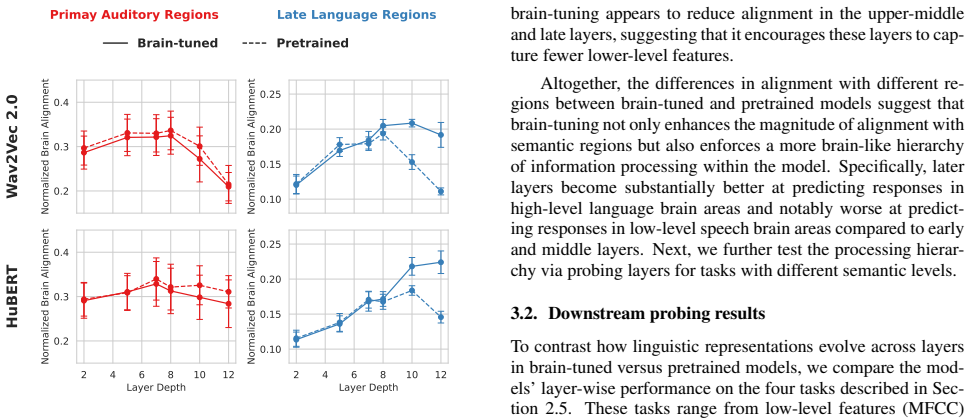
The central discovery is that brain-tuning restores the acoustic-to-semantic gradient that the human speech system is presumed to have. In both Wav2Vec2.0 and HuBERT, the pretrained models align best with late language regions in upper-middle layers and then decline; after brain-tuning on fMRI targets, alignment with late language regions rises toward the final layers. At the same time, alignment with primary auditory regions stays highest in early-to-middle layers, and layer-wise probing shows late layers becoming the best at phoneme and phonetic-sentence-type prediction while early layers keep the edge on low-level spectral features. The paper reads this as the model developing a clear hierarchical progression from acoustics to semantics, something its pretrained counterparts lack.
Load-bearing premise
The conclusion depends on the assumption that the improved brain alignment measured on two new stories from the same eight listeners reflects genuine generalization rather than overfitting to those listeners' brain responses.
Editorial extensions
If this is right
- Late layers of brain-tuned Wav2Vec2.0 and HuBERT predict activity in late language regions substantially better than pretrained models, whose alignment peaks in upper-middle layers.
- Early layers of brain-tuned models remain the best place to read out low-level spectral features, so the acoustic-to-semantic gradient is preserved rather than erased.
- Brain-tuned late layers improve over pretrained late layers on phoneme and phonetic sentence-type prediction, meaning the hierarchy change comes with a real gain in high-level speech tasks.
- Layer-wise brain alignment, rather than whole-model alignment, is the diagnostic that reveals the hierarchy change; averaged scores can hide the late-layer effect.
- Brain-tuned models are proposed as better model organisms for human speech processing because both their performance and their layer organization align more closely with the brain.
Reading between the lines
- Beyond the paper, the natural control experiment is brain-tuning with shuffled fMRI targets; if late-layer semantic alignment still rises, the hierarchy is an artifact of fine-tuning on any high-dimensional target rather than a response to brain structure.
- Beyond the paper, evaluating brain-tuned models on held-out participants would test whether the hierarchy is a general property of brain-tuned speech representations or an overfit to the eight listeners used for tuning.
- Beyond the paper, the same fMRI-reconstruction objective applied to larger speech models or other modalities should produce analogous late-layer semantic specialization, a prediction that can be checked before any new brain data are collected.
- Beyond the paper, the unchanged word-identity hierarchy suggests that single-word recognition in Speech Commands can be solved from low-level cues; a harder lexical task such as word-in-context or semantic similarity might expose late-layer lexical specialization.
Editorial analysis
A structured set of objections, weighed in public.
Referee Report
Summary. The manuscript brain-tunes two self-supervised speech models (Wav2Vec2.0 and HuBERT) on fMRI responses from eight participants listening to natural stories, using 25 stories per participant for tuning and 2 stories per participant for evaluation. The authors then measure layer-wise brain alignment with primary auditory and late language regions (Fig. 1) and layer-wise performance on four downstream tasks on fMRI-independent datasets (MFCC, word identity, phoneme prediction, and phonetic sentence type, Fig. 2). The central claims are that brain-tuned models show substantially improved alignment of late layers with semantic language regions, that they exhibit a clearer acoustic-to-semantic hierarchy than pretrained models, and that they are therefore better model organisms for human speech processing.
Significance. If the central claims hold, the paper would provide a useful contribution to the use of brain-tuned speech models as model organisms: it moves beyond aggregate brain-alignment scores to a layer-wise account of how fine-tuning on brain data reorganizes representations. The paper has concrete strengths: it evaluates two model families, reports layer-wise trends for both brain alignment and downstream probing, and the downstream probing on TIMIT and Speech Commands is genuinely independent of the fMRI data, which partially protects the hierarchy claim from circularity. The observation that late layers of brain-tuned models improve on phoneme-level and sentence-type classification while early layers retain low-level acoustic information is interesting even apart from the brain-alignment evidence. However, the primary brain-alignment evidence for the 'better model organism' claim rests on held-out stories from the same participants whose fMRI responses were used for tuning, and the design lacks a non-brain fine-tuning control. These issues need to be addressed before the strong causal and generalizability claims can be accepted.
major comments (3)
- [§2.2, §2.4, Fig. 1] The brain-alignment evaluation uses two held-out stories from the same eight participants whose 25 stories per participant were used to brain-tune the models. Because the model is fine-tuned per participant to predict that participant's fMRI voxel responses, the ridge-regression alignment on held-out stories from the same participant can reflect participant-specific tuning rather than a general, brain-like organizational principle. The improved late-layer alignment with late language regions in Fig. 1 is the direct support for the abstract's claim of 'substantially improve over pretrained models in their alignment with semantic language regions.' To make this claim load-bearing, the authors should evaluate brain alignment on held-out participants (e.g., leave-one-participant-out) or otherwise demonstrate that the late-layer improvement generalizes across participants. Reporting per-participant curves and a permutation test against participant-specific overfitting would also clarify the extent of the problem.
- [§2.3, §3] The design lacks a control condition in which the same models are fine-tuned on the same story audio with non-brain targets or with scrambled/permuted fMRI targets. Without such a control, the observed layer-wise hierarchy changes and downstream gains on TIMIT and Speech Commands cannot be causally attributed to brain-tuning per se; they could arise from additional training on natural story audio or from the extra parameters in the projection head. Adding a control fine-tuning condition (e.g., fine-tuning on audio reconstruction, on audio with random targets, or on the same audio without brain-derived supervision) is necessary to support the conclusion that brain responses specifically enforce the acoustic-to-semantic hierarchy.
- [§3.1, Fig. 1] The paper states that brain-tuned models follow a 'mostly rising pattern' and that pretrained models 'peak in the upper-middle layers,' but no statistical test or confidence interval is reported for these layer-wise trends across the eight participants. Given the small sample size and the per-participant model fitting, the claim of a well-defined hierarchy would be strengthened by a formal trend test (e.g., linear or monotonic trend across layers, or a permutation test comparing brain-tuned vs. pretrained layer profiles). Without such a test, the visual pattern in Fig. 1 is difficult to distinguish from noise.
minor comments (4)
- [Fig. 1] The caption contains a typo: 'Primay' should be 'Primary.'
- [§2.4] The description of the ridge-regression evaluation is ambiguous: the text says the linear function is 'trained on a training portion of the dataset, using cross-validation,' but it does not specify how the two held-out stories are split into training and test partitions or how many folds are used. Please clarify the exact cross-validation procedure.
- [§2.2] The reference to the fMRI dataset [15] is not accompanied by the dataset's exact name or version; please spell out the dataset identifier (e.g., 'LeBel et al., 2024') in the text for readers who may not have access to the reference list.
- [§3.2] For the word identity task, the brain-tuned models show no hierarchy change, and the discussion offers two speculative explanations. This is acceptable, but the speculation should be clearly labeled as untested, and the authors should note that the task may be too easy or too acoustically driven to differentiate layer-wise organization.
Circularity Check
Brain-alignment evidence for the hierarchy claim is partly the training objective itself, but independent downstream probing keeps the central claim from being fully circular.
-
fitted input called prediction
[Abstract; Sections 2.2, 2.3, 2.4, and 3.1]
"We use 25 stories of this dataset for brain-tuning and the remaining 2 stories as a held-out portion for estimating brain alignment... we fine-tune the pretrained speech model using the fMRI responses as targets, with the objective of reconstructing these fMRI responses (using an L2 objective function). ... We find that late layers of brain-tuned models substantially improve over pretrained models in their alignment with semantic language regions."
The brain-alignment metric is the same observable that was used as the training target: fMRI voxel responses. The model is fine-tuned with an L2 objective to reconstruct those responses from the pooled final-layer output, and then brain alignment is measured by training a ridge regression to predict held-out fMRI responses from each layer. Because the held-out stories come from the same eight participants whose 25 stories were used for brain-tuning, the improved late-layer alignment with late-language regions largely re-states the training objective rather than providing independent evidence of a brain-like hierarchy.
full rationale
The central claim that brain-tuned models exhibit an acoustic-to-semantic hierarchy rests on two kinds of evidence. The brain-alignment evidence (Fig. 1) is partially circular: the metric is the same fMRI-response reconstruction objective used for training, evaluated on held-out stories from the same participants. Improved alignment with late language regions is therefore an expected consequence of fitting the model to those participants' fMRI data, not an independent confirmation of brain-likeness. However, the downstream probing evidence (Fig. 2) is genuinely independent: it uses TIMIT and Speech Commands, which are completely separate from the fMRI stimulus audio, and it shows that late layers of brain-tuned models become best at phoneme and phonetic-sentence-type tasks while early layers retain low-level acoustic features. This independent support prevents the hierarchy claim from collapsing entirely into the training objective. The self-citations to prior work [12] are not load-bearing for the main new finding, because the paper re-implements brain-tuning and reproduces semantic improvements on tasks independent of the fMRI data. Overall, the paper is transparent about its procedure, but the brain-alignment portion of the argument is partially a fitted-input evaluation, yielding a moderate circularity score.
Assumptions & free parameters
assumptions (5)
- domain assumption The late language and primary auditory brain regions, as parsed by [4], correspond to semantic and low-level speech processing respectively.
- domain assumption Linear brain alignment with ridge regression accurately measures the degree to which a model layer represents the information in the fMRI response.
- domain assumption Brain-tuning on 25 stories per participant yields models that generalize to held-out stories from the same participants.
- domain assumption Downstream probing datasets (TIMIT, Speech Commands) measure the semantic complexity the authors attribute to them and are unaffected by brain-tuning distribution shift.
- domain assumption The observed changes in layer hierarchy are causally attributable to brain-tuning rather than to any fine-tuning procedure.
Cite this review
Pith. "Pith review of Brain-tuned Speech Models Better Reflect Speech Processing Stages in the Brain." pith.science (2026). https://pith.science/paper/IQKOHGAB
@misc{pith2026250603832,
  author       = {Pith},
  title        = {Pith review of: Brain-tuned Speech Models Better Reflect Speech Processing Stages in the Brain},
  year         = {2026},
  howpublished = {\url{https://pith.science/paper/IQKOHGAB}},
  note         = {Machine review of arXiv:2506.03832}
}
read the original abstract
Pretrained self-supervised speech models excel in speech tasks but do not reflect the hierarchy of human speech processing, as they encode rich semantics in middle layers and poor semantics in late layers. Recent work showed that brain-tuning (fine-tuning models using human brain recordings) improves speech models' semantic understanding. Here, we examine how well brain-tuned models further reflect the brain's intermediate stages of speech processing. We find that late layers of brain-tuned models substantially improve over pretrained models in their alignment with semantic language regions. Further layer-wise probing reveals that early layers remain dedicated to low-level acoustic features, while late layers become the best at complex high-level tasks. These findings show that brain-tuned models not only perform better but also exhibit a well-defined hierarchical processing going from acoustic to semantic representations, making them better model organisms for human speech processing.
Figures

Forward citations
Cited by 2 Pith papers
-
RABBiT: Rapidly adaptive BOLD foundation model via brain-tuning for accurate zero-shot and few-shot prediction of speech-elicited responses in the brain
A 12.9M-parameter audio-to-fMRI encoder achieves zero-shot prediction of speech-evoked brain responses on 324 unseen participants and few-shot adaptation with ~10 minutes of data, outperforming larger baselines and pe...
-
Representing Speech Through Autoregressive Prediction of Cochlear Tokens
Autoregressive prediction over discrete cochlear tokens yields a speech representation that beats prior self-supervised models on lexical-semantic similarity and is competitive on SUPERB tasks.
Reference graph
Works this paper leans on
-
[1]
Introduction With the rapid development of self-supervised (SSL) language and speech models, research at the intersection of neuroscience, language, and speech understanding has advanced considerably. Current pretrained self-supervised (SSL) speech and language models can predict human brain responses to natural speech with impressive accuracy, outperform...
-
[2]
Methods 2.1. Speech Language Models We analyze two popular pretrained self-supervised speech lan- guage model families: Wav2vec2.0 [13] and HuBERT [14]. Both models are transformer-based and rely on a CNN feature extractor to output latent speech representations that are fed to the transformer blocks. We use the base architectures, which arXiv:2506.03832v...
arXiv 2025
-
[3]
These analyses investigate the hierarchy of in- formation processing in brain-tuned vs
Findings In this section, we present layer-wise results for brain alignment and linear probing for different downstream tasks with increas- ing semantics. These analyses investigate the hierarchy of in- formation processing in brain-tuned vs. pretrained models. 3.1. Brain alignment results We compute the normalized brain alignment described in Sec- tion 2...
-
[4]
Discussion and Conclusion In this work, we utilize the method of fine-tuning speech models with fMRI data via brain-tuning [12] to show two pieces of evi- dence that brain-tuning reshapes speech models to more closely align with the hierarchy of human speech processing. First, brain-tuning improves alignment with late language regions for both Wav2vec2.0 ...
-
[5]
Toward a realistic model of speech processing in the brain with self-supervised learning,
J. Millet, C. Caucheteux, Y . Boubenec, A. Gramfort, E. Dunbar, C. Pallier, J.-R. King et al., “Toward a realistic model of speech processing in the brain with self-supervised learning,” Advances in Neural Information Processing Systems , vol. 35, pp. 33 428– 33 443, 2022
work page 2022
-
[6]
Self-supervised models of audio effectively explain human cortical responses to speech,
A. R. Vaidya, S. Jain, and A. Huth, “Self-supervised models of audio effectively explain human cortical responses to speech,” in International Conference on Machine Learning . PMLR, 2022, pp. 21 927–21 944
work page 2022
-
[7]
Scaling laws for language encoding models in fmri,
R. Antonello, A. Vaidya, and A. Huth, “Scaling laws for language encoding models in fmri,” Advances in Neural Information Pro- cessing Systems, vol. 36, 2024
work page 2024
-
[8]
Speech language models lack important brain-relevant semantics,
S. R. Oota, E. C ¸ elik, F. Deniz, and M. Toneva, “Speech language models lack important brain-relevant semantics,” ACL, 2024
work page 2024
Show all 21 references
-
[9]
Bridging language in machines with language in the brain,
M. Toneva, “Bridging language in machines with language in the brain,” Ph.D. dissertation, Carnegie Mellon University, 2021
2021
-
[10]
Aligning context-based statistical models of language with brain activity during reading,
L. Wehbe, A. Vaswani, K. Knight, and T. Mitchell, “Aligning context-based statistical models of language with brain activity during reading,” in Proceedings of the 2014 conference on empir- ical methods in natural language processing (EMNLP) , 2014, pp. 233–243
2014
-
[11]
Incorporating context into language encod- ing models for fmri,
S. Jain and A. Huth, “Incorporating context into language encod- ing models for fmri,” Advances in Neural Information Processing Systems, vol. 31, 2018
2018
-
[12]
Interpreting and improving natural- language processing (in machines) with natural language- processing (in the brain),
M. Toneva and L. Wehbe, “Interpreting and improving natural- language processing (in machines) with natural language- processing (in the brain),” Advances in Neural Information Pro- cessing Systems, vol. 32, 2019
2019
-
[13]
The neu- ral architecture of language: Integrative modeling converges on predictive processing,
M. Schrimpf, I. A. Blank, G. Tuckute, C. Kauf, E. A. Hosseini, N. Kanwisher, J. B. Tenenbaum, and E. Fedorenko, “The neu- ral architecture of language: Integrative modeling converges on predictive processing,” Proceedings of the National Academy of Sciences, 2021
2021
-
[14]
Brains and algorithms partially converge in natural language processing,
C. Caucheteux and J.-R. King, “Brains and algorithms partially converge in natural language processing,” Communications Biol- ogy, vol. 5, no. 1, p. 134, 2022
2022
-
[15]
The representation of semantic information across human cere- bral cortex during listening versus reading is invariant to stimulus modality,
F. Deniz, A. O. Nunez-Elizalde, A. G. Huth, and J. L. Gallant, “The representation of semantic information across human cere- bral cortex during listening versus reading is invariant to stimulus modality,” Journal of Neuroscience, 2019
2019
-
[16]
Improving semantic understanding in speech language models via brain-tuning,
O. Moussa, D. Klakow, and M. Toneva, “Improving semantic understanding in speech language models via brain-tuning,” in The Thirteenth International Conference on Learning Represen- tations, 2025
2025
-
[17]
wav2vec 2.0: A framework for self-supervised learning of speech repre- sentations,
A. Baevski, Y . Zhou, A. Mohamed, and M. Auli, “wav2vec 2.0: A framework for self-supervised learning of speech repre- sentations,” Advances in neural information processing systems , vol. 33, pp. 12 449–12 460, 2020
2020
-
[18]
Hubert: Self-supervised speech rep- resentation learning by masked prediction of hidden units,
W.-N. Hsu, B. Bolte, Y .-H. H. Tsai, K. Lakhotia, R. Salakhut- dinov, and A. Mohamed, “Hubert: Self-supervised speech rep- resentation learning by masked prediction of hidden units,” IEEE/ACM Transactions on Audio, Speech, and Language Pro- cessing, vol. 29, pp. 3451–3460, 2021
2021
-
[19]
”an fmri dataset during a passive natural language listening task
A. LeBel, L. Wagner, S. Jain, A. Adhikari-Desai, B. Gupta, A. Morgenthal, J. Tang, L. Xu, and A. G. Huth, “”an fmri dataset during a passive natural language listening task”,” 2024
2024
-
[20]
Timit acoustic phonetic continuous speech cor- pus,
J. S. Garofolo, “Timit acoustic phonetic continuous speech cor- pus,” Linguistic Data Consortium, 1993 , 1993
1993
-
[21]
Speech commands: A dataset for limited-vocabulary speech recognition,
P. Warden, “Speech commands: A dataset for limited-vocabulary speech recognition,” 2018
2018
Reviewed August 7, 2026 · model on record in the stance chip above.
Discussion (0). Sign in to comment.