REVIEW 3 major objections 3 minor 16 references
Prompt Candidates, then Distill: A Teacher-Student Framework for LLM-driven Data Annotation
T0 review · 3 major / 3 minor · reviewed 2026-08-07 · deepseek-v4-flash
Pith's one-line read Asking an LLM for every plausible label, then distilling them, beats single-label annotation.
desk verdict A useful candidate-annotation method with solid experiments, but the theoretical guarantee that is supposed to explain its success does not survive the m→∞ limit. read the letter →
The pith
A machine-rendered reading of the paper's core claim, the machinery that carries it, and where it could break.
The reading
What carries the argument
The load-bearing object is the candidate label set $s_i \subseteq \mathcal{Y}$, produced by prompting the LLM with CAadd (answer first, add alternatives if unsure) or CAall (list all possible answers). The second mechanism is the Distribution Refinery (DR): at each distillation step the student's target distribution is the renormalization of its own previous softmax over the candidate labels, with out-of-candidate samples filtered, small-loss samples sharpened by temperature $\gamma$, and high-confidence out-of-candidate samples converted to one-hot targets. The theoretical proof works through a closed-form solution of the $\ell^2$-regularized cross-entropy objective, obtained by linearly approximating softmax as $(1 + v_i)/C$, valid at high temperature or small logits; this yields the conditions in Theorem 1.
What would settle it
Run the paper's setup on synthetic data with known flip rates $R_{c,c'}$: choose rates satisfying the top-2 condition but violating the top-1 condition, train the teacher, distill top-1 and top-2 students, and check whether only the top-2 student reaches 100% training accuracy; also record teacher and student logit magnitudes to test whether the linear softmax approximation in Eq. (15) actually holds.
Extended reading notes
Core claim
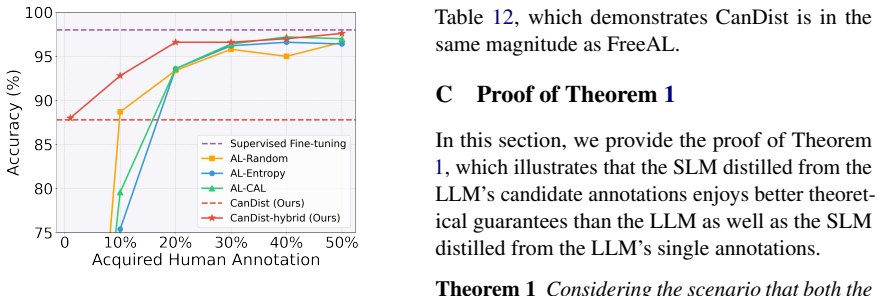
On the paper's own terms, the discovery is that candidate annotation plus distillation dominates direct single-label annotation both theoretically and empirically. Theorem 1 models the teacher as a classifier trained on noisy labels with flip rates $R_{c,c'}$ and the student as a classifier distilled from the teacher's top-1 or top-2 predictions. With infinite data and equal within-class feature similarity $a$ and between-class similarity $b$, the student distilled from top-2 predictions achieves 100% accuracy on the training data whenever $R_{c,c'} + \sum_{i\neq c} R_{c,i} < 1$, while the teacher and the top-1-distilled student require the strictly stricter condition $R_{c,c'} + \sum_{i\neq c} R_{c,i} < 1 - \theta/(\phi-\theta)$. The reason is that the top-2 target always contains the true label whenever the teacher ranks it first, so noise in the second slot is harmless. Experiments on six text classification tasks with a large-language-model teacher and a small-language-model student support the claim, with candidate-based distillation outperforming single-annotation distillation, self-consistency, and other LLM annotation baselines.
Load-bearing premise
The proof of Theorem 1 approximates softmax linearly in Eq. (15), which holds only for high temperature or small logits, and the theorem's candidate sets are top-2 predictions of a noisy teacher rather than the prompted candidate lists the method actually uses; if either fails, the claimed noise-tolerance thresholds do not follow.
Editorial extensions
If this is right
- LLM annotation pipelines can trade a single query per sample for one candidate-set query, then delegate resolution to a cheap student, cutting the cost of re-labeling difficult samples.
- The student's final labels inherit a provable tolerance to teacher noise: as long as the teacher's noise per class obeys $R_{c,c'} + \sum_{i\neq c} R_{c,i} < 1$, a top-2-distilled student can still label the whole training set correctly.
- Prompting for candidates also yields a free uncertainty signal: samples where the LLM emits many candidates are precisely the ones where single-answer prompting would be unreliable.
- Combining candidate prompting with sampling-based strategies like self-consistency further raises the coverage of true labels and downstream accuracy, as shown in the paper's synergy experiments.
Reading between the lines
- An extension: the same candidate-then-distill recipe should transfer to token-level tasks like named entity recognition by treating each span's candidate entity types as the label set; the paper's DR is classification-specific, but the candidate-hedging principle is not.
- A testable corollary of Theorem 1 is a three-way calibration: on synthetic noisy-teacher data satisfying only the looser condition, top-2 distillation should stay at 100% while top-1 distillation should drop; running that synthetic comparison would directly separate the theory's mechanism from the prompting recipe.
- The paper's candidate sets could double as a priority score for active learning: samples whose candidate lists are large or whose distilled student remains uncertain are the ones most worth human review; the paper does not run this experiment.
- Because the theory treats candidates as top-2 predictions while the prompts actually elicit 'all possible labels,' a misspecified bridge exists; one could test whether restricting prompted candidates to the LLM's two most likely labels reproduces the theorem's advantage more cleanly.
Editorial analysis
A structured set of objections, weighed in public.
Referee Report
Summary. The paper proposes CanDist, a teacher-student framework for LLM-driven data annotation. The teacher LLM is prompted to output a small set of candidate labels (CAadd or CAall) instead of a single label, and a student SLM is trained to distill these candidate sets into unique predictions using a Distribution Refinery that renormalizes targets over candidates, filters out-of-candidate samples, sharpens reliable targets, and uses high-confidence predictions. The paper claims a theoretical guarantee (Theorem 1) that distilling from the teacher's top-2 predictions is more noise-tolerant than distilling from top-1 predictions or using the teacher directly, and reports experiments on six text classification datasets showing consistent improvements over several LLM- and SLM-based baselines.
Significance. The empirical framework is timely and practically motivated: prompting for candidate labels is a simple and cheap way to hedge against LLM uncertainty, and the proposed distillation procedure with ablations is a useful contribution. The authors ship code, which aids reproducibility. If Theorem 1 were validly established, the theoretical comparison would also be a substantive contribution. However, the proof as written does not establish the theorem in a meaningful regime, and the theorem's setup does not match the prompting mechanism actually used. The empirical results are suggestive but are reported without variance and rely on a labeled validation set for hyperparameter selection. The paper is therefore not yet ready for acceptance; the central theoretical claim needs either a repaired proof with a clear validity regime or a substantially qualified statement.
major comments (3)
- [Section 4 / Appendix C, Eq. (15) and Eq. (6)/(11)] The proof of Theorem 1 hinges on the linear softmax approximation in Eq. (15), softmax(v)_i ≈ (1+v_i)/C, which is valid only when logits are small or the softmax temperature is high. The theorem is stated with m→∞ while a, b, and λ are regarded as fixed. In that limit θ→0 and ϕ→0, and the gap θ/(ϕ−θ) is O(1/m), so the top-1 condition in Eq. (6)/(11) converges to the top-2 condition in Eq. (7)/(12): the claimed noise-tolerance advantage disappears exactly in the limit used to replace empirical label frequencies by the limiting rates R_{c,c'}. If instead λ is scaled as λ=λ0/m in order to keep mλ finite and the gap non-vanishing, the logits of the trained model are of order 1/λ0, so Eq. (15) is trustworthy only for large λ0, and in that case θ/(ϕ−θ) is again negligible. The manuscript therefore does not identify any regime in which the proof's approximation is valid and the top-2-over-top-1 advantage is non-vanishing. This issue is load-bearing because the abstract and Section 4 claim a rigorous justification for candidate distillation.
- [Section 3.2 and Appendix C, Eqs. (28)–(34)] Section 3.2 generates candidate sets by prompting the LLM with CAadd/CAall, while Appendix C analyzes a student distilled from the teacher's top-2 predictions, with q_i = (1/2)e(y_i)+(1/2)e(\bar y_i) in Eq. (28). These are different objects: no assumption or measurement connects the prompt-induced candidate sets to the noise model {R_{c,c'}}, nor is it shown that CAadd/CAall produce the top-2 classes of a noisy softmax teacher or that the true label is always included in the candidate set. The Limitations section already concedes that the theory treats the LLM as a traditional encoder model, whereas the experiments use decoder-only GPT-3.5, Llama 3.1, and GPT-4o. Because of this mismatch, Theorem 1 as stated does not justify the actual CanDist pipeline, even apart from the approximation issue.
- [Section 5.2 and Appendix A.3] Tables 2 and 3 report only averages of three runs (Section 5.1 states 'we run three times and report the averaged results'), with no standard deviations or significance tests. Appendix A.3 additionally reports that hyperparameters such as δ, τ, and learning rate are selected using the default validation set of each dataset. Using human-labeled validation data for model selection in a proposed automatic annotation pipeline is an oracle-like step, and its effect relative to the baselines is not controlled. Without variance estimates, the claimed margins, e.g. the 5.47% improvement on TREC test, are difficult to assess; reporting per-run results or error bars and separating hyperparameter selection from evaluation would materially strengthen the empirical claims.
minor comments (3)
- [Section 3.2 / Table 8] The sentence in Section 3.2 that candidate annotations achieve higher F1-scores is stated without qualification, but Table 8 shows that on AGNews both CAadd (F1 92.2 vs 94.0) and CAall (85.7 vs 94.0) have lower F1 than SA; Appendix B.1 acknowledges this exception. Please qualify the main-text claim.
- [Eq. (1) and Eq. (5)] In Eq. (1), q_i^t is defined recursively from p_i^{t-1}, but Eq. (5) writes q_i and \hat q_i without iteration indices; please clarify how the final training target is obtained as training proceeds.
- [Theorem 1 statement] The phrase 'with m → ∞' is ambiguous because the theorem then discusses 100% accuracy on 'all training data'; please state the intended mode of convergence (e.g., probability over random label flips) or replace the asymptotic statement with finite-sample conditions that make the dependence on m explicit.
Circularity Check
No circular derivation: Theorem 1 is derived from explicit noise-rate assumptions; the top-2 condition largely restates the candidate-set benefit and the m→infinity limit erodes the claimed margin, but these are correctness risks, not circular reductions.
full rationale
The paper's central theoretical claim is not circular. Theorem 1 starts from explicit assumptions about the teacher's noisy label distribution (R_{c,c'}), fixed feature extractors, and l2-regularized cross-entropy, and derives closed-form predictions using the stated linear-softmax approximation (Eq. 15). No fitted parameter is renamed as a prediction, and no load-bearing premise is imported from the authors' own prior work. The self-citations to FreeAL (Xiao et al., 2023) concern baseline comparisons, few-shot example generation, and consistency/mixup training (Appendix A.2), none of which supports the theorem. The circularity-adjacent issue is that the top-2 success condition (Eq. 34: R_{c,c} > R_{c,c'}) is essentially the condition that the true label is the most probable teacher label, so the theorem presupposes rather than explains the empirical benefit of candidate annotations containing the correct label. In addition, in the stated m → infinity limit, θ → 0, so the top-1 margin θ/(φ−θ) vanishes and the advertised superiority of top-2 over top-1 disappears; reserving a nonzero gap requires logits large enough to break the linear-softmax approximation in Eq. (15). These are substantial correctness and interpretation concerns, but they are not circular reductions of the derivation to its inputs.
Assumptions & free parameters
free parameters (6)
- a =
not fitted; assumed 1 > a > 0
- b =
not fitted; assumed 1 > a > b > 0
- lambda (L2 regularization) =
not fitted; regularization parameter in Theorem 1
- delta (small-loss ratio) =
selected from {0.4, 0.5, 0.6}
- gamma (sharpening temperature) =
fixed as 0.85
- tau (high-confidence threshold) =
selected from {0.95, 0.99, 1.0}
assumptions (4)
- standard math Linear approximation of softmax: softmax(v)_i ≈ (1 + v_i)/C
- domain assumption Teacher LLM behaves like a classifier pretrained on a noisy dataset with label noise rates R_{c,c'}
- domain assumption Feature similarity S_ii=1, S_ij=a for same class, b otherwise; balanced class sizes
- domain assumption Prompted candidate annotations are equivalent to teacher top-2 predictions
Cite this review
Pith. "Pith review of Prompt Candidates, then Distill: A Teacher-Student Framework for LLM-driven Data Annotation." pith.science (2026). https://pith.science/paper/DEYOY5QX
@misc{pith2026250603857,
  author       = {Pith},
  title        = {Pith review of: Prompt Candidates, then Distill: A Teacher-Student Framework for LLM-driven Data Annotation},
  year         = {2026},
  howpublished = {\url{https://pith.science/paper/DEYOY5QX}},
  note         = {Machine review of arXiv:2506.03857}
}
read the original abstract
Recently, Large Language Models (LLMs) have demonstrated significant potential for data annotation, markedly reducing the labor costs associated with downstream applications. However, existing methods mostly adopt an aggressive strategy by prompting LLM to determine a single gold label for each unlabeled sample. Due to the inherent uncertainty within LLMs, they often produce incorrect labels for difficult samples, severely compromising the data quality for downstream applications. Motivated by ambiguity aversion in human behaviors, we propose a novel candidate annotation paradigm wherein large language models are encouraged to output all possible labels when incurring uncertainty. To ensure unique labels are provided for downstream tasks, we develop a teacher-student framework CanDist that distills candidate annotations with a Small Language Model (SLM). We further provide a rigorous justification demonstrating that distilling candidate annotations from the teacher LLM offers superior theoretical guarantees compared to directly using single annotations. Extensive experiments across six text classification tasks validate the effectiveness of our proposed method. The source code is available at https://github.com/MingxuanXia/CanDist.
Figures


Figures from the paper (3 more)


Reference graph
Works this paper leans on
-
[1]
, m with corresponding eigenvectors vi = ui
m eigenvalues that are shifts of the original eigenvalues from the rank-m matrix: σi = ξi + λ, i = 1, . . . , m with corresponding eigenvectors vi = ui
-
[2]
, n with corresponding eigenvectors orthogonal to the columns of U
(n − m) eigenvalues from the identity matrix: σi = λ, i = m + 1, . . . , n with corresponding eigenvectors orthogonal to the columns of U. Proof. The eigenvalue equation is given by: (U ΞU ⊤ + λIn)v = σv Decompose v into components v∥ + v⊥, where v∥ is in the column space ofU and v⊥ is orthogonal to the column space of U, and we have v∥ = U βand U ⊤v⊥ = 0...
-
[3]
, m and the corresponding eigenvectors vi
m − C pairs with eigenvalues: λi = (1 − a), i = C + 1, . . . , m and the corresponding eigenvectors vi. Denoting S′ = V CmλΛ−1 + Im V −1 in Eq.(19), and denoting θ, ϕ, ψaccording to the fol- lowing equations: θ = 1 − Cmλ Cmλ + 1 − a ϕ = 1 − Cmλ Cmλ + m C (a − b) + 1 − a ψ = 1 − Cmλ Cmλ + mb + m C (a − b) + 1 − a we have: S′ = mX i=1 λi Cmλ + λi viv⊤ i = λ...
-
[8]
Large language models are better reasoners with self-verification. In Findings of the Associa- tion for Computational Linguistics: EMNLP 2023, Singapore, December 6-10, 2023, pages 2550–2575. Association for Computational Linguistics. Ruixuan Xiao, Yiwen Dong, Junbo Zhao, Runze Wu, Minmin Lin, Gang Chen, and Haobo Wang. 2023. Freeal: Towards human-free ac...
work page 2023
-
[9]
LLM-DA: Data Augmentation via Large Language Models for Few-Shot Named Entity Recognition
Supervised knowledge makes large language models better in-context learners. In The Twelfth International Conference on Learning Representa- tions, ICLR 2024, Vienna, Austria, May 7-11, 2024. OpenReview.net. Junjie Ye, Nuo Xu, Yikun Wang, Jie Zhou, Qi Zhang, Tao Gui, and Xuanjing Huang. 2024. LLM-DA: data augmentation via large language models for few-sho...
work page Pith review arXiv 2015
-
[12]
one pair with eigenvalue: σ1 = Cb + (a − b) and eigenvector u1 = 1√ C 1C
-
[13]
, C and the corresponding eigenvectors ui
C − 1 pairs with eigenvalues: σi = a − b, i = 2, . . . , C and the corresponding eigenvectors ui. Denoting Σ = diag(σ1, . . . , σC) and U = [u1, . . . ,uC] ∈ Rm×C, thus: S = Y ⊤ZY + (1 − a)Im = Y ⊤U ΣU ⊤Y + (1 − a) Im = r C m Y ⊤U m C Σ r C m Y ⊤U !⊤ + (1 − a) Im (22) where we assume Pm j=1 Yi,j = m/C, namely, the dataset is balanced. Again, by applying L...
-
[14]
one pair with eigenvalue: λ1 = m C σ1 + (1 − a) = mb + m C (a − b) + (1 − a) and eigenvector v1 = q C m Y ⊤u1 = 1√m Y ⊤1C
Show all 16 references
-
[15]
, C: λi = m C σi + (1 − a) = m C (a − b) + (1 − a) and the eigenvectors vi = q C m Y ⊤ui
C −1 pairs with eigenvalues fori = 2, . . . , C: λi = m C σi + (1 − a) = m C (a − b) + (1 − a) and the eigenvectors vi = q C m Y ⊤ui
-
[2015]
CoRR, abs/1503.02531
Distilling the knowledge in a neural network. CoRR, abs/1503.02531. Alex Holub, Pietro Perona, and Michael C. Burl. 2008. Entropy-based active learning for object recognition. In IEEE Conference on Computer Vision and Pattern Recognition, CVPR Workshops 2008, Anchorage, AK, US...
2008 arXiv
-
[2016]
In Proceedings of the 54th Annual Meeting of the Association for Computational Linguistics, ACL 2016, August 7-12, 2016, Berlin, Germany, Volume 1: Long Papers
Improving neural machine translation models with monolingual data. In Proceedings of the 54th Annual Meeting of the Association for Computational Linguistics, ACL 2016, August 7-12, 2016, Berlin, Germany, Volume 1: Long Papers. The Association for Computer Linguistics. Jianhao...
2016 arXiv
-
[2020]
In Ad- vances in Neural Information Processing Systems 33: Annual Conference on Neural Information Process- ing Systems 2020, NeurIPS 2020, December 6-12, 2020, virtual
Language models are few-shot learners. In Ad- vances in Neural Information Processing Systems 33: Annual Conference on Neural Information Process- ing Systems 2020, NeurIPS 2020, December 6-12, 2020, virtual. Iñigo Casanueva, Tadas Temcinas, Daniela Gerz, Matthew Henderson, an...
2020 arXiv
-
[2021]
CoRR, abs/2110.14168
Training verifiers to solve math word prob- lems. CoRR, abs/2110.14168. Rudrajit Das and Sujay Sanghavi. 2023. Understanding self-distillation in the presence of label noise. In In- ternational Conference on Machine Learning, ICML 2023, 23-29 July 2023, Honolulu, Hawaii, USA, ...
2023 arXiv
-
[2023]
CoRR, abs/2303.15056
Chatgpt outperforms crowd-workers for text- annotation tasks. CoRR, abs/2303.15056. Antonio Gulli. 2005. The anatomy of a news search engine. In Proceedings of the 14th international conference on World Wide Web, WWW 2005, Chiba, Japan, May 10-14, 2005 - Special interest track...
2005 arXiv
-
[2024]
Xingwei He, Zhenghao Lin, Yeyun Gong, A-Long Jin, Hang Zhang, Chen Lin, Jian Jiao, Siu Ming Yiu, Nan Duan, and Weizhu Chen
OpenReview.net. Xingwei He, Zhenghao Lin, Yeyun Gong, A-Long Jin, Hang Zhang, Chen Lin, Jian Jiao, Siu Ming Yiu, Nan Duan, and Weizhu Chen. 2024b. Annollm: Mak- ing large language models to be better crowdsourced annotators. In Proceedings of the 2024 Conference of the North A...
2024
-
[8098]
Fabio Maccheroni, Massimo Marinacci, and Aldo Rus- tichini
Association for Computational Linguistics. Fabio Maccheroni, Massimo Marinacci, and Aldo Rus- tichini. 2006. Ambiguity aversion, robustness, and the variational representation of preferences. Econo- metrica, 74(6):1447–1498. Katerina Margatina, Giorgos Vernikos, Loïc Barrault,...
2006 arXiv
Reviewed August 7, 2026 · model on record in the stance chip above.
Discussion (0). Sign in to comment.