REVIEW 4 major objections 6 minor 68 references
CARL: Causality-guided Architecture Representation Learning for an Interpretable Performance Predictor
T0 review · 4 major / 6 minor · reviewed 2026-08-07 · deepseek-v4-flash
Pith's one-line read A NAS performance predictor that splits architectures into causal and redundant substructures and trains on re-paired representations generalizes better across five search spaces, reaching 97.67% top-1 accuracy on CIFAR-10.
desk verdict Solid empirical NAS predictor with an overclaimed causal story; deserves review but needs reproducibility fixes and a softer causal claim. read the letter →
The pith
A machine-rendered reading of the paper's core claim, the machinery that carries it, and where it could break.
The reading
What carries the argument
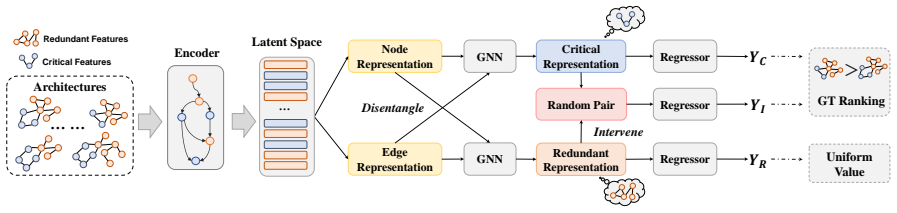
The load-bearing object is the representation-level causal intervention. The paper models architecture performance prediction with a structural causal model in which architecture data $X$ is produced by critical features $C$ and redundant features $R$, and $C \rightarrow Y$ is the true performance link while $C \leftrightarrow R$ creates a backdoor path $R \leftrightarrow C \rightarrow Y$. To cut this path without synthesizing invalid architectures, CARL operates in latent space: a substructure extractor (an MLP over GCN node and edge embeddings) produces masks $\alpha^C_i, \alpha^R_i$ with $\alpha^C_i + \alpha^R_i = 1$, yielding $Z^C$ and $Z^R$; interventional samples $Z^I$ are formed by pairing $Z^C$ with a random $Z'^R$ from another architecture. The intervention-based loss $L = L_C + \lambda_1 L_R + \lambda_2 L_I$ then trains the regressor so that ranking is determined by $Z^C$ regardless of which redundant representation it is paired with.
What would settle it
Train CARL and a standard predictor on a NAS benchmark whose training split is deliberately biased so that one redundant feature (for example, the number of average-pooling operations) is perfectly correlated with accuracy in the training set but uncorrelated in the test set. If CARL's ranking correlation on the test set stays high while the standard predictor collapses, the intervention is removing a real confound; if both drop equally, the causal mechanism is not doing the work. A second check is to freeze the learned masks and re-run prediction with redundant representations drawn from a different search space: invariance to that swap would confirm the backdoor path is cut.
Extended reading notes
Core claim
CARL's central discovery is that a performance predictor can be made to generalize across the distribution shift between a small training sample and a diverse search space by explicitly disentangling architecture representations into critical and redundant substructures and intervening on the redundant part. The intervention is performed in latent space: after a GCN encoder produces node and edge representations, a substructure extractor learns soft masks that split each architecture into a critical substructure $X^C$ and a redundant substructure $X^R$, embedded as $Z^C$ and $Z^R$. During training, each critical representation is paired with a randomly drawn redundant representation from another architecture in the mini-batch, producing interventional samples whose ranking target is the critical part's ground-truth performance. A hinge-ranking loss on critical samples, a mean-squared-error loss pulling all redundant predictions toward a constant, and a hinge-ranking loss on interventional samples together encourage the regressor to base predictions on $Z^C$ alone. The paper demonstrates on five search spaces that this yields better Kendall's Tau rankings, better searched architectures, and importance maps consistent with known performance-relevant motifs.
Load-bearing premise
The whole method rests on the assumption that swapping a critical representation with a random redundant representation from another architecture genuinely breaks the spurious link between redundant features and performance; if the mini-batch lacks redundant-feature diversity, or if the critical representation still encodes hidden shortcuts, the predictor will simply learn a different spurious correlation.
Editorial extensions
If this is right
- Predictor-based NAS can find competitive or better architectures with fewer queried architectures: on NAS-Bench-201, CARL matches the optimal accuracy on CIFAR-10 and CIFAR-100 with only 80 queries.
- The same predictor transfers across tasks: on TransNAS-Bench-101 micro and macro spaces it achieves the best average rank across seven vision tasks, and on NAS-Bench-NLP it reaches 4.572 log perplexity.
- With only 0.02% of NAS-Bench-101 as training data, CARL reaches a Kendall's Tau of 0.683, outperforming predictors trained on twice as much data, showing the method matters most when samples are scarce.
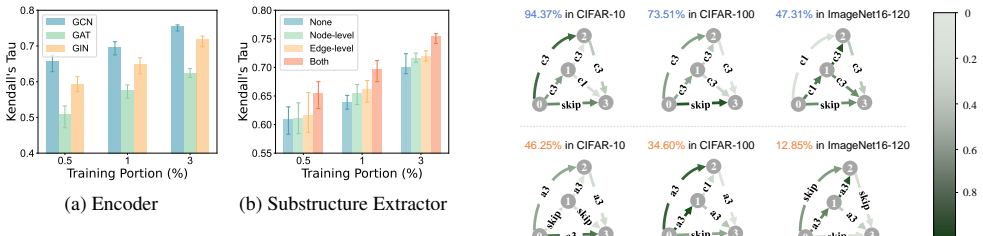
- The learned importance scores are interpretable: critical features concentrate near the input node and convolution-heavy motifs, consistent with known good motifs, while excessive average pooling marks poor architectures.
- CARL's search on DARTS costs about 0.25 GPU days, less than most predictor-based and one-shot baselines, while producing a 97.67% CIFAR-10 and 76.1% ImageNet architecture.
Reading between the lines
- The authors do not test whether the learned redundant representation is truly redundant on a distribution different from the training split; an explicit check would be to swap $Z^R$ with representations from a different search space and measure prediction invariance.
- The same disentangle-and-repair recipe could be carried over to other graph-structured regression tasks, such as molecule or program performance prediction, where the training distribution is similarly biased.
- If the causal reading is right, CARL's importance scores could be used to prune search spaces before searching, discarding architectures whose critical substructure is already known to be poor.
- A sharper test of the interpretability claim would compare the discovered critical substructures against the motifs found by Bayesian-optimization-based interpretable NAS, rather than only by visual inspection.
Editorial analysis
A structured set of objections, weighed in public.
Referee Report
Summary. This manuscript proposes CARL, an architecture performance predictor for NAS that splits GCN-based latent representations of a neural architecture into 'critical' and 'redundant' substructures via softmax-weighted masks, generates interventional training samples by pairing critical representations with redundant representations drawn from other mini-batch architectures, and trains with a combined loss consisting of two hinge ranking losses and a redundant-feature MSE loss. The authors evaluate CARL on NAS-Bench-101, NAS-Bench-201, TransNAS-Bench-101, NAS-Bench-NLP, and DARTS, reporting Kendall's Tau rankings and predictor-guided search results, and claim state-of-the-art accuracy and interpretability, for example 97.67% CIFAR-10 top-1 accuracy with a DARTS search space.
Significance. The empirical scope is substantial: five search spaces, ranking and search protocols, ablations of encoder choice, node/edge disentanglement, and loss weights, plus a qualitative visualization that aligns with earlier motif-based analyses. If the causal-interpretation claim were supported, CARL would be a notable step toward more generalizable and interpretable NAS predictors. However, the main advertised contribution—causality-guided separation and backdoor adjustment at the representation level—is not established by the current theory or diagnostics, and several headline numbers lack variance information. The empirical gains are still valuable as an engineering contribution, but the paper as written overclaims the causal mechanism.
major comments (4)
- [Section 4.3, Eq. (5)] The central claim that the random-pair interventional loss implements a backdoor adjustment is unsupported. A backdoor adjustment requires a formal adjustment set and an identifiability condition; pairing Z_C from one architecture with a randomly drawn Z'_R from another architecture in the same mini-batch changes the joint distribution, but there is no argument that predictions computed from such pairs equal the causal effect of C on Y, nor is there a condition under which the estimator is consistent. If the mini-batch is small or the redundant representations are clustered, the intervention differs little from the observational distribution. To keep the causal claim, the authors should either provide a formal identification result or substantially weaken the claim to 'a heuristic that encourages robustness to redundant representation substitution' and add diagnostics such as prediction variance under Z_R replacement.
- [Section 4.2, Eqs. (2) and (4)] The disentanglement procedure cannot guarantee that Z_C is free of redundant information. The masks are softmax outputs of an MLP trained end-to-end; without an independence or identifiability constraint, residual dependency between Z_C and R can persist. The loss L_R penalizes deviation of the redundant-branch prediction from the mean accuracy, but it does not penalize reliance on redundant information inside Z_C. Consequently, the 'critical features' may be merely the features that are easiest for the ranking loss to exploit, making the causal-interpretation claim partly circular. A concrete remedy is to add an independence or adversarial penalty and to evaluate whether predictions are invariant to substituting Z_R.
- [Tables 4 and 5] The headline DARTS results are not accompanied by any measure of uncertainty. Table 5 reports 97.67% versus PINAT's 97.58%, a 0.09 percentage point margin, and Table 4 reports 76.1% versus PRE-NAS's 76.0%, a 0.1 point margin. It is not stated whether these are single runs or averages, nor the number of seeds; such differences are typically within run-to-run variation for DARTS retraining. Please report mean and standard deviation over at least 3-5 independent search runs and the retraining seed protocol. This is necessary to support the state-of-the-art claim.
- [Section 5.1, Table 1] The ranking experiments also lack error bars, and the conclusion that CARL 'takes the lead across six data splits' is based on small Kendall's Tau differences, for example 0.683 versus 0.679 on NAS-Bench-101 at 0.02% training data. The paper does not state the number of seeds or the variance of the reported Ktau values. In addition, the training setup omits several hyperparameters that the method depends on: the mini-batch size (which directly affects the diversity of redundant representations used in Eq. (5)), the margin m, the GCN depth and hidden dimensions, and the specific values of lambda_1 and lambda_2 used in the main experiments. No code is released, which further impedes verification.
minor comments (6)
- [Eqs. (3) and (5)] The notation \hat{y}_i^c and \hat{y}_i^I is used without definition; please clarify that these are predictions from the critical-only and interventional branches, respectively.
- [Section 5.2] The text refers to 'PINAT [30]' while the reference list and other parts of the paper use '[29]' for PINAT; please unify the citation numbering.
- [Section 5.4] The sentence containing 'crtical features' has a typo, and the abstract contains nonstandard spacing in 'C ausality-guided A rchitecture Representation L earning'; please fix these formatting issues.
- [Figure 5 caption] The caption says 'edge types represent operations and edge direction represent the computation flow'; please correct the grammar and clarify how node importance scores are visualized, if at all.
- [Table 9] The reader cannot tell which axis corresponds to lambda_1 and which to lambda_2; please state this explicitly in the caption.
- [Table 4] The ImageNet result is obtained by transferring an architecture searched on CIFAR-10; please state this in the caption or main text for clarity.
Circularity Check
Performance claims are externally benchmarked, but the causal-discovery claim restates the training objective: CARL trains the 'critical' branch to predict ground-truth ranking and trains the 'redundant' branch to be constant, then reports this fitted behavior as a discovered causal mapping.
-
self definitional
[Introduction; Section 4.2 Equations (3)-(4); Section 4.3 Equation (6)]
"We further propose an intervention-based loss function, encouraging the predictor to primarily focus on critical features. Hence, CARL ensures a stable causal mapping from critical features to ground-truth performance."
The 'critical' representation is defined as the branch optimized by LC (Eq. 3), a hinge ranking loss against ground-truth labels, while LR (Eq. 4) forces the 'redundant' branch to a constant mean, and LI (Eq. 5) ranks paired representations against ground truth. Any split minimizing L = LC + λ1LR + λ2LI therefore has, by construction, ZC predictive of Y and ZR uninformative. The paper then takes this trained behavior as evidence that ZC contains the causal features of the SCM in Section 3.2. The conclusion 'stable causal mapping from critical features to ground-truth performance' is a restatement of the optimization objective, not an independent discovery about architectural causes.
-
fitted input called prediction
[Section 4.3, Interventional Samples Generation, Equations (5)-(6)]
"In this way, critical and redundant parts within the generated interventional sample have fewer statistical correlations. Hence, the intervention prediction YI should be consistent with the ground-truth performance of the critical part, no matter where the redundant representation ZR comes from."
The consistency asserted here is imposed by LI (Eq. 5), a ranking loss that forces YI to follow sign(yi - yj) for mixed pairs. The claim that random pairing gives 'fewer statistical correlations' is an assumption, not a verified backdoor adjustment; no identifiability condition or diagnostic showing prediction invariance under ZR substitution is provided. The observation that predictions depend only on the critical part is therefore fitted by the loss rather than measured as a causal property. Reporting it as causal intervention makes the result equivalent to the training target by construction.
full rationale
CARL's headline performance numbers are not circular: ranking accuracy is evaluated on held-out architectures in NAS-Bench-101/201, and searched architectures are retrained and reported on CIFAR-10/ImageNet. The circularity is confined to the causal-discovery contribution. Equations (3)-(6) define a training objective in which the branch labeled 'critical' is optimized to reproduce ground-truth ranking, the branch labeled 'redundant' is optimized to produce a constant, and mixed pairs are optimized to follow ground-truth ranking. Observing after training that ZC correlates with performance and ZR does not is a direct consequence of minimizing that objective, so the paper's claim that CARL 'discovers critical features causally correlated with performance' restates the loss rather than validating the Section 3.2 SCM. No load-bearing self-citation or imported uniqueness theorem is involved; the problem is that the causal interpretation is self-definitional. The method may still be a useful predictor, but its central causal-interpretation claim reduces by construction, warranting a partial-circularity score rather than a clean bill.
Assumptions & free parameters
free parameters (3)
- Loss weights lambda_1 and lambda_2 =
0.5 (best in Table 9; exact values used elsewhere not stated)
- Hinge margin m =
not reported
- GCN depth and hidden dimensions =
not reported
assumptions (3)
- ad hoc to paper Architecture data X is generated by two disjoint unobserved latent variables, critical C and redundant R, with C causing performance Y and C and R probabilistically dependent through an unknown common cause or direct link.
- domain assumption Redundant features make negligible contributions to architecture performance.
- ad hoc to paper Randomly pairing critical representation ZC with redundant representation Z'R in the mini-batch approximates the backdoor adjustment on R and breaks spurious correlations in the test distribution.
invented entities (1)
-
Unobserved critical (causal) features C and redundant (non-causal) features R
Cite this review
Pith. "Pith review of CARL: Causality-guided Architecture Representation Learning for an Interpretable Performance Predictor." pith.science (2026). https://pith.science/paper/YWTIQF7Q
@misc{pith2026250604001,
  author       = {Pith},
  title        = {Pith review of: CARL: Causality-guided Architecture Representation Learning for an Interpretable Performance Predictor},
  year         = {2026},
  howpublished = {\url{https://pith.science/paper/YWTIQF7Q}},
  note         = {Machine review of arXiv:2506.04001}
}
read the original abstract
Performance predictors have emerged as a promising method to accelerate the evaluation stage of neural architecture search (NAS). These predictors estimate the performance of unseen architectures by learning from the correlation between a small set of trained architectures and their performance. However, most existing predictors ignore the inherent distribution shift between limited training samples and diverse test samples. Hence, they tend to learn spurious correlations as shortcuts to predictions, leading to poor generalization. To address this, we propose a Causality-guided Architecture Representation Learning (CARL) method aiming to separate critical (causal) and redundant (non-causal) features of architectures for generalizable architecture performance prediction. Specifically, we employ a substructure extractor to split the input architecture into critical and redundant substructures in the latent space. Then, we generate multiple interventional samples by pairing critical representations with diverse redundant representations to prioritize critical features. Extensive experiments on five NAS search spaces demonstrate the state-of-the-art accuracy and superior interpretability of CARL. For instance, CARL achieves 97.67% top-1 accuracy on CIFAR-10 using DARTS.
Figures


Figures from the paper (1 more)
Reference graph
Works this paper leans on
-
[1]
Zero-cost proxies for lightweight nas
Mohamed S Abdelfattah, Abhinav Mehrotra, Łukasz Dudziak, and Nicholas D Lane. Zero-cost proxies for lightweight nas. arXiv preprint arXiv:2101.08134, 2021. 1
arXiv 2021
-
[2]
Random search for hyper-parameter optimization
James Bergstra and Yoshua Bengio. Random search for hyper-parameter optimization. Journal of Machine Learn- ing Research, 13(2), 2012. 6, 7
work page 2012
-
[3]
Xin Chen, Lingxi Xie, Jun Wu, and Qi Tian. Progres- sive differentiable architecture search: Bridging the depth gap between search and evaluation. In Proceedings of the IEEE/CVF International Conference on Computer Vision , pages 1294–1303, 2019. 6
work page 2019
-
[4]
Drnas: Dirichlet neu- ral architecture search
Xiangning Chen, Ruochen Wang, Minhao Cheng, Xi- aocheng Tang, and Cho Jui Hsieh. Drnas: Dirichlet neu- ral architecture search. In 9th International Conference on Learning Representations, ICLR 2021, 2021. 6
work page 2021
-
[5]
Ziye Chen, Yibing Zhan, Baosheng Yu, Mingming Gong, and Bo Du. Not all operations contribute equally: Hier- archical operation-adaptive predictor for neural architecture search. In Proceedings of the IEEE/CVF International Con- ference on Computer Vision, pages 10508–10517, 2021. 2, 6
work page 2021
-
[6]
Fair darts: Eliminating unfair advantages in differentiable ar- chitecture search
Xiangxiang Chu, Tianbao Zhou, Bo Zhang, and Jixiang Li. Fair darts: Eliminating unfair advantages in differentiable ar- chitecture search. In European conference on computer vi- sion, pages 465–480. Springer, 2020. 1, 6
work page 2020
-
[7]
Environment inference for invariant learning
Elliot Creager, J ¨orn-Henrik Jacobsen, and Richard Zemel. Environment inference for invariant learning. In Interna- tional Conference on Machine Learning , pages 2189–2200. PMLR, 2021. 2
work page 2021
-
[8]
NAS-Bench-201: Extending the scope of reproducible neural architecture search
Xuanyi Dong and Yi Yang. NAS-Bench-201: Extending the scope of reproducible neural architecture search. In Interna- tional Conference on Learning Representations, 2019. 5
work page 2019
Show all 68 references
-
[9]
Searching for a robust neu- ral architecture in four gpu hours
Xuanyi Dong and Yi Yang. Searching for a robust neu- ral architecture in four gpu hours. In Proceedings of the IEEE/CVF Conference on Computer Vision and Pattern Recognition, pages 1761–1770, 2019. 6
2019
-
[10]
TransNAS-Bench-101: Improving transferability and generalizability of cross-task neural architecture search
Yawen Duan, Xin Chen, Hang Xu, Zewei Chen, Xiaodan Liang, Tong Zhang, and Zhenguo Li. TransNAS-Bench-101: Improving transferability and generalizability of cross-task neural architecture search. In Proceedings of the IEEE/CVF Conference on Computer Vision and Pattern Recogniti...
2021
-
[11]
Brp-nas: Prediction-based nas using gcns
Lukasz Dudziak, Thomas Chau, Mohamed Abdelfattah, Royson Lee, Hyeji Kim, and Nicholas Lane. Brp-nas: Prediction-based nas using gcns. Advances in Neural Infor- mation Processing Systems, 33:10480–10490, 2020. 2, 4
2020
-
[12]
Neural architecture search: A survey
Thomas Elsken, Jan Hendrik Metzen, and Frank Hutter. Neural architecture search: A survey. The Journal of Ma- chine Learning Research, 20(1):1997–2017, 2019. 1
1997
-
[13]
Generalizing few-shot NAS with gradient matching
Shoukang Hu, Ruochen Wang, HONG Lanqing, Zhenguo Li, Cho-Jui Hsieh, and Jiashi Feng. Generalizing few-shot NAS with gradient matching. In International Conference on Learning Representations, 2021. 6, 7
2021
-
[14]
Angle-based search space shrinking for neural architecture search
Yiming Hu, Yuding Liang, Zichao Guo, Ruosi Wan, Xiangyu Zhang, Yichen Wei, Qingyi Gu, and Jian Sun. Angle-based search space shrinking for neural architecture search. In Computer Vision–ECCV 2020: 16th European Conference, Glasgow, UK, August 23–28, 2020, Proceedings, Part XIX...
2020
-
[15]
Arch-Graph: Acyclic architecture relation predictor for task-transferable neural ar- chitecture search
Minbin Huang, Zhijian Huang, Changlin Li, Xin Chen, Hang Xu, Zhenguo Li, and Xiaodan Liang. Arch-Graph: Acyclic architecture relation predictor for task-transferable neural ar- chitecture search. In Proceedings of the IEEE/CVF Con- ference on Computer Vision and Pattern Recogn...
2022
-
[16]
Flowerformer: Empowering neural architecture encod- ing using a flow-aware graph transformer
Dongyeong Hwang, Hyunju Kim, Sunwoo Kim, and Kijung Shin. Flowerformer: Empowering neural architecture encod- ing using a flow-aware graph transformer. In Proceedings of the IEEE/CVF Conference on Computer Vision and Pattern Recognition, pages 6128–6137, 2024. 2, 6
2024
-
[17]
Graph masked au- toencoder enhanced predictor for neural architecture search
Kun Jing, Jungang Xu, and Pengfei Li. Graph masked au- toencoder enhanced predictor for neural architecture search. In Proceedings of the Thirty-First International Joint Con- ference on Artificial Intelligence, IJCAI-22 , pages 3114– 3120, 2022. 1, 2, 6
2022
-
[18]
Neural architecture search with bayesian optimisation and optimal transport.Ad- vances in neural information processing systems , 31, 2018
Kirthevasan Kandasamy, Willie Neiswanger, Jeff Schneider, Barnabas Poczos, and Eric P Xing. Neural architecture search with bayesian optimisation and optimal transport.Ad- vances in neural information processing systems , 31, 2018. 7
2018
-
[19]
Semi-supervised classi- fication with graph convolutional networks
Thomas N Kipf and Max Welling. Semi-supervised classi- fication with graph convolutional networks. In International Conference on Learning Representations, 2016. 4, 8
2016
-
[20]
Nas-bench-nlp: neural architecture search benchmark for natural language processing
Nikita Klyuchnikov, Ilya Trofimov, Ekaterina Artemova, Mikhail Salnikov, Maxim Fedorov, Alexander Filippov, and Evgeny Burnaev. Nas-bench-nlp: neural architecture search benchmark for natural language processing. IEEE Access, 10:45736–45747, 2022. 5
2022
-
[21]
Learning multiple layers of features from tiny images
Alex Krizhevsky. Learning multiple layers of features from tiny images. 2009. 6
2009
-
[22]
Az-nas: Assembling zero- cost proxies for network architecture search
Junghyup Lee and Bumsub Ham. Az-nas: Assembling zero- cost proxies for network architecture search. In Proceedings of the IEEE/CVF Conference on Computer Vision and Pat- tern Recognition (CVPR), pages 5893–5903, 2024. 1
2024
-
[23]
Random search and repro- ducibility for neural architecture search
Liam Li and Ameet Talwalkar. Random search and repro- ducibility for neural architecture search. In Uncertainty in Artificial Intelligence, pages 367–377. PMLR, 2020. 6
2020
-
[24]
Improving one-shot NAS by suppressing the posterior fading
Xiang Li, Chen Lin, Chuming Li, Ming Sun, Wei Wu, Junjie Yan, and Wanli Ouyang. Improving one-shot NAS by suppressing the posterior fading. In Proceedings of the IEEE/CVF Conference on Computer Vision and Pattern Recognition, pages 13836–13845, 2020. 1
2020
-
[25]
DARTS: Differentiable architecture search
Hanxiao Liu, Karen Simonyan, and Yiming Yang. DARTS: Differentiable architecture search. In International Confer- ence on Learning Representations, 2018. 1, 5, 6
2018
-
[26]
Homogeneous ar- chitecture augmentation for neural predictor
Yuqiao Liu, Yehui Tang, and Yanan Sun. Homogeneous ar- chitecture augmentation for neural predictor. In Proceedings of the IEEE/CVF International Conference on Computer Vi- sion, pages 12249–12258, 2021. 1, 6
2021
-
[27]
Bridge the gap between architecture spaces via a cross-domain predictor
Yuqiao Liu, Yehui Tang, Zeqiong Lv, Yunhe Wang, and Yanan Sun. Bridge the gap between architecture spaces via a cross-domain predictor. Advances in Neural Information Processing Systems, 35:13355–13366, 2022. 4, 6 9
2022
-
[28]
TNASP: A transformer-based NAS predictor with a self- evolution framework
Shun Lu, Jixiang Li, Jianchao Tan, Sen Yang, and Ji Liu. TNASP: A transformer-based NAS predictor with a self- evolution framework. Advances in Neural Information Pro- cessing Systems, 34:15125–15137, 2021. 1, 2, 5, 6
2021
-
[29]
Pinat: A permutation invari- ance augmented transformer for nas predictor
Shun Lu, Yu Hu, Peihao Wang, Yan Han, Jianchao Tan, Jix- iang Li, Sen Yang, and Ji Liu. Pinat: A permutation invari- ance augmented transformer for nas predictor. In Proc. of AAAI, 2023. 2, 5, 6, 7
2023
-
[30]
PA&DA: Jointly sam- pling path and data for consistent NAS
Shun Lu, Yu Hu, Longxing Yang, Zihao Sun, Jilin Mei, Jianchao Tan, and Chengru Song. PA&DA: Jointly sam- pling path and data for consistent NAS. In Proceedings of the IEEE/CVF Conference on Computer Vision and Pattern Recognition, pages 11940–11949, 2023. 5, 6, 7
2023
-
[31]
Neural architecture optimization
Renqian Luo, Fei Tian, Tao Qin, Enhong Chen, and Tie-Yan Liu. Neural architecture optimization. Advances in Neural Information Processing Systems, 31, 2018. 5, 6
2018
-
[32]
Neural architecture search without training
Joe Mellor, Jack Turner, Amos Storkey, and Elliot J Crowley. Neural architecture search without training. In International conference on machine learning, pages 7588–7598. PMLR,
-
[33]
Build- ing optimal neural architectures using interpretable knowl- edge
Keith G Mills, Fred X Han, Mohammad Salameh, Shengyao Lu, Chunhua Zhou, Jiao He, Fengyu Sun, and Di Niu. Build- ing optimal neural architectures using interpretable knowl- edge. In Proceedings of the IEEE/CVF Conference on Com- puter Vision and Pattern Recognition , pages 5726–5735,
-
[34]
A generic graph-based neural architecture encoding scheme for predictor-based NAS
Xuefei Ning, Yin Zheng, Tianchen Zhao, Yu Wang, and Huazhong Yang. A generic graph-based neural architecture encoding scheme for predictor-based NAS. In European Conference on Computer Vision , pages 189–204. Springer,
-
[35]
Evaluat- ing efficient performance estimators of neural architectures
Xuefei Ning, Changcheng Tang, Wenshuo Li, Zixuan Zhou, Shuang Liang, Huazhong Yang, and Yu Wang. Evaluat- ing efficient performance estimators of neural architectures. Advances in Neural Information Processing Systems , 34: 12265–12277, 2021
2021
-
[36]
Ta-gates: An encoding scheme for neu- ral network architectures
Xuefei Ning, Zixuan Zhou, Junbo Zhao, Tianchen Zhao, Yiping Deng, Changcheng Tang, Shuang Liang, Huazhong Yang, and Yu Wang. Ta-gates: An encoding scheme for neu- ral network architectures. Advances in Neural Information Processing Systems, 35:32325–32339, 2022. 1, 2, 4
2022
-
[37]
Causality
Judea Pearl. Causality. Cambridge University Press, 2009. 3
2009
-
[38]
Causal inference in statistics: A primer
Judea Pearl, Madelyn Glymour, and Nicholas P Jewell. Causal inference in statistics: A primer. John Wiley & Sons,
-
[39]
Models, reasoning and inference
Judea Pearl et al. Models, reasoning and inference. Cam- bridge, UK: CambridgeUniversityPress, 19(2):3, 2000. 2
2000
-
[40]
PRE-NAS: Evolutionary neu- ral architecture search with predictor
Yameng Peng, Andy Song, Vic Ciesielski, Haytham M Fayek, and Xiaojun Chang. PRE-NAS: Evolutionary neu- ral architecture search with predictor. IEEE Transactions on Evolutionary Computation, 27(1):26–36, 2022. 6
2022
-
[41]
Regularized evolution for image classifier architecture search
Esteban Real, Alok Aggarwal, Yanping Huang, and Quoc V Le. Regularized evolution for image classifier architecture search. In Proceedings of the AAAI Conference on Artificial Intelligence, pages 4780–4789, 2019. 6, 7
2019
-
[42]
A comprehensive survey of neural architecture search: Challenges and solu- tions
Pengzhen Ren, Yun Xiao, Xiaojun Chang, Po-Yao Huang, Zhihui Li, Xiaojiang Chen, and Xin Wang. A comprehensive survey of neural architecture search: Challenges and solu- tions. ACM Computing Surveys (CSUR), 54(4):1–34, 2021. 1
2021
-
[43]
Interpretable neural architecture search via bayesian optimisation with weisfeiler-lehman kernels
Binxin Ru, Xingchen Wan, Xiaowen Dong, and Michael Os- borne. Interpretable neural architecture search via bayesian optimisation with weisfeiler-lehman kernels. In Interna- tional Conference on Learning Representations, 2020. 1, 6, 8
2020
-
[44]
Estimates of the regression coefficient based on kendall’s tau
Pranab Kumar Sen. Estimates of the regression coefficient based on kendall’s tau. Journal of the American Statistical Association, 63(324):1379–1389, 1968. 5
1968
-
[45]
Bridging the gap between sample-based and one-shot neural architecture search with BONAS
Han Shi, Renjie Pi, Hang Xu, Zhenguo Li, James Kwok, and Tong Zhang. Bridging the gap between sample-based and one-shot neural architecture search with BONAS. Advances in Neural Information Processing Systems , 33:1808–1819,
-
[46]
Mnas- net: Platform-aware neural architecture search for mobile
Mingxing Tan, Bo Chen, Ruoming Pang, Vijay Vasudevan, Mark Sandler, Andrew Howard, and Quoc V Le. Mnas- net: Platform-aware neural architecture search for mobile. In Proceedings of the IEEE/CVF conference on computer vi- sion and pattern recognition, pages 2820–2828, 2019. 1
2019
-
[47]
Invariant feature learning for generalized long-tailed classification
Kaihua Tang, Mingyuan Tao, Jiaxin Qi, Zhenguang Liu, and Hanwang Zhang. Invariant feature learning for generalized long-tailed classification. In European Conference on Com- puter Vision, pages 709–726. Springer, 2022. 2
2022
-
[48]
Attention is all you need
Ashish Vaswani, Noam Shazeer, Niki Parmar, Jakob Uszko- reit, Llion Jones, Aidan N Gomez, Łukasz Kaiser, and Illia Polosukhin. Attention is all you need. Advances in Neural Information Processing Systems, 30, 2017. 8
2017
-
[49]
On redundancy and diversity in cell-based neural architecture search
Xingchen Wan, Binxin Ru, Pedro M Esperanc ¸a, and Zhen- guo Li. On redundancy and diversity in cell-based neural architecture search. In International Conference on Learn- ing Representations, 2021. 1, 8
2021
-
[50]
Visual commonsense R-CNN
Tan Wang, Jianqiang Huang, Hanwang Zhang, and Qianru Sun. Visual commonsense R-CNN. In Proceedings of the IEEE/CVF Conference on Computer Vision and Pattern Recognition, pages 10760–10770, 2020. 2
2020
-
[51]
NPENAS: Neural predictor guided evolution for neural architecture search
Chen Wei, Chuang Niu, Yiping Tang, Yue Wang, Haihong Hu, and Jimin Liang. NPENAS: Neural predictor guided evolution for neural architecture search. IEEE Transactions on Neural Networks and Learning Systems, 2022. 1, 2, 6, 7
2022
-
[52]
Neural predictor for neural architecture search
Wei Wen, Hanxiao Liu, Yiran Chen, Hai Li, Gabriel Ben- der, and Pieter-Jan Kindermans. Neural predictor for neural architecture search. In European Conference on Computer Vision, pages 660–676. Springer, 2020. 1, 2, 4, 5, 6
2020
-
[53]
BA- NANAS: Bayesian optimization with neural architectures for neural architecture search
Colin White, Willie Neiswanger, and Yash Savani. BA- NANAS: Bayesian optimization with neural architectures for neural architecture search. In Proceedings of the AAAI Con- ference on Artificial Intelligence, pages 10293–10301, 2021. 6, 7
2021
-
[54]
Stronger NAS with weaker predic- tors
Junru Wu, Xiyang Dai, Dongdong Chen, Yinpeng Chen, Mengchen Liu, Ye Yu, Zhangyang Wang, Zicheng Liu, Mei Chen, and Lu Yuan. Stronger NAS with weaker predic- tors. Advances in Neural Information Processing Systems , 34:28904–28918, 2021. 6, 7
2021
-
[55]
Representing long- 10 range context for graph neural networks with global atten- tion
Zhanghao Wu, Paras Jain, Matthew Wright, Azalia Mirho- seini, Joseph E Gonzalez, and Ion Stoica. Representing long- 10 range context for graph neural networks with global atten- tion. In Advances in Neural Information Processing Systems (NeurIPS), 2021. 5
2021
-
[56]
Shapley-NAS: Discovering operation contribution for neural architecture search
Han Xiao, Ziwei Wang, Zheng Zhu, Jie Zhou, and Jiwen Lu. Shapley-NAS: Discovering operation contribution for neural architecture search. In Proceedings of the IEEE/CVF Con- ference on Computer Vision and Pattern Recognition, pages 11892–11901, 2022. 6
2022
-
[57]
Genetic cnn
Lingxi Xie and Alan Yuille. Genetic cnn. In Proceedings of the IEEE international conference on computer vision, pages 1379–1388, 2017. 1
2017
-
[58]
How powerful are graph neural networks? arXiv preprint arXiv:1810.00826, 2018
Keyulu Xu, Weihua Hu, Jure Leskovec, and Stefanie Jegelka. How powerful are graph neural networks? arXiv preprint arXiv:1810.00826, 2018. 8
2018 arXiv
-
[59]
PC-DARTS: Par- tial channel connections for memory-efficient architecture search
Yuhui Xu, Lingxi Xie, Xiaopeng Zhang, Xin Chen, Guo- Jun Qi, Qi Tian, and Hongkai Xiong. PC-DARTS: Par- tial channel connections for memory-efficient architecture search. In International Conference on Learning Represen- tations, 2019. 6
2019
-
[60]
Renas: Relativistic eval- uation of neural architecture search
Yixing Xu, Yunhe Wang, Kai Han, Yehui Tang, Shangling Jui, Chunjing Xu, and Chang Xu. Renas: Relativistic eval- uation of neural architecture search. In Proceedings of the IEEE/CVF conference on computer vision and pattern recognition, pages 4411–4420, 2021. 4, 6
2021
-
[61]
Does unsupervised architecture representation learning help neural architecture search? Advances in Neural Information Processing Systems, 33:12486–12498, 2020
Shen Yan, Yu Zheng, Wei Ao, Xiao Zeng, and Mi Zhang. Does unsupervised architecture representation learning help neural architecture search? Advances in Neural Information Processing Systems, 33:12486–12498, 2020. 5, 6
2020
-
[62]
CATE: Computation-aware neural architecture encoding with trans- formers
Shen Yan, Kaiqiang Song, Fei Liu, and Mi Zhang. CATE: Computation-aware neural architecture encoding with trans- formers. In International Conference on Machine Learning, pages 11670–11681. PMLR, 2021. 2, 6
2021
-
[63]
NAR-Former: Neural architecture representa- tion learning towards holistic attributes prediction
Yun Yi, Haokui Zhang, Wenze Hu, Nannan Wang, and Xi- aoyu Wang. NAR-Former: Neural architecture representa- tion learning towards holistic attributes prediction. In Pro- ceedings of the IEEE/CVF Conference on Computer Vision and Pattern Recognition, pages 7715–7724, 2023. 1, 2, 5, 6
2023
-
[64]
NAS-Bench-101: To- wards reproducible neural architecture search
Chris Ying, Aaron Klein, Eric Christiansen, Esteban Real, Kevin Murphy, and Frank Hutter. NAS-Bench-101: To- wards reproducible neural architecture search. In Interna- tional Conference on Machine Learning , pages 7105–7114. PMLR, 2019. 5
2019
-
[65]
Do transformers really perform badly for graph representation? Advances in neural information processing systems , 34: 28877–28888, 2021
Chengxuan Ying, Tianle Cai, Shengjie Luo, Shuxin Zheng, Guolin Ke, Di He, Yanming Shen, and Tie-Yan Liu. Do transformers really perform badly for graph representation? Advances in neural information processing systems , 34: 28877–28888, 2021. 5
2021
-
[66]
Dclp: Neu- ral architecture predictor with curriculum contrastive learn- ing
Shenghe Zheng, Hongzhi Wang, and Tianyu Mu. Dclp: Neu- ral architecture predictor with curriculum contrastive learn- ing. In Proceedings of the AAAI Conference on Artificial Intelligence, pages 17051–17059, 2024. 1, 2, 5, 6
2024
-
[67]
Neural architecture search with reinforcement learn- ing
B Zoph. Neural architecture search with reinforcement learn- ing. arXiv preprint arXiv:1611.01578, 2016. 1
2016 arXiv
-
[68]
Learning transferable architectures for scalable image recognition
Barret Zoph, Vijay Vasudevan, Jonathon Shlens, and Quoc V Le. Learning transferable architectures for scalable image recognition. In Proceedings of the IEEE conference on computer vision and pattern recognition, pages 8697–8710,
Reviewed August 7, 2026 · model on record in the stance chip above.
Discussion (0). Sign in to comment.