REVIEW 2 major objections 6 minor 1 cited by
Observable Covariance and Principal Observable Analysis for Data on Metric Spaces
T0 review · 2 major / 6 minor · reviewed 2026-08-07 · deepseek-v4-flash
Pith's one-line read Observable mean and covariance on metric spaces are proven stable under measure changes.
desk verdict A solid, honest paper that introduces observable mean/covariance and proves stability bounds for the covariance functional, but the practical POA method rests on an unproven optimization gap and on stability of principal observables that the paper itself flags as open. read the letter →
The pith
A machine-rendered reading of the paper's core claim, the machinery that carries it, and where it could break.
The reading
What carries the argument
The load-bearing object is the observable covariance $\Sigma_\mu$, the bilinear form $(f,g)\mapsto \int_X fg\, d\mu$ restricted to centered 1-Lipschitz functions. The 1-Lipschitz condition bounds every centered observable by $D_X$ and gives uniform equicontinuity, so the Arzelà–Ascoli theorem makes the admissible set compact and variance maximization well-posed; the same bounds turn coupling integrals into transport distances. To compare operators with different domains of definition, the paper uses a graph-Hausdorff distance on their domains, and for heterogeneous spaces it builds correspondences between observable spaces by McShane–Whitney extension of observables across a metric coupling. Those correspondences convert an optimal metric and probabilistic coupling into the $d_{KS,p}$ stability bound.
What would settle it
One could settle the stability claims by constructing compact metric spaces and measures with $w_1(\mu,\nu)$ arbitrarily small but $d_H(\Sigma_\mu, \Sigma_\nu) > \max\{1,4D_X\} w_1(\mu,\nu)$, or, for the implemented method, run the Section 3.1 routine on a fixed finite metric space from many random starting points and check whether different local optima produce visibly different POA embeddings while the covariance operators stay close.
Extended reading notes
Core claim
The paper's central claim, stated on its own terms, is that observable mean and observable covariance are stable statistics for metric measure spaces. Theorem 5.4 gives $d_H(\Sigma_\mu, \Sigma_\nu) \le \max\{1, 4D_X\} \, w_1(\mu,\nu)$ for probability measures $\mu,\nu$ on a compact metric space $(X,d)$, and Theorem 6.6 gives $d_{GH}(\Sigma_{p,\mu}, \Sigma_{p,\mu'}) \le \max\{2, 2(D_X + D_{X'})\}\, d_{KS,p}(\mu,\mu')$ for measures on different compact spaces. A corollary is that empirical means and covariance operators converge almost surely to their population versions as sample size grows. On the practical side, the paper defines principal observable analysis, proves the existence of principal observables as variance maximizers, shows that the POA embedding into $\mathbb{R}^k$ is 1-Lipschitz when $\mathbb{R}^k$ is given the $\ell^\infty$ metric, and provides empirical evidence that the resulting embeddings and signal representations are useful.
Load-bearing premise
The practical method assumes that the optimization routine really finds the globally most variable centered 1-Lipschitz functions; the paper does not prove this or quantify the gap, and it explicitly leaves stability of the principal observables themselves for future work.
Editorial extensions
If this is right
- Empirical observable means and covariance operators converge almost surely to their population versions; the cited Wasserstein convergence estimates give finite-sample rates.
- Small perturbations of a distribution, measured in Wasserstein distance, cannot change the observable covariance operator by more than a constant times the perturbation, so second-order summaries do not jump.
- Datasets on unrelated metric spaces can be compared through their covariance operators using the Kantorovich–Sturm distance, with a bound depending only on the diameters.
- POA embeddings are 1-Lipschitz into $\mathbb{R}^k$ with the $\ell^\infty$ metric, so far-apart input points cannot be mapped artificially close together.
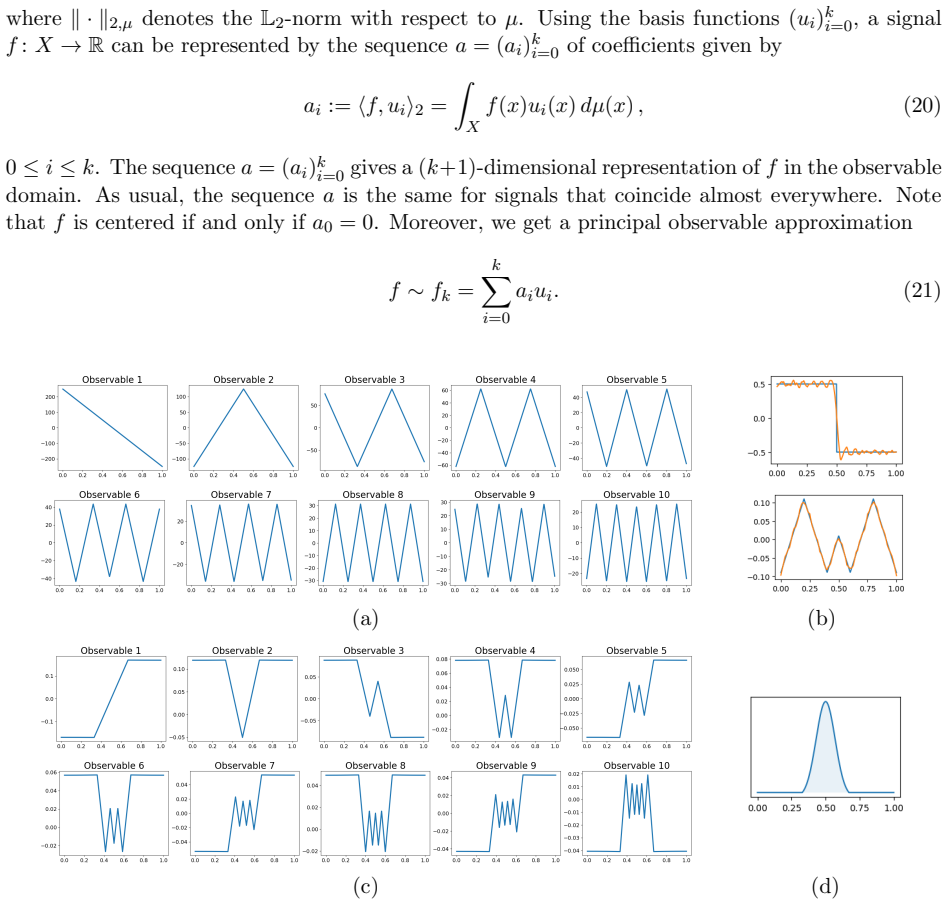
- Principal observables form a 1-Lipschitz basis for signal representation, and on weighted graphs the Lipschitz constraints reduce to checking edges, which keeps computations feasible.
Reading between the lines
- The paper establishes stability of the covariance operator, not of the principal observable functions themselves; a user of the implemented algorithm is implicitly assuming the convex-concave programming step finds global maximizers and that those maximizers move continuously with the data, which is not proven.
- A natural testable extension is to replace the balanced McShane–Whitney extension for out-of-sample points with other 1-Lipschitz extensions and measure how much downstream classification changes, since all extensions agree on the training data but can differ off it.
- The $\ell^\infty$ geometry of POA embeddings suggests that standard Euclidean-distance classifiers are mismatched with the method; adapting neighbor searches to $\ell^\infty$ or to the push-forward measure might preserve the stability guarantees.
Editorial analysis
A structured set of objections, weighed in public.
Referee Report
Summary. The paper introduces observable mean and covariance operators for probability measures on compact metric spaces, based on 1-Lipschitz observables. It proposes principal observable analysis (POA), a variance-maximization analogue of PCA, and proves Lipschitz stability of the mean and covariance with respect to the Wasserstein distance on a fixed metric space and the Kantorovich-Sturm distance for heterogeneous data. Consistency of empirical estimates is given as a corollary. The paper also presents applications of POA to network and image data and proposes principal observables as basis functions for signal representation.
Significance. The stability theorems are a useful contribution, and the proofs are self-contained, using standard tools such as Arzela-Ascoli, McShane-Whitney extensions, and Wasserstein metrization. Explicit constants are provided. The paper is honest about the open stability question for principal observables. However, the theoretical results do not, as they stand, establish the reliability of the POA method's output, since the argmax definition of principal observables is not stable under the proven covariance bounds, and the optimization is performed with a heuristic.
major comments (2)
- [Sections 3.1-3.2, Theorems 5.4 and 6.6] The paper defines principal observables as global maximizers in (13)-(14), but proves no stability for these maximizers. Theorems 5.4 and 6.6 bound the covariance operator in graph-Hausdorff distance; this is a statement about values of the bilinear form over all centered observables and does not control the argmax of the variance functional, nor the constrained argmax in (14). Consequently, the POA embedding i_k(x)=(phi_1(x),...,phi_k(x)) of Section 3.2 may be discontinuous under arbitrarily small Wasserstein perturbations of mu, even if every maximization is solved exactly. The paper acknowledges this in Section 1 ('Stability of principal observables is a more delicate question that requires further investigation'), but the abstract and introduction present POA as the main application of the stable statistics. To make the central applied claim supported, the authors should either prove a stability result for principal observables under additional hypotheses (e.g., a spectral gap that makes the maximizer unique up to sign) or explicitly restrict the paper's stability claims to the mean and covariance operators and state that POA embeddings are not proven stable.
- [Section 3.1] The computation of principal observables is described as employing the disciplined convex-concave programming (DCCP) algorithm of [27]. Since (13)-(14) are convex maximization problems, DCCP is a heuristic with no optimality certificate; the paper provides no analysis of the optimization gap. Thus the functions produced by the algorithm and used in the experiments of Sections 3 and 4 are not known to satisfy the defining equations (13)-(14). The paper should state this limitation explicitly and, ideally, provide a bound on the suboptimality (e.g., via a duality gap) or report the achieved gap on the examples. Without this, the term 'principal observables' for the computed outputs is not fully justified.
minor comments (6)
- [Appendix A.1] In the definition of T_n, the last component should be <f, phi_{n-1}>, not <f, phi_1> repeated.
- [Proof of Theorem 6.3, Eq. (36)] The integrand is missing the exponent p; it should read |f(x)-g(x)|^p dmu(x).
- [Proof of Lemma 6.10, Eq. (47)] The last term inside the max should be r_{p,mu'}(F'_2,G'_2), not r_{p,mu}(F'_2,G'_2).
- [Section 3.3] 'The maximal and minimal 1-Lipschitz extension' should be 'extensions'.
- [Introduction] The claim that the number of principal observables is infinite whenever |X| is infinite is stated without proof; a justification or reference would be helpful.
- [Abstract and Introduction] The name 'Mémoli' is typeset with a spurious accent; use the standard spelling.
Circularity Check
No significant circularity: the stability theorems are derived from standard transport inequalities and explicit constructions, with principal-observable stability explicitly deferred.
full rationale
The paper's central results, Theorems 5.1, 5.4, 6.3, and 6.6, are not obtained by assuming their conclusions. Theorem 5.1 is a direct one-sided Kantorovich-Rubinstein estimate: for any 1-Lipschitz f, |M_mu(f) - M_nu(f)| <= integral d(x,y) dh(x,y), and taking the infimum over couplings yields w1(mu,nu); this uses only the definition of w1 and the 1-Lipschitz condition. Lemma 5.3 then bounds covariance differences by combining Theorem 5.1 with Lemma 2.1's uniform bound on centered observables, after a term-by-term decomposition of the covariance difference; no step presupposes a bound of the form dH(Sigma_mu, Sigma_nu) <= C w1. Theorem 5.4 verifies admissibility in the graph-Hausdorff distance directly from Lemma 5.3 and Theorem 5.1, with explicit constants. The heterogeneous stability results are equally self-contained: the correspondences are built via McShane-Whitney extensions, and the structural and functional distortion bounds are derived from the defining inequalities of metric and probabilistic couplings plus Jensen-type estimates; none of these ingredients contains the target bound. Self-citations appear only for terminology (e.g., calling dKS,p the Kantorovich-Sturm distance as in [19]), for analogies in defining a functional Gromov-Hausdorff distance, and in outlook remarks about decorated merge trees; they are not load-bearing premises for the stability theorems. No fitted parameters are used, no empirical quantity is renamed as a prediction, and the paper explicitly states that stability of principal observables is left for future work, so the practical POA limitation is acknowledged rather than disguised. The main theorems are therefore independent of their conclusions and do not exhibit circularity.
Assumptions & free parameters
assumptions (5)
- standard math Arzela-Ascoli theorem
- standard math McShane-Whitney extension theorem
- standard math Wasserstein distance metrizes weak convergence
- domain assumption Sturm's Kantorovich-Sturm distance properties
- domain assumption Compactness of the metric space X and of the support of the measure
Cite this review
Pith. "Pith review of Observable Covariance and Principal Observable Analysis for Data on Metric Spaces." pith.science (2026). https://pith.science/paper/RZMSTBTH
@misc{pith2026250604003,
  author       = {Pith},
  title        = {Pith review of: Observable Covariance and Principal Observable Analysis for Data on Metric Spaces},
  year         = {2026},
  howpublished = {\url{https://pith.science/paper/RZMSTBTH}},
  note         = {Machine review of arXiv:2506.04003}
}
abstract
Datasets consisting of objects such as shapes, networks, images, or signals overlaid on such geometric objects permeate data science. Such datasets are often equipped with metrics that quantify the similarity or divergence between any pair of elements turning them into metric spaces $(X,d)$, or a metric measure space $(X,d,\mu)$ if data density is also accounted for through a probability measure $\mu$. This paper develops a Lipschitz geometry approach to analysis of metric measure spaces based on metric observables; that is, 1-Lipschitz scalar fields $f \colon X \to \mathbb{R}$ that provide reductions of $(X,d,\mu)$ to $\mathbb{R}$ through the projected measure $f_\sharp (\mu)$. Collectively, metric observables capture a wealth of information about the shape of $(X,d,\mu)$ at all spatial scales. In particular, we can define stable statistics such as the observable mean and observable covariance operators $M_\mu$ and $\Sigma_\mu$, respectively. Through a maximization of variance principle, analogous to principal component analysis, $\Sigma_\mu$ leads to an approach to vectorization, dimension reduction, and visualization of metric measure data that we term principal observable analysis. The method also yields basis functions for representation of signals on $X$ in the observable domain.
Figures


Figures from the paper (1 more)
Forward citations
Cited by 1 Pith paper
-
FDRMFL: Multimodal Federated Feature Extraction Model Based on Information Maximization and Contrastive Learning
FDRMFL combines MSE, mutual-information, KL-alignment, and InfoNCE losses to extract task-relevant features in federated multimodal regression, but the claimed ablations and baseline comparisons are not shown.
Reference graph
Works this paper leans on
-
[27]
X. Shen, S. Diamond, Y. Gu, and S. Boyd. Disciplined convex-concave programming. In 2016 IEEE 55th Conference on Decision and Control (CDC) , pages 1009–1014. IEEE, 2016
work page 2016
-
[1]
S. Anbouhi, W. Mio, and O. B. Okutan. On metrics for analysis of functional data on geometric domains. Found. Data Sci. , 7(3):671–704, 2025
work page 2025
-
[2]
S. Biasotti, B. Falcidieno, D. Giorgi, and M. Spagnuolo. Reeb Graphs, pages 69–74. Springer International Publishing, Cham, 2014
work page 2014
- [3]
- [4]
-
[5]
N. Charon and A. Trouv´ e. The varifold representation of nonoriented shapes for diffeomorphic registration. SIAM J. Imaging Sci , 6:2547–2580, 12 2013
work page 2013
- [6]
- [7]
Show all 31 references
-
[8]
Curry, W
J. Curry, W. Mio, T. Needham, O. B. Okutan, and F. Russold. Stability and approximations for decorated Reeb spaces. In Symposium on Computational Geometry , Athens, Greece, June 2024
2024
-
[9]
R. Dudley. Real Analysis and Probability . Cambridge Studies in Advanced Mathematics. Cambridge University Press, 2002
2002
-
[10]
M. Gromov. Metric Structures for Riemannian and Non-Riemannian Spaces. Springer Science & Business Media, 2007
2007
-
[11]
Hammond, P
D. Hammond, P. Vandergheynst, and R. Gribonval. Wavelets on graphs via spectral graph theory. Appl. Comput. Harmon. Anal. , 30:129–150, 12 2009
2009
-
[12]
D. G. Kendall. Shape manifolds, procrustean metrics, and complex projective spaces. Bull. Lond. Math. Soc. , 16(2):81–121, 1984. 18
1984
-
[13]
X. Liu, Y. Shi, I. Dinov, and W. Mio. A computational model of multidimensional shape. Int. J. Comput. Vis. , 89:69–83, 08 2010
2010
-
[14]
E. J. McShane. Extension of range of functions. Bull. Amer. Math. Soc. , 40(12):837 – 842, 1934
1934
-
[15]
A. Mead. Review of the development of multidimensional scaling methods. J. R. Stat. Soc. Series D , 41(1):27–39, 1992
1992
-
[16]
M´ emoli
F. M´ emoli. Gromov-Wasserstein distances and the metric approach to object matching.Found. Comput. Math. , 11(4):417–487, 2011
2011
-
[17]
M´ emoli and T
F. M´ emoli and T. Needham. Distance distributions and inverse problems for metric measure spaces. Stud. Appl. Math. , 149(4):943 –1001, 2022
2022
-
[18]
Michor and D
P. Michor and D. Mumford. D.: An overview of the Riemannian metrics on spaces of curves using the Hamiltonian approach. Appl. Comput. Harmon. Anal., , 23:74–113, 04 2006
2006
-
[19]
Mio and T
W. Mio and T. Needham. Robust representation and estimation of barycenters and modes of probability measures on metric spaces. Preprint, arXiv:2505.09609, 2025
2025 arXiv
-
[20]
Morozov, K
D. Morozov, K. Beketayev, and G. Weber. Interleaving distance between merge trees. Discret. Comput. Geom., 49:22–45, 01 2013
2013
-
[21]
S. A. Nene, S. K. Nayar, and H. Murase. Columbia Object Image Library (COIL-100). Tech- nical Report CUCS-006-96, February 1996
1996
-
[22]
X. Pennec. Barycentric subspace analysis on manifolds. Ann. Stat., 46(6A):2711–2746, 2018
2018
-
[23]
Petrakis
I. Petrakis. Mcshane-Whitney extensions in constructive analysis. Log. Meth. Comput. Sci. , 16(1), 2018
2018
-
[24]
Rosenberg
S. Rosenberg. The Laplacian on a Riemannian Manifold: An Introduction to Analysis on Manifolds. London Mathematical Society Student Texts. Cambridge University Press, 1997
1997
-
[25]
R. A. Rossi and N. K. Ahmed. The Network Data Repository with interactive graph ana- lytics and visualization. In Proceedings of the Twenty-Ninth AAAI Conference on Artificial Intelligence, 2015
2015
-
[26]
Rubner, C
Y. Rubner, C. Tomasi, and L. Guibas. A metric for distributions with applications to im- age databases. In Sixth International Conference on Computer Vision , pages 59–66. Narosa Publishing House, 1998
1998
-
[28]
K.-T. Sturm. On the geometry of metric measure spaces. Acta Math., 196(1):65–131, 2006
2006
-
[29]
van der Maaten and G
L. van der Maaten and G. Hinton. Visualizing data using t-SNE. J. Mach. Learn. Res. , 9:2579–2605, 2008
2008
-
[30]
Weed and F
J. Weed and F. Bach. Sharp asymptotic and finite-sample rates of convergence of empirical measures in Wasserstein distance. Bernoulli, 25(4A):2620–2648, 2019
2019
-
[31]
L. Younes. Computable elastic distances between shapes. SIAM J. Appl. Math. , 58, 12 2000. 19 A Appendix A.1 Existence of Principal Observables We first verify the sequential compactness (which is equivalent to compactness) of the metric space (Oc µ, ∥ · ∥∞) of centered princi...
2000
Reviewed August 7, 2026 · model on record in the stance chip above.
Discussion (0). Sign in to comment.