REVIEW 5 major objections 5 minor 29 references
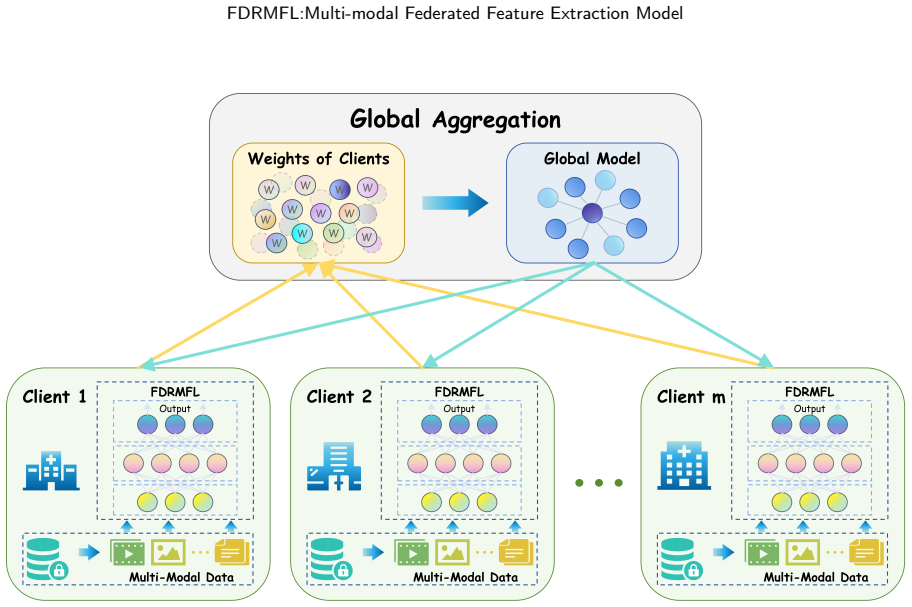
FDRMFL: Multimodal Federated Feature Extraction Model Based on Information Maximization and Contrastive Learning
T0 review · 5 major / 5 minor · reviewed 2026-08-03 · deepseek-v4-flash
Pith's one-line read FDRMFL claims that a four-term objective—prediction error, mutual-information retention, cross-modal KL alignment, and contrastive anchoring—makes federated multimodal regression more accurate and stable under non-IID data.
desk verdict Abstract overclaims—no ablations or FedAvg baselines exist in the body—but the core loss combination is sensible and the reported wins over PCA/VAE are consistent. read the letter →
The pith
A machine-rendered reading of the paper's core claim, the machinery that carries it, and where it could break.
The reading
What carries the argument
The central object is the four-term local objective L = L_pred + λ1 L_mi + λ2 L_kl + λ3 L_fcl. L_pred is mean squared error between prediction and true label. L_mi is an empirical surrogate for mutual information between the fused representation and the regression target, implemented as a sigmoid/binary cross-entropy bound with a negative-sample label. L_kl is a symmetric KL divergence between pairs of modality feature distributions; with a shared-variance Gaussian assumption it reduces to a scaled Euclidean distance between per-sample modality means. L_fcl is an InfoNCE-style contrastive loss using cosine similarity, with the previous round's global representation as the positive sample and
What would settle it
Run FDRMFL head-to-head against FedAvg, FedProx, MOON, SCAFFOLD, and FedBN on the paper's own simulation protocol; the abstract claims the lowest overall mean MSE among these six, but Tables 1-4 report only PCA/TSVD/RP/VAE comparisons. Also, remove each of the three regularizers one at a time; the paper claims all contribute, yet the promised ablation tables do not appear in the full text.
Extended reading notes
Core claim
The central claim is that the four-term objective works as a unit: the MSE term pins down regression accuracy, the mutual-information surrogate preserves dependence between the fused representation and the continuous target, the symmetric KL term aligns per-modality feature distributions before fusion, and the InfoNCE term stabilizes federated training by treating the previous global representation as the positive anchor and earlier global representations as negatives. Under a Gaussian homoscedastic approximation, the KL alignment collapses to a per-sample Euclidean penalty on modality-feature means. The paper reports that this combined objective yields the lowest MSE in all nine simulated n
Load-bearing premise
The method's load-bearing premise is that the sigmoid-based surrogate in Eq. (15) truly measures how much the fused representation depends on the continuous target; if it does not, the regularization can distort features rather than preserve predictive information.
Editorial extensions
If this is right
- If the central claim holds, federated multimodal regression can be built around a supervised objective instead of unsupervised dimension reduction, preserving task-relevant information that PCA, TSVD, and RP discard.
- The same four-term recipe should transfer to different encoder families (Transformer, CNN, LSTM, MLP) and fusion functions, so the method is not tied to one architecture.
- The reported reduction in cross-client MSE spread implies that contrastive anchoring and KL alignment jointly act as a stabilizer under non-IID partitions.
- For near-infrared spectroscopy, the method offers a privacy-preserving pipeline for food and agricultural quality prediction without centralizing sensitive spectral data.
- The performance on two real datasets suggests the method can handle small-sample, high-dimensional functional covariates.
Reading between the lines
- Because the KL term collapses to per-sample Euclidean distances under the Gaussian assumption, we suspect the claimed 'distribution alignment' may mostly be centroid matching; a Wasserstein or MMD-based alignment could reveal whether higher-order distributional information matters.
- The same objective could be adapted to classification or survival targets by replacing the MSE term and the MI surrogate, an extension the paper does not explore.
- The paper's rationale implies an untested ordering of components: if MI retention is the main driver, simpler supervised dimensionality reduction might capture part of the gain; a direct comparison would isolate the contribution of the contrastive and KL terms.
Editorial analysis
A structured set of objections, weighed in public.
Referee Report
Summary. The manuscript proposes FDRMFL, a federated multimodal feature-extraction method for regression. It combines an MSE prediction loss with three regularizers: a mutual-information surrogate (Eq. 15), a symmetric KL divergence between modality feature distributions (Eq. 17), and an InfoNCE-style contrastive loss against historical global representations (Eq. 19). The authors claim each component contributes and that FDRMFL achieves the lowest MSE among six federated algorithms including FedAvg, FedProx, MOON, SCAFFOLD, and FedBN. Experiments are reported on three synthetic link-function settings and two near-infrared spectroscopy datasets, with PCA, TSVD, RP, and VAE as baselines.
Significance. The problem of task-driven multimodal feature extraction under federated non-IID constraints is timely, and the proposed loss combination is plausible. If fully validated with proper ablations and federated baselines, the method could be a useful contribution. The paper ships a concrete algorithm and reports run-level statistics. However, as written, the central empirical claims are not supported: no ablation or sensitivity analysis appears, no federated algorithm is compared against, and the theoretical justifications for the MI surrogate and KL simplification are not established.
major comments (5)
- [Abstract; §3.1, §3.2] The abstract claims 'comprehensive ablation and sensitivity analyses' and that FDRMFL 'attains the lowest overall mean MSE among six federated algorithms including FedAvg, FedProx, MOON, SCAFFOLD, and FedBN.' The body contains no ablation study, no sensitivity analysis, and no comparison with any federated algorithm. Tables 1–4 list only PCA, TSVD, RP, and VAE; §3.1 explicitly names 'PCA, TSVD, RP, MAE and FDRMFL'. The only acknowledgment of FedAvg is §2.2 ('Building upon FedAvg training...'), which does not test it. Thus the load-bearing claims of component contribution and superiority over federated baselines are unsupported.
- [§2.2, Eq. (15)] Eq. (15) is presented as a 'variational lower bound' for I(Z_ij; y_ij), but no derivation is given. The expression uses binary logistic losses on f(Z)·y and f(Z)·ỹ; for a continuous target y this is not any standard InfoNCE or variational MI estimator. Moreover f is the same prediction network trained by the MSE term in Eq. (14), so the 'information' being maximized is not independent of the predictor. The claim that this term 'preserves dependence' is therefore unsupported and arguably circular.
- [§2.1, §2.2, Eqs. (10), (16), (17)] The KL alignment term is reduced to a per-sample Euclidean penalty under the per-sample homoscedastic Gaussian assumption (Eq. 10). But p(z_im) is a distribution over features, not defined per sample; Eq. (16) computes symKL on point estimates z_ijm, z_ijn. The shared variance σ² is a free parameter, and the reduction to ||z_ijm−z_ijn||²/(2σ²) turns a distributional alignment objective into a pointwise distance. The mechanistic interpretation as 'cross-modal alignment at the distribution level' (§4) is not supported.
- [§3.1, §3.2] The experiments do not actually create non-IID partitions. §3.1 says 'Samples are then randomly partitioned across three clients'; this is an IID split. The real-data descriptions (§3.2) mention qualitative differences ('client1 contains mostly lean samples') but no quantitative distribution-shift measure or partition protocol is given. Since non-IID is one of the three core challenges motivating the method, the reported results cannot be interpreted as evidence for the non-IID setting.
- [§3.1, Tables 1–4] No ablation or sensitivity study is performed for the weights λ1, λ2, λ3, temperature τ, or σ². The abstract's promise of 'comprehensive ablation and sensitivity analyses' is absent. Without these, one cannot tell whether the observed MSE reductions come from the three added regularizers or simply from the supervised federated training itself.
minor comments (5)
- [§3.1] The baseline list includes 'MAE' but no MAE results appear; presumably 'VAE' is meant. This typo obscures the baseline set and should be fixed.
- [§2.3] This section is a long textbook exposition of Transformer, CNN, LSTM, and MLP architectures. It is unrelated to the experiments and could be condensed or moved to an appendix.
- [Table 3] The target is labeled 'Water' in the table but 'moisture' in the text; standardize the terminology.
- [Abstract] The phrase 'six federated algorithms' is ambiguous: if it means FDRMFL plus five baselines, the names should be explicit; if it means six baselines, the list is incomplete. In any case, no such comparisons appear in the body.
- [Eq. (10)] The symbol μ_im is used in the Gaussian assumption but never defined. Eq. (17) then switches to sample-level notation z_ijm, which adds confusion about what is being aligned.
Circularity Check
No significant circularity: the derived loss terms are stated assumptions and algebraic simplifications, not fits renamed as predictions.
full rationale
The paper derives its four-term objective by explicit definitions (Eqs. 2, 5, 9, 12) and standard algebraic simplifications: Eq. (3) follows from y = f(Z) + epsilon, and Eq. (17) follows from the stated homoscedastic Gaussian assumption in Eq. (10). No parameter is fit to a target and then reported as a prediction; all reported MSE values compare FDRMFL against independent external baselines (PCA, TSVD, RP, VAE) on held-out test sets. The MI surrogate in Eq. (15) uses the prediction network f as a critic, but this is a shared-critic design choice, not a fitted input called a prediction and not an equivalence by construction. The paper contains no self-citations, no imported uniqueness theorems, and no ansatz smuggled through prior work. The abstract promises 'comprehensive ablation and sensitivity analyses' and superiority over FedAvg/FedProx/MOON/SCAFFOLD/FedBN, while Section 3 reports no ablation and no such federated baselines; this is an evidentiary gap that weakens the empirical claims, but it is not circular. Under the hard rule requiring a quoted equation-level reduction, no circular step can be established.
Assumptions & free parameters
free parameters (3)
- λ1, λ2, λ3 (regularization weights) =
not reported
- τ (temperature in InfoNCE) =
not reported
- σ² (Gaussian variance for KL simplification) =
not reported
assumptions (3)
- ad hoc to paper Variational lower bound for mutual information as in Eq (15): I(Z;y) ≥ E[log σ(f(Z)·y) + log(1−σ(f(Z)·ỹ))]
- ad hoc to paper Per-sample homoscedastic Gaussian distributions for each modality (Eq 10): p(z_m) ~ N(μ_m, σ²I)
- domain assumption Contrastive anchoring with historical global representations (Eq 19) reduces representation drift and catastrophic forgetting
Cite this review
Pith. "Pith review of FDRMFL: Multimodal Federated Feature Extraction Model Based on Information Maximization and Contrastive Learning." pith.science (2026). https://pith.science/paper/AG5RDB3Z
@misc{pith2026251202076,
  author       = {Pith},
  title        = {Pith review of: FDRMFL: Multimodal Federated Feature Extraction Model Based on Information Maximization and Contrastive Learning},
  year         = {2026},
  howpublished = {\url{https://pith.science/paper/AG5RDB3Z}},
  note         = {Machine review of arXiv:2512.02076}
}
read the original abstract
We propose FDRMFL, a task-driven multimodal feature extraction framework for federated regression under non-IID data distributions. Extracting predictive features from high-dimensional multimodal inputs is particularly challenging in this setting: data cannot leave each client, local samples are scarce and heterogeneously distributed, and unsupervised dimensionality reduction discards task-relevant information while federated training introduces representation drift across communication rounds. FDRMFL addresses these challenges through a unified four-term local objective: MSE prediction loss, a correlation-based mutual information surrogate that preserves dependence between the fused representation and the continuous target, a symmetric KL penalty that aligns cross-modal latent distributions before fusion, and an InfoNCE-style contrastive loss that anchors local representations to the global consensus. Experiments on three synthetic and two real-world near-infrared spectroscopy datasets under non-IID federated partitions, with comprehensive ablation and sensitivity analyses, demonstrate that each component contributes to the framework's effectiveness. FDRMFL reduces mean MSE by 33.8% relative to the best traditional baseline (PCA) and by 43.0% relative to VAE in simulation, and attains the lowest overall mean MSE among six federated algorithms including FedAvg, FedProx, MOON, SCAFFOLD, and FedBN.
Figures


Figures from the paper (3 more)


Reference graph
Works this paper leans on
-
[1]
Geometric means in a novel vector space structure on symmetric positive-definite matrices
Arsigny, V., Fillard, P., Pennec, X., Ayache, N., 2007. Geometric means in a novel vector space structure on symmetric positive-definite matrices. SIAM journal on matrix analysis and applications 29, 328– 347
2007
-
[2]
Prediction by supervised principal components
Bair, E., Hastie, T., Paul, D., Tibshirani, R., 2006. Prediction by supervised principal components. Journal of the American Statistical Association 101, 119–137
2006
-
[3]
Multimodal machine learning: A survey and taxonomy
Baltrušaitis, T., Ahuja, C., Morency, L., 2019. Multimodal machine learning: A survey and taxonomy. IEEE Transactions on Pattern Analysis and Machine Intelligence 41, 423–443
2019
-
[4]
Geometry of the space of phylogenetic trees
Billera, L.J., Holmes, S.P., Vogtmann, K., 2001. Geometry of the space of phylogenetic trees. Advances in Applied Mathematics 27, 733–767
2001
-
[5]
Randomprojectionindimensionality reduction: Applications to image and text data, in: Proceedings of the 7thACMSIGKDDInternationalConferenceonKnowledgeDiscovery and Data Mining, ACM
Bingham,E.,Mannila,H.,2001. Randomprojectionindimensionality reduction: Applications to image and text data, in: Proceedings of the 7thACMSIGKDDInternationalConferenceonKnowledgeDiscovery and Data Mining, ACM. pp. 245–250
2001
-
[6]
Tools for fast metric data search in structural methods for image classification
Daradkeh,Y.I.,Gorokhovatskyi,V.,Tvoroshenko,I.,Zeghid,M.,2022. Tools for fast metric data search in structural methods for image classification. IEEE Access 10, 124738–124746
2022
-
[7]
Computational topology for data analysis
Dey, T.K., Wang, Y., 2022. Computational topology for data analysis. Cambridge University Press
2022
-
[8]
Non-euclideanstatistics for covariance matrices, with applications to diffusion tensor imaging
Dryden,I.L.,Koloydenko,A.,Zhou,D.,2009. Non-euclideanstatistics for covariance matrices, with applications to diffusion tensor imaging. The Annals of Applied Statistics , 1102–1123
2009
Show all 29 references
-
[9]
Modelingtime-varyingrandomobjects anddynamicnetworks
Dubey,P.,Müller,H.G.,2022. Modelingtime-varyingrandomobjects anddynamicnetworks. JournaloftheAmericanStatisticalAssociation 117, 2252–2267
2022
-
[10]
Regression for non-euclidean data using distance matrices
Faraway, J.J., 2014. Regression for non-euclidean data using distance matrices. Journal of Applied Statistics 41, 2342–2357
2014
-
[11]
Finding structure with randomness: Probabilistic algorithms for constructing approximate matrix decompositions
Halko, N., Martinsson, P.G., Tropp, J.A., 2011. Finding structure with randomness: Probabilistic algorithms for constructing approximate matrix decompositions. SIAM Review 53, 217–288
2011
-
[12]
Robust nonparametric regression with metric-space valued output
Hein, M., 2009. Robust nonparametric regression with metric-space valued output. Advances in neural information processing systems 22
2009
-
[13]
beta-vae: Learning basic visual concepts with a constrained variational framework, in: International Conference on Learning Representations (ICLR)
Higgins, I., Matthey, L., Pal, A., Burgess, C., Glorot, X., Botvinick, M., Mohamed, S., Lerchner, A., 2017. beta-vae: Learning basic visual concepts with a constrained variational framework, in: International Conference on Learning Representations (ICLR)
2017
-
[14]
Areviewonevaluationmetricsfor data classification evaluations
Hossin,M.,Sulaiman,M.N.,2015. Areviewonevaluationmetricsfor data classification evaluations. International journal of data mining & knowledge management process 5, 1
2015
-
[15]
Kairouz, P., McMahan, H.B., Avent, B., Bellet, A., Bennis, M., et al.,
-
[16]
Observable covariance and principal observable analysis for data on metric spaces
Karacam, E., Mio, W., Okutan, O.B., 2025. Observable covariance and principal observable analysis for data on metric spaces. arXiv preprint arXiv:2506.04003
2025 arXiv
-
[17]
Scaffold: Stochastic controlled averaging for federated learning, in: Proceedings of the 37th International Conference on Machine Learning (ICML), PMLR
Karimireddy,S.P.,Kale,S.,Mohri,M.,Reddi,S.J.,Stich,S.U.,Suresh, A.T., 2020. Scaffold: Stochastic controlled averaging for federated learning, in: Proceedings of the 37th International Conference on Machine Learning (ICML), PMLR. pp. 5132–5143. Wu H.:Preprint submitted to Elsev...
2020
-
[18]
Overcom- ing catastrophic forgetting in neural networks
Kirkpatrick, J., Pascanu, R., Rabinowitz, N.C., et al., 2017. Overcom- ing catastrophic forgetting in neural networks. Proceedings of the National Academy of Sciences (PNAS) 114, 3521–3526
2017
-
[19]
Federated optimization in heterogeneous networks, in: Proceedings of the 2nd Conference on Machine Learning and Systems (MLSys)
Li, T., Sahu, A.K., Zaheer, M., Sanjabi, M., Talwalkar, A., Smith, V., 2020. Federated optimization in heterogeneous networks, in: Proceedings of the 2nd Conference on Machine Learning and Systems (MLSys)
2020
-
[20]
Eclipse: Efficient long-range video retrieval using sight and sound, in: European Conference on Computer Vision, Springer
Lin, Y.B., Lei, J., Bansal, M., Bertasius, G., 2022. Eclipse: Efficient long-range video retrieval using sight and sound, in: European Conference on Computer Vision, Springer. pp. 413–430
2022
-
[21]
Object oriented data analysis
Marron, J.S., Dryden, I.L., 2021. Object oriented data analysis. Chapman and Hall/CRC
2021
-
[22]
Communication-efficient learning of deep networks from decentralized data, in: Proceedings of the 20th International ConferenceonArtificialIntelligenceandStatistics(AISTATS),PMLR
McMahan, H.B., Moore, E., Ramage, D., Hampson, S., Aguera y Arcas, B., 2017. Communication-efficient learning of deep networks from decentralized data, in: Proceedings of the 20th International ConferenceonArtificialIntelligenceandStatistics(AISTATS),PMLR. pp. 1273–1282
2017
-
[23]
Functionalanalysis:anintroductiontometricspaces, Hilbert spaces, and Banach algebras
Muscat,J.,2024. Functionalanalysis:anintroductiontometricspaces, Hilbert spaces, and Banach algebras. Springer Nature
2024
-
[24]
Representation learning with contrastive predictive coding
van den Oord, A., Li, Y., Vinyals, O., 2018. Representation learning with contrastive predictive coding. URL:https://arxiv.org/abs/1807. 03748,arXiv:1807.03748
2018 arXiv
-
[25]
Optimal-transport analysis of single-cell gene expression identifies developmental trajectories in reprogramming
Schiebinger, G., Shu, J., Tabaka, M., Cleary, B., Subramanian, V., Solomon, A., Gould, J., Liu, S., Lin, S., Berube, P., et al., 2019. Optimal-transport analysis of single-cell gene expression identifies developmental trajectories in reprogramming. Cell 176, 928–943
2019
-
[26]
Aneffective multimodal image fusion method using mri and pet for alzheimer’s disease diagnosis
Song,J.,Zheng,J.,Li,P.,Lu,X.,Zhu,G.,Shen,P.,2021. Aneffective multimodal image fusion method using mri and pet for alzheimer’s disease diagnosis. Frontiers in digital health 3, 637386
2021
-
[27]
Remaining useful life prediction of iiot-enabled complex industrial systems with hybrid fusionofmultipleinformationsources.IEEEInternetofThingsJournal 8, 9045–9058
Wen, P., Li, Y., Chen, S., Zhao, S., 2021. Remaining useful life prediction of iiot-enabled complex industrial systems with hybrid fusionofmultipleinformationsources.IEEEInternetofThingsJournal 8, 9045–9058
2021
-
[28]
Local polynomial regression for symmetric positive definite matrices
Yuan, Y., Zhu, H., Lin, W., Marron, J.S., 2012. Local polynomial regression for symmetric positive definite matrices. Journal of the Royal Statistical Society Series B: Statistical Methodology 74, 697– 719. Wu H.:Preprint submitted to Elsevier Page 15 of 15
2012
-
[2021]
Foundations and Trends in Machine Learning 14, 1–210
Advancesandopenproblemsinfederatedlearning. Foundations and Trends in Machine Learning 14, 1–210
Reviewed August 3, 2026 · model on record in the stance chip above.
Discussion (0). Sign in to comment.