REVIEW 3 major objections 5 minor 38 references
The mutual exclusivity bias of bilingual visually grounded speech models
T0 review · 3 major / 5 minor · reviewed 2026-08-07 · deepseek-v4-flash
Pith's one-line read Bilingual visually grounded speech models show a mutual-exclusivity bias that is generally weaker than the monolingual bias, with some exceptions.
desk verdict A useful bilingual VGS word-learning study whose central claim is currently contradicted by its own statistical summary—likely a swapped adjective, but must be fixed before the paper can be cited. read the letter →
The pith
A machine-rendered reading of the paper's core claim, the machinery that carries it, and where it could break.
The reading
What carries the argument
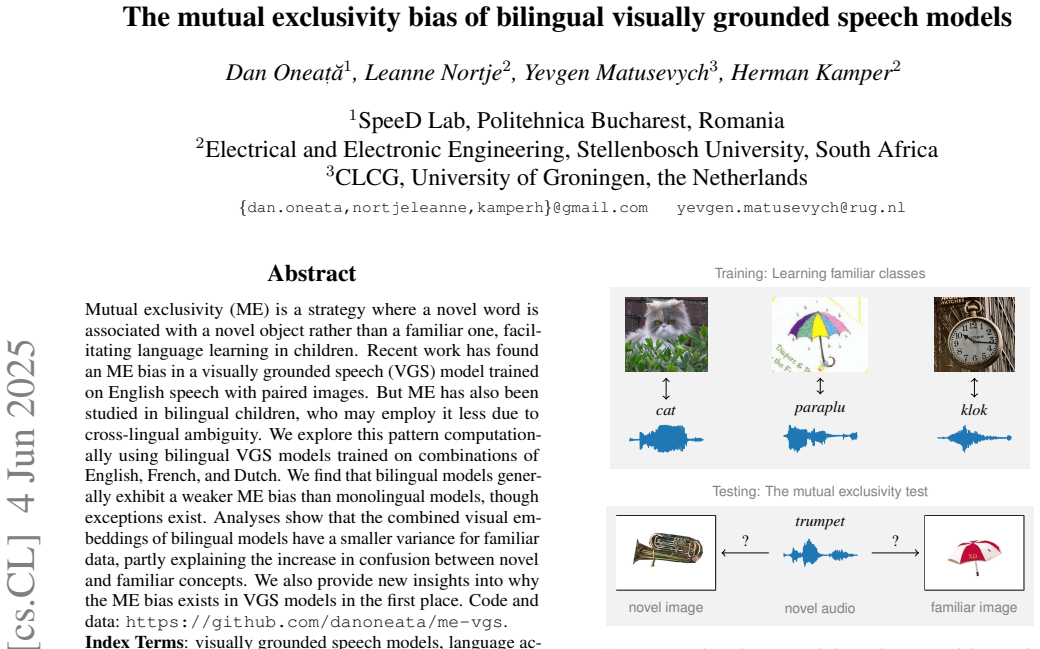
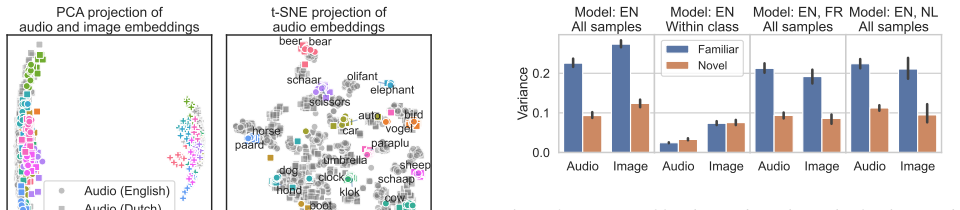
The central object is a visually grounded speech model: two towers that map an audio clip and an image into a shared 256-dimensional unit sphere, with a dot product giving their match score. Each tower consists of a frozen self-supervised encoder followed by a single trainable transformer pooling layer; training uses a contrastive objective that maximises the probability of matching a correct audio–image pair against distractors, with a learnable temperature. The mutual-exclusivity test is a two-way forced choice: given a spoken query from a class never seen in training, the model must pick between an image of that novel class and an image of a familiar class; choosing the novel image counts as an ME response. The paper's explanatory machinery is the variance of the embedding clouds—the trace of the covariance matrix—computed for familiar and novel samples, together with PCA and t-SNE projections. This reveals a separation, or modality gap, between where audio and image embeddings live on the sphere, with tight per-class bundles for familiar items and an in-between region for novel items, and it shows that the familiar image cloud shrinks in the bilingual models.
What would settle it
Retrain the same pooling layers with the frozen encoders replaced by ones that provably have never seen the 19 test classes, for example randomly initialised encoders or data with those categories removed; if the bilingual models no longer show a weaker mutual-exclusivity bias than the monolingual ones, then the paper's central finding is an artifact of pretraining rather than of bilingual word learning.
Extended reading notes
Core claim
Building on the monolingual mutual-exclusivity test from reference [16], the paper trains monolingual and bilingual visually grounded speech models on English, French, and Dutch, using frozen self-supervised visual and audio encoders and training only two small transformer pooling layers with a contrastive loss. On a two-image forced-choice test that pairs a spoken word from a held-out novel class with a novel image versus a familiar image, every model chooses the novel image well above the 50% chance level, so all models exhibit the bias. The bilingual models score below the corresponding monolingual model in most but not all of the 18 comparisons, with the clearest counterexample being the Dutch–French model tested on French, which reaches 69.4% against 67.6% for the French-only model. The embedding analyses show a modality gap between audio and image features, with familiar classes arranged in tight per-class bundles and novel classes concentrated in an overlapping in-between region; compared to monolingual models, bilingual models have a smaller variance in the familiar image embeddings, which the authors propose makes novel images more confusable with familiar ones. The paper also finds that the two languages' audio embeddings are aligned closely enough that a nearest-centroid classifier translates familiar words across languages with over 97% accuracy.
Load-bearing premise
The 19 classes used as 'novel' in the mutual-exclusivity test may already be known to the frozen pretrained encoders, since the image encoder was pretrained on ImageNet and the speech encoder on large English audio collections, so the measured bias could partly reflect prior object knowledge rather than behaviour learned during the bilingual training.
Editorial extensions
If this is right
- If the finding generalises, bilingual visually grounded speech training provides a controllable computational analogue of bilingual child word learning, letting researchers vary language pairs, vocabulary size, and exposure while measuring the bias.
- The model's near-perfect familiar-class discrimination together with a stronger mutual-exclusivity bias than the earlier English-only model suggests that stronger learners show a stronger bias, a prediction that could be sharpened in child studies.
- The variance analysis predicts that any intervention that tightens the familiar visual embedding cloud, such as more training data or higher model capacity, should reduce the mutual-exclusivity bias even in a monolingual model.
- The over-97% cross-lingual nearest-centroid translation accuracy indicates that bilingual visual grounding implicitly aligns word forms across languages, which could be exploited for low-resource speech retrieval.
- The observed exceptions to the weaker-bias pattern imply that the effect is not a guaranteed consequence of bilingual training, so future work should identify the conditions, such as specific language pairs or vocabulary overlap, that produce them.
Reading between the lines
- One extension beyond the paper: since the frozen encoders likely already contain the 'novel' object classes, a cleaner test of the mutual-exclusivity bias would use synthetic or truly novel categories, and the current numbers may overstate how much of the bias is learned from the training data.
- Another extension: the variance-shrinking mechanism predicts a monotone relationship between the amount of bilingual data imbalance and the reduction in bias, so training models with skewed English–Dutch ratios should shift the bias correspondingly.
- The cross-lingual alignment result suggests the model could be probed for code-switching behaviour: if both languages share one visual space, code-mixed or accent-matched queries should behave like same-language queries.
- The paper leaves open whether the weaker bilingual bias is due to the larger number of training steps (since bilingual models loop over more audio) or to the presence of two languages; an equal-step controlled experiment would separate these factors.
Editorial analysis
A structured set of objections, weighed in public.
Referee Report
Summary. The paper studies mutual exclusivity (ME) in visually grounded speech (VGS) models trained on one or two languages. Using frozen WavLM and DINO encoders with trained pooling layers, the authors train monolingual and bilingual models on English, French, and Dutch speech–image pairs, then measure the ME bias as the accuracy with which a novel spoken word is matched to a novel image over a familiar image. The main empirical claim is that bilingual models generally show a weaker ME bias than monolingual models, with some exceptions. The paper also analyzes embedding variances to propose an explanation and measures cross-lingual alignment, reporting near-perfect translation accuracy for familiar classes. Code and data are released.
Significance. If the main claim is supported after correcting the statistical reporting, this is a valuable contribution to computational studies of word learning: it is, to my knowledge, the first systematic comparison of ME bias in monolingual versus bilingual VGS models, and it extends the phenomenon to Dutch and French. The paper improves on prior work by providing a stronger baseline model, visualizations of the embedding space, and public code/data. However, as written, the paper's own statistical summary directly contradicts its headline claim, and the novelty of the held-out classes is compromised by the use of ImageNet-pretrained visual features, so the significance currently hinges on unresolved technical issues.
major comments (3)
- [Section 3.1] The sentence 'Out of 18 tests (3 languages × 2 language pairs × 3 model sizes), 9 show that the bias is significantly stronger in the bilingual models, and 6 show a difference in the expected direction but not significantly so' is internally inconsistent with the abstract and the concluding claim that bilingual models generally exhibit a weaker ME bias. If literally true, 9 of 18 tests found a significantly stronger bilingual bias, the opposite of the headline, and the remaining 6 are in the expected direction but not significant. The sentence must contain a swapped adjective or an error in the counts. Because Table 1 only reports one model size, the full set of 18 comparisons is not available to the reader. Please provide the complete results (e.g., a supplementary table with all 18 comparisons including test statistics and significance) and correct the text so that the reported numbers support the claim.
- [Section 2.2 and 2.4] The 19 'novel' classes are only novel with respect to the training stage of the pooling layers; the frozen DINO ResNet-50 visual encoder was pretrained on ImageNet, which very likely contains many of the same object categories (e.g., bus, piano, trumpet), and WavLM was pretrained on large English speech corpora. Since the model's only learned layers are the pooling layers, the ME test may be measuring, in part, whether the pretrained features already separate these 'novel' categories, rather than whether the model has learned a new word-to-object mapping. This confound is not acknowledged. Please discuss it and, ideally, include an analysis of the model's behavior at initialization (before any VGS training) or restrict the novel set to categories that are provably absent from the pretraining data.
- [Section 2.3] The bilingual models are trained on the combined audio data of two languages while the monolingual models see only one language; with a fixed number of epochs, the bilingual models therefore receive more gradient updates and see more data. The paper states that 'Results were similar when an equal number of training steps was used,' but no quantitative evidence is shown. This is important because the observed ME differences could stem from the amount of training rather than from bilingualism per se. Please provide the supporting results or a discussion of why this confound cannot explain the differences.
minor comments (5)
- [Header/Title page] The author name 'Dan Oneat, ˘a' in the header contains an encoding artifact and should be corrected to 'Dan Oneață'.
- [Section 3.3] Figure 4 is not referenced in the text before Section 3.3; please refer to it where the variance analysis is introduced.
- [Abstract] The abstract states that 'the combined visual embeddings of bilingual models have a smaller variance for familiar data, partly explaining the increase in confusion between novel and familiar concepts,' but the analysis in Section 3.3 is explicitly speculative and within-modality only; consider softening the abstract to match the caveats in the text.
- [Section 3.4] The 'nearest mean centroid' translation accuracy is reported for familiar and novel classes, but the chance level for novel words is given as 5.2% (1/19); consider clarifying that this is per-class chance and not per-episode.
- [Section 3.2] The paper says 'we also provide new insights into why the ME bias exists' but the novelty of 'novel concepts are placed in-between familiar concepts' is stated without comparison to prior work; add a discussion of what is new relative to [16].
Circularity Check
No significant circularity: the bilingual ME comparison is measured directly from a held-out test protocol and is not reduced to a fitted input or self-citation.
full rationale
The paper's central claim is an empirical comparison: ME accuracy is computed directly from a held-out test involving novel audio and novel images paired with familiar images (Sec. 2.4), and no free parameter is fitted to the ME outcome. The bilingual models are newly trained across three languages, and the only self-citations are to the prior work [16] for the dataset, the initial monolingual ME result, and a background hypothesis about why the ME bias exists; none of these forces the bilingual-versus-monolingual comparison. The variance analysis in Sec. 3.3 is a post hoc description of the same embeddings, presented as a possible partial explanation, not as a fitted prediction. The paper also explicitly acknowledges exceptions and limitations, including the inconsistency in Sec. 3.1's statistical summary, which is a correctness concern rather than a circularity concern. No equation in the paper reduces by construction to an input, and no fitted parameter is renamed as a prediction. Therefore, the derivation chain is self-contained for the purposes of circularity analysis.
Assumptions & free parameters
assumptions (4)
- domain assumption The ME test protocol: a higher score for a novel audio-novel image pair than a novel audio-familiar image pair is interpreted as a mutual exclusivity bias.
- domain assumption Frozen DINO and WavLM encoders provide sufficient perceptual features across the three languages and 33 visual classes.
- domain assumption The bilingual training data is a fair stand-in for bilingual exposure, despite heavy class imbalance and unequal audio/image counts per language.
- standard math Standard contrastive learning with an InfoNCE-style loss yields embeddings whose covariance (variance) analysis supports the paper's geometric explanation.
Cite this review
Pith. "Pith review of The mutual exclusivity bias of bilingual visually grounded speech models." pith.science (2026). https://pith.science/paper/T4PBNWJT
@misc{pith2026250604037,
  author       = {Pith},
  title        = {Pith review of: The mutual exclusivity bias of bilingual visually grounded speech models},
  year         = {2026},
  howpublished = {\url{https://pith.science/paper/T4PBNWJT}},
  note         = {Machine review of arXiv:2506.04037}
}
read the original abstract
Mutual exclusivity (ME) is a strategy where a novel word is associated with a novel object rather than a familiar one, facilitating language learning in children. Recent work has found an ME bias in a visually grounded speech (VGS) model trained on English speech with paired images. But ME has also been studied in bilingual children, who may employ it less due to cross-lingual ambiguity. We explore this pattern computationally using bilingual VGS models trained on combinations of English, French, and Dutch. We find that bilingual models generally exhibit a weaker ME bias than monolingual models, though exceptions exist. Analyses show that the combined visual embeddings of bilingual models have a smaller variance for familiar data, partly explaining the increase in confusion between novel and familiar concepts. We also provide new insights into why the ME bias exists in VGS models in the first place. Code and data: https://github.com/danoneata/me-vgs
Figures

Reference graph
Works this paper leans on
-
[16]
M. Kalashnikova, P. Escudero, and E. Kidd, “The development of fast-mapping and novel word retention strategies in monolingual and bilingual infants,” Developmental Science, 2018
work page 2018
-
[1]
Introduction The mutual exclusivity (ME) bias is a constraint that young chil- dren use in language learning, where they prefer to associate novel words with unfamiliar referents rather than familiar ones. For instance, if a child hears a novel word aardvark during book reading, they will naturally map it to the unusual animal in the picture rather than t...
-
[2]
The mutual exclusivity bias of bilingual visually grounded speech models
Data and method To investigate the ME bias computationally, we use a VGS model that takes audio and images as input. We train the model to associate spoken utterances of object names to their visual corre- spondences (Fig. 1-top). The concepts seen during training are then familiar to the learner. To test the model’s ME bias after arXiv:2506.04037v1 [cs.C...
work page Pith review arXiv 2025
-
[3]
Results and analyses We want to see whether both monolingual and bilingual models show an ME bias; whether the strength of the bias differs be- tween the two; and what the similarities and differences are in how the embedding spaces are organised. 3.1. Experimental results The results in Table 1 are ordered according to the language of the test query. Fam...
-
[4]
Conclusion In this study we investigated whether the ME bias—a heuristic employed by children in language learning—is also seen in visu- ally grounded speech models trained on bilingual speech–image data. We found that bilingual models consistently exhibit an ME bias and that the strength of the bias tends to be weaker than for monolingual models, with so...
-
[5]
101070190) and by CNCS-UEFISCDI (PN-IV- P7-7.1-PTE-2024-0600)
Acknowledgements This work was in part supported by the EU Horizon project AI4TRUST (No. 101070190) and by CNCS-UEFISCDI (PN-IV- P7-7.1-PTE-2024-0600)
work page 2024
-
[6]
Children’s use of mutual exclusivity to constrain the meanings of words,
E. Markman and G. Wachtel, “Children’s use of mutual exclusivity to constrain the meanings of words,”Cognitive Computation, 1988
work page 1988
-
[7]
The mutual exclusivity bias in children’s word learning,
W. Merriman, L. Bowman, and B. MacWhinney, “The mutual exclusivity bias in children’s word learning,”Monographs of the Society for Research in Child Development, 1989
work page 1989
Show all 38 references
-
[8]
Use of the mutual exclu- sivity assumption by young word learners,
E. Markman, J. Wasow, and M. Hansen, “Use of the mutual exclu- sivity assumption by young word learners,” Cognitive Psychology, 2003
2003
-
[9]
The role of developmental change and linguistic experience in the mutual exclusivity effect,
M. Lewis, V . Cristiano, B. M. Lake, T. Kwan, and M. C. Frank, “The role of developmental change and linguistic experience in the mutual exclusivity effect,”Cognition, 2020
2020
-
[10]
Monolingual, bilingual, trilin- gual: Infants’ language experience influences the development of a word-learning heuristic,
K. Byers-Heinlein and J. F. Werker, “Monolingual, bilingual, trilin- gual: Infants’ language experience influences the development of a word-learning heuristic,” Developmental Science, 2009
2009
-
[11]
Bilingualism affects 9-month-old infants’ ex- pectations about how words refer to kinds,
K. Byers-Heinlein, “Bilingualism affects 9-month-old infants’ ex- pectations about how words refer to kinds,”Developmental Science, 2017
2017
-
[12]
Language experience shapes the development of the mutual exclusivity bias,
C. Houston-Price, Z. Caloghiris, and E. Raviglione, “Language experience shapes the development of the mutual exclusivity bias,” Infancy, 2010
2010
-
[13]
Monolingual and bilingual children’s use of mutual exclusivity in the naming of whole objects,
D. Davidson and D. Tell, “Monolingual and bilingual children’s use of mutual exclusivity in the naming of whole objects,” Journal of Experimental Child Psychology, 2005
2005
-
[14]
The effects of linguistic experience on the flexible use of mutual exclusivity in word learning,
M. Kalashnikova, K. Mattock, and P. Monaghan, “The effects of linguistic experience on the flexible use of mutual exclusivity in word learning,” Bilingualism: Language and Cognition, 2015
2015
-
[15]
Lexicon structure and the disambiguation of novel words: Evidence from bilingual infants,
K. Byers-Heinlein and J. F. Werker, “Lexicon structure and the disambiguation of novel words: Evidence from bilingual infants,” Cognition, 2013
2013
-
[17]
Monolin- gual and bilingual children’s use of the mutual exclusivity con- straint,
D. Davidson, D. Jergovic, Z. Imami, and V . Theodos, “Monolin- gual and bilingual children’s use of the mutual exclusivity con- straint,” Journal of Child Language, 1997
1997
-
[18]
Mutual exclusivity as a challenge for deep neural networks,
K. Gandhi and B. Lake, “Mutual exclusivity as a challenge for deep neural networks,” in Proc. NeurIPS, 2020
2020
-
[19]
Deep daxes: Mu- tual exclusivity arises through both learning biases and pragmatic strategies in neural networks,
K. Gulordava, T. Brochhagen, and G. Boleda, “Deep daxes: Mu- tual exclusivity arises through both learning biases and pragmatic strategies in neural networks,” in Proc. CogSci, 2020
2020
-
[20]
Cross-situational word learning with multimodal neural networks,
W. K. V ong and B. Lake, “Cross-situational word learning with multimodal neural networks,” Cognitive Science, 2022
2022
-
[21]
Visually grounded speech models have a mutual exclusivity bias,
L. Nortje, D. Oneat,˘a, Y . Matusevych, and H. Kamper, “Visually grounded speech models have a mutual exclusivity bias,” Transac- tions of the Association for Computational Linguistics, 2024
2024
-
[22]
Deep multimodal semantic embeddings for speech and images,
D. Harwath and J. Glass, “Deep multimodal semantic embeddings for speech and images,” in Proc. ASRU, 2015
2015
-
[23]
The Buckeye corpus of conversational speech: Labeling conventions and a test of transcriber reliability,
M. Pitt, K. Johnson, E. Hume, S. Kiesling, and W. Raymond, “The Buckeye corpus of conversational speech: Labeling conventions and a test of transcriber reliability,”Speech Communication, 2005
2005
-
[24]
Librispeech: An ASR corpus based on public domain audio books,
V . Panayotov, G. Chen, D. Povey, and S. Khudanpur, “Librispeech: An ASR corpus based on public domain audio books,” in Proc. ICASSP, 2015
2015
-
[25]
Microsoft COCO: Common objects in context,
T.-Y . Lin, M. Maire, S. Belongie, L. Bourdev, R. Girshick, J. Hays, P. Perona, D. Ramanan, C. L. Zitnick, and P. Doll´ar, “Microsoft COCO: Common objects in context,” in Proc. ECCV, 2014
2014
-
[26]
One-shot learning of object categories,
L. Fei-Fei, R. Fergus, and P. Perona, “One-shot learning of object categories,” IEEE Transactions on Pattern Analysis and Machine Intelligence, 2006
2006
-
[27]
ImageNet classifi- cation with deep convolutional neural networks,
A. Krizhevsky, I. Sutskever, and G. E. Hinton, “ImageNet classifi- cation with deep convolutional neural networks,” Communications of the ACM, 2017
2017
-
[28]
The spoken Dutch corpus: Overview and first evalu- ation,
N. Oostdijk, “The spoken Dutch corpus: Overview and first evalu- ation,” in Proc. LREC, 2000
2000
-
[29]
MLS: A large-scale multilingual dataset for speech research,
V . Pratap, Q. Xu, A. Sriram, G. Synnaeve, and R. Collobert, “MLS: A large-scale multilingual dataset for speech research,” in Proc. Interspeech, 2020
2020
-
[30]
Common voice: A massively-multilingual speech corpus,
R. Ardila, M. Branson, K. Davis, M. Henretty, M. Kohler, J. Meyer, R. Morais, L. Saunders, F. M. Tyers, and G. Weber, “Common voice: A massively-multilingual speech corpus,” in Proc. LREC, 2020
2020
-
[31]
Montreal forced aligner: Trainable text-speech align- ment using Kaldi,
M. McAuliffe, M. Socolof, S. Mihuc, M. Wagner, and M. Son- deregger, “Montreal forced aligner: Trainable text-speech align- ment using Kaldi,” in Proc. Interspeech, 2017
2017
-
[32]
Scaling speech technology to 1000+ languages,
V . Pratap, A. Tjandra, B. Shi, P. Tomasello, A. Babu, S. Kundu, A. Elkahky, Z. Ni, A. Vyas, M. Fazel-Zarandi, A. Baevski, Y . Adi, X. Zhang, W. Hsu, A. Conneau, and M. Auli, “Scaling speech technology to 1000+ languages,” Journal of Machine Learning Research, 2024
2024
-
[33]
WavLM: Large-scale self- supervised pre-training for full stack speech processing,
S. Chen, C. Wang, Z. Chen, Y . Wu, S. Liu, Z. Chen, J. Li, N. Kanda, T. Yoshioka, X. Xiao, J. Wu, L. Zhou, S. Ren, Y . Qian, Y . Qian, J. Wu, M. Zeng, X. Yu, and F. Wei, “WavLM: Large-scale self- supervised pre-training for full stack speech processing,” IEEE Journal of Select...
2022
-
[34]
Emerging properties in self-supervised vision trans- formers,
M. Caron, H. Touvron, I. Misra, H. J´egou, J. Mairal, P. Bojanowski, and A. Joulin, “Emerging properties in self-supervised vision trans- formers,” in Proc. ICCV, 2021
2021
-
[35]
How language acquisition builds on cognitive devel- opment,
E. V . Clark, “How language acquisition builds on cognitive devel- opment,” Trends in Cognitive Sciences, 2004
2004
-
[36]
Unsupervised neural network models of the ventral visual stream,
C. Zhuang, S. Yan, A. Nayebi, M. Schrimpf, M. C. Frank, J. J. DiCarlo, and D. L. K. Yamins, “Unsupervised neural network models of the ventral visual stream,” Proceedings of the National Academy of Sciences of the USA, vol. 118, no. 3, 2021
2021
-
[37]
Learning transferable visual models from natural language supervision,
A. Radford, J. W. Kim, C. Hallacy, A. Ramesh, G. Goh, S. Agar- wal, G. Sastry, A. Askell, P. Mishkin, J. Clark, G. Krueger, and I. Sutskever, “Learning transferable visual models from natural language supervision,” in Proc. ICML, 2021
2021
-
[38]
Mind the gap: Understanding the modality gap in multi-modal contrastive representation learning,
W. Liang, Y . Zhang, Y . Kwon, S. Yeung, and J. Zou, “Mind the gap: Understanding the modality gap in multi-modal contrastive representation learning,” in Proc. NeurIPS, 2022
2022
Reviewed August 7, 2026 · model on record in the stance chip above.
Discussion (0). Sign in to comment.