REVIEW 3 major objections 6 minor 41 references
Sounding that Object: Interactive Object-Aware Image to Audio Generation
T0 review · 3 major / 6 minor · reviewed 2026-08-07 · deepseek-v4-flash
Pith's one-line read The paper claims that a diffusion model's learned text-image attention can be replaced at test time by a user-selected segmentation mask to generate the selected object's sound, and supports this with a formal error bound and experiments.
desk verdict Solid empirical result on interactive object-to-audio generation; the theory section oversells a conditional bound as a validation. read the letter →
The pith
A machine-rendered reading of the paper's core claim, the machinery that carries it, and where it could break.
The reading
What carries the argument
The key machinery is multi-modal scaled dot-product attention between text embeddings (queries) and image-patch embeddings (keys/values), feeding a latent diffusion audio model. The attention weights are treated as a learned soft mask, and at test time they are replaced by a normalized SAM segmentation mask of a user-selected object. The theoretical keystone is Theorem 3.1, which bounds the expected test-time error in terms of the segmentation error, the contrastive loss of the encoders, and Lipschitz constants, showing the substitution is controlled.
What would settle it
A concrete test is to compute, on held-out images with annotated object masks and per-object sound labels, the average overlap (for example, intersection over union) between the model's text-image attention map and the ground-truth mask; if attention and mask are nearly uncorrelated, or if swapping the attention for the mask changes human-rated object-relevance substantially, the functional-equivalence claim is undermined. A second direct test is to measure the model's InfoNCE loss and compare it with the optimal value, since Theorem 3.1 relies on that gap being small.
Extended reading notes
Core claim
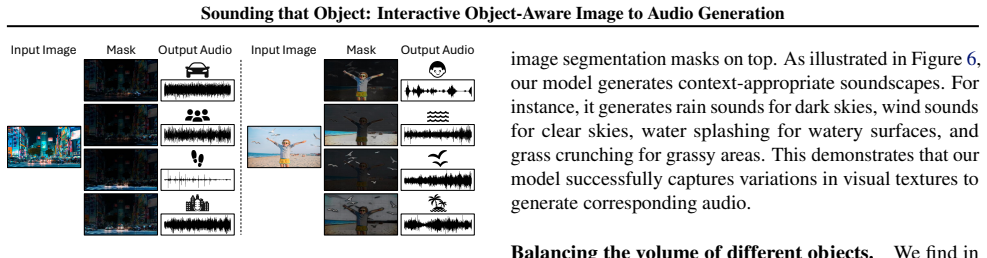
The paper discovers that a conditional latent diffusion model trained with scaled dot-product attention between CLAP text embeddings and CLIP image patch embeddings learns attention weights that approximate the posterior probability that each image patch generates the described sound. Because the softmax over patch attention matches the form of the InfoNCE contrastive loss, the trained attention map acts like a soft segmentation mask, and the model remains well-conditioned when those attention weights are replaced by a hard SAM segmentation mask at test time. This is the property that enables interactive, object-level audio generation from a single image without ever training on mask labels.
Load-bearing premise
The theoretical guarantee assumes that the fine-tuned attention weights stay close to the contrastive optimum of the frozen CLIP and CLAP encoders, so that the contrastive error is small, but the paper never measures that error or confirms it for its trained model.
Editorial extensions
If this is right
- A single image can drive a click-to-audio workflow in which each mouse-selected object yields its own soundtrack.
- The method outperforms text- and image-conditioned baselines on objective sound-event accuracy and human-rated relevance-to-object scores.
- The model transfers to out-of-domain scenes and datasets without retraining, as shown on VGG-Sound, ImageHear, and Places-derived images.
- Stronger segmentation modules yield better audio, consistent with the error bound that treats mask error as a driver of generation error.
- Because the diffusion model still sees the whole image, multi-object selections blend into a single coherent soundscape.
Reading between the lines
- The same attention-as-mask principle may extend to other generation tasks where a contrastively pretrained text-image encoder can localize a region of interest, such as object-conditioned image editing or region-conditioned video generation.
- The empirical equality of attention and mask performance holds even though the assumed small contrastive loss is never directly measured, so the substitution's practical viability does not depend on the theoretical guarantee being airtight.
- Because the model learns soft, sound-relevant attention rather than hard full-object masks, its masks are naturally concentrated on sound-emitting parts such as a dog's head, a property that could be exploited to improve grounding in future models.
- The interaction paradigm could be extended by using negative masks to suppress unwanted sounds, yielding a mask-based audio editing interface not described in the paper.
Editorial analysis
A structured set of objections, weighed in public.
Referee Report
Summary. The paper proposes an interactive object-aware audio generation system. A latent diffusion model is fine-tuned so that text-image dot-product attention (with CLIP image features, CLAP text features, and learnable projections) grounds generation in relevant image regions. At test time, the attention weights are replaced by SAM segmentation masks, so that a user can click on an object and obtain audio matching that object. The manuscript claims a theoretical validation (Theorem 3.1) that attention functionally approximates segmentation masks, and presents quantitative comparisons, ablations, cross-dataset evaluations, and human studies on AudioCaps, VGG-Sound, and ImageHear.
Significance. If the empirical claims hold, this is a practically useful and well-evaluated contribution: the idea of substituting segmentation masks for attention at test time is simple, and the ablations (especially mask-at-training vs mask-at-inference) are informative. The paper ships broad comparisons, a human study with controls, and a self-contained proof in the appendix. However, the headline theoretical validation is not established: Theorem 3.1 is a perturbation bound whose right-hand side contains error terms that are neither measured nor minimized by the training objective, and the paper's own empirical observations in Section 4.3 suggest those terms may not be small. The practical substitution is supported by the empirical ablation, not by the theorem as stated.
major comments (3)
- [Section 3.3, Eq. (6), Theorem 3.1] The theorem only bounds test error in terms of unmeasured quantities, in particular epsilon_contrast = E_q D_KL(p_q || u_q) and epsilon_sam = E_q ||m_q - p_q||_1. The model is trained with the denoising objective L_theta (Eq. 1); nothing in that objective minimizes epsilon_contrast, and the attention weights u_q rely on fine-tuned projections W^Q, W^K, W^V rather than the frozen CLIP/CLAP embeddings. CLIP/CLAP pretraining optimizes global image-text matching, not patch-level sound-source posteriors p_q = P(t_q | i_{q,k}), so the assertion that 'massive training' has minimized these errors is unsupported. To make the claimed validation load-bearing, the authors should measure these quantities on a held-out set (e.g., with human-annotated sound-source masks as a proxy for p_q) or explicitly reframe the theorem as a conditional guarantee that does not by itself justify the substitution.
- [Section 4.3, Section 4.4] The paper's own analysis contradicts the smallness of epsilon_sam. Section 4.3 states that 'masking entire object regions imposes an overly rigid prior, as sound is typically emitted from specific parts (e.g., a dog's head rather than its tail)' and that soft attention 'directly approximates the ground-truth distribution,' while Section 4.4 describes SAM masks as 'hard attention' covering entire objects. If the ground-truth mask p_q is a sound-source posterior, then a whole-object SAM mask is not close to p_q for many objects, so the theorem's epsilon_sam term need not be small. This tension should be resolved either by redefining p_q as an object-level mask (which would make the 'sound-relevant subregion' observation moot) or by quantifying attention-mask disagreement and its effect on the bound.
- [Section 3.3, Eq. (5)] The claimed equivalence between InfoNCE and the MLE loss of softmax attention weights is not established. The InfoNCE loss in Eq. (5) is defined over global text-image pairs, whereas the attention weights are computed over image patches; the manuscript does not specify the 'proper scaling' that makes the two losses coincide, and the substitution of patches for independent samples changes the optimization target. In addition, the encoder placement in Eq. (5) appears to be swapped: it writes <E_v(x_T), E_t(x_I_1)>, which evaluates the image encoder on text and the text encoder on an image. This makes the theoretical motivation in Section 3.3 difficult to follow and should be corrected or the equivalence should be stated as a loose analogy rather than an exact reduction.
minor comments (6)
- [Section 4.2, Table 1] The text says the method 'outperforms across metrics,' but Table 1 shows that SSV2A has slightly better FAD (1.265 vs 1.271) and AVC (0.893 vs 0.891). While the differences are small and ACC and REO are clearly better, the blanket claim should be qualified.
- [Section 3.3, Eq. (5)] As noted in the major comments, the roles of E_t and E_v in Eq. (5) appear reversed relative to the definitions of text and image encoders; please fix the notation.
- [Table 3] The header 'Muiti-Head Attn.' has a typo; it should read 'Multi-Head Attn.'.
- [Section 3.3, Theorem 3.1] The Lipschitz assumptions on f, f*, and v are not stated with respect to which arguments; for example, v takes three arguments (s, i, m), and the bound uses changes in both the first and third arguments. Please specify the relevant norms and which variables are held fixed.
- [Appendix C] The human evaluation description says each participant spent at least 90 seconds on each sample; with 100 samples and 50 participants this would require a very large total annotation time. Clarify whether 'each sample' means each HIT or whether the 90-second threshold applies to the entire batch.
- [Section 4.3] The phrase 'hard masks sampled from the ground-truth distribution exhibit high variance' is unclear because SAM masks are deterministic outputs, not samples from a distribution; please clarify the intended probabilistic statement.
Circularity Check
No significant circularity: Theorem 3.1 is a conditional error bound; the unverified smallness of its error terms is a validity concern, not a circular reduction.
full rationale
The paper's central theoretical claim, Theorem 3.1, is a valid error decomposition rather than a circular construction. The test-time gap between the optimal model using the ground-truth mask p_q and the deployed model using the SAM mask m_q is bounded through triangle inequalities and Lemma F.1 by error terms ϵV, ϵsam, ϵcontrast, and ϵf. Lemma F.1 itself is Pinsker's inequality applied to the definitional identity ϵcontrast = E_q[D_KL(p_q || u_q)], which follows from the definitions of ϵcontrast and u_q; this is a conditional statement, not the paper's conclusion. The paper's assertion that these error terms 'have been minimized by massive training' is unsupported because CLIP/CLAP training optimizes global image-text matching rather than patch-level sound-source posteriors, and Section 4.3 concedes that SAM masks highlight entire objects while attention focuses on sound-relevant subregions, so ϵsam is not guaranteed small. This is a validity gap in the claimed guarantee, not a circular reduction by construction. The empirical core of the paper—the ablation comparing attention to masks, the quantitative gains over SSV2A, and the human REO evaluation—is measured independently of the theorem. Self-citations are peripheral and not load-bearing for the main derivation. Therefore no prediction or first-principles result reduces to its input by definition or by self-citation.
Assumptions & free parameters
free parameters (2)
- CFG guidance scale λ =
2.0
- Audio-visual matching threshold =
0.6
assumptions (4)
- ad hoc to paper InfoNCE loss for CLAP/CLIP, after substituting image patches for samples, equals the MLE loss of the softmax attention weights under proper scaling.
- ad hoc to paper The fine-tuned attention module inherits the contrastive optimality of the frozen CLIP/CLAP encoders, so ϵ_contrast is small at test time.
- domain assumption A ground-truth patch-level mask p_q = P(t_q|i_q,k) exists and SAM masks approximate it with small ℓ1 error.
- standard math The composed network f and the value function v satisfy the stated Lipschitz conditions with finite constants.
Cite this review
Pith. "Pith review of Sounding that Object: Interactive Object-Aware Image to Audio Generation." pith.science (2026). https://pith.science/paper/LXOY7CXC
@misc{pith2026250604214,
  author       = {Pith},
  title        = {Pith review of: Sounding that Object: Interactive Object-Aware Image to Audio Generation},
  year         = {2026},
  howpublished = {\url{https://pith.science/paper/LXOY7CXC}},
  note         = {Machine review of arXiv:2506.04214}
}
read the original abstract
Generating accurate sounds for complex audio-visual scenes is challenging, especially in the presence of multiple objects and sound sources. In this paper, we propose an {\em interactive object-aware audio generation} model that grounds sound generation in user-selected visual objects within images. Our method integrates object-centric learning into a conditional latent diffusion model, which learns to associate image regions with their corresponding sounds through multi-modal attention. At test time, our model employs image segmentation to allow users to interactively generate sounds at the {\em object} level. We theoretically validate that our attention mechanism functionally approximates test-time segmentation masks, ensuring the generated audio aligns with selected objects. Quantitative and qualitative evaluations show that our model outperforms baselines, achieving better alignment between objects and their associated sounds. Project page: https://tinglok.netlify.app/files/avobject/
Figures


Figures from the paper (8 more)



Reference graph
Works this paper leans on
-
[1]
Afouras, T., Owens, A., Chung, J. S., and Zisserman, A. Self-supervised learning of audio-visual objects from video. InComputer Vision–ECCV 2020: 16th European Conference, Glasgow, UK, August 23–28, 2020, Proceed- ings, Part XVIII 16, pp. 208–224. Springer,
work page 2020
-
[5]
We empirically find that the model achieves optimal performance at a threshold of 0.6. Effect of positional encoding.We assess the impact of positional encoding (PE) on our model’s performance. As shown in Table 6, removing positional encoding leads to a significant degradation across all metrics, highlighting its importance in the model’s overall perform...
work page 2024
-
[7]
L., Wu, H.-H., Salamon, J., and Bello, J
Cramer, A. L., Wu, H.-H., Salamon, J., and Bello, J. P. Look, listen, and learn more: Design choices for deep audio embeddings. InICASSP 2019-2019 IEEE International Conference on Acoustics, Speech and Signal Processing (ICASSP), pp. 3852–3856. IEEE,
2019
-
[8]
10 Sounding that Object: Interactive Object-Aware Image to Audio Generation Devlin, J. Bert: Pre-training of deep bidirectional trans- formers for language understanding.arXiv preprint arXiv:1810.04805,
-
[9]
Dong, H.-W., Takahashi, N., Mitsufuji, Y ., McAuley, J., and Berg-Kirkpatrick, T. Clipsep: Learning text-queried sound separation with noisy unlabeled videos.arXiv preprint arXiv:2212.07065,
-
[11]
Each participant was presented with an input image and the corresponding generated audio, then rated each sample on a scale from 1 to 5 based on the following criteria: (i) Overall Quality (OVL), assess- ing the general audio quality; (ii) Relevance to Input Text (RET), measuring the alignment of the audio with the asso- ciated text description; (iii) Rel...
work page 2012
-
[12]
Gan, C., Huang, D., Chen, P., Tenenbaum, J. B., and Tor- ralba, A. Foley music: Learning to generate music from videos. InComputer Vision–ECCV 2020: 16th European Conference, Glasgow, UK, August 23–28, 2020, Proceed- ings, Part XI 16, pp. 758–775. Springer,
work page 2020
-
[13]
Gotta hear them all: Sound source aware vision to audio generation.arXiv preprint arXiv:2411.15447,
Guo, W., Wang, H., Ma, J., and Cai, W. Gotta hear them all: Sound source aware vision to audio generation.arXiv preprint arXiv:2411.15447,
Show all 41 references
-
[14]
and Salimans, T
Ho, J. and Salimans, T. Classifier-free diffusion guidance. arXiv preprint arXiv:2207.12598,
-
[16]
D., Kim, B., Lee, H., and Kim, G
Kim, C. D., Kim, B., Lee, H., and Kim, G. Audiocaps: Gen- erating captions for audios in the wild. InProceedings of the 2019 Conference of the North American Chapter of the Association for Computational Linguistics: Hu- man Language Technologies, Volume 1 (Long and Short Paper...
2019
-
[19]
Hifi-gan: Generative ad- versarial networks for efficient and high fidelity speech synthesis.Advances in Neural Information Processing Systems, 33:17022–17033, 2020a
Kong, J., Kim, J., and Bae, J. Hifi-gan: Generative ad- versarial networks for efficient and high fidelity speech synthesis.Advances in Neural Information Processing Systems, 33:17022–17033, 2020a. Kong, Q., Xu, Y ., Iqbal, T., Cao, Y ., Wang, W., and Plumb- ley, M. D. Acousti...
2019
-
[20]
H., Kim, S., Yoo, I., Yang, F., Cho, D., Kim, Y ., Chang, H., Kim, J., and Kim, S
Lee, S. H., Kim, S., Yoo, I., Yang, F., Cho, D., Kim, Y ., Chang, H., Kim, J., and Kim, S. Soundini: Sound- guided diffusion for natural video editing.arXiv preprint arXiv:2304.06818,
-
[21]
and Hutter, F
Loshchilov, I. and Hutter, F. Decoupled weight decay regu- larization.arXiv preprint arXiv:1711.05101,
-
[23]
Oord, A. v. d., Li, Y ., and Vinyals, O. Representation learn- ing with contrastive predictive coding.arXiv preprint arXiv:1807.03748,
-
[24]
A., Zhang, R., and Zhu, J.-Y
Park, T., Efros, A. A., Zhang, R., and Zhu, J.-Y . Con- trastive learning for unpaired image-to-image translation. InComputer Vision–ECCV 2020: 16th European Con- ference, Glasgow, UK, August 23–28, 2020, Proceedings, Part IX 16, pp. 319–345. Springer,
2020
-
[25]
Sam 2: Segment anything in images and videos.arXiv preprint arXiv:2408.00714,
Ravi, N., Gabeur, V ., Hu, Y .-T., Hu, R., Ryali, C., Ma, T., Khedr, H., Rädle, R., Rolland, C., Gustafson, L., et al. Sam 2: Segment anything in images and videos.arXiv preprint arXiv:2408.00714,
-
[26]
Self-supervised audio-visual co- segmentation
Rouditchenko, A., Zhao, H., Gan, C., McDermott, J., and Torralba, A. Self-supervised audio-visual co- segmentation. InICASSP 2019-2019 IEEE International Conference on Acoustics, Speech and Signal Processing (ICASSP), pp. 2357–2361. IEEE,
2019
-
[27]
and Adi, Y
Sheffer, R. and Adi, Y . I hear your true colors: Image guided audio generation. InICASSP 2023-2023 IEEE In- ternational Conference on Acoustics, Speech and Signal Processing (ICASSP), pp. 1–5. IEEE,
2023
-
[28]
Denoising diffusion implicit models.arXiv preprint arXiv:2010.02502,
Song, J., Meng, C., and Ermon, S. Denoising diffusion implicit models.arXiv preprint arXiv:2010.02502,
2010 arXiv
-
[29]
Llama 2: Open foundation and fine- tuned chat models.arXiv preprint arXiv:2307.09288,
Touvron, H., Martin, L., Stone, K., Albert, P., Almahairi, A., Babaei, Y ., Bashlykov, N., Batra, S., Bhargava, P., Bhosale, S., et al. Llama 2: Open foundation and fine- tuned chat models.arXiv preprint arXiv:2307.09288,
-
[30]
Analyzing multi-head self-attention: Specialized heads do the heavy lifting, the rest can be pruned.arXiv preprint arXiv:1905.09418,
V oita, E., Talbot, D., Moiseev, F., Sennrich, R., and Titov, I. Analyzing multi-head self-attention: Specialized heads do the heavy lifting, the rest can be pruned.arXiv preprint arXiv:1905.09418,
1905 arXiv
-
[31]
P., and Salamon, J
Wu, H.-H., Nieto, O., Bello, J. P., and Salamon, J. Audio- text models do not yet leverage natural language. In ICASSP 2023-2023 IEEE International Conference on Acoustics, Speech and Signal Processing (ICASSP), pp. 1–5. IEEE,
2023
-
[32]
Auffusion: Leveraging the power of diffusion and large language models for text- to-audio generation.arXiv preprint arXiv:2401.01044,
Xue, J., Deng, Y ., Gao, Y ., and Li, Y . Auffusion: Leveraging the power of diffusion and large language models for text- to-audio generation.arXiv preprint arXiv:2401.01044,
-
[33]
D., et al
Yuan, Y ., Jia, D., Zhuang, X., Chen, Y ., Liu, Z., Chen, Z., Wang, Y ., Wang, Y ., Liu, X., Plumbley, M. D., et al. Improving audio generation with visual enhanced caption. arXiv preprint arXiv:2407.04416,
-
[34]
Foleycrafter: Bring silent videos to life with lifelike and synchronized sounds.arXiv preprint arXiv:2407.01494,
Zhang, Y ., Gu, Y ., Zeng, Y ., Xing, Z., Wang, Y ., Wu, Z., and Chen, K. Foleycrafter: Bring silent videos to life with lifelike and synchronized sounds.arXiv preprint arXiv:2407.01494,
-
[35]
Results Video We provide a results video on the project webpage, which showcases our model’s ability to generate sounds based on the masked object prompts
15 Sounding that Object: Interactive Object-Aware Image to Audio Generation A. Results Video We provide a results video on the project webpage, which showcases our model’s ability to generate sounds based on the masked object prompts. Specifically, this video demon- strates th...
2017
-
[36]
The original dataset comprises 4,616 hours of video clips, each paired with corresponding labels and captions
as the primary source for this task. The original dataset comprises 4,616 hours of video clips, each paired with corresponding labels and captions. Inspired by Sound-VECaps (Yuan et al., 2024), we apply the following refinement steps to adapt the dataset for our use. Audio-vis...
2024
-
[37]
Speech" and “Music
annotations. We uniformly sample 48 hours across these categories for the test set, with the remaining used for training. Notably, there is no overlap between training and testing videos. As most clips contain multiple sound sources, we randomly select 100 examples from the te...
2017
-
[40]
By extracting features from both modalities and computing cosine similarity, we show in Table 9 that our method consistently outperforms baselines on this metric
to measure audio-visual matching on static images. By extracting features from both modalities and computing cosine similarity, we show in Table 9 that our method consistently outperforms baselines on this metric. E. Additional Dataset Evaluations VGG-Sound dataset.To further ...
2020
-
[41]
video clips with better audio-visual synchronization, for test- ing
0.39 Ours0.45 Table 9: Comparison of ImageBind (IB) scores across dif- ferent methods. video clips with better audio-visual synchronization, for test- ing. To obtain captions aligned with this dataset, we apply the same refinement procedure described in Appendix B.1. We assess...
2023
-
[1994]
P., Matthey, L., Watters, N., Kabra, R., Higgins, I., Botvinick, M., and Lerchner, A
Burgess, C. P., Matthey, L., Watters, N., Kabra, R., Higgins, I., Botvinick, M., and Lerchner, A. Monet: Unsupervised scene decomposition and representation.arXiv preprint arXiv:1901.11390,
1901 arXiv
-
[2015]
Kingma, D. P. and Welling, M. Auto-encoding variational bayes.arXiv preprint arXiv:1312.6114,
-
[2016]
D., Carr, C., Zukowski, Z., Taylor, J., and Pons, J
Evans, Z., Parker, J. D., Carr, C., Zukowski, Z., Taylor, J., and Pons, J. Stable audio open. InICASSP 2025-2025 IEEE International Conference on Acoustics, Speech and Signal Processing (ICASSP), pp. 1–5. IEEE,
2025
-
[2017]
Diff-foley: Syn- chronized video-to-audio synthesis with latent diffusion models.arXiv preprint arXiv:2306.17203,
Luo, S., Yan, C., Hu, C., and Zhao, H. Diff-foley: Syn- chronized video-to-audio synthesis with latent diffusion models.arXiv preprint arXiv:2306.17203,
-
[2018]
Neural machine translation by jointly learning to align and translate.arXiv preprint arXiv:1409.0473,
Bahdanau, D. Neural machine translation by jointly learning to align and translate.arXiv preprint arXiv:1409.0473,
-
[2019]
Visual acoustic matching
Chen, C., Gao, R., Calamia, P., and Grauman, K. Visual acoustic matching. InProceedings of the IEEE/CVF Conference on Computer Vision and Pattern Recognition, pp. 18858–18868, 2022a. Chen, H., Xie, W., Vedaldi, A., and Zisserman, A. Vg- gsound: A large-scale audio-visual datas...
2020
-
[2020]
Audio-visual synchronisation in the wild.arXiv preprint arXiv:2112.04432, 2021a
Chen, H., Xie, W., Afouras, T., Nagrani, A., Vedaldi, A., and Zisserman, A. Audio-visual synchronisation in the wild.arXiv preprint arXiv:2112.04432, 2021a. Chen, H., Xie, W., Afouras, T., Nagrani, A., Vedaldi, A., and Zisserman, A. Localizing visual sounds the hard way. InPro...
-
[2021]
Synch- former: Efficient synchronization from sparse cues
Iashin, V ., Xie, W., Rahtu, E., and Zisserman, A. Synch- former: Efficient synchronization from sparse cues. In ICASSP 2024-2024 IEEE International Conference on Acoustics, Speech and Signal Processing (ICASSP), pp. 5325–5329. IEEE,
2024
-
[2022]
On uni-modal feature learning in supervised multi-modal learning
Du, C., Teng, J., Li, T., Liu, Y ., Yuan, T., Wang, Y ., Yuan, Y ., and Zhao, H. On uni-modal feature learning in supervised multi-modal learning. InInternational Conference on Machine Learning, pp. 8632–8656. PMLR, 2023a. Du, Y ., Chen, Z., Salamon, J., Russell, B., and Owens...
2023
-
[2023]
S., Wiles, O., Moses, Y ., and Zisserman, A
Koepke, A. S., Wiles, O., Moses, Y ., and Zisserman, A. Sight to sound: An end-to-end approach for visual piano transcription. InICASSP 2020-2020 IEEE International Conference on Acoustics, Speech and Signal Processing (ICASSP), pp. 1838–1842. IEEE,
2020
-
[2024]
K., Ishii, M., Hayakawa, A., Shibuya, T., Schwing, A., and Mitsufuji, Y
Cheng, H. K., Ishii, M., Hayakawa, A., Shibuya, T., Schwing, A., and Mitsufuji, Y . Taming multimodal joint training for high-quality video-to-audio synthesis.arXiv preprint arXiv:2412.15322, 2024a. Cheng, X., Zheng, S., Wang, Z., Fang, M., Zhang, Z., Huang, R., Ma, Z., Ji, S....
Reviewed August 7, 2026 · model on record in the stance chip above.
Discussion (0). Sign in to comment.