REVIEW 5 major objections 6 minor 11 references
The GAIN Model: A Nature-Inspired Neural Network Framework Based on an Adaptation of the Izhikevich Model
T0 review · 5 major / 6 minor · reviewed 2026-08-07 · deepseek-v4-flash
Pith's one-line read The GAIN model claims that a grid-based Izhikevich variant with input-dependent recovery variables can reproduce a biologically plausible action potential, including repolarization and refractory dynamics, while staying computationally…
desk verdict A sincerely written but mathematically broken manuscript: the core GAIN equations are miswritten, so the model is not well-defined and cannot be evaluated or reproduced. read the letter →
The pith
A machine-rendered reading of the paper's core claim, the machinery that carries it, and where it could break.
The reading
What carries the argument
The central object is the GAIN model (Grid-based Adaptable Izhikevich Network): a regular grid of neurons in which each neuron connects only to its nearest neighbors. Its dynamics are the Izhikevich equations with two swapped-out pieces: the decay parameter becomes $a(I)=a_0+\sigma I$ and the sensitivity parameter becomes $b(V)=b_0+\gamma V$, and the input current becomes $I'=(\sum W_{\mathrm{syn}}\times \Delta V)+I$, summing neighbor influences. Synaptic weights are $W_{\mathrm{syn}}=(W_0+\Delta W)u(t)R(t)$, with $\Delta W$ from STDP and $u(t),R(t)$ from short-term plasticity. These modifications are what produce the claimed repolarization and refractory behavior; the grid is what produces local community structure and synchronization.
What would settle it
A systematic comparison of spike width, repolarization dip depth, and refractory duration of the GAIN model against Hodgkin-Huxley or recorded traces across many input currents; if the match only holds near the single current shown in Figure 9 and degrades outside the claimed -100 mV to 40 mV range, the central claim would be refuted.
Extended reading notes
Core claim
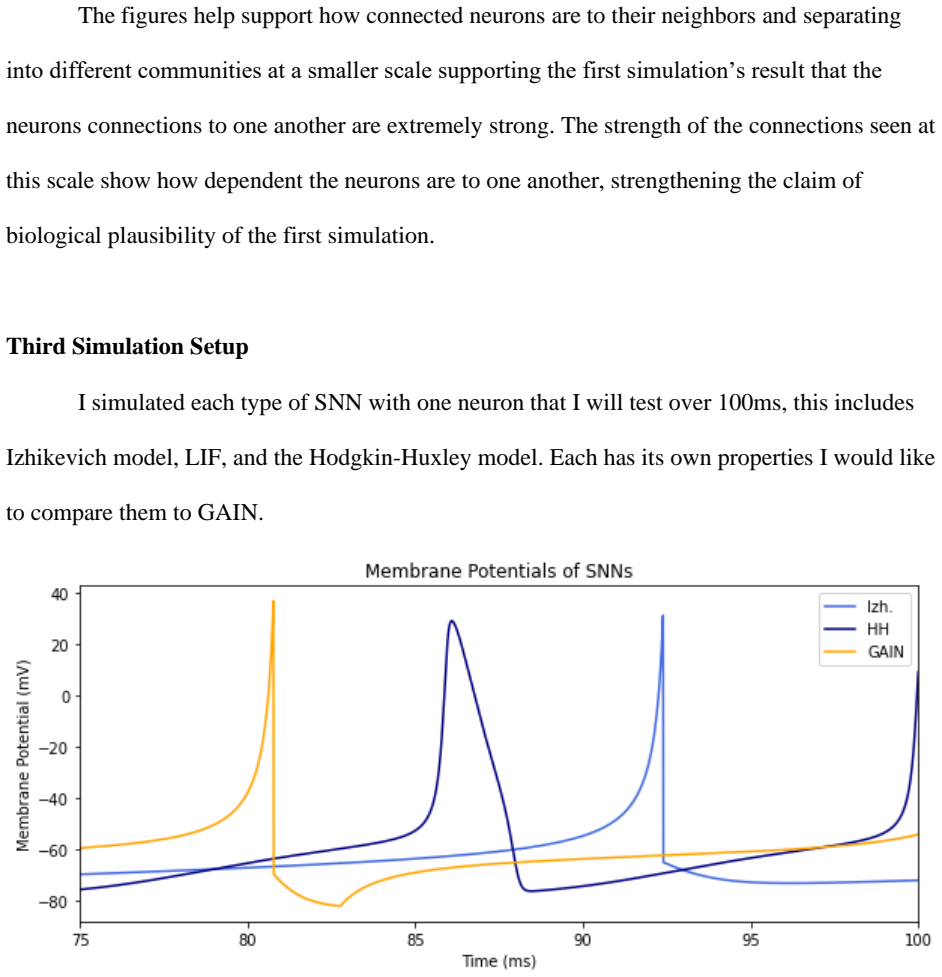
The paper argues that modifying the Izhikevich model so its recovery variable depends on input current and membrane potential, and embedding the neurons in a grid with nearest-neighbor STDP/STP coupling, produces a network whose single-neuron spikes include the depolarization, repolarization, and refractory phases of a biological action potential. It reports that the simulated membrane potentials stay within roughly -100 mV to 40 mV, that neurons synchronize over time, that synaptic weights settle into a power-law distribution, and that the spike shape more closely resembles Hodgkin-Huxley than the original Izhikevich model does, chiefly by adding a repolarization dip.
Load-bearing premise
The whole biological-plausibility claim rests on the assumption that randomly chosen parameter ranges and two simple linear formulas for the recovery variable produce realistic spikes without being calibrated to recorded neuron data, and that looking like a Hodgkin-Huxley spike in one plot is enough evidence.
Editorial extensions
If this is right
- A neuron's firing rate can adapt to sustained current because the recovery variable depends on $I$, so the network can represent changing stimuli rather than only fixed inputs.
- Nearest-neighbor coupling plus STDP yields local communities and synchronized spiking, so network geometry directly shapes learned structure.
- Synaptic weights evolving under the model settle into a power-law distribution like those seen in biological networks, supporting use as a biological simulation tool.
- The single-neuron spike includes repolarization and a refractory period, so simulations avoid unrealistically rapid re-spiking and match biological action-potential shape more closely.
- Because gradient descent reduced spiking in a small test, the model can be trained like a conventional network while retaining spiking dynamics.
Reading between the lines
- A testable consequence the paper leaves implicit is whether the linear replacements $a(I)=a_0+\sigma I$ and $b(V)=b_0+\gamma V$ are equivalent to Izhikevich's original model with a time-varying effective input; deriving that mapping would separate the grid/plasticity contribution from the parameter adaptation contribution.
- The paper does not isolate whether the power-law weight distribution and community structure arise from STDP or from the random initialization combined with local coupling; rerunning the same simulations without STDP would settle that.
- The reported 21-hour runtime for 10,000 neurons suggests the 'computationally efficient' claim will depend heavily on implementation choices; an object-oriented or compiled rewrite is an untested extension proposed in the paper.
- The model's claimed biological plausibility is based on one visual Hodgkin-Huxley comparison; a quantitative spike-shape metric across many input currents would be the natural next test.
Editorial analysis
A structured set of objections, weighed in public.
Referee Report
Summary. The paper introduces GAIN, a grid-based spiking neural network that adapts the Izhikevich neuron model by making the recovery-variable parameters a and b depend on input current and membrane potential, and by adding spike-timing-dependent plasticity, short-term plasticity, and a noise/refractory-period mechanism. The author claims the model improves biological plausibility, especially by producing a visible repolarization period, while retaining computational efficiency. Simulations of single neurons and small grids are presented as evidence, along with visual comparisons to Hodgkin-Huxley, Izhikevich, and LIF traces. The paper also reports qualitative observations of synchronization, community structure in synaptic weights, and a power-law weight distribution.
Significance. If the claims were substantiated, a computationally efficient spiking neuron model with improved adaptation and a grid-based topology could be a useful contribution to large-scale neural simulation. The paper has a plausible motivation: Izhikevich neurons are indeed efficient and widely used, and grid-based local connectivity is a natural way to approximate biological spatial structure. However, the current manuscript does not provide the evidence needed to establish either the correctness of the model equations or the biological plausibility of the dynamics. The central claims rest on visual inspection of single simulations, a mis-specified differential equation, and an unverified power-law assertion. The paper also lacks reproducibility details such as a complete reset rule and a specification of the numerical integration scheme. For these reasons, the contribution, as presented, is not yet suitable for publication in a peer-reviewed journal.
major comments (5)
- [Appendix B, Eqs. (3) and (3.1)] The defining equations of the GAIN model are internally inconsistent. Eq. (3) writes V' = 0.04V^2 + 5V + 140 - u' + I', but the Izhikevich model has V' = 0.04V^2 + 5V + 140 - u + I. If the prime denotes a time derivative, then substituting u' = a(I)(b(V) - u) into Eq. (3) changes the feedback term from -u to +a(I)u, which alters the sign and magnitude of the recovery-variable feedback. If the prime on u in (3) was intended only as a notation for the recovery variable, then the same symbol is used for both a variable and its derivative, making the system not well-defined. Either way, the equations as written do not implement the Izhikevich feedback structure claimed in the paper.
- [Appendix B and Simulations] The reset rule for the GAIN model is never specified. The Izhikevich model requires a reset of the form 'if V >= 30 mV then V <- c and u <- u + d' to prevent unbounded growth. The paper mentions a refractory period but does not give the corresponding algorithm or equation. Without this rule, the reported spiking behavior in Figures 1, 6, and 9 cannot be reproduced from the manuscript, and the claimed equivalence to the Izhikevich framework is incomplete.
- [Results, 'Synaptic Weight Adaptation' and Figure 8] The claim that the final synaptic weight distribution 'followed a power-law distribution' is not supported by any quantitative analysis. No fit, goodness-of-fit statistic, or comparison to alternative distributions is provided. Since the power-law claim is used as a central piece of evidence for biological plausibility, this assertion is load-bearing and currently unverified.
- [Simulations and 'Training'] All dynamical claims are based on visual inspection of single simulation runs. There are no error bars, no multiple trials, and no statistical tests. For example, the synchronization claim in Figure 5 and the 'warping' interpretation in Figure 6 are subjective. The paper also validates the model by checking for a refractory period and repolarization, which were explicitly implemented in the model, so the appearance of these features is not independent evidence of biological plausibility.
- [Appendix B, Eqs. (2) and (2.1)] The linear modifications a(I) = a0 + sigma*I and b(V) = b0 + gamma*V are introduced without justification or calibration to neural data. The parameter ranges in Appendix E are described as 'biologically realistic' but no source is cited. Since these modifications are central to the claimed improvement in dynamics, the paper should either provide a derivation or an empirical fit, or at minimum show that the chosen ranges do not lead to qualitatively different behavior across the range.
minor comments (6)
- [Abstract and Introduction] The abstract repeats itself and contains informal phrasing such as 'can aid in the development of neural networks, large scale simulations, and the development in the neuroscience field.' The paper would benefit from proofreading throughout.
- [Figure 1 caption] The caption for Figure 1 says 'Singular spike over the intervals 20ms and 60ms' but the text around it says 'a single spike' and the intent is unclear; the figure should be labeled with clear axes and units.
- [Appendix A, Eqs. (1) and (1.1)] The presentation of the Izhikevich model is incorrect as written. Eq. (1) uses -u' + I, but the standard Izhikevich equation is V' = 0.04V^2 + 5V + 140 - u + I. This error propagates to Appendix B and should be corrected in the background description.
- [Appendix C, Eq. (1)] The STDP update in Eq. (1) uses the same symbol tau for both tau+ and tau-; the text says tau+ and tau- but the equation prints tau in both branches. This should be clarified.
- [Appendix E, Table] The table lists 'tau+-' and 'tau-' as separate rows but the second row appears to be a duplicate. Also, many parameters (eta+, eta-, k) are not defined in the main text.
- [Conclusion and Future Work] The 'Limitations' section mentions that a 10,000-neuron simulation took 21 hours, but the paper earlier claims computational efficiency. This point should be discussed in the context of the claimed efficiency, since it suggests a scalability limitation.
Circularity Check
Validation is largely circular: the model's biological plausibility is read back from features and parameter ranges deliberately inserted into the simulation.
-
fitted input called prediction
[Methodology: Implementing and Interpreting GAIN; First Simulation Setup]
"I will first train the network to behave closer to biological neurons, specifically prefrontal cortex (PFC) neurons from data and behaviors that are seen from it. Finding an average range for each variable that the neuron is dependent on can serve as a foundation for what is stable and accurate."
The parameter ranges in Appendix E are free inputs to the model. The paper states these ranges are chosen by first training to PFC neuron data and behaviors. The First Simulation then initializes neurons with those ranges, and the resulting spikes and power-law weight distributions are presented as evidence of biological plausibility. Any biological realism in the output is therefore a restatement of the fitted input ranges, not an independent prediction. No held-out neural data or external quantitative comparison is used to break the loop.
-
self definitional
[Methodology: Interpreting the model's biological plausibility; Third Simulation Setup (Figure 9)]
"The graph shows that the GAIN model has a major improvement in its behavior including a repolarization period. As it has been mentioned, it was implemented along with a refractory period it compares it to a biological neuron."
The paper's own evaluation metric defines biological plausibility as containing depolarization, repolarization, and a refractory period. But the refractory period is an explicit external insertion: 'While developing the model I am including a noise function and refractory period not included within the model itself but helps the biological plausibility of the simulation.' The Figure 9 improvement is then attributed to that inserted refractory period. The central evidence for biological realism is a feature that was put in by hand and read back out as a result, rather than an emergent property of the model.
full rationale
The GAIN paper is not circular through self-citation: all cited prior work (Izhikevich, Hodgkin-Huxley, Benda and Herz, Bi and Poo, etc.) is external and is used as background rather than as a load-bearing justification for the GAIN equations. The circularity instead lies in the validation procedure. The author defines biological plausibility by a checklist of features, then adds a refractory period and noise outside the model, chooses parameter ranges by an informal 'training' to PFC-like behavior, and finally presents the presence of those same features and ranges as evidence that the model is biologically plausible. The claim that the GAIN model has a 'major improvement in its behavior including a repolarization period' is especially telling because the improvement is explicitly attributed to the externally implemented refractory period. The network-level results (synchronization, community formation, power-law weights) are more emergent and provide partial independent content, which keeps the score from being higher. The Appendix A/B equation inconsistency V' = ... - u' + I with u' = a(bV - u) is a serious correctness concern and prevents the model from being well-defined as written, but it is an internal mathematical error rather than a circularity, so it is noted here rather than scored as a circular step.
Assumptions & free parameters
free parameters (4)
- sigma =
0 to 0.1 (random)
- gamma =
0 to 0.1 (random)
- initial synaptic weights W0 =
-0.01 to 0.5 (random)
- decay variable a0 and sensitivity b0 =
a0: 0.02 to 0.1, b0: 0.2 to 0.5
assumptions (4)
- standard math Euler integration of the ODEs is stable and accurate for the chosen time step 0.01ms.
- domain assumption Neurons in a 2D grid with nearest-neighbor connections approximate biological network topology.
- ad hoc to paper The linear functional forms a(I)=a0+sigma*I and b(V)=b0+gamma*V capture spike-frequency adaptation without further justification.
- ad hoc to paper Visual similarity of simulated spikes to Hodgkin-Huxley spikes (Figure 9) is evidence of biological plausibility.
Cite this review
Pith. "Pith review of The GAIN Model: A Nature-Inspired Neural Network Framework Based on an Adaptation of the Izhikevich Model." pith.science (2026). https://pith.science/paper/NYZHWZY4
@misc{pith2026250604247,
  author       = {Pith},
  title        = {Pith review of: The GAIN Model: A Nature-Inspired Neural Network Framework Based on an Adaptation of the Izhikevich Model},
  year         = {2026},
  howpublished = {\url{https://pith.science/paper/NYZHWZY4}},
  note         = {Machine review of arXiv:2506.04247}
}
read the original abstract
While many neural networks focus on layers to process information, the GAIN model uses a grid-based structure to improve biological plausibility and the dynamics of the model. The grid structure helps neurons to interact with their closest neighbors and improve their connections with one another, which is seen in biological neurons. While also being implemented with the Izhikevich model this approach allows for a computationally efficient and biologically accurate simulation that can aid in the development of neural networks, large scale simulations, and the development in the neuroscience field. This adaptation of the Izhikevich model can improve the dynamics and accuracy of the model, allowing for its uses to be specialized but efficient.
Figures


Figures from the paper (3 more)


Reference graph
Works this paper leans on
-
[1]
Benda, J., & Herz, A. V. M. (2003). A universal model for Spike-Frequency adaptation. Neural Computation, 15(11), 2523–2564. https://doi.org/10.1162/089976603322385063
-
[2]
Bi, G., & Poo, M. (2001). Synaptic Modification by correlated Activity: HEBB’s postulate revisited. Annual Review of Neuroscience, 24(1), 139–166. https://doi.org/10.1146/annurev.neuro.24.1.139
-
[3]
Borg-Graham, L. J. (1999). Biophysics of Computation: Information Processing in Single Neurons, by Christof Koch. Trends in Neurosciences, 22(7), 328–329. https://doi.org/10.1016/s0166-2236(99)01403-4
-
[4]
Courant, R. (1943). Variational methods for the solution of problems of equilibrium and vibrations. Bulletin of the American Mathematical Society, 49(1), 1–23. https://doi.org/10.1090/s0002-9904-1943-07818-4
-
[5]
Galuske, R. A. W., Munk, M. H. J., & Singer, W. (2019). Relation between gamma oscillations and neuronal plasticity in the visual cortex. Proceedings of the National Academy of Sciences, 116(46), 23317–23325. https://doi.org/10.1073/pnas.1901277116
-
[6]
Hebb, D. O. (1949). The Organization of Behavior. https://doi.org/10.1002/sce.37303405110
-
[7]
Hodgkin, A. L., & Huxley, A. F. (1952). A quantitative description of membrane current and its application to conduction and excitation in nerve. The Journal of Physiology, 117(4), 500–544. https://doi.org/10.1113/jphysiol.1952.sp004764
-
[8]
Izhikevich, E. M. (2003). Simple model of spiking neurons. IEEE Transactions on Neural Networks, 14(6), 1569–1572. https://doi.org/10.1109/tnn.2003.820440
arXiv 2003
Show all 11 references
-
[9]
Marder, E., & Thirumalai, V. (2002). Cellular, synaptic and network effects of neuromodulation. Neural Networks, 15(4–6), 479–493. https://doi.org/10.1016/s0893-6080(02)00043-6 22
2002 doi
- [10]
-
[11]
a” and "b
Zenke, F., Agnes, E. J., & Gerstner, W. (2015). Diverse synaptic plasticity mechanisms orchestrated to form and retrieve memories in spiking neural networks. Nature Communications, 6(1). https://doi.org/10.1038/ncomms7922 23 Appendix A Structure and Function of the Izhikevich ...
2015 doi
Reviewed August 7, 2026 · model on record in the stance chip above.
Discussion (0). Sign in to comment.