REVIEW 4 major objections 6 minor 51 references
SSIMBaD: Sigma Scaling with SSIM-Guided Balanced Diffusion for AnimeFace Colorization
T0 review · 4 major / 6 minor · reviewed 2026-08-07 · deepseek-v4-flash
Pith's one-line read The paper claims that replacing the usual diffusion noise schedule with a squash function that makes visual structure degrade at a constant rate yields better anime-face colorization than prior reference-based methods.
desk verdict SSIMBaD is a useful empirical schedule tweak for anime colorization, but the causal link between SSIM linearity and the reported gains is not actually established. read the letter →
The pith
A machine-rendered reading of the paper's core claim, the machinery that carries it, and where it could break.
The reading
What carries the argument
The load-bearing object is the $\sigma$-space scaling function $\phi^*(\sigma)=\sigma/(\sigma+0.3)$, a bounded, monotone squash map that turns noise level $\sigma$ into a perceptual difficulty coordinate. Noise levels are sampled uniformly in $\phi^*$-space and mapped back through $(\phi^*)^{-1}$ to produce the schedule; the same value replaces the log-$\sigma$ embedding $c_{noise}$; and the same schedule defines both the training noise distribution and the Euler/Heun integration steps. The function's job is to equalize the SSIM drop per step, so no part of the trajectory is wasted on nearly-clean or nearly-pure-noise regions. The trajectory-refinement objective then trains the entire reverse path end-to-end against the ground truth.
What would settle it
Train SSIMBaD with a schedule that scores nearly as high on the same R2 criterion—for example $\sigma/(\sigma+0.5)$ or $\sigma/(\sigma+0.7)$, which the paper reports with $R^2$ 0.9275 and 0.8710—and compare PSNR, MS-SSIM, and FID on the same test set; if a clearly less-linear schedule matches or beats $\sigma/(\sigma+0.3)$, the claim that near-linear SSIM degradation is the operative cause fails. Re-running the R2 selection on a different 1% sample of training images and checking whether the top-ranked transformation changes would also test the stability of the schedule choice.
Extended reading notes
Core claim
The central discovery is that a single monotone squash function $\phi^*(\sigma)=\sigma/(\sigma+0.3)$ makes SSIM degradation nearly linear in the diffusion noise coordinate, and that scheduling noise by this function unifies training and inference. The paper searches a family of fourteen analytic transformations, computes the coefficient of determination ($R^2$) between transformed noise level and SSIM of a Gaussian-corrupted image, and finds that this bounded squash function has the highest linearity ($R^2=0.9793$ in the main table; $0.9949$ reported in the appendix). Using $\phi^*$ to build the $\sigma$ schedule, replacing the usual $\log(\sigma)$ noise embedding with $\phi^*(\sigma)$, and adding an objective that optimizes the whole Euler reverse trajectory yields PSNR 18.92 (same) and 15.84 (cross), MS-SSIM 0.8512 and 0.8207, and FID 34.98 and 37.10, beating both baselines. The authors frame this as aligning forward and reverse dynamics so that every denoising step faces equal perceptual difficulty.
Load-bearing premise
The load-bearing assumption is that making the structural-similarity score fall as evenly as possible across noise levels, measured on 1% of the training images, is what actually drives the reported quality gains; the paper does not show a causal chain from this linearity to the final PSNR, MS-SSIM, and FID numbers.
Editorial extensions
If this is right
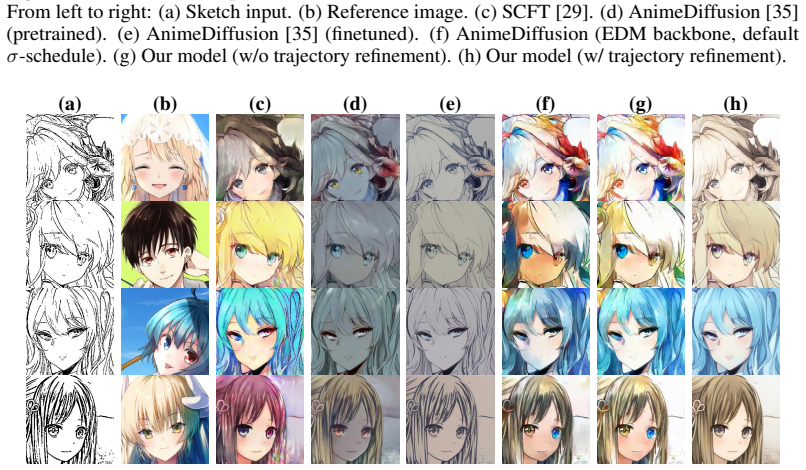
- Perceptually uniform scheduling lets a diffusion model trained for 300 epochs beat the GAN-based SCFT baseline and the pretrained and finetuned AnimeDiffusion variants on PSNR, MS-SSIM, and FID in both same- and cross-reference settings.
- Using the same $\phi^*$ transformation for training, noise embedding, and inference removes the mismatch between EDM's log-normal training distribution and its power-law inference schedule, which the paper identifies as a source of perceptual misalignment.
- Trajectory refinement improves all three reported metrics at once, whereas AnimeDiffusion's finetuning improves PSNR and MS-SSIM while worsening FID, suggesting the refinement objective acts differently from a simple finetuning step.
- An appendix result shows that adding a rotation to the TPS reference warping shrinks the same-versus-cross PSNR gap from 9.1 dB to 3.08 dB, so the cross-reference robustness of the full pipeline depends on this alignment step as well as on the schedule.
Reading between the lines
- An implication the authors leave implicit is that the same $R^2$-based schedule search could be applied to other conditional diffusion tasks where structural fidelity matters, such as super-resolution, sketch-to-image, or medical imaging; the paper's conclusion only gestures at this possibility.
- Because the $R^2$ selection was computed on a random 1% of training images, the choice of the constant 0.3 is plausibly dataset-dependent; a natural test is to rerun the schedule search on a different dataset and check whether the optimal squash constant shifts.
- The comparison between $\sigma/(\sigma+0.3)$ and the nearly-as-linear $\sigma/(\sigma+0.5)$ would isolate whether it is linearity itself, or the specific placement of intermediate noise levels, that drives the metric gains; the paper's current evidence cannot distinguish these.
- The trajectory-refinement gain may transfer to other samplers even without a new schedule, since minimizing the full Euler path can be read as correcting per-step integration error; testing SSIMBaD's refinement objective under the default EDM schedule would separate schedule effects from refinement effects.
Editorial analysis
A structured set of objections, weighed in public.
Referee Report
Summary. The paper proposes SSIMBaD, a modification of the EDM continuous-time diffusion framework for reference-guided anime sketch colorization. The core idea is to replace EDM's log-based noise schedule with a sigma-space transformation phi*(sigma) = sigma/(sigma + 0.3), selected by fitting the linearity (R^2) of SSIM degradation under Gaussian noise on 1% of training images (Section 4.1, Eq. 6). This transformation is then used for training-time sigma sampling (Eq. 7), noise embedding c_noise(phi*(sigma)), and inference scheduling (Eq. 10), and it is combined with a trajectory-refinement objective (Eq. 9). The paper reports state-of-the-art PSNR, MS-SSIM, and FID on the AnimeFace dataset under both same-reference and cross-reference settings (Table 2), with a cumulative ablation in Table 3.
Significance. If the central claim were established, the contribution would be notable: a conceptually simple, perceptually motivated noise schedule plus a reverse-trajectory refinement loss would improve structural fidelity and style transfer over strong baselines such as SCFT and AnimeDiffusion. The paper ships code and documents training hyperparameters in Appendix F, which aids reproducibility. The ablation study in Table 3 shows a clear direction of improvement, and the appendix (Appendix D) candidly reports the sensitivity of results to the TPS-rotation augmentation. However, the current evidence does not isolate whether SSIM linearity, the changed sigma distribution, the changed noise embedding, or the trajectory refinement is responsible for the reported gains; the benchmark numbers are single runs without confidence intervals; and the choice of rotation augmentation materially changes the headline metrics. The idea is worth pursuing, but the causal claim needs substantially stronger experimental support.
major comments (4)
- [4.1, Appendix B, Eq. (6)-(10)] The paper's load-bearing claim is that maximizing R^2 of SSIM-degradation linearity yields a schedule that improves final colorization quality. This causal link is not demonstrated. Switching from EDM's log-normal sigma sampling to uniform sampling in phi-space simultaneously changes (i) the training distribution over sigma, (ii) the noise embedding c_noise from log(sigma) to phi*(sigma), and (iii) the inference schedule in Eq. (10), while trajectory refinement (Eq. 9) is an additional change. The R^2 fit is computed on only 1% of training images with no confidence intervals, and no alternative transformation (e.g., log(sigma) or arcsinh(sigma)) is trained with the same pipeline to test whether the improvement is caused by SSIM linearity or merely by the new sigma distribution. Without such a control, the attribution of the Table 2/Table 3 gains to SSIM-aligned perceptual scaling is not established.
- [Table 3, Section 5.4] The cumulative ablation does not isolate the contribution of individual components. The row labeled '+ SSIM-aligned sigma-space scaling' changes both the training distribution and the noise embedding relative to the EDM row, and the following row adds trajectory refinement; there is no row that adds trajectory refinement to the default EDM schedule without SSIMBaD scaling, and no row that uses SSIMBaD scaling without the EDM backbone. Moreover, the cumulative progression is not monotone: adding EDM worsens MS-SSIM and FID, and adding SSIM-aligned scaling worsens FID further (from 52.18/53.60 to 53.33/55.18) before trajectory refinement improves all metrics. The statement that 'each component contributes' is therefore not supported by the presented data; single-factor ablations are needed.
- [Appendix D, Table 4 vs. Table 2] The headline comparison is heavily affected by an auxiliary augmentation choice that is not part of the SSIM-linearity argument. Adding rotation to the TPS reference changes same-reference PSNR from 23.10 to 18.92, cross-reference PSNR from 14.00 to 15.84, same-reference FID from 24.35 to 34.98, and cross-reference FID from 40.73 to 37.10. Thus the claimed superior cross-reference generalization comes at a substantial same-reference cost, and the reported FID improvement on the same-reference setting actually reverses. The paper should report both settings (with and without rotation) in the main text, justify the choice of rotation as part of the method rather than a test-protocol artifact, and avoid claiming state-of-the-art performance on the basis of a single configuration of this augmentation.
- [Tables 2 and 3] All quantitative results are reported from a single run, with no confidence intervals, standard deviations, or significance tests. For a method whose central advantage is described as a 3-5 dB PSNR improvement and a large FID reduction, the absence of repeated-run statistics makes it impossible to assess whether the differences are stable or within training variance. At minimum, the authors should report means and standard deviations over multiple seeds, or bootstrap intervals over the 579 test images.
minor comments (6)
- [Appendix B vs. Table 1] Appendix B states that phi*(sigma) = sigma/(sigma+0.3) achieves R^2 = 0.9949, while Table 1 reports R^2 = 0.9793 for the same function; the discrepancy should be reconciled.
- [Table 1] The table header contains malformed expressions ('log 1 p(σ)', 'σ p /σ p +1') that appear to be a LaTeX rendering error; the definitions of all candidate transformations should be readable and unambiguous.
- [Appendix A, Eq. (15)] The EDM noise embedding is written as c_noise = 1/4 ln σ in the appendix, while the main text repeatedly refers to the 'conventional log(σ) noise embedding'; please clarify which definition is used and whether c_noise is the raw embedding or a scaled version.
- [Section 5.3.2] There is a duplicated word in 'improving reconstruction reconstruction fidelity' and the text uses both 'SSIMBaD' and 'SSIMBad'; please standardize the spelling.
- [Abstract and Introduction] The phrase 'large-scale Anime face dataset' is only qualified in Section 5.1 as a 31,696-image split from AnimeDiffusion; please state the dataset provenance and split clearly in the abstract or introduction for readers who do not reach Section 5.
- [Section 5.3.3 and Figure 3] The claim that the proposed schedule yields 'smooth and balanced noise at every step' is illustrated on a single image with N=25 or N=50 steps; a quantitative distribution of SSIM slopes across many images would better support the uniformity claim.
Circularity Check
The central 'near-linear SSIM degradation' property of phi* is the exact objective used to select phi* in Eq. (6), so the paper's perceptual-linearity claim is circular; the downstream colorization metrics remain independent evidence.
-
fitted input called prediction
[Section 4.1, Eq. (6), echoed in Abstract and Section 5.3.1/Table 1]
"Our empirical search reveals that ϕ∗(σ) = σ σ+0.3 yields the highest R2 and near-linear SSIM degradation. We adopt this transformation consistently in both training and inference, unifying the sampling dynamics across the diffusion process."
Equation (6) defines ϕ* as the arg max over Φ of the expected R² between the ϕ-scheduled noise levels σϕ_i and SSIM(Igt+σϕ_i·n, Igt). The immediately following sentence reports that this ϕ* 'yields the highest R2 and near-linear SSIM degradation'; that is the same criterion used to select it, so the property is guaranteed (among the candidate set) by construction rather than independently predicted. The Abstract converts this fitted property into the paper's core claim: 'This scaling ensures uniform visual difficulty across timesteps.' Since the R² search was run on 1% of training images, the near-linear degradation claim is a fit to that subset, not an external prediction. The Table 2 PSNR/MS-SSIM/FID numbers are not forced by the R² criterion, so the circularity is partial, not total.
full rationale
The paper's derivation chain has one load-bearing circular link: the schedule's headline property, linear perceptual degradation, is not a discovered consequence but the selection objective. Eq. (6) chooses ϕ* by maximizing R² of SSIM degradation linearity on 1% of training images; the text then reports that ϕ*(σ)=σ/(σ+0.3) has the highest R² and near-linear behavior, and the abstract states the scaling 'ensures uniform visual difficulty across timesteps.' This is fitted-input-called-prediction: the 'prediction' is the fit criterion restated. However, the paper's SOTA claims rest mainly on Table 2 and Table 3 metrics, which are external benchmarks and not implied by the R² maximization; a lower-R² schedule could in principle still perform well, so those numbers are independent evidence. No load-bearing self-citation or imported-uniqueness pattern was found; the paper does not cite itself for its central premise. The absence of a control schedule with lower R² under otherwise identical training and refinement is a confound that weakens the causal attribution to SSIM linearity, but that is a correctness limitation rather than circularity. Overall score 6: one central perceptual claim reduces by construction, while the empirical colorization gains are not circular.
Assumptions & free parameters
free parameters (1)
- c in phi*(sigma) = sigma/(sigma + c) =
0.3
assumptions (4)
- domain assumption SSIM is a valid and sufficient proxy for perceptual degradation, and linear SSIM degradation across timesteps is the property that improves colorization.
- ad hoc to paper The hand-picked candidate set Phi of 13 transformations contains the optimal schedule.
- domain assumption EDM's preconditioning coefficients and constants such as sigma_data=0.5 transfer unchanged from unconditional image synthesis to reference-guided colorization.
- domain assumption Sampling sigma so that phi*(sigma) is uniform during training is the correct way to balance noise levels.
Cite this review
Pith. "Pith review of SSIMBaD: Sigma Scaling with SSIM-Guided Balanced Diffusion for AnimeFace Colorization." pith.science (2026). https://pith.science/paper/DGHLJNCC
@misc{pith2026250604283,
  author       = {Pith},
  title        = {Pith review of: SSIMBaD: Sigma Scaling with SSIM-Guided Balanced Diffusion for AnimeFace Colorization},
  year         = {2026},
  howpublished = {\url{https://pith.science/paper/DGHLJNCC}},
  note         = {Machine review of arXiv:2506.04283}
}
read the original abstract
We propose a novel diffusion-based framework for automatic colorization of Anime-style facial sketches. Our method preserves the structural fidelity of the input sketch while effectively transferring stylistic attributes from a reference image. Unlike traditional approaches that rely on predefined noise schedules - which often compromise perceptual consistency -- our framework builds on continuous-time diffusion models and introduces SSIMBaD (Sigma Scaling with SSIM-Guided Balanced Diffusion). SSIMBaD applies a sigma-space transformation that aligns perceptual degradation, as measured by structural similarity (SSIM), in a linear manner. This scaling ensures uniform visual difficulty across timesteps, enabling more balanced and faithful reconstructions. Experiments on a large-scale Anime face dataset demonstrate that our method outperforms state-of-the-art models in both pixel accuracy and perceptual quality, while generalizing to diverse styles. Code is available at github.com/Giventicket/SSIMBaD-Sigma-Scaling-with-SSIM-Guided-Balanced-Diffusion-for-AnimeFace-Colorization
Figures


Figures from the paper (5 more)


Reference graph
Works this paper leans on
-
[1]
XDoG: An extended difference-of- Gaussians compendium including advanced image stylization,
H. Winnemöller, J. E. Kyprianidis, and S. C. Olsen, “XDoG: An extended difference-of- Gaussians compendium including advanced image stylization,” Computers & Graphics, vol. 36, no. 6, pp. 740–753, 2012
work page 2012
-
[2]
Deep Unsupervised Learning using Nonequilibrium Thermodynamics,
J. Sohl-Dickstein, E. A. Weiss, N. Maheswaranathan, and S. Ganguli, “Deep Unsupervised Learning using Nonequilibrium Thermodynamics,” in Proceedings of the 32nd International Conference on Machine Learning (ICML) , 2015
work page 2015
-
[3]
Denoising Diffusion Probabilistic Models,
J. Ho, A. Jain, and P. Abbeel, “Denoising Diffusion Probabilistic Models,” in Advances in Neural Information Processing Systems (NeurIPS) , 2020
work page 2020
-
[4]
Generative Modeling by Estimating Gradients of the Data Distribution,
Y . Song and S. Ermon, “Generative Modeling by Estimating Gradients of the Data Distribution,” in Advances in Neural Information Processing Systems (NeurIPS) , 2019
work page 2019
-
[5]
Score-Based Gen- erative Modeling through Stochastic Differential Equations,
Y . Song, J. Sohl-Dickstein, D. P. Kingma, A. Kumar, S. Ermon, and B. Poole, “Score-Based Gen- erative Modeling through Stochastic Differential Equations,” inProceedings of the International Conference on Learning Representations (ICLR) , 2021
work page 2021
-
[6]
Denoising Diffusion Implicit Models,
J. Song, C. Meng, and S. Ermon, “Denoising Diffusion Implicit Models,” in Proceedings of the International Conference on Learning Representations (ICLR) , 2021
work page 2021
-
[7]
Improved Denoising Diffusion Probabilistic Models,
A. Q. Nichol and P. Dhariwal, “Improved Denoising Diffusion Probabilistic Models,” CoRR, vol. abs/2102.09672, 2021
arXiv 2021
-
[8]
Diffusion Models Beat GANs on Image Synthesis,
P. Dhariwal and A. Nichol, “Diffusion Models Beat GANs on Image Synthesis,” in Advances in Neural Information Processing Systems (NeurIPS) , 2021
work page 2021
Show all 51 references
-
[9]
Variational Diffusion Models,
D. P. Kingma, T. Salimans, B. Poole, and J. Ho, “Variational Diffusion Models,” inAdvances in Neural Information Processing Systems (NeurIPS) , 2021
2021
-
[10]
Improved Techniques for Training Score-Based Generative Models,
Y . Song and S. Ermon, “Improved Techniques for Training Score-Based Generative Models,” in Advances in Neural Information Processing Systems (NeurIPS) , 2020
2020
-
[11]
Elucidating the Design Space of Diffusion-Based Generative Models,
T. Karras, M. Aittala, T. Aila, and S. Laine, “Elucidating the Design Space of Diffusion-Based Generative Models,” in Advances in Neural Information Processing Systems , vol. 35, pp. 26565–26577, 2022
2022
-
[12]
High-Resolution Image Synthesis with Latent Diffusion Models,
R. Rombach, A. Blattmann, D. Lorenz, P. Esser, and B. Ommer, “High-Resolution Image Synthesis with Latent Diffusion Models,” in Proceedings of the IEEE/CVF Conference on Computer Vision and Pattern Recognition (CVPR), 2022
2022
-
[13]
Progressive Distillation for Fast Sampling of Diffusion Models,
T. Salimans and J. Ho, “Progressive Distillation for Fast Sampling of Diffusion Models,” in Proceedings of the International Conference on Learning Representations (ICLR) , 2022
2022
-
[14]
Pseudo Numerical Methods for Diffusion Models on Manifolds,
L. Liu, Y . Ren, Z. Lin, and Z. Zhao, “Pseudo Numerical Methods for Diffusion Models on Manifolds,” in Proceedings of the International Conference on Learning Representations (ICLR), 2022
2022
-
[15]
DPM-Solver: A Fast ODE Solver for Diffusion Probabilistic Model Sampling in Around 10 Steps,
C. Lu, Y . Zhou, F. Bao, J. Chen, C. Li, and J. Zhu, “DPM-Solver: A Fast ODE Solver for Diffusion Probabilistic Model Sampling in Around 10 Steps,” inAdvances in Neural Information Processing Systems (NeurIPS), 2022
2022
-
[17]
GLIDE: Towards Photorealistic Image Generation and Editing with Text-Guided Diffusion Models,
A. Q. Nichol, P. Dhariwal, A. Ramesh, P. Shyam, P. Mishkin, B. McGrew, I. Sutskever, and M. Chen, “GLIDE: Towards Photorealistic Image Generation and Editing with Text-Guided Diffusion Models,” in Proceedings of the 39th International Conference on Machine Learning (ICML), 2022. 10
2022
-
[18]
SDEdit: Guided Image Syn- thesis and Editing with Stochastic Differential Equations,
C. Meng, Y . He, Y . Song, J. Song, J. Wu, J.-Y . Zhu, and S. Ermon, “SDEdit: Guided Image Syn- thesis and Editing with Stochastic Differential Equations,” in Advances in Neural Information Processing Systems (NeurIPS), 2022
2022
-
[19]
Paint by Example: Exemplar-Based Image Editing with Diffusion Models,
B. Yang, S. Gu, B. Zhang, T. Zhang, X. Chen, X. Sun, D. Chen, and F. Wen, “Paint by Example: Exemplar-Based Image Editing with Diffusion Models,” in Proceedings of the IEEE/CVF Conference on Computer Vision and Pattern Recognition (CVPR) , 2023
2023
-
[21]
T2I-Adapter: Learning Adapters to Dig out More Controllable Ability for Text-to-Image Diffusion Models,
C. Mou, X. Wang, L. Xie, J. Zhang, Z. Qi, Y . Shan, and X. Qie, “T2I-Adapter: Learning Adapters to Dig out More Controllable Ability for Text-to-Image Diffusion Models,” CoRR, vol. abs/2302.08453, 2023
2023 arXiv
-
[22]
The Perception-Distortion Tradeoff in Image Restoration,
Y . Blau and T. Michaeli, “The Perception-Distortion Tradeoff in Image Restoration,” in Proceedings of the IEEE/CVF Conference on Computer Vision and Pattern Recognition (CVPR), 2018
2018
-
[23]
Perceptual Losses for Real-Time Style Transfer and Super-Resolution,
J. Johnson, A. Alahi, and L. Fei-Fei, “Perceptual Losses for Real-Time Style Transfer and Super-Resolution,” in Proceedings of the European Conference on Computer Vision (ECCV) , 2016
2016
-
[24]
The Unreasonable Effectiveness of Deep Features as a Perceptual Metric,
R. Zhang, P. Isola, A. A. Efros, E. Shechtman, and O. Wang, “The Unreasonable Effectiveness of Deep Features as a Perceptual Metric,” in Proceedings of the IEEE/CVF Conference on Computer Vision and Pattern Recognition (CVPR), 2018
2018
-
[25]
Image Quality Assessment: From Error Visibility to Structural Similarity,
Z. Wang, A. C. Bovik, H. R. Sheikh, and E. P. Simoncelli, “Image Quality Assessment: From Error Visibility to Structural Similarity,” IEEE Trans. on Image Processing, vol. 13, no. 4, pp. 600–612, 2004
2004
-
[26]
User-Guided Deep Anime Line Art Colorization with Conditional Adversarial Networks,
Y . Ci, X. Ma, Z. Wang, H. Li, and Z. Luo, “User-Guided Deep Anime Line Art Colorization with Conditional Adversarial Networks,” in Proceedings of the 26th ACM International Conference on Multimedia (ACM MM), 2018
2018
-
[27]
Scribbler: Controlling Deep Image Synthesis with Sketch and Color,
P. Sangkloy, J. Lu, C. Fang, F. Yu, and J. Hays, “Scribbler: Controlling Deep Image Synthesis with Sketch and Color,” in Proceedings of the IEEE/CVF Conference on Computer Vision and Pattern Recognition (CVPR), 2017
2017
-
[28]
Comicolorization: Semi-Automatic Manga Colorization,
C. Furusawa, K. Hiroshiba, K. Ogaki, and Y . Odagiri, “Comicolorization: Semi-Automatic Manga Colorization,” in ACM SIGGRAPH Asia Technical Briefs, 2017
2017
-
[29]
Reference-Based Sketch Image Colorization Using Augmented-Self Reference and Dense Semantic Correspondence,
J. Lee, E. Kim, Y . Lee, D. Kim, J. Chang, and J. Choo, “Reference-Based Sketch Image Colorization Using Augmented-Self Reference and Dense Semantic Correspondence,” in Proceedings of the IEEE/CVF Conference on Computer Vision and Pattern Recognition (CVPR), 2020
2020
-
[30]
Tag2Pix: Line Art Colorization Using Text Tag with SECat and Changing Loss,
H. Kim, H. Y . Jhoo, E. Park, and S. Yoo, “Tag2Pix: Line Art Colorization Using Text Tag with SECat and Changing Loss,” in Proceedings of the IEEE/CVF International Conference on Computer Vision (ICCV), 2019
2019
-
[31]
Two-Stage Sketch Colorization,
L. Zhang, C. Li, T.-T. Wong, Y . Ji, and C. Liu, “Two-Stage Sketch Colorization,”ACM Trans. Graph. (Proc. SIGGRAPH Asia), vol. 37, no. 6, pp. 261:1–261:14, 2018
2018
-
[32]
User-Guided Line Art Flat Filling with Split Filling Mechanism,
L. Zhang, C. Li, E. Simo-Serra, Y . Ji, and C. Liu, “User-Guided Line Art Flat Filling with Split Filling Mechanism,” in Proceedings of the IEEE/CVF Conference on Computer Vision and Pattern Recognition (CVPR), 2021
2021
-
[33]
Eliminating Gradient Conflict in Reference- Based Line-Art Colorization,
Z. Li, Z. Geng, Z. Kang, W. Chen, and Y . Yang, “Eliminating Gradient Conflict in Reference- Based Line-Art Colorization,” in Proceedings of the European Conference on Computer Vision (ECCV), 2022
2022
-
[34]
Diffusart: Enhancing Line Art Colorization with Conditional Diffusion Models,
H. Carrillo, M. Clément, A. Bugeau, and E. Simo-Serra, “Diffusart: Enhancing Line Art Colorization with Conditional Diffusion Models,” in Proceedings of the IEEE/CVF Conference on Computer Vision and Pattern Recognition Workshops (CVPRW), 2023. 11
2023
-
[35]
AnimeDiffusion: Anime Face Line Drawing Colorization via Diffusion Models,
Y . Cao, X. Meng, P. Y . Mok, X. Liu, T.-Y . Lee, and P. Li, “AnimeDiffusion: Anime Face Line Drawing Colorization via Diffusion Models,” IEEE Trans. Vis. Comput. Graphics, 2024
2024
-
[36]
Style-Structure Disentangled Features and Normalizing Flows for Diverse Icon Colorization,
Y .-K. Li, Y .-H. Lien, and Y .-S. Wang, “Style-Structure Disentangled Features and Normalizing Flows for Diverse Icon Colorization,” inProceedings of the IEEE/CVF Conference on Computer Vision and Pattern Recognition (CVPR), 2022
2022
-
[37]
StarGAN v2: Diverse Image Synthesis for Multiple Domains,
Y . Choi, Y . Uh, J. Yoo, and J.-W. Ha, “StarGAN v2: Diverse Image Synthesis for Multiple Domains,” in Proceedings of the IEEE/CVF Conference on Computer Vision and Pattern Recognition (CVPR), 2020
2020
-
[38]
Multimodal Unsupervised Image-to-Image Translation,
X. Huang, M.-Y . Liu, S. Belongie, and J. Kautz, “Multimodal Unsupervised Image-to-Image Translation,” in Proceedings of the European Conference on Computer Vision (ECCV) , 2018
2018
-
[39]
Diverse Image-to-Image Translation via Disentangled Representations,
H.-Y . Lee, H.-Y . Tseng, J.-B. Huang, M. K. Singh, and M.-H. Yang, “Diverse Image-to-Image Translation via Disentangled Representations,” in Proceedings of the European Conference on Computer Vision (ECCV), 2018
2018
-
[40]
Deep Exemplar-Based Colorization,
M. He, D. Chen, J. Liao, P. V . Sander, and L. Yuan, “Deep Exemplar-Based Colorization,”ACM Trans. Graph., vol. 37, no. 4, pp. 47:1–47:16, 2018
2018
-
[41]
Stylization-Based Architecture for Fast Deep Exemplar Colorization,
Z. Xu, T. Wang, F. Fang, Y . Sheng, and G. Zhang, “Stylization-Based Architecture for Fast Deep Exemplar Colorization,” in Proceedings of the IEEE/CVF Conference on Computer Vision and Pattern Recognition (CVPR), 2020
2020
-
[42]
Image Style Transfer Using Convolutional Neural Networks,
L. A. Gatys, A. S. Ecker, and M. Bethge, “Image Style Transfer Using Convolutional Neural Networks,” in Proceedings of the IEEE/CVF Conference on Computer Vision and Pattern Recognition (CVPR), 2016
2016
-
[43]
Arbitrary Style Transfer in Real-Time with Adaptive Instance Normalization,
X. Huang and S. Belongie, “Arbitrary Style Transfer in Real-Time with Adaptive Instance Normalization,” in Proceedings of the IEEE/CVF International Conference on Computer Vision (ICCV), 2017
2017
-
[44]
Consistency Models,
Y . Song, P. Dhariwal, M. Chen, and I. Sutskever, “Consistency Models,” inProceedings of the 40th International Conference on Machine Learning , vol. 202, pp. 32211–32252, 2023
2023
-
[45]
Instance-Aware Image Colorization,
J.-W. Su, H.-K. Chu, and J.-B. Huang, “Instance-Aware Image Colorization,” in Proceedings of the IEEE/CVF Conference on Computer Vision and Pattern Recognition (CVPR) , 2020
2020
-
[46]
RePaint: Inpainting using Denoising Diffusion Probabilistic Models,
A. Lugmayr, M. Danelljan, A. Romero, F. Yu, R. Timofte, and L. Van Gool, “RePaint: Inpainting using Denoising Diffusion Probabilistic Models,” in Proceedings of the IEEE/CVF Conference on Computer Vision and Pattern Recognition (CVPR) , 2022
2022
-
[47]
GANs Trained by a Two Time-Scale Update Rule Converge to a Local Nash Equilibrium,
M. Heusel, H. Ramsauer, T. Unterthiner, B. Nessler, and S. Hochreiter, “GANs Trained by a Two Time-Scale Update Rule Converge to a Local Nash Equilibrium,” inAdvances in Neural Information Processing Systems, vol. 30, 2017
2017
-
[48]
Multi-scale structural similarity for image quality assessment,
Z. Wang, E. P. Simoncelli, and A. C. Bovik, “Multi-scale structural similarity for image quality assessment,” in The Thirty-Seventh Asilomar Conference on Signals, Systems & Computers , vol. 2, pp. 1398–1402, 2003
2003
-
[49]
A Style-Based Generator Architecture for Generative Adversarial Networks,
T. Karras, S. Laine, and T. Aila, “A Style-Based Generator Architecture for Generative Adversarial Networks,” in Proceedings of the IEEE/CVF Conference on Computer Vision and Pattern Recognition (CVPR), pp. 4401–4410, 2019
2019
-
[50]
ImageNet: A large-scale hierarchical image database,
J. Deng, W. Dong, R. Socher, L.-J. Li, K. Li, and L. Fei-Fei, “ImageNet: A large-scale hierarchical image database,” in 2009 IEEE Conference on Computer Vision and Pattern Recognition, pp. 248–255, 2009
2009
-
[51]
Diffusart: Enhancing Line Art Colorization with Conditional Diffusion Models,
H. Carrillo, M. Clément, A. Bugeau, and E. Simo-Serra, “Diffusart: Enhancing Line Art Colorization with Conditional Diffusion Models,” in Proceedings of the IEEE/CVF Conference on Computer Vision and Pattern Recognition Workshops (CVPRW), 2023. 12
2023
-
[52]
ILVR: Conditioning Method for Denoising Diffusion Probabilistic Models,
J. Choi, S. Kim, Y . Jeong, Y . Gwon, and S. Yoon, “ILVR: Conditioning Method for Denoising Diffusion Probabilistic Models,” in Proceedings of the IEEE/CVF International Conference on Computer Vision (ICCV), 2021
2021
-
[53]
Adding Conditional Control to Pretrained Diffusion Models,
L. Zhang and M. Agrawala, “Adding Conditional Control to Pretrained Diffusion Models,” CoRR, vol. abs/2302.05543, 2023. 13 Appendix A Details of the Proposed Framework A.1 Conditional Input Construction Let Igt ∈ RH×W ×3 denote the RGB ground-truth anime image, where H and W a...
2023 arXiv
Reviewed August 7, 2026 · model on record in the stance chip above.
Discussion (0). Sign in to comment.