REVIEW 3 major objections 5 minor 1 cited by
Superconducting antiqubits achieve optimal phase estimation via unitary inversion
T0 review · 3 major / 5 minor · reviewed 2026-08-07 · deepseek-v4-flash
Pith's one-line read An entangled qubit and antiqubit sensor reaches the maximum possible Fisher information, 4 per two units of space-time volume, for measuring the strength of a field pointing in an unknown direction; the experiment records about 3.0.
desk verdict A clean proof of optimal FI=4 for agnostic phase estimation via 'antiqubit' unitary inversion, with a credible but imperfect experiment; the main gap is a fixable step in the uniqueness proof. read the letter →
The pith
A machine-rendered reading of the paper's core claim, the machinery that carries it, and where it could break.
The reading
What carries the argument
The load-bearing mechanism is platform-specific unitary inversion, realized by negating the effective gyromagnetic ratio of one transmon. Z pulses reverse the x- and y-components of the perceived field, while an off-resonant drive at the magic frequency 4.177 GHz produces an AC Stark shift (a drive-induced energy shift) with equal and opposite values on the two transmons, $\delta_q = -\delta_{\bar{q}}$, reversing the z-component. When combined with the singlet state, the joint evolution $(U_\alpha \otimes U_\alpha^\dagger)|\Psi^-\rangle$ is equivalent to evolving one probe by $U_\alpha^2$, so the generator's effective spectral gap doubles and the Fisher information quadruples. The resource metric is the space-time volume, (number of transmons) times (number of sequential applications of the unitary), fixed to $v_{\rm st}=2$ for the main proof and generalized to Fisher information $4n^2$ for $n$ sequential applications.
What would settle it
A direct check is to measure $\delta_q$ and $\delta_{\bar{q}}$ simultaneously with Ramsey interferometry while sweeping drive amplitude at the claimed magic frequency 4.176998 GHz; if their ratio departs from $-1$ by more than the linewidth, arbitrary-direction unitary inversion fails. Equivalently, fit the singlet-survival probability $P(|\Psi^-\rangle)$ versus $\alpha$ for a field axis that maximizes the residual off-resonant rotation: the theory demands Fisher information 4 at the optimal $\alpha$ for every axis, so an inferred value clearly below 4 after readout correction would refute the claim.
Extended reading notes
Core claim
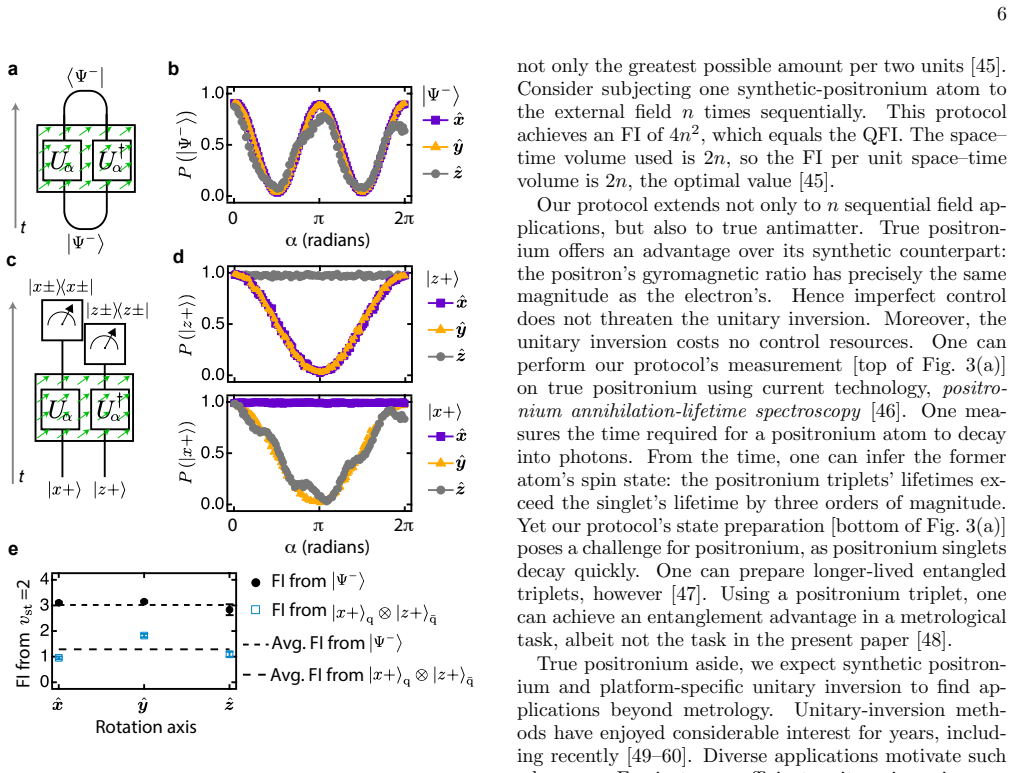
The central discovery is that antimatter's time-reversal property can be simulated on a superconducting transmon and turned into a metrological resource. Two control techniques give the "antiqubit" an effective magnetic response opposite to the qubit's: Z gates reverse the x- and y-components of the field, and an off-resonant drive at a magic frequency gives the two transmons equal-and-opposite energy shifts, reversing the z-component. Under a field in any direction, the qubit evolves by $U_\alpha$ while the antiqubit evolves by $U_\alpha^\dagger$; because the singlet $|\Psi^-\rangle$ is invariant under $U_\alpha \otimes U_\alpha$, the pair's evolution is equivalent to one probe evolving under $U_\alpha^2$, doubling the phase accumulated. This yields Fisher information 4 per two units of space-time volume, matching the quantum Fisher-information bound, and the paper proves that any strategy attaining that bound must use a maximally entangled state and effective unitary inversion. The experimental singlet-survival curves give FI $= 3.03 \pm 0.07$ per two units of space-time volume, versus 1 for two entangled ordinary qubits and $4/3$ for a separable qubit-antiqubit pair.
Load-bearing premise
The load-bearing premise is that a single microwave frequency can make the qubit and antiqubit experience exactly equal and opposite energy shifts while the residual off-resonant rotation it also causes stays small; that magic frequency is inferred from calibration data rather than predicted from the device model, and it sits only 9.52 MHz from the qubit transition, where the unwanted rotation visibly contaminates the z-axis data.
Editorial extensions
If this is right
- An unknown-direction field can be measured at the quantum Fisher-information limit without adaptive measurements, because the singlet plus inverted gyromagnetic ratio removes the need to know the rotation axis.
- Repeated applications extend the advantage: $n$ sequential field applications on one synthetic-positronium pair give Fisher information $4n^2$, the quantum Fisher information, and an optimal FI per unit space-time volume of $2n$.
- Platform-specific unitary inversion supplies $U^\dagger$ at the cost of a drive configuration rather than the $O(d^2)$ applications needed by tomography-based reversal, so algorithms that call both $U$ and $U^\dagger$ could inherit the saving.
- True positronium would implement the same protocol with no control overhead, because the positron's gyromagnetic ratio exactly mirrors the electron's; readout is available through annihilation-lifetime spectroscopy, and longer-lived triplet states can support related entanglement advantages.
Reading between the lines
- The observed 1.78-fold field-amplitude asymmetry between qubit and antiqubit suggests the magic-frequency condition depends on drive and wiring asymmetries; engineering those asymmetries predictably should let the experimental FI climb from about 3.0 toward 4, and would remove the need to infer the magic frequency from data.
- Because the inversion flips the sign of the effective generator on all three axes at once, the same pair could serve a multiparameter problem, estimating field strength and direction simultaneously; the paper does not develop this, but its quantum-Fisher-information-matrix analysis points to it.
- The effective-$U^2$ equivalence implies the sensitivity boost comes from sign-flipping the coupling rather than from adding photons, qubits, or sequential applications; any platform with a controllable sign flip of its Hamiltonian could in principle reproduce the improvement.
Editorial analysis
A structured set of objections, weighed in public.
Referee Report
Summary. The paper proposes and demonstrates "antiqubits": transmons driven so that their effective gyromagnetic ratio is opposite to that of an ordinary qubit, thereby realizing platform-specific unitary inversion. The central theoretical claim is that an entangled qubit–antiqubit singlet, with the field acting as U_α on the qubit and U†_α on the antiqubit, achieves the maximal Fisher information per two units of space–time volume, I_α = 4, and that this strategy is unique for unknown field direction. The experimental section reports P(|Ψ−⟩) ≈ cos(2α) curves, an averaged Fisher information of 3.03 ± 0.07 per v_st = 2, and comparisons with separable qubit–antiqubit and agnostic-sensing strategies. The supplement contains the QFI derivation, the uniqueness proof, and the experimental calibration details, including the AC-Stark "magic frequency" used for z-axis inversion.
Significance. If the proof is completed and the experimental z-axis data are robust, this is a valuable contribution: it offers a physical, low-overhead route to unitary inversion and demonstrates a clear metrological advantage in a platform-specific setting. The paper's strengths include an explicit analytic derivation of the QFI bound, a self-contained supplement with derivations of Eq. (13) and the concurrence bound, careful resource accounting via the space–time volume, and direct experimental comparison with two competitor strategies. The uniqueness claim, once repaired, would be a strong and interesting result that goes beyond merely showing an advantage.
major comments (3)
- [Supplementary Note I D] The uniqueness proof applies Eq. (26) to a general pure two-TLS state, but Eq. (26) was derived in Supplementary Note I B under the assumption that the state is maximally entangled (vanishing Bloch vectors). For a general pure state, the correct QFI expression is Eq. (13), which contains the additional nonpositive term −(r_A_n + s r_B_n)². As written, the step "the optimal ˆn-independent strategy implies, by Eq. (26), that I(s)_α = 2(1 + s n^T T n) = 4" is therefore not justified for general |ψ⟩. This gap is load-bearing because it underlies the claim that the singlet plus effective unitary inversion is the unique optimal strategy. The gap is likely repairable, e.g., by first using the bound I_α ≤ 2[1 + C(|ψ⟩)] ≤ 4 to conclude that any strategy reaching I_α = 4 for all ˆn must have C = 1, and only then applying Eq. (26), but the current text needs this argument spelled out.
- [Sec. V and Supplementary Note I E] The main text states that P(|Ψ−⟩) ≈ cos(2α) (Fig. 3(b) and surrounding text), while Supplementary Note I E, Eq. (70), derives P(|Ψ−⟩) = cos²(α) for the same protocol. These two expressions are not equivalent: cos(2α) takes negative values on (π/4, 3π/4), which is impossible for a probability, and the FI formula in Eq. (71)–(72) is computed from cos²(α). The two statements should be reconciled; presumably the intended probability is cos²(α) = [1 + cos(2α)]/2, with the "2" in the text referring to the doubled effective angle under U²_α rather than to a cos(2α) functional form. As written, the experimental claim that the curve supports the effective-U² interpretation is internally inconsistent with the theoretical derivation.
- [Sec. IV, Fig. 2(e), and Supplementary Note III] The experimental claim of arbitrary-direction unitary inversion rests on the z-component inversion produced by the AC-Stark magic frequency. The supplement reports that the inferred magic frequency, 4.176998 GHz, differs from the predicted 4.19742 GHz by a factor attributed to a 1.78× field-amplitude difference that is not independently measured, and that the inferred frequency is only 9.52 MHz detuned from the qubit transition, causing off-resonant x/y rotations that visibly contaminate the z-axis data ("gray disks ... wobble more"). The paper does not report the per-axis Fisher information values from Fig. 3(e), so it is not possible to assess whether the z-axis FI is substantially below the average of 3.03 ± 0.07 or whether the average is carried by the x- and y-axes. Since the central experimental message is that the optimal FI is achieved for an arbitrary (unknown) field direction, the authors should report the three per-axis FIs with uncertainties and quantify the sensitivity of the z-axis FI to the magic-frequency calibration and to the residual off-resonant rotations.
minor comments (5)
- [Abstract vs. Sec. V] The abstract reports an experimental FI of 3.02 per two units of space–time volume, while Sec. V reports 3.03 ± 0.07; the two numbers should be made consistent.
- [Sec. V] The phrase "per two units of phase-space volume" appears in the text of Sec. V; elsewhere the paper consistently uses "space–time volume." The typo should be corrected.
- [Fig. 2(e) and Supplementary Note III] The main text quotes the magic frequency as 4.177 GHz, while the supplement quotes 4.176998 GHz; the text should state explicitly that the former is a rounded value, and ideally give both the predicted and inferred magic frequencies in the main text with a brief explanation of the 1.78× amplitude discrepancy.
- [Sec. VI] The extension to arbitrary space–time volume is cited as reference [45] ("in prep."); the statement that this achieves "the optimal value" should be clearly marked as an outlook result based on unpublished work rather than as a theorem proved in the present manuscript.
- [Supplementary Note I D] The proof of uniqueness should explicitly state that "optimal" means achieving I_α = 4 for every field direction ˆn, not merely on average over ˆn, since this is what the subsequent algebraic condition T = s1 uses.
Circularity Check
No significant circularity: the optimal-FI proof is self-contained, and the experimental FI is a measured quantity obtained with calibrated controls; self-citations are contextual, not load-bearing.
full rationale
The paper's central theoretical claim, that positronium metrology achieves FI = 4 per v_st = 2 and that this is the unique optimal strategy, is derived in Supplementary Note I from the standard QFI formula, a concurrence bound, and explicit algebraic optimization. The derivation does not invoke the conclusion it is proving, nor does it rely on the authors' prior results to establish the bound. The comparison baselines (agnostic sensing FI = 1, separable qubit-antiqubit FI = 4/3) come from the authors' prior published work [35], but they are contextual benchmarks rather than inputs to the main proof; the main result stands independently. The experimental FI of 3.03 is obtained from phase-estimation measurements, not from the calibration data used to set the magic AC-Stark frequency. Calibrating a control parameter (the magic frequency) from Ramsey data and then measuring a different observable (the singlet probability versus alpha) is standard experimental practice, not a fitted input renamed as a prediction. The self-citations to [35], [38], [45], and [48] are either prior published results used for context, cross-references to the paper's own included supplementary proofs, or explicitly in-preparation extensions; none of them carries the load of the central derivation. The apparent discrepancy between the main text's 'cos(2alpha)' and the supplement's 'cos^2(alpha)' appears to be a typographical inconsistency rather than a circular step, since the FI calculation in the supplement is explicit and self-contained. Overall, the derivation chain from stated assumptions to FI = 4 and to the experimental demonstration is not circular.
Assumptions & free parameters
free parameters (4)
- magic drive frequency =
4.176998 GHz
- drive amplitude for metrology experiment =
|δ_j| = Ω_x = Ω_y = 2π(2.13 MHz)
- singlet preparation fidelity =
97%
- readout fidelities =
97.8% (qubit), 95.0% (antiqubit)
assumptions (5)
- domain assumption Two-level approximation of the transmon with controllable effective magnetic field (Eq. 3)
- domain assumption AC Stark shift formula δ_q = α_q Ω_s² / [2Δ_qs(α_q+Δ_qs)] (Eq. 89 of the supplement)
- domain assumption Field direction n is completely unknown during the experiment and no adaptive strategies are used
- domain assumption Resource metric space-time volume vst = (number of TLSs) x (number of sequential U applications)
- standard math The singlet is invariant under U⊗U, allowing the equivalence between (U⊗U†) and effective U² on the probe
invented entities (2)
-
antiqubit
-
synthetic positronium
Cite this review
Pith. "Pith review of Superconducting antiqubits achieve optimal phase estimation via unitary inversion." pith.science (2026). https://pith.science/paper/O6X3FHRT
@misc{pith2026250604315,
  author       = {Pith},
  title        = {Pith review of: Superconducting antiqubits achieve optimal phase estimation via unitary inversion},
  year         = {2026},
  howpublished = {\url{https://pith.science/paper/O6X3FHRT}},
  note         = {Machine review of arXiv:2506.04315}
}
read the original abstract
A positron is equivalent to an electron traveling backward through time. Casting transmon superconducting qubits as akin to electrons, we simulate a positron with a transmon subject to particular resonant and off-resonant drives. We call positron-like transmons "antiqubits." An antiqubit's effective gyromagnetic ratio equals the negative of a qubit's. This fact enables us to time-invert a unitary implemented on a transmon by its environment. We apply this platform-specific unitary inversion, with qubit--antiqubit entanglement, to achieve a quantum advantage in phase estimation: consider measuring the strength of a field that points in an unknown direction. An entangled qubit--antiqubit sensor offers the greatest possible sensitivity (amount of Fisher information), per qubit, per application of the field. We prove this result theoretically and observe it experimentally. This work shows how antimatter, whether real or simulated, can enable platform-specific unitary inversion and benefit quantum information processing.
Figures


Forward citations
Cited by 1 Pith paper
-
Quantum coherence leveraged agnostic phase estimation
A coherently controlled superposition of a unitary and its inverse on a probe qubit gives optimal, axis-agnostic phase estimation with Fisher information 1.
Reference graph
Works this paper leans on
-
[1]
E. C. C. St¨ uckelberg. La Mecanique du point materiel en theorie de relativite et en theorie des quanta. Helv. Phys. Acta , 15:23–37, 1942
1942
-
[2]
R. P. Feynman. A relativistic cut-Off for classical electrodynamics. Phys. Rev., 74:939–946, 1948
1948
-
[3]
R. P. Feynman. The theory of positrons. Phys. Rev., 76:749–759, 1949
1949
-
[4]
R. P. Feynman. The development of the space-time view of quantum electrodynamics, 1965. Nobel Lecture
1965
-
[5]
Measuring the scrambling of quantum information
Brian Swingle, Gregory Bentsen, Monika Schleier-Smith, and Patrick Hayden. Measuring the scrambling of quantum information. Phys. Rev. A , 94:040302, 2016
2016
-
[6]
Measurement of many-body chaos using a quantum clock
Guanyu Zhu, Mohammad Hafezi, and Tarun Grover. Measurement of many-body chaos using a quantum clock. Phys. Rev. A, 94:062329, 2016
2016
-
[7]
Quasiprobability behind the out-of-time-ordered correlator
Nicole Yunger Halpern, Brian Swingle, and Justin Dressel. Quasiprobability behind the out-of-time-ordered correlator. Phys. Rev. A , 97:042105, 2018
2018
-
[8]
Rozema, Iris Agresti, ˇCaslav Brukner, and Philip Walther
Teodor Str¨ omberg, Peter Schiansky, Marco T´ ulio Quintino, Michael Antesberger, Lee A. Rozema, Iris Agresti, ˇCaslav Brukner, and Philip Walther. Experimental superposition of a quantum evolution with its time reverse. Phys. Rev. Res. , 6:023071, 2024
2024
Show all 88 references
-
[9]
Reversing Unknown Qubit-Unitary Operation, Deterministically and Exactly
Satoshi Yoshida, Akihito Soeda, and Mio Murao. Reversing Unknown Qubit-Unitary Operation, Deterministically and Exactly. Phys. Rev. Lett. , 131:120602, 2023
2023
-
[10]
Theoretical framework for higher-order quantum theory
Alessandro Bisio and Paolo Perinotti. Theoretical framework for higher-order quantum theory. Proceedings of the Royal Society A: Mathematical, Physical and Engineering Sciences , 475(2225):20180706, 2019
2019
-
[11]
Measuring Out-of-Time-Order Correlators on a Nuclear Magnetic Resonance Quantum Simulator
Jun Li, Ruihua Fan, Hengyan Wang, Bingtian Ye, Bei Zeng, Hui Zhai, Xinhua Peng, and Jiangfeng Du. Measuring Out-of-Time-Order Correlators on a Nuclear Magnetic Resonance Quantum Simulator. Phys. Rev. X , 7:031011, 2017
2017
-
[12]
Measuring out-of- time-order correlations and multiple quantum spectra in a trapped ion quantum magnet
Martin G¨ arttner, Justin Bohnet, Arghavan Safavi-Naini, Michael Wall, John Bollinger, and Ana Rey. Measuring out-of- time-order correlations and multiple quantum spectra in a trapped ion quantum magnet. Nature Physics, 13, 2016
2016
-
[13]
Quantum singular value transformation and beyond: exponential improvements for quantum matrix arithmetics
Andr´ as Gily´ en, Yuan Su, Guang Hao Low, and Nathan Wiebe. Quantum singular value transformation and beyond: exponential improvements for quantum matrix arithmetics. In Proceedings of the 51st Annual ACM SIGACT Symposium on Theory of Computing , page 193–204. ACM, 2019
2019
-
[14]
Martyn, Zane M
John M. Martyn, Zane M. Rossi, Andrew K. Tan, and Isaac L. Chuang. Grand Unification of Quantum Algorithms. PRX Quantum, 2:040203, 2021
2021
-
[15]
Chuang and M
Isaac L. Chuang and M. A. Nielsen. Prescription for experimental determination of the dynamics of a quantum black box. Journal of Modern Optics , 44(11-12):2455–2467, 1997
1997
-
[16]
G. M. D’Ariano and P. Lo Presti. Quantum Tomography for Measuring Experimentally the Matrix Elements of an Arbitrary Quantum Operation. Phys. Rev. Lett. , 86:4195–4198, 2001
2001
-
[17]
J. B. Altepeter, D. Branning, E. Jeffrey, T. C. Wei, P. G. Kwiat, R. T. Thew, J. L. O’Brien, M. A. Nielsen, and A. G. White. Ancilla-Assisted Quantum Process Tomography. Phys. Rev. Lett. , 90:193601, 2003
2003
-
[18]
Quantum process inference for a single-qubit Maxwell demon
Xingrui Song, Mahdi Naghiloo, and Kater Murch. Quantum process inference for a single-qubit Maxwell demon. Physical Review A, 104(2), 2021
2021
-
[19]
Quantum Advantage in Reversing Unknown Unitary Evolutions, 2024
Yu-Ao Chen, Yin Mo, Yingjian Liu, Lei Zhang, and Xin Wang. Quantum Advantage in Reversing Unknown Unitary Evolutions, 2024
2024
-
[20]
Adiyatullin, Zeyang Li, Enrique Mendez, Chi Shu, and Vladan Vuleti´ c
Simone Colombo, Edwin Pedrozo-Pe˜ nafiel, Albert F. Adiyatullin, Zeyang Li, Enrique Mendez, Chi Shu, and Vladan Vuleti´ c. Time-reversal-based quantum metrology with many-body entangled states.Nature Physics, 18(8):925–930, 2022
2022
-
[21]
Precision bounds for gradient magnetometry with atomic ensembles
Iagoba Apellaniz, I˜ nigo Urizar-Lanz, Zolt´ an Zimbor´ as, Philipp Hyllus, and G´ eza T´ oth. Precision bounds for gradient magnetometry with atomic ensembles. Physical Review A , 97(5), 2018. 8
2018
-
[22]
Ruster, H
T. Ruster, H. Kaufmann, A. Luda, M. V. Kaushal, T. Schmiegelow, C. F. Schmidt-Kaler, and G. Poschinger, U.˙ Entanglement-Based dc Magnetometry with Separated Ions. Physical Review X , 7(3), 2017
2017
-
[23]
A New Design of a Single-Device 3D Hall Sensor: Cross-Shaped 3D Hall Sensor
Wei Tang, Fei Lyu, Dunhui Wang, and Hongbing Pan. A New Design of a Single-Device 3D Hall Sensor: Cross-Shaped 3D Hall Sensor. Sensors, 18(4), 2018
2018
-
[24]
Recent Progress of Fluxgate Magnetic Sensors: Basic Research and Application
Songrui Wei, Xiaoqi Liao, Han Zhang, Jianhua Pang, and Yan Zhou. Recent Progress of Fluxgate Magnetic Sensors: Basic Research and Application. Sensors, 21(4), 2021
2021
-
[25]
Measurement System for Short-Pulsed Magnetic Fields
Voitech Stankeviˇ c, Skirmantas Kerˇ sulis, Justas Dilys, Vytautas Bleizgys, Mindaugas Vilinas, Viliuns Vertelis, Andrius Maneikis, Vakaris Rudokas, Valentina Plauˇ sinaitien˙ e, and Nerija ˇZurauskien˙ e. Measurement System for Short-Pulsed Magnetic Fields. Sensors, 23(3), 2023
2023
-
[26]
Smith, Crispin H
Joseph G. Smith, Crispin H. W. Barnes, and David R. M. Arvidsson-Shukur. Iterative quantum-phase-estimation protocol for shallow circuits. Phys. Rev. A , 106:062615, 2022
2022
-
[27]
Smith, Crispin H
Joseph G. Smith, Crispin H. W. Barnes, and David R. M. Arvidsson-Shukur. Adaptive Bayesian quantum algorithm for phase estimation. Phys. Rev. A , 109:042412, 2024
2024
-
[28]
Jared Rovny, Shimon Kolkowitz, and Nathalie P. de Leon. Multi-qubit nanoscale sensing with entanglement as a resource, 2025
2025
-
[29]
Smith, Crispin H
Joseph G. Smith, Crispin H. W. Barnes, and David R. M. Arvidsson-Shukur. Risk-minimizing states for the quantum- phase-estimation algorithm, 2025
2025
-
[30]
Richard P. Feynman. Simulating physics with computers. International Journal of Theoretical Physics , 21(6-7):467–488, 1982
1982
-
[31]
Lower bounds on the complexity of recognizing SAT by Turing machines
Rahul Santhanam. Lower bounds on the complexity of recognizing SAT by Turing machines. Information Processing Letters, 79(5):243–247, 2001
2001
-
[32]
Braunstein and Carlton M
Samuel L. Braunstein and Carlton M. Caves. Statistical distance and the geometry of quantum states. Phys. Rev. Lett. , 72:3439–3443, 1994
1994
-
[33]
Helstrom
Carl W. Helstrom. Quantum Detection and Estimation Theory , volume 123. Elsevier, 1976. 1st Edition
1976
-
[34]
Optimal probe states are pure, as mixed states result from the qubit’s leaking information into an environment
-
[35]
Xingrui Song, Flavio Salvati, Chandrashekhar Gaikwad, Nicole Yunger Halpern, David R. M. Arvidsson-Shukur, and Kater Murch. Agnostic Phase Estimation. Phys. Rev. Lett. , 132:260801, 2024
2024
-
[36]
Nielsen and Isaac L
Michael A. Nielsen and Isaac L. Chuang. Quantum Computation and Quantum Information: 10th Anniversary Edition . Cambridge University Press, New York, NY, USA, 10th edition, 2011
2011
-
[37]
The unitaries, together, cost no more than just one Uα
Consider applying Uα to each of two qubits in parallel. The unitaries, together, cost no more than just one Uα. Figure 2(a) illustrates why: one uniform field implements both unitaries simultaneously
-
[38]
Supplemental Material contains experimental details, data processing techniques, and further theoretical analysis of the sensing protocols
-
[39]
Quantum mechanics near closed timelike lines
David Deutsch. Quantum mechanics near closed timelike lines. Phys. Rev. D , 44:3197–3217, 1991
1991
-
[40]
Rozema, Ardavan Darabi, Yasaman Soudagar, Lynden K
Seth Lloyd, Lorenzo Maccone, Raul Garcia-Patron, Vittorio Giovannetti, Yutaka Shikano, Stefano Pirandola, Lee A. Rozema, Ardavan Darabi, Yasaman Soudagar, Lynden K. Shalm, and Aephraim M. Steinberg. Closed Timelike Curves via Postselection: Theory and Experimental Test of Cons...
2011
-
[41]
Quantum mechanics of time travel through post-selected teleportation
Seth Lloyd, Lorenzo Maccone, Raul Garcia-Patron, Vittorio Giovannetti, and Yutaka Shikano. Quantum mechanics of time travel through post-selected teleportation. Phys. Rev. D , 84:025007, 2011
2011
-
[42]
David R. M. Arvidsson-Shukur, Aidan G. McConnell, and Nicole Yunger Halpern. Nonclassical Advantage in Metrology Established via Quantum Simulations of Hypothetical Closed Timelike Curves. Phys. Rev. Lett. , 131:150202, 2023
2023
-
[43]
If different trials can begin with different state preparations, one can achieve more FI, on average over trials [35]
-
[44]
If ˆn is unknown, the problem falls under the heading of multiparameter estimation; the FI matrix should replace the FI [38, 66]
Our assumption renders Iα an appropriate measure of how well one can inferα via the competitor protocol. If ˆn is unknown, the problem falls under the heading of multiparameter estimation; the FI matrix should replace the FI [38, 66]
-
[45]
Surihan Sean Borijigin, Xingrui Song, Flavio Salvati, Yuxin Wang, Nicole Yunger Halpern, David R. M. Arvidsson-Shukur, and Kater Murch, in prep
-
[46]
D. B. Cassidy, S. H. M. Deng, H. K. M. Tanaka, and A. P. Mills, Jr. Single shot positron annihilation lifetime spectroscopy. Applied Physics Letters , 88(19):194105, 2006
2006
-
[47]
L. T. Gl¨ oggler, N. Gusakova, B. Rien¨ acker, A. Camper, R. Caravita, S. Huck, M. Volponi, T. Wolz, L. Penasa, V. Krumins, F. P. Gustafsson, D. Comparat, M. Auzins, B. Bergmann, P. Burian, R. S. Brusa, F. Castelli, G. Cerchiari, R. Ciury lo, G. Consolati, M. Doser, L. Graczyk...
2024
-
[48]
Quantum advantage in antimatter sensing, in prep
Flavio Salvati et al. Quantum advantage in antimatter sensing, in prep
-
[49]
McCall, and John R
Bernard Yurke, Samuel L. McCall, and John R. Klauder. SU(2) and SU(1,1) interferometers. Phys. Rev. A, 33:4033–4054, 1986
1986
-
[50]
de Matos Filho, Girish S
Jiaxuan Wang, Ruynet L. de Matos Filho, Girish S. Agarwal, and Luiz Davidovich. Quantum advantage of time-reversed ancilla-based metrology of absorption parameters. Phys. Rev. Res. , 6:013034, 2024
2024
-
[51]
Qubit-assisted quantum metrology under a time-reversal strategy
Peng Chen and Jun Jing. Qubit-assisted quantum metrology under a time-reversal strategy. Phys. Rev. A , 110:062425, 2024
2024
-
[52]
Time-reversal assisted quantum metrology with an optimal control, 2023
Da-Wei Luo and Ting Yu. Time-reversal assisted quantum metrology with an optimal control, 2023. 9
2023
-
[53]
Jalabert and Horacio M
Rodolfo A. Jalabert and Horacio M. Pastawski. Environment-Independent Decoherence Rate in Classically Chaotic Sys- tems. Phys. Rev. Lett. , 86:2490–2493, 2001
2001
-
[54]
F. M. Cucchietti, D. A. R. Dalvit, J. P. Paz, and W. H. Zurek. Decoherence and the Loschmidt Echo. Phys. Rev. Lett. , 91:210403, 2003
2003
-
[55]
Loschmidt echo for quantum metrology
Tommaso Macr ` ı, Augusto Smerzi, and Luca Pezz` e. Loschmidt echo for quantum metrology. Phys. Rev. A , 94:010102, 2016
2016
-
[56]
Variational Quantum Metrology with Loschmidt Echo
Ran Liu, Ze Wu, Xiaodong Yang, Yuchen Li, Hui Zhou, Zhaokai Li, Yuquan Chen, Haidong Yuan, and Xinhua Peng. Variational Quantum Metrology with Loschmidt Echo. National Science Review , 2025
2025
-
[57]
Time-reversal in a dipolar quantum many-body spin system.Phys
Sebastian Geier, Adrian Braemer, Eduard Braun, Maximilian M¨ ullenbach, Titus Franz, Martin G¨ arttner, Gerhard Z¨ urn, and Matthias Weidem¨ uller. Time-reversal in a dipolar quantum many-body spin system.Phys. Rev. Res., 6:033197, 2024
2024
-
[58]
Schiansky, T
P. Schiansky, T. Str¨ omberg, D. Trillo, V. Saggio, B. Dive, M. Navascu´ es, and P. Walther. Demonstration of universal time-reversal for qubit processes. Optica, 10(2):200–205, 2023
2023
-
[59]
Nic Ezzell, Bibek Pokharel, Lina Tewala, Gregory Quiroz, and Daniel A. Lidar. Dynamical decoupling for superconducting qubits: A performance survey. Phys. Rev. Appl. , 20:064027, 2023
2023
-
[60]
Bar-Gill, L
N. Bar-Gill, L. Pham, A. Jarmola, D. Budker, and R. L. Walsworth. Solid-state electronic spin coherence time approaching one second. Nature Communications, 4:1743, 2013
2013
-
[61]
Quantum amplitude amplification and estimation, 2002
Gilles Brassard, Peter Høyer, Michele Mosca, and Alain Tapp. Quantum amplitude amplification and estimation, 2002
2002
-
[62]
On low-depth algorithms for quantum phase estimation
Hongkang Ni, Haoya Li, and Lexing Ying. On low-depth algorithms for quantum phase estimation. Quantum, 7:1165, 2023
2023
-
[63]
Imaginarity-free quantum multiparameter estimation
Jisho Miyazaki and Keiji Matsumoto. Imaginarity-free quantum multiparameter estimation. Quantum, 6:665, 2022
2022
-
[64]
Achieving the Multiparameter Quantum Cram´ er-Rao Bound with Antiunitary Symmetry.Physical Review Letters, 133(21), 2024
Ben Wang, Kaimin Zheng, Qian Xie, Aonan Zhang, Liang Xu, and Lijian Zhang. Achieving the Multiparameter Quantum Cram´ er-Rao Bound with Antiunitary Symmetry.Physical Review Letters, 133(21), 2024
2024
-
[65]
Pilaszewicz, L.R
C. Pilaszewicz, L.R. Muth, and M. Margraf. A black-box attack on fixed-unitary quantum encryption schemes. Discover Computing, 27(14), 2024
2024
-
[66]
J. Liu, H. Yuan, X. Lu, and X. Wang. Quantum Fisher information matrix and multiparameter estimation. J. Phys. A Math., 53(2):023001, 2019
2019
-
[67]
Wootters
William K. Wootters. Entanglement of Formation of an Arbitrary State of Two Qubits. Phys. Rev. Lett. , 80:2245–2248, Mar 1998
1998
-
[68]
Salimi, A
S. Salimi, A. Mohammadzade, and K. Berrada. Concurrence for a two-qubits mixed state consisting of three pure states in the framework of SU(2) coherent states, 2012
2012
-
[69]
Quantify entanglement by concurrence hierarchy
Heng Fan, Keiji Matsumoto, and Hiroshi Imai. Quantify entanglement by concurrence hierarchy. Journal of Physics A: Mathematical and General , 36(14):4151–4158, March 2003
2003
-
[70]
Quantum state estimation with nuisance parameters
Jun Suzuki, Yuxiang Yang, and Masahito Hayashi. Quantum state estimation with nuisance parameters. Journal of Physics A: Mathematical and Theoretical , 53(45):453001, October 2020
2020
-
[71]
Matteo G. A. Paris. Quantum estimation for quantum technology. Int. J. Quantum Inf. , 7(supp01):125–137, 2009
2009
-
[72]
Supplemental Material for ”Agnostic Phase Estimation”
See Supplemental Material at http://link.aps.org/supplemental/10.1103/PhysRevLett.132.260801. Supplemental Material for ”Agnostic Phase Estimation”. http://link.aps.org/supplemental/10.1103/PhysRevLett.132.260801, 2024
2024 doi
-
[73]
Carroll, S
M. Carroll, S. Rosenblatt, P. Jurcevic, I. Lauer, and A. Kandala. Dynamics of superconducting qubit relaxation times. npj Quantum Information , 8(1), 2022
2022
-
[74]
Certain equipment, instruments, software, or materials are identified in this paper to specify the experimental procedure adequately. Such identification is not intended to imply recommendation or endorsement of any product or service by NIST; nor is it intended to imply that ...
-
[75]
Levenson-Falk, and Kater W
Chandrashekhar Gaikwad, Daria Kowsari, Carson Brame, Xingrui Song, Haimeng Zhang, Martina Esposito, Arpit Ranadive, Giulio Cappelli, Nicolas Roch, Eli M. Levenson-Falk, and Kater W. Murch. Entanglement Assisted Probe of the Non-Markovian to Markovian Transition in Open Quantum...
2024
-
[76]
Maxime Boissonneault, J. M. Gambetta, and Alexandre Blais. Dispersive regime of circuit QED: Photon-dependent qubit dephasing and relaxation rates. Physical Review A , 79(1), 2009
2009
-
[77]
Walter, P
T. Walter, P. Kurpiers, S. Gasparinetti, P. Magnard, A. Potoˇ cnik, Y. Salath´ e, M. Pechal, M. Mondal, M. Oppliger, C. Eichler, and A. Wallraff. Rapid High-Fidelity Single-Shot Dispersive Readout of Superconducting Qubits. Phys. Rev. Appl., 7:054020, 2017
2017
-
[78]
Kerr reversal in Josephson meta-material and traveling wave parametric amplification
Arpit Ranadive, Martina Esposito, Luca Planat, Edgar Bonet, C´ ecile Naud, Olivier Buisson, Wiebke Guichard, and Nicolas Roch. Kerr reversal in Josephson meta-material and traveling wave parametric amplification. Nature Communications, 13(1):1737, 2022
2022
-
[79]
Rapin and O
J. Rapin and O. Teytaud. Nevergrad - A gradient-free optimization platform. https://GitHub.com/FacebookResearch/ Nevergrad, 2018
2018
-
[80]
Pedregosa, G
F. Pedregosa, G. Varoquaux, A. Gramfort, V. Michel, B. Thirion, O. Grisel, M. Blondel, P. Prettenhofer, R. Weiss, V. Dubourg, J. Vanderplas, A. Passos, D. Cournapeau, M. Brucher, M. Perrot, and E. Duchesnay. Scikit-learn: Machine Learning in Python. Journal of Machine Learning...
2011
-
[81]
de Jong, and Christian W
Benjamin Nachman, Miroslav Urbanek, Wibe A. de Jong, and Christian W. Bauer. Unfolding quantum computer readout noise. npj Quantum Information , 6(1), 2020
2020
-
[82]
Superconducting antiqubits achieve optimal phase estimation via unitary inversion
Daniel F. V. James, Paul G. Kwiat, William J. Munro, and Andrew G. White. Measurement of qubits. Physical Review A, 64(5), 2001. 10 . Supplementary Information for “Superconducting antiqubits achieve optimal phase estimation via unitary inversion” Supplementary Note I concerns...
2001
-
[83]
(32) This state has the concurrence [68] C0 := C(|ψ⟩) = |ad − bc| ∈[0, 1]
General pure two-TLS state and concurrence A general two-TLS pure state has the form |ψ⟩ = a |00⟩ + b |01⟩ + c |10⟩ + d |11⟩ , wherein |a|2 + |b|2 + |c|2 + |d|2 = 1. (32) This state has the concurrence [68] C0 := C(|ψ⟩) = |ad − bc| ∈[0, 1]. (33) Denote by |χ⟩ a reference state...
-
[84]
Directly evaluating the QFI is algebraically cumbersome
QFI achievable with fixed-concurrence states In this section, we compute the QFI achievable with a general pure two-TLS state |ψ⟩ of fixed concurrence C0. Directly evaluating the QFI is algebraically cumbersome. Yet we can simplify the calculation because every such state deco...
-
[85]
They represent the single- TLS unitaries UA and UB
QFI achievable with a general two-TLS pure state, calculated in a rotated reference frame Equation (45) shows a QFI dependent on the Bloch-sphere rotations RA, RB ∈ SO(3). They represent the single- TLS unitaries UA and UB. We now analyze how these rotations affect the QFI. Ac...
-
[86]
One might hope to maximize the first term inside the curly braces in Eq
Greatest QFI achievable with any fixed-concurrence two-TLS state In this section, we identify the external-field directions ˆn and the relative rotation Rrel that maximize the QFI achievable with a concurrence- C0 state. One might hope to maximize the first term inside the cur...
-
[87]
We define the optimal input states |ψ⟩ as those that, while having a concurrence C0, saturate the upper bound (31)
Optimal input states We now characterize the optimal two-TLS input states consistent with a fixed concurrence C0. We define the optimal input states |ψ⟩ as those that, while having a concurrence C0, saturate the upper bound (31). They achieve the greatest possible QFI, I (s) α...
-
[88]
(66)] then implies a = d = 0, which satisfies the earlier requirement R(ad∗) = 0 [Eq
The normalization of |ψ⟩ [Eq. (66)] then implies a = d = 0, which satisfies the earlier requirement R(ad∗) = 0 [Eq. (68)]. Consider substituting |b| = |c| = 1/ √ 2 and a = d = 0 in the first equality in (68). The condition s = −1 results (s = +1 leads to a contradiction). Only...
Reviewed August 7, 2026 · model on record in the stance chip above.
Discussion (0). Continue with ORCID to comment.