REVIEW 3 major objections 4 minor 56 references
Quasinormal modes in Kerr spacetime as a 2D Eigenvalue problem
T0 review · 3 major / 4 minor · reviewed 2026-08-07 · deepseek-v4-flash
Pith's one-line read The Kerr quasinormal-mode spectrum for each azimuthal number $m$ can be computed as a direct eigenvalue problem on a two-dimensional hyperboloidal slice, eliminating root-finding and initial guesses.
desk verdict The 2D eigenvalue formulation is a real step forward, but validation is self-referential and needs an independent benchmark before the method is fully trusted. read the letter →
The pith
A machine-rendered reading of the paper's core claim, the machinery that carries it, and where it could break.
The reading
What carries the argument
The load-bearing object is the hyperboloidal $m$-mode Teukolsky operator: after the coordinate transformation (7), the regularity factor (15), and the azimuthal Fourier decomposition (16), the master equation becomes the 2D elliptic PDE (17), written as $s\bar D_{m;\bar\omega}\bar\Phi_{m;\bar\omega}=0$ with spatial operators $L_1$ and $L_2$. Introducing the auxiliary function $\bar\Upsilon_{m;\bar\omega}=s\bar\Phi_{m;\bar\omega}$ converts it into the linear eigenvalue problem $Lu=s u$ of Eq. (20). Discretizing $u$ on a Chebyshev tensor grid renders the spectrum as eigenvalues of a finite matrix, with boundary conditions at null infinity and the horizon enforced geometrically by the hyperboloidal coordinates and by the regularity prefactors in Eq. (15).
What would settle it
Run the solver at several resolutions for a fixed $m$ and compare every filtered eigenvalue against independent high-accuracy continued-fraction values across many spins and overtones: if any retained eigenvalue fails to match a known mode, or any known mode is missing at tolerance $10^{-3}$, the central claim is refuted. A complementary check is to substitute a computed eigenpair back into the original Teukolsky equation and verify that the residual and the boundary behaviour decay at the expected rates.
Extended reading notes
Core claim
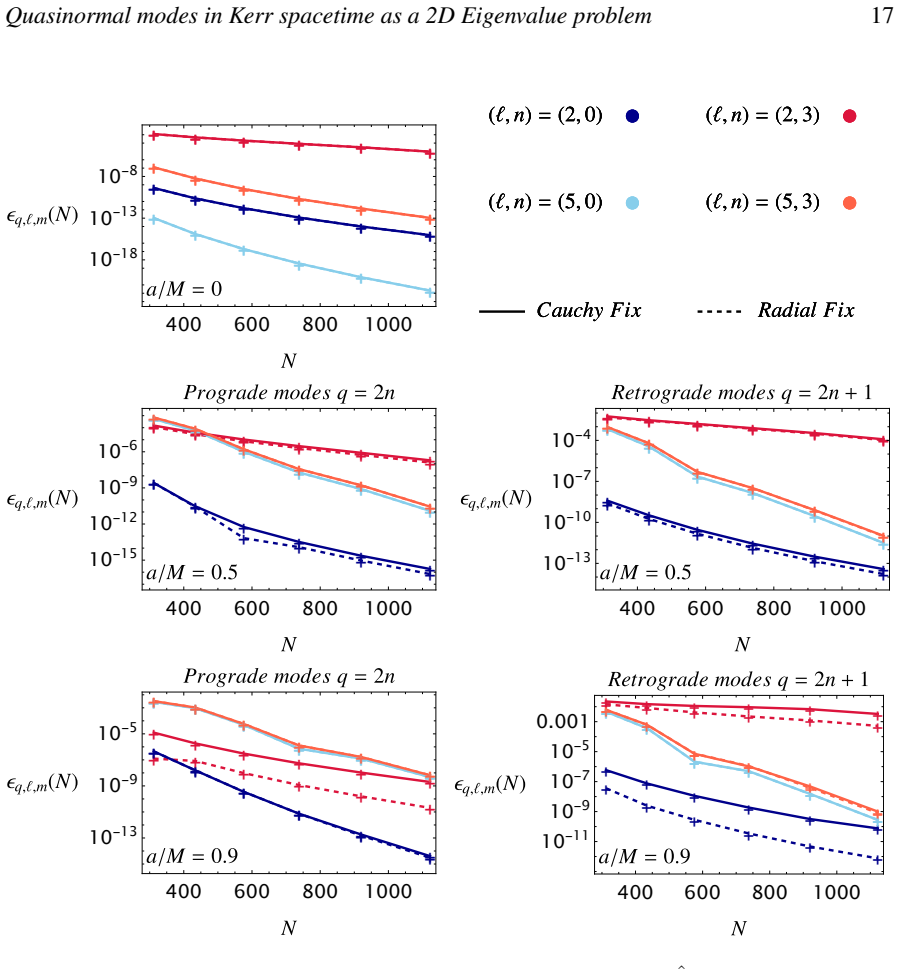
The central discovery is that separating variables is unnecessary for computing Kerr quasinormal modes. Combining the hyperboloidal compactification with a decomposition into azimuthal modes $m$ turns the frequency-domain Teukolsky equation into a two-dimensional linear operator whose eigenvalues are the QNM frequencies, with the auxiliary function $s\bar\Upsilon_{m;\bar\omega}=s\,s\bar\Phi_{m;\bar\omega}$ making the problem first order in the spectral parameter. The paper demonstrates the resulting spectra for gravitational perturbations $s=-2$ across spins from Schwarzschild to $a/M=0.99$, reproduces known values, and shows that both hyperboloidal gauges converge exponentially to the same frequencies. It then exploits the directly available eigenfunctions to show that the near-extremal gradients are gauge-dependent, and to project the angular profile onto both spheroidal and spherical harmonic bases. In the authors' reading, the QNM problem is not two coupled ODE eigenvalue problems but a single 2D spectral problem for each $m$.
Load-bearing premise
The load-bearing premise is that the eigenvalues of the discretized hyperboloidal operator that survive the tolerance filter are the actual quasinormal modes of the Teukolsky equation with the correct boundary conditions, rather than numerical artifacts of the discretization.
Editorial extensions
If this is right
- For a fixed $m$, one matrix eigenvalue problem returns many QNMs at once, so constructing the Kerr spectrum no longer needs a root finder with a good initial guess.
- The single overtone index $q$, ordered by decay rate, replaces the four-way labels and exposes the prograde/retrograde ordering directly.
- Radial-fixing and Cauchy-horizon-fixing gauges give the same frequencies with the same exponential convergence, so the gauge choice does not affect spectral accuracy.
- Steep near-horizon gradients in extremal-Kerr eigenfunctions are slicing artifacts, not physical features, resolving a question raised by earlier radial computations.
- QNM eigenfunctions can be projected onto either spin-weighted spheroidal or spherical harmonics, easing direct comparison with gravitational-wave templates.
Reading between the lines
- Beyond the paper, the same no-seed eigenvalue setup should make pseudospectrum and QNM-instability analyses in Kerr substantially cheaper, because the full eigensystem is available in one solve rather than mode by mode.
- The $q$-index ordering by decay rate could serve as a standard for ringdown comparisons, removing the ambiguity in which one overtone label $n$ covers four distinct modes.
- Because near-horizon gradient formation is gauge-dependent, any physical claim tied to eigenfunction steepness near extremality, such as an instability of the horizon, should be checked in a gauge-invariant quantity rather than in a fixed slicing.
- A direct extension is to Kerr-Newman or other non-separable backgrounds, where the same 2D diagonalization could replace the Newton-Raphson root searches currently used.
Editorial analysis
A structured set of objections, weighed in public.
Referee Report
Summary. The paper develops a numerical method for computing quasinormal modes (QNMs) of the Kerr spacetime by formulating the frequency-domain Teukolsky equation as a two-dimensional eigenvalue problem. The authors combine a hyperboloidal compactification with an azimuthal m-mode decomposition, obtaining an operator whose eigenvalues directly yield QNM frequencies without a separation constant or root-finding. They present the discretized operator, a filtering procedure to remove spurious eigenvalues, convergence tests for two hyperboloidal gauges, a proposed re-labelling of overtones by a single index q, and studies of the angular and radial structure of the eigenfunctions. The central advertised results are that the method extracts the Kerr QNM spectrum directly as eigenvalues, that both gauges perform comparably, and that strong near-horizon gradients seen in one gauge are coordinate artefacts.
Significance. If the central claim is correct, the paper provides a practical and conceptually clean route to Kerr QNM spectra: for each azimuthal number m, all overtones and angular harmonics are obtained simultaneously as eigenvalues of a single discretized operator, with no need for initial guesses. This would be a useful tool for QNM stability studies, pseudospectrum computations, and mode-excitation problems, and the paper's demonstration of equivalent performance between two hyperboloidal gauges is a valuable practical message. The m-mode projection onto both spheroidal and spherical harmonic bases is also potentially useful for gravitational-wave data analysis. However, the paper's validation is entirely self-referential: the convergence study compares the solver to its own high-resolution results, and the only independent anchor is a qualitative Schwarzschild plot. Because the correctness of the extracted spectrum is the load-bearing claim, the lack of a direct quantitative comparison with established Kerr QNM values leaves the central result not fully established.
major comments (3)
- [Sec. 4.2, Eq. (59)] The convergence error ϵ in Eq. (59) is computed relative to ω_Ref obtained from the same solver at N_ref = 55. This is a self-consistency check and cannot detect a systematic error in the boundary-condition encoding or in the filtering procedure. The only independent anchor is the qualitative Schwarzschild benchmark in Fig. 2, which is not quantified. Since the paper's central claim is that the filtered eigenvalues are the physical Kerr QNM spectrum, please add a quantitative comparison against independent published values—for example Leaver's continued-fraction results or the high-accuracy data of Cook and Zalutskiy—for representative modes, for spins including a/M = 0.8, 0.9, and 0.99, and for both prograde and retrograde branches.
- [Sec. 4, filtering criterion with TOL ≈ 1e-3] The filtering procedure retains eigenvalues satisfying |1 − ω_low/ω_high| < TOL, but the paper reports no sensitivity analysis with respect to TOL or the truncation pair (n_low, n_high), nor a demonstration that spurious eigenvalues near the branch cut are always discarded. The concern is most acute precisely where the paper itself notes slow convergence, namely retrograde modes as a/M approaches 1 and spurious eigenvalues cluster near the branch cut. Without a robustness study, the filter could in principle admit or discard the wrong eigenvalues. Please quantify the dependence of the retained spectrum on TOL and resolution, and cross-check the filtered values against independent Kerr QNM data.
- [Sec. 4.3.1 and Fig. 6] The conclusion that the near-horizon gradients in the radial-fixing gauge are coordinate artefacts is inferred from comparing eigenfunctions in the radial-fixing and Cauchy-horizon-fixing gauges. These gauges use different radial coordinate choices (ρ_o = 0 versus ρ_o = κ²), so the same physical field is represented by different functions of σ; the absence of steep gradients in one gauge does not by itself prove that the gradients are unphysical. Please compare an invariant quantity, such as the original Teukolsky master function or a suitably normalized covariant quantity, or explicitly justify why the comparison of the two gauges is conclusive.
minor comments (4)
- [Sec. 2.1.1, before Eq. (21)] The text states "For the radial fixing gauge (σc = κ2)", but Eq. (8) with ρ_o = 0 gives σ_c = κ^{-2}, and the factor (1 − κ²σ) in Eq. (22) is consistent with σ_c = κ^{-2}; please correct this typo.
- [Throughout] There are several typographical errors that should be corrected, including "respecvelty", "Teulkolsky", "straightfoward", "the the", and "discretized operador".
- [Fig. 4 caption] The horizontal axis is described as the "total size" of the discretized operator; please clarify that it is the total number of grid points n_total = n1 × n2, since the truncation is parameterized by N1 = 5N2 = N.
- [Sec. 4.1, Eq. (56)] The proposed ordering by decay rate is natural, but the statement that even q corresponds to prograde and odd q to retrograde modes requires the caveat, already partly given, that for m = 0 the q = 0 and q = 1 modes are degenerate in frequency; please make this caveat explicit in the definition of the ordering.
Circularity Check
Derivation is a direct spectral reformulation of the Teukolsky equation; no circular reduction.
full rationale
The paper's derivation chain is explicit and algebraic: the Teukolsky equation (Eq. 14) is transformed via hyperboloidal coordinates (Eq. 7), the master function is regularized (Eq. 15), an m-mode Fourier ansatz is introduced (Eq. 16), and the resulting 2D operator (Eq. 20) is discretized with Chebyshev collocation (Eqs. 35-50). The QNM frequencies are obtained as eigenvalues of this discretized operator, not as fitted parameters or as quantities defined in terms of the target spectrum. The hyperboloidal framework is cited from prior work, including [27] and [41], but the relevant coordinate transformations and operator coefficients are stated in full, so the argument does not reduce to an unverified self-citation or an imported uniqueness theorem. The main caveat is that the convergence study in Sec. 4.2 defines the reference values omega_Ref using the same solver at Nref = 55, so the reported errors measure self-convergence rather than agreement with an independent calculation; the Schwarzschild benchmark (Fig. 2) is also only qualitative. These are accuracy and robustness limitations, not circularity, because the eigenvalues themselves are computed independently of any externally imposed values. The tolerance-based filtering (TOL ~ 1e-3) selects eigenvalues that are stable under resolution changes, but it does not construct or define the eigenvalues. No load-bearing step in the derivation is equivalent to its own input by construction.
Assumptions & free parameters
free parameters (1)
- Filter tolerance TOL =
10^-3
assumptions (4)
- domain assumption The Teukolsky equation (Eq. 14) correctly describes linear perturbations of the Kerr spacetime.
- domain assumption The hyperboloidal coordinate transformation (Eq. 7) and the minimal gauge conditions from Ref. [41] yield a regular PDE whose eigenvalues correspond to QNMs with the correct boundary conditions.
- domain assumption The regularity factors (1+x)^{delta1/2}(1-x)^{delta2/2} in Eq. (15) are necessary and sufficient for regular eigenfunctions on the axis.
- ad hoc to paper The convergence filter with TOL ~ 1e-3 correctly distinguishes physical QNMs from spurious eigenvalues of the discretized operator.
Cite this review
Pith. "Pith review of Quasinormal modes in Kerr spacetime as a 2D Eigenvalue problem." pith.science (2026). https://pith.science/paper/AA7A52RK
@misc{pith2026250604326,
  author       = {Pith},
  title        = {Pith review of: Quasinormal modes in Kerr spacetime as a 2D Eigenvalue problem},
  year         = {2026},
  howpublished = {\url{https://pith.science/paper/AA7A52RK}},
  note         = {Machine review of arXiv:2506.04326}
}
abstract
We revisit the computation of quasinormal modes (QNMs) of the Kerr black hole using a numerical approach exploiting a representation of the Teukolsky equation as a $2D$ elliptic partial differential equation. By combining the hyperboloidal framework with a $m$-mode decomposition, we recast the QNM problem into a genuine eigenvalue problem for each azimuthal mode. This formulation enables the simultaneous extraction of multiple QNMs, traditionally labelled by overtone number $n$ and angular index $\ell$, without requiring prior assumptions about their structure. We advocate for a simplified notation in which each overtone is uniquely labelled by a single index $q$, thereby avoiding the conventional but artificial distinction between regular and mirror modes. We compare two distinct hyperboloidal gauges-radial fixing and Cauchy horizon fixing-and demonstrate that, despite their different geometric properties and behaviour in the extremal limit, they yield numerical values for the QNM spectra with comparable accuracy and exponential convergence. Moreover, we show that strong gradients observed near the horizon in the extremal Kerr regime are coordinate artefacts of specific slicing rather than physical features. Finally, we investigate the angular structure of the QNM eigenfunctions and show that the $m$-mode approach allows flexible projection onto both spin-weighted spheroidal and spherical harmonic bases. These results underscore the robustness and versatility of the hyperboloidal $m$-mode method as a foundation for future studies of QNM stability, pseudospectra, and mode excitation in gravitational wave astronomy.
Figures


Figures from the paper (4 more)


Reference graph
Works this paper leans on
-
[1]
Rotating black holes: Separable wave equations for gravitational and electromagnetic perturbations
Teukolsky Saul A. Rotating black holes: Separable wave equations for gravitational and electromagnetic perturbations. Phys. Rev. Lett., 29:1114–1118, 1972
work page 1972
-
[2]
Perturbations of a rotating Black hole
Teukolsky Saul A. Perturbations of a rotating Black hole. I. Fundamental equations for gravitational, electromagnetic, and neutrino-field perturbations. The American Astronomical Society , 185:635:647, 1973
work page 1973
-
[3]
William H. Press and Saul A. Teukolsky. Perturbations of a Rotating Black Hole. II. Dynamical Stability of the Kerr Metric. Astrophys. J., 185:649–674, 1973
work page 1973
-
[4]
S. A. Teukolsky and W. H. Press. Perturbations of a rotating black hole. III - Interaction of the hole with gravitational and electromagnet ic radiation. Astrophys. J., 193:443–461, 1974
work page 1974
-
[5]
The mathematical theory of black holes
Subrahmanyan Chandrasekhar. The mathematical theory of black holes . Oxford University Press, 1985
work page 1985
-
[6]
Bernard F. Whiting. Mode Stability of the Kerr Black Hole. J. Math. Phys., 30:1301, 1989
work page 1989
-
[7]
Boundedness and decay for the Teukolsky equation on Kerr spacetimes I: the case |a| ≪M
Mihalis Dafermos, Gustav Holzegel, and Igor Rodnianski. Boundedness and decay for the Teukolsky equation on Kerr spacetimes I: the case |a| ≪M. 11 2017
work page 2017
-
[8]
Stability for linearized gravity on the Kerr spacetime
Lars Andersson, Thomas B ¨ackdahl, Pieter Blue, and Siyuan Ma. Stability for linearized gravity on the Kerr spacetime. 3 2019
work page 2019
Show all 56 references
-
[9]
Black Hole Perturbation Theory and Gravitational Self-F orce , pages 1–119
Adam Pound and Barry Wardell. Black Hole Perturbation Theory and Gravitational Self-F orce , pages 1–119. Springer Singapore, Singapore, 2020
2020
-
[10]
Waveform Modelling for the Laser Interferometer Space Antenna
Niayesh Afshordi et al. Waveform Modelling for the Laser Interferometer Space Antenna. 11 2023
2023
-
[11]
Black hole spectroscopy: from theory to experiment
Emanuele Berti et al. Black hole spectroscopy: from theory to experiment. 5 2025
2025
-
[12]
Quasinormal modes of stars and black holes
Schmidt B.G Kokkotas, K.D. Quasinormal modes of stars and black holes. Living Rev. Rel., 1999
1999
-
[13]
H.P. Nollert. Topical review: Quasinormal modes: the characteristic ‘sound’ of black holes and neutron stars. Class. Quant. Grav., 1999
1999
-
[14]
Starinets E
A.O. Starinets E. Berti, V . Cardoso. Quasinormal modes of black holes and black branes. Class. Quant. Grav., 26:163001, 2009
2009
-
[15]
Zhidenko R.A
A. Zhidenko R.A. Konoplya. Quasinormal modes of black holes : From astrophysics to string theory. Reviews of Modern Physics, 2011
2011
-
[16]
Kelly, Badri Krishnan, Lee Samuel Finn, David Garrison, and Ramon Lopez- Aleman
Olaf Dreyer, Bernard J. Kelly, Badri Krishnan, Lee Samuel Finn, David Garrison, and Ramon Lopez- Aleman. Black hole spectroscopy: Testing general relativity through gravitational wave observations. Class. Quant. Grav., 21:787–804, 2004
2004
-
[17]
Clifford M. Will E. Berti, V . Cardoso. On gravitational-wave spectroscopy of massive black holes with the space interferometer LISA. arXiv preprint arXiv:gr-qc/0512160, 2005
2005 arXiv
-
[18]
Rico K. L. Lo, Leart Sabani, and Vitor Cardoso. Quasinormal modes and excitation factors of Kerr black holes. 3 2025
2025
-
[19]
Marcilhacy
G. Marcilhacy. On the Teukolsky Equation. Lettere al Nuovo Cimento, 37(8):300, 1983
1983
-
[20]
Blandin, R
J. Blandin, R. Pons, and G. Marcilhacy. General Solution of Teukolsky’s Equation. Lettere al Nuovo Cimento, 38(17):561, 1983
1983
-
[21]
Hortacsu
M. Hortacsu. Heun Functions and Some of Their Applications in Physics. pages 23–39, 2012
2012
-
[22]
The confluent Heun functions in black hole perturbation theory: a spacetime interpretation
Marica Minucci and Rodrigo Panosso Macedo. The confluent Heun functions in black hole perturbation theory: a spacetime interpretation. Gen. Rel. Grav., 57(2):33, 2025
2025
-
[23]
E.W. Leaver. An analytic representation for the quasi-normal modes of kerr black holes. proc. R. Soc. , 1985
1985
-
[24]
Quasinormal modes of Schwarzschild black holes: The determination of quasinormal frequencies with very large imaginary parts
Hiemensans-Peter Nollert. Quasinormal modes of Schwarzschild black holes: The determination of quasinormal frequencies with very large imaginary parts. Phys. Rev. D, 47:5253–5258, 1993. Quasinormal modes in Kerr spacetime as a 2D Eigenvalue problem 24
1993
-
[25]
Cook and Maxim Zalutskiy
Gregory B. Cook and Maxim Zalutskiy. Gravitational perturbations of the Kerr geometry: High-accuracy study. Phys. Rev. D, 90(12):124021, 2014
2014
-
[26]
Hyperboloidal foliations and scri-fixing
Anil Zenginoglu. Hyperboloidal foliations and scri-fixing. Class. Quant. Grav., 25:145002, 2008
2008
-
[27]
A Geometric framework for black hole perturbations
Anil Zenginoglu. A Geometric framework for black hole perturbations. Phys. Rev., D83:127502, 2011
2011
-
[28]
Hyperboloidal approach for static spherically symmetric spacetimes: a didactical introduction and applications in black-hole physics
Rodrigo Panosso Macedo. Hyperboloidal approach for static spherically symmetric spacetimes: a didactical introduction and applications in black-hole physics. Phil. Trans. Roy. Soc. Lond. A , 382:20230046, 2024
2024
-
[29]
Hyperboloidal Approach to Quasinormal Modes
Rodrigo Panosso Macedo and Anil Zenginoglu. Hyperboloidal Approach to Quasinormal Modes. Front. Phys., 12:1497601, 2025
2025
-
[30]
Pseudospectrum and black hole quasinormal mode instability
Jos ´e Luis Jaramillo, Rodrigo Panosso Macedo, and Lamis Al Sheikh. Pseudospectrum and black hole quasinormal mode instability. Physical Review X, 11(3):031003, 2021
2021
-
[31]
Pseudospectrum and binary black hole merger transients
Jos ´e Luis Jaramillo. Pseudospectrum and binary black hole merger transients. Class. Quant. Grav. , 39(21):217002, 2022
2022
-
[32]
Numerical investigation of the late-time Kerr tails
Istvan Racz and Gabor Zsolt Toth. Numerical investigation of the late-time Kerr tails. Class. Quant. Grav., 28:195003, 2011
2011
-
[33]
Hyperboloidal slices for the wave equation of Kerr-Schild metrics and numerical applications
Michael Jasiulek. Hyperboloidal slices for the wave equation of Kerr-Schild metrics and numerical applications. Class. Quant. Grav., 29:015008, 2012
2012
-
[34]
A new gravitational wave generation algorithm for particle perturbations of the Kerr spacetime
Enno Harms, Sebastiano Bernuzzi, Alessandro Nagar, and An Zenginoglu. A new gravitational wave generation algorithm for particle perturbations of the Kerr spacetime. Class. Quant. Grav. , 31(24):245004, 2014
2014
-
[35]
Axisymmetric fully spectral code for hyperbolic equations
Rodrigo Panosso Macedo and Marcus Ansorg. Axisymmetric fully spectral code for hyperbolic equations . Computational Physics, 276:357–379, 2014
2014
-
[36]
Numerical investigation of the dynamics of linear spin s fields on a Kerr background: Late-time tails of spin s = ±1, ±2 fields
K ´aroly Csuk´as, Istv´an R´acz, and G´abor Zsolt T´oth. Numerical investigation of the dynamics of linear spin s fields on a Kerr background: Late-time tails of spin s = ±1, ±2 fields. Phys. Rev. D, 100(10):104025, 2019
2019
-
[37]
Numerical investigation of the dynamics of linear spin s fields on a Kerr background II: Superradiant scattering
K ´aroly Csuk´as and Istv´an R´acz. Numerical investigation of the dynamics of linear spin s fields on a Kerr background II: Superradiant scattering. Phys. Rev. D, 103(8):084035, 2021
2021
-
[38]
Symmetric integration of the 1+1 Teukolsky equation on hyperboloidal foliations of Kerr spacetimes
Charalampos Markakis, Sean Bray, and Anıl Zengino ˘glu. Symmetric integration of the 1+1 Teukolsky equation on hyperboloidal foliations of Kerr spacetimes. 3 2023
2023
-
[39]
Ansorg D
M. Ansorg D. Schinkel, R. Panosso Macedo. Initial data for perturbed kerr black holes on hyperboloidal slices. Class. Quantum Grav, 2014
2014
-
[40]
Ansorg D
M. Ansorg D. Schinkel, R. Panosso Macedo. Axisymmetric constant mean curvature slices in the kerr spacetime. Class. Quantum Grav, 2014
2014
-
[41]
Hyperboloidal framework for the Kerr spacetime
Rodrigo Panosso Macedo. Hyperboloidal framework for the Kerr spacetime. Class. Quant. Grav. , 37(6):065019, 2020
2020
-
[42]
Justin L. Ripley. Computing the quasinormal modes and eigenfunctions for the Teukolsky equation using horizon penetrating, hyperboloidally compactified coordinates. Class. Quant. Grav. , 39(14):145009, 2022
2022
-
[43]
Ripley, Alejandro C ´ardenas-Avenda˜no, and Frans Pretorius
Hengrui Zhu, Justin L. Ripley, Alejandro C ´ardenas-Avenda˜no, and Frans Pretorius. Challenges in quasinormal mode extraction: Perspectives from numerical solutions to the Teukolsky equation. Phys. Rev. D, 109(4):044010, 2024
2024
-
[44]
Decay of Axisymmetric Solutions of the Wave Equation on Extreme Kerr Backgrounds
Stefanos Aretakis. Decay of Axisymmetric Solutions of the Wave Equation on Extreme Kerr Backgrounds. J. Funct. Anal., 263:2770–2831, 2012
2012
-
[45]
Horizon Instability of Extremal Black Holes
Stefanos Aretakis. Horizon Instability of Extremal Black Holes. Adv. Theor . Math. Phys., 19:507–530, 2015
2015
-
[46]
Oscar J. C. Dias, Mahdi Godazgar, and Jorge E. Santos. Linear Mode Stability of the Kerr-Newman Black Hole and Its Quasinormal Modes. Phys. Rev. Lett., 114(15):151101, 2015
2015
-
[47]
Rodrigo Panosso Macedo, Patrick Bourg, Adam Pound, and Samuel D. Upton. Multidomain spectral method for self-force calculations. Phys. Rev. D, 110(8):084008, 2024
2024
-
[48]
The pseudospectrum for the Kerr black hole: spin s = 0case
Rong-Gen Cai, Li-Ming Cao, Jia-Ning Chen, Zong-Kuan Guo, Liang-Bi Wu, and Yu-Sen Zhou. The pseudospectrum for the Kerr black hole: spin s = 0case. 1 2025. Quasinormal modes in Kerr spacetime as a 2D Eigenvalue problem 25
2025
-
[49]
In preparation
Edgar Gasperin, Justin Feng, and Rodrigo Panosso Macedo. In preparation. 2025
2025
-
[50]
Hyperboloidal slicing approach to quasi-normal mode expansions: the Reissner-Nordstr¨om case
Rodrigo Panosso Macedo, Jos ´e Luis Jaramillo, and Marcus Ansorg. Hyperboloidal slicing approach to quasi-normal mode expansions: the Reissner-Nordstr¨om case. Phys. Rev. D, 98(12):124005, 2018
2018
-
[51]
Quasi-normal mode expansions of black hole perturbations: a hyperboloidal Keldysh’s approach
J ´er´emy Besson and Jos ´e Luis Jaramillo. Quasi-normal mode expansions of black hole perturbations: a hyperboloidal Keldysh’s approach. 12 2024
2024
-
[52]
Pseudospectrum of rotating analog black holes
Lucas Tobias de Paula, Pedro Henrique Croti Siqueira, Rodrigo Panosso Macedo, and Maur ´ıcio Richartz. Pseudospectrum of rotating analog black holes. Phys. Rev. D, 111(10):104064, 2025
2025
-
[53]
(bhptoolkit.org)
Black Hole Perturbation Toolkit. (bhptoolkit.org)
-
[54]
High precision ringdown modeling: Multimode fits and BMS frames
Lorena Maga ˜na Zertuche et al. High precision ringdown modeling: Multimode fits and BMS frames. Phys. Rev. D, 105(10):104015, 2022
2022
-
[55]
Personal website: Ringdown data, 2025
Emanuele Berti. Personal website: Ringdown data, 2025. Accessed: 31 March 2025
2025
-
[56]
Quadratic quasinormal modes at null infinity on a Schwarzschild spacetime
Patrick Bourg, Rodrigo Panosso Macedo, Andrew Spiers, Benjamin Leather, Bonga B ´eatrice, and Adam Pound. Quadratic quasinormal modes at null infinity on a Schwarzschild spacetime. 3 2025
2025
Reviewed August 7, 2026 · model on record in the stance chip above.
Discussion (0). Sign in to comment.