REVIEW 3 major objections 6 minor 4 cited by
Probing the electromagnetic structure of the $P_c(4337)^+$ pentaquark: Insights from a diquark-diquark-antiquark picture for $J^P = \frac{1}{2}^-$ and $\frac{3}{2}^-$ states
T0 review · 3 major / 6 minor · reviewed 2026-08-07 · deepseek-v4-flash
Pith's one-line read Under a diquark-diquark-antiquark picture, this paper predicts the $P_c(4337)^+$ pentaquark's magnetic moment as $+1.76$ nuclear magnetons for $J^P = \frac{1}{2}^-$ or $-1.38$ for $J^P = \frac{3}{2}^-$, with a non-spherical charge…
desk verdict The spin-3/2 half of the paper is built on an identically zero interpolating current; the 1/2^- result may be salvageable but is presented as a black box. read the letter →
The pith
A machine-rendered reading of the paper's core claim, the machinery that carries it, and where it could break.
The reading
What carries the argument
The machinery is the QCD light-cone sum rule in an external electromagnetic background field, applied to diquark-diquark-antiquark interpolating currents—quark bilinears that create the pentaquark as two tightly bound quark pairs plus an antiquark. The spin-$\frac{1}{2}$ and spin-$\frac{3}{2}$ currents (Eqs. (6) and (7)) are taken from a prior QCD sum rule analysis, which also supplies the residue parameters $\lambda_{P_c}$ and $\lambda_{P_c^*}$ that fix the state's overlap with each current. The calculation matches the hadronic and QCD sides of a correlation function in a weak photon field, isolates the $\not p\, \not\varepsilon\, \not q$ Lorentz structure at zero momentum transfer, then Borel-transforms and subtracts the continuum to extract the magnetic moment. Non-perturbative photon physics enters through photon distribution amplitudes up to twist-4, combined with quark condensates and gluon condensate parameters.
What would settle it
Measure the magnetic moment of the $P_c(4337)^+$ directly or through the radiative decay $P_c(4337)^+ \to J/\psi\, p\, \gamma$: the model predicts about $+1.76\,\mu_N$ for $J^P = \frac{1}{2}^-$ and about $-1.38\,\mu_N$ for $J^P = \frac{3}{2}^-$, so a measured negative moment would rule out the $\frac{1}{2}^-$ diquark picture and a positive moment would disfavor the $\frac{3}{2}^-$ picture. A measurement of the quadrupole-sensitive radiative transition would further test the predicted prolate deformation.
Extended reading notes
Core claim
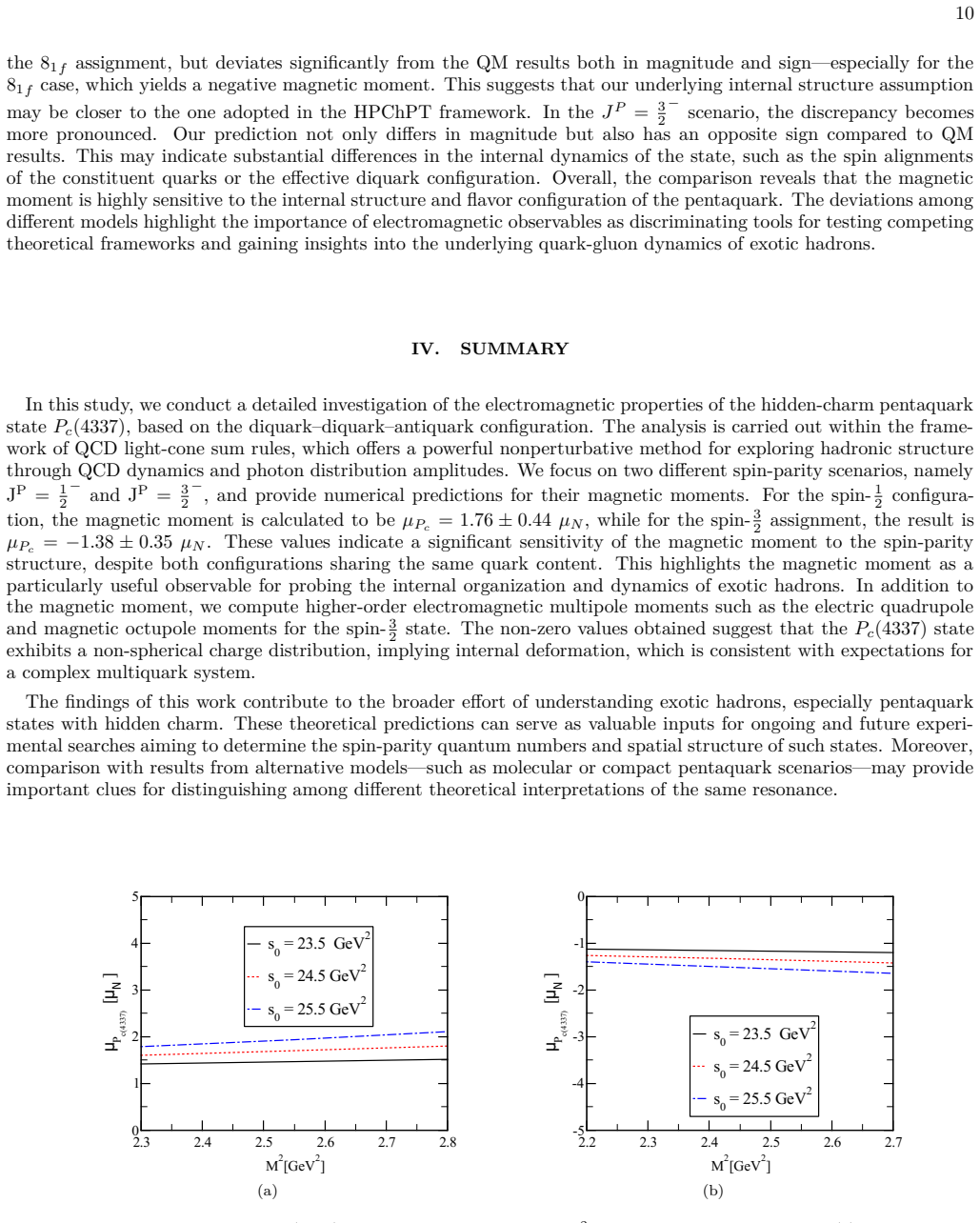
The paper claims that, under the diquark-diquark-antiquark model for the hidden-charm pentaquark $P_c(4337)^+$, QCD light-cone sum rules predict a magnetic moment of $1.76 \pm 0.44\,\mu_N$ for $J^P = \frac{1}{2}^-$ and $-1.38 \pm 0.35\,\mu_N$ for $J^P = \frac{3}{2}^-$, where $\mu_N$ is the nuclear magneton. The spin-$\frac{3}{2}$ state additionally acquires an electric quadrupole moment $Q = (0.65 \pm 0.16)\times 10^{-2}\,\mathrm{fm}^2$ and a magnetic octupole moment $O = (0.16 \pm 0.04)\times 10^{-3}\,\mathrm{fm}^3$, both positive, which the author reads as evidence for a prolate (cigar-shaped) charge distribution rather than a spherical one. The absolute value and sign of the magnetic moment are dominated by the charm quark, with light-quark contributions suppressed to about 2% for $\frac{1}{2}^-$ and about 13% for $\frac{3}{2}^-$. These predictions differ sharply from quark-model and heavy-pentaquark chiral perturbation theory results obtained under a molecular assumption, so the paper offers the magnetic moment as a discriminating observable for the state's quantum numbers and internal configuration.
Load-bearing premise
The calculation assumes that the physical $P_c(4337)^+$ resonance is a compact diquark-diquark-antiquark state whose structure is faithfully captured by the interpolating currents and residue values taken from a prior QCD sum rule analysis (Ref. [31]); if the state were instead a hadronic molecule, or if those currents had poor overlap with the real resonance, the predicted moments would not describe the observed particle.
Editorial extensions
If this is right
- If the $J^P = \frac{1}{2}^-$ assignment is the right one, a future measurement should find $\mu_{P_c} = +1.76 \pm 0.44\,\mu_N$; if $J^P = \frac{3}{2}^-$ is right, it should find $-1.38 \pm 0.35\,\mu_N$, a clear sign flip between the two possibilities.
- The positive electric quadrupole moment $Q = (0.65 \pm 0.16)\times 10^{-2}\,\mathrm{fm}^2$ for the $\frac{3}{2}^-$ state implies a prolate, non-spherical charge distribution, so a later shape-sensitive measurement would provide a direct test of this deformation.
- Since the charm quark contributes about 98% (for $\frac{1}{2}^-$) and about 87% (for $\frac{3}{2}^-$) of the total magnetic moment, the observable is mainly a probe of the charm-quark spin alignment inside the diquark-diquark-antiquark structure.
- The predicted values differ in sign and magnitude from molecular quark-model and chiral perturbation theory results (for example, quark models give $+1.36$ to $+1.86\,\mu_N$ for $\frac{3}{2}^-$ while the present work gives $-1.38\,\mu_N$), so a future measurement could help decide between a compact pentaquark and a hadronic molecule.
Reading between the lines
- Going beyond the paper, the same light-cone sum rule machinery could be applied to the other hidden-charm pentaquarks ($P_c(4312)$, $P_c(4440)$, $P_c(4457)$) to see whether the diquark-diquark-antiquark picture yields a coherent family pattern of magnetic moments; the author does not attempt that here.
- The predicted nonzero quadrupole moment implies that the radiative transition between the $\frac{3}{2}^-$ and $\frac{1}{2}^-$ spin states would carry a measurable electric-quadrupole ($E2$) component, something the paper does not discuss.
- The strong sensitivity of the moment to diquark arrangement suggests that electromagnetic form factors away from $q^2 = 0$—not just the static moments—could discriminate between the two spin-parity assignments, and future photoproduction data near the $P_c$ threshold might access them.
- If future data show that the $J/\psi p$ spectrum near 4337 MeV is better described by a threshold effect or a molecule, then the moments computed here would apply to a different state than the observed resonance, not to the physical $P_c(4337)^+$.
Editorial analysis
A structured set of objections, weighed in public.
Referee Report
Summary. The paper uses QCD light-cone sum rules in an external electromagnetic background field to compute the magnetic dipole moment of the hidden-charm pentaquark P_c(4337)^+ under the diquark-diquark-antiquark picture, for both J^P = 1/2^- and J^P = 3/2^- assignments. The reported values are μ = 1.76 ± 0.44 μ_N for the 1/2^- state and μ = -1.38 ± 0.35 μ_N for the 3/2^- state, and the electric quadrupole and magnetic octupole moments of the 3/2^- state are obtained as Q = (0.65 ± 0.16) × 10^-2 fm^2 and O = (0.16 ± 0.04) × 10^-3 fm^3. The non-zero quadrupole and octupole moments are interpreted as evidence for a non-spherical, prolate charge distribution. The manuscript follows the standard LCSR template: hadronic and QCD representations are matched, Borel transformations and continuum subtraction are applied, and pole dominance and OPE convergence are checked.
Significance. If the calculation were correct, the paper would provide a compact-pentaquark benchmark for the electromagnetic structure of P_c(4337)^+, complementing molecular-model predictions and potentially helping to discriminate the J^P assignment. The work explicitly checks pole dominance and OPE convergence, propagates input uncertainties, and compares with quark-model and chiral-perturbation results. However, the reliability of the predictions is undermined by a serious internal inconsistency in the spin-3/2 interpolating current and by the absence of the spin-1/2 spectral density, so the results as printed cannot be regarded as established.
major comments (3)
- [Section II, Eq. (7)] The printed spin-3/2 interpolating current in Eq. (7) is identically zero as written. In the first factor, ε_ade u_d^T Cγ5 u_e, the matrix Cγ5 is antisymmetric, which makes the Grassmann bilinear u_d^T Cγ5 u_e symmetric under the exchange d ↔ e, while ε_ade is antisymmetric; therefore the sum over d and e vanishes. Consequently the correlation function in Eq. (4), the hadronic representation in Eq. (13), the sum rule in Eq. (33), and the resulting 3/2^- magnetic, quadrupole, and octupole moments in Table II and Eqs. (43)-(44) are not supported by the formalism as written. Moreover, the QCD-side expression in Eq. (25) contains a d-quark propagator in the first trace and appears to be built from a [ud] scalar diquark rather than the [uu] scalar diquark printed in Eq. (7); the text must either correct Eq. (7) to the current actually used or re-derive all 3/2^- expressions from a consistent non-vanishing current.
- [Section III, Eqs. (33)-(39)] The spectral density ρ_2(M^2,s_0) that enters the 1/2^- sum rule in Eq. (34) is never displayed; only ρ_1 for the 3/2^- channel is given, in Eqs. (37)-(39). Without ρ_2 or a code deposit, the headline result μ = 1.76 ± 0.44 μ_N for J^P = 1/2^- cannot be reproduced or independently checked, and the reported pole-dominance and OPE-convergence percentages for that channel cannot be verified from the manuscript.
- [Section II, Eq. (6) and Table I] The residues λ_Pc and λ_Pc* are taken from Ref. [31], which uses interpolating currents for the same quantum numbers. Since the central predictions inherit the overlap assumption of those currents, the paper should state explicitly that the calculation assumes the compact diquark-diquark-antiquark current has dominant overlap with the observed P_c(4337) resonance; a poor overlap or a molecular interpretation would invalidate the numerical predictions. This is a model-assumption caveat that should be placed prominently, not only in the introduction.
minor comments (6)
- [Table I] The value listed for m_Pc is 4335 ± 3 MeV, while Eq. (1) and the abstract quote M = 4337^{+7}_{-4} MeV; please harmonize these numbers and specify which experimental value is used in each sum rule.
- [Section II, Eq. (28)] The text mentions K_3 in connection with the heavy-quark propagator, but only K_1 and K_2 appear in Eq. (30); please remove the reference to K_3 or define it.
- [Section III, Eq. (42)] The notation ρ_i^{Dim N} in the definition of CVG is not defined; please state which dimensions are included in the numerator and denominator.
- [Table III] The notation "8 1f" and "8 2f" in Table III is not explained; please define these flavor representations in the caption or in a footnote.
- [Eq. (39)] There is a typographical error in the condensate term: "m^2_c ¯qq⟩" is missing the opening angle bracket, and the same line has an extra bracket; please correct the typesetting.
- [Fig. 1] The figure shows curves for three discrete values of s_0; adding error bands that combine the input-parameter uncertainties would make the stability claim easier to assess.
Circularity Check
No circularity: the predicted magnetic and multipole moments are new outputs of a standard LCSR calculation, and the flagged Eq. (7) issue is an internal-consistency flaw rather than a construction-based equivalence.
full rationale
The paper's central predictions are not equivalent to its inputs by construction. The magnetic moments are extracted by equating the hadronic representation (Eqs. (20) and (21)) with the QCD-side correlation functions (Eqs. (25) and (26)), applying Borel transformations and continuum subtraction (Eqs. (33)-(36)), and then dividing by the squared residues. The residues lambda_Pc and lambda_P*c enter Table I from Ref. [31], where they are determined by mass sum rules, not from the magnetic-moment data or from the electromagnetic sum rules computed here. The final values in Table II and Eqs. (43)-(44) are new outputs; no term in the printed sum rule expressions contains the predicted mu_Pc as an input. Input parameters (charm mass, experimental masses, condensates, magnetic susceptibility, photon DAs) are taken from independent experimental or theoretical sources (Refs. [59], [71]-[74], [31]), and the interpolating currents from Ref. [31] are an explicit model assumption rather than a fit to the predicted moment. The present author's own prior works are cited mainly as context, comparators, or methodological references and do not carry the derivation in a load-bearing way. The skeptic's concern that Eq. (7) is identically zero because it contains an antisymmetrized [uu] scalar diquark (u^T C gamma5 u = 0) is a serious internal-consistency or typographical issue: if the current vanishes, the printed correlation function, hadronic representation, and resulting 3/2^- sum rule are empty. That issue, however, is a correctness flaw in the stated formalism, not a circular reduction in which the output is built into the input by definition or by fitting. Under the hard rules for this analysis, it does not raise the circularity score, so the appropriate finding is no significant circularity.
Assumptions & free parameters
free parameters (2)
- Borel parameter M^2 =
2.3-2.8 GeV^2 (1/2^-); 2.2-2.7 GeV^2 (3/2^-)
- Continuum threshold s0 =
23.5-25.5 GeV^2
assumptions (4)
- domain assumption Quark-hadron duality: after Borel transformation, continuum and higher resonances are subtracted using threshold s0.
- domain assumption Photon distribution amplitudes up to twist-4 from Ref. [59] fully describe the long-distance photon interaction; charm-quark photon DAs and condensates are negligible.
- domain assumption The interpolating currents in Eqs. (6) and (7) couple predominantly to Pc(4337) with residues lambda_Pc and lambda_P*c from Ref. [31].
- domain assumption The chosen Borel window and continuum threshold satisfy the quoted pole dominance (PC >= 30%) and OPE convergence (CVG <= 5%) criteria.
Cite this review
Pith. "Pith review of Probing the electromagnetic structure of the $P_c(4337)^+$ pentaquark: Insights from a diquark-diquark-antiquark picture for $J^P = \frac{1}{2}^-$ and $\frac{3}{2}^-$ states." pith.science (2026). https://pith.science/paper/74SSYFED
@misc{pith2026250604345,
  author       = {Pith},
  title        = {Pith review of: Probing the electromagnetic structure of the $P_c(4337)^+$ pentaquark: Insights from a diquark-diquark-antiquark picture for $J^P = \frac12^-$ and $\frac32^-$ states},
  year         = {2026},
  howpublished = {\url{https://pith.science/paper/74SSYFED}},
  note         = {Machine review of arXiv:2506.04345}
}
abstract
In this work, the electromagnetic structure of the hidden-charm pentaquark $P_c(4337)$ is investigated within the diquark-diquark-antiquark model using the QCD light-cone sum rule approach. The magnetic moments of the $ P_c(4337) $ state are calculated for the spin-parity assignments $ J^P = \frac{1}{2}^- $ and $\frac{3}{2}^-$. The results are found to be $ \mu_{P_c} = 1.76 \pm 0.44~\mu_N $ for the $ \frac{1}{2}^- $ case and $ \mu_{P_c} = -1.38 \pm 0.35~\mu_N $ for the $ \frac{3}{2}^- $ scenario. These findings offer important insights into the internal quark-gluon structure and electromagnetic features of this multiquark system. Beyond their theoretical relevance, the results serve as essential benchmarks for future experimental studies aimed at determining the quantum numbers and underlying configuration of the $ P_c(4337) $. Additionally, the electric quadrupole and magnetic octupole moments of the spin-$\frac{3}{2}$ state are extracted, indicating a non-spherical charge distribution for this exotic pentaquark.
Figures
Forward citations
Cited by 4 Pith papers
-
Charting doubly strange hidden-charm pentaquarks: An electromagnetic mapping of spin-$\frac{1}{2}$ and $\frac{3}{2}$ states
LCSR calculations of magnetic, quadrupole and octupole moments for S=-2 hidden-charm pentaquarks yield large current-dependent ranges (-4.25 to 5.74 μ_N) dominated by the charm quark in most diquark configurations.
-
Magnetic moments of open bottom--charm molecular pentaquark octets
Open b¯c and c¯b molecular pentaquark octets have near-universal magnetic moments in the 8_2f pseudoscalar channel and a broad, sign-changing spectrum in 8_1f, encoding heavy-quark flavor symmetry breaking.
-
Magnetic dipole moments as probes of doubly-bottom molecular pentaquarks
For the molecular pentaquark configurations BΣ_b, BΣ_b*, and B*Σ_b, the predicted magnetic dipole moments are 2.40, −2.84, and 5.17 nuclear magnetons respectively, with a sign and magnitude pattern sensitive to spin s...
-
Electromagnetic form factors: A window into the $D\Lambda_c$, $D^*\Lambda_c$, and $D\Lambda_c^*$ molecular structure
Using light-cone QCD sum rules, the paper predicts negative magnetic dipole moments of roughly -1.27, -2.78, and -3.80 nuclear magnetons for the DΛc, D*Λc, and DΛc* molecular pentaquark candidates, plus small quadrupo...
Reference graph
Works this paper leans on
-
[31]
Z.-G. Wang, Analysis of the3 2 ± pentaquark states in the diquark-diquark-antiquark model with QCD sum rules, Nucl. Phys. B 913 (2016) 163–208.arXiv:1512.04763,doi:10.1016/j.nuclphysb.2016.09.009
work page Pith review arXiv 2016
-
[1]
R. Aaij, et al., Observation ofJ/ψpResonances Consistent with Pentaquark States inΛ0 b→J/ψK −pDecays, Phys. Rev. Lett. 115 (2015) 072001.arXiv:1507.03414,doi:10.1103/PhysRevLett.115.072001
arXiv 2015
-
[2]
R. Aaij, et al., Observation of a narrow pentaquark state,Pc(4312)+, and of two-peak structure of thePc(4450)+, Phys. Rev. Lett. 122 (22) (2019) 222001.arXiv:1904.03947,doi:10.1103/PhysRevLett.122.222001
arXiv 2019
-
[3]
R. Aaij, et al., Evidence of aJ/ψΛstructure and observation of excitedΞ− states in theΞ− b →J/ψΛK − decay, Sci. Bull. 66 (2021) 1278–1287.arXiv:2012.10380,doi:10.1016/j.scib.2021.02.030
arXiv 2021
-
[4]
R. Aaij, et al., Observation of a J/ψΛResonance Consistent with a Strange Pentaquark Candidate in B-→J/ψΛp¯Decays, Phys. Rev. Lett. 131 (3) (2023) 031901.arXiv:2210.10346,doi:10.1103/PhysRevLett.131.031901
arXiv 2023
-
[5]
I. Adachi, et al., Evidence of thePccs(4459)0 inΥ(1S,2S)inclusive decays at Belle (2 2025).arXiv:2502.09951
arXiv 2025
-
[6]
A. Esposito, A. L. Guerrieri, F. Piccinini, A. Pilloni, A. D. Polosa, Four-Quark Hadrons: an Updated Review, Int. J. Mod. Phys. A 30 (2015) 1530002.arXiv:1411.5997,doi:10.1142/S0217751X15300021
arXiv 2015
-
[7]
A. Esposito, A. Pilloni, A. D. Polosa, Multiquark Resonances, Phys. Rept. 668 (2017) 1–97.arXiv:1611.07920,doi: 10.1016/j.physrep.2016.11.002
arXiv 2017
Show all 75 references
-
[8]
S. L. Olsen, T. Skwarnicki, D. Zieminska, Nonstandard heavy mesons and baryons: Experimental evidence, Rev. Mod. Phys. 90 (1) (2018) 015003.arXiv:1708.04012,doi:10.1103/RevModPhys.90.015003
2018 arXiv
-
[9]
R. F. Lebed, R. E. Mitchell, E. S. Swanson, Heavy-Quark QCD Exotica, Prog. Part. Nucl. Phys. 93 (2017) 143–194. arXiv:1610.04528,doi:10.1016/j.ppnp.2016.11.003
2017 arXiv
-
[10]
Nielsen, F
M. Nielsen, F. S. Navarra, S. H. Lee, New Charmonium States in QCD Sum Rules: A Concise Review, Phys. Rept. 497 (2010) 41–83.arXiv:0911.1958,doi:10.1016/j.physrep.2010.07.005
2010 arXiv
-
[11]
Brambilla, S
N. Brambilla, S. Eidelman, C. Hanhart, A. Nefediev, C.-P. Shen, C. E. Thomas, A. Vairo, C.-Z. Yuan, TheXYZstates: experimental and theoretical status and perspectives, Phys. Rept. 873 (2020) 1–154.arXiv:1907.07583,doi:10.1016/j. physrep.2020.05.001
2020 arXiv
-
[12]
Agaev, K
S. Agaev, K. Azizi, H. Sundu, Four-quark exotic mesons, Turk. J. Phys. 44 (2) (2020) 95–173.arXiv:2004.12079, doi:10.3906/fiz-2003-15
2020 arXiv
-
[13]
H.-X. Chen, W. Chen, X. Liu, S.-L. Zhu, The hidden-charm pentaquark and tetraquark states, Phys. Rept. 639 (2016) 1–121.arXiv:1601.02092,doi:10.1016/j.physrep.2016.05.004
2016 arXiv
-
[14]
A. Ali, J. S. Lange, S. Stone, Exotics: Heavy Pentaquarks and Tetraquarks, Prog. Part. Nucl. Phys. 97 (2017) 123–198. arXiv:1706.00610,doi:10.1016/j.ppnp.2017.08.003
2017 arXiv
-
[15]
F.-K. Guo, C. Hanhart, U.-G. Meißner, Q. Wang, Q. Zhao, B.-S. Zou, Hadronic molecules, Rev. Mod. Phys. 90 (1) (2018) 015004, [Erratum: Rev.Mod.Phys. 94, 029901 (2022)].arXiv:1705.00141,doi:10.1103/RevModPhys.90.015004. 13
2018 arXiv
-
[16]
Liu, H.-X
Y.-R. Liu, H.-X. Chen, W. Chen, X. Liu, S.-L. Zhu, Pentaquark and Tetraquark states, Prog. Part. Nucl. Phys. 107 (2019) 237–320.arXiv:1903.11976,doi:10.1016/j.ppnp.2019.04.003
2019 arXiv
-
[17]
G. Yang, J. Ping, J. Segovia, Tetra- and penta-quark structures in the constituent quark model, Symmetry 12 (11) (2020) 1869.arXiv:2009.00238,doi:10.3390/sym12111869
2020 arXiv
-
[18]
Dong, F.-K
X.-K. Dong, F.-K. Guo, B.-S. Zou, A survey of heavy-antiheavy hadronic molecules, Progr. Phys. 41 (2021) 65–93.arXiv: 2101.01021,doi:10.13725/j.cnki.pip.2021.02.001
2021 arXiv
-
[19]
Dong, F.-K
X.-K. Dong, F.-K. Guo, B.-S. Zou, A survey of heavy–heavy hadronic molecules, Commun. Theor. Phys. 73 (12) (2021) 125201.arXiv:2108.02673,doi:10.1088/1572-9494/ac27a2
2021 arXiv
-
[20]
L. Meng, B. Wang, G.-J. Wang, S.-L. Zhu, Chiral perturbation theory for heavy hadrons and chiral effective field theory for heavy hadronic molecules, Phys. Rept. 1019 (2023) 1–149.arXiv:2204.08716,doi:10.1016/j.physrep.2023.04.003
2023 arXiv
-
[21]
H.-X. Chen, W. Chen, X. Liu, Y.-R. Liu, S.-L. Zhu, An updated review of the new hadron states, Rept. Prog. Phys. 86 (2) (2023) 026201.arXiv:2204.02649,doi:10.1088/1361-6633/aca3b6
2023 arXiv
-
[22]
Aaij, et al., Evidence for a new structure in theJ/ψpandJ/ψ¯psystems inB 0 s →J/ψp¯pdecays, Phys
R. Aaij, et al., Evidence for a new structure in theJ/ψpandJ/ψ¯psystems inB 0 s →J/ψp¯pdecays, Phys. Rev. Lett. 128 (6) (2022) 062001.arXiv:2108.04720,doi:10.1103/PhysRevLett.128.062001
2022
-
[23]
Germani, F
D. Germani, F. Niliani, A. D. Polosa, A model of pentaquarks, Eur. Phys. J. C 84 (7) (2024) 755.arXiv:2403.04068, doi:10.1140/epjc/s10052-024-13103-y
2024 arXiv
-
[24]
C.-W. Shen, D. Rönchen, U.-G. Meißner, B.-S. Zou, Exploratory study of possible resonances in heavy meson - heavy baryon coupled-channel interactions, Chin. Phys. C 42 (2) (2018) 023106.arXiv:1710.03885,doi:10.1088/1674-1137/ 42/2/023106
2018 arXiv
-
[25]
Yan, F.-Z
M.-J. Yan, F.-Z. Peng, M. Sánchez Sánchez, M. Pavon Valderrama, Interpretations of the new LHCbPc(4337)+ pentaquark state, Eur. Phys. J. C 82 (6) (2022) 574.arXiv:2108.05306,doi:10.1140/epjc/s10052-022-10522-7
2022 arXiv
-
[26]
J.-Z. Wang, X. Liu, T. Matsuki, Evidence supporting the existence of Pc(4380)±from the recent measurements of Bs→J/ψpp¯, Phys. Rev. D 104 (11) (2021) 114020.arXiv:2110.09423,doi:10.1103/PhysRevD.104.114020
2021 arXiv
-
[27]
S. X. Nakamura, A. Hosaka, Y. Yamaguchi,Pc(4312)+ andP c(4337)+ as interferingΣc ¯DandΛ c ¯D∗ threshold cusps, Phys. Rev. D 104 (9) (2021) L091503.arXiv:2109.15235,doi:10.1103/PhysRevD.104.L091503
2021 arXiv
-
[28]
E. Y. Paryev, Towards clarifying the possibility of observation of the LHCb hidden-charm pentaquarks Pc+(4312), Pc+(4337), Pc+(4440) and Pc+(4457) in near-threshold charmonium photoproduction off protons and nuclei, Nucl. Phys. A 1029 (2023) 122562.arXiv:2211.16037,doi:10.1016...
2023 arXiv
-
[29]
Therefore, it can be concluded that, according to QCD sum rules, the observed state cannot possess the quantum numbers1 2 + and 3 2 +
andM= 4.51±0.13GeV [30], respectively, which are significantly different from the experimentally measured mass of thePc(4337)pentaquark. Therefore, it can be concluded that, according to QCD sum rules, the observed state cannot possess the quantum numbers1 2 + and 3 2 + . Howe...
-
[30]
Wang, Analysis of the1 2 ± pentaquark states in the diquark–diquark–antiquark model with QCD sum rules, Eur
Z.-G. Wang, Analysis of the1 2 ± pentaquark states in the diquark–diquark–antiquark model with QCD sum rules, Eur. Phys. J. C 76 (3) (2016) 142.arXiv:1509.06436,doi:10.1140/epjc/s10052-016-3983-2
2016 arXiv
-
[32]
Wang, Analysis of thePc(4312),P c(4440),P c(4457)and related hidden-charm pentaquark states with QCD sum rules, Int
Z.-G. Wang, Analysis of thePc(4312),P c(4440),P c(4457)and related hidden-charm pentaquark states with QCD sum rules, Int. J. Mod. Phys. A 35 (01) (2020) 2050003.arXiv:1905.02892,doi:10.1142/S0217751X20500037
2020 arXiv
-
[33]
Wang, Analysis of the¯DΣc, ¯DΣ∗ c, ¯D∗Σc and ¯D∗Σ∗ c pentaquark molecular states with QCD sum rules, Int
Z.-G. Wang, Analysis of the¯DΣc, ¯DΣ∗ c, ¯D∗Σc and ¯D∗Σ∗ c pentaquark molecular states with QCD sum rules, Int. J. Mod. Phys. A 34 (19) (2019) 1950097.arXiv:1806.10384,doi:10.1142/S0217751X19500970
2019 arXiv
-
[34]
G.-J. Wang, R. Chen, L. Ma, X. Liu, S.-L. Zhu, Magnetic moments of the hidden-charm pentaquark states, Phys. Rev. D 94 (9) (2016) 094018.arXiv:1605.01337,doi:10.1103/PhysRevD.94.094018
2016 arXiv
-
[35]
Özdem, Shedding light on the nature of the Pcs(4459) pentaquark state, Phys
U. Özdem, Shedding light on the nature of the Pcs(4459) pentaquark state, Phys. Rev. D 111 (7) (2025) 074038.arXiv: 2411.11442,doi:10.1103/PhysRevD.111.074038
2025 arXiv
-
[36]
Özdem, Elucidating the nature of hidden-charm pentaquark states with spin-32 through their electromagnetic form factors, Phys
U. Özdem, Elucidating the nature of hidden-charm pentaquark states with spin-32 through their electromagnetic form factors, Phys. Lett. B 851 (2024) 138551.arXiv:2402.03802,doi:10.1016/j.physletb.2024.138551
2024 arXiv
-
[37]
Özdem, Electromagnetic properties of D¯(∗)Ξc’, D¯(∗)Λc, D¯s(∗)Λc and D¯s(∗)Ξc pentaquarks, Phys
U. Özdem, Electromagnetic properties of D¯(∗)Ξc’, D¯(∗)Λc, D¯s(∗)Λc and D¯s(∗)Ξc pentaquarks, Phys. Lett. B 846 (2023) 138267.arXiv:2303.10649,doi:10.1016/j.physletb.2023.138267
2023 arXiv
-
[38]
Özdem, Investigation of magnetic moment of Pcs(4338) and Pcs(4459) pentaquark states, Phys
U. Özdem, Investigation of magnetic moment of Pcs(4338) and Pcs(4459) pentaquark states, Phys. Lett. B 836 (2023) 137635.arXiv:2208.07684,doi:10.1016/j.physletb.2022.137635
2023 arXiv
-
[39]
Özdem, K
U. Özdem, K. Azizi, Electromagnetic multipole moments of theP+ c (4380)pentaquark in light-cone QCD, Eur. Phys. J. C 78 (5) (2018) 379.arXiv:1803.06831,doi:10.1140/epjc/s10052-018-5873-2
2018 arXiv
-
[40]
Ortiz-Pacheco, R
E. Ortiz-Pacheco, R. Bijker, C. Fernández-Ramírez, Hidden charm pentaquarks: mass spectrum, magnetic moments, and photocouplings, J. Phys. G 46 (6) (2019) 065104.arXiv:1808.10512,doi:10.1088/1361-6471/ab096d
2019 arXiv
-
[41]
Xu, Y.-L
Y.-J. Xu, Y.-L. Liu, M.-Q. Huang, The magnetic moment ofPc(4312)as a ¯DΣc molecular state, Eur. Phys. J. C 81 (5) (2021) 421.arXiv:2008.07937,doi:10.1140/epjc/s10052-021-09211-8
2021 arXiv
-
[42]
Özdem, Electromagnetic properties of thePc (4312) pentaquark state, Chin
U. Özdem, Electromagnetic properties of thePc (4312) pentaquark state, Chin. Phys. C 45 (2) (2021) 023119.doi: 10.1088/1674-1137/abd01c
2021 doi
-
[43]
Özdem, Magnetic dipole moments of the hidden-charm pentaquark states:Pc(4440),P c(4457)andP cs(4459), Eur
U. Özdem, Magnetic dipole moments of the hidden-charm pentaquark states:Pc(4440),P c(4457)andP cs(4459), Eur. Phys. J. C 81 (4) (2021) 277.arXiv:2102.01996,doi:10.1140/epjc/s10052-021-09070-3
2021 arXiv
-
[44]
Li, Z.-W
M.-W. Li, Z.-W. Liu, Z.-F. Sun, R. Chen, Magnetic moments and transition magnetic moments of Pc and Pcs states, Phys. Rev. D 104 (5) (2021) 054016.arXiv:2106.15053,doi:10.1103/PhysRevD.104.054016
2021 arXiv
-
[45]
F.-L. Wang, X. Liu, Higher molecular PψsΛ/Σpentaquarks arising from theΞc(’,*)D¯1/Ξc(’,*)D¯2* interactions, Phys. Rev. D 108 (5) (2023) 054028.arXiv:2307.08276,doi:10.1103/PhysRevD.108.054028
2023 arXiv
-
[46]
Gao, H.-S
F. Gao, H.-S. Li, Magnetic moments of hidden-charm strange pentaquark states*, Chin. Phys. C 46 (12) (2022) 123111. arXiv:2112.01823,doi:10.1088/1674-1137/ac8651
2022 arXiv
-
[47]
Guo, H.-S
F. Guo, H.-S. Li, Analysis of the hidden-charm pentaquark states based on magnetic moment and transition magnetic 14 moment, Eur. Phys. J. C 84 (4) (2024) 392.arXiv:2304.10981,doi:10.1140/epjc/s10052-024-12699-5
2024 arXiv
-
[48]
Özdem, Magnetic moments of pentaquark states in light-cone sum rules, Eur
U. Özdem, Magnetic moments of pentaquark states in light-cone sum rules, Eur. Phys. J. A 58 (3) (2022) 46.doi: 10.1140/epja/s10050-022-00700-2
2022 doi
-
[49]
Wang, S.-Q
F.-L. Wang, S.-Q. Luo, H.-Y. Zhou, Z.-W. Liu, X. Liu, Exploring the electromagnetic properties of theΞc(’,*)D¯s* and Ωc(*)D¯s* molecular states, Phys.Rev. D 108 (3) (2023) 034006.arXiv:2210.02809,doi:10.1103/PhysRevD.108.034006
2023 arXiv
-
[50]
Wang, H.-Y
F.-L. Wang, H.-Y. Zhou, Z.-W. Liu, X. Liu, What can we learn from the electromagnetic properties of hidden-charm molecular pentaquarks with single strangeness?, Phys. Rev. D 106 (5) (2022) 054020.arXiv:2208.10756,doi:10.1103/ PhysRevD.106.054020
2022 arXiv
-
[51]
Özdem, Analysis of the isospin eigenstate¯DΣc, ¯D∗Σc, and ¯DΣ∗ c pentaquarks by their electromagnetic properties, Eur
U. Özdem, Analysis of the isospin eigenstate¯DΣc, ¯D∗Σc, and ¯DΣ∗ c pentaquarks by their electromagnetic properties, Eur. Phys. J. C 84 (8) (2024) 769.arXiv:2401.12678,doi:10.1140/epjc/s10052-024-13124-7
2024 arXiv
-
[52]
H.-S. Li, F. Guo, Y.-D. Lei, F. Gao, Magnetic moments and axial charges of the octet hidden-charm molecular pentaquark family, Phys. Rev. D 109 (9) (2024) 094027.arXiv:2401.14767,doi:10.1103/PhysRevD.109.094027
2024 arXiv
-
[53]
Li, Molecular pentaquark magnetic moments in heavy pentaquark chiral perturbation theory, Phys
H.-S. Li, Molecular pentaquark magnetic moments in heavy pentaquark chiral perturbation theory, Phys. Rev. D 109 (11) (2024) 114039.arXiv:2401.14759,doi:10.1103/PhysRevD.109.114039
2024 arXiv
-
[54]
Özdem, Investigation on the electromagnetic properties of theD(∗)Σ(∗) c molecules, Eur
U. Özdem, Investigation on the electromagnetic properties of theD(∗)Σ(∗) c molecules, Eur. Phys. J. A 61 (1) (2025) 10. arXiv:2405.07273,doi:10.1140/epja/s10050-024-01477-2
2025 arXiv
-
[55]
Özdem, Insight into the nature of thePc(4457)and related pentaquarks, Eur
U. Özdem, Insight into the nature of thePc(4457)and related pentaquarks, Eur. Phys. J. C 85 (6) (2025) 624.arXiv: 2409.09449,doi:10.1140/epjc/s10052-025-14323-6
2025 arXiv
-
[56]
Mutuk, X.-W
H. Mutuk, X.-W. Kang, Unveiling the structure of hidden-bottom strange pentaquarks via magnetic moments, Phys. Lett. B 855 (2024) 138772.arXiv:2405.07066,doi:10.1016/j.physletb.2024.138772
2024 arXiv
-
[57]
Mutuk, Magnetic moments of hidden-bottom pentaquark states, Eur
H. Mutuk, Magnetic moments of hidden-bottom pentaquark states, Eur. Phys. J. C 84 (8) (2024) 874.arXiv:2403.16616, doi:10.1140/epjc/s10052-024-13263-x
2024 arXiv
-
[58]
Mutuk, In the pursuit for the nature of thePc(4457)and related pentaquarks (11 2024).arXiv:2411.16486
H. Mutuk, In the pursuit for the nature of thePc(4457)and related pentaquarks (11 2024).arXiv:2411.16486
2024 arXiv
-
[59]
Özdem, Unveiling the electromagnetic structure and intrinsic dynamics of spin-3 2 hidden-charm pentaquarks: A com- prehensive QCD analysis (4 2025).arXiv:2504.13488
U. Özdem, Unveiling the electromagnetic structure and intrinsic dynamics of spin-3 2 hidden-charm pentaquarks: A com- prehensive QCD analysis (4 2025).arXiv:2504.13488
2025 arXiv
-
[60]
P. Ball, V. M. Braun, N. Kivel, Photon distribution amplitudes in QCD, Nucl. Phys. B 649 (2003) 263–296.arXiv: hep-ph/0207307,doi:10.1016/S0550-3213(02)01017-9
2003 arXiv
-
[61]
V. A. Novikov, M. A. Shifman, A. I. Vainshtein, V. I. Zakharov, Calculations in External Fields in Quantum Chromody- namics. Technical Review, Fortsch. Phys. 32 (1984) 585
1984
-
[62]
B. L. Ioffe, A. V. Smilga, Nucleon Magnetic Moments and Magnetic Properties of Vacuum in QCD, Nucl. Phys. B 232 (1984) 109–142.doi:10.1016/0550-3213(84)90364-X
1984 doi
-
[63]
D. B. Leinweber, R. M. Woloshyn, T. Draper, Electromagnetic structure of octet baryons, Phys. Rev. D 43 (1991) 1659– 1678.doi:10.1103/PhysRevD.43.1659
1991 doi
-
[64]
H. J. Weber, H. Arenhovel, Isobar Configurations in Nuclei, Phys. Rept. 36 (1978) 277–348.doi:10.1016/0370-1573(78) 90187-4
1978 doi
-
[65]
Nozawa, D
S. Nozawa, D. B. Leinweber, Electromagnetic form-factors of spin 3/2 baryons, Phys. Rev. D 42 (1990) 3567–3571. doi:10.1103/PhysRevD.42.3567
1990 doi
-
[66]
Pascalutsa, M
V. Pascalutsa, M. Vanderhaeghen, S. N. Yang, Electromagnetic excitation of the Delta(1232)-resonance, Phys. Rept. 437 (2007) 125–232.arXiv:hep-ph/0609004,doi:10.1016/j.physrep.2006.09.006
2007 arXiv
-
[67]
Ramalho, M
G. Ramalho, M. T. Pena, F. Gross, Electric quadrupole and magnetic octupole moments of the Delta, Phys. Lett. B 678 (2009) 355–358.arXiv:0902.4212,doi:10.1016/j.physletb.2009.06.052
2009 arXiv
-
[68]
I. I. Balitsky, V. M. Braun, Evolution Equations for QCD String Operators, Nucl. Phys. B 311 (1989) 541–584.doi: 10.1016/0550-3213(89)90168-5
1989 doi
-
[69]
V. M. Belyaev, B. Y. Blok, CHARMED BARYONS IN QUANTUM CHROMODYNAMICS, Z. Phys. C 30 (1986) 151. doi:10.1007/BF01560689
1986 doi
-
[70]
Antonov, J
D. Antonov, J. E. F. T. Ribeiro, Quark condensate for various heavy flavors, Eur. Phys. J. C 72 (2012) 2179.arXiv: 1209.0408,doi:10.1140/epjc/s10052-012-2179-7
2012 arXiv
-
[71]
U. Özdem, Unveiling the underlying structure of axial-vector bottom-charm tetraquarks in the light of their magnetic moments, JHEP 05 (2024) 301.arXiv:2403.16191,doi:10.1007/JHEP05(2024)301
2024 arXiv
-
[72]
R. L. Workman, et al., Review of Particle Physics, PTEP 2022 (2022) 083C01.doi:10.1093/ptep/ptac097
2022 doi
-
[73]
J. Rohrwild, Determination of the magnetic susceptibility of the quark condensate using radiative heavy meson decays, JHEP 09 (2007) 073.arXiv:0708.1405,doi:10.1088/1126-6708/2007/09/073
2007 arXiv
-
[74]
B. L. Ioffe, QCD at low energies, Prog. Part. Nucl. Phys. 56 (2006) 232–277.arXiv:hep-ph/0502148,doi:10.1016/j. ppnp.2005.05.001
2006 arXiv
-
[75]
Narison, mc,b, < αsG2 >andα s from Heavy Quarkonia, Nucl
S. Narison, mc,b, < αsG2 >andα s from Heavy Quarkonia, Nucl. Part. Phys. Proc. 300-302 (2018) 153–164.doi: 10.1016/j.nuclphysbps.2018.12.026
2018 doi
Reviewed August 7, 2026 · model on record in the stance chip above.
Discussion (0). Sign in to comment.