REVIEW 3 major objections 5 minor 21 references
Feature-Based Lie Group Transformer for Real-World Applications
T0 review · 3 major / 5 minor · reviewed 2026-08-07 · deepseek-v4-flash
Pith's one-line read A single unsupervised model learns to categorize a real object's rotations and translations while also masking it from its background.
desk verdict A plausible extension of the authors' pixel-level Lie group transformer, but the central claim of unsupervised rotation/translation categorization on real-world data is never actually measured, and the group-theoretic story rests on a homomorphism that 2D rigid motions do not admit. read the letter →
The pith
A machine-rendered reading of the paper's core claim, the machinery that carries it, and where it could break.
The reading
What carries the argument
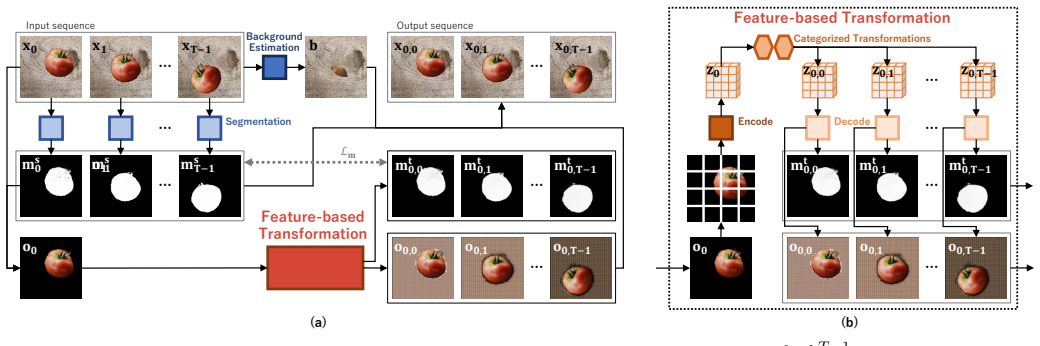
The load-bearing construct is the group homomorphism f: G → G′ with f(g∘v)=v, whose kernel {g} is a normal subgroup of the transformation group; because kernels are always normal subgroups, this gives an algebraic decomposition of transformations into a rotation-like part (the kernel) and a translation-like part (the quotient), generalizing commutativity to conditional independence. On top of this, four components carry the implementation: a patch encoder that maps an object image to an N×N grid of feature vectors; a NeuralODE-based coordinate shift that translates those feature vectors while guaranteeing the Lie group property; a decoder conditioned on the transformation parameters that rotates feature vectors; and a U-Net-style segmenter whose inferred masks are tied to the transformed mask of the first frame by a mask reconstruction loss, making segmentation and transformation categorization mutually consistent.
What would settle it
A concrete test is to train the model on sequences with pure translation (no rotation) and check whether the learned g channel stays at identity; if it does not, the kernel is not being recovered from geometry. A sharper falsifier is the conjugation check required for a genuine normal-subgroup kernel: apply a learned v, then a learned g, then the inverse v, and test whether the result is still classified as g. For the 2D rigid motion group, v g $v^{{-1}}$ generally does not lie in the rotation subgroup, so this experiment would show whether the kernel property is discovered or merely enforced by the loss.
Extended reading notes
Core claim
The central claim is that a single unsupervised pipeline can, from a sequence of scene images in which only one object moves against a static background, learn both to categorize the object's motion into two transformation types and to segment the moving object from the background, with no labels. The categorization is defined algebraically: a homomorphism f with f(g∘v)=v makes the kernel of f exactly the g-type transformations, a rotation-like subgroup, while v carries the translation-like quotient; the Lie group property is implemented by integrating an ODE for the coordinate shifts. To handle real imagery, the object image is divided into N×N patches, each encoded into a feature vector, and translations act on the resulting feature grid, while a decoder that receives the transformation parameters performs the patch-centered rotation that feature translation alone cannot express. Object segmentation is formulated as grouping the features that share the same transformation, and a mask reconstruction loss forces each inferred mask to match the mask obtained by applying the learned transformation to the first frame, which the experiments show is necessary for correct masks. On a synthetic object without background and on a real tomato on wood, the model reports successful simultaneous learning of transformation categorization and object segmentation, with the homomorphism and self-supervision losses enforcing the algebraic structure.
Load-bearing premise
The method assumes that the two transformation types admit a group homomorphism whose kernel is exactly the rotation-type transformations, but for the 2D rigid motion group the rotation subgroup is not normal, so the losses Lh and Ls enforce that algebraic structure rather than recovering it from the data; if that premise fails, the categorization is an imposed fit, not a discovered structure.
Editorial extensions
If this is right
- Unsupervised learning can separate a raw scene sequence into a static background, a moving object, and the rotation-like and translation-like components of that object's motion.
- The group-theoretic notion of conditional independence becomes trainable on real high-resolution images, not just on toy pixel-translation data.
- The mask reconstruction loss offers a principled way to bootstrap object segmentation from transformation consistency, which can be carried over to scenes with multiple objects.
- Because feature translation runs on an N×N grid instead of on H×W pixels, the method scales to high-resolution imagery with reduced computational cost.
Reading between the lines
- The homomorphism is imposed by losses, so an immediate extension is to measure how strongly the learned transformations actually satisfy the kernel property (for instance, with the conjugation test described in the falsifier) as a diagnostic of whether the algebra is discovered or enforced.
- The authors note the static-background assumption; moving to a moving camera would require learning camera motion as an additional transformation and grouping as objects only the features not explained by camera motion, a natural next step they leave open.
- The conditioned decoder receives explicit transformation parameters, so probing its internal representations could reveal where and how patch-centered rotation is encoded, offering a window into the learned geometry.
Editorial analysis
A structured set of objections, weighed in public.
Referee Report
Summary. The paper proposes a feature-based Lie group transformer that learns two categorized transformations from image sequences and simultaneously performs unsupervised object segmentation. The method maps image patches to feature vectors, applies pixel-style translations to feature grids, and uses a conditioned decoder that also rotates feature vectors to handle patch-centered rotations. Object segmentation is implemented by masking the scene and enforcing consistency between a directly inferred mask and a mask produced by the feature transformation. Experiments on a synthetic object dataset and a real tomato-on-wood dataset report improved reconstruction (Ir) and segmentation (Im) when the proposed components are used, and the authors claim the first simultaneous unsupervised categorization of feature-based Lie group transformations and object segmentation on real-world background data.
Significance. If the central claims were fully supported, the paper would extend Lie group transformation learning from low-resolution, background-free pixel data to feature-based, real-world scenes, providing a step toward representation learning rooted in algebraic structure. The conditioned-decoder trick for rotating feature vectors is a plausible engineering contribution, and the mask reconstruction loss is a reasonable way to encourage temporally consistent segmentation. However, the paper's defining novelty—unsupervised categorization of rotations versus translations through group decomposition—is compromised by an algebraic inconsistency between the theory and the experiment labels, and by the absence of any quantitative metric that directly tests the categorization. The reported metrics (Ir and Im) only measure reconstruction fidelity and mask overlap, not whether the learned transformation parameters correspond to the intended geometric operations or whether the enforced homomorphism actually describes the data. The paper does not ship code or machine-checked proofs, but it does provide clear ablations for the decoder conditioning and mask loss.
major comments (3)
- [Section II-B, Eqs. (7)-(8)] The homomorphism f(g∘v)=v with ker(f) equal to the set of g-transformations is mathematically valid only when the kernel is a normal subgroup of the full transformation group. For the 2D rigid motion group SE(2) used in the experiments, the rotation subgroup is not normal; the normal subgroup is the translation subgroup, and the projection onto the translation component is not a group homomorphism under semidirect-product composition. Since the experimental sections (e.g., Fig. 5 caption) identify g as rotation and v as translation, the paper's algebraic decomposition does not apply to the demonstrated setting. The losses Lh and Ls in Eqs. (17) and (19)-(20) enforce this structure by construction, so the learned 'categorization' is an imposed constraint rather than a discovered group-theoretic decomposition.
- [Section IV-B, Section IV-C, Eqs. (16) and (39)] The claim that transformations are 'categorized appropriately' (Fig. 5 caption) is not supported by any quantitative metric. The only reported metrics are Ir (image reconstruction MSE, Eq. 16) and Im (mask IoU, Eq. 39), neither of which verifies that the learned parameter pairs (λg,cg) and (λv,cv) correspond to rotation versus translation, nor that the homomorphism condition in Eq. (9) holds on test sequences. A direct quantitative evaluation is needed—for example, comparing the estimated transformation parameters with the ground truth motion parameters (rotation angle and translation vector) or reporting the values of Lh and Ls on held-out sequences—before the central categorization claim can be accepted.
- [Section II-D, Eqs. (19)-(20)] The self-supervised parameter-estimation loss Ls explicitly trains the estimator I to output zero parameter values for the transformation that was replaced by identity. This is a form of imposed supervision: the network is told that one transformation is absent and the other is present in each synthesized sequence. Consequently, the statement in Section I that the method 'achieved the simultaneous unsupervised categorization' is overstated; the categorization is partly enforced by the loss design, and the paper should acknowledge this or demonstrate that the categorization arises even without Ls.
minor comments (5)
- [Section II-B] The symbol g is used both as a specific transformation and as the group element variable; clarify the notation to avoid confusion in Eqs. (6)-(9).
- [Section II-C, Eq. (10)] The integral in Eq. (10) is written without an explicit integration variable; adding 'dt' in the limits and integrand would improve clarity.
- [Section III-A] The patch size (H/N)×(W/N) is implied but never stated explicitly; please state it in the text.
- [Fig. 3b and Fig. 5] The arrows used to represent g0,1 and v0,1 are not clearly distinguished in the figure captions; indicate which arrows correspond to which transformation and what the arrow direction means.
- [Section IV] The paper compares the proposed method only against its own ablations. Adding a comparison with a recent unsupervised segmentation baseline (e.g., Slot Attention or DINOSAUR) would strengthen the empirical evaluation.
Circularity Check
The transformation-categorization claim is enforced by the homomorphism and self-supervised losses rather than independently measured; the segmentation result retains external IoU grounding.
-
fitted input called prediction
[Section II-D, Eqs. 17 and 20; Section IV-C, Fig. 5 claim]
"We consider a homomorphism f that satisfies f(g ◦ v) = v. The kernel of this homomorphism f coincides with the set of g... Lh = M SE(v0,2o0, (v0,1 · v1,2)o0)... Ls = M SE(I(og→e 0:T −1), (0, 0, λv 0,1, cv 0,1)) + M SE(I(ov→e 0:T −1), (λg 0,1, cg 0,1, 0, 0))... Transformations were categorized appropriately, with transformation g representing a rotation and transformation v representing a translation."
The paper defines the category boundary as the kernel of an assumed homomorphism f(g◦v)=v (Eqs. 7-8). It then trains the model with Lh, which enforces exactly that homomorphism on v, and Ls, which supervises the estimator I to recognize the model's own g/v slots through identity substitution. The categorical identity 'g=rotation, v=translation' is therefore not a quantity predicted from the data and checked against ground truth; it is the same constraint being optimized. No external quantitative metric is reported for this identity on Real-obj-bg, such as agreement of learned (λ,c,A,b) with ground-truth rotation angles/translation vectors or hold-out accuracy of I.
full rationale
The paper's most defensible contribution is object segmentation, which is externally grounded through ground-truth IoU (Eq. 39) and an ablation against the mask reconstruction loss. That part is not circular. The transformation-categorization claim, however, is circular in a partial sense: the algebraic decomposition into g and v is not discovered from unconstrained data but imposed through the homomorphism loss Lh and the self-supervised parameter-estimation loss Ls. These losses directly encode Eqs. 7-9, and the paper's conclusion that 'transformation g represents a rotation and transformation v represents a translation' is asserted from visualizations of the trained model's own parameters, with no quantitative evaluation connecting those parameters to the true rotation/translation labels. This is closer to a fitted constraint than an emergent prediction. The normal-subgroup concern about whether rotation is a normal subgroup of the 2D rigid motion group is a correctness risk, not itself a circularity, so it does not increase the score further. Overall, no load-bearing self-citation circularity was found; the moderate score reflects the self-referential evidence for the central categorization claim while acknowledging the independent IoU-based segmentation validation.
Assumptions & free parameters
free parameters (3)
- per-sequence transformation parameters (lambda_g, c_g, lambda_v, c_v) =
learned per sequence and per i-j pair via estimator I
- loss weights alpha, beta, gamma, delta, epsilon, zeta, eta =
1, 1, 0.1, 0.01, 1, 0.005, 0.1 (Real-obj-bg); 1, 1, 1, 0.1, 1, 0.05 (Syn-obj)
- patch grid N and feature dimension Z =
N=32, Z=16
assumptions (4)
- domain assumption Transformations form a group G with elements g∘v, and the map f(g∘v)=v is a homomorphism onto the subgroup of v transformations.
- domain assumption Geometric transformations g and v are isometric Lie group transformations (rotation and translation), with constant per-timestep amount and direction.
- domain assumption The background is static and only one object moves, with a fixed camera.
- domain assumption Feature translation of N x N patch features, together with a transformation-conditioned decoder, can represent patch-centered rotations without destroying object identity.
Cite this review
Pith. "Pith review of Feature-Based Lie Group Transformer for Real-World Applications." pith.science (2026). https://pith.science/paper/25CUZAWO
@misc{pith2026250604668,
  author       = {Pith},
  title        = {Pith review of: Feature-Based Lie Group Transformer for Real-World Applications},
  year         = {2026},
  howpublished = {\url{https://pith.science/paper/25CUZAWO}},
  note         = {Machine review of arXiv:2506.04668}
}
read the original abstract
The main goal of representation learning is to acquire meaningful representations from real-world sensory inputs without supervision. Representation learning explains some aspects of human development. Various neural network (NN) models have been proposed that acquire empirically good representations. However, the formulation of a good representation has not been established. We recently proposed a method for categorizing changes between a pair of sensory inputs. A unique feature of this approach is that transformations between two sensory inputs are learned to satisfy algebraic structural constraints. Conventional representation learning often assumes that disentangled independent feature axes is a good representation; however, we found that such a representation cannot account for conditional independence. To overcome this problem, we proposed a new method using group decomposition in Galois algebra theory. Although this method is promising for defining a more general representation, it assumes pixel-to-pixel translation without feature extraction, and can only process low-resolution images with no background, which prevents real-world application. In this study, we provide a simple method to apply our group decomposition theory to a more realistic scenario by combining feature extraction and object segmentation. We replace pixel translation with feature translation and formulate object segmentation as grouping features under the same transformation. We validated the proposed method on a practical dataset containing both real-world object and background. We believe that our model will lead to a better understanding of human development of object recognition in the real world.
Figures


Figures from the paper (1 more)

Reference graph
Works this paper leans on
-
[1]
T. Takada, Y . Ohmura, and Y . Kuniyoshi, “Unsupervised learning of shape-invariant lie group transformer by embedding ordinary differen- tial equation,” in IEEE International Conference on Development and Learning (ICDL) , pp. 1–6, 2021
work page 2021
-
[2]
Unsupervised learning for global and local visual perception using navon figures,
K. Nishitsunoi, Y . Ohmura, and Y . Kuniyoshi, “Unsupervised learning for global and local visual perception using navon figures,” in Cognitive Science Society (CogSci) , vol. 46, 2024
work page 2024
-
[3]
Representation learning: A review and new perspectives,
Y . Bengio, A. Courville, and P. Vincent, “Representation learning: A review and new perspectives,” IEEE transactions on pattern analysis and machine intelligence , vol. 35, no. 8, pp. 1798–1828, 2013
2013
-
[4]
Beta-vae: Learning basic visual con- cepts with a constrained variational framework,
I. Higgins, L. Matthey, A. Pal, C. Burgess, X. Glorot, M. Botvinick, S. Mohamed, and A. Lerchner, “Beta-vae: Learning basic visual con- cepts with a constrained variational framework,” in International Con- ference on Learning Representations (ICLR) , 2017
work page 2017
-
[5]
X. Chen, Y . Duan, R. Houthooft, J. Schulman, I. Sutskever, and P. Abbeel, “Infogan: Interpretable representation learning by information maximizing generative adversarial nets,” in Neural Information Process- ing Systems (NeurIPS) , vol. 29, 2016
work page 2016
-
[6]
Disdiff: Unsupervised dis- entanglement of diffusion probabilistic models,
T. Yang, Y . Wang, Y . Lu, and N. Zheng, “Disdiff: Unsupervised dis- entanglement of diffusion probabilistic models,” in Neural Information Processing Systems (NeurIPS) , vol. 36, pp. 69130–69156, 2023
work page 2023
-
[7]
Towards a definition of disentangled representations,
I. Higgins, D. Amos, D. Pfau, S. Racaniere, L. Matthey, D. Rezende, and A. Lerchner, “Towards a definition of disentangled representations,” arXiv preprint arXiv:1812.02230 , 2018
arXiv 2018
-
[8]
Unsupervised categoriza- tion of similarity measures,
Y . Ohmura, W. Shimaya, and Y . Kuniyoshi, “Unsupervised categoriza- tion of similarity measures,” arXiv preprint arXiv:2502.08098 , 2025
arXiv 2025
Show all 21 references
-
[9]
Category-theoretic structure for independence and condi- tional independence,
A. Simpson, “Category-theoretic structure for independence and condi- tional independence,” Electronic Notes in Theoretical Computer Science , vol. 336, pp. 281–297, 2018
2018
-
[10]
Learning conditionally independent transformation using normal subgroup in group theory,
K. Nishitsunoi, Y . Ohmura, T. Komatsu, and Y . Kuniyoshi, “Learning conditionally independent transformation using normal subgroup in group theory,” arXiv preprint arXiv:2504.04490 , 2025
2025 arXiv
-
[11]
The last mathematical testament of galois,
A. Singh, “The last mathematical testament of galois,” Resonance, pp. 93–100, 1999
1999
-
[12]
Disentangling patterns and transformations from one sequence of images with shape- invariant lie group transformer,
T. Takada, W. Shimaya, Y . Ohmura, and Y . Kuniyoshi, “Disentangling patterns and transformations from one sequence of images with shape- invariant lie group transformer,” in IEEE International Conference on Development and Learning (ICDL) , pp. 54–59, 2022
2022
-
[13]
Unsupervised judgment of properties based on transformation recognition,
R. Takatsuki, Y . Ohmura, and Y . Kuniyoshi, “Unsupervised judgment of properties based on transformation recognition,” in IEEE International Conference on Development and Learning (ICDL) , pp. 409–414, 2023
2023
-
[14]
Imagenet classification with deep convolutional neural networks,
A. Krizhevsky, I. Sutskever, and G. E. Hinton, “Imagenet classification with deep convolutional neural networks,” in Neural Information Pro- cessing Systems (NeurIPS) , vol. 25, 2012
2012
-
[15]
Benchmarking neural network ro- bustness to common corruptions and perturbations,
D. Hendrycks and T. Dietterich, “Benchmarking neural network ro- bustness to common corruptions and perturbations,” in International Conference on Learning Representations (ICLR) , 2019
2019
-
[16]
Neu- ral ordinary differential equations,
R. T. Chen, Y . Rubanova, J. Bettencourt, and D. K. Duvenaud, “Neu- ral ordinary differential equations,” in Neural Information Processing Systems (NeurIPS) , vol. 31, 2018
2018
-
[17]
Long short-term memory,
S. Hochreiter and J. Schmidhuber, “Long short-term memory,” Neural computation, vol. 9, no. 8, pp. 1735–1780, 1997
1997
-
[18]
U-net: Convolutional networks for biomedical image segmentation,
O. Ronneberger, P. Fischer, and T. Brox, “U-net: Convolutional networks for biomedical image segmentation,” in Medical Image Computing and Computer-Assisted Intervention (MICCAI) , pp. 234–241, 2015
2015
-
[19]
Instance normalization: The missing ingredient for fast stylization,
D. Ulyanov, A. Vedaldi, and V . Lempitsky, “Instance normalization: The missing ingredient for fast stylization,”arXiv preprint arXiv:1607.08022, 2016
2016 arXiv
-
[20]
Monet: Unsupervised scene decom- position and representation,
C. P. Burgess, L. Matthey, N. Watters, R. Kabra, I. Higgins, M. Botvinick, and A. Lerchner, “Monet: Unsupervised scene decom- position and representation,” arXiv preprint arXiv:1901.11390 , 2019
1901 arXiv
-
[21]
Ablation study to clarify the mechanism of object segmentation in multi-object representation learn- ing,
T. Komatsu, Y . Ohmura, and Y . Kuniyoshi, “Ablation study to clarify the mechanism of object segmentation in multi-object representation learn- ing,” in IEEE International Conference on Development and Learning (ICDL), pp. 1–7, 2024
2024
Reviewed August 7, 2026 · model on record in the stance chip above.
Discussion (0). Sign in to comment.